

Robinson Jeffers gets his due.

Share

My friend and sometime-editor Terry Hummer triumphantly posted on Facebook that he had managed to buy four Robinson Jeffers stamps on ebay, after the first sale was cancelled because the seller was “out of stock.”

Perhaps it’s a good sign that there’s a demand for Jeffers – even if only in stamp form. Few American poets have undergone quite so much disparagement and neglect (I wrote about that here).  Like Walt Whitman, however, Jeffers always had his fans.  As I wrote a few years ago:

“Unlike most contemporary American poetry, his legacy has been kept alive by individuals who love his work, not by academia’s class-assignment sales. Such luminaries as Stanford’s late Yvor Winters, who in 1947 declared Jeffers’s work ‘unmastered and self-inflicted hysteria,’ effectively banned him from the curriculum.”

Thoughts of Jeffers and the U.S. postal service turned me weighty tome that arrived in my mailbox a few days ago – the 1,100 page second volume of Jeffers’ letters (covering 1931 to 1939), and newly published by Stanford University Press.

I wrote about the earlier volume of letters here, which included the years of his courtship and marriage to Una Kuster.

“I’ll say he’s the most important poet of the 20th century, but nobody’s buying that yet,” said James Karman, editor of the projected 3-volume series. “No one in the 20th century came near to what he was trying to do. The sheer scope of his endeavor is unrivaled. There’s nothing like it in American literature in the 20th century.”

According to Tim Hunt, editor of Stanford University Press’ five-volume Collected Poetry, Jeffers is “the least understood of the major American poets from the first half of the 20th century.”

The volumes include a substantial number of letters from Una Jeffers, as well as her husband. You can get a good feel for both the Jeffers in even their most casual notes.  Here’s her Christmas thank-you to Bennett Cerf in January 1938:

Now thanks very much for the two Christmas {books} I’ve just finished the Iceland book [that is, W.H. Auden and Louis MacNeice‘s Letters from Iceland] tonight & O but its clever! & its packed full of information too   I never expected to like Auden as well as I do this very moment!  As for the New Yorker – I must confess I stand alone almost in not being its enthusiastic reader. It is funny – but so all alike & always taking people down is so easy & in the end so humiliating to every human. & bathtubs & fat ladies bulging out of their lacey lingerie, & over-fed dogs & betrayed & betraying businessmen husbands are tiring to keep one’s mind on.

But I suspect that I make myself disliked by carping at the New Yorker.

Here’s his 1933 letter to a Mr. Pumphrey from the Jeffers’ legendary home, Tor House in Carmel (definitely worth a visit if you haven’t been there):

Thank you sincerely for your letter; but I have not time to copy the verses. You lose nothing by that, for my handwriting – you see – is neither beautiful nor easy to read.

And I am sorry not to be able to answer your question. One can say that Mount Everest is higher than Mont Blanc, but there is no way to measure poetry. I cannot even tell whom I prefer to read – sometimes Yeats, sometimes some other.

The publisher’s website promises “a full account of the 1938 crisis at Mabel Dodge Luhan‘s home in Taos, New Mexico that nearly destroyed their marriage.”  A crisis that has not disturbed my sleep to date.  Can’t wait.

Postscript:  I  had thought the Jeffers stamp was a new issue.  Silly me.  Terry corrected me quickly.  It came out in the 1970s.  The new ones for 2012 are described here.

Postscript on 12/9:  I got a note from David Rothman, president of the Robinson Jeffers Association: “I don’t know if you’ve seen our website, at www.robinsonjeffersassociation.org – it’s quite thorough and you might enjoy it. Also, I wrote a review of the first volume of the Letters that you can see here, if you’re curious: http://muse.jhu.edu/journals/sewanee_review/summary/v119/119.1.rothman.html.”

By the by, if you live in the area and haven’t been to see Jeffers’s Tor House in Carmel … well, you must.  You really must.  The poet learned stonecutting so he could build it himself.  It is a peculiar kind of Pacific perfection.
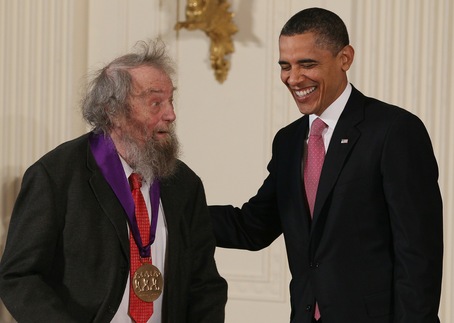
 

Donald Hall laughs at death

Share

Brush with fame, brush with death

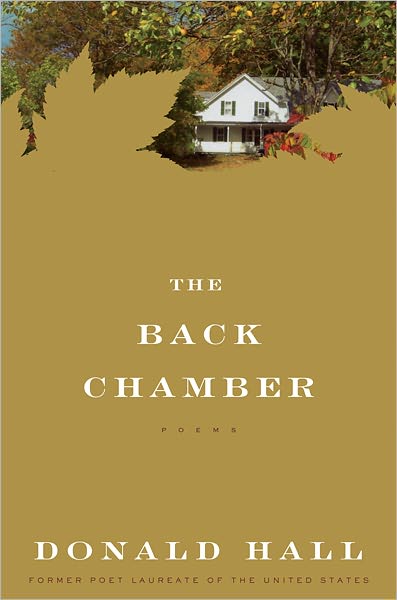
Donald Hall‘s newest collection, The Back Chamber, arrived in my mailbox the other day.

I was at the University of Michigan during the years Hall was teaching, but I never crossed paths with Ann Arbor’s preeminent poet (by that time, Anne Stevenson had returned to England and was only a legend there). The small university burg is where he met and married poet Jane Kenyon.

In the postwar years, he spent a lone year at Stanford, but that was enough to fall under the spell of Yvor Winters.  Long before my day, however.

I would meet the poet finally at the West Chester Poetry conference in Pennsylvania, about a decade ago.  And a few other occasions since – even interviewed him once.

By that time, the former U.S. poet laureate had already survived metastasized colon cancer, against the odds.  As he was recovering, Kenyon succumbed to leukemia.  In his famous poem of mourning, “Kill the Day,” he wrote: “How many times will he die in his own lifetime?”

Now he’s 82 years old.  I wrote about his receiving the National Medal of Honor in Washington earlier this year.

I remembered all these brushes as I leafed through the new volume.  He defeated death once, perhaps many times, and now he mocks it in “Apple Peaches,” riffing on the jump rope rhyme:

Apples, peaches,
Pumpkin pie.
How many years
Until I die.

Here are two of his variations:

Hostess Twinkies,
Wonder Bread.
How many springs
Until I’m dead?

The New York Times,
Le Monde, Der Sturm
.
How many breaths
Before the worm?

Voilà! Diane Middlebrook Memorial Writers’ Residence

Share

Voilà!  The Diane Middlebrook Memorial Writers’ Residence has been launched.  I attended the dedication ceremony this afternoon, way up in  forested hills around LaHonda, Skyline, and Woodside.  (I wrote about the venture earlier, here.)  Got mightily lost, too.

"Above all, radiant" (Photo: Amanda Lane)

Renowned chemist, novelist, and playwright Carl Djerassi, Diane Middlebrook‘s husband, assured the 50 or 60 gathered in the brilliant August day about the “green” nature of the four new domiciles built in memory of the gifted and groundbreaking biographer, who died in 2007.  The Djerassi Resident Artists Program currently hosts about 60 artists a year.  The spare new residences, overlooking the hills, will add a few more.

The 87-year-old Djerassi read a poem written by the person who had been the second oldest resident ever – Janet Lewis, the wife (and by then widow) of legendary Yvor Winters.  She was 90 at the time – two years younger than the composer who holds the record in the program. The poem Carl read,  “Landscape near Bear Gulch Road,” had been written during her residency.

Carl recalled his wife worked only on ambitious projects.  When her cancer diagnosis gave her only months to live, she turned to her personal brand of therapy, he said – that is, “to immerse yourself totally in intellectual work.”  Middlebrook tackled a biography of Ovid,  which, “though unfinished, has been published posthumously in portions as ‘A Roman in his Prime’ in the Norton Critical edition of Ovid’s Metamorphoses; and as ‘Ovid Is Born,’ in Feminist Studies,” according to the program’s website. I had wondered what happened to it.

Until today, I wasn’t aware that Dana Gioia, Diane’s student, had published the author’s only collection of poems, Gin Considered as a Demon, in 1983, when he was editing a series of chapbooks for Elysian Press.  He waved the volume at the gathering.  He also waved the battered paperback of Wallace Stevens‘s poems that he had studied with Diane way back in 1971.

He described Diane Middlebrook as “above all, radiant.”  Such people are rare, he said: “in the warmth, enlightenment, and clarity of their presence we discover ourselves.”

Dana read Stevens’s “Final Soliloquy.”  But Diane’s daughter, Leah Middlebrook, read a rapt and haunting poem that Dana had composed at the Djerassi home-in-the-hills, “Becoming a Redwood.”  It concludes:

Something moves nearby. Coyotes hunt
these hills and packs of feral dogs.
But standing here at night accepts all that.

You are your own pale shadow in the quarter moon,
moving more slowly than the crippled stars,
part of the moonlight as the moonlight falls,

Part of the grass that answers the wind,
part of the midnight’s watchfulness that knows
there is no silence but when danger comes.

Poet Moore Moran: A death in Ordinary Time

Share

Moore Moran, Sept. 27, 1931 - Feb. 27, 2011

I received an email from my publisher at Ohio University Press/Swallow Press earlier this week – the poet Moore Moran, known to his friends as Mike, died on February 27.  He was 79.

I had blogged about the Santa Rosa poet here and here. He had published his first full-length book, Firebreaks, in 1999 – it bagged a National Poetry Book Award.  His newest book, The Room Within, was published last year.

“Imagine a poet who could deal with the experience of Jack Kerouac but with too much intelligence to limit himself to the road. You don’t have to imagine him. He exists. He has many skills, all of them beautifully bright, and on occasions when he looks into the abyss they take him safely over it,” said Turner Cassity of Moran’s poems.

But I was startled when I reread the email a few days later and realized I had overlooked that the memorial would not be in Santa Rosa, but nearby, in Menlo Park – where, it turns out, he had graduated from high school before getting two degrees from Stanford.

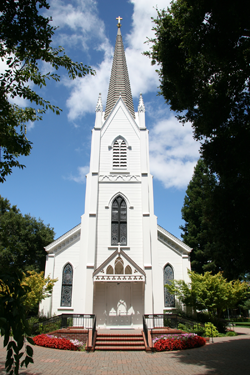
So I dropped in on Friday afternoon to pay my respects to a poet in the century-old Church of the Nativity.  But it was not a poet who was being honored so much as  “husband, father, grandfather, great grandfather, father-in-law, friend, poet,” according to the program.

He was much loved.  About 150-200 friends and family came to the mass, with bluegrass guitar and bass fiddle performers Dennis and Ehlert Lassen singing “Amazing Grace” and Leonard Cohen’s “Hallelujah.”  Not necessarily what one would expect from the poems, with their bleak, spare mystery.

Surprisingly, everyone looked like they had come for the same event – the men were all in jackets and ties, and the women in somber suits and dresses. Banished were all traces of “California casual,” where some people look as if they had wandered in from the garden or the beach or a cocktail party.  Nor did there seem to be any poets on hand from the “Yvor Winters Circle” – but then, the room was crowded and I was in a back corner, and this was a very quiet death, after all.

The priest, referred to only as “Father Davenport,” recalled that Moore Moran, despite disability, was “always smiling” and “a good man.”

His son, businessman Mike Moran, said, “I never stopped amazing my dad, and my dad never stopped amazing me.”  The son, to put it mildly, was not a poet or lit freak.

His father taught the kids Latin and music, as well as Yvor Winters, John Steinbeck, and J.D. Salinger.  He was “an encyclopedia of jokes,” recalled his son.  And, in fact, the program included his poem “Just Joking,” written on his 51st birthday, when he had “maybe a third of a tank left”:

…the bewildered heart in us which,
Year by year, measuring our slim attainments
With mounting despair, still feeds
In its recesses some faint hope, despite
The certain knowledge that what it hopes for
Cannot change the tide…

“He was often lost in afterthought,” said his son.  “I’m certainly no poet, but I came to appreciate my father’s poetry.” He recalled the children’s hesitancy to have their father correct their writing, because “then we’d go back for another hour of writing.”

But sometimes dad came in handy.  Moran Jr. recalled a long discussion his father launched when the son was having trouble “getting” Chaucer‘s Canterbury Tales.  The next day in class,  Moran Jr. performed the usual duck-and-hide with averted gaze, to avoid the teacher targeting him with a question.  The teacher targeted him anyway.

Thanks to his dad’s monologue, the so-so student poured forth with a reply “at a depth and level far beyond what my teacher had.”

The class was “absolutely stunned.  The whole room was silent,” he recalled.

“I was bumped up to AP English,” he said, and paused for only an instant. “That lasted about four days.”

On Moran’s memorial page at legacy.com, David Sanders wrote: “A gentleman and a fine poet. It was an honor to edit and publish his last book.”

“Just Joking,” with its rambling style is nice, but my favorite Moran poems are quick and cryptic – like this one:

Ordinary Time in the Pews

Church of the Nativity, Menlo Park

Ordinary days again.
Advent, Pentecost are past;
who now will accept our sins,
raise the dust in which we’re cast?

Cold the God flesh on the tree,
banned the crèche to attic murk,
sheer the silence after prayer.
Nothing seems at all to work.

Yet we try and try again
serving Him we hardly know:
honk if you love Jesus, friend,
beeping blessings as we go.

Here we meet who, somehow, must
rescue meaning from the dust,
where betrayal’s kiss presents
our best hope of relevance.

PostscriptPatrick Kurp at Anecdotal Evidence has added a lovely tribute here.  “Earth only will find him cold.”

Postscript on 3/7: Looking online for others who remember Moore Moran, I found this mini-memoir from Peter Robinson.

Peter Dale Scott’s “J’aime mais j’accuse”

Share

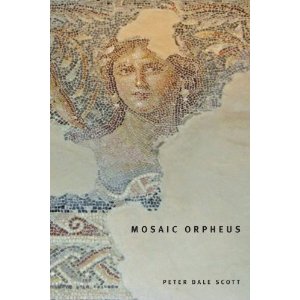
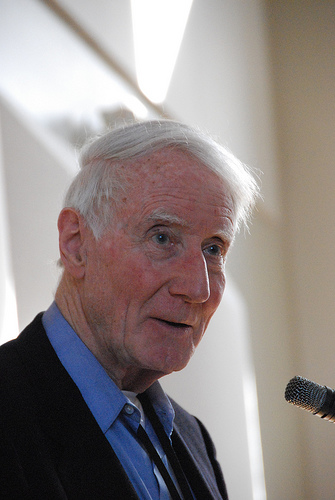
Poetry reviews are hard to come by in our increasingly distracted world, so Peter Dale Scott wrote me yesterday to say that he is understandably chuffed with John Peck‘s hefty, megawatt review for his  Mosaic Orpheus in the current Notre Dame Review. (If you scroll way down to the bottom of the screen here, you can download the 15-page pdf, which is certainly a clumsy way for NDR to do things.)

Peter, a former Canadian diplomat, is one of the few to tackle political poetry in a way that is gritty and specific, rather than the more commonplace attempt to commandeer politics to give oneself unearned gravitas via airy and politically correct generalities.  Robert Hass called Peter’s 1988 Coming to Jakarta: A Poem About Terror “the most important political poem to appear in the English language in a very long time.”

Peck’s discussion opens with the 1988 “contemplative epic”: 

“Coming to Jakarta, his attempt to contain distress over the blocked publication of his investigative research findings comes up against ‘mosaic darkness’—not familiarly seamless obscurity, but kaleidoscopic stuff—while in the poem’s later books Dante’s civic grief and wrath, with his loyal love for a dead woman, make him an Orphic brother-father to Scott, in that Alighieri’s existential defeat folds out into contrary visionary assurance. Such is not regulation Orphism, particularly as invoked collegially against American amnesiac indifference toward a largely occulted, webby congress of state terrorism, proxy mass slaughters, off-the-books funnelings of the sluice from international drug cartels to black ops, economic decline and the management of fear by debt, false-flag events, assassinations, and greasy resource wars.”

Shovel ready

Peck’s writing style is dense, but often rewarding.  And while I hadn’t been terribly looking forward to a long gaze at the nastiest sides of American policy — other than that proffered by the daily news — I must say that Peck’s review has heightened my interest.  Of Scott, Peck writes:

“He must be the only poet now writing who can say that Czesław Miłosz, peace-studies scholar Ola Tunander, various prominent vipassana teachers, and certain unnamed informants in government service deceased in mysterious circumstances, equally have nourished his effort. This span, together with an iron stomach for the forensics and catharsis of difficult findings, spell his personal equation. His poetics therefore will likely be neither a standard Orphic affair nor a canonical Buddhist one, although the poetry plainly arises in order to square those canons, and that personal equation, with a civics obdurately impersonal and malign.”

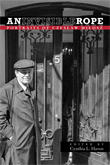
Peter, one of Miłosz’s earliest translators, describes his up-and-down relationship with the Nobel laureate — the two parted over politics, but reconciled much later — in my  An Invisible Rope: Portraits of Czesław Miłosz.

Peck concludes:

“The spirit of research in this our dump needs every acolyte who carries a shovel. My Ketman-meter, its needle pushing into the red zone, tells me that our bitched order forces doubleness into both zones, out behind the vast oligarchic scrim and down into the crannies of palimpsested authority.  Scott has done us the honor of adopting this country as his own. Shall we read his voluminous J’aime mais j’accuse with due attention? His vade mecum, Mosaic Orpheus, reminds us that this labor has been one of hopeless, yet justified, love.”

By the way, Clive Wilmer called Peck, a Pittsburgh-born psychotherapist, “the outstanding American poet of his generation–as well as one of the most difficult.” As a young man he studied under Yvor Winters, and earned his Stanford PhD with doctoral thesis on Ezra Pound, supervised by Donald Davie.  Some of Peck’s poems are at the Poetry Foundation here.

Happy birthday, Fulke Greville!

Share

The birthday boy

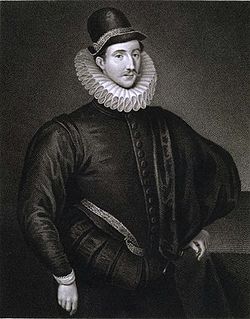
A few more hours to wish a very happy birthday to Fulke Greville, 1st Baron Brooke,  de jure 13th Baron Latimer and 5th Baron Willoughby de Broke, born this day in 1554.

Patrick Kurp has a fine tribute to him at Anecdotal Evidence here:  “He was known not as a poet but as treasurer of the navy, chancellor of the exchequer and commissioner of the Treasury. Only in the twentieth century was his accomplishment as a writer of austerely passionate verse, the peer of Herbert, Donne and Shakespeare, truly weighed.”

Kurp credits the late Thom Gunn, who edited Selected Poems of Fulke Greville in 1968.  Not surprising, since Gunn was a student of Yvor Winters, and no one exalted the obscure poet Greville more than Winters,  who rated Greville more highly than Sidney and Spenser.  Said Winters:

“How great a poet Greville is. It is my opinion that he should be ranked with Jonson as one of the two great masters of the short poem in the Renaissance”
— Yvor Winters, Forms of Discovery: Critical and Historical Essays on the Forms of the Short Poem in English, 1967

Former U.S. Poet Laureate Robert Pinsky compared him with John Donne in imaginative power.  Here’s Pinsky in The Paris Review on the subject of Greville (and Winters):

Pinsky -- a Winters protégé (Photo: Steve Castillo)

PINSKY:  Winters claimed to have read every poem by every poet of any distinction who ever wrote in English; he challenged those of us who disagreed with him to do the same. He certainly seemed able to respond to anything anybody ever alluded to. Winters resurrected Fulke Greville,  a really great poet, I am convinced; and some of the poems he pointed to, like Herbert’s “Church Monuments” and Jonson’s “To Heaven,” were influential to many of us who studied with him, like Thom Gunn, Bob Hass, Donald Justice, Phil Levine, James McMichael, John Peck.

INTERVIEWER:  Some of Winters’s favorite poems seem to have found their way into your own work, as for instance your “Poem with Refrains,” with its gobbets of Fulke Greville.

PINSKY:  Yes, “Absence my presence is, strangeness my grace. / With them that walk against me is my sun.” That’s Greville,  and he is unsurpassed at lines of that kind. What Winters showed me about the English poets of that period gave me an inkling of the level of the art, the quality of seriousness, the principles of musical language that one might hope to attain. I feel that those couple of years when I read poetry intensely with him have served me well, and I’m grateful for that.

He gets the final word

Let’s give Winters the final word on the subject, then.  Try this, from “Problems for the Modern Critic of Literature” from Winters’s 1956 The Function of Criticism:

“The language of metaphysics from Plato onward is a concentration of the theoretical understanding of human experience; and that language as it was refined by the great theologians is even more obviously so. The writings of Aquinas have latent in them the most profound and intense experiences of our race. It is the command of scholastic thought, the realization in terms of experience and feeling of the meaning of scholastic language, that gives Shakespeare his peculiar power among dramatists and Fulke Greville his peculiar power among the English masters of the short poem. I do not mean that other writers of the period were ignorant of these matters, for they were not, and so far as the short poem is concerned there were a good many great poets, four or five of whom wrote one or more poems apiece as great as any by Greville; but the command in these two men is not merely knowledge, it is command, and it gives to three or four tragedies by Shakespeare, and to fifteen or twenty poems by Greville, a concentration of meaning, a kind of somber power, which one will scarcely find matched elsewhere at such great length in the respective forms.”