
“Literature does not die because nobody writes, but when everybody writes” — Nicolás Gómez Dávila

Share

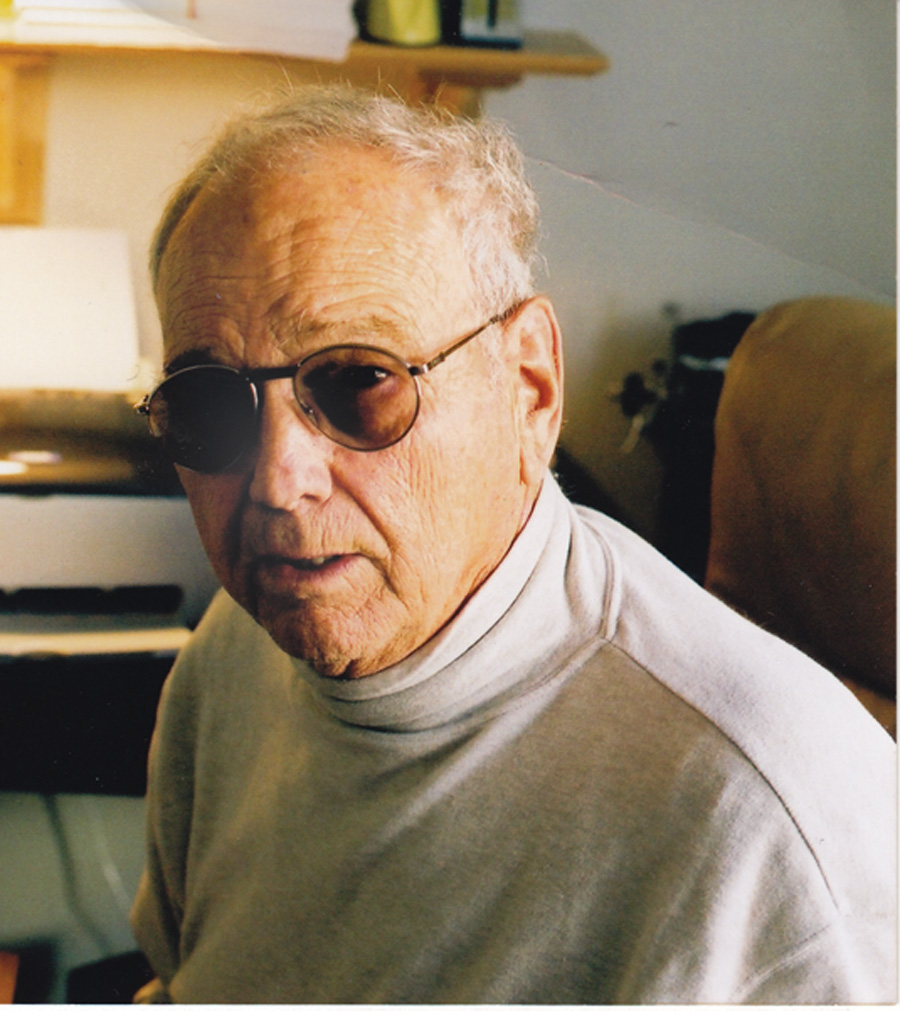
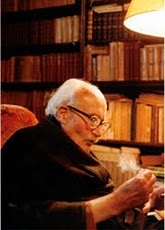
In his library ... where else?

This is too much fun to pass up.  Ever hear of Nicolás Gómez Dávila (a.k.a. “Don Colacho“)?  I hadn’t, either. So thanks be to Anecdotal Evidence and Patrick Kurp for bringing him to my attention.  (There’s a super-duper website on Gómez Dávila here.)

The Columbian writer (1913-1994) led a life of leisure:

“Gómez Dávila generally only visited the office once a week at midday for about ten minutes, in order to tell the business manager to increase profits, before going out to lunch with friends at the Bogotá Jockey Club, where he was an active member, playing polo and even serving as an officer for a while. (He had to give up polo, though, after injuring himself on his horse—he was thrown off while trying to light a cigar.)”

He is known mostly for his aphorisms:

“Literature does not die because nobody writes, but when everybody writes.”

“Why do people write when they have nothing worthwhile to say and are unable to say it? The same reason we sing in the shower, when at least we have the courtesy to keep the door closed.”

“Clarity is courtesy. Muddle is ill-mannered.”

“The soul grows inwards.”

“Modern man deafens himself with music in order not to hear himself.”

“Journalism is writing exclusively for others.”

“Among the inventions of human pride, one will finally slip in which will destroy them all.”

“A genuine vocation leads the writer to write only for himself: first out of pride, then out of humility.”

“Whoever says that he ‘belongs to his time’ is only saying that he agrees with the largest number of fools at that moment.”

“The criterion of ‘progress’ between two cultures or two eras consists of a greater capacity to kill.”

“The word ‘modern’ no longer has an automatic prestige except among fools.”

“Individualism is the cradle of vulgarity.”

“Our last hope lies in the injustice of God.”

Patrick ends with a quote from Yvor Winters,  from his introduction to The Quest for Reality: An Anthology of Short Poems in English (1969), which he edited with Kenneth Fields:

“Our best writers live fully in the knowledge that language is at once personal and public; they know that only by precisely controlling the public medium of language can they realize private experience. For each of us language is the essential intermediary between the isolated self and the world of others; rather than trammeling the mind and affections, it sets them free, giving them proper objects.”

Let me end with a final aphorism that intrigued me:

The artist does not compete with his fellow artists; he does battle with his angel.

It reminded me of a similar thought Robert Hass told me a decade ago:

You know, to write a book of poems is to wrestle with an angel, and the first part of the task is to figure out what angel you are wrestling.
More on Gómez Dávila here.  And more from my Hass interview in my forthcoming book, An Invisible Rope: Portraits of Czesław Miłosz.
.
.

No rejection letter will ever seem quite that bad again

Share

Wonder what the first edition goes for...

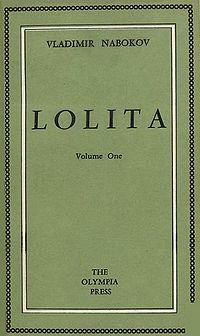
Here is news that will cheer writers everywhere.  This is a December 1953 review of the then-unpublished Lolita manuscript:

“It is overwhelmingly nauseating, even to an enlightened Freudian. To the public, it will be revolting. It will not sell, and will do immeasurable harm to a growing reputation…. I recommend that it be buried under a stone for a thousand years.”

Five leading publishers rejected the manuscript:  Doubleday; Farrar, Straus; New Directions; Simon & Schuster; and Viking.  When it was finally published, 55 years ago next month, John Gordon of the Sunday Express denounced it as “about the filthiest book I’ve ever read” and “sheer unrestrained pornography.”  This, about a book that is curiously sexless — where the porn is largely projected onto the book by the mind of the reader.  But that’s okay.  Dorothy Parker described the pretentious Humbert Humbert as a man of “taste and culture.”  The book would seem to be a Rorschach test — or perhaps a mirror.

The quotations above are the latest gleanings from the Library of America’s new blog, Reader’s Almanac. We’ve written about R.S. Gwynn‘s theory that Pale Fire‘s John Shade is actually poet Yvor Winters here.  And I’ve written about the bruited link between Humbert Humbert and the founder of Stanford’s Slavic Department, Henry Lanz over here.

I still think one of the best opinions of the book was offered in Azar Nafisi’s Reading Lolita in Tehran (2003): “This is the story of a twelve-year-old girl who had nowhere to go. Humbert had tried to turn her into his fantasy, into his dead love, and he had destroyed her. The desperate truth of Lolita’s story is not the rape of a twelve-year-old by a dirty old man but the confiscation of one individual’s life by another.”

Elizabeth Janeway expressed something of the same idea when the book came out:

“Humbert is every man who is driven by desire, wanting his Lolita so badly that it never occurs to him to consider her as a human being, or as anything but a dream-figment made flesh 3/4 which is the eternal and universal nature of passion. … As for its pornographic content, I can think of few volumes more likely to quench the flames of lust than this exact and immediate description of its consequences.”

My neighbor Vladimir Nabokov himself recognized the consequences, while reflecting on the work that pleased him most:

I would say that of all my books Lolita has left me with the most pleasurable afterglow—perhaps because it is the purest of all, the most abstract and carefully contrived. I am probably responsible for the odd fact that people don’t seem to name their daughters Lolita any more. I have heard of young female poodles being given that name since 1956, but of no human beings.

Don’t look for him in Wikipedia

Share

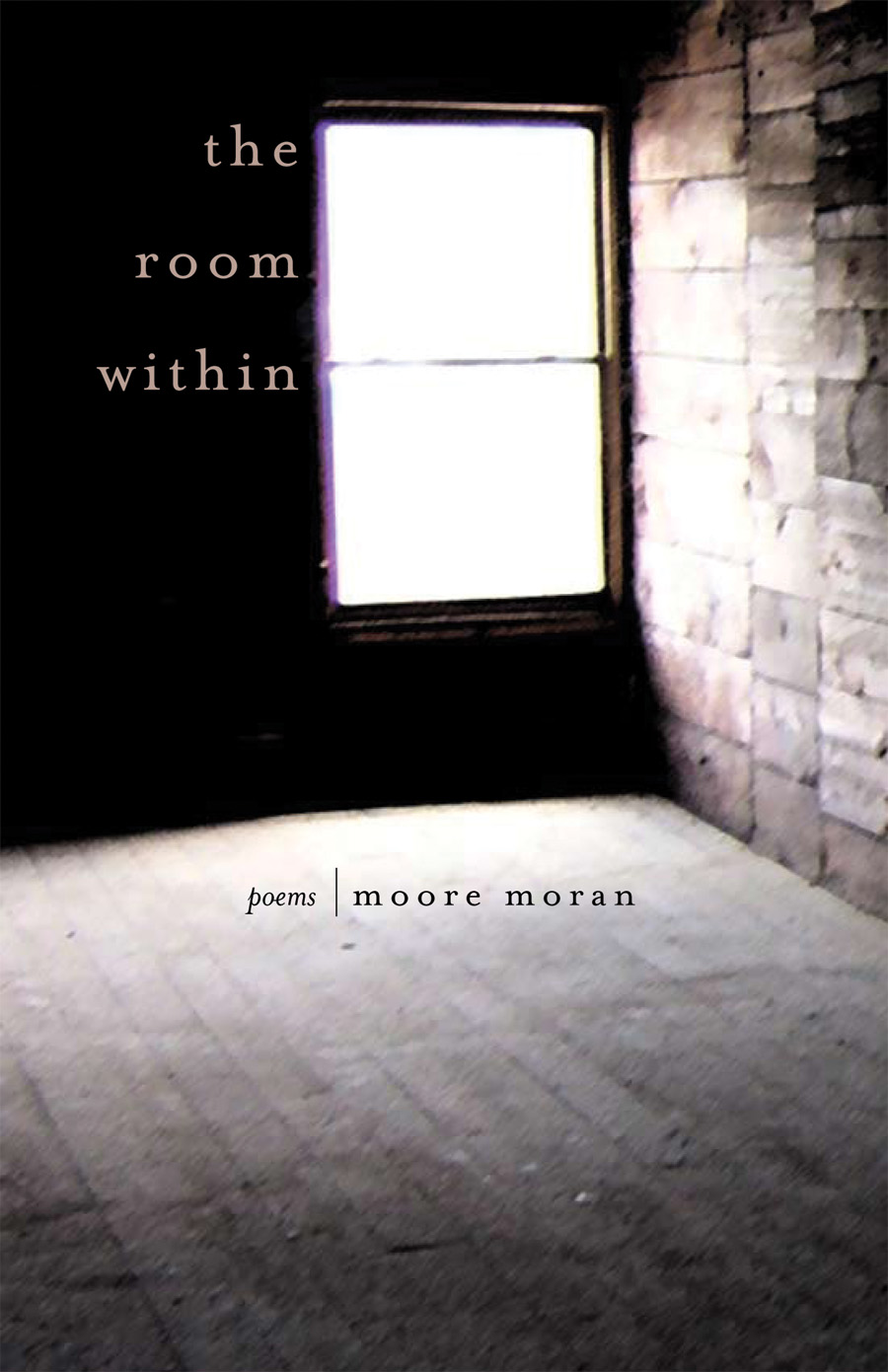
In an era when most prominent poets seem to have a protected perch in academia, Moore Moran is rather refreshing.  Moran, one of the lesser known students of Yvor Winters, left Stanford and entered the advertising world as a copywriter and later creative director.  He lives in Santa Rosa, and has raised four daughters and a son — all the while writing poetry for the last half-century or so.  He’s managed to avoid even a Wikipedia entry.

Nevertheless, his first full-length book, Firebreaks, won the National Poetry Book Award in 1999.  His newest book, The Room Within, was published this month.

It rather startles that Moran’s name was entirely unknown to me.  For awhile, I had made a point of writing about the generally unheralded Yvor Winters/J.V. Cunningham group of poets, which included Thom Gunn, Edgar Bowers, and many others in the so-called “Stanford School of Poets” (I say “so-called,” because they dodge any grouping).  Moran and I have a number of mutual friends — Timothy Murphy for one.  The accolades on the back of the book include a few others who have been mentioned on these cyberspace pages:

“Imagine a poet who could deal with the experience of Jack Kerouac but with too much intelligence to limit himself to the road. You don’t have to imagine him. He exists. He has many skills, all of them beautifully bright, and on occasions when he looks into the abyss they take him safely over it”  — Turner Cassity (my article here — Book Haven post here)

“Moore Moran writes out of a wide range of experience in both traditional and experimental verse. Reading his work is a joy for the reader seeking a mature and sensitive mind.” — Helen Pinkerton (my article here)

And an important voice from my own alma mater, X.J. Kennedy, chimed in, too: “Moore Moran knows how poems should be made, and a great many of his poems score resounding victories.”

I haven’t had much time to go over the book thoughtfully.  But there is much that is striking and fine, and a good deal can be found online —  “Ordinary Time in the Pews,” for example.

The title poem will be top-rated for many readers, I think, but I favor this one, edged in spare mystery:

Holy Thursday

Tonight I ask You in to help me mourn.
You who help whom you please,
don’t leave me just with these–
a loincloth, timber, nail and scarlet thorn.

I‘m what I earn to think, not think I am.
Nor love, wisdom or art
sustains the baffled heart,
and fact contains no holy anagram.

Be more, Lord, than my hope, Your innocence.
Reason has never known
how to live with its own
immaculate, hard-hearted arguments.

My neighbor: Volodya Nabokov

Share

Secretive Sam...at West Chester's Poetry Conference

I had lunch on Memorial Day with poet R.S. Gwynn and his lovely wife Donna, the day before their 33rd anniversary, in a cosy little Mexican cafe on California Avenue. But Sam was sitting on a little secret he didn’t share with me.  Or perhaps I merely hadn’t had a chance to worm it out of him before the two visiting Texans swapped me for the more pedestrian charms of the Pacific coast.

Now he’s at the center of the storm:  Ron Rosenbaum, writing in Slate, announces the next hot Nabokov controversy, and the story is making the rounds in the blogosphere.  The poem “Pale Fire” is about to be liberated from Pale Fire. The 900-line poem at the center of what many call Vladimir Nabokov‘s finest novel, written presumably by the murdered John Shade, will be published separately by Ginkgo Press:  “Nabokov wrote it, and the question of why he wrote it and who he modeled Shade on is the subject of what will be an equally controversial essay accompanying the edition, by poet and poetry professor R.S. Gwynn.”

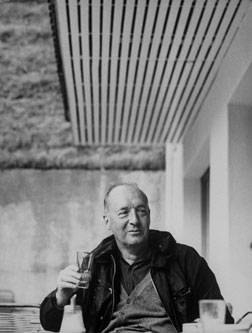
Vladimir Nabokov, my neighbor ... so to speak

Wait!  Wait!  Don’t dash for the exits in your excitement!

“I know, I know, this may seem to be more esoteric, it doesn’t have the built-in intrigue of a manuscript in a Swiss safe-deposit box. But it’s no tempest in a teapot, not to those familiar with the long-simmering controversy over the poem ‘Pale Fire.’ And with the unbearable beauty and delight both the poem and novel offer. But when you’re dealing with how to read—on the most basic level—the central node of perhaps the greatest work of the supreme artist of the English language of our era, the stakes are high and worth, I believe, my attempt to explain what it’s all about for non-Nabokov readers. (Needless to say, I’d prefer all of you latecomers to run out to read or reread the novel; it is a work of pure pleasure, eminently accessible, sometimes laugh-out-loud funny, despite its deceptive “experimental novel” outer architecture.)

Rosenbaum continues:

“I was particularly struck by the degree of erudition about contemporary American poetry that Gwynn brought to his case that Nabokov meant ‘Pale Fire’ to be a reproof to over-casual, over-personal, over-trivial trends in American poetry. A reproof to the belief that formal poetics could not capture deep feeling in traditional verse forms. And that Nabokov had modeled John Shade on the well-known traditionalist American poet Yvor Winters, who was a partisan of formal poetics.

Lanz ... Humbert?

I’ve written about Nabokov’s brief, but fruitful, residency in Palo Alto here, in a little house on Sequoia Avenue so close to my own home that I occasionally walk my dog past it.  At that time, I was exploring the connection between Humbert Humbert and, believe it or not, the founder of the Stanford Slavic Department, Henry Lanz.  Sam had queried me about the connection between Yvor Winters and Nabokov, and I wrote to Helen Pinkerton on the subject: she seemed to have a vague memory of poet Janet Lewis, Winters’s wife, washing dishes with him at the Winters home in Los Altos.  She finally tracked down the reference in Larry McMurtry‘s “The Return of Janet Lewis,” in the New York Review of Books (June 11, 1998) — “a delightful essay on her and all of her work.”  McMurtry writes:

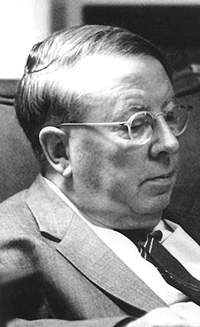
Winters...John Shade?

“Janet too is very polite, but she’s neither fussy nor chilly. She’s lived in that smallish but cheerful house for sixty-four years and is thoroughly the mistress of it; there she raised her family, there she watched war come and war be over, there she entertained generations of poets, artists, musicians, and even the occasional lepidopterist such as Vladimir Nabokov, who showed up at her door with his butterfly net one day in 1941.  The Nabokovs and the Winterses hit it off; the exiles came often for meals. I had heard that Navokov enjoyed himself so much in her kitchen that he sometimes helped her wash up; when I asked her about this she chuckled and said, ‘Why, I wouldn’t be surprised if he had.'”

Sam told me at the time “there doesn’t seem to be any record of their having met or corresponded after that. … For obvious reasons, the trail is pretty cold.”

That was then; this is now.  Rosenbaum promises the essay will be controversial:  “Was I right that Paul Berman‘s book would cause a brawl or what?”

***

UPDATE:  From Sam:  “If anyone has any information about the Nabokov-Winters friendship, please post a comment here.”  Read his post in the “comment” section below.