It’s been a long wait, but you will be rewarded for your patience! At 7 p.m. on Tuesday, November 17, Another Look will launch its fall season with Tobias Wolff’s Old School.
Another Look wishes to honor Toby’s long life in books, and so we asked him to pick one of his many books to spotlight. Old School describes a preparatory student a working-class or lower-middle-class background and attends an elite New England prep school on a scholarship.
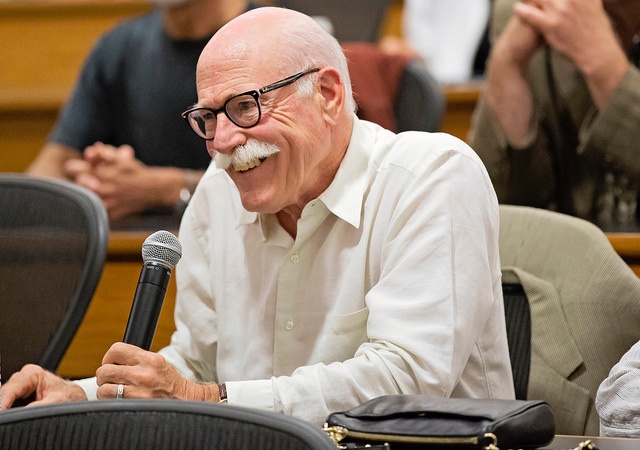
Some of the faces on the panel will be new ones; others familiar to you: Carol Edgarian, co-founder of Narrative Magazine, author of novels such as Vera, will be on the panel. Many of you will remember her from our event for William Kennedy’s “Billy Phelan’s Greatest Gamefive years ago. Her husband Tom Jenks is the co-founder and editor of Narrative Magazine. He is also a former editor of Esquire, Gentlemen’s Quarterly, The Paris Review, and others. They will be joined by Corey Anderson Dansereau, a lecturer in Stanford’s French and Italian Department. And of course Toby Wolff will be the guest of honor.
According to The Los Angeles Times, our featured book, Old School, is “gentle, reserved, graceful,” as the school’s newest student tries to fit into his tony New England prep school. Wolff again proves himself to be a writer of the highest order: part storyteller, part philosopher, someone deeply engaged in asking hard questions.”
Meanwhile, if you want to read more about Toby and Old School, you might check out the Stanford Magazine article I wrote when the book was first published in 2004. Go here.
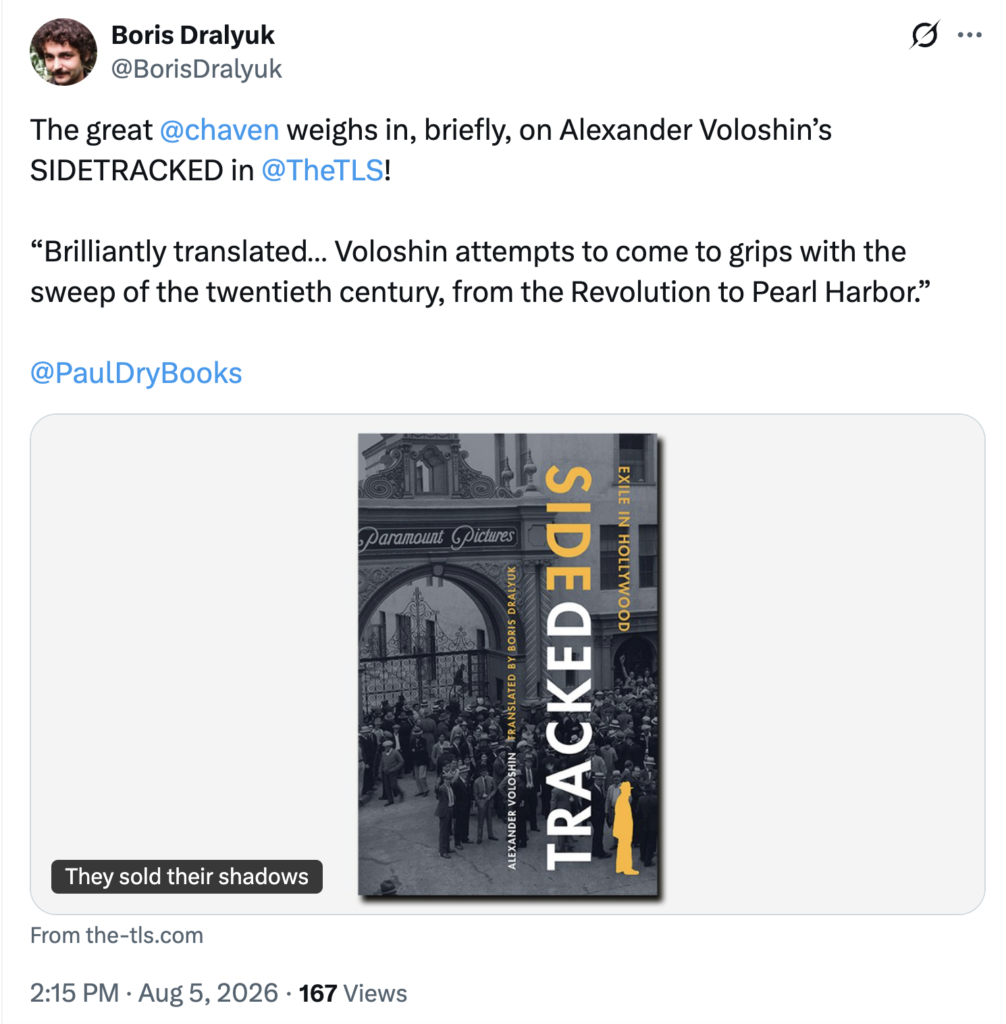
Guest contributor Elena Danielson, emerita director of the Hoover Library & Archives, writes about a soon-to-be Russian classic.
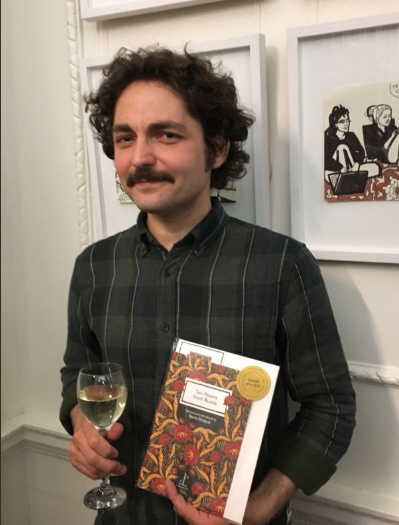
Ukrainian-American poet, editor, writer, and translator Boris Dralyuk (at right) has rescued an obscure masterpiece. Maybe this poem could have been considered a quaint relic of the chaotic Russian emigre experience with educated and once- prosperous, now despairing, people reduced to odd jobs like driving taxis and working as movie extras in a foreign country. But the poem Dralyuk has resurrected, at this crucial moment, has an unexpected immediacy as well as unexpected charm. (Those two qualities rarely happen together these days…)
Sidetracked is the titular poem of a 1953 collection that is difficult to find even in the original Russian. Dralyuk’s introduction and notes are crucial to understanding and appreciating the text and context, but his translation makes it a simple joy to read.
As an emigre author, Alexander Voloshin, shared the dual identity experienced by many Ukrainians. Ukrainians that I worked with in the Hoover Archives at Stanford explained that Russian was the language of school, business, and government. The closely related Ukrainian language was spoken almost as a private code at home, with friends and relatives. Ukrainian identity was submerged but never purged. Some of my reading provided a bit of background: Anne Applebaum‘s book Famine, explains the extreme and deadly lengths that the central Soviet government went to in order to crush Ukrainian independence in the 1930s, and Teffi’s memoirs sketch a territory briefly under the control of the Ukrainian separatist Skoropadsky even earlier, during the 1920s. Voloshin was a brilliant writer in classic Russian, and also a Ukrainian proud of his cultural heritage.
Elena Danielson:
After his experiences in the Russian Civil War and the failed efforts for Ukrainian independence during that early period, Voloshin has few illusions. But he did survive, barely, working unpredictable, odd jobs as an extra in Hollywood movies:
“Reader its time you understood: There’s no free lunch in Hollywood.”
He survived the revolution and civil war, found a perch in Los Angeles, but then news from Europe in the 1930s brought back old fears. And these once esoteric footnotes that I savored as a history nerd, suddenly have an immediate relevance, here and now:
“here – laws are trampled and some crazed loony takes on the World entire War, with its bloody wind and fire, again has set the globe aglow.”
But Voloshin also has a message from his experience that is positive in its own Slavic way:
“War a raging hurricane… The Whole world has gone insane… Yet faith smolders in our souls like a mound of stubborn coals.”
As these brief quotes suggest: the translation is sparkling and brilliant even when dealing with tragedy. There is a chapter on translation in Alberto Manguel’s “History of Reading” that suggests that – while most of the time sense and beauty are ‘lost in translation,’ – there are instances when the translation has its own merits beyond the original. I don’t know the original Russian text of Sidetracked, and my Russian wouldn’t be sufficient even if I tracked it down, but Dralyuk’s translation is simply brilliant. It sparkles. Native Russian speakers do have an appreciation for rhyme – much easier in Slavic languages than in English. But it is instructive that sometimes a Russian can master English better than the “natives.” Darlyuk’s rhyme schemes are highly colloquial, unexpected, and unexpectedly bright. Occasionally I have noticed the same effect when Joseph Brodsky wrote in English. Dralyuk’s English is better than Brodsky’s, but there are also a few times when, like with Brodsky’s English, the text sounds slightly better read with a Russian accent, like when he rhymes “rejoice” with “toys.” In any case I recommend reading Sidetracked, and best to find a quiet spot where you can read it out loud, the way poetry is meant to be.
I, too, am tired of the noise surrounding Christopher Nolan’s Odyssey, but this is among the best responses I’ve seen to the film so far, posted on X by Maria Papadopoulou. Thanks also to writer and author Tenia Christopoulos and Irena Karafilly.
Here goes:
Dear Christopher Nolan,
My name is Herod Priovolos and I want to tell you what #TheOdyssey truly means to me and to generations of Greeks who grew up with Homer’s story.
Homer did not sing of Odysseus simply to entertain us with ships, storms, gods and monsters. He told the story because he understood what war, time, distance and loss can do to the human soul.
Odysseus leaves Ithaca as a king, a husband and a father. He returns twenty years later alone, exhausted and disguised as a beggar, carrying the memory of every companion who never made it home.
The monsters are not merely creatures created for spectacle.
The Cyclops is power without justice. The Sirens are the beautiful voices that tempt a person to abandon their purpose. Circe represents the danger of losing our humanity. Calypso offers Odysseus immortality, but even eternal life becomes a prison when the price is forgetting his wife, his son, his homeland and his own identity.
And Ithaca is not merely an island.
Ithaca is the place that remembers you when the world no longer recognizes your face. It is the home that remains alive inside you after everything else has been taken away. It is Penelope growing older while she waits. It is Telemachus becoming a man without his father. It is Argos surviving long enough to recognize his master one final time.
Odysseus is not great simply because he defeats monsters. He is great because he is proud, frightened, wounded, clever, imperfect and deeply human. He loses his companions, his youth, his name and twenty years of his life, yet he refuses to forget who he is.
When he finally returns, Penelope does not recognize him through strength, glory or appearance. She tests him. Odysseus proves his identity by remembering the bed they built together around the roots of a living olive tree.
That is the heart of The Odyssey.
Not the battles. Not the ships. Not the monsters.
Two people standing before each other after twenty years, asking whether love, memory and identity can survive everything time has done to them.
That is why this poem has survived for almost 3,000 years. Every human being is trying to return to something: a home, a person, a lost part of themselves, or the life they had before the world changed them.
So use Homer’s seas, gods, heroes and monsters. But please understand what you are touching.
The Odyssey was never truly about how far a man could travel.
It was about how much the world could take from him before he stopped being himself, and whether, after losing almost everything, he could still find his way home.”
A postscript from William Green: This is moving and perceptive, especially in its emphasis on war, loss, recognition, and the costly return home. I am less certain that each monster carries so fixed an allegorical meaning, or that Ithaca can bear quite so much symbolic innocence. Still, the reminder is timely: The Odyssey is not merely an adventure but a poem about what survives distance, violence, and time. – Thanks for this post, Cynthia!
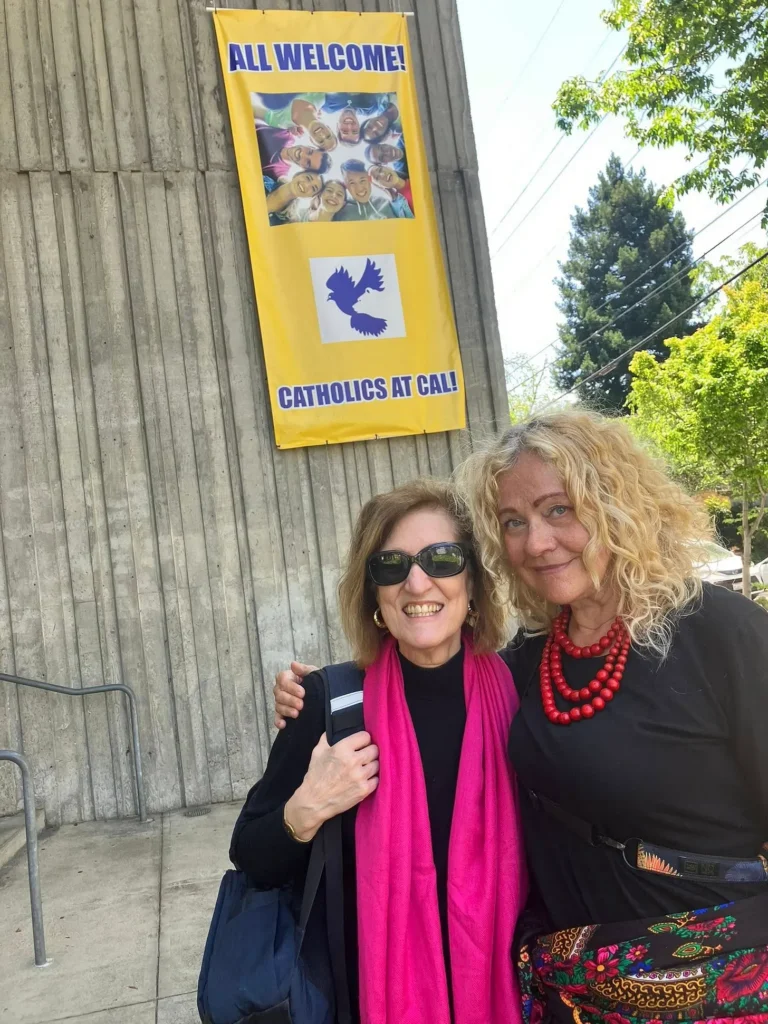
Barbara Gruszka-Zych, a Polish author currently working on a book about Nobel poet Czesław Miłosz, visited the Nobel poet’s old haunts earlier this year. We wrote about the visit here. After her Berkeley tour, we worked across two continents for the front-page article that appeared this week in a leading Warsaw newspaper, Rzeczpospolita.
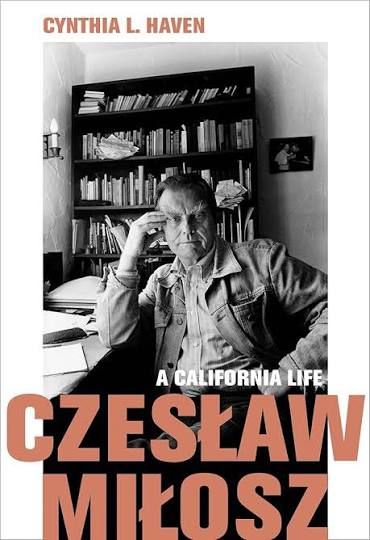
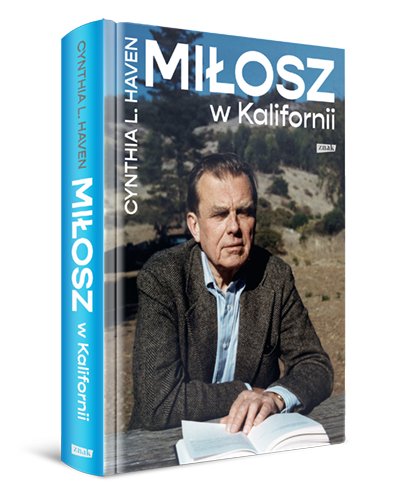
So here’s the Q&A with Basha Gruszka-Zych. The book covers below are from Czesław Miłosz: A California Life (with Berkeley’s Heyday Books) and farther below, the Polish edition, published by Miłosz’s favored publisher, Znak. Hope the conversation gives you as much as it gave me:
Dear Cynthia, You know very well what an important book you have written. Reading it, I come to know the secrets of my poet’s life in California, but also California itself. It is a hero of your work as well. I always addressed Czesław Miłosz as “Pan Czesław.” I have found in you a woman who, like me, is fascinated by him, and that brings me joy.
Below are a few questions: How did you discover that there was someone in the world like Czesław Miłosz? Did your meetings with him matter to you more, or rather his work?
I studied with Joseph Brodsky at the University of Michigan. He was a pivotal influence for me. When he died in 1996, I began rereading some of his essays. You’ll remember he famously said Miłosz was “one of the greatest poets of our time, perhaps the greatest.” I wondered where this paragon lived. To my surprise, I learned that he lived just across the Bay from me. Why not find an excuse to interview him? So I did. Twice, in the year 2000. My Q&A turned out to be his last interview in the United States, before he returned to Poland forever.
Which meant more to me? Hard to say. Knowing someone firsthand fixes the dye, so to speak. It makes the connection more than a name on a page, more than someone you read about in a newspaper article.
You say repeatedly that he is the greatest American poet, although he writes in Polish. So are you convinced that the place where he lived for so many years and the influence of thinkers and fellow scientists who affected him while he taught at Berkeley created his poetry? In other words – did America create him?
You can’t live forty years in a place and not be of that place, and not have it sink into your bones. The redwoods created his poetry, the lights along the San Francisco Bay did, too. The hills and the Golden Gate Bridge had a role, and so did the mighty Pacific. And so did the rowdy, free-wheeling Berkeley students in the classroom, who appalled and transfixed him at once. America made him a world poet, not a niche poet who spoke in “some unheard-of tongue,” as he put it.
Let me correct the record, however: there are some other contenders for the “greatest” American laureate. Walt Whitman, for one. T.S. Eliot emigrated to England; W.H. Auden emigrated to America. Are either of them “American”? Are both of them “American”? It’s all rather tangled. My take is a dissident one, to be sure. But my point remains: we should embrace him as an American poet. He should be taught in American classrooms. We were lucky to have him for so many years.
And yet, as Heidegger wrote, “Language is the house of Being,” and Miłosz wrote in Polish. What did a man – a poet who left his native cities burning in the conflagration of war and found the Magic Mountain in Berkeley – give to American poetry, vast as that country?
He gave us the whole world, and he made Polish an indispensable world language, one that gave America a deeper, wider, and more profound and universal vision. Keep in mind that this was the era of self-involved “confessional” poetry in America.
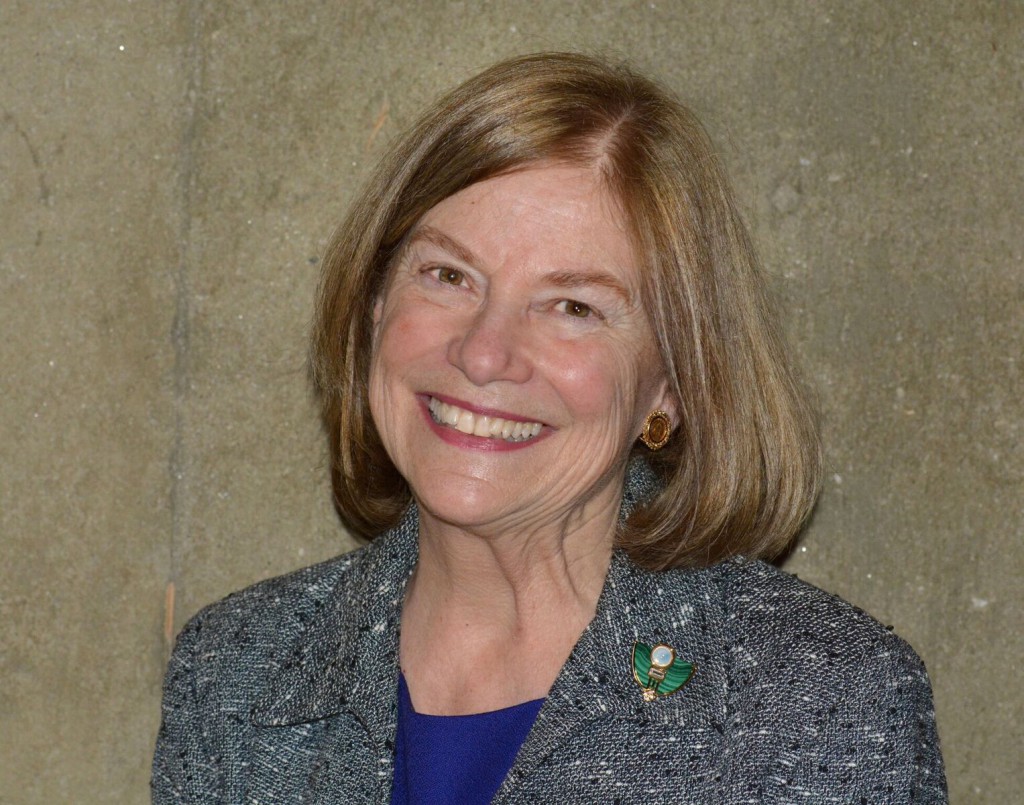
America gave Miłosz a place to think and write on the edge of the world, sheltered from the crises of Europe that made him an exile and eventually an American citizen. And he was prolific! My goodness, he was prolific! (At left, Barbara Gruszka-Zych in Berkeley.)
Which poem or poems of Miłosz guide you through life? Does poetry take part in your writing life and in your daily life? Does it help you or sustain you?
Absolutely! This from “Winter”:
Waters close over us, a name lasts but an instant. Not important whether the generations hold us in memory. Great was that chase with the hounds for the unattainable meaning of the world.
And like him,
… now I am ready to keep running When the sun rises beyond the borderlands of death.
He belongs to all of us in this migratory, fad-ridden nation. He gave us a taste of eternity.
In your book you draw attention to his words about an important esse: “In my opinion it is a deadly thing to lose oneself in movement, in becoming,” Miłosz said. “One must have some basis in being, in esse, in the Latin root of the English word essence.”
What, in your opinion, constitutes the esse of his poetry?
Nature, certainly. It was his first calling. He wanted to be a naturalist. His lifelong consideration of the notions of être and devenir, the dance between them.
He fascination with time and history. His tireless effort to retrieve memory from oblivion. The esse is him, himself.
In one of his first letters from Berkeley, Miłosz wrote that his life was “badly tangled”. Do you think so, too? Could this great poetry have come into being without that tangledness?
Probably not. It was a lonely time for him, and he forged himself in it.
Oh, I keep going back to “Magic Mountain.” That magnificent metaphysical view.
The tangledness of the poetry or the tangledness of the man? We will never be able to untangle all of it. The fun is trying.
When you describe the lives of your subjects, do you think about how much of it is truth and how much is invention?
Would we have it any other way? We think of the past as a rock, but we are endlessly recreating the past. And the past is still in us. D.H. Lawrence wrote in a letter: “The dead don’t die. They look on and help.” It’s still true. Miłosz … dead? What an odd idea!
Often we ourselves do not know what our life looks like, because it is better seen from a distance. In writing biographies, do we not create new people?
Certainly, we create new people when we write a biography. How could it be otherwise? Consciously or unconsciously, we bring parts of ourselves to the subject of our writing – how could we not? We couldn’t possibly capture or create everything. There’s too much of it! There’s too much world!
We’re not honest. The attempt to clean up the record is irresistible. Can we remake the past?
What do you like about Miłosz as a human being?
His restless intelligence. His endless curiosity. His charm and humor. At one point, in his eighties, he began to teach himself Lithuanian, the language of his birthplace. Robert Hass, the poet who translated so much of Miłosz’s work, asked him why he was bothering to study it at such at late age. Miłosz’s reply? “I think it might be the language of heaven.”
Do you ever talk with him?
I only had those two magic afternoons on Grizzly Peak. They were his last interviews in America, in the year 2000.
I notice you inadvertently put your question in the present tense: ‘Do you ever talk with him?’
I didn’t think of it, but … Yes, yes, I think I will!
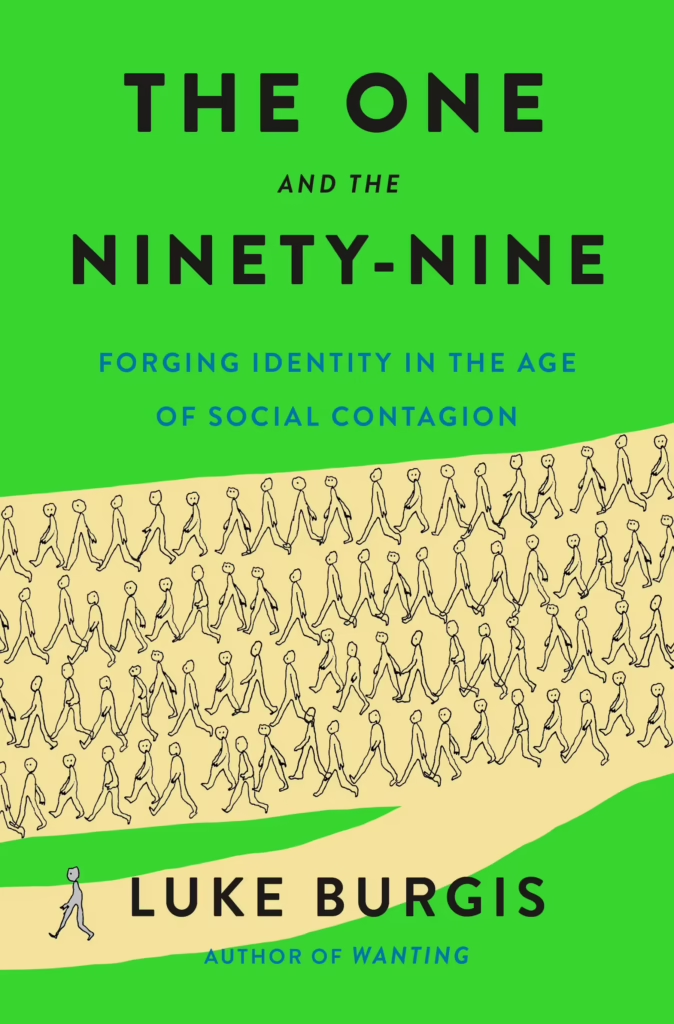
The Book Haven just published a post (below) on Luke Burgis’s newly launched book, The One and the Ninety-Nine. We were going to take the day off. But the entrepreneur author’s Father’s Day post today was something that needed more attention – today, most of all.
When I was thirty-nine, I was traveling out of state and grew concerned when my mother stopped responding to texts and calls. My aunt and uncle went to the house and discovered a nightmare that would change my life forever. They found my mother catatonic in bed, and my father puttering around as if nothing was wrong.
He thought she was taking a nap. In reality, my mother had suffered a sudden, catastrophic health decline—and my father was disappearing into the fog of undiagnosed Alzheimer’s disease.
I returned home in shock to peel back the layers of a miserable onion. My mother had been my father’s sole caregiver for more than five years, since the disease had become debilitating—but there had been signs going back more than a decade.
“He is losing his memory. In losing it, he reminded me that the mind was never a solitary thing.”
Her fear of confronting Alzheimer’s was too great, so she ignored it as his faculties slipped away. Then, when she needed him most, when urgent medical attention could have saved her life, he didn’t have the presence of mind to respond. By the time I arrived, it was too late. She was dead in a week.
The extent of his disease became clear only in increments. When the ambulance took my mother to the hospital, the paramedics didn’t realize that my father couldn’t be left alone for more than five minutes without risk—that he might put a metal bowl in the microwave, which by then my mother had taped shut. He would need constant care.
In The One and the Ninety-Nine, I recount the story of my arriving home on the day my mother was hospitalized to find him chain-smoking the cigarettes he had found in my mom’s purse. My dad doesn’t smoke, and neither do I. But on that day, it was so absurd—and in the moment, so oddly funny—that I asked him for a couple, since I’d heard that my mom was stable. We sat there smoking together for ten minutes, in the brief moment before we left for the hospital.
That is the particular vertigo of the only child: there is no sibling to call, no one to run things by, no one to ask whether you are seeing what you think you’re seeing. I often felt as though I were going crazy—alone, watching a very slow car crash. My parents had been so afraid of losing the life they’d built, the memories they shared, the person he had been, that they would sooner barrel blindly into catastrophe than ask for help. The few times I pleaded with them, I was met with promises to deal with it—later.
I learned everything I could about Alzheimer’s: what causes it, what it does to the people who have it, what I might do to help. I came away with more questions than answers. It is a complex, mysterious disease of the mind—the dissolution of memory and meaning even as the soul burns bright. There are treatments that, given early, can slow it and in rare cases even restore some function. But the doctors confirmed what I feared: for my father, that window had closed.
And here, in the throes of it, I found something I can only call a gift. It was too late to save my father’s mind. But there was still time to save my own.
Through his illness, and through caring for him, I felt called back to something almost primordial in myself—a deeper conscience. I needed to take better care of my health, yes. But more than that, my attention. I began to see the feeds I scrolled as their own disease of the mind: an endless timeline on which every moment blurs into every other, indistinct, nothing quite distinguishable from anything else—not so far, I realized, from what my father must experience. And I became painfully aware of how thoroughly we abandon the old, and especially the demented. We forget them. We forget them, in part, because they forget. We begin to mirror their forgetting.
But the deepest reckoning was with community. As an entrepreneur, I like the feeling of controlling my own destiny, and I had to come to grips with the fact that, with aging parents, I controlled nothing. They were adults, in fact and in law; I could not make them do what they would not do for themselves. Coercion was not the answer. But neither was abnegating my responsibility as a son. So what, practically, could I do?
The answer arrived, as these things sometimes do, on Sunday. The Mass reading was from Sirach: My child, help your father in his old age, and do not grieve him as long as he lives; even if his mind fails, be patient with him; because you have all your faculties, do not despise him. I prayed for the grace to live those words. And then I noticed something about how the trouble had surfaced in the first place.
The only reason I had known anything was wrong was that I’d run into my parents’ parish priest, who told me he hadn’t seen them at Mass in some time and wondered how they were. That is what a thick community does. The parish is grounded in something that transcends politics, hobbies, consumption, content—and so it notices an absence. It comes looking.
Too many of the communities I’d belonged to over my life had been thin. They didn’t tolerate difference. They didn’t summon anyone to grow in integrity. They would not have been there in my hour of need, much less my hour of dying. They rewarded the thinnest possible forms of belonging—having the right enemy, learning the right words to humiliate him.
Such communities, which thrive online and across our increasingly artificial world, reward whatever strengthens the status and the power of the group. They turn everything into totalizing politics. Inside them, we become shape-shifters. We never learn the art of belonging well; we learn only how to belong at any cost.
It turns out my father had been schooling me on the difference all along, simply by what he refused to forget. As his mind failed, the memories that held on longest were the ones most deeply embedded in him—and every one of them was a small circle of people. His brothers from the 101st Airborne, the men he’d jumped out of planes beside. His fellow parachutists. His Teamsters. His golfing buddies. The regulars at the store he bought and worked the last fifteen years of his life. The thick associations were the last to go. Many of them he carries still. The mind discards a great deal under siege; it clings hardest to the people who knew it.
And he has kept his humor. One thing I learned quickly is that my father now engages in zero social calculus, because he is entirely unaware of what anyone thinks of him. If someone were angry with him, he wouldn’t hold it for more than a few seconds. “It’s not all bad being me,” he told me once, with a glint that suggested he knew exactly what he was saying, “…because there are a lot of things that are not worth remembering.”
There is more wisdom in that than he knows. It is so easy to fall into entanglements that warp our priorities away from what matters most and toward what matters only in the vanishing moment. Some people help us remember who we are. Others help us forget.
My father has lost the ability to tell them apart—and in losing it, he has reminded me to attend to the difference while I still can.
Because our memories, and our very sense of who we are, do not live inside our skulls alone. They live in the space between people. The first time someone said of my father that he was “no longer there,” I understood that he is very much there—because I am there. His memory is not what it was. But his existence, and his dignity, were never his to hold onto by himself.
We are more than one another’s keepers. We are one another’s seekers.
There is an old story about a shepherd who leaves ninety-nine sheep to go after the one that wandered off, and who, finding it, comes home rejoicing. I used to think the parable was about the sheep. I’ve come to think it’s about the shepherd—about what it does to a person to refuse to let someone be lost. We must go and seek what is lost. And if we look hard enough, and long enough, we will find it, and carry it home, rejoicing.
In my case, what was lost—what I keep going back for—is my father. I do it for him. I do it, now, for the daughter who arrived shortly after that catastrophic day, and for her younger sister now, so that they will grow up knowing what it looks like to be sought.
And I do it for myself, while I still have the faculties to choose.
This Father’s Day, my father will not remember that it is Father’s Day. It doesn’t matter. I will remember for both of us.
That, in the end, is the whole of it: a mind, unlike a brain, is not a solitary thing. It is something we engage in with one another, and with the world. A mind, unlike a brain, is made to dance. And we can dance even with those who no longer remember the steps.
Luke Burgis’s new book, The One and the Ninety-Nine, is out now. This Father’s Day essay is drawn from the theme of the book.
My morning was spent online at a zoom celebration of the release. A dozen-or-so of us gathered to discuss the book on Zoom. Today’s release The One and the Ninety-Nine follows the astonishing success of his 2025 Wanting: The Power of Mimetic Desire in Everyday Life.
Leading economist Tyler Cowen, author of The Complacent Class, led the praise: “Social contagion is the most important phenomenon of our time. The One and the Ninety-Nine is the place to go to learn about it.” And so we will.
My copy of the book hasn’t arrived, so I’m relying on Luke Burgis’s recent discussion of Judas on his Substack to whet our appetite. Here’s Luke’s discussion of “Political Judas.”
Like everything Luke Burgis writes, it’s well worth your time. And I’ll be writing more about it in days to come.
French theorist René Girard‘s original use of the term “political atheist” appeared in his first book, Deceit, Desire, and the Novel (1961). In it, he referred to the French writer Stendhalas an “atheist in politics” (athée en politique). Stendhal’s spirit of political atheism is embodied in Julien Sorel, the protagonist of his novel The Red and the Black.15
Burgis writes in Political Judas:
When Julien learns that his former employer has switched parties, he smiles. Girard comments on this scene: “Julien savors the ‘conversion’… as a music lover who sees a melodramatic theme re-appear under a new orchestral disguise. Most men are taken by disguises. Stendhal places a smile on Julien’s lips so that his readers will not be deceived.”16 Julien, the political atheist, sees the political machinations of his day as the superficial games that they are. When Stendhal places a smile on his lips, he is hinting that Julien sees through the mimesis. He refuses to believe in any type of deeper meaning that others might attach to a turncoat.
To the naive, every conversion—whether political or religious—is genuine. The Stendhalian revelation was his pulling back of the veil on the real dynamics of superficial change through his characters.
Monsieur de Rênal’s “false” conversion, as well as Julien’s reaction to it, is reminiscent of the biblical Judas and the illusion of his outward signs and appearances. When witnessing a woman pouring perfumed oil to anoint Christ’s feet, Judas said the politically correct thing: “Why was this ointment not sold for three hundred denarii and given to the poor?”17 In the very next sentence, he is called a thief by the Gospel writer.
But Judas is more than a thief. He is also a cynic. He would later sell Christ for one-tenth the amount of those three hundred denarii that he suggested giving to the poor. The words that he speaks with his lips, and the signs he communicates with his actions (he kissed Christ as a “sign” of his friendship, which simultaneously signaled his betrayal) are but false signals of a false conversion—of an interior disposition that has, by this point in the story, become that of the Machiavellian political atheist. Like Julien Sorel in Stendhal’s story, he does not hesitate to wrap himself in false appearances to accomplish his political aims.
“Judas, however, quickly migrates from the Machiavellian to the black-pilled. And this darker type of political atheist rejects not only religious belief and belief in politics, he also ceases to believe in his own ability to act within or upon political structures. Unlike the Machiavellian political atheist who finds a way to survive within the existing structures—maybe even exploit them—the black-pilled political atheist believes that current political systems are thoroughly corrupt and unsalvageable. He believes that the only thing reasonable for a self-respecting person to do is remove oneself from participating in such a system.”
Meanwhile, Ted Gioia over at The Honest Broker (and pictured at right) is also having Girardian fever. He lists “Twelve Things I Learned from René Girard.” Here’s one observation: “”Girard devoted his life to exposing the lies behind fashions and trends. And now, after his death, he is fashionable and trendy. It’s almost like some kind of punishment.”
4. Imitation leads to blood feuds and reciprocal violence—escalating like Mafia wars—which are traditionally resolved by the sacrifice of a scapegoat.
In ancient times, an actual bloody sacrifice took place. In other situations, a ritualized sacrifice is served up. Today, it might be somebody blacklisted in Hollywood or canceled on social media. (Heroes often turn into scapegoats—see item #5 below).
To halt (temporarily) the blood feud, violent impulses of the combatants are targeted at the scapegoat, instead of at each other. (Here’s an example: After 9/11, Democrats and Republicans came to together and focused their hostility on non-existent weapons of mass destruction in Iraq, creating a short-lived lull in their political feuding.)
“Nine-tenths of politics,” Girard asserts, is “choosing the same scapegoat as everyone else.”