Sławomir Sierakowski: “You cannot change anything with irony.”

Share
Photo: Jarek Kruk

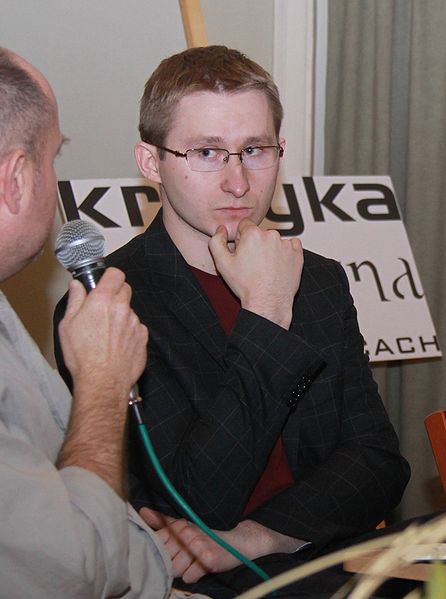
Searching for the missing “other.” (Photo: Jarek Kruk)

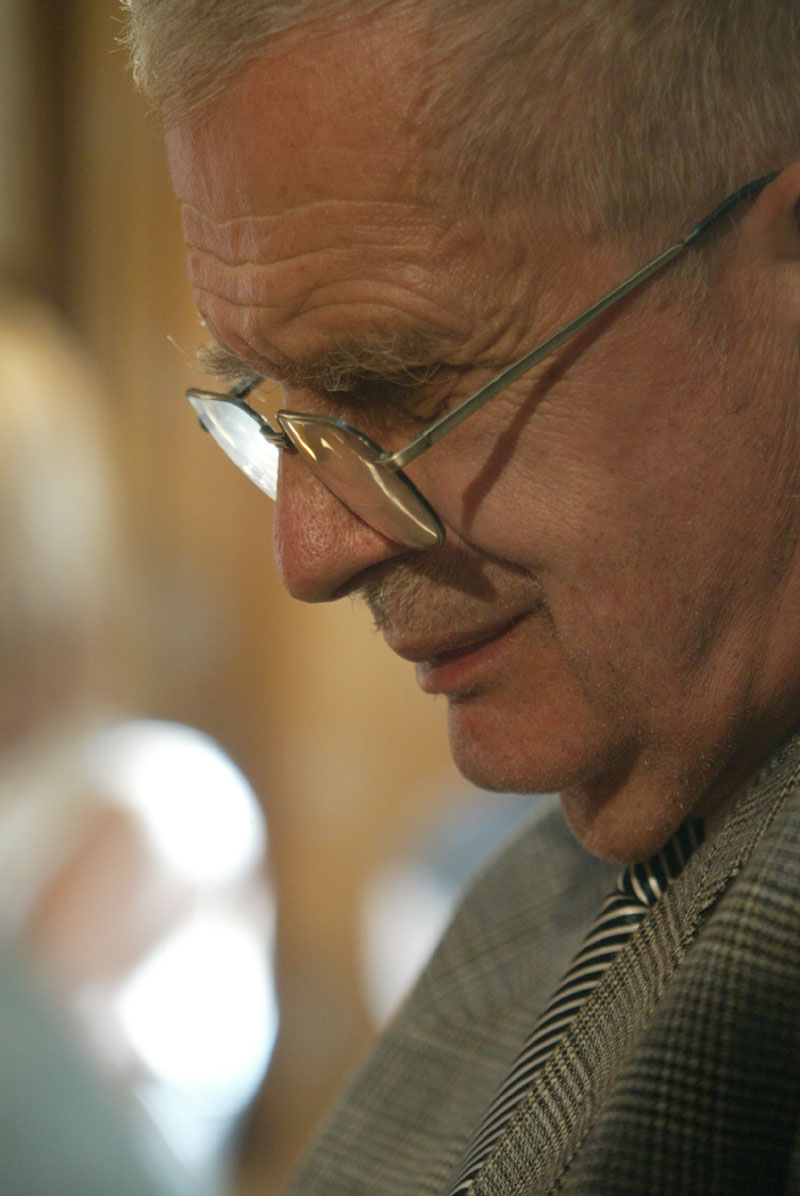
Cutting-edge Polish intellectual Sławomir Sierakowski breezed through town last week. I’d been alerted to the visit by Shana Penn of the Taube Foundation. In a busy schedule, I made the time, and I’m glad I did.  The 34-year-old wunderkind is founding director of a publishing house and magazine, Krytyka Polityczna, the focus of a left-wing movement, and of a think tank, Warsaw’s Institute for Advanced Study. The author is also a Harvard fellow this year. His project at hand (and the reason for Shana’s note): he is writing a book about the political, social, religious outlook of Czesław Miłosz.

Because of an earlier appointment, I arrived after his noon talk, “Time for Neo-Dissidents,” was well under way. Against my better judgment (knowing they’d be piecemeal and wouldn’t nearly capture his quick, wide-ranging intelligence), I began scribbling notes.  

He urged us to reconsider whether democracy equals party politics. Political parties?  “It’s a social construct,” he said, an outgrowth of the late 19th century, and somewhat irrelevant in his native land, since “there’s no social consensus about anything in Poland.” I, for one, would celebrate a dissolution of political party power in the U.S., which has increasingly turned to brainless slogans and character assassination to pull down the worthy and the worthless on all points of the political spectrum. I’d like to see an outbreak of goodness instead.

Sławomir said that to get anything done in Poland, one must bypass political parties and “negotiate between a coalition of NGOs and certain ministries and departments. You cannot do too much with parties; it’s not the decisive access. … if you want to change something in politics, don’t go to Parliament.” The task facing the nation of 40 million is “how to create trust, how to create social glue.” We discussed that and Miłosz at a small lunch afterwards.

His most passionate comments were reserved that evening for “Beyond the Dialogue: Jews, Poles, and What is Left?” and a screening of Yael Bartana‘s film, Mary Koszmary (Nightmares), in which he is the sole actor.

The 11-minute film is done in Leni Riefenstahl mode, the style of the propaganda movies that are a familiar staple to Eastern Europeans over the age of thirty, but it has a different message.  “Propaganda movies are always about community, togetherness,” he said, and so is this one.  But he’s speaking instead about the millions of missing Jews in Poland, the “other” that gave depth, meaning, and (that buzzword of the age) diversity to the social tapestry in Poland.

“It’s easy to be ironic,” he said. “But you cannot change anything with irony…All of us are liberal ironists.” He opted for pathos instead, and “saying something bluntly.”

“Any dissent today is easily corrupted by mass culture – it becomes another commodity on offer.” Hence the easy option of irony. “To say something serious today is to be for something,” he insisted.

Humble Moi … in Polish!

Share
polishbook3

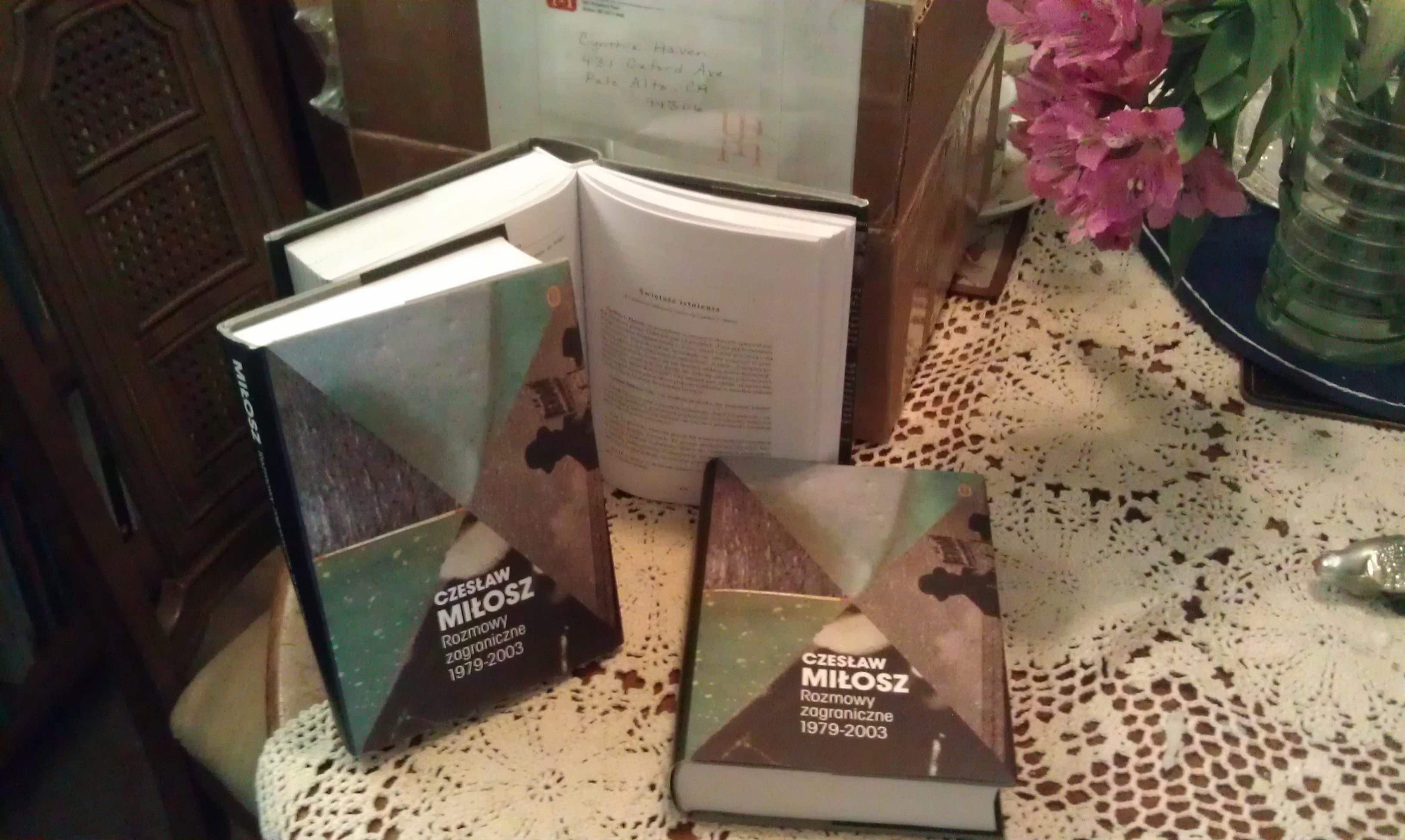
Three books on my Warsaw tablecloth.

So look what arrived in the post today! Three thick books of Czesław Miłosz: Rozmowy zagraniczne, 1979-2003.  I’ll bet it means nothing to you.

miloszTurn to p. 435. That’s right. That’s me.  “Świętość istnienia.” My Q&A with Czesław Miłosz, “A Sacred Vision,” which ran in the Georgia Review in 2003, is finally in Polish.  Wydawnictwo Literackie in Kraków, the co-publisher of the Nobel poet’s work in Poland, has just released another volume within its Collected Works of Miłosz series. This time it’s a volume of interviews published outside Poland – that may sound like a narrow niche, but recall that  Miłosz wasn’t getting a lot of press in Poland between 1951, when he defected, and the 1980s.  For that matter, he didn’t get many interviews in the West before the Nobel in 1980. Clearly, he made up for lost time: the full edition of Miłosz’s conversations that Wydawnictwo Literackie is planning will run to several volumes. The endeavor is a prestigious one, my contact at Wydawnictwo Literackie said, but at the same time a non-profit effort. Go to the publisher’s website here; the list is pretty impressive.

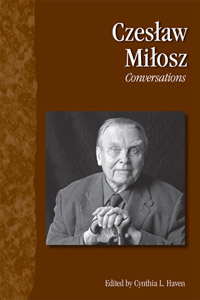
I was pleased that the volume picked up thirteen interviews from my own Czesław Miłosz: Conversations. Some of those, such as James Marcus‘s excellent interview for Amazon, might have disappeared in the whirlpool of time without republication – it’s no longer online, and hasn’t been, to my knowledge, for years. I’m not sure Carl Proffer‘s 1983 interview, from the pre-internet days, is that easy to find, either. The Polish publisher expressed gratitude for my humble book, which helped them greatly in culling for the best interviews.  Delighted to have been of service.

“Świętość istnienia” is the very last interview in the volume.  The first shall be last, or the last shall be first…something like that. I was the last person to interview Miłosz on Grizzly Peak before he returned to Poland in 2000.  Maybe it’s simply that the last will be last. In any case, you can still get my volume, in the English tongue, here.

R.I.P. Daniel Weissbort, champion of translation everywhere

Share
Weissbort2

Reading at the Ars Interpres Poetry Festival, 2006

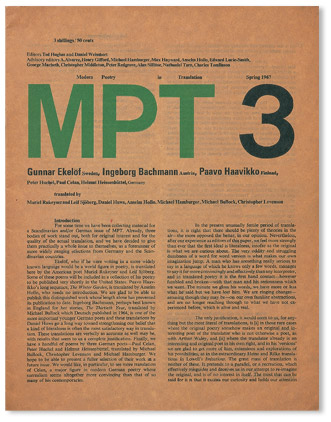
Daniel Weissbort is dead. I heard this yesterday from Neil Astley of Bloodaxe Books in the U.K., but hadn’t been able to confirm it till I found it posted here, on the website of the influential journal he founded with Ted Hughes in 1965, Modern Poetry in Translation. He continued to edit the magazine until 2003.

Perhaps the major obituaries are yet to come out, but it’s surprising how little a splash major figures in translation make in today’s world, although Weissbort was also a poet of note. I never met him face-to-face, but I know him from once remove; his wife, the Russian scholar Valentina Polukhina, is a colleague, friend and regular correspondent. He would have been 78 this year, and I know he has been ill for some years.

According to the website (which has a page for tributes here):

He was associated with MPT for nearly forty years, and he saw it through its birth as a “scrappy-looking thing – just to keep their spirits up…” (from a letter by Ted Hughes to Daniel Weissbort in 1965) to becoming a periodical of international importance and renown, which published some of the best international poets in the best translations. He was also a translator of poetry and a poet in his own right, and he made it his cause to get Russian poetry better known and better read in the English-speaking world, editing and translating Russian poetry tirelessly, and hosting and leading translation workshops. His most recent translations of the Russian poet Inna Lisnianskaya Far from Sodom were published to great acclaim by Arc Publications in 2005.

mpt3Nicholas Wroe, whose 2001 Guardian interview with Czesław Miłosz was included my volume Czesław Miłosz: Conversations, interviewed Weissbort in the same year.  It was posted on a few Facebook pages:

“Poetry happens everywhere,” writes Daniel Weissbort in the introduction to Mother Tongues, “but sometimes, often, it happens in languages that do not attract attention. We are the poorer for not experiencing it, at least to the extent it can be experienced in translation.”

Although he wasn’t conscious of it at the time, translation had been a part of this poet, editor and translator’s life from the outset. “My parents were Polish Jews who came to London from Belgium in the early 1930s,” Weissbort explains. “They spoke French at home because that was the language they met in, but I was so determined to be English that I’d always answer them in English.” …

It was Hughes’s idea to get as many literal translations of work as possible. “We didn’t want carefully worked, minute things that took forever to produce,” explains Weissbort. “It sounds a bit insensitive now, but we wanted quantity even if it was in quite rough-and-ready translation.” He says that at the moment one of the big debates in translation is between so called foreignisation and domestication. “Domestication looks like something that was first written in English,” explains Weissbort. “Post-colonial theory is very much in favour of foreignisation, seeing domestication as an imperialistic strategy that is opposed to allowing the foreignness to come into the language. I suppose we were foreignisers before it was invented.”‘

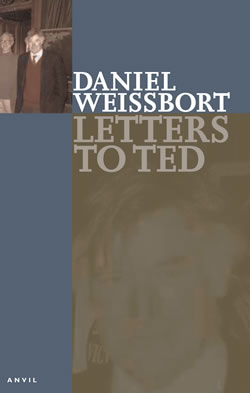
Weissbort3Weissbort is also due to publish his own, 11th collection of poems, Letters to Ted, written after Hughes’s death, as well as a memoir of Nobel prizewinner Joseph Brodsky.  (Read the rest here.)

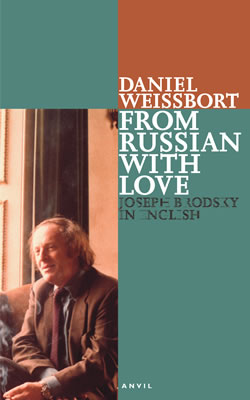
I reviewed the latter volume, From Russian with Love, in a Kenyon Review article called “Uncle Grisha Was Right” – it’s here.  Being a Brodsky translator was a crushing, ego-deflating experience for many, and Weissbort was one of the earliest translators, before he could have taken courage from the tales of other casualties. Weissbort agonizes over the experience, analyzing and doubting himself – something the Russian Nobel laureate never did.  As I wrote: “He [Brodsky] came from a culture that had bypassed Freud and his heirs, where an enemy was an enemy and not just a projection of an inner landscape. He was not, to put it mildly, a man crippled with a sense of his own contradictions. Hence, his attacks could be unambiguous and fierce. As sycophants multiplied exponentially, it became hard, some of his friends say, to tell him the truth—for example, the truth about his abilities to write English verse and translate into it.”

Yet in the end, Weissbort seemed to be unexpectedly buoyed by the experience, and came to a startling conclusion that says as much about the master translator as it does about the poet:

Weissbort__From_Russian“At a commencement address years later, he [Brodsky] spoke of ‘those who will try to make life miserable for you,’ and added: ‘Above all, try to avoid telling stories about the unjust treatment you received at their hands; avoid it no matter how receptive your audience may be. Tales of this sort extend the existence of your antagonists. . . .’

That’s the legacy of the man. But the poetry? Weissbort seesaws and perseverates for pages and pages, and there is much repetition and confusing back-and-forth in time … Yet despite the waffling and self-deprecation, he makes a central, remarkable contention: Weissbort argues that Brodsky ‘was trying to Russianize English, not respecting the genius of the English language, … he wanted the transfer between the languages to take place without drastic changes, this being achievable only if English itself was changed.’

In short, Weissbort invites us to listen to Brodsky’s poetry on its own terms. As he tells a workshop: ‘It’s like a new kind of music. You may not like it, may find it absurd, outrageous even, but admit, if only for the sake of argument, that this may be due to its unfamiliarity. Give it a chance, listen!’”

Update on 12/3:  Guardian obituary by Sasha Dugdale is here.


Tomas Venclova speaks at the EU about his mother tongue and an “eccentric, capricious city.”

Share
t.venclova

Tomas in Vilnius

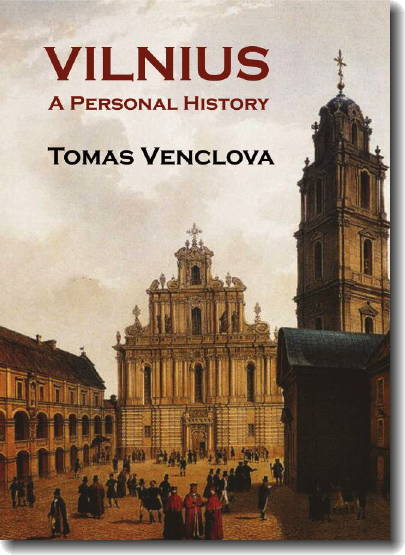
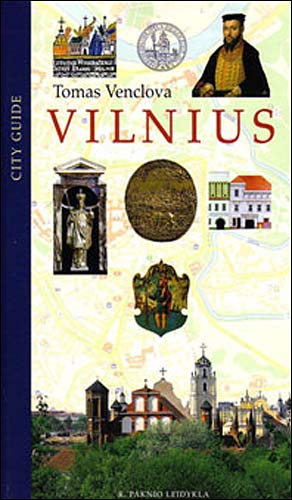
I met Tomas Venclova in his role as a poet, and it is primarily as a poet he is known.  However, he has a lesser-known role as a champion of Lithuanian culture, literature, and above all language. His work in that arena is as impressive as his poetry – and he had a chance to show it at the European Union yesterday and today, in Brussels and Luxembourg, where he was speaking.  I asked him if I could share some of his remarks, which he had sent to me. “Mais oui!” he replied.

I’ve blogged so much about Vilnius and Lithuania – try here and here and here and here and here. But it’s a wonderful country and during my most recent visit, traveling from Warsaw to Vilnius, I gained a deeper appreciation of its wildness and mystery, of its old superstitions and myths, and the enchantment of  its jewel-box capital, aptly symbolized, on its coat of arms, by Saint Christopher wading through the mud of history.

The Lithuanian language has has kept many archaic features of ancient languages such as Sanskrit or Ancient Greek, and is spoken by about 3.2 million people. Yet, as Tomas pointed out, it’s in better shape today than Gaelic – “now, it is not just the official state language, but also the language of schools, universities, press and other media, as well as of very good theaters. Even before World War I, Lithuanian literature in Vilnius had built quite a reputation, though during the two interwar decades, when the city was annexed to Poland, it was often dismissed as inferior.”

Marvelous Vilnius, a Jerusalem claimed by two nations, the Lithuanians and the Poles, is “the perfect and sacred city which had been lost in the whirlwinds of history,” he said.  The city, which at times almost a religious space, “is often said to be mysterious and magic, eccentric and peculiar, the inspiration of myths and poetry. A particularly strong connection between the city and its surroundings is also very characteristic to it, allowing poets to see Vilnius as a pastoral place with ‘wild’ but idyllic nature intruding into the city center and adorning its baroque décor. … The text of Vilnius is composed of smaller texts, written in different languages, sometimes rich in code-switching, as for instance the seventeenth-century dramas, where Lithuanian and Belarussian cues are interwoven with Polish ones.

“But there is more than just linguistics involved here. Most varied cultural discourses overlay one another, letting competing myths sprout from the primeval mythological trunk. The national identity of many residents of Vilnius is similarly complicated: the same person can simultaneously belong to several cultures, which is why she or he sometimes stands aloof from the rest of society, suffering from an inner conflict.”

Two of the Polish language’s greatest poets were born and reared in Lithuania: Czesław Miłosz in the 20th century and Adam Mickiewicz in the 19th – and Miłosz was a close friend of the Lithuanian-language poet.  Venclova’s talk wasn’t short on his friend:
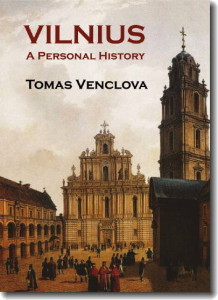
vilnius3“Czesław Miłosz, the greatest Vilnius poet of the twentieth century, also started his career in the interwar period … The life of Vilnius-Wilno (at that time, annexed to Poland) did not change much from Mickiewicz’s to Miłosz’s times; the city and its suburbs were populated by the same provincial Polish gentry, known as szlachta, the memories of the free masons’ lodges were still alive, and the great University, closed by Tsarist Russia in 1832, was reopened in 1918. Thus, the budding poet could readily feel he was entering a larger tradition. But for Miłosz, Vilnius was not a sanctuary to visit on a pilgrimage; nor was it a place asking for a particular literary genre to record its magnificence, namely, the poetic Baedeker, much exploited by the lesser poets of the time. Miłosz was not a regional but a European poet, as was Mickiewicz. According to him, the Mickiewicz tradition marked a revolt, a disagreement with reality as well as the prospect of exile. But for him, too, Vilnius-Wilno was a sacred city. Finding himself in exile in 1950s, he denied feeling nostalgic: he wanted to start anew and to build his poetic tower without looking back. Yet his texts soon acquired a double perspective: he would depict the city of his youth through the prism of his new French and American experiences, reviving the details of the past life with heartfelt love and skill, and contrapuntally comparing Vilnius to his new surroundings. He recreated the city spaces in the Proustian manner: his city is idealized because of his physical and temporal distance, but the picture is realistic enough and devoid of unnecessary sentimentality. In the cycle Miasto bez imienia (City without a Name) published in 1969, as well as in other poems, Milosz was approaching what he himself called apocatastasis, the revival of purified, primordial reality. He was greatly, probably mainly, interested in the language of that reality. In this, an obvious example and archetype for Milosz was Mickiewicz, but also the Lithuanian Konstantinas Sirvydas, the author of the seventeenth-century dictionary, to whom Miłosz devoted his beautiful poem ‘Philology.’

 “The peak of this poetry is manifest in the poems written after the restoration of Lithuania’s independence, when Miłosz could return to it. Nostalgia acquires a new shape: 52 years later, Vilnius looks like a city of the dead and Lithuania is some ‘other space’ described in metaphysical categories. At the same time, nothing has disappeared from the landscape of Vilnius: Miłosz sees the same ‘forests of brown gold’ in October, when the weather, again, is like wine, and the familiar hills and twisted baroque gables whisper that everything passes but are also witnesses to the permanence of the world, resurrected in human memory.

vilnius2“Miłosz and his companions were interested in the history and culture of the ethnic communities which had their own right to the city, namely, the Lithuanians, the Belarusians and the Jews. Together with a friend, he translated the works of the Lithuanian poet Kazys Boruta and wrote reviews of twentieth-century Lithuanian literature, his lifelong interest. In some ways he considered himself a Lithuanian who wrote in Polish; I remember how happy he was when Lithuanian translations of his poems were published before the Polish originals.”

“Miłosz possessed some knowledge of Lithuanian, just as Yeats possessed some knowledge of Gaelic,” he said – but that’s a bit of an overstatement. Miłosz was born among Lithuania’s Polish-speaking gentry, and didn’t bother to learn the language, even though he had a ethnically Lithuanian grandmother. Robert Hass said he began learning the language instead when Miłosz was in his 80s. Why bother so late?  “Because I think it might be the language of heaven,” he confessed to Hass.
vilniusDespite attempts to make Vilnius a truly national city, Tomas said, “the Lithuanian capital has remained what it had always been―complex and multidimensional, a continent in miniature. But this is a fragile condition, and we are responsible for it.”

“The creation of our continent and our civilization has always been a duty, an uncertainty, and a risk. I don’t know of any place in Europe that better lives up to this risk than Vilnius―a perpetual peripheral area and borderland, an eccentric, capricious, erratic city with a unique past that violates all the rules of logic and probability.”

 

Seamus Heaney: “rhymes as important as revolution”

Share

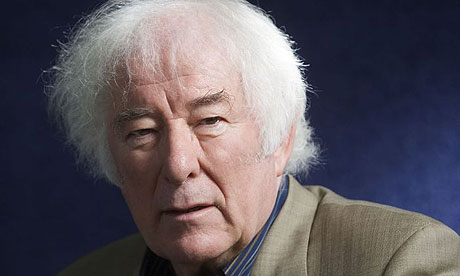
heaney2I’ll be speaking at a private book club event next week.  On what?  The role of the reader.  So many write and write and write about the process of writing, the burdens of the writer, the writer’s obligations to society, and so on and so on and so on.  Who thinks about the reader?  I do, sometimes.  And I’m not alone.  Here’s what Seamus Heaney, who died a last week (see posts here and here) had to say on the subject … well, he starts out on the right horse, but quickly falls off.

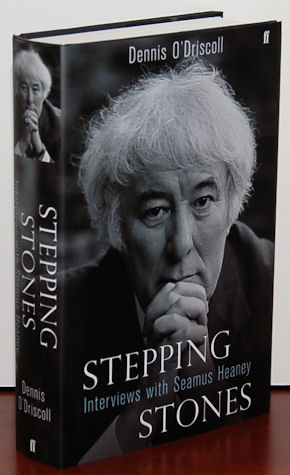
From Stepping Stones, a 500-page Q&A with Dennis O’Driscoll:

How do you respond to Joseph Brodskys contention that ‘a reader who has a great experience of poetry is less likely to fall prey to demagoguery on the part of the politician’? There is also Yves Bonnefoy‘s somewhat similar view that ‘poetry is a cure for ideology’.

Joseph was right to contend that a person sensitized to language by poetry is less likely to sway in the mass-media breeze; and I agree with Bonnefoy if he means that successful poetry will launch itself beyond the pull of the contingent and get into its own self-sustaining linguistic and imaginative orbit. Take a poem like ‘Leda and the Swan’.  It begins with what Bonnefoy might call ideology: Yeats starts thinking of the Russian Revolution, which represents the rule of the many, the arrival of power from below, from down to up, and that he opposes the rule of the few, the rule from above, from up to down, so the violent descent of Zeus upon Leda comes to mind as analogous to all this – but then, as Yeats himself has told us, bird and girl took over his imagining, and the poem, powerful and problematical as it is, took off.  Thinking about rhymes becomes as important as thinking about revolution.

But poems can be political insofar as they discover the paradigmatic. Think of Cavafy. Cavafy’s cameos of the ambitions and victories and defeats among various tyrannies and dynasties and satrapies during the Hellenistic age have a wonderful, clarified political wisdom, but they’re free – or, if you prefer, cured – of ideology. It’s hard to talk about this without citing examples, probably because examples tell us that the only real answers to the general problem are specific poems in specific situations. Whitman‘s hospital poems during the American civil war. Poems by Auden and MacNeice in the 1930s – ‘Look, Stranger’, ‘The Sunlight on the Garden’.  Derek Mahon‘s ‘Lives’.

How should we regard a question like Czeslaw Miloszs ‘What is poetry that does not save/Nations or people?’

hartley's jamIt’s a cry wrung from him in extremis, de profundis, the cry of the responsible human. But it’s one he answers in different ways in his work – in the witness of poems like ‘Campo dei Fiori’ and ‘Song on Porcelain’, and in the obstinate espousal of beauty and order – the calligraphy, as he once called it – of poems like ‘The World’, or ‘Encounter’, or ‘Gift’.  These latter ones, incidentally, could have as their motto Brodsky’s equally challenging declaration that ‘if art teaches anything, it’s that the human condition is private’.

Where do you stand between those two positions?

Betwixt and between them – which is, in effect, where Czeslaw Milosz and Joseph Brodsky also stood. Joseph was out to save people when he suggested during his time as Poet Laureate of the United States that poetry should, like the Gideon Bible, be available in hotel rooms and should be distributed like handouts at supermarket checkouts. And Czeslaw writes about loving herring and strawberry jam as well as beauty and truth.

Au revoir, Seamus Heaney! My two letters from the Nobel laureate

Share
Heaney

Generous, humble, and glowing from the inside

“You of all people!”  That’s how my first letter from Nobel poet Seamus Heaney began.  It’s not hard to keep track of them; there were only two.  This, the first one, was in a large envelope,  addressed in his loose, open handwriting in December 2007.  His Strand Street address was in one corner, and some attractive, carefully chosen stamps with foxgloves, dandelions, and black bog rush.  (You see how carefully I still treasure this missive?)  I had written half a year before to ask that the Irish poet contribute his memories to An Invisible Rope: Portraits of Czeslaw Milosz, and hadn’t received an answer.  When I heard today that he’d died, at 74, I went and pulled the letter out of a storage chest.

“You of all people! I’m very sorry to have overlooked your letter of last July: your book of Conversations with Czeslaw is one of the most helpful and constantly readable, and I’ve admired several reviews,” he wrote. He wanted to contribute, but warned that his memoir would be brief, and asked if I thought this would look “niggardly.” He kindly enclosed another piece on Joseph Brodsky, which he’d written for our mutual friend Valentina Polukhina. He neglected to remind me that he was still recovering from his 2006 stroke when I first wrote him, and had cancelled work for a year afterward.

heaney2Well, this was the man.  He was being humble to me.  It’s a powerful lesson in noblesse oblige, whether in poetry or some other field.  But one has to admit in the literary arena, it’s somewhat rare.  As an editor or journalist, one is more likely to be treated like an annoying tick than a respected colleague.  I pinned the letter to my wall for several years, to look at it in the bad times.

So I even treasured the second letter from Dublin, nine months later, signed simply “Seamus” with handwritten insertions (this one with a stamp featuring sea asters).  He wouldn’t be able to contribute after all.  He was about to set out on a road show with Dennis O’Driscoll (who died before him, I wrote about Seamus’s generous tribute hailing him as “my hero” here) – they’d just published a book-length Q&A called Stepping Stones – plus a TV documentary for his 70th birthday.  Given his schedule, and he was “naturally very sorry not to have been able to deliver a piece that would do credit to Czeslaw and indeed to myself before now.”  Henceforth we communicated back-and-forth through a flurry of emails via the mysterious cyberspace intermediary “Susie,” since she had an email address and he didn’t – he admitted “I’m still at the scriptorium stage of development.” We wound up reprinting his earlier memoir, “In Gratitude for All the Gifts” for the book, written when his fellow Nobelist had died in 2004. And no, it wasn’t “niggardly” at all.  It was, like him, generous and humble and glowing from the inside, like a peat fire in a cold Irish winter.

Postscript from Jane Hirshfield, as always eloquent. Jane joins the world in mourning the loss of Seamus Heaney, one of its greatest, most eloquent, and most generous poets. She writes: “In his presence and in his words, you felt always the embrace of being. His words brought the burnish of original seeing. You were made, quite simply, more alive by his aliveness, in life and on the page – as in the opening poem from his 2010 collection, Human Chain:

Had I Not Been Awake

Had I not been awake I would have missed it,
A wind that rose and whirled until the roof
Pattered with quick leaves off the sycamore

And got me up, the whole of me a-patter,
Alive and ticking like an electric fence:
Had I not been awake I would have missed it

It came and went too unexpectedly
And almost it seemed dangerously,
Hurtling like an animal at the house,

A courier blast that there and then
Lapsed ordinary. But not ever
Afterwards. And not now.

Jane&seamus

Two poets, held in memory…