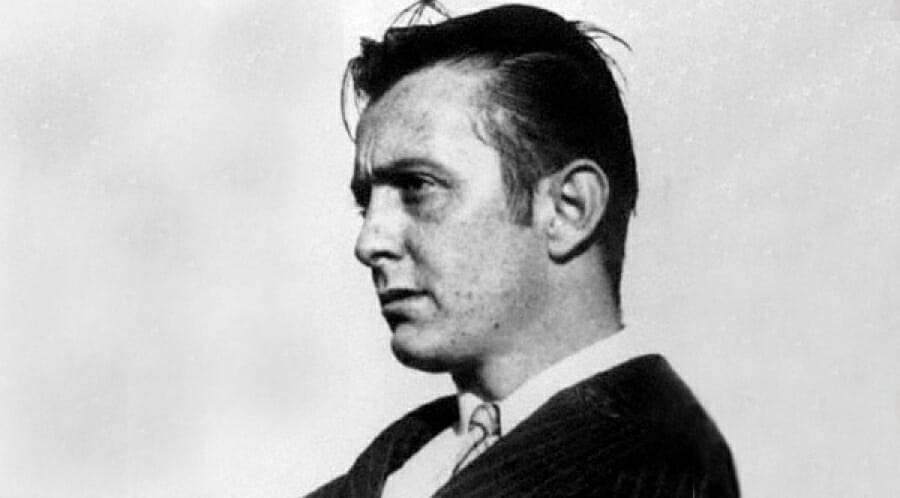

Robert Harrison: “Our culture is getting more and more prosaic…We’re trafficking in concepts and not in spirit.”

Featured

Share

You could easily miss this long article with the long title, “Writer, podcaster “Robert Harrison challenges A.I. brain delusion, the Humanities’ deathbed and Fear & Loathing with the Love Bots.” I wouldn’t pass it up I were you. Scott Thomas Anderson has a conversation with Robert Pogue Harrison, Stanford’s leading humanist and Dante scholar, and Aqsa Ijaz, who writes for The Marginalia Review (we’ve written about her on the Book Haven here) and it shouldn’t be missed.

An excerpt:

“We were talking about the horrifying and exciting possibilities of Chat GPT, and I asked, ‘What if it starts to write books like you?” Ijaz reminded Harrison. “And you said, ‘I’m not worried that A.I. will be able to think metaphorically, or write books like mine. I’m worry that it will hasten the day when human beings themselves will no longer be able to think metaphorically and lose access to those depths.’ What do you think is happening in the Humanities? Have students already lost access to their metaphoric depths?”
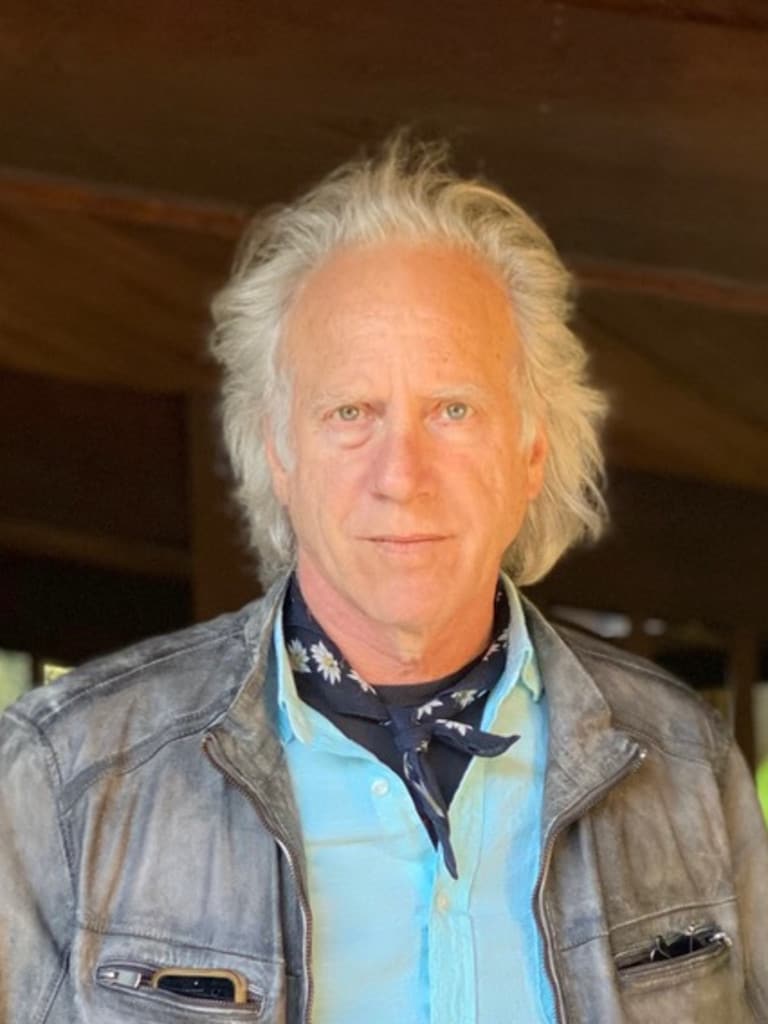
Robert Pogue Harrison

“I think so, yeah,” Harrison admitted. “At Stanford, when I arrived in the 80s, there was the whole war over the Western canon. It had gone from Western Civilization to ‘Civilization, Ideas and Values.’ So, when they changed the reading list from Western Civ. to ‘C.I.V.,’ essentially, they threw out all the poets. They retained Thomas Aquinas but threw out Dante. They retained Machiavelli and threw out Shakespeare. They retained the theorists, the people who think in terms of concepts, but not in terms of images. So, this isn’t even due to technology, it’s just the fact that our culture is getting more and more prosaic, and professors are more and more in the profession of trafficking in concepts and not in spirit. So, it’s that de-spiritualization. And we’re becoming completely illiterate in terms of the language of imagery, symbol, metaphor. This increasing literalization of reality is a terrible blight on the poetic imagination.”

For Harrison and many of his listeners, that has consequences: This weakening of the full breadth of the human experience is accelerating at the very same moment that the zealots of Tech utopianism would have A.I. replace the human creative capacity all together. Harrison thinks that many of his colleagues are too consumed with indoctrination to see this grim writing on the wall.   

“Rather than them being an antidote or tonic or some kind of corrective to the general disaster that has been visited upon our ordinary human intelligence by technology, and the whole sorcery of the screen, I think the majority of my colleagues in the Humanities – according to my general awareness of the tribe to which I belong – won’t be in a position where we should expect much from them,” Harrison offered. “They won’t be providing a productive alternative or some kind of counter-impulse to the worst disfigurations … It seems to me that it’s just going to render everyone more and more vulnerable to fraud, propaganda, ideological manipulation and greater political polarization. And it’s the same technology that enhances and enables all of these exploitations of human loneliness.”
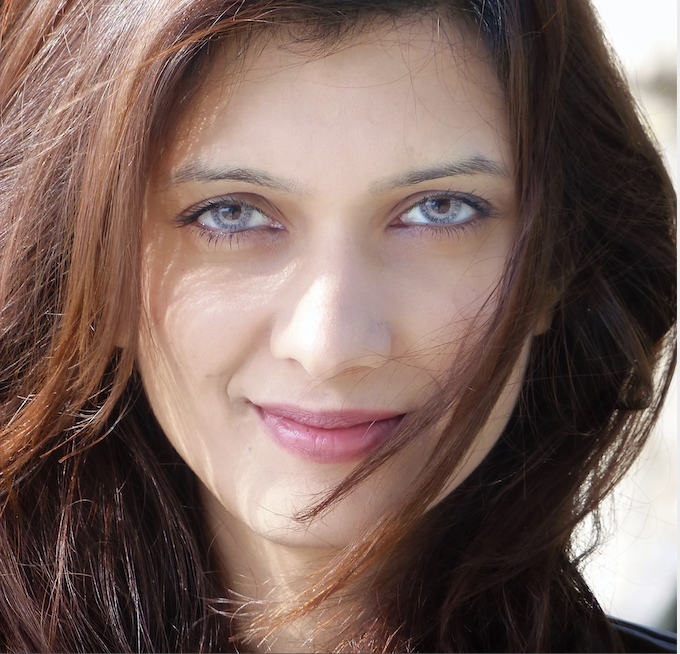
Aqsa Ijaz

The conversation turned to AI, perhaps inevitably: NYU professor Gary Marcus, who spoke recently about the extreme confusion society will now face between reality and unreality.

“What criminals are going to do here is create counterfeit people,” Marcus said. “It’s hard to even envision the consequences of that. We have built machines that are bulls in a China shop. Powerful, reckless and difficult-to-control.”

In other words, as these forms of machine learning teach themselves how to play to people’s egos and vanity, breathing in our collective online behavior – and how we use social media to desperately grasp for breadcrumbs of affirmation – these bots get better and better at gauging how a person secretly likes to imagine themself. They will learn to cater to such vulnerabilities, doing so from the guise of some vaguely independent, apparently all-knowing ghost. This alone gives A.I. the potential to be as addictive, or more addictive, than any force we’ve yet encountered in our mammalian experience, especially when love and sex are forced into the equation. And Marcus’s reference to criminals? Up until this point, con artists of average intelligence have been successfully preying on isolated, withdrawn and hurting people, often managing to catfish those victims for tens of thousands of dollars; or in some cases hundreds of thousands. Now imagine what a predictive “super-intelligence” can do to isolated, withdrawn and hurting people.  

Can Silicon Valley and the academic breeding ground that bolsters it somehow chain this part of the genie?  

Having taught at Stanford University for 38 years, Harrison has little faith that the ivy league institutions will be the answer … Read the whole thing here.
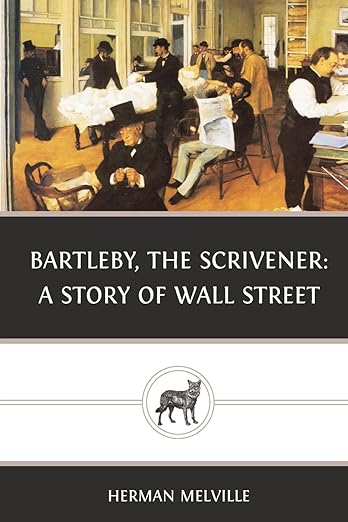
“It was his soul that suffered, and his soul I could not reach.” Melville’s “Bartleby, the Scrivener” on Jan. 8!

Featured

Share

Please join us for a discussion of Herman Melville‘s classic short story Bartleby, the Scrivener: A Story of Wall Street at 7 p.m. (PST) on Monday, January 8, at Levinthal Hall in the Stanford Humanities Center at 424 Santa Teresa Street on the Stanford campus. This is a hybrid event, so you can come in person or via zoom, but we encourage you to register either way (link below). 

Panelists will include Stanford Prof. Robert Pogue Harrison, author, director of Another Look, host of the radio talk show and podcast series Entitled Opinions, and a regular contributor to the New York Review of Books, and Stanford Prof. Tobias Wolff, one of America’s leading writers and the founding director of Another Look, as well as a recipient of the National Medal of Arts. Two special guests will round out the high-powered panel out to four: Robert’s brother Thomas Harrison, professor of European Languages and Transcultural Studies at the University of California, Los Angeles, and Katie Peterson, an award-winning poet, professor of English at UC-Davis, and a Stanford alum. 

Melville is most famous for his masterpiece Moby Dick, but his 1853 Bartleby is a short wonder, and his protagonist’s repeated “I prefer not to” is one of the most famous lines in American literature. Novelist Sophie Hannah, writing in The Independent, called it “a flawless and ambiguous work of art.” She writes, “Bartleby, blank in character, tests the characters of others. … Bartleby is pure enigma.” 

The short story is famous and widely available – buy a copy on amazon or abebooks.com, in local libraries and in bookstores. It’s also widely available online – google for links. 

This event is sponsored by the Stanford Division of Literatures, Cultures, and Languages, the Stanford Humanities Center, and the Continuing Studies Program at Stanford.

Register here.

For some perspectives on the twentieth century take on the long short story, you might check out the 1970 cult classic of the same name, starring Paul Scofield and John McEnery, here. You can see a short clip over the 2001 remake here. Better yet, read Melville. His long short story (it’s about 30 pages) will surprise you.

“Los Angeles come to me the way I came to you … you sad flower in the sand.” Come join us Sept. 19 for John Fante’s “Ask the Dust”!

Featured

Share
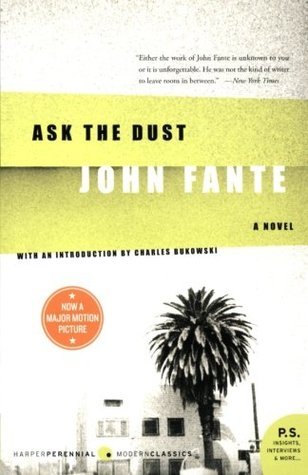
“All at once I was full of plans. Laguna Beach!” John Fante (1909-1983)

Please join us at Stanford on for a discussion of John Fante‘s 1939 novel Ask the Dust at 7 p.m. (PST) on Tuesday, Sept. 19, at Levinthal Hall in the Stanford Humanities Center, 424 Santa Teresa Street on the Stanford campus. It’s a hybrid event, so come virtually or in person. Registration here or below.

Something you may not have known about Fante. He was the son of Italian immigrants, born in 1909 (he died in 1983). Hence, Italy considers him one of its own. So we’re partnering with the Italian Cultural Institute of San Francisco for the event!

Poet Charles Bukowski (not Italian) said the book had a lifetime influence on his own writing, and that the works of Fante, a novelist, short story writer, and screenwriter, were “written of and from the gut and the heart.”

“One day I pulled Ask the Dust down from the library book shelf and stood for a moment, reading.  Then like a man who had found gold in a city dump, I carried the book to a table.  The beginning of that book was a wild and enormous miracle for me….Fante became my god.” 

The book was adapted into a 2006 film starring Colin Farrell and Salma Hayek.

Panelists will include Stanford Prof. Robert Pogue Harrison, author, director of Another Look, host of the radio talk show and podcast series Entitled Opinions, and a regular contributor to the New York Review of Books, and Stanford Prof. Tobias Wolff, one of America’s leading writers and the founding director of Another Look, as well as a recipient of the National Medal of Arts. Novelist Terry Gamble will round out the panel. Many will remember her from the Another Look discussion of Alfred Hayes‘s My Face for the World to See in 2019.

Copies are available as in Kindle and paperback. (In a pinch, the book is even available in a less user-friendly pdf format online.)

In addition to the Italian Cultural Institute of San Francisco, this event is co-sponsored by the Continuing Studies Program and the Division of Literatures, Cultures, and Languages at Stanford.

REGISTER ON THE LINK HERE

Postscript: There’s more! Read about how Fante’s Ask the Dust turned around the life of a convict: here. What happens to a civilization that grows up alongside the constant vision of dust? Read novelist Alan Rifkin’s take on that here.

Robert Harrison to explore “critical frontiers” in Cambridge’s Clark Lectures, May 9-18

Featured

Share
Courting adventure and possible disaster


LINKS TO THE LECTURES:
Lecture 1: The Thin Blue Line here.
Lecture 2: Mysteries of the Plainosphere here.
Lecture 3: Tellurian Symbols here.
Lecture 4: On Separation
here .

Stanford’s Robert Pogue Harrison is the Clark Lecturer at Trinity College, Cambridge, this year – an important honor. In preparation for the lectures (the theme will be “thresholds”), he had a Q&A interview that was published on the Trinity College website. Read the whole thing here; excerpt below. He says: “The more deeply you explore the western canon, the more you realize how liberating and revolutionary it really is.”

Tell us a bit more about the theme of your lectures: why ‘thresholds’?

Thresholds both separate and relate what they come between. In my Clark Lectures I will examine a variety of thresholds: between the finite and the infinite, the terrestrial and extraterrestrial, the living and the dead, the apparent and the nonapparent. In an essay called “The Psychology of Places” (1910), the British writer and outdoorsman Algernon Blackwood wrote that “the threshold is ever the critical frontier that invites adventure and therefore possible disaster. The psychical aspect of a threshold is essentially thrilling.” He advises campers never to pitch camp on the edge of anything: “put your tent in the wood or out of it but never on the borderland between the two, since that is not a place of rest but of activity.” I choose not to follow his advice in my lectures but to court adventure and possible disaster by seeking out different types of edges where things get critical as well as thrilling…

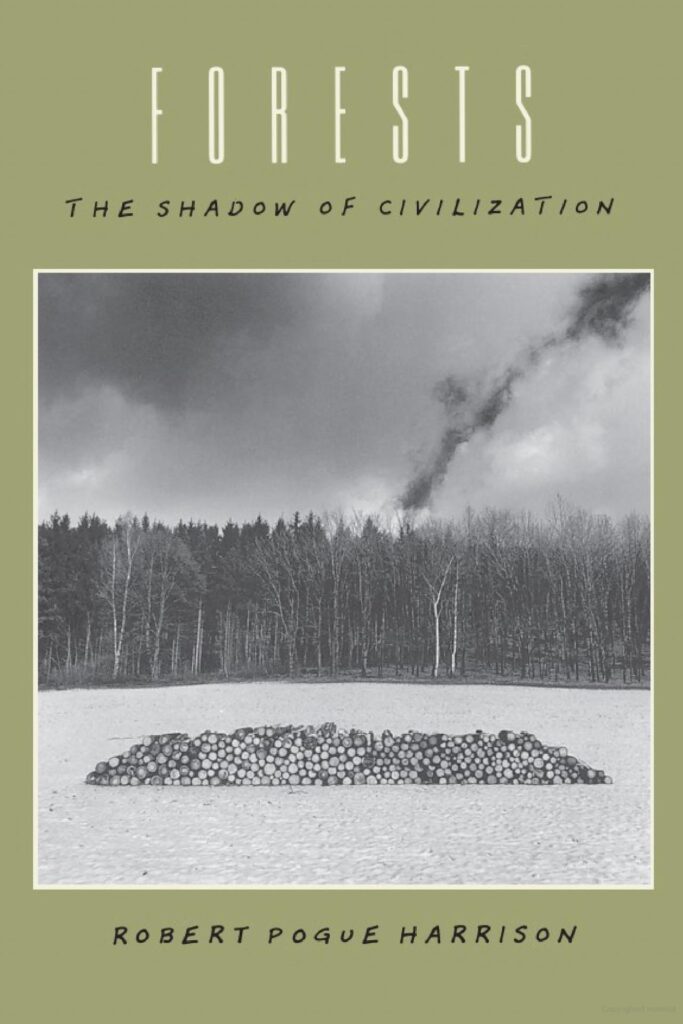
You wrote Forests: The Shadow of Civilization over 30 years ago now and it has only grown in relevance. How differently would you write it now, if at all?

It’s quite amazing for me to remember how, when I was writing Forests (University of Chicago Press, 2009), most of my friends and colleagues thought I was crazy to pursue such a project and endanger my academic career by defying academic genres and specialization. I was young enough at the time to take that risk, yet even more than that, Forests was a book that wanted to be written. Some books write themselves almost independently of their authors.  At least that is the experience I had during the years in which I labored over this selective history of forests in the western imagination.  I’m sure there are any number of ways Forests could be profitably revised, supplemented, or reconfigured, yet I would not know how to change a word of it, given that I do not really consider myself its author, if by authorship we mean ownership of a book’s contents and manner of expression.

Your work covers what was once called, without challenge or embarrassment, the whole canon of Western literature. Is the idea of such a canon still defensible?

According to the idea of translatio imperii, western civilization has been on a westward course for quite some time. I live at the western edge of the western world, in a place called California.  From this edge, it seems to me that the western canon is poised for “a new birth of freedom,” to quote Abraham Lincoln. It’s not a question of “defending” it so much as rediscovering its astonishing richness and subversive radicality. The more deeply you explore the western canon, the more you realize how liberating and revolutionary it really is.

The Clark Lectures take place in the Winstanley Lecture Theatre. No booking is required. The website here says they’ll be available online. Watch the website space.

Tuesday 9 May at 5pm: The Thin Blue Line

Thursday 11 May at 5pm: Mysteries of the Phainosphere

Tuesday 16 May at 6pm: Tellurian Symbols

Thursday 18 May at 5pm: On Separation

One of the best nonfiction books of all time? Join us for Virginia Woolf’s “A Room of One’s Own” on April 11!

Featured

Share

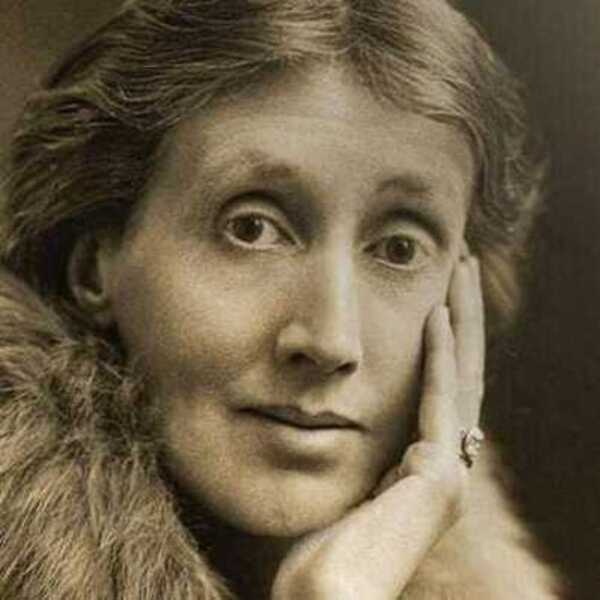
Please join us for a discussion of Virginia Woolf‘s 1929 A Room of One’s Own at 7 p.m. (PST) on Tuesday, April 11, in Levinthal Hall, Stanford Humanities Center, 424 Santa Teresa Street on the Stanford campus.

The Guardian called the book “a landmark in feminist thought and a rhetorical masterpiece” and rated it one of the top 100 non-fiction books of all time. Read about that here.

According to a contemporary review in The Los Angeles Times: “If you miss this book, which is profound and subtle and gently ironic and beautifully written, you will have missed an important reading experience.” Another Look will consider the work’s legacy a century later. The Bloomsbury author’s iconic book, an extended essay, is in public domain and widely available.

Panelists will include: Stanford Prof. Robert Pogue Harrison, author, director of Another Look, host of the radio talk show and podcast series “Entitled Opinions,” and a regular contributor to The New York Review of Books and Stanford Prof. Tobias Wolff, one of America’s leading writers, a founding director of Another Look, and a recipient of the National Medal of Arts.

Constance Solari is a writing coach and the author of four novels, including 2012’s Sophie’s Fire: The Story of Saint Madeleine Sophie Barat. Maria Florence Massucco, is a PhD candidate in Italian Studies who specializes in the 20th century novel. You’ll remember her from our discussion of Dorothy Strachey‘s Olivia.

Join us in person or virtually, but please register here. Or scan the QR code. We look forward to seeing you on April 11th! It’s going to be a great discussion.


Robert Harrison speaks on creation at the University of Notre Dame: it may be “the single best, and most deliciously surprising, conference talk” you’ve ever heard!

Featured

Share

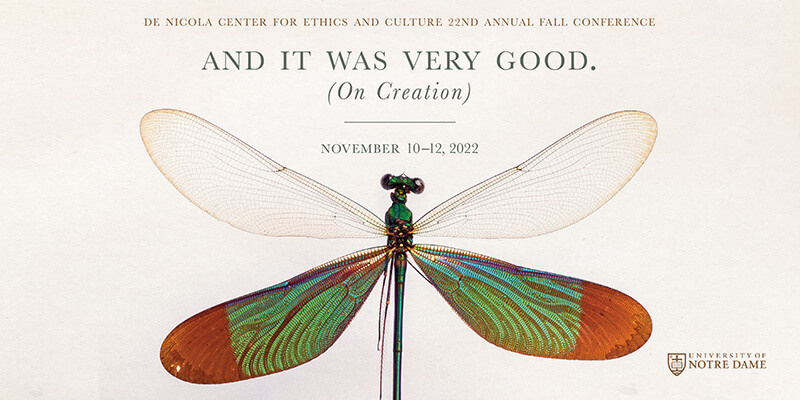
Last week, the University of Notre Dame’s de Nicola Center held a three-day conference on creation, brought together more than a hundred leading thinkers to discuss ethics, culture, and public policy from the points of view of a range of disciplines: theology, philosophy, political theory, law, history, economics, and the social sciences, as well as the natural sciences, literature, and the arts.

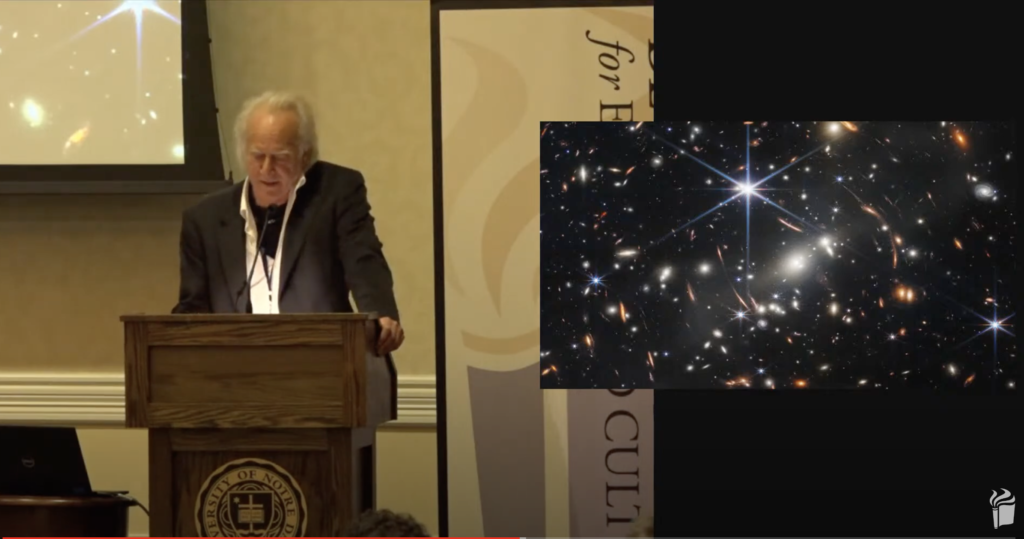
The keynote address that launched the conference was Stanford’s Robert Pogue Harrison, of Entitled Opinions fame, and his talk was entitled, “The Thin Blue Line.” About a thousand people attended in-house, with hundreds more virtually – a big turnout by just about any standards. Artur Rosman, editor of Notre Dame’s online Church-Life Journal (we’ve written about that effort here and here) was glowing about the Stanford professor’s talk afterwards: “‘The Thin Blue Line,’ on what he calls sacramental geocentrism, was perhaps the single best, and most deliciously surprising, conference talk I’ve ever heard. I mean, the whole thing rocks. The whole notion of a sacramental geocentrism blew everyone’s minds. It’s a great provocation.” You’ll hear all about “sacramental geocentrism” during the last ten minutes of the Youtube video here.

For this year’s conference, the De Nicola Center partnered with Stanford University’s “Boundaries of Humanity” project, which seeks to advance dialogue on “human place and purpose in the cosmos, particularly with respect to conceptions of human uniqueness and choices around biotechnological enhancement.”

A surprising guy.

But back to the talk. Here’s how Robert Harrison began:

“One month after NASA’s Lunar Orbiter 1 took the first photos of Earth from the moon’s orbit on August 23, 1966, Martin Heidegger sat down with two journalists from the German magazine Der Spiegel to answer some pointed questions about his thought and his involvement with the Nazi regime in the 1930s.  Late in the interview, which was published after his death in 1976, Heidegger decried modern technology’s deracinating effects on humanity, claiming that technology is not a tool and that humankind ‘has not yet found a way to respond to the essence of technicity.’  That essence, as Heidegger understood it, consists in an unmastered will to master nature by rendering all things orderable, fungible, and reproducible through objectification and manipulation.  Somewhat perplexed, the interviewers declared: ‘But someone might object very naively: what must be mastered? Everything is functioning.  More and more electric power companies are being built.  Production is up.  In highly technologized parts of the earth, people are well cared for.  We are living in a state of prosperity.  What really is lacking to us?’ A perfectly reasonable query, to which Heidegger responded as follows:

Everything is functioning.  That is precisely what is uncanny, that everything functions, that the functioning propels everything more and more toward further functioning, and that technicity increasingly dislodges man and uproots him from the earth.  I don’t know if you were shocked, but [certainly] I was shocked when a short time ago I saw the pictures of the earth taken from the moon.  We do not need atomic bombs at all [to uproot us]—the uprooting of man is already here.  All our relationships have become merely technical ones.  It is no longer upon an earth that man lives today. (Heidegger: The Man and the Thinker, 1981).

“Whereas the popular imagination at the time saw in those photos a wondrous revelation of our mother planet and cosmic home, Heidegger saw in them stark evidence of modern technology’s deterrestrialization of the human species – its increasing alienation from, and loss of essential relations with, the earth.”

You can watch the whole talk on Youtube, here.

Robert Harrison at the podium, on technology and the future of Mother Earth.