
From Kraków – a great queen, a green queen, and 2 heavy books

Share

The hotseat

The big day:  I spoke at the Collegium Novum of Jagiellonian University yesterday at the Czesław Miłosz Centenary Festival.

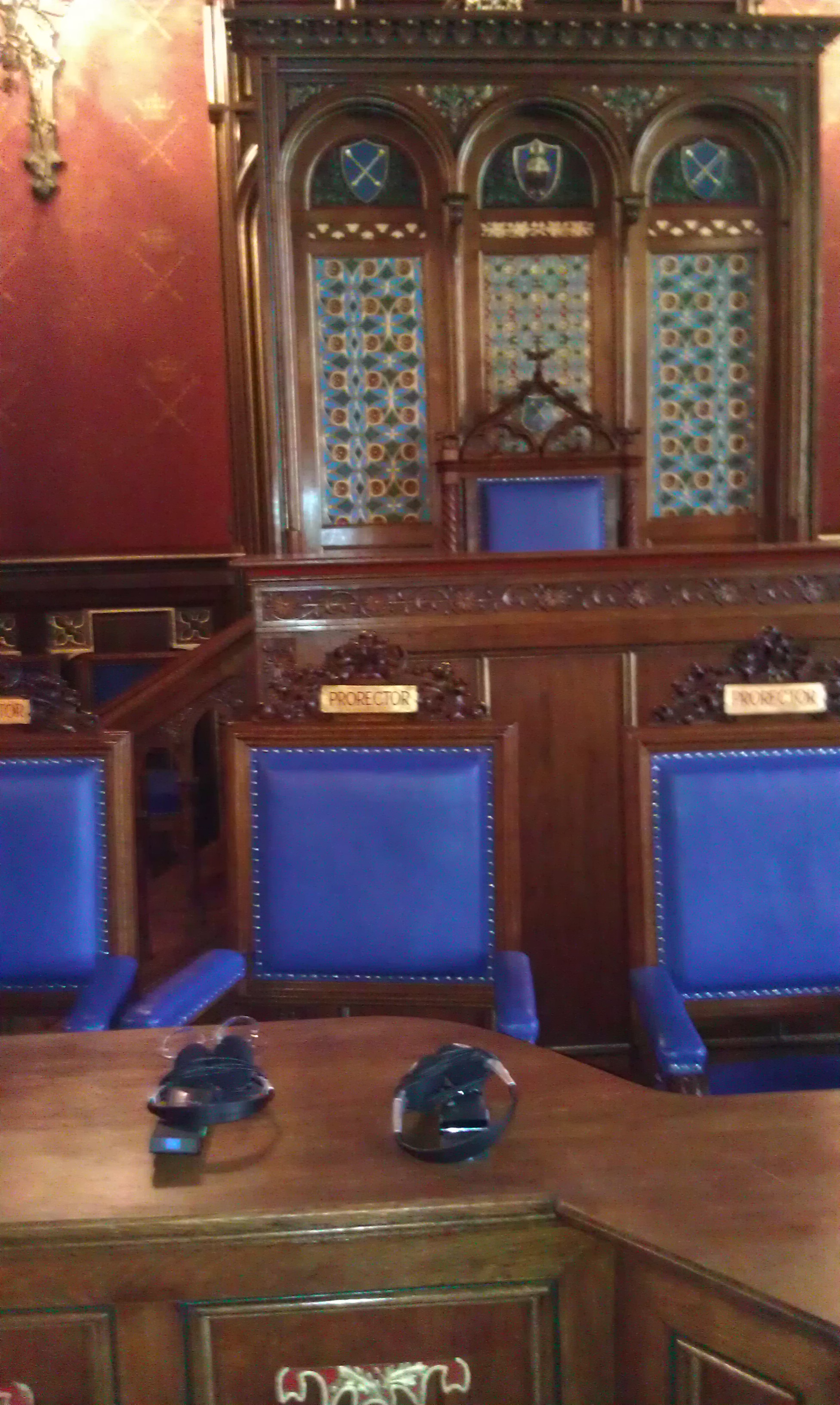
If you have to say anything at all, this is about the most intimidating setting that can be imagined to say it in.  Queen (and Saint) Jadwiga looked down on me from above, Pope John Paul II (an alum) gazed at me compassionately from a large portrait to my right, and farther down the hall, a young Copernicus (another alum) gazed up in astonishment at the night sky in a huge painting.  And then there was Humble Moi, in the prorector’s chair.

Nothing to do except take a deep breath, stand up, and imagine that everyone’s head is a cabbage.  Just me and Copernicus.

It’s humbling in other ways.  You roll your eyes at how boring some of the talks were – and then you get the opportunity to bore people yourself.  At least I kept mine beneath the requested 20 minutes.
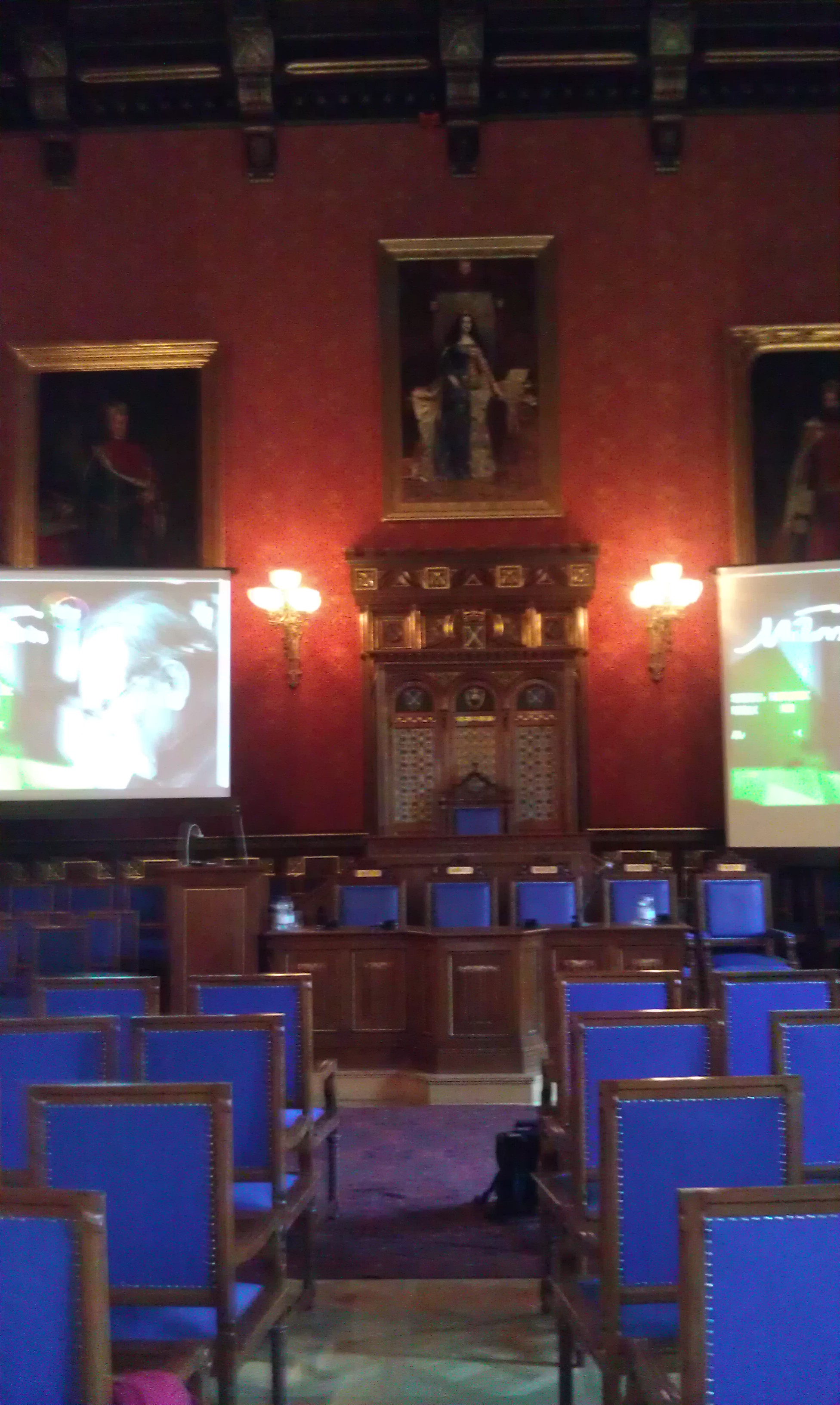
Queen Jadwiga...not amused

It was nevertheless an honor to speak here.  A picture of the intimidating prorector’s chair I occupied is at right – the very first Book Haven photo from my brand new Droid.

Two years ago I fell in love with the university, one of the oldest in Europe, and Kraków as well, after a moonlight introduction to the city after a glass of wine with Adam Zagajewski. The city is charming at night, alive with lights and people and cafes against the dark backdrop of the trees in the Planty.  That impromptu tour, which included the famous, shadowlit arches of the Collegium Maius, helped me persevere in what sometimes seemed like a daunting,  Rupelstiltskin-type research task during my Milena Jesenská Fellowship with the Institut für die Wissenschaften vom Menschen.

I told many stories from the podium at Jagiellonian, but one of my favorites is another kind of Rumpelstiltskin-type odyssey explained by Clare Cavanagh, Miłosz’s American biographer, as she describes her relationship with the curmudgeonly Miłosz:

Green Queen

“Sometimes the doubts ran deeper—his life, his poetry, his soul. And sometimes the doubts were about me: ‘You will produce not my life, but only some facsimile,’ he said with a scowl in the summer of 2003. He spent several weeks that summer putting me through the biographer’s equivalent of boot camp. … every day he gave the same response: ‘Takie oszywiste pytania,’ ‘(Such obvious questions).’ Then he’d would invite me for another session the next day, when yet another set of questions would be dismissed and after an excruciating hour or two, I’d would be sent home to think up some ‘questions no one’s asked me yet.’ …

Finally, after a sleepless night spent reading and rereading the then-untranslated Second Space, I went in and asked about the poems, and about religion. Those were the questions he wanted. And that was what I’d wanted to talk about, too, but I’d thought biographers were supposed to do something different. We talked about ‘Father Seweryn’ and ‘The Treatise on Theology’—I said I’d been surprised by the Virgin at the end, and he laughed and said, ‘I was, too.’
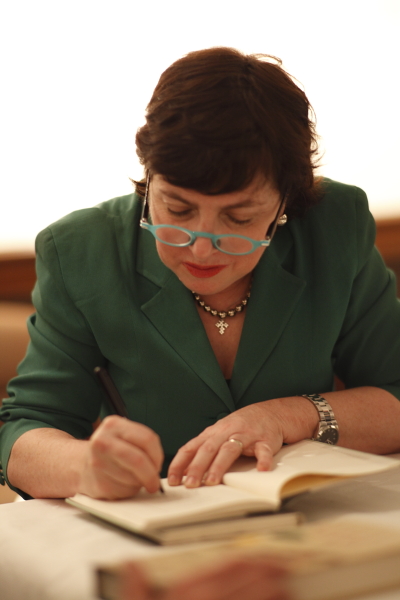
Clare, of course, is here in Kraków, too.  And still wearing her green jacket, her green glasses, and (I’ve learned in Kraków) she has a green backpack to match.  Daughter of Eire.

***
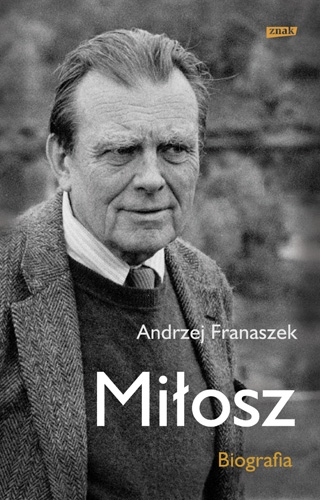
Today I got more swag.  After a seminar on translation with Agnieszka Kosińska, another of my contributors (the session was in Polish, but I went just for Agnieszka), we made a trek to the Book Institute off Kraków’s main square. The Book Institute is a wonderful organization in Kraków – funded by the Ministry of Culture, I think – that promotes Polish literature.

The books they gave me will tip the scales at the next airport.  Andrzej Franaszek‘s new 1,000-page biography of Miłosz, and a 1,400-page collected poems – both published by Znak. Clare told me that about a third of Miłosz’s poems have not been translated yet, to my best recollection of the size of the English-language Collected, that sounds about right.

During a visit with octogenarian poet and author Marek Skwarnicki (another contributor) way on the outskirts of Kraków this afternoon, he said the biography is a bit of a wonder in Kraków.  Andrew has spent 10 years working on the book, and is now only about 40.  Such a thick book from such a young man is not commonplace in Poland, Marek said.

Now.  All I have to be able to do is get on the airplane with all this.

Oh, oh, oh … I haven’t told you about the Miłosz pavilion yet.  And the reading with Adonis and Ryszard Krynicki and Ed Hirsch and Jane Hirshfield tonight. There’s more to come.
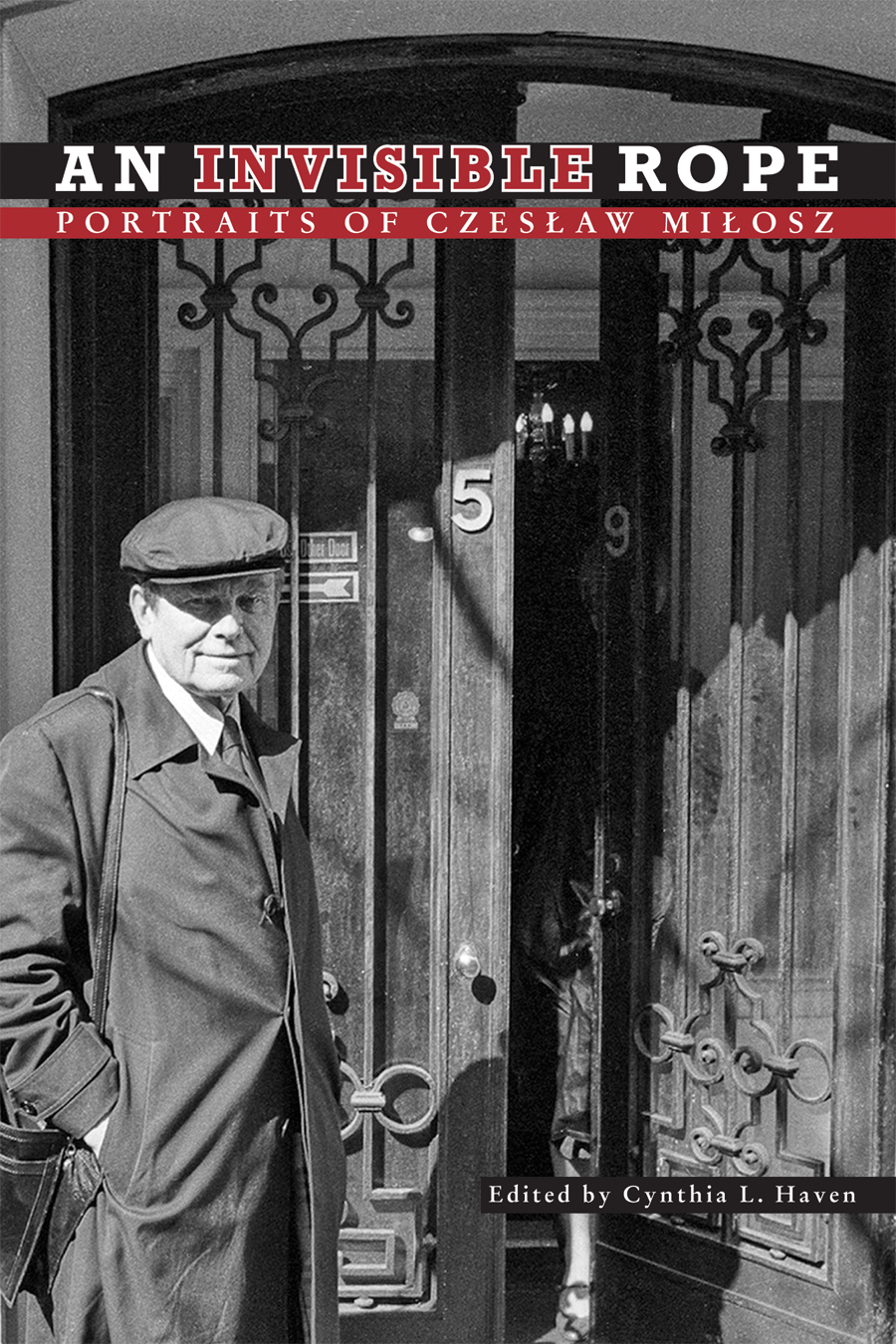
Youtube immortality — Adam Zagajewski, Anna Frajlich, and me in Brooklyn

Share

Everyone asks about the Brooklyn Central Library launch for An Invisible Rope: Portraits of Czesław Miłosz. How did it go?

You can see for yourself here and here — or click on the links below to hear poets Anna Frajlich (at top) and Adam Zagajewski (at bottom) share their memories of Miłosz for a few minutes. (By the by, the woman to Adam’s left is art historian Elisabeth Kridl Valkenier, who knew  Miłosz in the 1930s. And the man to Elisabeth’s left is photographer Zygmunt Malinowski, who kindly provided photos, including the cover art, for An Invisible Rope.

Thanks to Grzegorz Worwa for providing the clips.

“Heaven is the third vodka” — Czesław Miłosz

Share

One...

So far the events celebrating the Czesław Miłosz centenary have been marked by a special warmth and conviviality, almost like a family reunion – but nowhere was that impression more pronounced than at last Wednesday’s event at Wheeler Hall at the University of California, Berkeley.  No surprise.  Berkeley was the poet’s home for four decades.

Thanks to the notorious Berkeley parking — a university parking lot meter that would not take cards, not take bills, and, once I got about three dozen quarters, wouldn’t take those either (nor return them) – I arrived about 45 minutes late.

Adam Zagajewski was saying “Has he grasped the totality? … Well, yes.”

“It’s in ruins, because totality is in ruins, but it’s still a totality.”  I wasn’t quite sure what the “it” was – the world?  the Nobel laureate’s oeuvre? — nor did I get more than the gist of what he was trying to say, having missed the context, but it was vintage Zagajewski, so I pass it on.

“The world does not belong to any single poet,” said Adam.

Two...

Robert Hass was the emcee for the event, and commented on Miłosz’s stunning memory, and also on the unusual and sometimes dark connections it made.  A singing of “happy birthday” would remind Miłosz of the crematoria at Auschwitz, and crematoria might remind him of strawberry jam.

Berkeley is also the home of the poet’s son, Anthony (or Antoni) Milosz.  I met him once before, several years ago at the San Francisco memorial organized by poet Jane Hirshfield, but the resemblance to his father did not strike me nearly so forcefully then.  On Wednesday evening, it gobsmacked me.

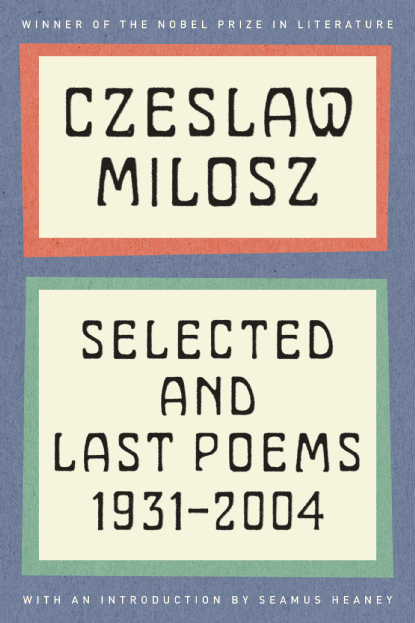
Toni has translated his father’s last poems (Wiersze ostatnie was published by Znak in 2006), to be published with the paperback selected this fall as Selected and Last Poems.

The younger Miłosz said that he was aiming at “sound translation,” and felt too often translations of his father’s poems “intellectual content dominates.”

He noted the rhythm of his father’s work, and that, among musical instruments, Miłosz favored the bass and drum – “though he claimed to like the harpsichord and more refined instruments.”

“My father’s poetry is immensely direct,” he said, adding that directness pits it against current trends.

He read his father’s late poem “In Honor of Father Baka,” which he described as “funky, short-lined” poems in the baroque manner.  It’s wry and mysterious – and I am looking forward to the November 15 publication.

Peter Dale Scott reiterated the claim that Czesław Miłosz was “perhaps the greatest poet of our time,” and called him  “a poet of radical hope” in a way “not seen since Schiller and Mickiewicz.” Miłosz saw poetry as “a home for incorrigible hope” — another feature of his work that was “in marked contrast to the times.”

Peter ranked Miłosz with poets from Dante to Blake, the poets who were “enlarging human consciousness.”  He discussed Miłosz’s poem, “Dante,” which concludes:

“The inborn and the perpetual desire
Del deiformo regno — for a God-like domain,
A realm or a kingdom. There is my home.
I cannot help it. I pray for light,
For the inside of the eternal pearl, L’eterna margarita.”

Miłosz, said Peter, was “obsessed with the need to reach the ‘second space’ – the world of paradise and perfection beyond this world we inhabit.”

Peter called Miłosz a “leading visionary of his time, looking into the open space ahead.”

Jane Hirshfield noted that for Miłosz, “everything was I and Thou, everything was personal.”

Most of the evenings speakers at the front of the room arrived via literature, said journalist Mark Danner. “I come here through real estate.”  (That’s not quite true; he was Miłosz’s friend for several years before he bought the poet’s house on Grizzly Peak.)

He described the roughstone chimney and the roughstone path of the house that has been compared to a cottage from a Grimm Brothers’ fairy tale.  He also remembered “Czesław’s deer.”  “The deer populate the place,” even though Miłosz would chase them away from the garden they viewed as a salad bar.

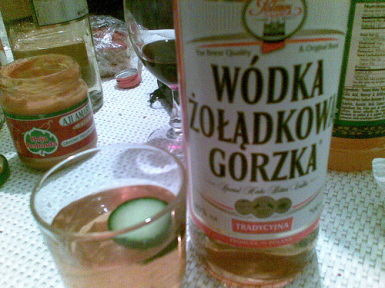
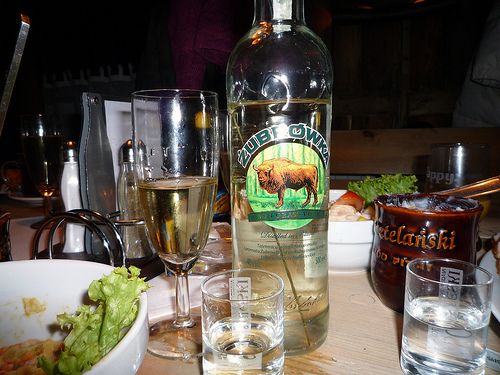
Bingo! (But it's not Żubrówka...but would you notice by the third round?)

One morning he recalled seeing more deer on the lawn than he had ever seen before – over a dozen, as he recalled.  Bob Hass’s voice was on his answerphone – “Mark, I don’t want to leave a message on a machine…” Miłosz had died in Krakow.

Mark thumbed through a book Miłosz had inscribed to him, and was startled to read the reference he had apparently forgotten, the inscription “in the name of all generations of deer.”

Bob Hass’s wife, the poet Brenda Hillman, recalled the Monday translation sessions Bob shared with Miłosz — sometimes spending the session working on a single line.  Bob recalled Miłosz appearing on their doorstep, with the command, “Vodka, Brenda!”  A bottle was always in the freezer, waiting. I hope it was Żubrówka.

Brenda was, for a time, interested in the knotty issues the Gnostics raised, and asking Miłosz, “What is heaven?  What is it like?”  To which the poet replied:

“Brenda, heaven is the third vodka.”

“Like being alive twice”: Hass, Zagajewski, Cavanagh, and Hirsh on Czesław Miłosz — this time in Queens

Share

The crowds are unending

I’ve been to New York City four or five times in my life – but I’ve never been to Queens.  Somehow I didn’t expect the constant river of people to continue beyond the borders of Manhattan, but it did.  Getting on a Queens bus, I saw the line behind me grow steadily longer and longer, increasing rather than diminishing as people climbed onboard.  Finally, until the weary bus driver closed the doors on protesting people, still trying to get on.  That’s usual, he told me.  The line doesn’t end.

So that’s one reason why I was 45 minutes late to the discussion about Czesław Miłosz at Queens College on Tuesday night. Two days ago, I posted about same cast of charactersRobert Hass , Adam Zagajewski, Clare Cavanagh — let me do so again, with the addition of poet Ed Hirsch, MacArthur “genius” fellow, president of the John Simon Guggenheim Memorial Foundation.

Here are a few notes from the discussion (and apologies for not having time to polish these nuggets):

This time at Queens College

Adam Zagajewski discussed the Miłosz’s polyphony and his  “incredible ambition to grasp the world.”  The enormous range of points of view and voices within his work is disconcerting to many readers, who expect “one voice that’s recognizable in every poem,” the unity you find in such poets as Georg Trakl, for example.

Robert Hass recalled Miłosz writing at night, and thinking he had at last captured reality with his words – only to wake up the next morning, reread what he had written, and see he had been “beaten back into the pen of literature.” “He was tormented by the way our experience is lost to us,” said Bob.  “He found time itself unbearable.”

In praise of polyphony

Ed Hirsch commented on the “tremendous internal argument in his work” – in which he would often “criticize the poet who wrote the last poem.” Miłosz’s polyphony is one reason “so many readers and critics latched onto the idea of witness” in his poems.  His reputation as “poet of witness” to two totalitarian regimes has obscured his reputation as a metaphysical poet and a poet of … well, a poet of wonder, really.

The discussion turned to Miłosz’s unfortunate early reputation in the U.S. as a political theorist, thanks to Captive Mind. It’s a book not as well thumbed today as it was a few decades earlier, but Clare Cavanagh pointed out its unusual legacy – for example, in giving us the term ketman, which Miłosz claimed to have rescued from Persia.  Clare, however, searched assiduously on the internet for its supposed Islamic origins and could only find references to Miłosz’s work.  (I have a different memory of finding a few of the references she was seeking – but I’ll have to check again.  The references may be lost in the cyperspace flotsam and jetsam – as endless as the bus lines of Queens.)

Ed called Captive Mind “a remarkable work of historical consciousness.”

“For us, it’s crucial because he anatomizes how people fell into it,”  he said. However, its relevance  for younger readers may not be evident — “one of the problems is that you have to understand what communism is.”  One of history’s terrible lessons that may be lost on a younger generation.

"Like being alive twice"

Bob hailed Captive Mind as “an enormously vivid and readable book … powerful and still relevant.” Young people today caught instead in the “foment of small imperialisms” – but so were the Persians who originated the term ketman, I would argue, and a small tyranny can be as oppressive and barbarous as a large one.

The four writers recalled the arc of his career.

The decades in America prior to the 1980 Nobel were years of excruciating loneliness. Adam recalled that when he turned sixty, Miłosz didn’t receive a single card or greeting.  Bob was told by two people that he used to write letters to himself, so that he would get mail.

Yet, said Bob, when he joined the Berkeley faculty, Miłosz immediately used his funds to hire a secretary and dictated The History of Polish Literature — a work that began to put Polish poetry on the map of American consciousness.

A rebuke instead of blessing

Adam recalled, in his youth, being one of a group of young poets who wrote to the maestro for a blessing.  Instead, they got a rebuke.  He told them they were behaving like “flies in a battle” and urged them towards distance and restraint. “He became a metaphysical poet, but I think he was a little jealous of those lesser poets who touched their own city.”  In other words, he envied those poets whose daily reality included the places where they grew up, who did not partially live in demolished worlds.

During the question period from the large crowd, Ed was asked what poem of Miłosz’s did he wish he himself had written.  “That’s a puzzle,” Ed hedged, then came up with two: “Bypassing Rue Descartes” and “Guilt.”

Bob Hass was asked what it was like spending so many years translating Miłosz.  He responded in an instant: “Like being alive twice.”

Next installment from NYC:  Ed Hirsch, Alyssa Valles, and Adam Zagajewski honor Zbigniew Herbert at Poets House.

“Too big to be swallowed”: Robert Hass, Adam Zagajewski, Clare Cavanagh remember Czesław Miłosz

Share

Clare signs books after the event (Photo: David A. Goldfarb)

The apocalyptic scene enveloping Japan brings to mind Czesław Miłosz‘s poem, “A Song on the End of the World,” written in Warsaw, 1944, during another kind of apocalypse.  The poem ends with a white-haired old man binding his tomatoes, who would be a prophet but is “too busy to be a prophet,” repeating:

No other end of the world will there be.

Sound wrong?  According to translator Clare Cavanagh, speaking at the 92nd Street Y on Monday night, it’s a new kind of right.  The line is usually translated “There will be no other end of the world.”  But the original Polish has an inversion that doesn’t always work well in English.  Antoni Miłosz has translated the poem, keeping the original inversion.  I kinda like it — the poem ends with a dactylic chant.

Clare was one of three heavy-hitters speaking about Miłosz that night and reading his poems – Robert Hass and Adam Zagajewski were the others.

Clare pointed out that, although Miłosz celebrates the rural Lithuania childhood, it is at least part an invented one.  In fact, his father was a civil engineer working in Russia, and the six-year-old experienced the Russian Revolution firsthand and traveled widely.  Movement was as much a characteristic of his upbringing as the stability he mythologized.

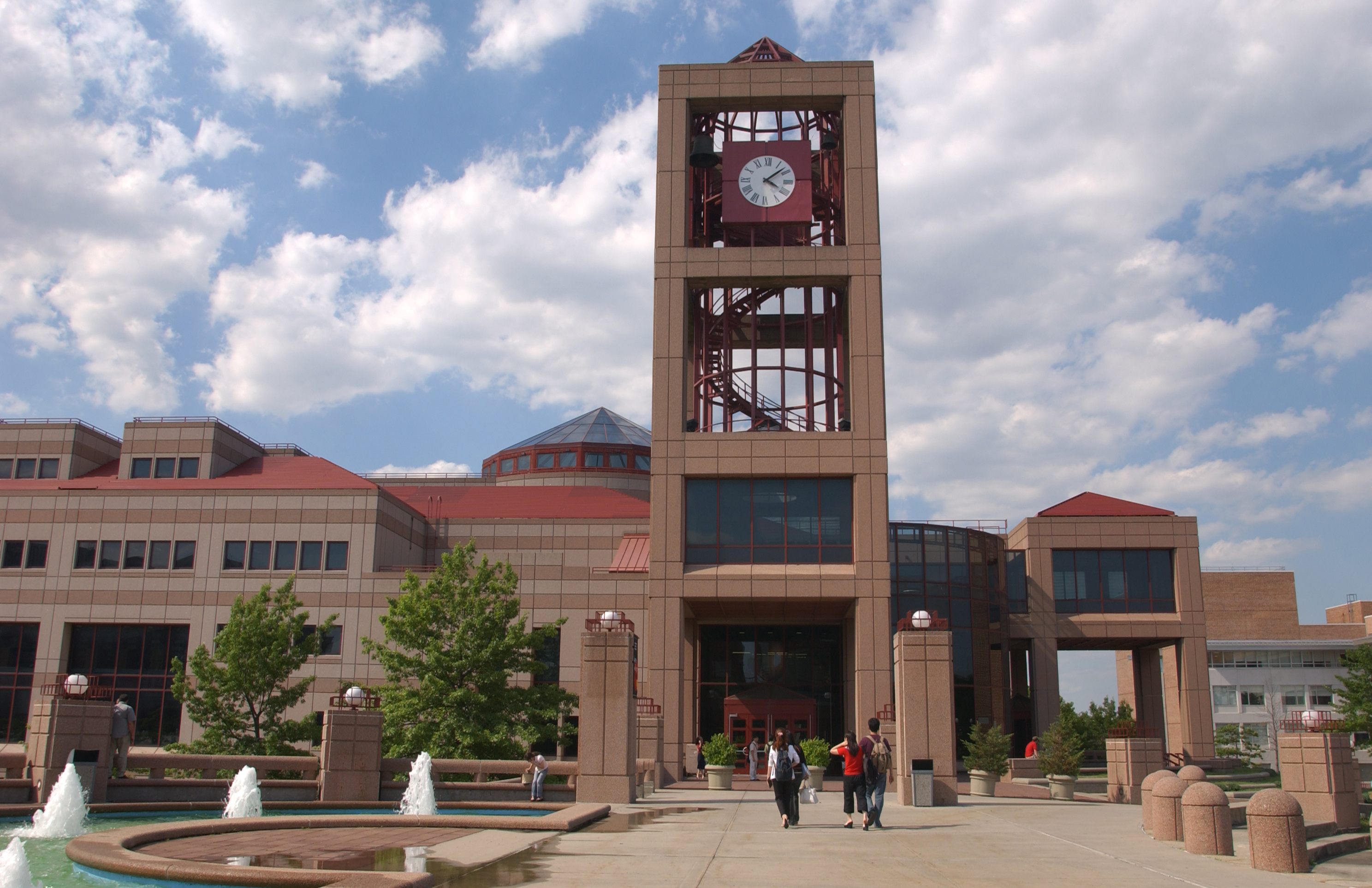
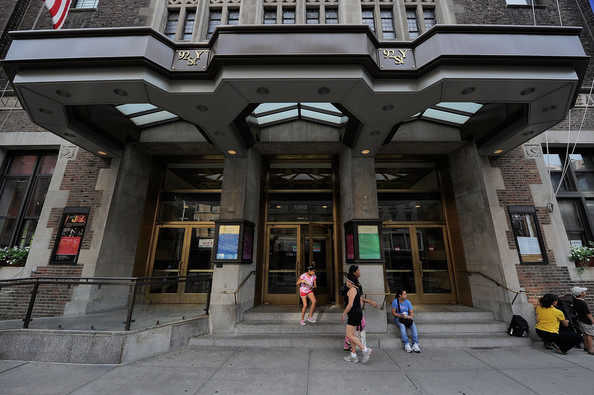
The venue: 92nd Street Y

She recalled the long theological discussions that I mentioned in my post several days ago.  She wouldn’t describe them in the essay she wrote for An Invisible Rope – and she wouldn’t describe them Monday night either.  I hope her silence on this subject is not permanent. “I’m not going to repeat what he said,” she finished, “but I keep wondering what he knows now.”

Bob Hass, wearing a heavy bandage on his nose, told the audience he hadn’t been in a fight, but advised his listeners to wear sunscreen.  He recalled a poet “tormented by how inexpressible experience was.”

"Please wear sunscreen"

Bob quoted Milosz, “War is only nature speeded up.”

The Berkeley prof recalled approaching Miłosz to discuss an anti-nuclear movement on campus, only to be told,  “I am against anti-nukes.”

“Blue hair?  Why does no one protest blue hair?” the elder poet responded. Beautiful young women become old ones with blue hair (note to young ‘uns: blue-tinted rinse was a common for elderly women in the 20th century).  “Who protests?”

“The true enemy of man is generalization,” Hass recalled Milosz saying.  His response to generalization was memory, said Clare. Miłosz’s memory was “beyond human – except that it’s most perfectly human, the way memory ought to be – how it should be in heaven.”

Hass recalled traveling in rural California, and on a whim going into an old secondhand shop – or rather, he said, it was as if he were drawn to it.  He found a thick book, in Polish, on the history of women’s underwear.  He plopped the $40 for the book and gave it to Milosz.

“I do not know that I have ever seen him so happy,” he said.  Suddenly, he could identify the underclothes he had seen on his aunt’s clothesline during his childhood.

"to glorify things as they are"

Adam Zagajewski spoke last – the perils of having a name that begins with “Z,” he said.

He noted Miłosz’s many contradictions.  He was drawn to the notion of “secret knowledge,” Adam said. “He craved initiation and looked for gurus” — for example, Miłosz’s influential kinsman Oskar Milosz and the man called “Tiger” in Native Realm. At the same time, he had “a longing for ignorance and innocence,” said Adam – which accounts for his attraction to William Blake, in part.

Ivan Turgenev said that poets are either rivers, absorbing everything in their current, or mountains, overlooking the world from an elevated plane of existence.  According to Adam, Miłosz decided he wanted to be “like a river and a mountain.”  The result?  A poet “too big to be swallowed,” he said.

Though Miłosz “loathed propaganda poetry,” Adam said he walked “the narrow road between pure poetry and poetry engagée, which he thought a mistake.”

In his restless questioning of existence, Miłosz took on God — “God being the strongest enemy that was,” said Adam, and objected to Blaise Pascal’s wager, which Adam said, “was like a shopkeeper saying it’s better to save some money because times can be hard.”

Adam concluded, “This is his religious vocation – to glorify things as they are.” And in this mission he was truly omnivorous. His poetic hubris – wanting to understand everything, wanting to experience everything – has caused his eclipse in current Poland.  Will his reputation wax again?

“I don’t worry.  I am totally convinced he will return.  He will have the last word.  Not I.” (Adam’s “Z” notwithstanding.)

Meet you in Manhattan!

Share

I’m off!  Or at least I will be in a few hours.

I’m on my way to a week of gigs honoring the Czesław Miłosz centenary in New York City — with a side order for Zbigniew Herbert.  I posted about them a while back here.

Come up and say hello if you see me — otherwise, prepare for a few logistical delays, but I expect to be posting about Clare Cavanagh, Robert Hass, Edward Hirsch, Adam Zagajewski, Anna Frajlich, Bogdana Carpenter, James Marcus, and many others in the coming days.

See you there!