
Robinson Jeffers gets his due.

Share

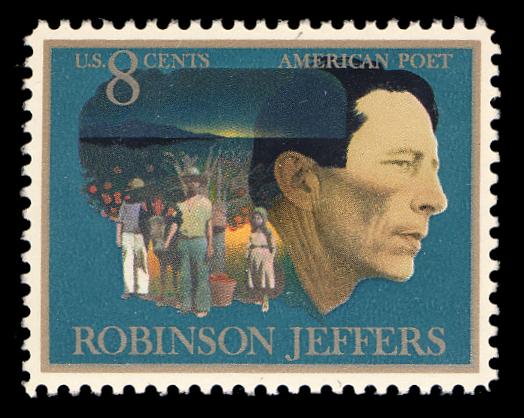
My friend and sometime-editor Terry Hummer triumphantly posted on Facebook that he had managed to buy four Robinson Jeffers stamps on ebay, after the first sale was cancelled because the seller was “out of stock.”

Perhaps it’s a good sign that there’s a demand for Jeffers – even if only in stamp form. Few American poets have undergone quite so much disparagement and neglect (I wrote about that here).  Like Walt Whitman, however, Jeffers always had his fans.  As I wrote a few years ago:

“Unlike most contemporary American poetry, his legacy has been kept alive by individuals who love his work, not by academia’s class-assignment sales. Such luminaries as Stanford’s late Yvor Winters, who in 1947 declared Jeffers’s work ‘unmastered and self-inflicted hysteria,’ effectively banned him from the curriculum.”

Thoughts of Jeffers and the U.S. postal service turned me weighty tome that arrived in my mailbox a few days ago – the 1,100 page second volume of Jeffers’ letters (covering 1931 to 1939), and newly published by Stanford University Press.

I wrote about the earlier volume of letters here, which included the years of his courtship and marriage to Una Kuster.

“I’ll say he’s the most important poet of the 20th century, but nobody’s buying that yet,” said James Karman, editor of the projected 3-volume series. “No one in the 20th century came near to what he was trying to do. The sheer scope of his endeavor is unrivaled. There’s nothing like it in American literature in the 20th century.”

According to Tim Hunt, editor of Stanford University Press’ five-volume Collected Poetry, Jeffers is “the least understood of the major American poets from the first half of the 20th century.”

The volumes include a substantial number of letters from Una Jeffers, as well as her husband. You can get a good feel for both the Jeffers in even their most casual notes.  Here’s her Christmas thank-you to Bennett Cerf in January 1938:

Now thanks very much for the two Christmas {books} I’ve just finished the Iceland book [that is, W.H. Auden and Louis MacNeice‘s Letters from Iceland] tonight & O but its clever! & its packed full of information too   I never expected to like Auden as well as I do this very moment!  As for the New Yorker – I must confess I stand alone almost in not being its enthusiastic reader. It is funny – but so all alike & always taking people down is so easy & in the end so humiliating to every human. & bathtubs & fat ladies bulging out of their lacey lingerie, & over-fed dogs & betrayed & betraying businessmen husbands are tiring to keep one’s mind on.

But I suspect that I make myself disliked by carping at the New Yorker.

Here’s his 1933 letter to a Mr. Pumphrey from the Jeffers’ legendary home, Tor House in Carmel (definitely worth a visit if you haven’t been there):

Thank you sincerely for your letter; but I have not time to copy the verses. You lose nothing by that, for my handwriting – you see – is neither beautiful nor easy to read.

And I am sorry not to be able to answer your question. One can say that Mount Everest is higher than Mont Blanc, but there is no way to measure poetry. I cannot even tell whom I prefer to read – sometimes Yeats, sometimes some other.

The publisher’s website promises “a full account of the 1938 crisis at Mabel Dodge Luhan‘s home in Taos, New Mexico that nearly destroyed their marriage.”  A crisis that has not disturbed my sleep to date.  Can’t wait.

Postscript:  I  had thought the Jeffers stamp was a new issue.  Silly me.  Terry corrected me quickly.  It came out in the 1970s.  The new ones for 2012 are described here.

Postscript on 12/9:  I got a note from David Rothman, president of the Robinson Jeffers Association: “I don’t know if you’ve seen our website, at www.robinsonjeffersassociation.org – it’s quite thorough and you might enjoy it. Also, I wrote a review of the first volume of the Letters that you can see here, if you’re curious: http://muse.jhu.edu/journals/sewanee_review/summary/v119/119.1.rothman.html.”

By the by, if you live in the area and haven’t been to see Jeffers’s Tor House in Carmel … well, you must.  You really must.  The poet learned stonecutting so he could build it himself.  It is a peculiar kind of Pacific perfection.
 

W.H. Auden’s prose, and why art matters

Share

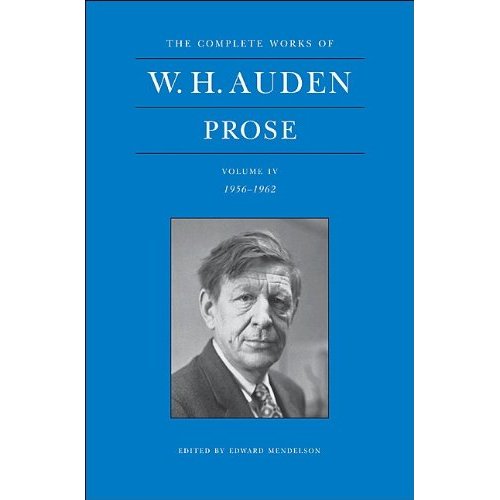
If you haven’t already read it, I recommend Michael Wood‘s “I Really Mean Like” in one of last summer’s issues of the London Review of Books. He discusses The Complete Works of W.H. Auden: Prose Vol. IV, 1956-62, edited by Edward Mendelson.

From Wood’s review:

Marianne Moore says of poetry that she too dislikes it; Eliot tells us that it doesn’t matter; Auden says it makes nothing happen. In fact, none of these propositions represents anything like the whole story for any of these poets, but there’s an element of affectation here all the same, an unseemly wooing of the philistine. Neither Mallarmé nor Valéry ever expressed any interest in a muse who didn’t bother to read poetry – they knew that the world was already full of people saying that it didn’t matter, and saw no reason to join the chorus, even out of strategy.

I wonder if it’s the difference between the French and the English – it’s so easy to sound hysterical in English. In French and Italian,  it doesn’t seem to matter.  Perhaps they are hysterical all the time, so it doesn’t count.

I like this:

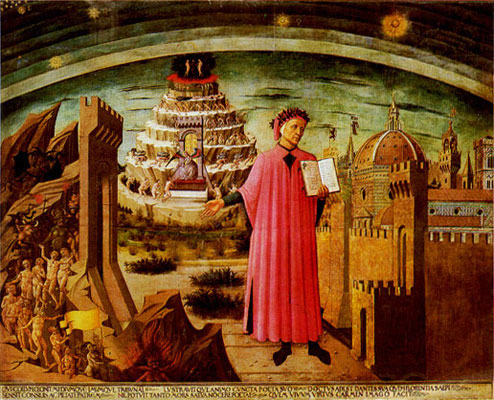
… when Auden wants to evoke ‘a parable of agape’, or ‘Holy Love’, he talks about Bertie Wooster’s relation to Jeeves. Bertie in his blithering is a comic model of humility, and his reward is Jeeves’s immaculate and unfailing allegiance. There is also an appealing moment when Auden, suggesting that popular art is dead and that ‘the only art today is “highbrow”,’ suddenly remembers he has to make an exception: ‘aside from a few comedians’. He says he learned long ago that ‘poetry does not have to be great or even serious to be good, and that one does not have to be ashamed of moods in which one feels no desire whatsoever to read The Divine Comedy.’

Forget it.

Note to self:  Go back to The Dyer’s Hand, although Auden makes one weep with envy, not least of all for his aphorisms, like this one:

We enjoy caricatures of our friends because we do not want to think of their changing, above all, of their dying; we enjoy caricatures of our enemies because we do not want to consider the possibility of their having a change of heart so that we would have to forgive them.

Or these: “he says that ‘every good poem is very nearly a Utopia,’ and ‘every beautiful poem presents an analogy to the forgiveness of sins.’ And again, shifting to music but not exactly leaving the other arts behind: ‘Every high C accurately struck demolishes the theory that we are the irresponsible puppets of fate or chance.’”

Can poetry matter?  Wood answers:  “Art can’t redeem the world, and that is why we must be modest about it. But it can show us what redemption would look like, and this is why it matters.”

Can poetry save the world? Zagajewski, Auden: the poets of 9/11

Share

"Try to Praise the Mutilated World"

Matthew Kaminski of The Daily Beast says that Adam Zagajewski was “The Poet of September 11,” thanks to his poem “Try to Praise the Mutilated World.”

Well, not quite so.  That honor belongs to W.H. Auden, with his “September 1, 1939.”  Let’s say that Adam was the greatest living embodiment of that atrocity:

“Try to Praise the Mutilated World” recalls a trip Zagajewski took with his father through Ukrainian villages in Poland forcibly abandoned in the population transfers of the post-Yalta years. “This was one of the strongest impressions I ever had,” he says. “There were these empty villages with some apple trees going wild. And I saw the villages became prey to nettles; nettles were everywhere. There were these broken houses. It became in my memory this mutilated world, these villages, and at the same time they were beautiful. It was in the summer, beautiful weather. It’s something that I reacted to, this contest between beauty and disaster.”

"We must love one another or die"

I have to agree with Adam – and I guess it’s sacriligeous to say it this week – that 9/11 didn’t change my fundamental worldview, which always included a mysterious allowance for evil in human goings-on. He thinks, however, it has changed our collective response to trauma. In “the past in general and not only in Europe,” he says, “the rule was to forget, to move on. There’s a relatively new idea that you have to work on it—that you have to keep everything in our memory. Which I like. It’s changing us. I don’t think people in the mid–19th century were going back to the Napoleonic wars and thinking, ‘We have to work on it’?”

Goodness, I wish that were the case.  The way I see it, memory has all but evaporated.  I was speaking to jazz artist Jim Cullum recently, and he was telling me about classes he taught, filled with bright students – but when he wrote “December 7, 1941” on the board, they had no associations with that date.

Kaminski says Adam “often purrs his words and speaks slowly” – well, not quite.  In America, we call it a kind of Polish drawl. I  recall someone hesitating to invite Adam as a speaker on a panel because, well … you really never knew how long a sentence from Adam would take.

I like this paragraph from Kaminski’s piece the best:

Polish poets have long thought of themselves as national bards, called to engage with the harsh world around them. “Polish poetry is one of the marvels of 20th-century literature,” wrote former U.S. poet laureate Charles Simic, who cited its “one rare virtue: it is very readable in a time when modernist experiments made a lot of poetry written elsewhere difficult.” Zagajewski says some critics see “something barbarian” in Polish poetry’s emphasis on meaning over syntax or style. “I’ve heard some French poets say Polish poetry is just journalism, because you can understand it.”


From the March event at NYC’s 92nd Street Y, which I wrote about here:

As 9/11 anniversary approaches, litcrit’s Marjorie Perloff speaks out on American insularity

Share

No comfort in Whole Foods Market

I’ve had a chance to finally go through Marjorie Perloff‘s “Language,” which has been open on my MacBook Pro forever…well, at least since August 7, when it was published in the Chronicle of Higher Education.  Perloff, one of the preeminent lit critics and a champion of the Language Poets and other avant-garde movements, takes on the changes in the nation since the events of 9/11.

In her essay, she argues that an event that should have made us more attuned to the outside world haa, paradoxically, made us more inward instead:

A new worldview

“The very language of the decade expresses our anxiety about the outside world. Talk of the ‘third world’ and ’emergent nations,’ expressing as it does a first-world confidence and sense of control, has given way to the ubiquitous ‘our planet,’ as in, ‘saving our planet.’ …”

“When most Americans talk of saving our planet, they have a myopic view: They mean the environment they witness every day, with its SUV-clogged freeways, plastic-bottle glut, and absurd excesses of electricity and water consumption. In this context, a session at Whole Foods Market may feel comforting, but what about those places on the planet where there is not enough electricity to speak of excess or where there are no paper diapers to clog landfills? Better not to think about them, and to focus on such issues as childhood obesity (Michelle Obama‘s cause) or the relative effectiveness of the various sunscreens on the market.”

Time to look outward again

She concludes:

“Perhaps, now that a decade has gone by since 9/11, it is time for us once again to look outward. The increasingly tedious discourse of self-reflection—based on the assumption that we are the leaders of the ‘free world’—must give way to a more accurate sense of who and where we are in relation to the developing nations and cultures in our ‘global’ backyard. Language study—not just of ‘foreign’ languages but also of our own—will help us to deal with the reality that, as Wallace Stevens put it, ‘we are not / At the center of the diamond.'”

I don’t find her final argument terrifically convincing. “We are not the center of the world” has been the mantra of President Obama, but so far I don’t see Brazil or South Korea or even China stepping up to the plate of “world leader,” though their economies may be (comparatively) booming and their populations swelling.  Perhaps the role of “world leader”itself is one of the 21st century’s early retirees, and there are no cops on the beat anymore.

She quotes Stevens, but W.H. Auden makes a more foolproof bet:

"I told you so"

Time will say nothing but I told you so,
Time only knows the price we have to pay;
If I could tell you I would let you know.

Counterclockwise, in Polish: postcard from Kraków

Share

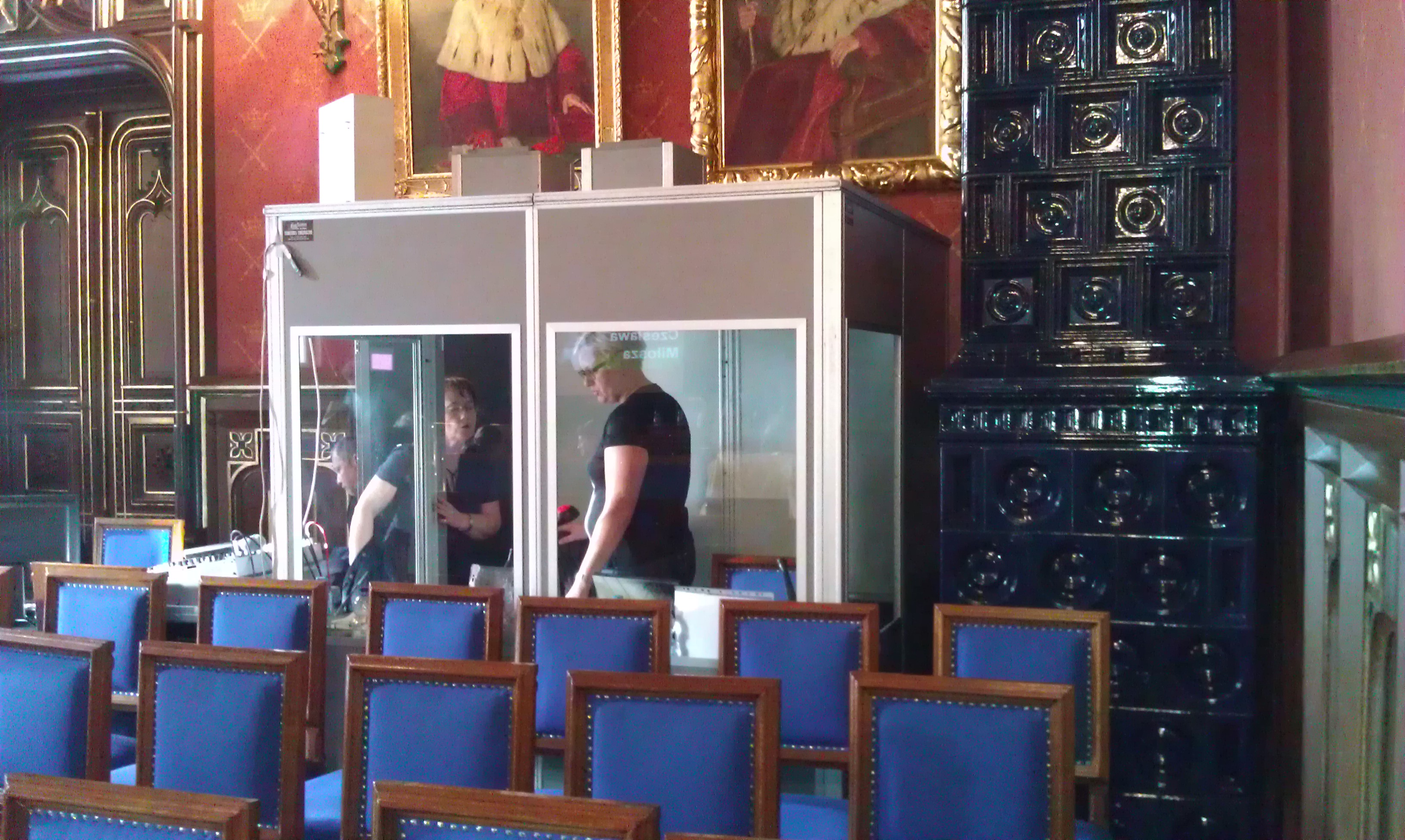
Lady in a glass box (Magda Skoć at right)

At the back of the Aula of the Collegium Maius of Jagiellonian University, there was a glass box with prisoners inside.

Those were the translators.  Pity them.  Each of the 75  sessions, 20 minutes each (some 30 minutes, actually, or 40), were translated simultaneously into either Polish or English.  All of the speakers were told to submit papers by April 27, but  I doubt many of us met the deadline – in any case, we were tinkering and revising till the last minute.  Moreover, there were lots of unscripted questions and discussion after each session.

Those who listened carefully during the week-long academic conferences during the Czesław Miłosz Centenary Festival … well, actually you didn’t have to listen that carefully … would have noticed  that the translators working with the Polish-to-English portions of the program were still talking as the applause for the speakers began to die down.

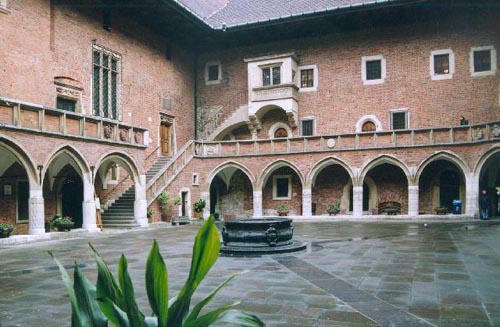
Jagiellonian's famous arches

There’s a reason, translator Piotr Krasnowolski told me.  English is a very compact language.  The Polish renditions are substantially longer.

I think that’s one reason W.H. Auden said: “I love Italian, it’s the most beautiful language to write in, but terribly hard for writers because you can’t tell when you have written nonsense. In English you know right away.”

Another way

Another way

Ever try translating French poetry?  When I tried my admittedly amateur hand, I usually wound up needing a handful of extra syllables to stuff out the line by the time I’d expressed the French thought.  Polish even more so.

Piotr said there’s lots of English turns of phrase that have no Polish equivalents.

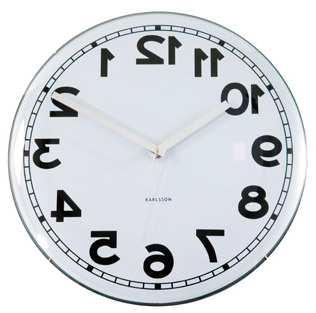
He cited a simple example he recalled from some translation for a software company.  Counter-clockwise.  Simple enough in English, but here’s the Polish version:

w kierunku przeciwnym do ruchu wskazówek zegara

Right again

At least, that what I can make out of the words Piotr scrawled on a napkin for me.  That’s the literal translation for:  “In the direction opposite to the movement of the hands of the clock,” he said. A mouthful.

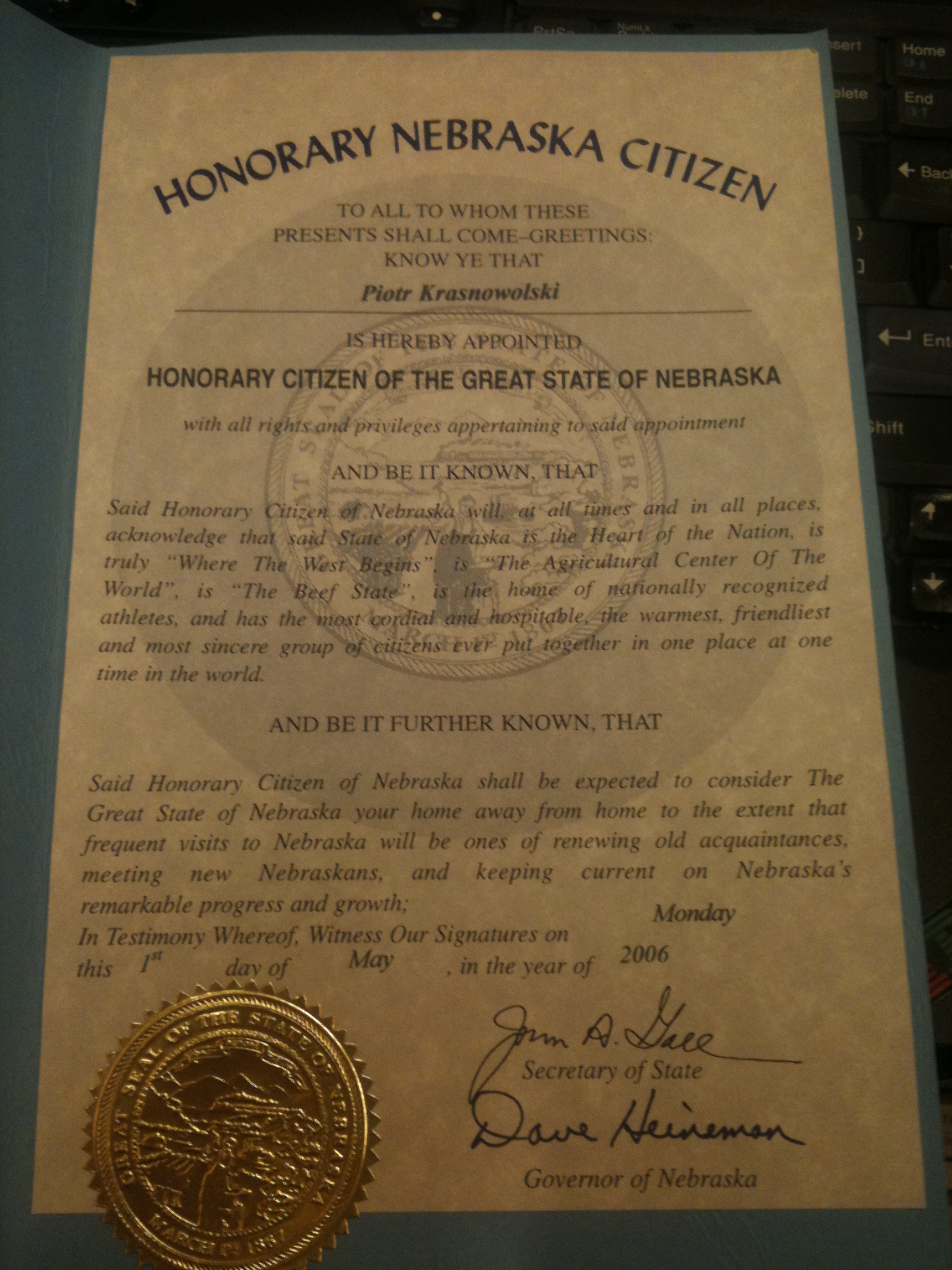
He solved the problem with an illustration instead (he also made a diagram on my napkin with a fountain pen): “That was my translation,” he said.  Piotr and his sidekick Magda Skoć were unflaggingly courteous, though their patience must have been sorely tried, throughout the week-long ordeal.  Magda’s impeccably accented upper-crust English was a joy to listen to, even when the papers were not.  And Piotr is, among other things, an honorary citizen of Nebraska. (Long story.)

Don’t drop the headset, Piotr warned me as I walked away, fumbling with my device – though they’re made for endurance, replacing them is 500 dollars a pop.  Or maybe it was złotys.  A lot of money, in any case.

Postscript on May 31:  After rummaging around in his storage, Piotr just sent me proof of his citizenship of Nebraska, for all those doubters out there.  See right.

So you can be a citizen of a state without being a citizen of the U.S.  Who knew?

“A new music” — Brad Leithauser on the late W.H. Auden

Share

A few days ago I mentioned W.H. Auden — but I didn’t name the poem I was citing.  It’s the “Nones” section from his Horae Canonicae, written between 1949 and 1955 the whole thing is here. It’s gorgeous, and I adore it, though it is part of his much-disparaged “late poetry.”

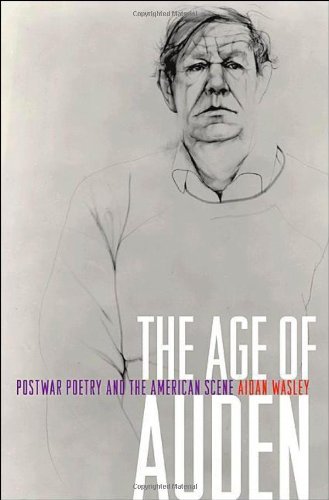
So I was pleased to read  Brad Leithauser‘s  Wall Street Journal review of Aidan Wasley‘s Age of Auden (Princeton University Press):

“Mr. Wasley takes a dim view of Auden’s final years. The once innovative poet was left behind; he receded into ‘cultural conservatism and contented domesticity.’ He became a ‘figure of sad diminishment.’ This is a plausible view—probably a majority view. But a notable minority feels otherwise. Two of the poets Mr. Wasley embraces, James Merrill and Anthony Hecht, saw the old master further extending himself in his final decade, discovering a new music— a strain of poetry that blended heartbreak with aplomb. The poem ‘A Lullaby,’ in which Auden wittily sings himself to sleep (‘Let your last thoughts all be thanks’), is a haunting example.

Though Auden’s influence is powerful and broad, The Age of Auden helpfully delineates its borders. The battle of literary reputations takes place in a dusty arena, and W. H. Auden will surely be one of those titanic figures that loom through whatever dim clouds arise. He will remain unignorable.”

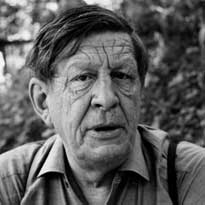
(Picture of the elder Wystan at left.  Toward the end of his life, he described his face as looking like “a wedding cake left out in the rain.”)