Auden on Hitler and Napoleon: “Their fatality is being what they are.”

Share

"a hunger to be needed"

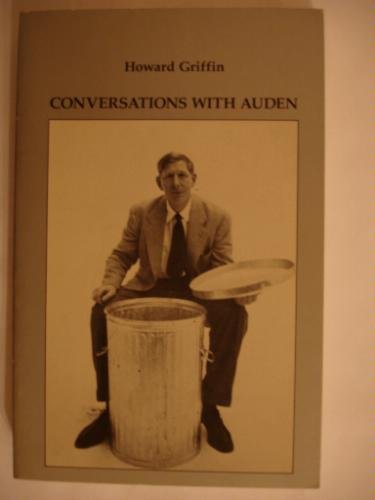
Some time ago I wrote about Howard Griffin‘s Conversations with Auden.  I’m not sure I ever had read the front matter before tonight.  Had I done so, I would have learned that the young poet Griffin took these notes using a kind of shorthand (W.H. Auden would never have allowed a tape recorder) in 1946 and 1947, then transcribed them painstakingly with Peter Eckermann‘s Conversations with Goethe in mind as a model. They were highly regarded by literary circles in the 1950s.  Another poet, Marianne Moore, said “these discussions … profitable to me if no one else…”

The volume begins with this question:

Howard Griffin: Would you rather have lived at an earlier time when men knew less, when there was no police force, no plumbing?

W.H. Auden: I would not. If one thinks in terms of happiness or love, human behavior certainly has not improved through the ages, but if one thinks in terms of knowledge, power and potential for good, one must say: there has been an advance.

This was in 1946-47, remember. World War II was still a living wound; the avalanche of facts and photos and eyewitness accounts about it had yet to be published.  Auden had this take on Adolf Hitler:

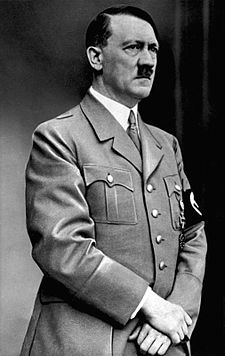
“Although he seemed to be always telling other people what to do, Hitler’s acts were determined by compulsion and desire for prestige. Men like Hitler, Napoleon and Richard III contrive to make their surroundings sufficiently exciting so that they are sustained in a state of passion, which dictates what they will do. People like Hitler have a hunger for complete mastery and when things begin to go wrong, then there is nothing for them to do but wish their death.  The Hitler type is able to choose for others, but incapable of self-choice and he must go on arousing enemies because their fact proves that he exists. When we read of the night of the long knives, the SS slogan ‘Heads must roll,’ the Rohm purge, etc., we see that the Nazi leaders contrived to do evil consciously for its own sake in order to demonstrate their objective reality … Once they get started, they cannot stop. Their fatality is being what they are; they are their own disease …. For the dictator, war is a good thing; then he feels wanted. He has a hunger to be needed. A war provides people with a negative sense of self – enough self to destroy. What Hitler, Napoleon and Alexander lacked was a consciousness of their finiteness, a lack that can be disastrous …”

These conversations were published in literary journals, but never found a publisher – at least not in Auden’s lifetime. Nor in Griffin’s. He died in 1975, two years after Auden’s death, also in Austria.


W.H. Auden in film, a remembered poem, and a forgotten murder

Share

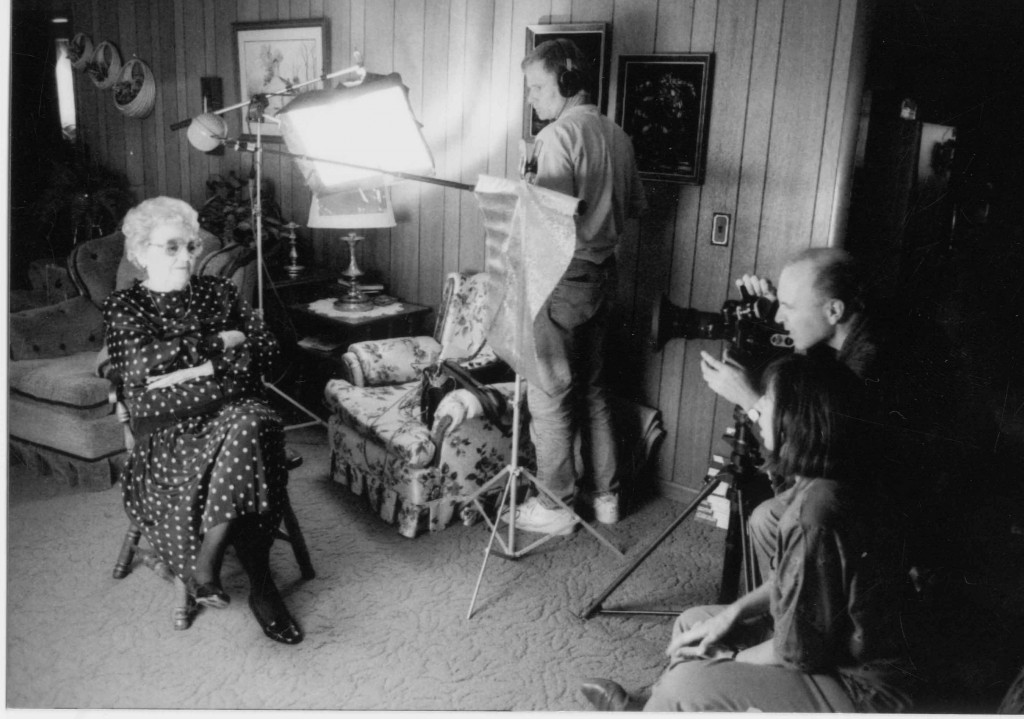
The Making of the film "U S" – triumph and tragedy rolled into one

Some time ago we wrote about W.H. Auden on stage, in a new Broadway musical.  But how many know of his work on film?

David Collard writes in England’s Literary Reviewabout Auden’s lifelong fascination with film.  For six months from 1935 to 1936, Auden worked for the General Post Office Film Unit (GPO), which included the time that it produced  Night Mail, the Citizen Kane, Coal FaceNegroes (released as God’s Chillun), and The Way to the Sea – “all four films featuring brilliant modernist scores by the young Benjamin Britten,” according to Collard. “No artists of comparable stature had collaborated so closely since 1691, when John Dryden and Henry Purcell worked together on the ‘dramatick opera’ King Arthur.”
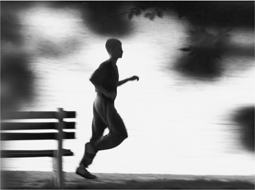
From "Runner"

Collard also writes that GPO, “despite its prosaic-sounding title, was for five years the most exciting, innovative and progressive cultural project in Britain, staffed by a dazzling cohort of international talents. In a short-lived flurry of commitment to the cause, Auden also lectured on film, wrote reviews, provided subtitle renderings of Russian peasant folk songs for Dziga Vertov‘s Three Songs of Lenin, and collaborated on various other projects, even appearing in front of the camera (disguised as a department store Father Christmas in Evelyn Spice‘s spirited Calendar of the Year).”

But all was not well:

Naturally insubordinate, however, Auden soon began to question what he saw as the compromise and hypocrisy implicit in a state-sponsored organisation that purported to criticise the state’s shortcomings. He resigned from the Unit following publication of a Listener article in which he attacked the documentary movement, before Night Mail became the Unit’s one great critical and popular success. The film has since tended to overshadow his other documentary achievements.

His favorite films...

Auden later seemed indifferent to films.  During a talk at Cambridge, his student host Paul McQuail recalled, “We sat and talked for an hour in a relaxed way, much of it about films: Auden’s most memorable remark, though we didn’t know how to take it, was that the films he liked most were the ones where animals talk with human voices. He mentioned Francis the Talking Mule as an example.”

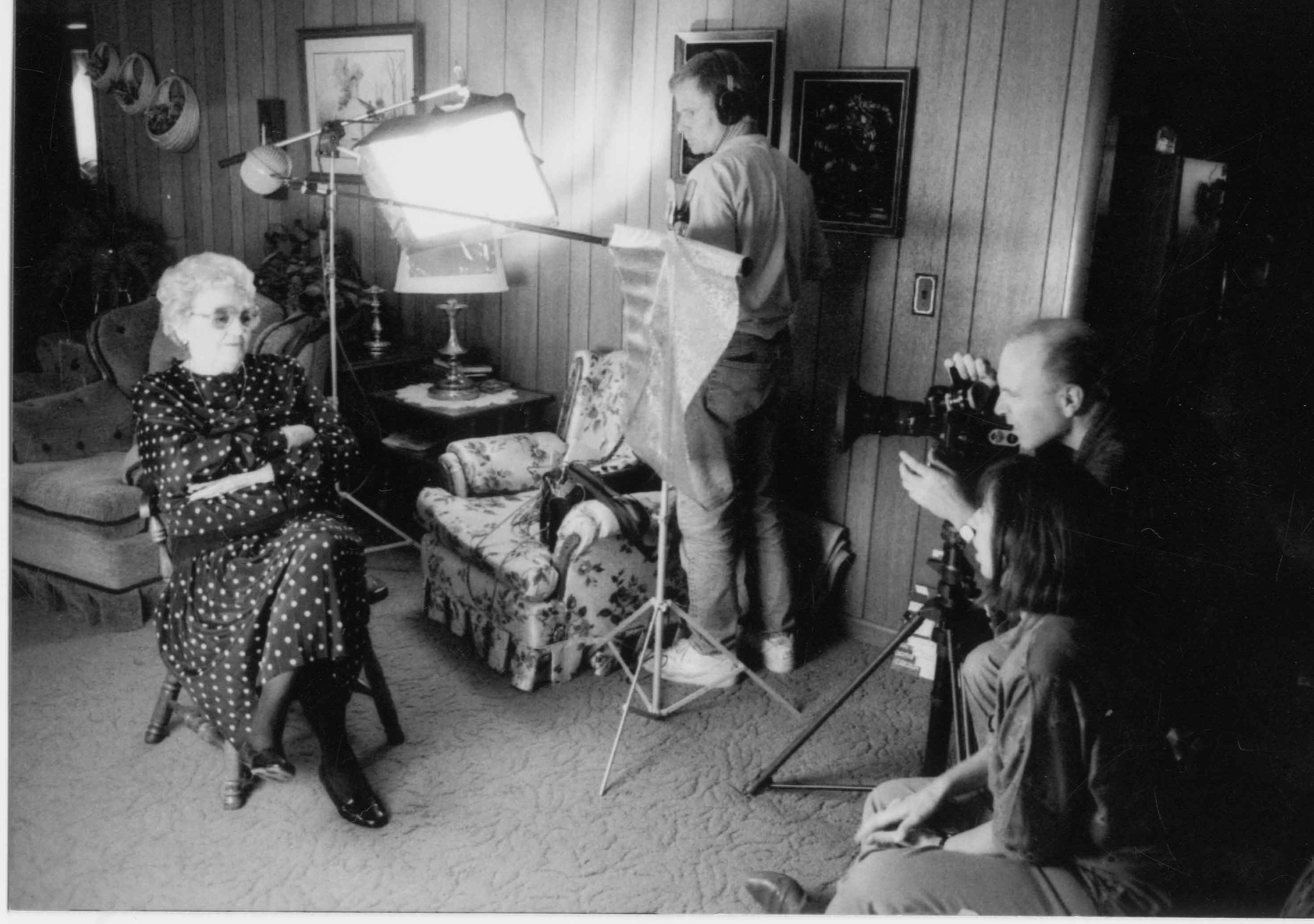
The story has a happy ending, and then a sad one.  Auden returned to films with 1962’s  Runner, where he wrote a “verse commentary” for the documentary about the young Canadian distance runner Bruce Kidd.  A few years later, he participated in U S, a film about the U.S. and, well, us. It begins with breathtaking clouds and panoramic vistas, but didn’t pull back from the plight of Native Americans, slaves imported from West Africa, and America’s underclass.  The last caused problems.

***

From what Collard has cited, it appears that celluloid did not elicit Auden’s best poetic efforts.  I should know.  The rhythms of Auden are in my blood, thanks to Joseph Brodsky, who made us memorize hundreds of lines of poetry, many of them Wystan’s. It was not a popular activity then, and even less now.

So I was intrigued to learn that I have unexpected company as I champion the loving labor of memorization.  Over at poetryfoundation.org, Josh Warn (any relation to the ezine’s founding editor Emily Warn?) recalled reciting Auden’s “Shield of Achilles” while dragging welding cables on a construction site, as a response to his companion wittily recounting Eminem’s rap lyrics.  Wrote Warn,  “the poem’s sixty-seven lines you restrain yourself from the familiar flurries of contemporary mediaspeak and follow phrasings that come from a deeper place.”  On the whole, it sounds more like he was showing off, especially since the floor grinders began whirring away and drowned out both of them.

He writes: “A good solid poem in your cortex can be almost like ballast in a ship’s hold. If turbulent mental activity surges, speaking a poem to oneself can be a way to even out the waves. I first learned this through my practice of memorizing Psalms. But even nominally secular poems recited aloud soothe, and not merely by providing a distraction from disturbing matters, but by the steady rhythm of their sound, and their effects on the breath.”

Beyond that, “The intense familiarity of a work known by heart allows happy moments of sensing the poem as a whole and in details. This pleasure is not simply the kick of solving a puzzle, nor my ironworker affinity for structure. There is also pleasure in sounds and rhythms, even the mouth pleasure of ‘unintelligible multitude’ [from Auden’s “Shield of Achilles”]. But at its best the experience of a good poem has to do with trying to apprehend a deeply known truth that another person could communicate only with a precise set of words.”

***
O'Connor
Ison

Auden’s film U S , on America ended the American way, with a murder. While filming in Appalachian Kentucky, Scottish-Canadian documentary filmmaker Hugh O’Connor was shot dead by a local landlord, Hobart Ison, who was infuriated by the filmmakers on his property, and enraged at the media images that he felt exploited and stigmatized Appalachia during Lyndon Johnson‘s War on Poverty.  Some of the jurors agreed.

“Following a hung jury at the end of his first trial, Ison pleaded guilty to voluntary manslaughter. He was sentenced to ten years and paroled after just one.”

Auden’s prophetic voice: “All forms of knowledge and power have two sides.”

Share

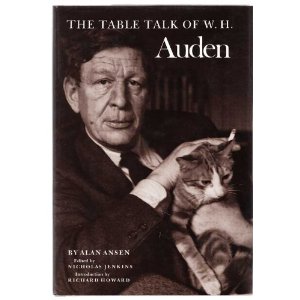
One of the problems of a large library is that it depends on a fallible sense of memory. I have a visual recollection of where a book might be, and that is my sole form of “organization.”  So naturally, I couldn’t find Alan Ansen‘s The Table Talk of W.H. Auden when I wanted it.  It wasn’t where I remembered seeing it, and therefore will remain in hibernation until it chooses to be found.

The immediate spur to my search was an article in last week’s The Scotsman, an interview with Edward Mendelson, Auden’s literary executor:  “So impressed was Auden by Mendelson’s dedication – he told his long-term partner Chester Kallman ‘I’ve just met a young man who knows more about me than I do’ – that he asked him to become his literary executor. He died two years later, in 1973, aged 66.” Read the whole article here.

I found instead Conversations with Auden by Howard Griffin, another young man who attached himself to the ageing poet.

Now here’s what’s curious.  I was talking earlier today with a technologist about the double-edged sword of modern technology. It can lead to international sharing of medical research – or it can lead to porn addiction.  In that sense it’s like nuclear energy – it can power a nation, or bring us another Hiroshima.

So what did I find on the first page of Griffin’s book?  After discussing the advantages of the modern era, there’s this prophetic exchange:

Griffin: You mean at least we have technological advantages?

Auden:  Yes. The power instruments.  You cannot have advances in science without having the good and bad, without being given a choice. It is always up to men to decide how they are going to use what they have.  With each new invention, the question of free will is resurrected. The first invention of all was the apple – divine knowledge which caused the trouble. The story of Chapters 2 and 3 of Genesis is a myth to explain history. One must acknowledge its poetic truth, for human beings still seem much like Adam and Eve, blaming things on each other, and desiring to be gods.  Out of their monstrous vanity human creatures want to be their own cause. Adam succumbed to the temptation to eat the apple – but not out of appetite. … The story of the Fall has to be told in mythical terms because it is what conditions history.  In Genesis we do not have a race of people but the first man and woman, and the first thing they do is eat of the tree, an act that begins time and loses them this innocence.  Civilization itself remains neutral and ambiguous.  All forms of knowledge and power have two sides.  As temptations, they can make a man behave either much better or much worse.

Someday I’ll find The Table Talk of W.H. Auden again. Perhaps I’ll even find the syllabus Auden used for his University of Michigan classes, back when he was poet in residence in the 1940s.  I had retrieved this treasure from the university’s archives year’s ago.  Somewhere in the garage, I’m sure.

Auden in the footlights: “Art is our chief means of breaking bread with the dead”

Share

Julian Fleisher as George Davis, Kristen Sieh as Carson McCullers, Stephanie Hayes as Erika Mann, and Erik Lochtefeld as W.H. Auden (Photo: T. Charles Erickson)

I’m a fan of New York City’s Public Theater, so I was especially cheered to read about its new world première musical February House this month.  How could one not be chuffed about a play that focuses on W.H. Audens house at 7 Middagh Street, and the miscellany of writers, composers, and artists it attracted for housemates?

I read about the production not in a New York paper – at least not initially – but rather in Jim Holt‘s charming post in the London Review of Books blog:

As a young man

Besides Auden, who lived on the top floor, the tenants were Carson McCullers, Benjamin Britten and Peter Pears, and – most improbably of all – Gypsy Rose Lee, who at the time was busy writing a mystery called The G-String Murders. Other occasional residents included Paul and Jane Bowles, Louis MacNeice, Richard Wright (who lived with his wife and child in the basement), and Golo Mann (who holed up in the attic). It was Anaïs Nin, a frequent visitor, who named it ‘February House’, because so many of the residents, including Auden, had birthdays in February. … Other than that, however, they seem to have had little in common except a commitment to their art and to not ever being bored. Cocaine is snorted in “February House”; bedbugs are extravagantly shuddered over; a good deal of whiskey is poured.

The LRB piece dwells on Auden’s mysterious connection with the number 7 and his grubby living habits throughout his life.  In a later residence, writes Holt, “So squalid was everything in the dusty, cold and bottle-strewn loft that [Igor] Stravinsky later told Edmund Wilson that Auden was ‘the dirtiest man I have ever liked’.”

Wish I could be in New York City to see the production (music and lyrics by Gabriel Kahane, based on a book by Seth Bockley.) I’ll have to settle for Dwight Garner‘s description in the New York Times:

They had both.

Sparks fly early and often. When Auden pretentiously blurts to McCullers that “I am a thinking-sensation artist in the Jungian sense, whereas you are clearly a feeling-intuitive type,” she takes out a flask, eyeballs him as if were a space alien, and says: “Uh huh. Gin?”

Auden seemed to enjoy McCullers’s impudence. He is, after all, the man who said, “Among those whom I like or admire, I can find no common denominator, but among those whom I love, I can: all of them make me laugh.”

Auden and McCullers are a pure and defiant literary odd couple. Both stoke your imagination in February House, in part because of their youth, in part because both wrestle with where their obligations to art end and their obligations to politics begin. They are increasingly obsessed with what Lionel Trilling, in “The Liberal Imagination,” called “the dark and bloody crossroads where literature and politics meet.”

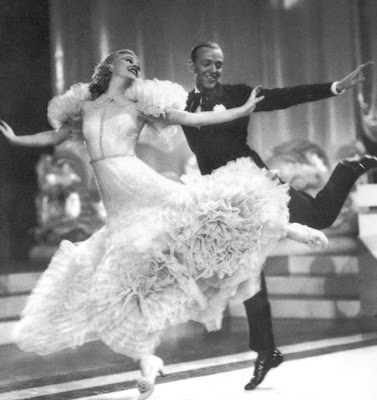
One quibble though, the NYT piece refers to “something once said about Pauline Kael and The New Yorker magazine: She gave it sex, and it gave her class.” The comment (as his hyperlink hints) was said about Ginger Rogers and Fred Astaire (using him and he rather than it) – and it was famously said by Katherine Hepburn.

His closing quote, however, is undisputed Auden: “Art is our chief means of breaking bread with the dead.”

A late 2020 postscript from Book Haven reader Dwight Green: 

I began reading Alan Jacobs‘ recent book Breaking Bread with the Dead and I wanted to look up the Auden quote where the title came from. Your blog came up first on the list, from a 2013 post you did. Here is the full footnote on the quote:
“Art is our chief means”: This is an image that Auden seems to have come up with late in his life, but he liked it enough to use it repeatedly. Its first occurrence I believe, came in a lecture he delivered in 1967: “Let us remember that through the great artists of the past could not change the course of history, it is only through their work that we are able to break bread with the dead, and without communion with the dead a fully human life is impossible.” W. H. Auden, The complete Works of W. H. Auden, vol. 5, Prose: 1963—1968, ed. Edward Mendelson (Princeton, N.J.: Princeton University Press, 2015), 477.
I found the confluence of the book and your post funny and wanted to share what may be the source of it. Thanks!

Antoine Jaccottet’s Le Bruit du Temps: Fresh air for French readers

Share

Translation is the poor stepchild of literature – academics get more applause for producing their own books, not for translating the writing of others; for writers, it’s a distraction from their own work and not terribly well remunerated. Hence, a welter of books never appear on the international stage the way they deserve.

So it’s cheering to see a venture like the Paris-based Le Bruit du Temps, a publishing house crowded in one large room in one of the more picturesque neighborhoods in a city that has plenty of them.  Founder and director Antoine Jaccottet has a desk in one corner; his collaborator, Cécile Meissonnier, has a desk on the other side.  Pictures of Osip Mandelstam, Isaac Babel, and others are stuffed into the edges of a large mirror – they are the real masters here. The window next to it gives a clear view on a plaque indicates that James Joyce finished Ulysses across the street here, on rue du Cardinal Lemoine in the Latin Quarter.

Antoine Jaccottet, son of the poet and translator Philippe Jaccottet (who translated Goethe, Hölderlin, Mann, Mandelstam, Góngora, Leopardi, Musil, Rilke,  Ungaretti, and Homer into French), worked for 15 years at the famous French publisher Gallimard, publishing classics, before he broke out on his own for a shoestring enterprise in 2008. The tight-budge endeavor, however, produces elegantly designed, finely crafted volumes.

Masterpieces don’t die, he says, but they can get lost in the noise of time.  It’s the job of publishers to rediscover them for the public, and what better place than the small adventurous publishers who have a freedom and esprit not usually tapped by large publishing houses.

As I gaze over the offices teeming bookshelves, I notice an entire shelf of W.H. Auden in English.  He’s one of the house’s authors.  Le Mer et le Miroir … Auden in French? How does he come across?  It’s difficult, Antoine admits, for the French to “get” Auden’s sensibility.

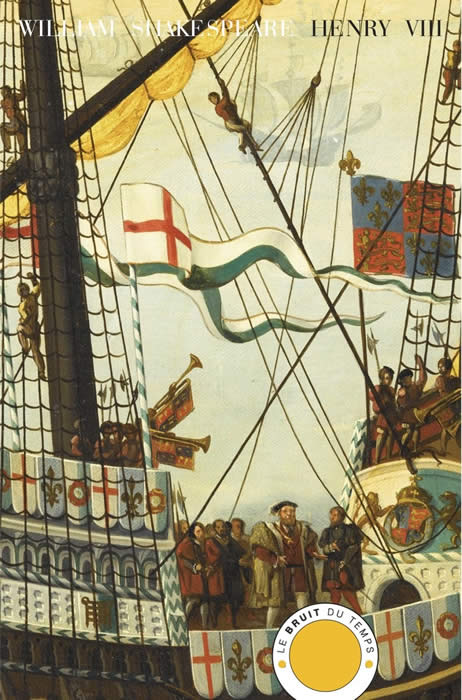
He’s also published  Zbigniew Herbert in French, Lev Shestov‘s Athens and Jerusalem, the complete works of Isaac Babel, and Henry James‘s The Ambassadors.  Even Shakespeare‘s (cough, cough) Henry VIII.

Mandelstam is, in a sense, the reason for the place.  The title of the publishing house itself – “the noise of time” – is taken from the title of Mandelstam’s prose collection, which includes perhaps his most autobiographical writing.  Antoine had been taken with the Russian poet in the 90s, and the translations and biography by the eminent scholar Clarence Brown.  One of the first books the house published was Le Timbre égyptien (The Egyptian Stamp).  The Ralph Dutli biography will be published this month.  (The house published Dutli’s poems in 2009).

A piece of old France

Le Bruit du Temps’ books by and about Mandelstam illustrate an underlying principle at the house:  Antoine publishes works that develop and deepen recurrent themes like a symphony.  In 2009, he published published Browning’s L’Anneau et le Livre, republished G.K. Chesterton‘s out-of-print 1903 Robert Browning (Chesterton’s first book), Elizabeth Barrett Browning‘s Sonnets from the Portuguese and Henry James‘s Sur Robert Browning. That’s probably more Browning than Elizabeth Barrett ever saw.

Literary journalism, apparently, is as much in a crisis in France as it is here – the media often publishes book blurbs intact, and critics are famous for not reading the books they review.  So how do people hear about books?  Often, they don’t, he says.

As I leave, Antoine gives me a little souvenir of my visit, the publishing house’s brand new Le Bruit du Temps, a slim and elegant volume, fresh from the press.  What could be more fitting?

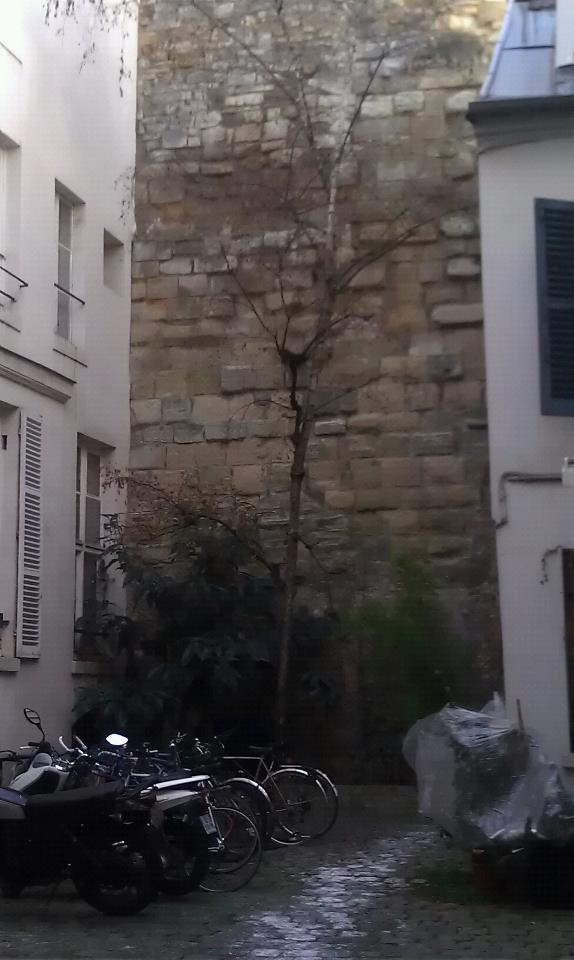
He also shows me a rarely seen landmark as he shows me the door – at the back of the courtyard, between the buildings, in the soft sunlight of the late afternoon, the ancient Paris city walls of  Philippe Auguste, the oldest surviving city walls, about the time of the poet Marie de France.

Postscript on 3/16:  Nice mention on the University of Rochester’s “Three Percent” blog over here.


Pablo Neruda: Greatest pick-up artist evah?

Share

The conversation erupted on my Facebook page, debating the eternally recurring subject of unjust Nobel awards. It’s recently been revealed that J.R.R. Tolkien had been snubbed by the Nobel committee because his writing wasn’t up to snuff.

Other poor Nobel choices came to mind among my FB friends – the 1971 Nobel to Pablo Neruda over Tolkien?  Or over W.H. Auden, for that matter?  Or Jorge Luis Borges?  Or Vladimir Nabokov?

Another Nobel laureate, Octavio Paz called Neruda “the greatest bad poet of the century,” a much-repeated soundbite that sticks.  Yet Nobelist Gabriel García Márquez called him “the greatest poet of the twentieth century – in any language.” To which one can only reply Osip Mandelstam, W.H. Auden, Marina Tsvetaeva, T.S. Eliot, Czeslaw Milosz.

Our view of Neruda is now inevitably colored by his Stalinist politics.

Apologists say the Stalinists couldn’t possibly have known about the murderous excesses of the U.S.S.R.  Couldn’t possibly have known?  Despite a generation of slaughtered, imprisoned and exiled writers from Russia?  Despite a man-made famine that starved millions?  Despite the writings of Robert Conquest?  If Neruda had any questions, all he had to do was ask Czeslaw Milosz, who defected in 1950.  Instead, he infamously penned a denunciation of Milosz as “The Man Who Ran Away.”

There is nothing so dangerous to us as the thing we do not want to be true, the thing we turn our backs to.

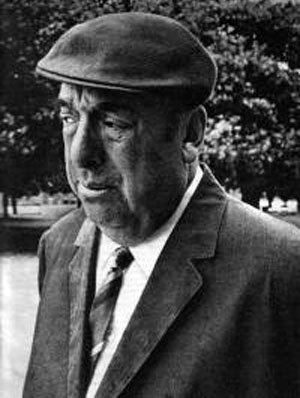
Not bad for a dumpy-looking guy

In time for the 2004 Neruda centenary, Stephen Schwartz (not a literary critic, but a conservative political commentator), wrote in a seminal article that has been cited all over the internet:

There is probably no more chance of halting this current binge of Neruda worship than there is of banishing the cicadas, but, still, the truth does need to be said: Pablo Neruda was a bad writer and a bad man. His main public is located not in the Spanish-speaking nations but in the Anglo-European countries, and his reputation derives almost entirely from the iconic place he once occupied in politics – which is to say, he’s “the greatest poet of the twentieth century” because he was a Stalinist at exactly the right moment, and not because of his poetry, which is doggerel.

So does Neruda’s poetry have a future?

Eternally.  On Facebook, my friend Kevin assured me that Pablo Neruda has enduring market value in the Spanish-speaking world for his … pick-up lines. Not bad for a dumpy-looking guy (see right).

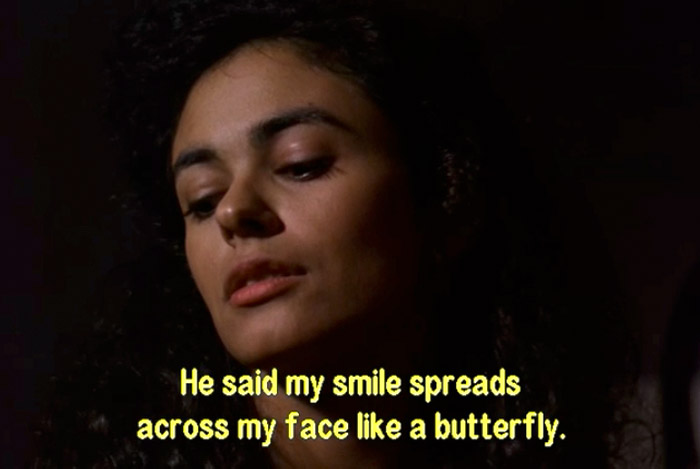
Hard to argue that point – an award-winning film was made on precisely that subject, Il Postino/The Postman.  The plot: nerdy Italian postman wants to pick up pretty girl.  He befriends the exiled Neruda and voilà!  Plagiarism is born in a small Italian village.

As Schwartz himself admitted:

Yes, his work is still plagiarized by teenage boys in Latin America, who see his Twenty Love Poems and a Desperate Song and figure there is nothing wrong with borrowing from it–just as one poem in the book is itself stolen from Rabindranath Tagore – and presenting its overwrought lines to their girlfriends. But if those boys grow up to be serious writers, they leave Neruda behind.

No luck with the line

But Kevin had a story of his own.  During a summer studying at the London School of Economics, an attractive young Spanish woman caught his eye.  How to attract her attention? His friend Pedro (there were a lot of Spaniards around that summer)  said it was very important to open with a sure-fire line.  Neruda was the ticket.

A dormitory lunchroom discussion of Neruda and the art of line-by-line seduction followed.  The young woman demanded an example of a florid Iberian pick-up line: “Let me hear it.”

Kevin recalled the line Pedro had taught him:  “The sentence would be something like “Oh, cielito mío, que Dios me dió” [Oh, my little heaven, given to me by God].

“It’s the cheesiest thing in the world.  And she said, ‘Wow, that’s really good.’”

Did he get the date?  No.  But he learned his lesson: “That’s how it’s done in España.”