
From Vilnius with love: Stanford’s Brodsky archive in the Russian press

Share
romas

A separate peace: Katilius, Brodsky, Venclova in Lithuania

“Посетители библиотеки Стэнфордского университета в Калифорнии получат доступ к литовским архивам поэта Иосифа Бродского. Об этом в журнале Stanford Magazine написала исследователь и редактор книги «Joseph Brodsky: Conversations» («Иосиф Бродский: Диалоги») Синтия Хэвен. Собрание писем, рукописей, рисунков, фотографий и открыток Бродского из Вильнюса библиотека университета получила в мае 2013 года.”

See that?  Синтия Хэвен.  That’s me.  The article also says:

Архив Иосифа Бродского, оставленный им в Вильнюсе у его друзей Рамунаса и Эли Катилюсов, был продан Стэнфордскому университету после того, как Синтия Хэвен в 2011 году посетила Литву и познакомилась с его владельцами. По ее словам, физик Рамунас Катилюс как раз подыскивал новое хранилище для документов, доставшихся ему от поэта.
brodsky2

There it is again.  Синтия Хэвен.  I shall never think of myself the same way again.

Lenta.ru is a popular Moscow-based news website that gets over 600,000 visitors today.  An English version, “Stanford Buys Joseph Brodsky‘s Lithuanian Archives,” is online at Russia Beyond the Headlines here.

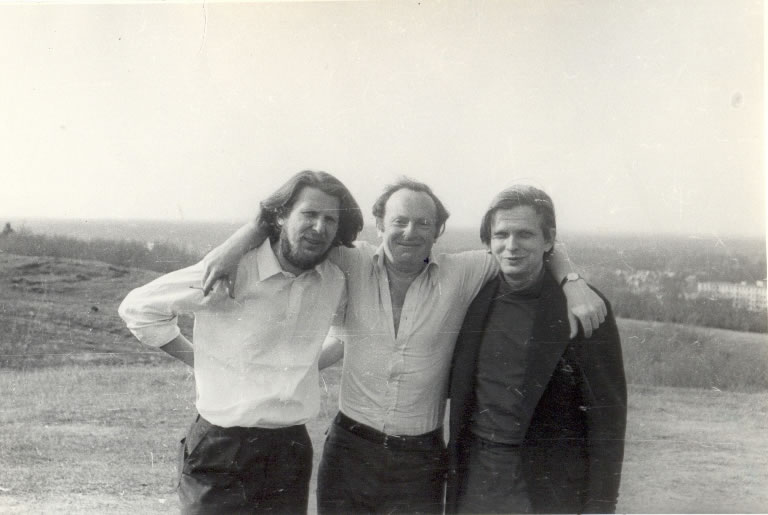
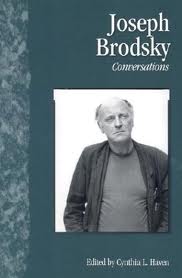
Above right, an iconic image from the collection – happy days in Lithuania for Lithuanian physicist Ramunas Katilius, Joseph Brodsky, and the Lithuanian poet Tomas Venclova.  But I also like the image on the cover of my book, at left, by the immortal (and I can testify generous) Richard Avedon.

You can read my own version of the story, Brodsky@Stanford (plus the California story of a very special edition of Brodsky’s Watermarkhere.

Brodsky@Stanford

Share
romas

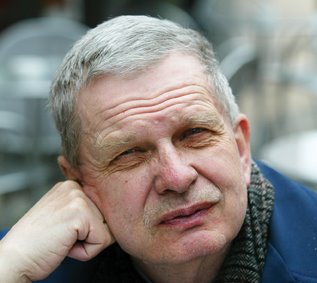
Happy days: Katilius, Brodsky, Venclova in Lithuania (Archives of Ramūnas and Elė Katilius)

It won’t be news to the readers of the Book Haven that the late Nobel poet Joseph Brodsky was a friend to Lithuania – I’ve written about it here and elsewhere. Now visitors to Stanford Libraries will have primary evidence of the affinity, thanks to the Ramūnas and Elė Katilius archive. I’m mightily chuffed to have had a role in bringing this treasure to Stanford – so yes, I’m bragging a bit.  It’s been one of the best adventures I’ve ever had at the university that has been my off-and-on home for years – and I owe it all to Lithuanian poet Tomas Venclova.  And we all owe thanks to Romas Katilius.

Here’s how my story begins:

At the end of August 1966, the young Russian poet Joseph Brodsky was in low spirits. He was having trouble readjusting to Leningrad life on his return from 18 months of exile doing hard labor near the Arctic Circle. Brodsky’s crime was “having a worldview damaging to the state” and “social parasitism . . . except for the writing of awful poems.” There were romantic troubles besides.

A colleague was worried, and kept in touch with him while traveling. One night he telephoned Brodsky from Lithuania, where he was staying with friends in Vilnius.

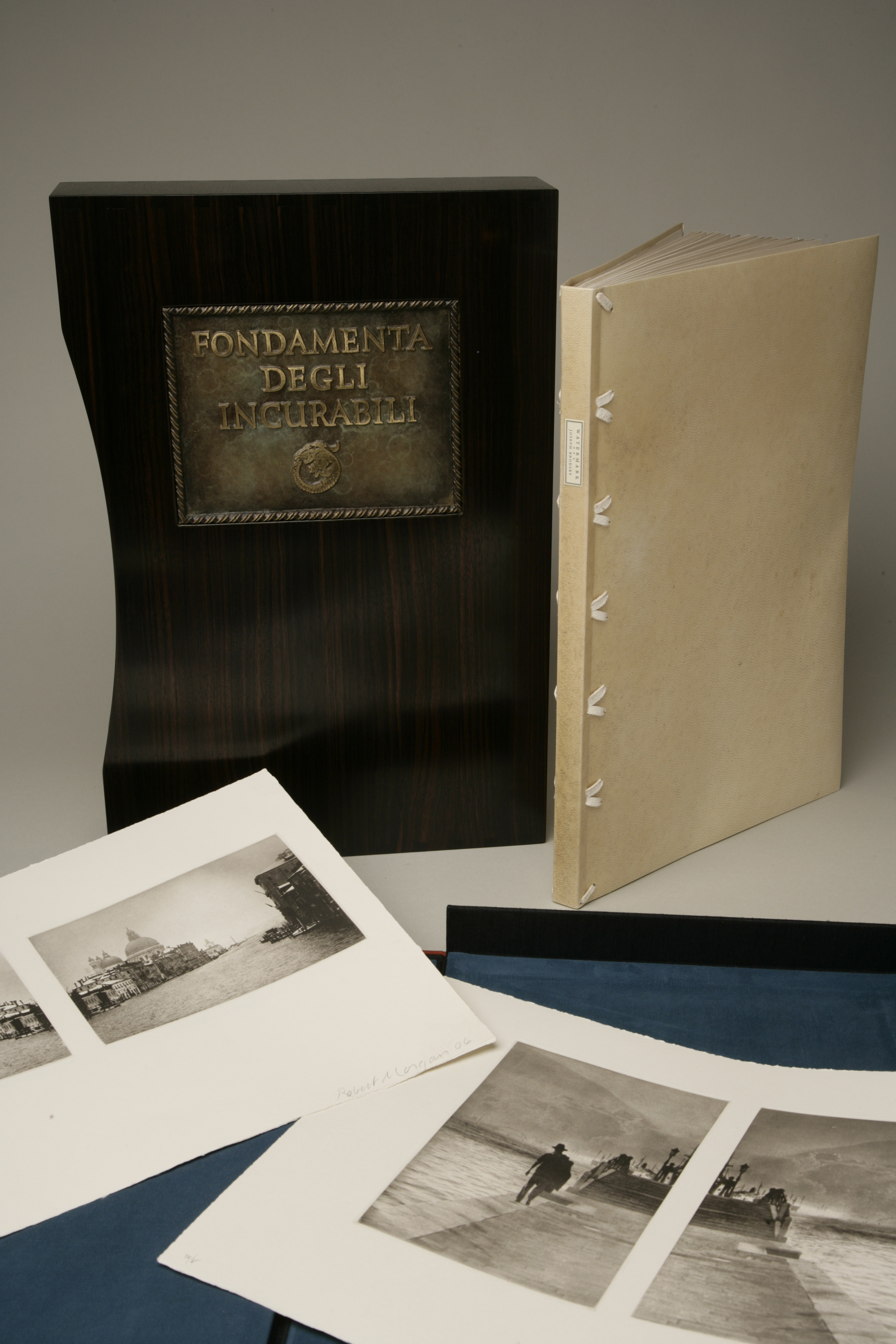
Peter Koch’s magnificent “Watermark” (Courtesy Peter Koch Printers)

“Let him come over here. We are all in a good mood here,” urged the Lithuanian host, Ramūnas Katilius. Brodsky arrived before noon the next day, and even held two readings at the apartment during his stay.

Thus began a lifelong friendship with the Katilius family and a long romance with Lithuania, a comparative refuge during the dying years of the Soviet empire. Eventually, Brodsky gained recognition as Russia’s greatest postwar poet and, in exile, a controversial titan on the New York literary scene who taught at several U.S. universities. He belonged to the world, becoming, in his words, “a Russian poet, an English essayist, and of course, an American citizen.” He won the Nobel Prize in Literature in 1987 and died at his desk at age 55 in 1996.

Read the rest here.  Please.

Oh! Oh! Oh!  Don’t forget to read about the Berkeley printer Peter Rutledge Koch‘s special edition of Watermark, also at the Libraries:

Venice has entranced poets through the centuries, perhaps none more so than Russian Nobel laureate Joseph Brodsky. “I always adhered to the idea that God is time, or at least that His spirit is,” Brodsky wrote. “I always thought that if the Spirit of God moved upon the face of the water, the water was bound to reflect it.” So it was that every New Year’s Eve, the poet tried to be near water, “to watch the emergence of a new helping, a new cupful of time from it.” He particularly tried to journey to Venice, a favored destination captured inWatermark, his book-length meditation on the city.

The rest is here.

Congratulations! Tomas Venclova responds to his newest honor

Share
"Above all, love language" (Photo: Dylan Vaughan)

“Above all, love language” (Photo: Dylan Vaughan)

Preeminent Lithuanian poet Tomas Venclova has been named an honorary citizen of Vilnius … but wait!  Why does he need honorary citizenship?  His family moved to Vilnius from Klaipėda when he was quite young, and he attended Stefan Batory University (now Vilnius University) in the city, as did his friend Czesław Miłosz.

Oh, that’s right.  He was more or less kicked out.  He was active the dissident movement, hence,  he was “deprived of Soviet citizenship,” which means he had to leg it out of his native land in 1977.  I believe he spends part of the year in Vilnius,  as well as in Kraków and New Haven, Conn., where he is now an emeritus professor at Yale.  Well, he gets around a lot.

From a Lithuanian news site:

Vilnius City Council unanimously decided to name Tomas Venclova, a Lithuanian poet, publicist and translator, an honorary citizen of Vilnius.

“Vilnius deserves to have the right and reason to be proud of the fact that such an outstanding figure came of age in the city; by naming Tomas Venclova an honorary citizen of Vilnius, the ties between the poet and his beloved city will be strengthened forever,” the Directorate of Vilnius Memorial Museums said in its nomination letter.

35 years ago, Venclova published his correspondence with Czeslaw Milosz, another celebrated writer born in Vilnius [not true, he was born in Szetejnie – ED], in an essay titled “On Vilnius as a Form of Spiritual Life.” Thanks to this publication, the world learned more about problems of Soviet-occupied Lithuania and Vilnius.

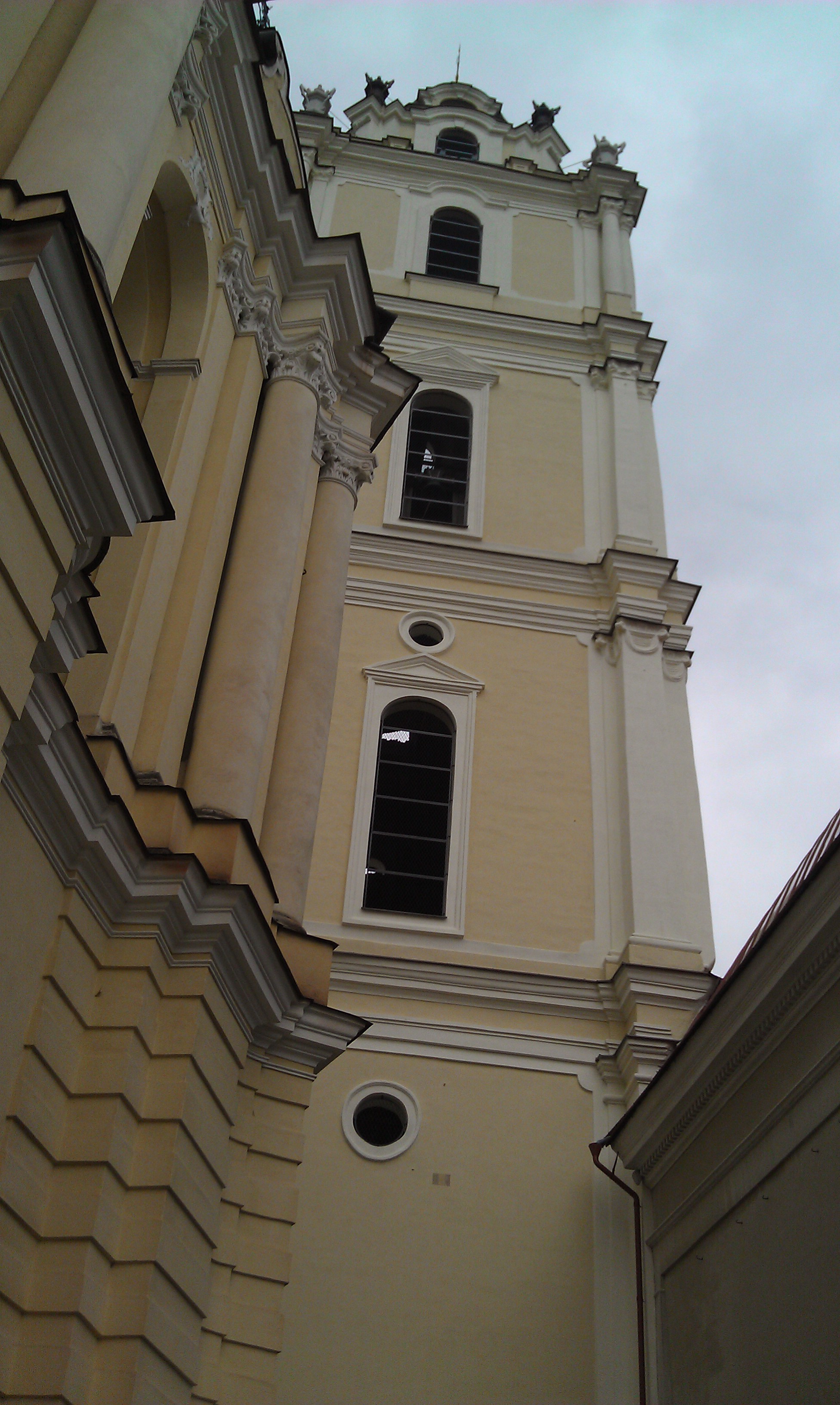
His alma mater, Vilnius University (Photo: C.L. Haven)

His alma mater, Vilnius University (Photo: C.L. Haven)

Venclova will become the 11th honorary citizen of Vilnius.

Wait.  Publicist???  I suppose they’re referring to his top-notch guide to Vilnius, which exists in English.  From his introduction:

…Vilnius has always remained many-faceted and multi-lingual.  It has been and will always be a dialogue city. … The Lithuanian capital reminds one of a palimpsest – an ancient manuscript in which the text reveals traces of an earlier text or even several of them underneath it.  The city is surrounded by a hilly northern landscape: because of abundant forests and lakes it has always appeared somewhat untamed. Throughout the city, up to its very centre, islands of untamed nature can be found.

So what does it mean to be a citizen of the city you have lived in so many years?  I sought quick clarification from the poet himself.  He wrote back yesterday from Berlin:

Dear Cynthia,

There are eleven honorary citizens of Vilnius, including Milosz (for whom the  city was also home for decades). The list includes Reagan and Brzezinski; that may look a bit awkward (they helped Lithuanians in the fight for independence).

Winner takes nothing, except the right to participate in the meetings of the city council (nobody ever insisted on that privilege). City also provides for the upkeep of his/her grave. In case of Reagan, the last provision is obviously void.

Love,
Tomas.

Well, there you have it.  From the horse’s mouth.

“Sustok, sustok” … this just might be the language of heaven

Share


"Above all, love language." (Photo: Dylan Vaughan)

Diana Senechal discovered the Book Haven, and we discovered her own blog “on education and other things.”  One of those other things was Tomas Venclova, the subject of a recent post on this site.  She wrote about her first encounter with the Lithuanian poet’s verse:

It was in 1988 that I first encountered Tomas Venclova’s poetry. I was a senior at Yale; he was directing my independent project on Russian poetry translation. Knowing that he was a poet, I wanted to read his work (but didn’t want to tell him this). So one day I made a furtive trip into the library stacks. I opened up a volume of his poetry and read the lines,

Sustok, sustok. Suyra sakinys.
Stogų riba sutampa su aušra.
Byloja sniegas, pritaria ugnis.

What did these words mean? At the time, it didn’t matter. I was drawn into the sounds, or what I thought were the sounds. “Sustok, sustok. Suyra sakinys.”

(Later, I learned that they meant, roughly, “Stop, stop. The sentence disintegrates. The border of rooftops coincides with the dawn. The snow proclaims, the fire repeats.”)

Tomas later invited her to translate his poems – an honor, certainly.  But she has some mixed feelings about the poems she eventually translated for Winter Dialogue.  She writes:

Inspired and inspiring.

“The strength and weakness of my translations was that I tried to preserve the sound, rhythm, and form of the original—or, rather, to recast the poem in comparable sound, rhythm, and form. When it worked, it worked splendidly (for instance, in Tu, Felix Austria,” “Pestel Street,” and “Autumn in Copenhagen”). When it didn’t, it came across as stilted. I don’t regret taking this approach. I do wish, in retrospect, that I had trained my ear to hear the translations in themselves. I always heard the originals behind the translations.”

As a teacher, she worries about the lack of quietness in our world, the lack of silence within us. Natalie Gerber made similar observations about her own university students in upstate New York – I quoted her a bit here.  Diana Senechal’s proposed solution?  The reading, writing and memorization of poetry.  Joseph Brodsky would certainly have endorsed her suggestion – we had to memorize hundreds of lines.

I was so enthusiastic about her recollections that I immediately downloaded MP3 version of Venclova’s album “Winter Dialogue: Chants from the Holy Land, and shall go to bed listening to the Lithuanian language.  After all,  Czesław Miłosz said it just might be the language of heaven.

Happy 75th birthday, Tomas Venclova! Plus a note on the feldspar of languages…

Share

His alma mater, Vilnius University (Photo: C.L. Haven)

I toast a special anniversary at midnight, though not, perhaps, the one you’re thinking of.  The poet Tomas Venclova turns 75, and a few days ago returned to Vilnius in his native Lithuania to celebrate the occasion. (Frankly, I prefer honoring this anniversary – it’s a refusal to let killers own this day.)

I think the Lithuanian writer would agree that poets are the means by which language lives.  So what better way to honor him than to celebrate his native tongue, spoken by a few million people?  In his own words:

“Matters get more tangled when we speak about the poetry of a small country, a country that is – or was, just until a few months ago [this was written in 1990 – ED] – under the rule of a foreign-speaking, totalitarian empire. Lithuania is one of those small countries. Besides, the Lithuanian language differs from its friends in misfortune. It is one of the classical Indo-European languages, like Latin, Ancient Greek, Gothic, or Old Slavonic; but it is the only one of them that is still alive and is by no means near to being dead, regardless of sufficiently adverse conditions …

“On the whole, the Lithuanian language is by no means delicate or weak. In an odd way, a poet’s direct feeling also confirms this. The Lithuanian language is harsh, jagged, not especially musical, with consistency and texture that bring a feldspar to mind. Its verb is sculptural in catching a hundred nuances of evolution and change. It is especially because our language is palpable and graspable that writing in Lithuanian is a happy and gratifying preoccupation.”

It seems to have been a happy and gratifying preoccupation for him, though often a lonely one.  I cannot say this is now my favorite poem by him, but it’s my first favorite, and serves as a sort of ars poetica:

Above all, though it’s hard, love language –
humbled in newspapers, obituaries saturated with lies,
in the bedroom’s close darkness, the informer’s confession,
in the cry at the bazaar, trenches, the stench of hospital wards,

Birthday Boy (Photo: Dylan Vaughan)

in third-rate theatres, secret police offices, on lavatory walls.
In grey buildings where the stairwell’s shaft is guarded
by steel nets, so that it is not a man, but the century,
which selects the instant of his death;

this language, almost collapsed, littered with sound
and fury. That’s it, love language –
banished to earth beside us,
Though carrying with it the primordial Word …

Happy birthday, Tomas.

Postscript on 9/12:  The U.S. ambassador to Libya, J. Christopher Stevens, was murdered in a rocket attack yesterday. The killers got the day after all.


Why reality holds little love for poets

Share

Venclova: "Above all, love language" (Photo: Dylan Vaughan)

“To travel through time, a poem must possess a unique intonation and perception.”

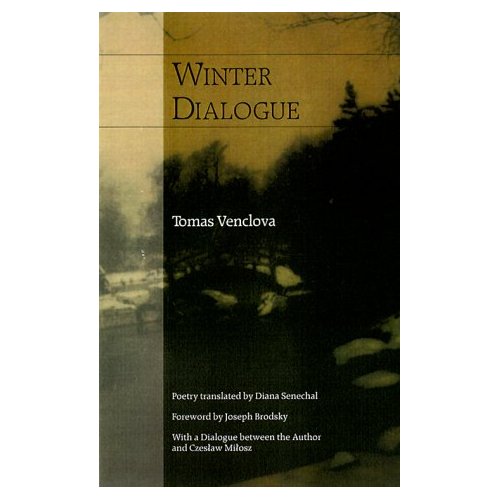
I’d never read the late great Nobel laureate Joseph Brodsky‘s essay on his friend and fellow poet Tomas Venclova (they also shared a common fate, ejected from the U.S.S.R. a few years apart), but last week I rummaged through the Stanford Libraries to find the Lithuanian poet’s Winter Dialogue so that I could find the Brodsky essay, “Poetry as a Form of Resistance to Reality,” which was included as a foreword to the volume.

It didn’t disappoint:

Venclova’s poetry fits this requirement perfectly. His intonation is striking for its restraint and low-key quality, for the conscientious, intentional monotony that seems to be trying to muffle the far too obvious drama of his existence. In Venclova’s poems the reader will not find the slightest sign of hysteria or the slightest insistence on the uniqueness of the author’s fate, an insistence that logically presumes the reader’s compassion. On the contrary, if his poems postulate anything, it is the awareness of despair as a habitual and exhausting existential norm, which is temporarily overcome not so much by an effort of will as by the simple elapse of time.

I have The Junction: Selected Poems, and look forward to comparing its choices with the total collection of Winter Dialogue.  In any case, one particular poem, which the poet himself discussed in recent correspondence, has become a particular favorite. From “Tu, Felix Austria” (translated by Diana Senechal):

Death is not here, she always looms.
The tones of the bells come closer;
she lives in granite, heat, wine,
and bread, in chestnuts entwined
with acacias. She roams
in dreams. History is part
of death. Galileo, not Hegel, was right:
eppur si muove.  A dense, charred
sphere revolves into night.

What at first seemed real is just a denial
of time. There is no revival
in sleep. Nothing and clouds extend
through the window. Death
is not here. Death is at hand.
She rides around in the cage of the room,
crosses out the next calendar date,
then looks in the mirror and meets
you face to face.

Brodsky continues in the introduction:

Venclova’s song starts at the point where the voice usually breaks, at the end of exhalation, when all inner forces are used up. In this characteristic lies the exceptional moral value of his poetry, because the ethical focus of the poem is in its lyricism rather than in any narrative element. For the lyrical quality of the poem is in effect a sort of utopia attained by the poet, and it conveys to readers their own psychological potential. In the best circumstances, this “good news” provokes a similar internal motion in readers, moves them toward creation of a world on the level suggested by this news. At the least, it liberates them from dependence on the reality they know, making them aware that this reality is not the only one. That achievement is not small, and it is for this reason that reality holds little love for poets.

Tomas Venclova tells the story of how he was deprived of Soviet citizenship on video here.  Curiously, the story involves Algirdas Avižienis, the kindly professor from Kaunas who showed me Czesław Miłosz‘s rural birthplace.