“We are nothing without our language.” Salman Rushdie and courageous footwear.

Share

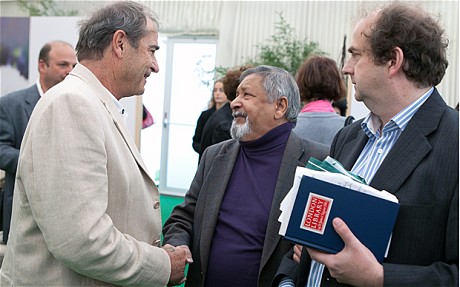
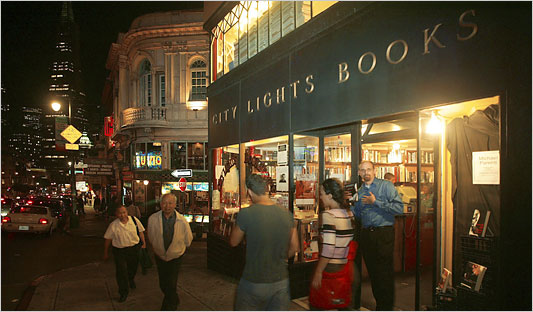
Breyten Breytenbach, an unnamed editor, Philip Gourevitch, and the man himself (Photo: Zygmunt Malinowski)

This week, we posted about great literary slugfests.  But are they a thing of the past?  One prominent literary agent thinks so:

“The day of the writer as public character is greatly diminished,” said Mort Janklow, the veteran literary agent. “Writers are more professional. You don’t hear about feuds. You don’t see the most prolific writers out.”

“It’s hard to be a great social figure and a great writer.”

And that, apparently, means the end of feuds.

This comment came from a New York Times article about Salman Rushdie, that witty, brilliant, and increasingly banal figure on the public literary scene.

Just when you are about to give up on him entirely, just when you want to see no more of this leering, goateed, grizzled grandee with another grinning babe on his arm, just when you are about to conclude that he has descended on a smug, one-way trip into vulgarity and a cliché, he whips out with a crisp comment like this one:

“The human being, let’s remember, is essentially a language animal. We are a creature which has always used language to express our most profound feelings and we are nothing without our language. The attempt to silence our tongue is not only censorship. It’s also an existential crime about the kind of species that we are. We are a species which requires to speak, and we must not be silenced. Language itself is a liberty and please, do not let the battle for this liberty be lost.”

The comments are from The Guardian article about his “rousing address” in Delhi – read the whole thing here; I found it rather plodding and waspish, always ready for a jab at a foe.  I guess after what he’s been through he’s entitled to the jabs.  One just longs for … well, a little nobility, a little moral grandeur.

The fatwa thrust him unexpectedly to an international stage – potentially the foremost in a new generation of giants such as Alexander Solzhenitsyn, Joseph Brodsky, Vaclav Havel. So it’s dispiriting to see him living in a cheesy fantasy of celebrity; he’s shrinking before our very eyes.  Am I missing something?

My friend Zygmunt Malinowski, the photographer who provided the images for An Invisible Rope: Portraits of Czeslaw Milosz, alerted me about the NYT article.  He’s a bit more cautiously optimistic than I am: “I don’t know what to think about a writer who is that popular in the celebrity business. It seems to me that he broke the mold of the isolated writer such as Salinger, Updike and of course Czeslaw Milosz. Good for him.”

He sent me this photo: “I photographed him a few years back by the  New York Public Library with the editor of Paris Review and with Breyten Breytenbach and his editor walking close by.  They just finished a talk about Ryszard Kapuściński.  S. Rushdie was very interesting to listen to.

“Their footwear is fun, sneakers and red shoes – that takes a bit of courage too!”

V.S. Naipaul opens mouth, changes feet: A round-up of literary kerfuffles, and a soupçon of misogyny

Share

Friends again. (Photo: Daniel Mordzinski)

V.S. Naipaul has offered definitive proof against the adage that to be a good writer, you must be a good reader.

First, the happy news:  Naipaul has ended his 30-year feud-over-nothing with Paul Theroux.  The root of the matter seems to be that Naipaul thought Theroux was horsing around with his first wife.  From the Telegraph:

A furious Naipaul retaliated by trying to sell one of Theroux’s books, inscribed to Naipaul and his first wife, online for $1,500. When Theroux found out, Naipaul told him to “take it on the chin and move on.” Naturally Theroux didn’t, and went on to write a book, Sir Vidia’s Shadow, in which he’s said to detail Naipaul’s “elevated crankishness”. The fracas went on until last weekend when – in what is surely Hay [Festival]’s biggest literary coup to date – they made up, “corralled” into a handshake by Ian McEwan in the festival’s green room.

Perhaps Hallmark ought to create a card for the occasion.  The forgettable feud and its resolution is recounted here and here.

The episode has brought to mind other great literary feud of our times, recounted here:

We all love a good literary feud, not least because they are much more amusing and erudite than a spat between, say, a footballer and a reality television star. Of Tom Wolfe’s novel A Man in Full, Norman Mailer wrote: “Reading the work can even be said to resemble the act of making love to a 300lb woman. Once she gets on top, it’s over. Fall in love, or be asphyxiated.” Wolfe retaliated in his essay “My Three Stooges,” casting Mailer alongside his other critics, John Irving and John Updike.

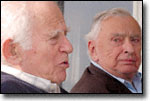
Mad men: Mailer, Gore

Revenge can take many forms. Norman Mailer punched Gore Vidal. “As usual, words failed him,” said Vidal. Evelyn Waugh used the name of his tutor at Oxford for such diverse characters as a quack doctor and a psychopathic burglar. Salman Rushdie and John le Carré had a row over who had suffered more at the hands of religious fanatics, which ended in Rushdie calling le Carré “an illiterate pompous ass”.

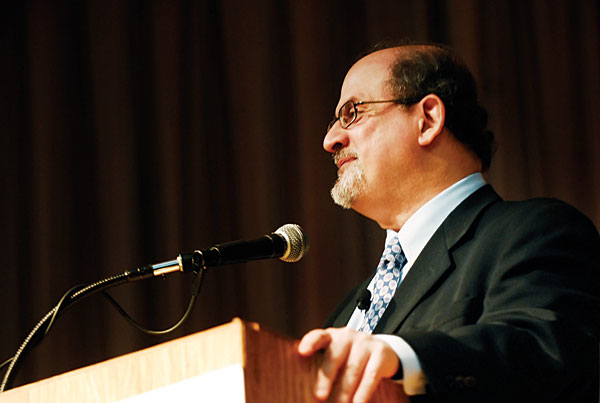
Rushdie not above the fray (Photo: Mae Ryan)

In 2006, Salman Rushdie also fell out with John Updike after the latter panned Shalimar the Clown, in particular Rushdie’s choice of names. “A name is just a name,” Rushdie retorted. “Somewhere in Las Vegas, there’s probably a male prostitute called John Updike.” The same year Bevis Hillier duped A.N. Wilson, the writer of a rival biography of John Betjeman, into publishing a spoof love letter; the first letter of each sentence spelt out: “A N Wilson is a —-.”

Which all goes to show that maturity or character, also, isn’t a prerequisite for being a writer, either.

But in the Telegraph here you can also read about the feuds between Mary McCarthy and Lillian Hellman (that one will not be resolved; the principals are dead) and Harold Bloom and J.K. Rowling.

And I thought the Poles were bad with their acrimonious literary feuds – I’ve recounted the one between Czeslaw Milosz and Zbigniew Herbert here, in “The Worst Dinner Party Ever.”

Naipaul must be anxious to promote himself, because he made these cranky comments to the press.  From the Guardian:

In an interview at the Royal Geographic Society on Tuesday about his career, Naipaul, who has been described as the “greatest living writer of English prose”, was asked if he considered any woman writer his literary match. He replied: “I don’t think so.” Of [Jane] Austen he said he “couldn’t possibly share her sentimental ambitions, her sentimental sense of the world”.

Queen of literary mathematics

He felt that women writers were “quite different”. He said: “I read a piece of writing and within a paragraph or two I know whether it is by a woman or not. I think [it is] unequal to me.”

The author, who was born in Trinidad, said this was because of women’s “sentimentality, the narrow view of the world”. “And inevitably for a woman, she is not a complete master of a house, so that comes over in her writing too,” he said.

He added: “My publisher, who was so good as a taster and editor, when she became a writer, lo and behold, it was all this feminine tosh. I don’t mean this in any unkind way.”

Of course that dropped the cat among the pigeons.  Why?  Why would one expect Sir Vidia to say something sensible on the subject?  He’s obviously not a careful reader of Austen.

Oh yeah?

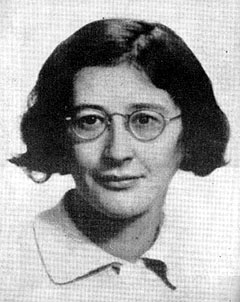
As for women’s “sentimentality, the narrow view of the world,” I have only two words to say:  Simone Weil.

Jennifer Egan took the bait, however, and made these comments on the kerfuffle to the Wall Street Journal:

“He is such a kook. It makes me laugh because he sounds like such a cranky old man. It’s the classic case of how prejudice works – you feel like you see it confirmed all over the world but the prejudice is tainting your perception everywhere you look.”

“I would put money on the fact that he has not read Jane Austen in 10 years. She’s the most cool, mathematical writer to come along, male or female. It’s a word no one who’s familiar with her work would call her. The nature of the comments read as so silly that it’s hard to see it spurring a gigantic turmoil. They’re not remarks that lead to a deeply-engaged conversation because they’re just so easily dismissible, largely because of what he says about Austen. He raises questions about his authority by calling her sentimental. Only a person with an idea of what Austen is — and not actual familiarity with her work – would say that. She’s not a melodramatic writer.”

Meanwhile, the Guardian has published “The Naipaul Test:  Can You Tell an Author’s Sex?” – it’s here.

Naipaul is said to be a great writer (I haven’t read him, so I’m taking that on authority), but a crappy human being.  So why do we take any of his opinions seriously?

If you’ve a taste for this sort of thing, Vidal and Mailer wrangle on fuzzy clip from The Dick Cavett Show below – journalist Janet Flanner takes the better part.  


se più avvien che fortuna t’accoglia
dove sien genti in simigliante piato:

ché voler ciò udire è bassa voglia.

What? No Kepler’s?

Share

10,000 square feet of books

On Christmas Eve, Flavorwire named the top ten U.S. bookstores here. The article begins in this user-friendly way:  “Bookstores are dying. They’re dying because of jerks who are too cheap to buy a hardcover, or even a paperback, and too lazy to get a library card.”  Odd, for an article that is running online.

Two bookstores in Seattle made the cut, and Powell’s of Portland.  San Francisco’s City Lights is named — no surprise there, either:

Justly famous: City Lights

“Started by poet Lawrence Ferlinghetti and Peter D. Martin, City Lights Booksellers and Publishers in San Francisco, CA offers the best in classic and newly-released literature. Their claim to fame is publishing Allen Ginsberg’s Howl and Other Poems then suffering through the resulting obscenity trial. After all that, the store was designated a San Francisco landmark. Supplementing their in-store performances and promotion is their delightful podcast with news on releases and upcoming events.”

Kepler's in 1955

The comments are filled with protest.  Several nominate San Francisco’s Green Apple Books and one reader voted for Diane Goodman’s Ocean Avenue Books.  But, surprise:  no Cody’s and Moe’s from Berkeley.  And … what?  No Kepler’s?

After all, the fame of Kepler’s is international.  Salman Rushdie, the Shah of Blah himself, lamented during a recent visit that he had “never made it to Kepler’s before” and added “I am delighted to finally find my way to Menlo Park.”

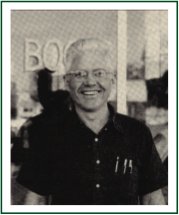
Roy Kepler

Kepler’s was founded in May 1955 by peace activist Roy Kepler. The Grateful Dead gave live shows there early in their career, and they, along with folk singer Joan Baez, often made appearances at the bookstore.  (Management assumed by Clark Kepler, Roy’s son, in 1980.)  Customer loyalty is fierce.

In 1990 Publishers Weekly named Kepler’s “Bookseller of the Year.” However, by 1996, large discount warehouses and Amazon.com were revolutionizing the bookselling business. Kepler’s closed its doors on August 31, 2005.  That’s where the fierce customer loyalty kicked in:  The local community responded with demonstrations. Thousands gathered on the expanse of what is now known as “Kepler’s Plaza” to express support and protest the loss.

The bookstore re-opened in October 2005.

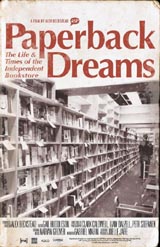
Kepler’s story is told in the documentary, Paperback Dreams, which aired on PBS, tells the tale of two landmark independent booksellers and their struggle to survive. Cody’s and Kepler’s Books helped launch a counter-culture, and for 50 years have protected free speech and celebrated intellectual inquiry. At one time or another, the owners of these stores were harassed, vandalized, threatened, and even suffered acts of terrorism for simply selling books. But their future is uncertain in our fast digital world.  You can order the DVD here.

Salman Rushdie: The Shah of Blah in Menlo Park

Share

The Shah of Blah celebrated being in “a great bookstore” last night, and lamented he had “never made it to Kepler’s before.”

“I am delighted to finally find my way to Menlo Park.”

Delighted to be in – what?  Menlo Park?  At Kepler’s?  Salman Rushdie, who has lived in London, Bombay, and New York looks forward to quietly signing books for a hundred people in this polite little burg?

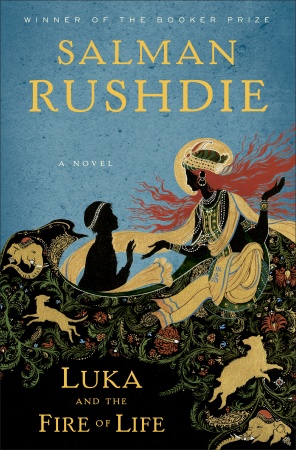
Clearly, this was not the abrasive Salman Rushdie I remember from 2008.  Was there the sort of metaphysical body switch one might find in his latest book Luka and the Fire of Life?  Even the voice was different:  The word choice was distinctly British, but the accent softer, Americanized.  There wasn’t a bodyguard in sight.  He was nothing but charm and affability.  (I wrote about the recent kerfuffle with Jon Stewart and the Cat Stevens/Yusuf Islam here and here and here.

Luka and the Fire of Life was written for his son Milan.  His older son advised Rushdie:  “Dad, don’t write novels. Write series.”

“It is very good commercial advice.”  He didn’t take it.  It was more than two decades between his first children’s fantasy, Haroun and the Sea of Stories, and the sequel. 

What motivates him to “make it new”? “A low boredom threshold,” he said.  “Repetition is the most boring thing in the world for me.”

Here are my notes as he answered questions from the audience:

Are Western audiences missing a lot of the cultural references?

“They’re missing something, sure, but they’re all still sitting here,” he said, indicating the audience.  Polite Menlo Park laughter.

He noted that William Faulkner is now popular in India; apparently, “what they’re getting is enough.”

We lose cultural references not only in space, but in time, he said.  Tolstoy, for example, is full of references that are lost to a 21st century audience.

But still, he said, it’s fine if only one-and-a-half billion people get it – “merely one-fifth of the human race.  So it’s kind of a private joke.”  More polite laughter.

How long has he been writing books?

“Books that got published?  Since 1975.  I was writing before that – just nobody liked it.

How did he move from unpublished to published?

“I started to write better books.”  It took “12 and a half years getting it wrong.”

“I’m grateful my earlier efforts never saw the light of day,” he said – it’s the   advantage of being a novelist over a playwright.  “You can make your mistakes in private.”

But a play’s not alive till it’s performed.  “You’re naked, vulnerable in front of an audience.”

Are his books autobiographical?

Writing from the borderland (Photo: Mae Ryan)

“People are always asking if the characters in my book are autobiographical,” he said, noting it was any novelist’s most-frequently asked question. “It means I must have had one helluva life.”

He recalled giving opposite answers to this question to journalists in the same city, on the same day.  When the responses were published at the same time, “nobody even noticed.”

He also commented on the longing of readers to be in the book.  He recalled meeting a “very grand” lady covered in jewelry and carrying a fan.  She swatted him with the fan, and accused him of representing her in his book. “Naughty boy!  Never mind.  I forgive you.”  He replied to no avail: “Madam, you have to accept that this is the first time I have ever laid eyes on you.”

“I don’t know why you’re going on about it.  I said I forgive you,” she replied haughtily.

On roots

“The place you land is not the place you start from.”

Rushdie said that we live in a world where “everyone knows everything within ten seconds.”  But he recalled growing up in a slower world in India, where communication was pretty much left to the radio and newspaper.

He commented on “the individual in the world to whom the idea of roots is not important — not uprooted, but who moves around in the world without a sense of belonging.”

“We have privileged roots and the idea of belonging in our culture,” he said. “Other ideas are not given air time, except in art,” where we often celebrate the outcast, the voyager, the cowboy, the adventurer. “Official culture says, ‘Stay home.’”

On imagination and reality

“Things cross between imagination and reality,” he said, noting that we live among “things even our grandparents would have found ridiculously fanciful – airplanes, cellphones.”  (Well, his grandparents perhaps.  Mine whizzed about in airplanes.)

“Before you can make a wheel, you have to imagine a wheel.  The world begins in imagination and move into reality.”

“I wanted to write about that borderland.”

And not a word about the fatwa.

Peace Train? The Atlantic revisits Cat Stevens/Yusuf Islam, Salman Rushdie

Share

The paparazzi haven’t caught on yet, but I’m famous, kind of.  I’m in the cyberpages of The Atlantic this weekend, a feature item in “Atlantic Wire’s The Long War Between Salman Rushdie and Cat Stevens” by Max Fisher.  The “war” refers to the “still-running and extremely bitter war of words between the two men.”

However, the words from the crooner were not merely “bitter” — as I described in my post, Cat Stevens/Yusuf Islam was supporting murder, however much he may (or may not) have changed his position since, in carefully crafted ambiguous statements, such as the one here. Stevens clearly wishes to move beyond the controversy, yet fails to show the slightest remorse or concern for the well-being for those whose lives he has further endangered (the list has grown much longer since Rushdie’s 1989 fatwa, including the murder of several people).

Fisher notes:

The conflict reignited most recently when a reporter asked Rushdie for his thoughts on Stevens’s performance at the Washington, D.C., rally held by Jon Stewart and Steven Colbert.

Actually, Rushdie was text messaging a friend in the media, not responding to a reporter’s questions.

Fisher noted in my follow-up post I was “reporting more of Rushdie’s unhappiness.”  Well… yes… I guess “unhappiness” describes it.  I’d be pretty unhappy too if someone endorsed nutters who were putting a bounty on my head.  (He also says Rushdie was telling “another Stanford blogger” — nope, it was still Nick Cohen, a Standpoint blogger.  )

It sounds like Fisher was writing on the trot, like most bloggers.  I plead guilty to the same charge.

Although I was aware that Salman Rushdie was making more and more public appearances (in fact, I covered one here), I wasn’t aware that he has no longer considers himself officially in “hiding.” Brave man.  I understand that a fatwa can only be repealed by those issuing them, and Khomeini is dead.  That means any nutcase who wants to make a name for himself can pick off Rushdie during his guest stint at Emory University or during one of his lectures on contemporary literature.

Fisher comments: “Havens [sic]  concludes by lamenting the state of free speech, although it’s not clear if she’s criticizing Rushdie’s objection that Stevens would appear at the rally or Stevens’s possible support for killing Rushdie.”

Got me again — writing on the trot.  My free-speech comments may have appeared to come out of the blue, so apologies for that.  Here’s where I was coming from:  When I raise topics like these, I get objections that, for example, Rushdie isn’t such a red-hot writer anymore. I must nowadays reaffirm that I support a writer’s right to write even a bad book without being stabbed, gunned down, or beheaded.  Similarly, when I defend Ayaan Hirsi Ali‘s right to exist, even when she’s offensive, I’m told that she’s received support from the right-wingers.  I support non-violent free speech for the left and right.  Similarly, with Molly Norris, I’m told what a bad idea it was to launch a “Everybody Draw Mohammed” day, and that she was “asking for it” by doing so (even though she later withdrew her suggestion and apologized for it) — but the whole point of being a cartoonist is to be edgy, and nobody “asks for” a fatwa.
I will even support Cat Stevens/Yusuf Islam’s right to sing Golden Oldies at a rally for “sanity” — but I also reserve the right to call it out — and I will call out the lazy, ironic, faux-sophistication of Jon Stewart, Stephen Colbert, & co., as they sit on the sidelines on important moral issues, as if the issues do not have anything to do with them.

In the words of Jeff Sypeck:

“As far as I’m concerned, if you’re breaking no other laws, then you can say whatever you want, draw whatever you want, and deface or defile anything that’s your own property, be it a flag, a holy symbol, an effigy, you name it. However, in return, I reserve the right to judge you, denounce you, lobby against you, tell others how wrong you are, and speak vociferously in reply.”

My comments on this issue are becoming boilerplate.  I guess this isn’t covered in 9th grade civics anymore.  Witness this witless comment on the Standpoint article:

… The point is that Jon Stewart didn’t say he was “fine with it,” Salman Rushdie interpreted Jon Stewart’s apology as such. Who cares what Rushdie thinks anyway. Khomeini is dead and Salman Rushdie, well, he’s yesterday’s man too… indeed if it wasn’t for the dated Fatwa no-one would even be talking about him anymore.
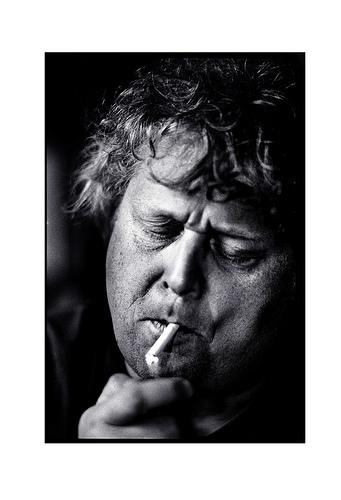
Rest in Peace: Theo van Gogh

It’s hard to believe we’ve arrived at a juncture where we have to explain all this stuff.  Again and again and again.

Peace is more than dreaming and singing songs.  Sometimes it requires courage.  In fact, it doesn’t mean much unless it does.  Otherwise, it’s just the easy pacifism of the non-combatant.

Some people “get it.”  Last March, Michael Gordon-Smith wrote for Australian Broadcasting wrote:

Ultimately, however, it’s not something to be made light of. It’s not a yawn. It mattered then and it matters now. Yusuf supported killing a man because someone took offence at what he had written.  …

But 20 years on Yusuf seems to think all the wrongs were done by others. Journalists asked him loaded questions. His replies were misinterpreted. It was the book, not the call for violence that “destroyed the harmony between peoples and created an unnecessary international crisis”.   At worst, his remarks were silly but they were dry English humour. …
He will probably sing Peace Train at his concerts:

Now I’ve been crying lately,
thinking about the world as it is
Why must we go on hating,
why can’t we live in bliss?

It’s time he stopped singing the question and answered it. He had an opportunity to stand for peace and tolerance when the need for such a voice was critical. Instead, when Geoffrey Robertson asked the question, he found no room for tolerance or doubt, but with dogmatic certainty took the side of violence and tyranny.

For me, it remains the most important thing he ever did. Unless he revisits the issue and finds room for difference, in my mind he’s forever defined by the choice he made in those weeks in 1989. The only message I hear from him is the echo of Khomeini’s threat not just to Salman Rushdie but to every free thinker in the world: If you speak your mind we may kill you.

It gets worse: More from Salman Rushdie

Share

Understandably depressed (Photo: Mae Ryan)

I posted yesterday about the appearance of Yusuf Islam — formerly Cat Stevens — at Jon Stewart‘s weekend rally (read it here).  Nick Cohen at Standpoint posted about Salman Rushdie‘s surprise that Stewart “had given a starring role at his ‘Rally for Sanity’ to a crooner who had previously opined that Rushdie deserved to die for deciding of his own free will to abandon Islam and criticise its texts.”  Actually, I thought the 1989 fatwa was specifically for Satanic Verses, but be that as it may…

Rushdie messaged him with more today:

I spoke to Jon Stewart about Yusuf Islam’s appearance. He said he was sorry it upset me, but really, it was plain that he was fine with it. Depressing.

We’ve come to a strange point when we have to explain the need to defend fundamental freedoms, such as non-violent freedom of expression.  Free speech begins where you offend me.  Otherwise it means nothing.  And it doesn’t matter whether Rushdie is past his prime, whether you ever liked his books, or whether you find his attitudes repugnant (in many cases, I do, though I find him brilliantly provocative, as well.)  And no one “asked for it” when it comes to a fatwa.

So I continue to link arms with Susan Sontag, Joseph Brodsky, Andrei Voznesensky, and others.

It’s sad that this kind of point even has to be explained in our “whatever” times, when lives are at stake.

Postscript on 11/14: The Atlantic weighs in — more here.