
[Film clip above deleted from Youtube for “copyright infringement.” Ummmm… how much “copyright infringement” can you have in 10 seconds?]
Salman Rushdie has spoken out against the appearance of Yusuf Islam (a.k.a. Cat Stevens) at a weekend rally: “I’ve always liked Stewart and Colbert but what on earth was Cat Yusuf Stevens Islam doing on that stage? If he’s a ‘good Muslim’ like Kareem Abdul-Jabbar then I’m the Great Pumpkin. Happy Halloween.” You may recall that the popular singer supported the fatwa against Rushdie, way back when.
The case of Cat Stevens/Yusuf Islam is a troubling one. He was one of my favorite singers in my misspent youth — one of those cases where I don’t want to believe the truth, either. I applaud his charity work for UNICEF, Palestinian refugees, and the children in Gaza. But the data on basic human freedoms are pretty damning.
This from the Observer‘s Andrew Anthony: “He told me in 1997, eight years after saying on TV that Rushdie should be lynched, that he was in favour of stoning women to death for adultery. He also reconfirmed his position on Rushdie. He set up the Islamic school in Brent, which is currently undergoing council-backed expansion. Its mission statement three years ago explicitly stated that its aim was to bring about the submission of the individual, the community and the world at large to Islam. For this aim it now receives state funding. Its an incubator of the most bonkers religious extremism and segregation, and is particularly strong on the public erasure of women. Why do people go to such lengths to ignore these aspects of Yusuf Islam’s character and philosophy?”
A recap: While I don’t care for the hectoring tone of the BBC inquisition by Geoffrey Robertson, Queen’s Counsel, the 1989 grilling is here. An excerpt:
Robertson: You don’t think that this man deserves to die?
Y. Islam: Who, Salman Rushdie?
Robertson: Yes.
Y. Islam: Yes, yes.
Robertson: And do you have a duty to be his executioner?
Y. Islam: Uh, no, not necessarily, unless we were in an Islamic state and I was ordered by a judge or by the authority to carry out such an act – perhaps, yes.
[Later, Robertson discusses a protest where an effigy of Rushdie is to be burned]
Robertson: Would you be part of that protest, Yusuf Islam, would you go to a demonstration where you knew that an effigy was going to be burned?
Y. Islam: I would have hoped that it’d be the real thing.
Troubling, also, is the disappearance of Rushdie’s youtube comments here and here and here, due to “copyright claims by Yusuf Islam.” How much of a copyright infringement can you do in 10 seconds? (Isn’t ten seconds of anything fair use?)
I’d like to believe that the singer’s objections to these youtube clips signals a reconsideration of views. But a low-key objection (let alone legal threats) is not enough at this point; what is needed is a full repudiation.
In 2007, Rushdie wrote a letter to the Sunday Telegraph:
However much Cat Stevens/Yusuf Islam may wish to rewrite his past, he was neither misunderstood nor misquoted over his views on the Khomeini fatwa against The Satanic Verses (Seven, April 29). In an article in The New York Times on May 22, 1989, Craig R Whitney reported Stevens/Islam saying on a British television programme “that rather than go to a demonstration to burn an effigy of the author Salman Rushdie, ‘I would have hoped that it’d be the real thing’.”
He added that “if Mr Rushdie turned up at his doorstep looking for help, ‘I might ring somebody who might do more damage to him than he would like. I’d try to phone the Ayatollah Khomeini and tell him exactly where this man is’.”
In a subsequent interview with The New York Times, Mr Whitney added, Stevens/Islam, who had seen a preview of the programme, said that he “stood by his comments”.
Let’s have no more rubbish about how “green” and innocent this man was.
All in all, his Saturday appearance was a strange way to revel in sanity. His appearance in a rally to celebrate post-modern irony goes beyond irony — especially remembering the solidarity of Susan Sontag, Joseph Brodsky, Andrei Voznesensky, Tariq Ali, Adam Michnik, Harold Pinter, and many, many others in 1989. Mr. Yusuf, I still love your music, but… I’ll stand by Rushdie, even though I don’t like him much.
Am I missing something in this picture? Please let me know.
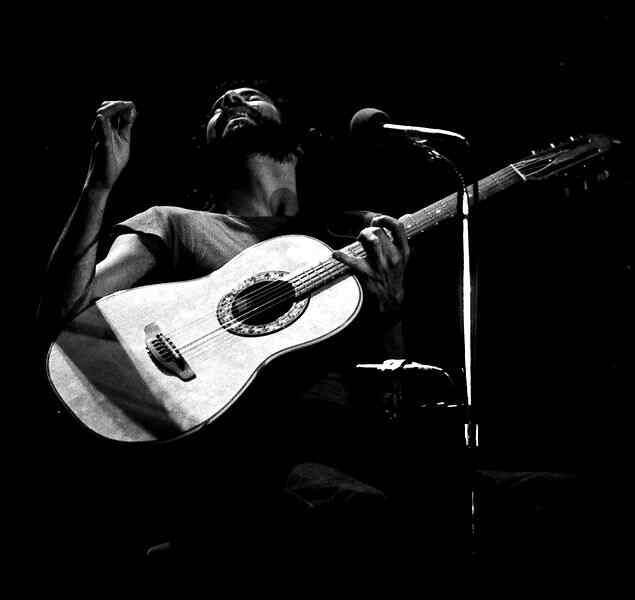
Cat Stevens/Yusuf Muslim sings “Peace Train.” Rushdie remains in hiding.
Postscript on 11/2: More dispiriting news from Rushdie posted above, here.
Postscript on 11/14: The Atlantic weighs in — more here.