
The first case of real forgiveness ever? Maybe so. My talk on René Girard at Notre Dame.

Share

Giovanni Maria Bottala’s “Joseph Sold by His Brothers,” circa 1636-42

On September 23, I was honored to be invited to Notre Dame to deliver the inaugural Church Life Journal lecture on “René Girard and the Present Moment.” The talk is now up here

An excerpt:

Roughly 200 billion tweets appear every year. And 100 million hours of videos are watched on Facebook daily, and more than 250 billion photos have been uploaded to Facebook. Reaction time gets faster and faster, and we are free to vent our worst side, our unconsidered selves, on more and more platforms. We excuse our daily defamation as harmless, but it is not. It changes us.
In this environment, how difficult to hold to Girard’s injunction of total non-retaliation! …

We have some good precedents: Girard often described the story of the Old Testament Joseph, son of Jacob, bound and sold into slavery by his mob of ten envious and resentful half-brothers. He called it a counter-mythical story, because in myth, the lynchers are always satisfied with their lynching. But here, the story takes a different twist. Initially, the brothers plan to kill Joseph, but one of them, Judah, has the idea to sell him into slavery instead. However, Joseph reestablishes himself as one of the leaders of Egypt and then tearfully forgives his brothers in a dramatic reconciliation. Its full description of forgiveness is, Girard claimed, the first in all of history, in its sophistication and nuance. I haven’t been able to disprove him yet.

I recommend Robert Alter‘s magnificent retelling, with annotation, of the story in his Genesis. The read is absolutely gripping, a page-turner, with very careful breakdown of the dialogue. Before his self-revelation, Joseph tries his half-brothers with several ordeals, and demands that they bring him their youngest brother, Benjamin. He is cautiously testing his half-brothers with Benjamin, the only other child of Jacob’s beloved Rachel, born of the rivalry that poisoned the family. After all, he does not know whether they have killed Benjamin, too. Why would they not?
But the figure who is at least as riveting, to me, is Judah—the very brother who had the idea to monetize the elimination of his brother. During the dialogue, he is transformed. He says his father’s heart would break with the loss of Benjamin—he who had maliciously, recklessly shredded his father’s heart before, accepts the bitter pill of his father’s outrageous favoritism, and begs to offer himself as a slave instead.

The wailing of Joseph in the recognition scene is so loud and unrestrained that, as it is written, “the Egyptians heard and the house of Pharoah heard.” We all admire Joseph, we imagine we would like to be like him – but who wants to be Judah in his culpability, in his callousness, in his repentance, and his anguish? Yet the Jewish people are named for him.


Read the rest here.

“The beating heart of good prose”: Robert Alter on rhythm and translating the Hebrew Bible

Share

Alter at Berkeley’s Heyday (Photo: Wendy Ruebman)

This week, Berkeley’s Robert Alter honored a lunchtime gathering at Heyday Books with his gentle presence and his scholarly wisdom – just in time for Purim. Alter is the translator of the surprise hit of the year: the new acclaimed 3,500-page Hebrew Bible (Norton). (We’ve written about his work here and here.) He’s also the author of Princeton’s The Art of Bible Translation.

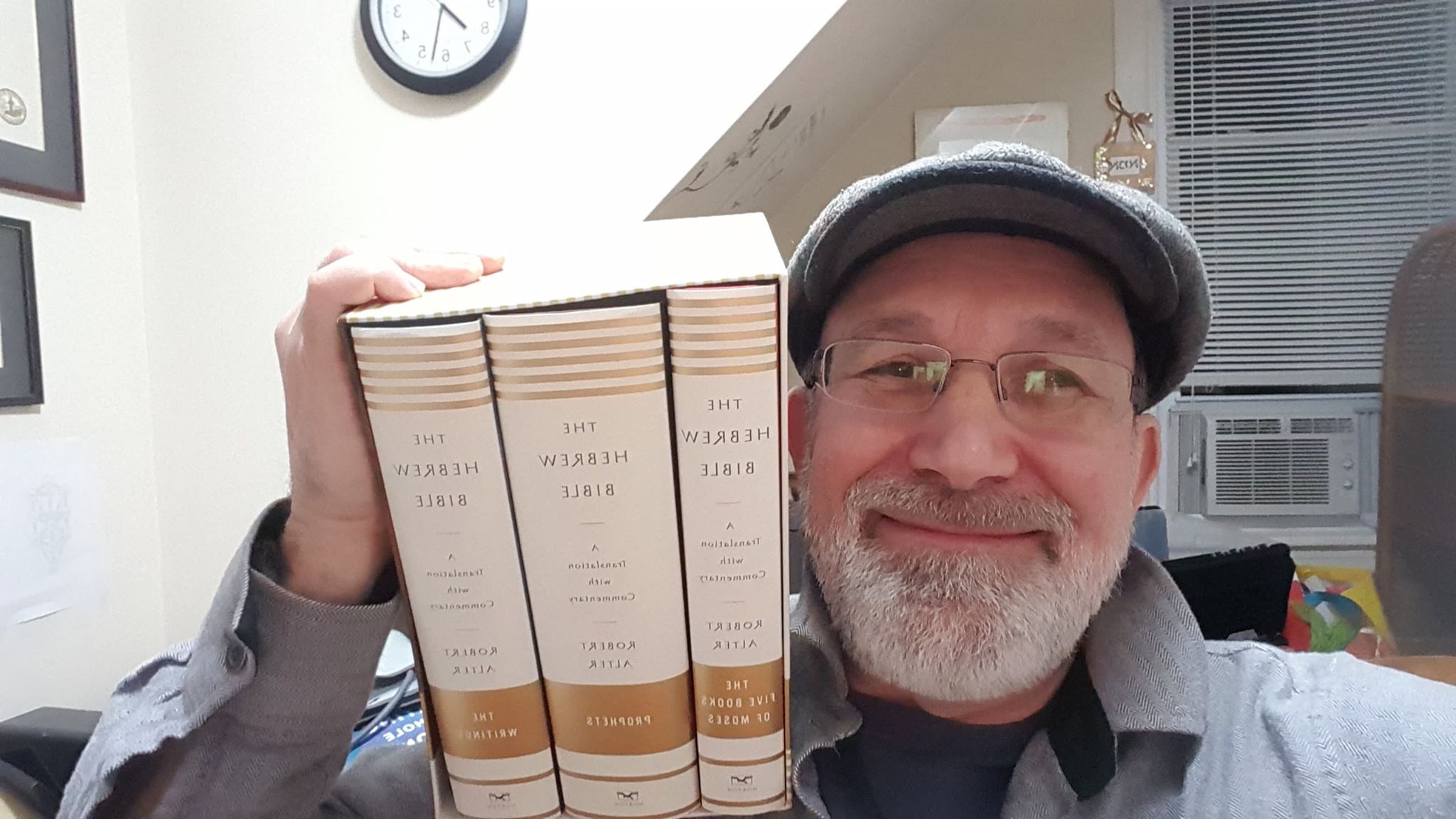
I’ve been a big fan since I read his translation of Genesis more than two decades ago, and so I lugged my big-splurge purchase of 2019, the three-volume set, for his signature. (Gauche, I know, but I couldn’t resist – he only signed one volume before he rushed off to pick up his wife.)

The largely atheist/agnostic/”none” crowd was skeptical of the foundational masterpiece of Western civilization, but in a short hour or so, the amiable, learned Alter had them eating out of his hand. Rhythm, he said, is “the beating heart of good prose” and “not merely decorative.” He spoke about the iambic rhythm of Shakespeare, Milton, and Melville – “it wasn’t just icing on the cake for Melville” – and the intricacies of replicating the rhythm of ancient Hebrew. He decried “the dumbed-down modern versions – and they’re all dumbed-down.” He had to “scrape off the theological veneer” for “the detective work of language.”

I had a chance to chat with him for a few minutes before his talk. I mentioned that René Girard calls the Genesis story of Joseph the first representation of forgiveness, as something more than letting go of a debt or not clubbing an enemy, after all. Alter didn’t disagree, but he pointed out that the Old Testament also shows the first hero who changes over time, i.e., “character development.” To wit: the patriarch Jacob, who begins as a trickster on the make, ends by being tricked himself, and suffers cruel loss and bereavement. On his deathbed – humbled, broken, mourning – he says: “Few and evil have been the days of the years of my life, and they have not attained the days of the years of my fathers in their days of sojourning” (in Alter’s translation, of course). Ancient heroes like Ulysses don’t do that – when he gets back home to Ithaca after twenty years  he turns right back and heads for the sea again. (Dante condemned it, though Tennyson rendered it as an act of heroism.)

In his introduction, Heyday publisher Steve Wasserman called Alter “enviably erudite and lovely.” He is, he is.

How the Bible is like Franz Kafka

Share

Alter’s predecessor, by Dürer

Is Robert Alter the Jerome of the new millennium? I rather think he is, and I’m in good company. My friend, the poet and ctitic Adam Kirsch, has a review at the newest issue of the Jewish magazine, Tabletand will pretty much convince the fence-sitters it is so: “Translating the entire Bible single-handed—a text of more than 3,000 pages, in this edition—is a scholarly and literary feat that puts Alter in the company of legendary figures such as Jerome, whose Latin translation of the Bible was adopted by the Catholic Church, and Martin Luther, whose German version helped to fuel the growth of Protestantism.”

The Alter Bible has been issued in installments since 1997, first Genesis and then The David Story. I lost track after that (but wrote about it here). Now is my chance to catch up.

An excerpt:

The Bible is a refractory book, never behaving quite as we expect it to. Indeed, much of the creativity of Jewish tradition has been devoted to harmonizing the actual Bible with Judaism’s changing expectations of what it should be. The rabbinic genre of midrash tries to make sense of the text’s many narrative contradictions and ethical perplexities. The Talmud assumes that every word in the Torah is there to teach a point of halacha, while Maimonides insisted that the Bible actually teaches the same truths as Greek philosophy, though it uses an allegorical method that can easily mislead the ignorant. And the mystical Zohar, written in medieval Spain, says that if all there were to the Torah were its surface meaning, it would be easy to write a better book: It is only the hidden, esoteric content of the Torah that makes it sacred.

The one thing the Bible could not be, for most Jews throughout history and many still today, is mere literature. After all, literature is a secular art, a product of the human imagination, while the Bible is supposed to be a sacred text, the product of divine inspiration. Perhaps the first person to openly suggest otherwise was Baruch Spinoza, the 17th-century Jewish philosopher, who daringly wrote that the books of the Bible ought to be studied in just the same way we would study Greek and Italian poetry.

I met Adam on a bus in Pennsylvania, actually…

Robert Alter’s newly completed English translation of the Hebrew Bible shows what it means to take the idea of the Bible as literature seriously. For Alter, the most important thing for a translator to know about the Bible is that its authors were great literary artists. This doesn’t mean that they lacked a religious purpose, of course; but it does mean that they paid close attention to literary technique, without which their writing might never have become canonical in the first place. Getting the Bible right, for Alter, means offering the English reader a literary and aesthetic experience that comes as close as possible to the Hebrew reader’s.

He also tackles a gripe I’ve had for some time, and insists, as I do, that it should be considered as an anthology and not a single book. I thought that would have been self-evident by now, but people are continually claiming that “the Bible says that.” What can I do, but grab them and shake them by the shoulders, shouting: “Which book? Who said it? And when was it written, by whom, and under what historical circumstances?”

Adam Kirsch again:

The rabbi gets first dibs…

Another strength of Alter’s translation is the way it conveys the Bible’s internal diversity, and the tensions it can cause. Bible, in English, is a singular noun, and we refer to the Bible as “a” book. But the word comes from a Greek plural, biblia, and one of the traditional Jewish names for the Bible is “the twenty-four books.” This plurality gets lost when we think of the Bible as one big book, and implicitly expect from it some kind of stylistic and theological unity. This expectation is reinforced by the idea that all the parts of the Bible stem ultimately from the same author, God (even if Jewish tradition holds that different books were written by different people: The Book of Job by Moses, the Psalms by David.

Yet the Bible disappoints this expectation of unity at every turn. Written over a period of five or more centuries by dozens of different authors, it is best thought of as anthology rather than a book: verse and prose, myth and history, genealogical catalogues and territorial surveys, architectural measurements and erotic poetry. Even individual sections of the Bible are full of narrative inconsistencies and duplications that suggest they are combinations of several different texts. (Abraham goes to Egypt and pretends Sarah is his sister on two occasions; Noah is told to take two of each species of animal on board the ark, then in the next sentence to take seven of each.) Spinoza doubted that the true origins of the Bible could ever be discovered, but modern scholarship has gone a long way to proving him wrong, discerning different layers in the text that reflect various origins and agendas.

Read the whole thing here.

Now I will have to find a way of coughing up $75 for the three new volumes. My friend the rabbi, David Goodman of Philadelphia, already has, and my teeth grind in jealousy. “I couldn’t resist,” he confessed.

You thought I was pulling your leg with that headline, didn’t you? Below, Berkeley’s Robert Alter describes how the Bible is like Franz Kafka – and shares his beefs about other translations.

Robert Alter on translating the Old Testament, Hebrew, and “the greatest poetry in the whole ancient world”

Share
????????????????????????????????????

Translator extraordinaire

I’ve long been a fan of Robert Alter’s Old Testament translations, ever since the 1990s. Frank Kermode is another apparently. He concluded in the New York Review of Books: “I cannot say that this is the best translation since 1611, only because I have not read the great mass of those that intervened; but I can say that in my opinion it is certainly a great translation, to be honorably compared with the admired Homeric translations of recent years.” John Updike waxed lyrical in The New Yorker:  “The ferocity of this tribal God measures the ferocity of tribal existence. … The miracle of the Pentateuch is that, unlike the numerous other tribes and gods that vitally figure in it, the Jews and their God have survived three millennia. The Israelites’ effort to claim and maintain their Promised Land fuels a contemporary crisis and occupies today’s painful headlines.” 

I was pleased that the Chicago Manual of Style blog “Shop Talk” recently interviewed the Berkeley translator. A few excerpts:


genesisCMOS:
 You have now translated a large portion of the Hebrew Bible into English. What motivated you to take on such an enormous, high-profile, high-stakes project?

RA: I have to say that it really sneaked up on me. That is, I was dissatisfied with the existing translations, and I thought, well, I’ll give a whirl at translating Genesis and see if I can do something about the English that would make it exhibit more of the stylistic power of the Hebrew. I was rather unsure that this was going to work, but I figured it was worth a try. And it turned out to work better than I thought it would. Not that I ever think that my translations are perfect, but it got some very good responses: a rave review in the New York Times and that kind of thing. So I thought I’d do one other book that I like, and I translated Samuel, basically the David story, and that also got a nice response, and then I was kind of talked into doing the Five Books of Moses by my editor at Norton. And then because it was perceived as a fundamental building block of the whole Bible, it got reviewed all over in places I’d never been reviewed before like the New Yorker and the New York Review of Books. So there I was. Up until a certain point I wasn’t thinking of doing the whole Bible, but then I looked back and said, “Hey, I’ve done about two-thirds of it, so I might as well go on and do the whole.”

songofsongsCMOS: Are there passages in your translations that you’re particularly proud of?
RA: I’m quite happy with my translation of Job, which I think is among the greatest poetry in the whole ancient world. I’m really happy with the way Job’s death-wish poem turned out, and I feel good about my rendering of the Voice from the Whirlwind. The very beginning of Genesis—which is the grand, stately prose of the writer identified by scholars as the “priestly writer”—I think that I’ve gotten something of the rhythms of that writer. And I think Jonathan Lear mentioned in his introduction the sound-play of the Hebrew phrase for chaos: Tohu Wabohu. And I’m happy with the alliteration of welter and waste.

CMOS: Are there any other translators whom you particularly admire? Do you ever find yourself emulating aspects of their work?

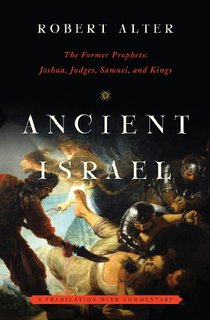
israelRA: The only English translation I honestly admire is the King James Version. You can’t directly adopt it, because the language is four hundred years old and there are lots of errors in understanding the Hebrew in the King James Version. Sometimes the seventeenth-century translators did wonderful things with the Hebrew because they had a great sense of the English language, but there are lots of lines that are clunky, where they seem not to have paid attention to how the Hebrew sounds. So there’s my qualified admiration of the King James Version. The various modern English versions I really don’t like at all. I think they have a very shaky sense of English style, and they don’t pay attention to things they ought to in the Hebrew. My one exception to this sweeping objection is that sometimes on the level of a single word, if I’m struggling to find a good English equivalent, I’ll look at a couple of other translations and say—oh, that word works better than the word I had come up with. (I never look at the other translations until I finish a draft of a section.) But that’s not exactly emulation.

Read the whole thing here.