

How the Bible is like Franz Kafka

Share

Alter’s predecessor, by Dürer

Is Robert Alter the Jerome of the new millennium? I rather think he is, and I’m in good company. My friend, the poet and ctitic Adam Kirsch, has a review at the newest issue of the Jewish magazine, Tabletand will pretty much convince the fence-sitters it is so: “Translating the entire Bible single-handed—a text of more than 3,000 pages, in this edition—is a scholarly and literary feat that puts Alter in the company of legendary figures such as Jerome, whose Latin translation of the Bible was adopted by the Catholic Church, and Martin Luther, whose German version helped to fuel the growth of Protestantism.”

The Alter Bible has been issued in installments since 1997, first Genesis and then The David Story. I lost track after that (but wrote about it here). Now is my chance to catch up.

An excerpt:

The Bible is a refractory book, never behaving quite as we expect it to. Indeed, much of the creativity of Jewish tradition has been devoted to harmonizing the actual Bible with Judaism’s changing expectations of what it should be. The rabbinic genre of midrash tries to make sense of the text’s many narrative contradictions and ethical perplexities. The Talmud assumes that every word in the Torah is there to teach a point of halacha, while Maimonides insisted that the Bible actually teaches the same truths as Greek philosophy, though it uses an allegorical method that can easily mislead the ignorant. And the mystical Zohar, written in medieval Spain, says that if all there were to the Torah were its surface meaning, it would be easy to write a better book: It is only the hidden, esoteric content of the Torah that makes it sacred.

The one thing the Bible could not be, for most Jews throughout history and many still today, is mere literature. After all, literature is a secular art, a product of the human imagination, while the Bible is supposed to be a sacred text, the product of divine inspiration. Perhaps the first person to openly suggest otherwise was Baruch Spinoza, the 17th-century Jewish philosopher, who daringly wrote that the books of the Bible ought to be studied in just the same way we would study Greek and Italian poetry.
I met Adam on a bus in Pennsylvania, actually…

Robert Alter’s newly completed English translation of the Hebrew Bible shows what it means to take the idea of the Bible as literature seriously. For Alter, the most important thing for a translator to know about the Bible is that its authors were great literary artists. This doesn’t mean that they lacked a religious purpose, of course; but it does mean that they paid close attention to literary technique, without which their writing might never have become canonical in the first place. Getting the Bible right, for Alter, means offering the English reader a literary and aesthetic experience that comes as close as possible to the Hebrew reader’s.

He also tackles a gripe I’ve had for some time, and insists, as I do, that it should be considered as an anthology and not a single book. I thought that would have been self-evident by now, but people are continually claiming that “the Bible says that.” What can I do, but grab them and shake them by the shoulders, shouting: “Which book? Who said it? And when was it written, by whom, and under what historical circumstances?”

Adam Kirsch again:

The rabbi gets first dibs…

Another strength of Alter’s translation is the way it conveys the Bible’s internal diversity, and the tensions it can cause. Bible, in English, is a singular noun, and we refer to the Bible as “a” book. But the word comes from a Greek plural, biblia, and one of the traditional Jewish names for the Bible is “the twenty-four books.” This plurality gets lost when we think of the Bible as one big book, and implicitly expect from it some kind of stylistic and theological unity. This expectation is reinforced by the idea that all the parts of the Bible stem ultimately from the same author, God (even if Jewish tradition holds that different books were written by different people: The Book of Job by Moses, the Psalms by David.

Yet the Bible disappoints this expectation of unity at every turn. Written over a period of five or more centuries by dozens of different authors, it is best thought of as anthology rather than a book: verse and prose, myth and history, genealogical catalogues and territorial surveys, architectural measurements and erotic poetry. Even individual sections of the Bible are full of narrative inconsistencies and duplications that suggest they are combinations of several different texts. (Abraham goes to Egypt and pretends Sarah is his sister on two occasions; Noah is told to take two of each species of animal on board the ark, then in the next sentence to take seven of each.) Spinoza doubted that the true origins of the Bible could ever be discovered, but modern scholarship has gone a long way to proving him wrong, discerning different layers in the text that reflect various origins and agendas.

Read the whole thing here.

Now I will have to find a way of coughing up $75 for the three new volumes. My friend the rabbi, David Goodman of Philadelphia, already has, and my teeth grind in jealousy. “I couldn’t resist,” he confessed.

You thought I was pulling your leg with that headline, didn’t you? Below, Berkeley’s Robert Alter describes how the Bible is like Franz Kafka – and shares his beefs about other translations.
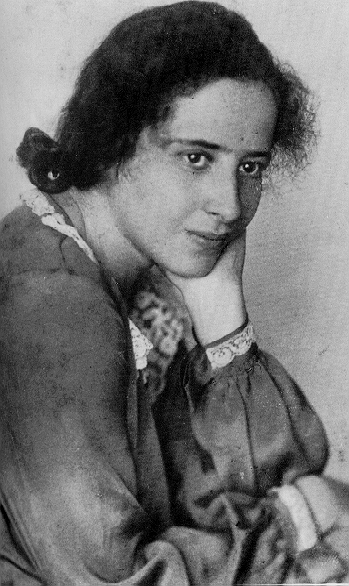

New short biography of Hannah Arendt: “Her hope for the world lay in ‘natality.'”

Share
Hannah_Arendt1

A photo from before the dark times.

I don’t follow publishing news very closely (I know I should), but I was disappointed when the Penguin Lives series, edited by James Atlas, disappeared shortly after I became aware of it. In the olden days, before I became a blogger, I used to gulp down biographies like dark chocolate, and the short format (about 200 pages) made these books bite-sized. According to the Observer:

The Penguin Lives boutique biography series – a collaboration between Viking publishing, former New York Times Magazine editor James Atlas and former deputy mayor and financier Kenneth Lipper – is kaput.

Mr. Atlas, the general editor for Penguin Lives, told Off the Record that after publishing 22 of the diminutive, handsomely designed hardcover books pairing noted authors with an eclectic range of subjects ranging from Napoleon to Rosa Parks, Viking – a division of Penguin-Putnam – has decided to pull out of the venture.

“They’re closing it down. No real explanation was given,” Mr. Atlas said. “It was a question of its place in the corporate structure. It fit well, but it didn’t always fit well.”

Well, there you have it. That was a dozen years ago. Shows how up-to-date I am. Cut away to a few weeks ago when I received a notice of a package at the Stanford Post office. I tore open the package on my way to a meeting. A book by Hannah Arendt about “dark times.” I assumed it was a fancy new reissue of her Men in Dark Times – I wrote about that here, and assumed it would return me to that time “when there was only wrong and no outrage.” I figured my earlier post and been flagged by some ‘bot for a publishers’ mailing list. So I added the book to a tall pile for future perusal.

Wrong! The book is a short (134 pages) new biography of the philosopher by Anne C. HellerA Life in Dark TimesIt’s one of the short biographies issued in a new Amazon Publishing series called “Icons” (more here.) Seven of the eleven “inaugural” titles have already been published. Next on the list: Karen Armstrong takes on St. Paul, and Brooke Allen writes about Benazir Bhutto. What a good idea this is! It is still a good idea! And the Arendt book had a release date of only four days ago, so I’m just in time!

According to Adam Kirsch (we’ve written about him here and here), “Hannah Arendt was one of the most compelling and provocative thinkers of her time, and she remains indispensable today. In this lucid, accessible biography, Anne Heller shows how Arendt’s eventful life – shaped by war and exile, love and friendship – gave rise to her most important insights into politics and the nature of evil.”

I found this passage in the last chapter, at the end of her life. It is not about dark times – I hear enough about those already in the news – but rather about miracles. And couldn’t we all use one about now?

Arendt-KellerHer hope for the world lay in “natality,” “the miracle that saves the world,” she wrote, by which she meant the unimaginable possibilities that attend every human birth and must be safeguarded until they can reach full flower. “The beginning is also a god; so long as he dwells among men, he saves all things,” she noted, quoting Plato in her 1971 tribute to Martin Heidegger upon his eightieth birthday. And as she would write poignantly in her last book, The Life of the Mind, published after her death in 1978:
In this world which we enter, appearing from a nowhere, and from which we disappear into a nowhere, Being and Appearing coincide. … Seen from the viewpoint of the spectators to whom [a human life] appears and from whose view it finally disappears, each individual life, its growth and decline, is a developmental process in which an entity unfolds itself in an upward movement until all its properties are fully exposed; this phase is followed by a period of standstill – its bloom or epiphany, as it were – which in turn is succeeded by the downward movement of disintegration that is terminated by complete disappearance.

The human soul is born to make an appearance on a public stage, Arendt seemed to have concluded in her later years, and to become most vibrantly itself in a shared world. For her, authenticity did not require withdrawal from noisy modernity into the solitude of Being, as it did for Heidegger, but neither did it permit taking action without standing back and thinking about “what is.” And in her later years what is always encompassed the point of view of people different, even alien, from oneself.

Arendt’s Eichmann in Jerusalem turns 50 – and it’s still controversial

Share

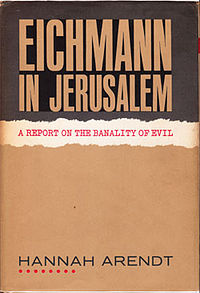
eichmannHannah Arendt‘s Eichmann in Jerusalem was published fifty years ago, in 1963, and it’s still provoking controversy.  The New York Times offers two interesting takes: one from poet-critic Adam Kirsch, the other from author Rivka Galchen, who incidentally, was a recipient of the William J. Saroyan International Prize for Fiction (we wrote about the prize here). Both focus on the use of language.

Kirsch argues that she’s misunderstood. Many objected to the inflammatory tone, but for Arendt, the medium is the message: “It’s not hard to see that for Arendt, this stringency was a form of respect. By holding Jews to what she conceived to be the highest professional and personal standards, she was treating them as full moral persons. For Eichmann, on the other hand, she had only contempt, refusing even to dignify him with hatred: He appears in the book only as a bumbling mediocrity, ‘genuinely incapable of uttering a single sentence that was not a cliché.’ But it’s also easy to understand how this tactic could appear, to readers still traumatized by the Holocaust, as an arrogant inversion placing blame on the victim while minimizing the criminality of the criminal. Eichmann would be a better book, perhaps, if Arendt were not so intent on demonstrating mastery over her material, and could admit that at times the only adequate response to the Holocaust was mute pity and terror.'”

Kirsch points out that the book has been, at times, a litmus test for gentile and Jewish sensibilities. Arendt’s chum Mary McCarthy characterized the book as “a paean of transcendence, heavenly music, like that of the final chorus of Figaro or the Messiah“; Saul Bellow accused Arendt of “making use of a tragic history to promote the foolish ideas of Weimar intellectuals.”  Well, as we pointed out earlier, he didn’t like her much.

Hannah_Arendt1

She fled the Nazis twice, in 1933 and 1940.

Galchen writes that “Eichmann spoke in a mix of canned speech, officialese and repetitions of his own formulations. Arendt sees this as a symptom and an abettor of his variety of evil. ‘The longer one listened to him,’ she wrote, ‘the more obvious it became that his inability to speak was closely connected with an inability to think, namely, to think from the standpoint of somebody else.’”

She continued: “Nearly 15 years after the publication of Eichmann in Jerusalem, Arendt wrote another long essay for The New Yorker, ‘Thinking,’ in which she tried to clarify and further analyze the ‘thoughtlessness’ of Eichmann. ‘Clichés, stock phrases, adherence to conventional, standardized codes of expression and conduct have the socially recognized function of protecting us against reality; that is, against the claim on our thinking attention which all events and facts make by virtue of their existence,’ she wrote. ‘If we were responsive to this claim all the time, we would soon be exhausted; Eichmann differed from the rest of us only in that clearly he knew of no such claim at all.'”

Buried in the comments section is an unusual reminiscence from Rudy Wein: “I had lunch with Hannah Arendt not all that long after the publication of Eichmann in Jerusalem. I had read the New Yorker article, but was completely ignorant of the controversy. I was no doubt a soothing lunch companion, since I told her that I understood what she had in mind with ‘the banality of evil’ and agreed with her. So let me say, as no one really does in the above, what I think she meant by the banality of evil – that is the banality of Eichmann’s doing evil. And let me do so by pointing to the doing of evil that is not banal. Start with fiction: the baddies in the film Metropolis are explicitly, consciously aiming to kill, maim, undo those underground workers. Not banal. Himmler aimed at rounding up Jews, starving and killing them. Yes, he did what Hitler wanted done, but he was not following orders first and doing evil as a result; he aimed at doing that evil because he wanted it to happen. Eichmann, on the other hand, if anything like Arendt’s depiction is correct, followed orders first or, worse, induced what his superiors wanted done, for the sake of being the kind of bureaucrat that would be praised and, above all, be promoted. If doing good deeds would have accomplished that goal, Eichmann would have done good deeds. The fact of his evil’s banality doesn’t make it less evil or excuse it and, as I recall, Arendt agreed that Eichmann’s death sentence was fully justified.”

Read the whole thing here. And below, Margarethe von Trotta‘s 2012 film, Hannah Arendt, starring Barbara Sukowa, pretty much makes the case for Galchen and Kirsch: