
René Girard: “Today envy is the emotion which plays the greatest role in our society.”

Share

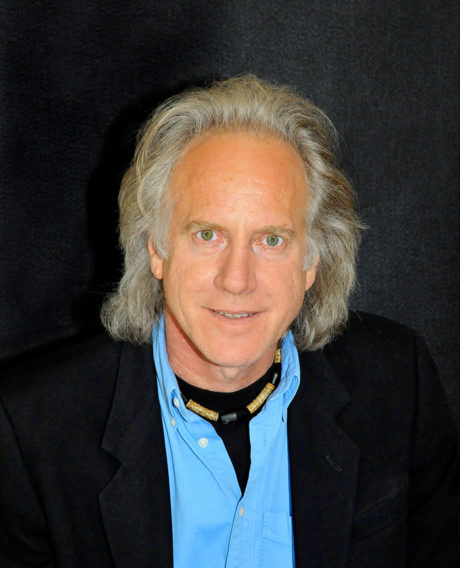
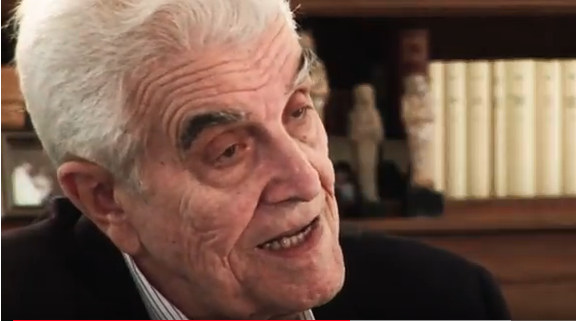
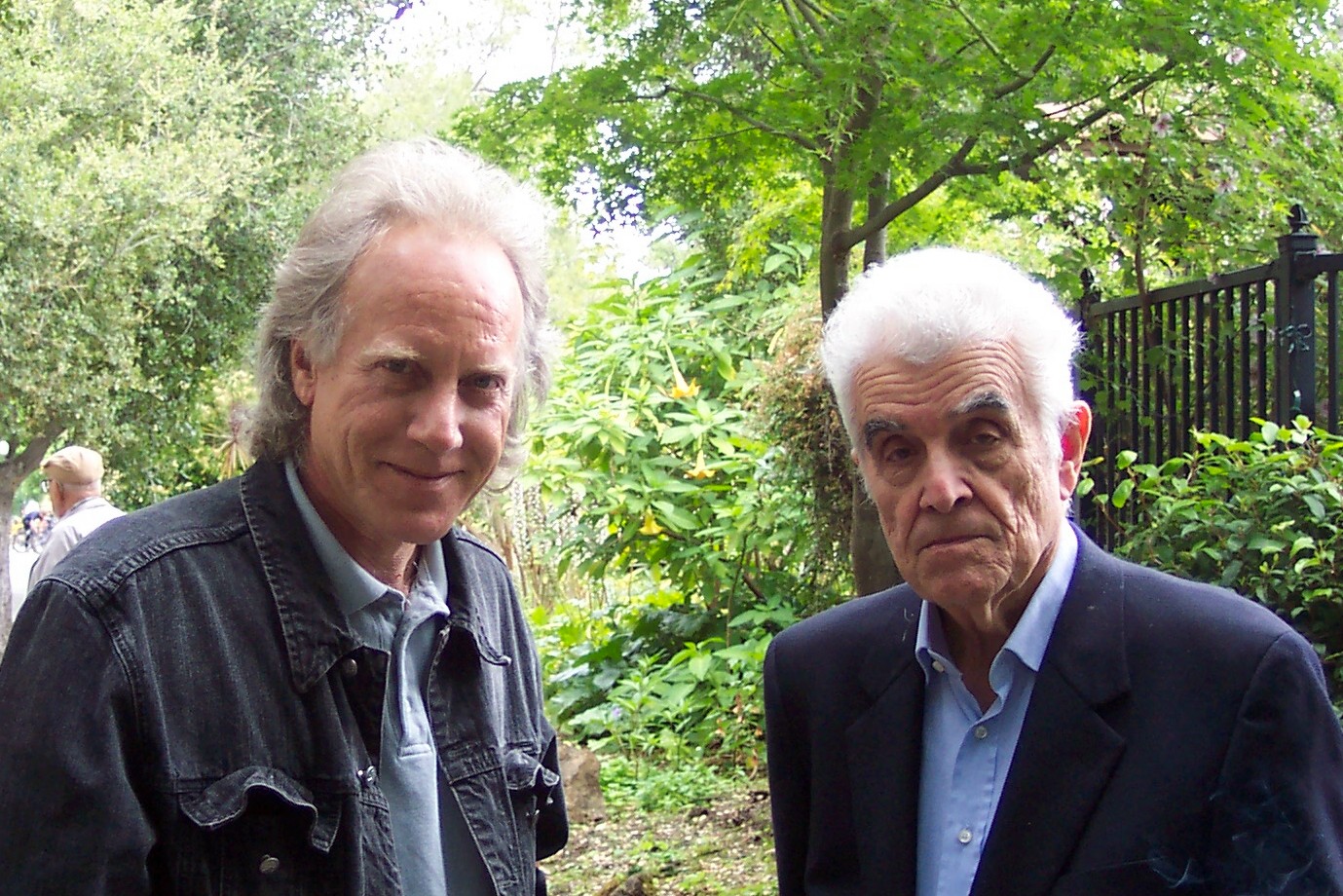
Robert Harrison with René Girard outside the Stanford Faculty Club (Photo: Ewa Domańska)

Here’s some good news for the holidays! My Evolution of Desire: A Life of René Girard has been named one of the San Francisco Chronicle‘s top books of 2018! You can read about it here. We can’t think of a better Christmas present. But there’s more good news.

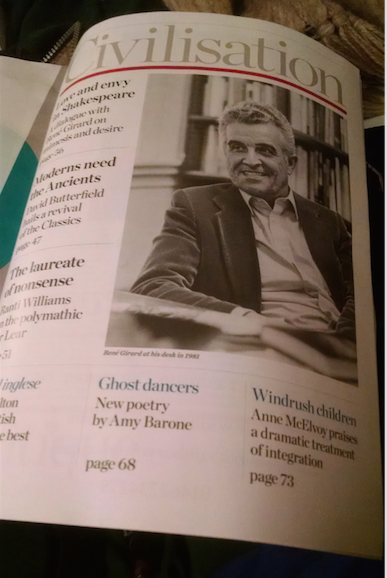
We wrote about Robert Pogue Harrison’s New York Review of Books essay, “Prophet of Envy,” on French theorist René Girard. We’ve also written about his Entitled Opinions radio show and podcasts. The year-end double issue of the U.K.’s  Standpoint has published a transcript of one of his 2005 Entitled Opinions interviews with his Stanford colleague – and with a line on the cover, too! (See right.) Excerpt below:

Robert Pogue Harrison: The founding adage of western philosophy is “know thyself.” That’s not an easy proposition. To know yourself means, above all, to know your desire. Desires lurk at the heart of our behavior, determine our motivations, organise our social relations, and inform our politics, religions, ideologies, and conflicts. Yet nothing is more mysterious, elusive, or perverse than human desire.

Our government invests billions of dollars in scientific research every year so we might better understand the world of nature, so that we might continue our pursuit of knowledge, yet commits only a tiny fraction of that to advancing the cause of self-knowledge. Most of our major problems today are as old as the world itself. The problem of reciprocal violence, for example. You would think we would want to understand its mechanisms, its psychology, and its tendencies to spiral out of control. Instead, we keep on perpetuating its cycles much the way our ancestors have done for centuries, and even millennia. Nor are we any closer to knowing the deeper layers of our conflicting and conflict-generating desires than they were.

René, your work has an enormous reach. It branches out into various areas and disciplines — literary criticism, anthropology, religious studies, and so forth. Today, I’d like to focus on what I take to be the foundational concept of all your thinking, namely mimetic desire. Can you tell our listeners exactly what you mean by that term?

René Girard: Mimetic desire is when our choice is not determined by the object itself, as we normally believe, but by another person. We imitate the other person, and this is what “mimetic” means. For example: why have all the girls been baring their navels for the last five years? Obviously, they didn’t all decide by themselves that it would be nice to show one’s navel — or that maybe that one’s navel is too warm, and one must do something about it.

One of San Francisco Chronicle’s top books for 2018

We’ll see the mimetic nature of that desire the day that fashion collapses. Suddenly, it will be a very old-fashioned to show one’s navel and no one will show it any more. And it will all happen because of other people — just as now, it is because of other people that they show it.

RPH: But how far do you want to go in saying that desire — by its very nature, and in human beings — is fundamentally mimetic?

RG: Maybe one can start from this question: what is the difference between need, appetite, and desire? Need is an appetite all animals have. We know very well that if we are alone in the Sahara Desert and we are thirsty, we don’t need a model to want to drink. It’s a need that we have to satisfy. But most of our desires in a civilised society are not like that.

Think of vanity, or snobbery. What is snobbery? In snobbery, you desire something not because you really had an appetite for it, but because you think you look smarter, you look more fashionable, if you imitate the man who desires that object, or who also pretends to desire it.

 And later in the interview…

RPH:  I asked in my opening remarks about why can’t we have an institution devoted strictly to the study of vengeance, for example, and work out its logic — reciprocal violence, these kinds of things. We are far from overcoming the behaviour that has characterised human history throughout the centuries.

But let’s move on to another emotion, which is closely linked, obviously, to hatred, vengeance, and jealousy, namely envy. I think envy is a highly underestimated emotion in the human relations. How do you see the role of envy?

RG:
 I see it the same way. Today envy is the emotion which plays the greatest role in our society, where everything is directed towards money. Therefore you envy the people who have more than you have. You cannot talk about your envy. I think the reason we talk so much about sex is that we don’t dare talk about envy. The real repression is the repression of envy.
And of course, envy is mimetic. You cannot help imitating your model. If you want money very badly, you’re going to enter the same business as the man who is your model. More likely than not, you will be destroyed by strength. So when people talk about masochism and so forth, they are still talking about mimetic desire. They are talking about how we move always to the greatest strength in the direction of the desire we envy most. We do so because that power is greater than ours — and it’s probably going to defeat us again. So there will be what Freud calls repetition in psychological life, which is linked to the fact that we’re obsessed with what has defeated us the first time. Our victorious rival in lovemaking becomes a permanent model. So novelists like Dostoevsky and Cervantes will show you characters who literally asked their rival to choose for them the girl they should love.

Read the whole thing here

Postscript on 12/18: The actual, physical copies of Standpoint arrived in my Stanford p.o. box today. It’s beauuu-ti-ful! (See photo at left.) Moreover, “Love and Envy in Shakespeare: A Dialogue with René Girard on Mimesis and Desire” leads the “Civilisation” section of the magazine. Thanks to Daniel Johnson and the London staff of Standpoint magazine. What fine work you do! And what a splendid Christmas present – not just for me, but for all of us!

Praise for Evolution of Desire: A Life of René Girard in the New York Review of Books!

Share

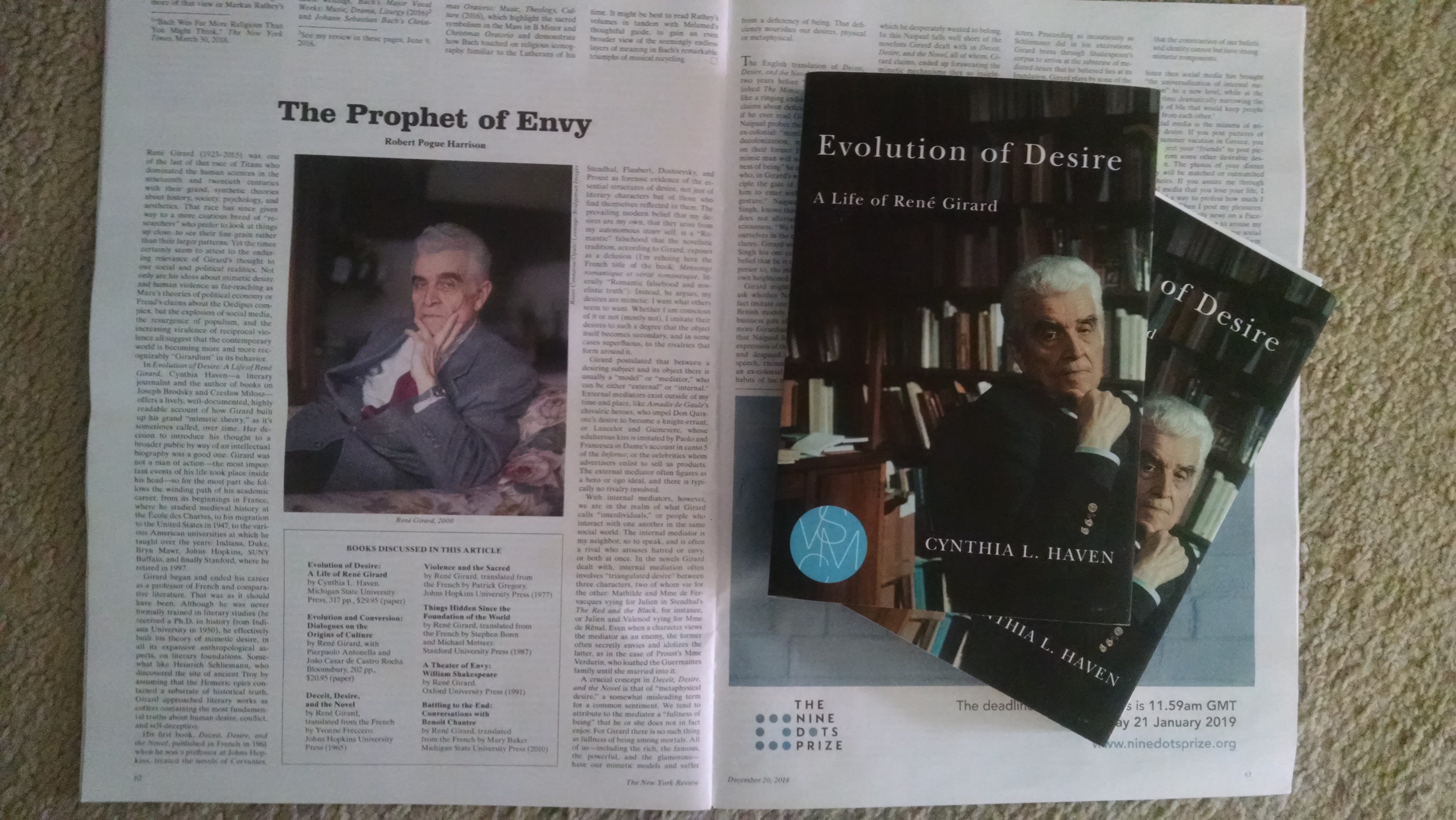
The New York Review of Books has a three-page spread on our favorite French theorist, René Girard, in its Dec. 20 holiday issue – and Evolution of the Desire: A Life of René Girard is at the top of it. The article, “Prophet of Envy” by Robert Pogue Harrison, a friend and colleague of the Académie Française immortel, is a bold and brilliant, incisive and insightful consideration of René Girard’s theories and works. I hope it is cited, picked up, and republished everywhere. It begins:

A friend of Harrison’s and a friend of mine…

René Girard (1923–2015) was one of the last of that race of Titans who dominated the human sciences in the nineteenth and twentieth centuries with their grand, synthetic theories about history, society, psychology, and aesthetics. That race has since given way to a more cautious breed of “researchers” who prefer to look at things up close, to see their fine grain rather than their larger patterns. Yet the times certainly seem to attest to the enduring relevance of Girard’s thought to our social and political realities. Not only are his ideas about mimetic desire and human violence as far-reaching as Marx’s theories of political economy or Freud’s claims about the Oedipus complex, but the explosion of social media, the resurgence of populism, and the increasing virulence of reciprocal violence all suggest that the contemporary world is becoming more and more recognizably “Girardian” in its behavior.

In Evolution of Desire: A Life of René Girard, Cynthia Haven—a literary journalist and the author of books on Joseph Brodsky and Czesław Miłosz—offers a lively, well-documented, highly readable account of how Girard built up his grand “mimetic theory,” as it’s sometimes called, over time. Her decision to introduce his thought to a broader public by way of an intellectual biography was a good one. Girard was not a man of action—the most important events of his life took place inside his head—so for the most part she follows the winding path of his academic career, from its beginnings in France, where he studied medieval history at the École des Chartes, to his migration to the United States in 1947, to the various American universities at which he taught over the years: Indiana, Duke, Bryn Mawr, Johns Hopkins, SUNY Buffalo, and finally Stanford, where he retired in 1997.

Of the seven books on the list, Evolution of Desire is the only one not authored by René himself. The  final book is one of my favorites, and I discuss it a good deal in Evolution of Desire: it’s his  Battling to the End: Conversations with Benoît Chantre:

A frequent essayist in NYRB

It is in many ways one of his most interesting, for here he leaves behind speculations about archaic origins and turns his attention to modern history. The book’s conversations with Benoît Chantre, an eminent French Girardian, feature a major discussion of the war theorist Carl von Clausewitz (1780–1831), whose ideas about the “escalation to extremes” in modern warfare converge uncannily with Girard’s ideas about the acceleration of mimetic violence.

Toward the end of his life, Girard did not harbor much hope for history in the short term. In the past, politics was able to restrain mass violence and prevent its tendency to escalate to extremes, but in our time, he believed, politics had lost its power of containment. “Violence is a terrible adversary,” he wrote in Battling to the End, “especially since it always wins.” Yet it is necessary to battle violence with a new “heroic attitude,” for “it alone can link violence and reconciliation…[and] make tangible both the possibility of the end of the world and reconciliation among all members of humanity.” To that statement he felt compelled to add: “More than ever, I am convinced that history has meaning, and that its meaning is terrifying.” That meaning has to do with the primacy of violence in human relations. And to that statement, in turn, he added some verses of Friedrich Hölderlin: “But where danger threatens/that which saves from it also grows.”

Here’s the good news! “Prophet of Envy” is online here! And the holidays are coming up – time to buy some books for family and friends.

Why We Want What We Want: René Girard and Robert Harrison in conversation

Share

“I THINK THE REASON WE TALK SO MUCH ABOUT SEX IS THAT WE DON’T DARE TALK ABOUT ENVY. THE REAL REPRESSION IS THE REPRESSION OF ENVY.” –RENÉ GIRARD

“Know thyself.” It’s not an easy proposition. As Entitled Opinions host Robert Harrison says, “To know yourself means, above all, to know your desire. Desires are what lurk at the heart of our behavior. It’s what determines our motivations. It’s what organizes our social relations. It’s what informs our politics, religions, ideologies, and above all, our conflicts.”

René in a video interview…

In this conversation and podcast, over at the Los Angeles Review of Books here, Harrison talks with Stanford’s expert on human desire, René Girard, whose work on the subject was rooted in literary criticism, but eventually reached across disciplines to embrace anthropology, sociology, history, religions, and even the hard sciences.

Girard began his work in the 1960s with a new concept of human desire: our desires are not our own, he said, we are social creatures, and we learn what to want from each other. He has been called “the new Darwin of the human sciences” and was one of the immortels of the prestigious Académie Française.

… Robert Harrison as radio host

Their 2005 interview discusses envy and desire in literature — in Canto V of the Inferno, in Cervantes, Balzac, and Flaubert, but most of all in the plays of Shakespeare. They also discuss the role of vengeance as an act of mimetic rivalry, “snobbery” as a form of imitation, and the “sacramental” nature of advertising today. “If you consume Coca-Cola, maybe if you consume a lot of it, you will become a little bit like these people you would like to be. It’s a kind of Eucharist that will turn you into the person you really admire.”

Ultimately, they talk about the mimetic escalation of warfare, Girard’s late-life fascination with the war theoretician Clausewitz, and the need to renounce violence.

This is Part 1 of a two-part discussion – you can listen to it over at the Los Angeles Review of Books “Entitled Opinions” channel here. Meanwhile, Robert Harrison writes about René Girard in the Dec. 20, 2018, issue of the New York Review of Books here.

Potent quotes:

From RENÉ GIRARD

Envy is the emotion which plays the greatest role in our society.”

Mimetic desire is an absolute monarch.”

If you have a rivalry, your vanity is involved and you want to win at all cost.”

The institution that is most mimetic of all is the greatest capitalist institution – the stock market.”

Clausewitz constantly shows you the mimetic nature of war.”

From ROBERT HARRISON

Nothing is more mysterious, evasive, or perverse than human desire.”

We are far from overcoming the behavior that has characterized human history.”

Why is it that human behavior is so resistant to adapting itself to what the mind knows?”

To know yourself means, above all, to know your desire.”

It’s amazing that our governments invests billions of dollars in scientific research every year in order to better understand the world of nature, yet commits only a tiny fraction of that to advance the cause of self-knowledge in order to better understand ourselves.”

And speaking of Proust … another wonderful quotation on the anniversary of his death

Share

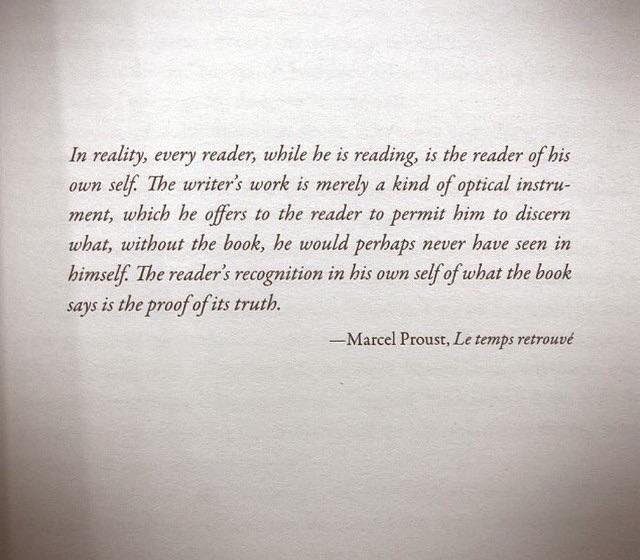
Luftmensch Paul Holdengräber is on a roll with Marcel Proust, and we posted his quote on the anniversary of the French author’s 1922 death yesterday. He followed up with this one today, and we couldn’t resist reposting it (see below). The reason: we use the same citation from Proust at the tail-end of the introduction to Evolution of Desire: A Life of René Girard:

Why? Why? Why?

I had a more modest view of my book and it would be incorrect to say even that I was thinking of those who might read it as ‘my readers.’ For, to my mind, they would not be my readers but the very readers of themselves, my book serving only as a sort of magnifying glass, such as the optician of Combray used to off er to a customer; my book might supply the means by which they could read themselves. So that I would not ask them to praise me or to speak ill of me, but only to tell me that it is as I say,if the words which they read within themselves are, indeed, those which I have written.

The passage I cite was translated by the matchless Richard Macksey, a colleague of René Girard’s at Johns Hopkins University.

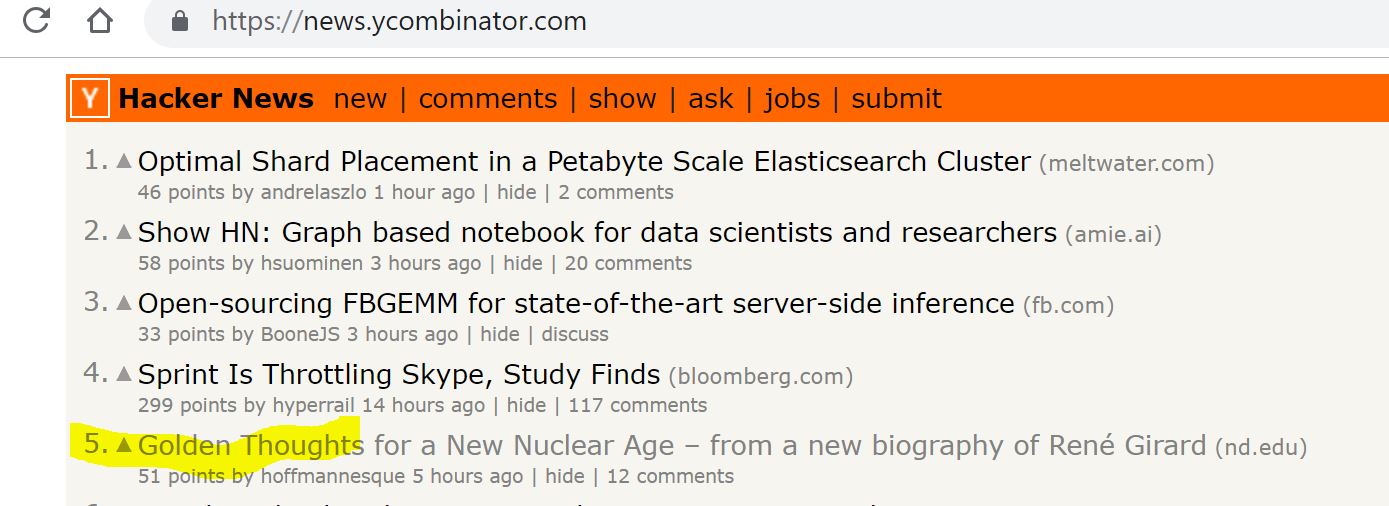
Incidentally, the whole introduction to Evolution of Desire was published in America Magazine over the weekend here. Notre Dame published it earlier, and it was linked in Hacker News, here. (Several people wondered why Artur Sebastian Rosman picked a golden image for the article, entitled “Golden Thoughts for a Nuclear Age” – you might note that it’s the “Mask of Agamemnon,” one of the findings of Heinrich Schliemann at the Troy excavation, an archaeological adventure described in the first paragraph of my intro.)

René Girard, meet the techies: Evolution of Desire climbs the charts at Hacker News.

Share

Even though the Book Haven lives in the heart of Silicon Valley, I generally avoid the sphere of computer nerds and techies, except when I need my Macbook Pro repaired or I’m battling a spam attack. But every so often, I get something that sends me into this brave new world.  So it was with yesterday’s news on Evolution of Desire: A Life of René Girard.

Artur gave me the heads-up.

It began when I received a Facebook message from Artur Rosman at 6 a.m.: “Happy news, a techie link picked up your book excerpt that we ran earlier this year. It has 1,700 hits today so far. You’re going to crash our site!”

He was referring to the introduction to Evolution of Desire, which was excerpted on a Notre Dame University journal as “Golden Thoughts from a Nuclear Age” here. The techie link was an unknown website to both of us, but that’s what Wikipedia is for. I looked up Hacker News there:

Hacker News is a social news website focusing on computer science and entrepreneurship. It is run by Paul Graham‘s investment fund and startup incubator, Y Combinator. In general, content that can be submitted is defined as “anything that gratifies one’s intellectual curiosity”.

The site was created by Paul Graham in February 2007. Initially it was called Startup News or occasionally News.YC. On August 14, 2007, it became known by its current name. It developed as a project of his company Y Combinator, functioning as a real-world application of the Arc programming language which Graham co-developed.

Paul Graham turns out to be kind of a big deal. Computer scientist, entrepreneur, venture capitalist, author and essayist.

But meanwhile, back in Indiana, Artur was beginning to panic. The numbers kept climbing minute by minute. He was pondering whether he should take the page down quickly so the server wouldn’t go boom. It didn’t, but meanwhile it quickly racked up 2,700 visits in a few short hours.

Paul gave us the lift-off.

Faithful Book Haven reader George Jansen, who runs a terrific blog 20011 (we’ve added it to our blogroll), also saw us on Hacker News. “I was going to post about this on my own blog, but then figured that you should get first dibs.” We let him go first.

From his blogpost: “I often check the Hacker News to see what topics interest the tech world. Perhaps 60% of the linked items have to do with computing, science, or mathematics, another 20% to do with politics or economics, and the remainder can be curiously assorted. Over the last couple of days a link to an article about whether Nero killed Agrippina has been in the first few pages.

“Though I do now and then see them, I don’t go to Hacker News looking for links to pieces about the humanities. I was surprised, then, today to see what was evidently an item by Cynthia Haven about René Girard on the first page… A sometime co-worker has made it to the first page of Hacker News a few times. However, his blog mostly has to do with old computer hardware, which suits what I take to be the interests of most of the Hacker News readership. I am interested to see that the techies find mimetic desire so well worth reading and arguing about.”

In the Hacker News comment section, Oliver Jones urged people to read the article over at Notre Dame: “Our trade is strongly influenced by René Girard’s understanding of competitive mimetic desire and its violence. Why? The people who organize the ad-driven internet know all about Girard. Peter Thiel invested in Facebook because he saw its potential for harnessing mimetic desire to drive engagement. (reference: https://www.lrb.co.uk/v39/n16/john-lanchester/you-are-the-pr…)

“Facebook-style social media is addictive precisely because of the fear of not being as good as ‘friends.’ Mimetic desire is the the human yearning behind the Fear of Missing Out. Driving engagement is most effective when it exploits that fear. It works very well indeed. Other attempts at building social media networks (Stack Overflow, Linked In, Slack, for example) try to avoid that exploitation. They try to use other motivators than FOMO [“Fear of Missing Out” to the rest of us. – CH] to drive engagement. Can they be successful without overusing mimetic desire? It’s the key question they must answer to be successful. The obligatory panel of customer logos just below the fold on SaaS landing pages engages mimetic desire in IT buyers. ‘Wow! Schwab uses this! I want to be like Schwab!’ It’s benign in these cases.

“Girard offers a good unifying framework for understanding the human nature behind all sorts of marketing work. Convincing people their hair is ablaze and offering them ways to put it out is the heart of building new businesses. Getting people to set each others’ hair on fire, then putting it out, is the holy grail of new businesses.

“It’s no accident that Silicon Valley employs that framework in lots of ways: he was a scholar at Stanford’s Hoover Institution. [He wasn’t – CH.] It can be a hard slog to learn about him. But it’s worth your trouble.”

I hope I’ve made the job a little easier for Oliver and the others with Evolution of Desire: A Life of René Girard. Meanwhile, read the whole discussion here. It includes the best quote ever from Peter Thiel, who studied with René at Stanford: “To believe yourself invested with divine self-sufficiency is not the mark of a strong individual, but of a person who has mistaken the crowd’s worship – or jeering – for the truth. The single greatest danger for a founder is to become so certain of his own myth that he loses his mind. But an equally insidious danger for every business is to lose all sense of myth and mistake disenchantment for wisdom.”

The excerpted introduction to Evolution of Desire, “Golden Thoughts for a Nuclear Age” is here.

Postscript: Speaking of signal honors, I received this Facebook comment, from another gentle reader, Marianne Bacon: “Cynthia, we are re-reading your book. Aloud. I am absorbing much more deeply and we are both loving it!”

A wise and timely note from Gandhi on election day…

Share

A note from my friend George Dunn, via Facebook, writing all the way from Ningbo, China:

Here’s a new New Yorker essay from Age of Anger author Pankaj Mishra, in which he argues for the contemporary relevance of Mahatma Gandhi. His importance, according to Mishra, lies not just in his elevation of non-violence as political tactic, but also in his critique of modern liberalism. He saw self-restraint and the imposition of ethical limits, rather than the celebration of individual liberty and the emancipation of human desire, as the foundations of a healthy political community. He clearly saw that a society predicated on self-exaltation and the perpetual manufacturing of new desires was courting disaster.

“At every point,” writes Mishra, “Gandhi still upends modern assumptions, insisting on the primacy of self-sacrifice over self-interest, individual obligations over individual rights, renunciation over consumption, and dying over killing.”

Like René Girard, he believed that the alternative to self-sacrifice was sacrificing others. And, like Girard, his principle teachers were the Western religious tradition and contemporary thinkers who had been deeply shaped by it.

But what makes Gandhi’s thought especially timely is the understanding of truth and dialogue contained in his doctrine of Satyagraha. In addition to encouraging humility and obliging us always to remain open to the possibility that we may be wrong and our adversaries right, it entails the recognition that “we shall always see truth in fragments and from different angles of vision.” Understood in this way, Satyagraha leaves no room whatsoever for moral or political dogmatism. Can we imagine a world where our progressive activists and devoted conservatives take that lesson to heart?

Read the article here.