
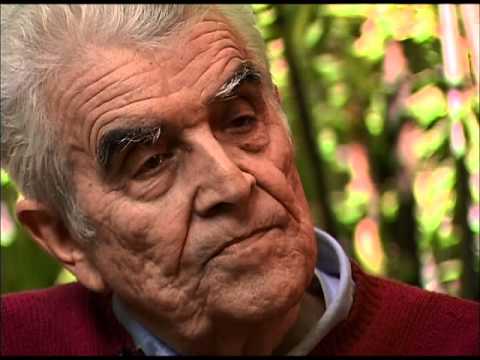
My interview on René Girard and Evolution of Desire: “If you don’t howl with the wolves, the wolves will howl for you.”

Share

“…no possible compromise between killing and being killed.”

My interview with author Scott Beauchamp is up at Full-Stop, a tony literary venue Full-Stop, which focuses on debuts, works in translation, small press works, and the broader landscape of arts and ideas that need a champion more than ever. Scott’s writing has appeared in The Paris Review, Rolling Stone, and the Washington Post, among other places. The subject, as always, is Evolution of Desire: A Life of René GirardYou can read the whole interview here.

Meanwhile, an excerpt:

The basic idea animating Girard’s breakout book, Deceit, Desire, and the Novel, is, as you write, that “[w]e live derivative lives. We envy and imitate others obsessively, unendingly, often ridiculously…We wish to conceal our metaphysical emptiness from others, in any case, and from ourselves most of all.” As Girard himself explained, “All desire is a desire for being.” I think most people who have heard of Girard are familiar with this basic, simple, and profound insight.

It pegs the true source of desire. In a panel discussion of Evolution of Desire at the American Academy of Religion earlier last fall in Denver, one panelist described it as Girard’s koan. And it rather is.

Some have taken issue with it, since “being” has so much baggage in philosophical circles, but I think it has a valuable role in taking us away from those triangles of desire – instead of searching for objects and mediators, we must take a step back and ask instead “who do I worship?”

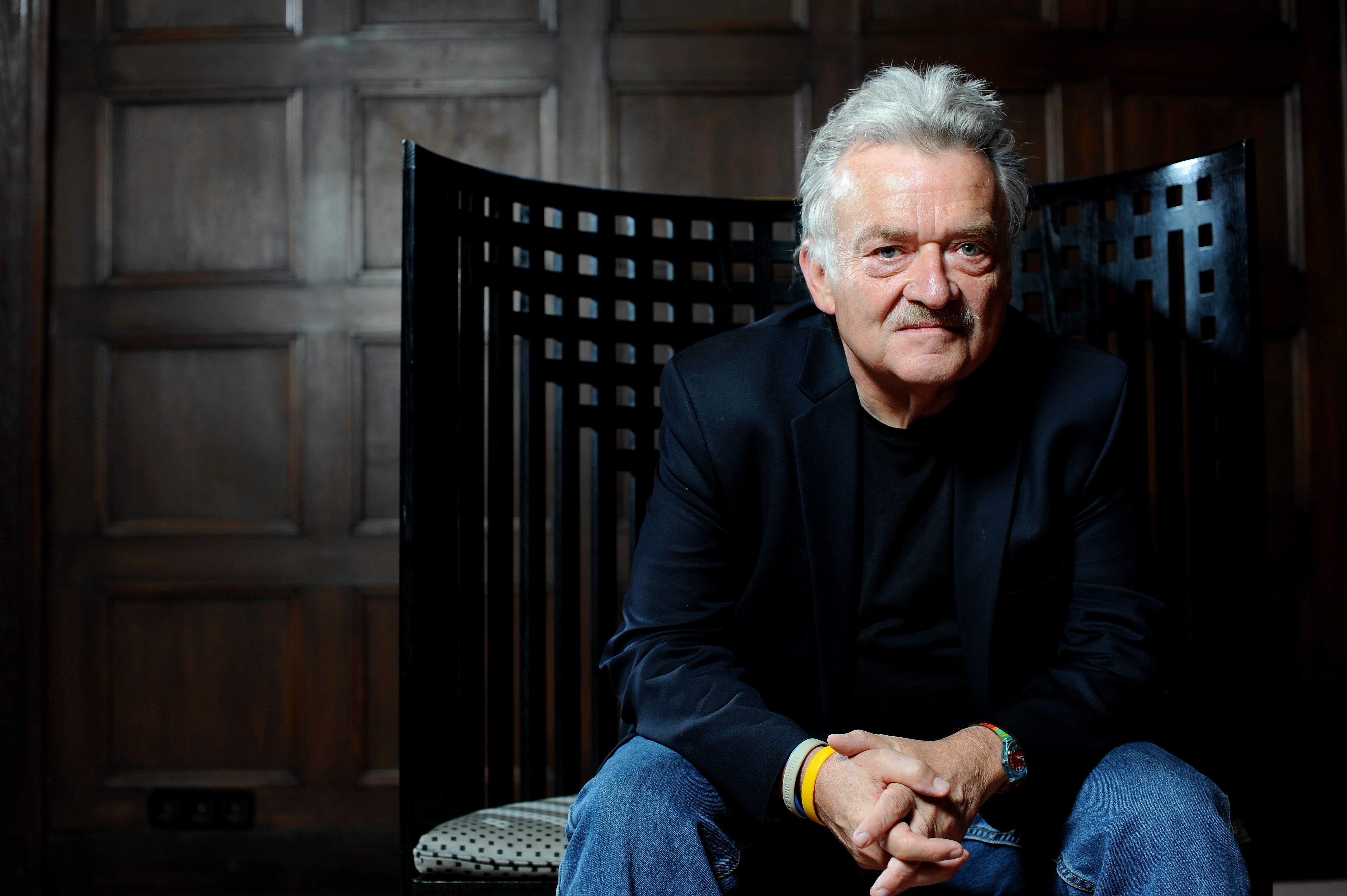
Interviewer Scott Beauchamp

“All desire is a desire for being” is a single line mentioned in passing during the long conversation that is When These Things Begin, a book-length Q&A with Michel Treguer. Far from being overly familiar, in fact I plucked it out of the book and now it seems to be contagious – in a good way! I expect to see it on tote bags and t-shirts soon.

But something that you take pains to explain in your book is that Girard didn’t consider all mimetic desire a necessarily bad thing, right?

Of course it isn’t. Imitation is not only inevitable, it’s how we learn language, or how to tell a joke, or how to run a business, or anything else. It’s how we learn to navigate human exchanges, how to give and receive affection, how to nurture friendships.

Ultimately, imitation has another dimension altogether. Virgil speaks of it in Purgatorio, and it’s worth repeating: “And the more souls there are who love on high, the more there is to love, the more of loving, for like a mirror each returns it to the other.” That is the evolution of desire, its final destination.

Girard built on the notion of mimetic desire in his subsequent books. Violence and the Sacred, which was in many ways a more radical book than its predecessor, explores the meaning of sacrifice and the scapegoat – the complicated ways in which we assign guilt and perpetuate violence. I was struck by the refreshingly pre- or even para-political reasoning at work. It seems to elevate itself above the Manichean moral dead ends of an “us vs. them” mentality and instead implicates everyone. Where do you most sense the need for this sort of analysis in contemporary American society?
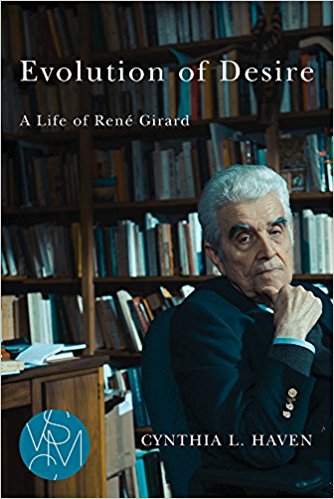
Everywhere. Increasingly our public discourse is descending into two warring tribes, who resemble each other more and more the longer they fight. Are you a Democrat or Republican? Did you vote for Trump or Clinton? Left-left, or center-left, or left behind. Independent thinkers are hectored and threatened into falling in line. The mob requires unanimity. If you are not part of it they turn against you, and you are, if you are lucky, driven from the flock. We’ve seen reputations destroyed, jobs lost, fortunes demolished, but that’s not the worst. Look at what the murderous mob tried to do to Asia Bibi in Pakistan. Now she and her family must live in under a new name at an undisclosed location in faraway Canada.

It’s serious stuff, and is dangerous. If you don’t howl with the wolves, the wolves will howl for you. As René wrote: “…we must see that there is no possible compromise between killing and being killed. … For all violence to be destroyed, it would be sufficient for all mankind to decide to abide by this rule. If all mankind offered the other cheek, no cheek would be struck. … If all men loved their enemies, there would be no more enemies. But if they drop away at the decisive moment, what is going to happen to the one person who does not drop away? For him the word of life will be changed into the word of death.”

“It is absolute fidelity to the principle defined in his own preaching that condemns Jesus. There is no other cause for his death than the love of one’s neighbour lived to the very end, with an infinitely intelligent grasp of the constraints it imposes.”

Read the rest here.
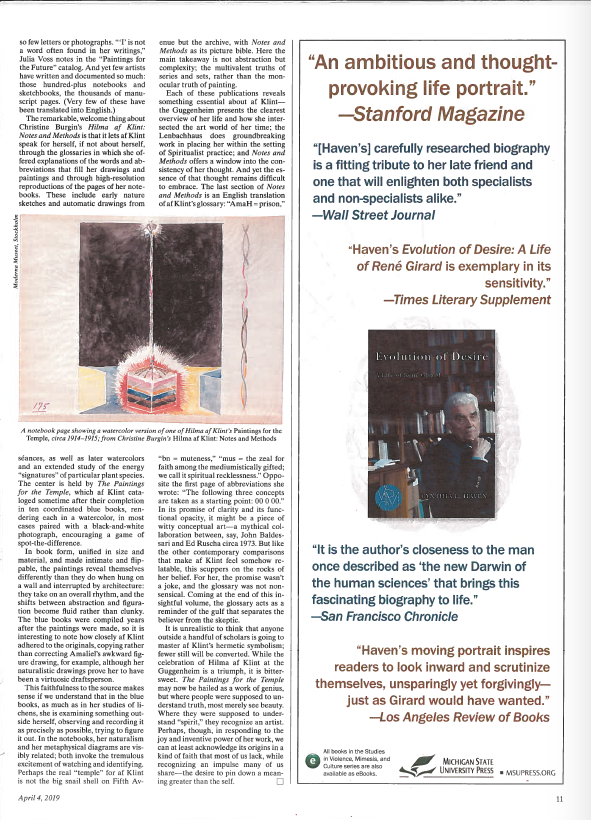
Yet more praise for Evolution of Desire: A Life of René Girard: “gorgeously written … a scintillating and atmospheric read.”

Share

You may have noticed we have been unusually silent in recent weeks about Evolution of Desire: A Life of René Girard and its progress through the world. Let us make amends. We received an lovely email from someone more familiar to us in our Twitter incarnation: Aashish Kaul, assistant professor in English at SUNY, Albany.

He wrote: “With an incredibly busy semester winding down, I have allowed myself the luxury of reading your marvel of a book on Girard. I am halfway through Evolution of Desire, and it is gorgeously written. The conjoining of balance, poise, and erudition makes this a scintillating and atmospheric read. Loving every moment of it. My congratulations!”

A second letter arrived the following day. 

Andrew Thompson of New York wrote us:  “I’m about halfway through your biography and am thoroughly enjoying it as an accessible introduction to Girard’s thought. I’ve just finished your chapter on the symposium with Derrida et al. and found it to be both the most lucid overviews of how post-structuralism found its way into the minds and tongues of American academics that I’ve found, and also one of the most succinct critiques of how those ideas filter down into memes that spread as intellectual vogue.”

Grateful thanks to both! And look what appeared last month in the New York Review of Books:

Western civilization cannot do without him: Baltimore’s legendary polymath Richard Macksey at 87

Share

It was a privilege to spend hours talking with Johns Hopkins Prof. Richard Macksey for Evolution of Desire: A Life of René Girard. Now that I’ve read Kate Dwyer’s “Meet the Man Who Introduced Derrida to America: On the Remarkable Legacy of Richard Macksey,” a new profile of the 87-year-old polymath in LitHub, I’m convinced Western civilization cannot do without him. 

I’ve written about him on the Book Haven here and here – with a film clip here. (A quick note, however: The 1966 Baltimore conference that brought Derrida to America was the work of a triumvirate: René Girard, Macksey, and Eugenio Donato. That story was told in the chapter published as “The French Invasion” in Quarterly Conversation, December 2017.) 

What I wrote about Dick Macksey in Evolution of Desire:

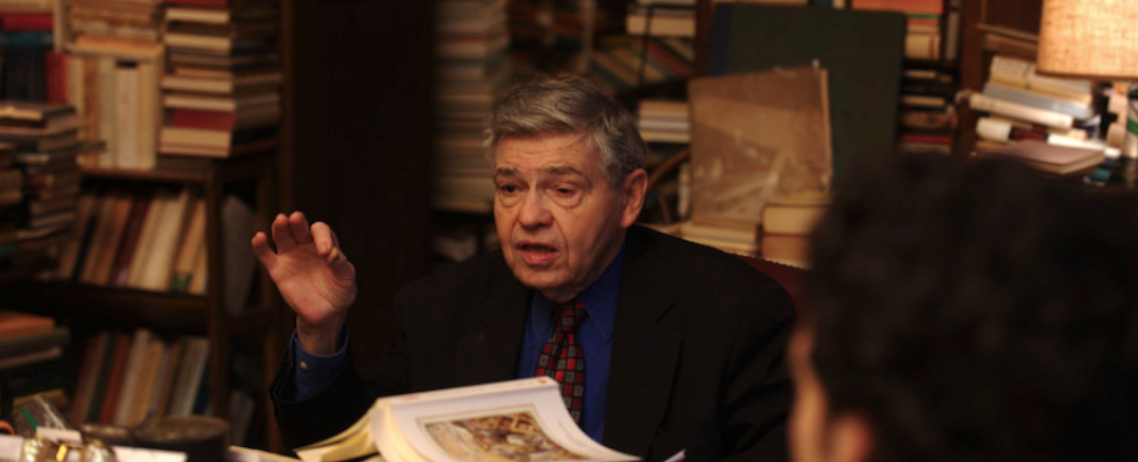
He shared his memories from his home stuffed with seventy thousand books and manuscripts in English, Russian, French, German, Italian, Spanish, even Babylonian cuneiform (he can read and write in six languages, and laconically noted that his collection includes an autographed copy of The Canterbury Tales and a presentation copy of the Ten Commandments). A generous and legendary teacher, he still holds seminars in this spacious landmark home, even though the house is so crowded that a visitor can’t walk more than a few feet in any direction without running into a bookshelf. He lives, according to a colleague, on “three hours of sleep and pipe smoke.” He writes as prolifically as he reads, publishing fiction and poetry as well as scholarly works. No topic bores him, and his memory is astonishing. Milton Eisenhower, brother of the president and Johns Hopkins’s president at the time of the conference, commented that going to Dick Macksey with a question was like going to a fire hydrant for a glass of water.

Kate Dwyer was a student of Macksey’s three years ago, which warms the narrative like  hands curled around a snifter warm cognac. Here’s what she says about the professor and the legendary home known as “Chez Macksey”:

The lore around Macksey and his library has an air of myth—some alumni describe knocking over a sheet of paper to discover original correspondence with D.H. Lawrence (who died the year before Macksey was born), while others swear there was an original Picasso sketch in his bathroom at one time. Four-foot Chinese scrolls, tiny model skeletons, antique theater binoculars. The valuable pieces are no longer in the house; they have been locked up in Special Collections on campus. One time during class, I myself picked up the nearest book and discovered it was an inscribed advance copy of his friend Oliver Sacks’ book, Seeing Voices. The objects in his house speak to his interests, which is to say he is interested in everything.

Chez Macksey

That is not an exaggeration.

“When you listen to him talk, he begins in one place, and then it’s as though he’s crossed the room and gone to a different section of the library and pulled out a book on a different topic,” the author Jessie Chaffee (Florence in Ecstasy) noted. “He’ll take you down a path that is surprising, and then another, and another . . . until you realize that they’re all connected.”

***

“There was always this rumor that when he was up for his PhD and doing his orals, they couldn’t stump him on anything,” the Oscar-nominated cinematographer Caleb Deschanel, a former student, said. “Finally, exasperated, one of his interviewers decided to ask him about 16th-century French cooking or something and he goes, ‘well that’s great that you should ask that question, because it happens to be one of my hobbies.’”

Deschanel studied with Macksey during the 1960s. “I’ve always felt that, when you read a script, your first ideas tend to be really cliché,” he said. “What you want to do is get away from that and apply some of the ideas from all the things you’ve learned over the years and try doing something totally against that first idea.” He credits this strategy to time in Macksey’s library. “He would relate some imagery in Turgenev to some paintings that were done in Germany in the 1920s.”

***

“The future and the past are bound together,” Dr. Macksey said. “One thing I like to point to is Chekhov’s little story, ‘Student.’ It’s only about four pages or so, and it’s about somebody who discovers the power of narrative to bind, not just people, but whole eras together. It sounds very pretentious, but it’s an unpretentious story, and it can change one’s life.”

Read the whole profile here. You must.

Evolution of Desire: “as absorbing as a very good novel – I could not put it down.”

Share

Bill Cain at Wellesley

A lovely letter from William Cain, Mary Jewett Gaiser Professor of English at Wellesley College, who has just finished reading Evolution of Desire: A Life of René Girard: “I am writing to congratulate you, and to thank you, for your brilliant and beautiful biography of René Girard. It is so interesting and enlightening about his life and career. You did a wonderful piece of work from start to finish: it was as absorbing to me as a very good novel – I could not put it down.

“You did a great job on this book … Thank you again for this superb biography.”

He had some firsthand experience with the subject: he knew René Girard when he was a grad student in the English department at Johns Hopkins University, 1974-1978. “I especially remember his great enthusiasm about Shakespeare,” he writes.

Below, that’s one of my tribe of bros, posting on Facebook from Barnes & Noble in Rochester Hills: “Look what’s on the shelves in southeastern Michigan!” There’s Aristotle, and there’s me … or rather there’s René Girard and Evolution of Desire.

Postscript on February 18Evolution of Desire: A Life of René Girard in Ann Arbor, too!

More praise for “Evolution of Desire: A Life of René Girard” – was he “the last of the structuralists”? A poet speaks.

Share

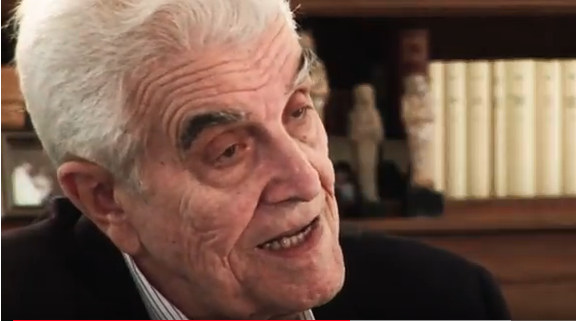
My on-camera interview with René Girard (screenshot from youtube)


Somehow in the crush of events and the daily momentums, we haven’t yet mentioned “The Last Structuralist,” poet James Matthew Wilson’s lovely and thoughtful review of Evolution of Desire: A Life of René Girard over at the Claremont Review of Books. Let us make amends, with appreciation!

He opens the piece this way:

Beginning in the early 1980s Stanford University’s Cynthia Haven would occasionally spy a remarkable man walking across that bright tropical campus. He caught her attention on account of his “large, totemic head, with its dark, deep-set eyes and shock of thick, wavy, salt-and-pepper hair.” Only in 2007 was she introduced to this man and learned that he was René Girard, the legendary French “theorist,” and, by then, emeritus Chair of French language and literature. Within a year, Haven was paying regular visits to Girard at his home. She could not have known then where these visits would lead.

Evolution of Desire is the first biography of Girard to appear, and I would venture to say it will be the last. Girard was a quiet, passive man who repeatedly stated he lived mostly inside his own head. His outward life was placid and uneventful, even though he came of age during the Nazi occupation of France and presided over at least one key episode in the intellectual tumult that overtook universities in the 1960s.

To this scarcity of dramatic detail, Haven brings a sympathetic reading of Girard’s books in all their towering ambition, along with a journalist’s first-person narration as she goes in search of clues to the intellectual origins of her elusive subject. Her candor humanizes a man known for his forbidding and assertive prose, for books that seemed to cast a cold, sometimes naïve, eye on all opposition as he pursued the articulation of what he deemed his one great idea, his one grand theory of human nature and history.

He concludes:

In her account of the last decades of Girard’s life, Haven interviews many who taught alongside him or sought to continue his work. But the real wealth lies in her frequently bemused account of Girard, the laconic theorist of Christian self-renunciation, in the hyper and ambitious tropical paradise of Stanford. It is a place, Haven observes, where everyone “would really rather be robots.” While Thiel and other Silicon Valley magnates sank billions into dodging death, Girard sat at home working on still another book, Achever Clausewitz (in English, Battling to the End, 2010). Its subject is a Prussian general of the Napoleonic age whose reflections on the psychology of war serve as a basis for modern theories of total warfare.

“A rage of mimetic desire…”

Girard’s study comprehended not just the cause and dimensions of the great wars of the twentieth century but also the intricate mimetic dimensions of the new age that opened with 9/11. His seems the right viewpoint, for instance, from which to understand the fact that Mohamed Atta spent the last three days before hijacking American Airlines Flight 11 “drinking vodka and playing video games.” In a rage of mimetic desire, he and his accomplices felt compelled “to destroy the thing that they crave and loathe at once.”

In our contemporary cult of victimhood, we see supposed victims of oppression routinely set out on self-righteous crusades to humiliate and punish their former persecutors. Persecution “is pursued in the name of anti-persecution.” The former persecutors become the new scapegoats who must be sacrificed to eliminate social violence and allow peace to reign. That so many of the causes whose advocates now seek to “punish the wicked” are morally inimical to Christianity is incidental in comparison with Girard’s chief insight about them. Modern scapegoating resuscitates archaic religious sacrifice; the post-Christian world is also a pagan world redivivus, as it refuses to learn the lesson of Christ on the cross fixed at the center of history.

Haven’s story conveys how beloved Girard, a warm but withdrawn man, was to those who knew him; how fruitfully his ideas have influenced others; and how powerful his thought proves in explaining the structures of violence and desire in history. Girard was, in a sense, the last of the structuralists. He shows us the possibility of a post-structuralism that does not reduce the life of the mind to a light, meaningless play of “discourse,” but which digs down into the hidden depths of reality in hopes of understanding the “contagion” of mimetic violence and glimpses the possibility of redemption through a renunciation of our deeply ingrained desire to make a sacrifice.

Read the whole thing here

***

Ah yes! It’s also time to mention some of the grateful letters we’ve received from readers recently. Here are two:

From Bill Schaberg at Athena Rare Books in Fairfield, Connecticut: “… A book that could have been a dreadfully dreary read was, instead, lively, well organized (I loved the way you masterfully wove so many narrative threads together) and a literal pleasure to pick up each night.

Both René as the subject and you as the concerned author just jump off the page. (I make my way though about a book a week – half non-fiction – and I can’t tell you how absolutely rare that it.)

So, THANK YOU! It really was an enjoyable, informative and thought-provoking book. 

From Dr. John F. Gilligan of Peoria, Ill.: In my life of 80 years, I have never read as good a biography as you have written.  Over the years I have read many of the bestseller biographies.  I put your book above them.  I say this as a general reader; mostly science and history and a smattering of literature captures my interests.  I did read most of Dostoevsky’s novels while working as a business consultant in Russia for several years, but that was back in the 90s.  And I was a student for 4 years in Europe (France and Italy) after graduating from college.  …  I came across your book and thought it might be a good entrée because French writers and critics are typically quite abstract, at least for me.  But you have made him an engaging albeit a complex person and his insightful thoughts on the human condition quite clear and concise.

When I was in Greece, my wife and I visited Delphi.  We wanted to see where the Delphic Oracle did her work.  Her sage advice: γνῶθι σεαυτόν, has been greatly aided by Girard and your introduction to him.  I thank you for writing that biography.  It has helped me to know myself better.  I guess old dogs can indeed learn new tricks.

“Evolution of Desire: A Life of René Girard” goes into its third printing – and sparks some reflections in Zürich’s “Neue Zürcher Zeitung”

Share
 

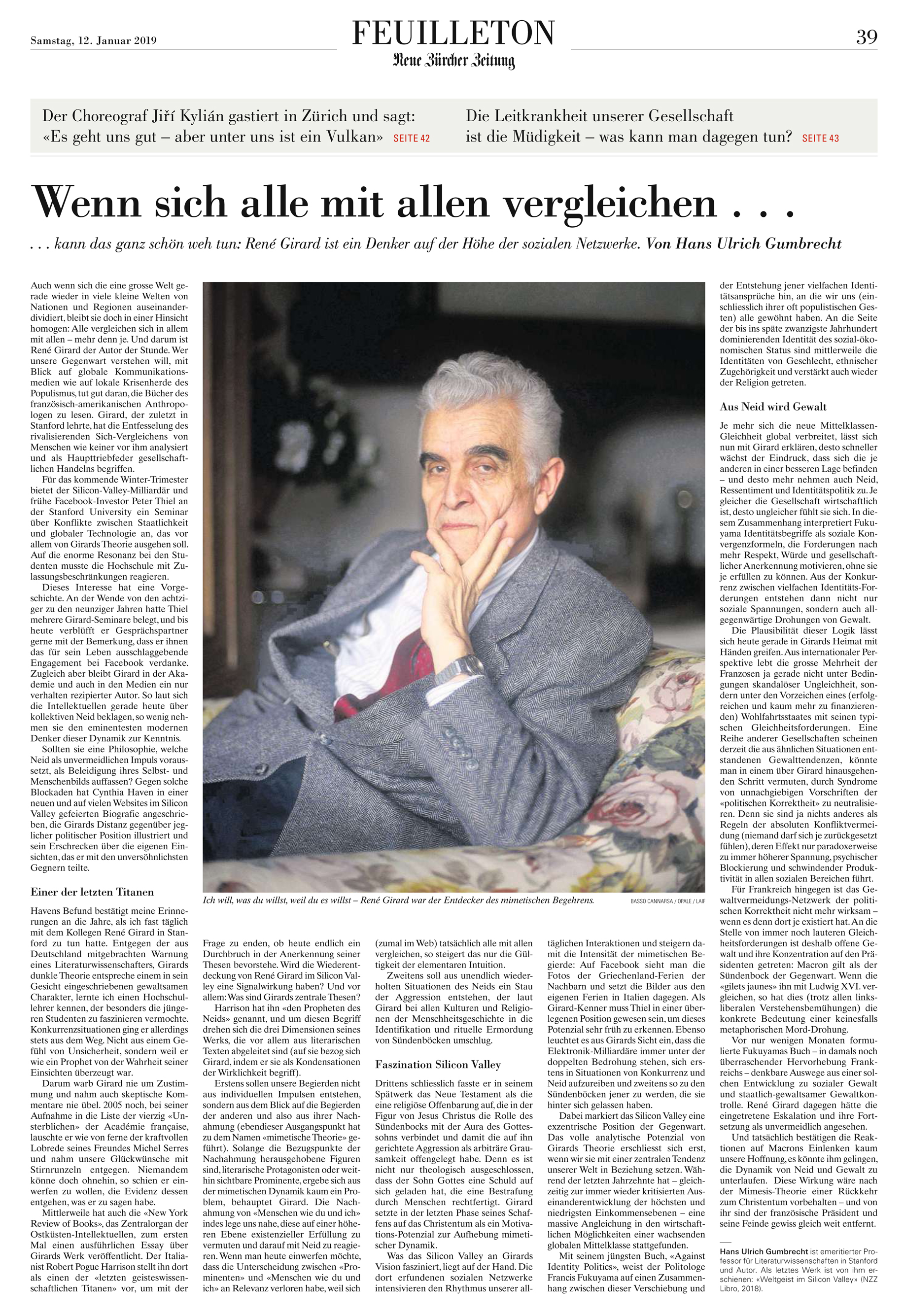
Some good news! Evolution of Desire: A Life of René Girard is going into its third printing in its first year! Here’s some more good news: an article in Zürich’s Neue Zürich Zeitungone of Europe’s most highly regarded newspapers. The piece is by one of the continent’s leading intellectuals, Stanford’s own Hans Ulrich Gumbrecht

The first few paragraphs in a rough, off-the-cuff translation by a German-speaking friend of ours. An excerpt from: “Equality, Desire, Violence and the Restrained Presence of René Girard”:

A few weeks ago the French magazine Le Point invited Peter Sloterdijk to a conversation about the protest movement of the yellow jackets and their relationship to President Macron. With his learned and yet very decisive point of view, the philosopher activated an unconventional line of intellectual positions: in addition to  Mikhail Bakhtin‘s thesis on the transformation of Carnival moments into violence, and to Alain Peyrefitte‘s identification of social immobility as the heritage of absolutism, and to Elias Canetti’s theory on the dynamics of people in masses, he also referenced–most of all–the vision of the French-American anthropologist René Girard, who is rarely cited in his own homeland, a vision of working out  collective tensions through the attack and murder of a “scape goat.” Sloterkijk’s interlocutor could only with difficulty hide his outrage over this application of an analysis of the present situation.

Sepp Gumbrecht (Photo: Reto Klar)

With his left-liberal aligned reaction, the news would have no doubt fit well, to hear that the Silicon Valley billionaire and original Facebook investor Peter Thiel offered, for the coming Winter quarter at Stanford, a seminar on the conflict between “Statehood and Global Technology,” a course that was supposed to be derived from Girard’s theory and a course with such unusual resonance among the students that the university had to implement conditions for acceptance into the class.  Around 1990 Thiel had in fact taken several Girard Seminars, and to this day Thiel likes to amaze his interlocutors with the comment that he owes his life-changing engagement with  Facebook to these Girard seminars. In view of Sloterdijk, Thiel and their antagonists, it is  increasingly evident that there is a  pattern of tension between the way eccentric thinkers trust Girard’s intuitions and a mostly unfounded refusal to even acknowledge them. Against this blockade, in a new biography which is widely celebrated in many websites in Silicon Valley, Cynthia Haven has described how Girard distanced himself from all political positions, and described his shock at his own insights, a shock he shared with his most vehement opponents.

Haven’s conclusions and the peculiar ambivalence that she references confirm my memories from the 1990s, when I met with René Girard as a colleague at Stanford almost daily. Despite the warning brought from Germany by an eminent literary scholar that Girard’s dark theory corresponds to a powerful sense of character engraved in his face, I learned to know a professor who fascinated the youngest students in particular, and who consistently avoided competitive situations. Not from a feeling of uncertainty or self-doubt at all, but rather because as a prophet he was convinced of the truth of his insights. He in fact felt called to point out these insights repeatedly, and yet expected no personal admiration, never courted agreement, and never held it against me for instance, when I reacted with skeptical commentary. Already in 2005, when he was accepted into the forty “Immortals” of the Académie Française, Girard heard from afar the powerful encomium of his friend Michel Serres and reacted to our congratulations with a rumpled brow. Nonetheless, he seemed to want to say, no one could avoid the evidence of what he had to say.

The articles goes on to discuss Robert Pogue Harrison’s “Prophet of Envy” in the New York Review of Books (“the central organ of the American East Coast intellectuals”), the intensification of internet envy with FaceBook, and more. Read it here.

Not enough good news for you? The Claremont Review of Books article is up. Did we mention we’re getting lovely letters? Enough! We’ll share more tomorrow.
 .