“I want what she’s having.” London lauds a new book on the nature of our wanting.

Share
The movie that inspired the meme: “When Harry Met Sally”

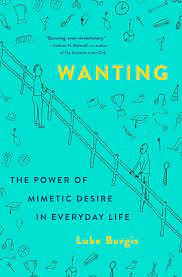
We want what others want. It’s a law as old as mankind, going all the way back to Eden. It was the subject of René Girard‘s corpus, and the French theorist’s work inspired Luke Burgis’s new book Wanting. “Movements of desire are what define our world. Economists measure them, politicians poll them, businesses feed them,” he writes.

René Girard began with literature, and moved to anthropology, religions, history, and more. Burgis brings his lens to a new domain: the world of entrepreneurship, of business, of technology, of international finance. Christina Patterson writes about it her review, “I Want What She’s Having” in the Times of London review yesterday.

From The Times review:

The key issue, he says, is “What do you want?” and “What have you helped others want?” The answer shapes our lives and our life satisfaction, but we are, he argues, fighting some strong tides. Powerful figures have always changed our desires. Now we don’t just have PR Svengalis and the influence of peers and celebrities such as, say, the Kardashians. We have the tech giants stoking our desires every time we glance at our phone. And the cycles of “thin desires” they are generating are creating division and stress.

Burgis is open about his key ideas coming from Girard, but he fleshes them out witty stories, personal anecdotes and research that bring them alive. His prose is punchy. His anecdotes are entertaining. There are even witty cartoons.

Writing from an entrepreneur’s perspective

It concludes:

It isn’t “Celebristan”, the world of celebrities and influencers, we have to worry about, he says. It’s “Freshmanistan”, the world of models from inside our lives who can drive us to destructive cycles of envy, exhaustion and distress. We should learn, he says, to pursue our “thick desires”, like Sébastien Bras, the chef who asked to be removed from the Michelin guide because he wanted to see more of his family and do things his way.

“Part philosophical tract, part self-help guide, Wanting is a thought-provoking book. It’s also a deeply moral one. Like many Silicon Valley entrepreneurs, Burgis wants to create a better world. The ideas he presents, and his suggestions for action, seem to offer a more realistic hope than most.

Read the whole thing (warning: paywall) here. And you can read an excerpt from the book, “The Joy of Hate Watching” here.

René Girard, Russia, and Evolution of Desire: “It’s hard to wish for a better biography of Girard.”

Share

Evolution of Desire: A Life of René Girard has just appeared in Russia with Moscow’s tony publisher N.L.O. (translated by Svetlana Silakova) – and the first review by Alexey Zygmont, about the serene Stanford professor who “exposed the nature of violence,” is glowing. The title of the article in Gorky Media is taken from a line in the book: Жирар, поджигающий под вами стул – in English: “Girard: Setting Fire to the Chair Beneath You.”

An excerpt:

Evolution of Desire is the long-awaited biography of the social scientist, philosopher and theologian René Girard (1923-2015). Girard is known as the creator of “mimetic theory” – one of the last “grands récits” of the humanities in the 21st century. Today, this theory finds application in a range of disciplines, from anthropology and sociology to psychiatry, biology, and the neurosciences. Through the efforts of Girardian scholars, it is gradually making its way in the universities, and it is really changing people’s lives. Actually, one of the facts facing us is that this first biography should be enough: even if the book were unsuccessful, it would still be used by both the historians of philosophy studying his thought and other researchers who adapt Girard’s theory to their own interests. The book, however, is a success, and its value is all the greater because throughout his life Girard spoke about himself reluctantly … It was difficult for an ordinary reader, familiar only with his major works, to imagine him as a living person; now that’s possible.

In Russian at last!

Often mimetic theory is presented as a kind of “sect,” consisting, as one author wrote, of the “disciples, translators, and proselytes” of the philosopher. This isn’t true – although some people are indeed unable to stop saying “Girard, Girard, René Girard, but Girard has…” and so on. In short, there was a high probability that the first biography of the thinker would be written by his apostle: there would be a risk that its objectivity and artistic merit would undermine the good memory of the teacher and the “common cause” bequeathed to him. But we were lucky with the author: Cynthia Haven is a professional journalist, author of biographies of Miłosz and Brodsky, and a longtime friend of the thinker. Hence the tone of the book: friendly, involved, critical when needed, and targeted for a wide audience.

The review concludes:

Until now, I have not yet said a single word of criticism about the book, and there is almost nothing to criticize it for. But Evolution of Desire is a biography almost written within his own lifetime, by someone close to the thinker and based on their personal conversations. Therefore, it lacks not only objectivity, but distance. The fate of Girard is almost devoid of “dark spots,” and he himself resembles a living icon: we constantly read about his merits and do not hear a word about his shortcomings – which would probably introduce something paradoxical to his image. The only thing we are told about is his childhood passion for practical jokes, his excusable youthful passion for “parties and cars,” and even the opinion of some colleagues that he dominated people and space too much. In an interview, Girard admitted that he was “very mimetic” and wrote only about what he experienced himself.

And yet, it’s hard to wish for a better biography of Girard. It will be of great service to both his followers and researchers, and deserves every possible recommendation.

Read the whole thing here. And you can order the Russian edition from NLO here.

“Evolution of Desire: A Life of René Girard” – теперь на русском!

Share

Attention, all Russians and Russian speakers: Evolution of Desire: A Life of René Girard is available for pre-order with the tony Moscow publisher, издательство НЛО – for the rest of us, NLO (New Literary Observer). The cover features René Girard among the rocks of Half Moon Bay … so, a California note for this French theorist. You can pre-order the Russian version here.

From the book jacket (see left, above)

“All desire is a desire for being,” said the renowned Franco-American philosopher René Girard. Our desires determine who we are, but they do not belong to us: since they are mimetic (that is, imitative and mirrored), we become an endless series of other people’s reflections. Desire is a lifelong evolution: we begin to imitate as children, we compete at school and at work, we want more, we suffer without getting what we want, we have deathbed regrets. Cynthia L. Haven’s book is a first-of-its-kind biography of Girard, based on conversations with him, his family, his friends and colleagues from France and the United States. In it, the life of the thinker becomes an illustration of his theory, which is analyzed not as a speculative concept, but as a philosophy of life, which Girard was the first to put into practice. Years of study in his native Avignon and then chilly occupied Paris, the fateful move to the United States, religious conversion in the late 1950s, the discovery of the violent origins of culture, doubts, recognition and its temptations – the reader will learn how the philosopher’s spiritual and creative evolution unfolded from his first work, Deceit, Desire, and the Novel, through his seminal Violence and the Sacred, to the dark apocalyptic prophecies of his final book, Battling to the End.

Oh yes, for you Russians:

«Любое желание — это желание быть», — говорил знаменитый франко-американский философ Рене Жирар. Именно наши желания определяют, кто мы, однако нам они не принадлежат: будучи миметическими (подражательными и зеркальными), они превращают нас в бесконечную серию чужих отражений. Желание — это эволюция длиною в жизнь: мы начинаем подражать еще детьми, соперничаем в школе и на работе, хотим все большего, страдаем, не получая желаемого, и раскаиваемся на смертном одре. Книга Синтии Л. Хэвен —первая в своем роде биография Жирара, основанная на беседах с ним самим, его близкими, друзьями и коллегами из Франции и США. Жизнь мыслителя предстает в ней иллюстрацией к его теории, которая анализируется не как умозрительная концепция, но как философия жизни, которую Жирар первый же и стремился практиковать. Годы учебы в родном Авиньоне и промозглом оккупированном Париже, судьбоносный переезд в США, религиозное обращение в конце 1950-х, открытие насильственных истоков культуры, сомнения, признание и его соблазны — читатель узнает, как разворачивалась духовная и творческая эволюция философа от первой работы «Ложь романтизма и правда романа» через фундаментальный труд «Насилие и священное» к мрачным апокалиптическим пророчествам его заключительной книги «Завершить Клаузевица».

Синтия Л. Хэвен — литературный критик, журналист, сотрудник Национального фонда гуманитарных наук (США).

Thanks to Maria Stepanova, Helga Landauer, and NLO’s Sergey Elagin for help making this book happen. The book will be officially out in a few weeks. Again, you can pre-order it here.

“A Happy Contrarian”: Praise for Conversations with René Girard… and Evolution of Desire, too!

Share

Conversations with René Girard and Evolution of Desire: A Life of René Girard are featured in the current edition of Commonweal. An excerpt from the lively article by Costica Bradatan, a Professor of Humanities in the Honors College at Texas Tech University. It’s a great read and making the rounds – in 3quarksdaily and Arts & Letters Daily, among other venues:

René Girard’s best-known books, such as Violence and the Sacred and The Scapegoat, leave the distinct impression of an intellectual project plotted and forged in solitude. Serious strategy seems to be at work here: the books are both dense and lucid, their arguments not only tightly knit but also elegantly presented. One imagines the long hours of hard, lonely labor behind each of these titles. And yet Girard (1923–2015) was a rather social person and a compulsive conversationalist; he needed to be with others as much as he needed his solitude. Someone who knew Girard well observed that he was “doggedly dialogic”; he liked “working with people on things.” There is in fact a whole series of books—above all, the groundbreaking Things Hidden Since the Foundation of the World (1987)—in which he involved other scholars as interlocutors. Girard was aware that much of what he was proposing was too new and too unusual (and sometimes too idiosyncratic) to go unchallenged. Always the strategist, he often invited people to challenge his arguments before he published them. Beyond the sheer human need to be with others, Girard needed the opposition and counterarguments of his conversation partners to test his ideas and push them to their breaking point.

And not only that. Dialogue itself can be a singularly creative process: something new is often born in your mind in the very process of addressing the person in front of you. You didn’t know that thing existed until you opened your mouth. Now that it has come out, you may be as surprised as your dialogue partner. Girard the conversationalist must have known a thing or two about this process.

Another excerpt:

In When These Things Begin: Conversations with Michel Treguer, Girard tells Treguer, “I’m not concealing my biography, but I don’t want to fall victim to the narcissism to which we’re all inclined.” For Girard, interviews served the same purpose as his “books of conversation”: to challenge and test his ideas while discovering new things in the company of others. Cynthia L. Haven, the author of a remarkably insightful biography of Girard, Evolution of Desire: A Life of René Girard, has now put together a selection of these interviews. They give us a good picture not only of the complexity and multifacetedness of Girard’s ideas, but also of the process through which a young professor of French literature originally operating in a rather narrow field turned into a visionary thinker of global renown, as revered as he was contested. As Haven puts it in her introduction, in “these interviews, over years and decades, Girard gradually becomes Girard, like an image slowly appearing in the developer of an old darkroom.”

Read the whole thing here. It’s fun.

Conversations with René Girard in the LARB: “Girard at both his most typical and his most surprising.”

Share

Philosopher Down Under

Chris Fleming has written a witty and lively review of my Conversations with René Girard: Prophet of Envy for the The Los Angeles Review of Books. (We’ve written about him here and here.) The Australian professor has written widely on issues of culture, philosophy, and literature, both in academic journals and in mainstream publications such as The Guardian, LitHub, The Chronicle Review, and The Sydney Review of Books. His debut on the West Coast is titled “The Last of the Hedgehogs” … well you see where that’s going:

IN 1953, Isaiah Berlin published his long essay “The Hedgehog and the Fox,” outlining his now-famous Oxbridge variant on there are two kinds of people in this world. He drew the title from an ambiguous fragment attributed to the ancient lyric poet Archilochus of Paros: “The fox knows many things, but the hedgehog one big thing.” Written with the aim of pointing out tensions between Tolstoy’s grand view of history and the artistic temperament that saw such a view as untenable, Berlin’s essay became an unlikely hit, although less for its argument about Russian literature than for its contention that two antithetical personae govern the world of ideas: hedgehogs, who view the world in terms of some all-embracing system, seeing all facts as fitting into a grand pattern; and foxes, those pluralists or particularists who refuse “big theory” for reasons either intellectual or temperamental.

Berlin’s typology is beautifully blunt: perhaps more a serious game than a scientific typology, it works wonderfully only when it does. With the French American literary and cultural theorist René Girard, it works very well. As Roberto Calasso suggested, Girard was almost the Platonic ideal of a hedgehog: he belongs to that lineage of 19th- and 20th-century thinkers whose vast synthetic ambition is now seen by many in the academy as not simply wrongheaded but almost impolite. Sweeping intellectual projects such as his come across today as naïve and even oppressive, animated by the most obnoxious nostalgias for the Enlightenment. Of course, the academics who offer such judgments are typically those whose own work is parasitical upon grand synthesizing theorists like Marx, Freud, and Nietzsche.

Like these older thinkers, although distinct from them in important ways, Girard was disinclined toward mere taxonomic labor, such as structuralist classification or the identification of linguistic “themes” and “figures,” but was interested rather in asking large questions about origins — the origin of religion, of language, of culture, of violence, of human psychic life. And although such explanatory ambition is hard to find in humanities academics these days, it is surprisingly common among contemporary scientists, who suffer far fewer anxieties — one might argue, insufficient anxieties — about their own capacities to address the big questions that interest them most. And so, physicists and biologists continue to write magnificently incoherent, best-selling books addressing large questions about human nature and culture on behalf of those of us who, some time ago, politely vacated the field. Whether this is because we in the humanities no longer find such all-encompassing theorizing intellectually tenable, or whether (less flatteringly) we have been conditioned by those institutional and funding frameworks that render such projects nonviable, a generation devoid of Freuds or Nietzsches or Marxes of its own might turn out to be something we will one day regret. (Unless, of course, we are now content to have Yuval Noah Harari carry the banner for us all.)

The upshot:

“Cynthia Haven’s fascinating new collection, Conversations with René Girard: Prophet of Envy, showcases Girard at both his most typical and his most surprising. Like many intellectuals, and not just hedgehogs, Girard returned repeatedly to the same themes throughout his career — what he called with self-mocking charm, in one exchange included here, his “monomania.” Of course, as one would hope, the reader will find in this book explications of the standard Girardian theses about imitative desire, scapegoating, and religion. And yet, throughout the volume, Girard also turns his attention to topics rarely if ever broached in his body of work: opera, eating disorders, Husserlian phenomenology, literary modernism. … Haven’s book is a welcome tonic for those of us for whom universalist theories are liable to provoke an outbreak of hives. As Adam Phillips once said about psychoanalysis: “like all essentialist theories,” it “makes a cult out of what could be just good company.” Regardless of how one evaluates Girard’s overarching intellectual project, there is little doubt that he was often excellent company indeed, as this collection amply attests.

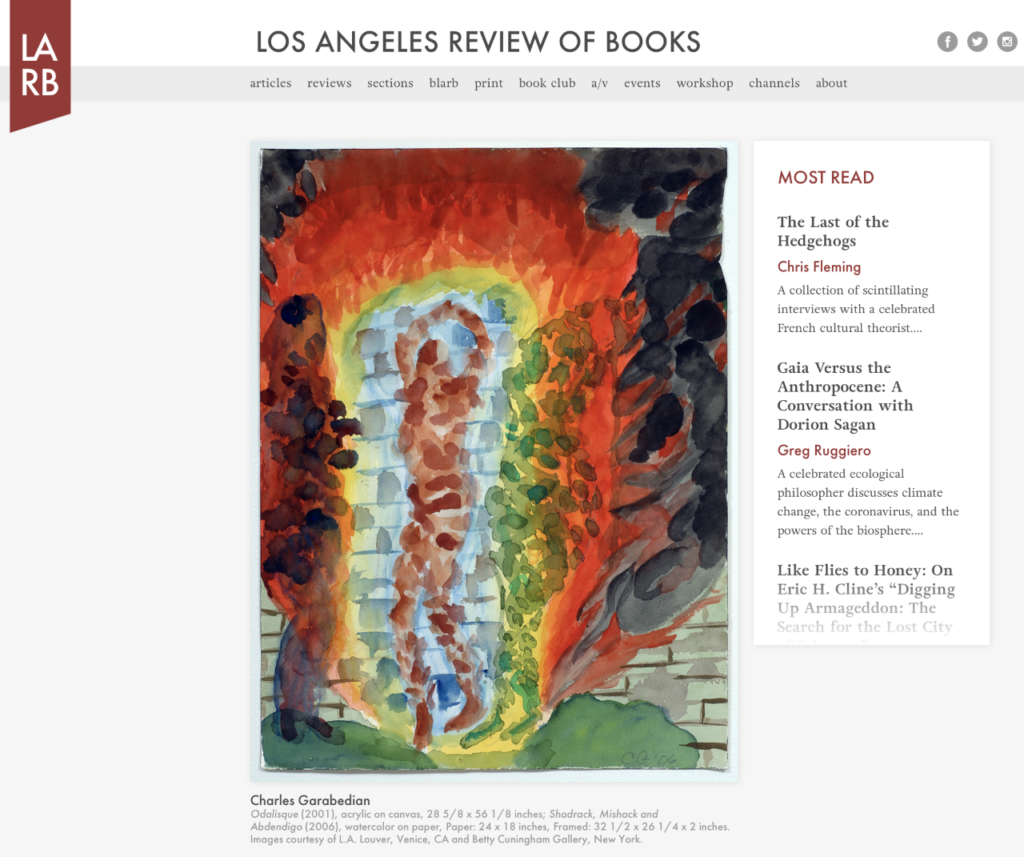
Read the whole thing here. Many people did – it was picked up by 3quarksdaily, Books Inc. and Daily Nous, among others. A week after its publication it was still the best read piece at LARB. See the screenshot below for proof:

 

Christopher Lydon, Robert Pogue Harrison discuss our “worldwide theater of imitated desire”

Share

“HISTORY IS A TEST FOR MANKIND, BUT WE KNOW VERY WELL THAT MANKIND IS FAILING THAT TEST.” – RENÉ GIRARD

Is Geryon an image of our time?

The tables are turned on Entitled Opinions’ Robert Pogue Harrison: public radio show host Christopher Lydon recently interviewed the interviewer for Open Source in Boston. The wide-ranging conversation considered the French theorist René Girard’s mimetic theory, the nature of warfare, the dangers of biotechnology, and the social media.

A recording of the conversation is available at the Los Angeles Review of Books’ Entitled Opinion channel here.

Mankind is an imitative species “with a terrible envy built into it, a competitive desire to be like some ideal of the other person,” Harrison said, citing the work of Girard. Facebook is the “perfect mechanical vehicle” of such envy. Facebook services mimetic needs with “a prosthetic self and a prosthetic social life and prosthetic friends.”

“We have this illusion that there’s nothing more proper to my inner self than my own desires,” said Harrison – but Girard challenges that assumption, showing that our desires are the result of imitation. No coincidence, then, that Facebook was “a worldwide theater of imitated desire on people’s personal computers,” he said. Certainly his former Stanford pupil Peter Thiel, an early investor in Facebook, understood the importance of Girard’s legacy when he said: “I suspect that when the history of the 20th century is written circa 2100, he will be seen as truly one of the great intellectuals, but it may still be a long time till it’s fully understood.”

Radio host Lydon

Imitation leads to violence, and Harrison noted that Girard is “more compelling in his diagnosis of the problem of violence rather than what he offers as an alternative.” Girard’s solution? “The refusal to retaliate he believed was the only sane recommendation in the face of this vortex that international violence could create,” said Harrison.

Harrison also took on the gene-editing boom: “In the name of doing good, you can license a lot of harm,” he said. “Mengele in Auschwitz will eventually be recognized as a visionary of the 20th century, although his methods will be condemned and his Nazi affiliations never endorsed.”

Radio host Harrison

Harrison, a Dante scholar, pointed out that the Inferno’s portrayal of sea-faring Ulysses was the “archetype of scientific discovery,” always heading to new frontiers of exploration and knowledge, which ultimately led to his death. “The line that’s being crossed today is taking the role of creation into our own hands and presuming to know better than nature.” He asked what the motivations behind biotechnology are. Dante’s Geryon, the furry monster who represents fraud in the Inferno, “has the face of a gentle, kind, smiling man, and the tail of a scorpion,” he said. “I want to know where the scorpion tail is hiding in this new explosion of biotech.”

Listen to the whole thing at The Los Angeles Review of Books here.

“THE ONE WHO BELIEVES HE CAN CONTROL VIOLENCE BY SETTING UP DEFENSES IS IN FACT CONTROLLED BY VIOLENCE.” – ROBERT HARRISON