
A hot fire on a cold night: Peter’s denial and “Mitsein”

Featured

Share
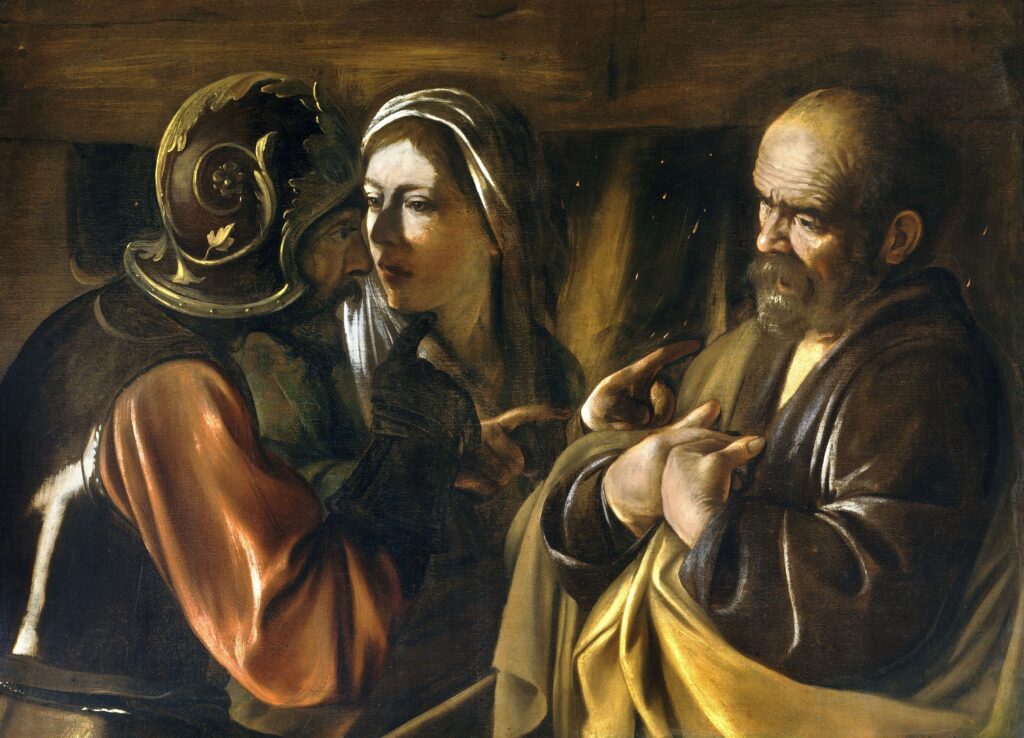
“Saint Peter’s Denial” by Caravaggio

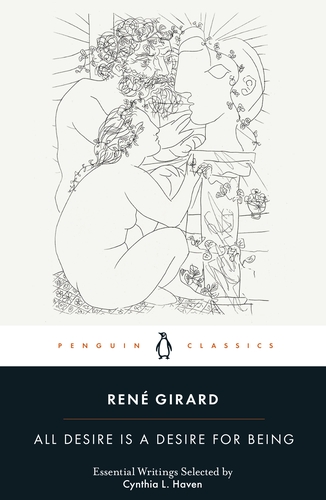
It’s hard to pick a favorite essay from my new anthology, All Desire Is a Desire for Being: Essential Writings – all of the pieces by French theorist René Girard are exceptional, otherwise I wouldn’t have picked them – but the essay on Peter’s Denial is certainly high on the list. So I was very pleased when the University of Notre Dame decided to publish the piece in its eminent Church-Life Journal, under the editor and friend Artur Sebastian Rosman, who is also a Czesław Miłosz scholar.

An excerpt from “The Question of Mimesis and Peter’s Denial“:

After Jesus had been arrested, the disciples fled in all directions, but Peter alone or, according to John, Peter and another disciple, followed at a distance right into the courtyard of the High Priest’s palace, and, I quote: “there he remained, sitting among the attendants, warming himself at a fire.” John says that “the servants and the police had made a charcoal fire, because it was cold, and were standing round it warming themselves.” And Peter too “was standing with them, sharing the warmth.”
The text shifts to inside the palace, where a hostile and brutal interrogation of Jesus was taking place. Then we shift back to Peter and, again I quote:

Meanwhile Peter was still in the courtyard downstairs. One of the High Priest’s servant girls came by and saw him there warming himself. She looked into his face and said, “You were there too, with this man from Nazareth, this Jesus.” But he denied it: “I do not know him,” he said. “I do not understand what you mean.” Then he went outside into the porch; and the girl saw him there again and began to say to the bystanders, “He is one of them,” and again he denied it.

Again, a little later, the bystanders said to Peter, “Surely you are one of them. You must be; you are Galilean.” At this he broke out in curses, and with an oath he said: “I do not know this man you speak of.” Then the cock crowed a second time; and Peter remembered how Jesus had said to him, “Before the cock crows twice you will disown me three times.” And he burst into tears.

Auerbach makes some shrewd comments on that text: “I do not believe,” he writes, “that there is a single passage in an antique historian where direct discourse is employed in this fashion in a brief, direct dialogue.” He also observes that “the dramatic tension of the moment when the actors stand face to face has been given a salience and immediacy compared with which the dialogue of antique tragedy appears highly stylized.” It is quite true, and I am not averse to using such words as “mimesis” and “mimetic realism” to describe the feeling of true-to-life description which is created here, but I do not think that Auerbach really succeeds in justifying his use of the term “mimesis.”

Careful and sensitive as he is as a reader, Auerbach did not perceive something that is highly visible and which should immediately strike every observer: it is the role of mimesis in the text itself, the presence of mimesis as content. Imitation is not a separate theme but it permeates the relationship between all the characters; they all imitate each other. This mimetic dimension of behavior dominates both verbal and non-verbal behavior. Peter’s behavior is imitative from the beginning, before a single word is uttered by anyone.

In Mark and John, when Peter entered, the fire was already burning. People were “standing round warming themselves.” Peter too went to that fire; he followed the general example. This is natural enough on a cold night. Peter was cold, like everybody else, and there was nothing to do but to wait for something to happen. This is true enough, but the Gospels give us very little concrete background, very few visual details, and three out of four mention the fire in the courtyard as well as Peter’s presence next to it. They mention this not once but twice. The second mention occurs when the servant girl intervenes. She sees Peter warming himself by the fire with the other people. It is dark and she can recognize him because he has moved close to the fire and his face is lighted by it. But the fire is more than a dramatic prop. The servant seems eager to embarrass Peter, not because he entered the courtyard, but because of his presence close to that fire. In John it is the courtyard, upon the recommendation of another disciple acquainted with the High Priest.

A fire in the night is more than a source of heat and of light. A fire provides a center of attraction; people arrange themselves in a circle around it and they are no longer a mere crowd; they become a community. All the faces and hands are jointly turned toward the fire as in a prayer. An order appears which is a communal order. The identical postures and the identical gestures seem to evoke some kind of deity, some sacred being that would dwell in the fire and for which all hands seem to be reaching, all faces seem to be watching.

There is nothing specifically Christian, there is nothing specifically Jewish about that role of fire; it is more like primitive fire-worship, but nevertheless it is deeply rooted in our psyches; most human beings are sensitive to this and the servant girl must be; that is why she is scandalized to see Peter warm himself by that fire. The only people who really belong there are the people who gravitate to the High Priest and the Temple, those who belong to the inner core of the Jewish religious and national community. The servant maid probably knows little about Jesus except that he has been arrested and is suspected of something like high treason. To have one of his disciples around the fire is like having an unwelcome stranger at a family gathering.

The fire turns a chance encounter into a quasi-ritualistic affair and Peter violates the communal feeling of the group, or perhaps what Heidegger would call its Being-together, its Mitsein, which is an important modality of being. In English, togetherness would be a good word for this if the media had not given it a bad name, emptying it entirely of what it is supposed to designate.

This Mitsein is the servant girl’s own Mitsein. She rightfully belongs with these people; but when she gets there, she finds her place occupied by someone who does not belong. She acts like Heidegger’s “shepherd of being,” a role which may not be as meek as the expression suggests. It would be excessive in this case to compare the shepherd of being with the Nazi stormtrooper, but the servant maid reminds us a little of the platonic watchdog, or of the Parisian concierge. In John she is described as precisely that, the guardian of the door, the keeper of the gate.

This Mitsein is her Mitsein, and she wants to keep it to herself and to the people entitled to it. When she says: “You are one of them, you belong with Jesus,’ she really means, ‘You do not belong here, you are not one of us.”

We always hear that Peter acts impulsively, but this really means mimetically. He always moves too fast and too far; but still, why move so close to the center, why did the fire exert such an attraction on him?

Read the rest here.

René Girard in Penguin Classics – now out! “This is a big deal, so buckle up.”

Featured

Share

Finally! All Desire is a Desire for Being, a Penguin Classics anthology of Stanford Prof. René Girard‘s “essential writings,” is officially out this week! To my knowledge, the French theorist is the first Stanford faculty to be celebrated in the eminent series. I was honored that Penguin invited me to create this collection of Girard’s finest essays.

Prof. William Johnsen, who directs the publication of a series of books on René Girard and his mimetic theory at the Michigan State University Press, spoke about All Desire is a Desire for Being at the Paris centenary conference for Girard’s 100th birthday, at the Institut Catholique de Paris last week. Here are Bill Johnsen’s words on that occasion:

Since All Desire is a Desire for Being is 95 percent pure Girard, it would seem that only the editor’s preface, selections and apparatus would be left to discuss. That’s all fine, I love what is in it, I am really happy to see especially the piece on Nietzsche from Paul Dumouchel‘s collection which shows the high-flying, often joyful colloques that Jean-Pierrre Dupuy and Dumouchel organized to integrate Girard with his intellectual peers in the Eighties, but I want to emphasize where Girard now appears (Penguin) and what that means: as my President says, this is a big deal.

In his interviews with Nadine Dormoy in 1988, René Girard attributes the 20,000 dependable French readers of serious books to the Écoles, and the smaller American audience to the silos of academic specialization. I have heard the same figure of 20,000 assured readers from Benoît Chantre so I assume that French readership is steady.

In 2006 I was invited by Girard and Robert Hamerton-Kelly to be Publications Chair of Imitatio, a project funded by The Thiel Foundation. One of the earliest projects was the public launch of Achever Clausewitz and Imitatio in Paris in 2007.

Imitatio had begun supporting production costs for books on mimetic theory at Michigan State University Press to find this readership. (We all should be grateful for their more than ten years of support, the slowest startup in Thiel’s stable). When Lindy Fishburne of The Thiel Foundation later assumed the directorship of Imitatio, she urged us to follow our core mission, to develop Girard’s ideas, to find them a greater recognition and circulation worldwide but also in the English-speaking world to catch up with the breadth of his readership in France and Europe.

I have spent my entire adult life in universities. As the editor of the series, I had some plans for how to spread ideas from the university to that outer world by influencing teachers who would influence their students who leave when they graduate, but I had no idea on how to approach the public directly, or whether America, despite its number of educated readers (my university alone granted 9,500 degrees this last spring), had any number approaching 20,000 dependable readers of serious books.

If Girard was besieged by reporters in Paris after Achever Clausewitz was published in 2007, nothing like that happened in America in 2009 when we published it in English as Battling to the End. In 2011, at a conference on Mimetic Theory and World Religions at Berkeley, I suggested to Cynthia Haven that she write a book about René Girard, something personal and accessible enough to help find him a wider audience in English. Girard had told me in appreciation that Haven had written specifically about the Clausewitz book in The San Francisco Chronicle, as well as other public venues in her one-person publicity campaign.

Evolution of Desire (2018) is informative both about Girard and his ideas, placing him effectively in a historical context by reference to his life and work and interviewing many people who knew him. She is both respectful and warm to her subject. It would be impossible to disentangle the circumstances that have made her book so popular: Girard himself, this century’s recognition of him with honorary degrees and awards, his election to the L’Académie Française, several organisations worldwide devoted to his work. But Haven has played a key role with her book and her reputation – she is a well-known and respected serious author for serious readers who bridges the academic and the public book world. She has her sights always on the dependable core readership of serious books in English.

My field is British Studies, I could go on and on about Penguin so I need to just summarize here. Penguin books has been the most successful venture in gaining a wide audience for serious books in English for the last one hundred years. Nothing else even comes close. So congratulations to Cynthia on publishing All Desire is a Desire for Being at Penguin, and to everyone else working in mimetic theory: this is a big deal, so buckle up.

René Girard @100: Stanford’s provocative immortel comes of age

Featured

Share
René Girard among the bamboo outside his Stanford home in 2008.
(Photo: Linda A. Cicero / Stanford News Service)

All Desire is a Desire for Being is becoming a reality! I got my advance copies of the new Penguin Classics anthology of René Girard’s “essential writings” this week. (You can pre-order a copy here.) It was an honor to contribute to his legacy with Penguin Classics, as we near his hundredth birthday on Christmas Day. To celebrate, I am republishing an article you may not have seen before. It was published June 11, 2008, by Stanford News Service. I had met the “French polymath” (that’s how the Google “knowledge panel” identifies him nowadays) only a months before. This would become the first of many interviews, essays, and books about the French thinker.

This article and many others from the Stanford News Service are now archived and no longer publicly available. So in the centenary year of René’s birth, I thought I’d make at least this one available to all of you. Enjoy!

The story goes like this: In 2004, Jean-Pierre Dupuy, a professor of  French at Stanford, is attending a conference in Berlin when he is  confronted by a man in a café who asks, “Why did you become a Girardian?” Dupuy replies in a beat: “Because it’s cheaper than psychoanalysis.”

Did it really happen? Although the event was witnessed, Dupuy responds  with a Gallic shrug and an Italian saying: “Si non e vero e ben trovato.” The American equivalent might be Ken Kesey‘s dictum, “It’s the truth even if it didn’t happen.”

In any case, the anecdote illustrates the kind of effect René Girard, the Andrew B. Hammond Professor of French Language, Literature and  Culture, Emeritus, at Stanford and one of the immortels of the  Académie Française, has had on people. Aficionados of the scholar even have a name: Girardians.

Mimesis and Theory: Essays on Literature and Criticism, 1953-2005,  published this spring by Stanford University Press, explores the  literary side of Girard’s thinking over his long career-a career that originally focused on literary scholarship but that has gradually embraced anthropology, religion, sociology, psychology, philosophy and  theology. French Professor Michel Serres, another immortel (America has only two, and both are at Stanford), has called him “the new Darwin of the human sciences.”

Girard’s Achever Clausewitz, published last year in France by Editions Carnets Nord, will be published in English by Michigan State University Press this winter. The book, which takes as its point of departure the Prussian military historian and theorist Carl von Clausewitz (1780-1831), is considered by many to be groundbreaking. Its implications place Girard, known mostly for his studies of literature and archaic cultures, squarely in the 21st century.

“It doesn’t take much insight to realize that wars have been getting  worse every time – worse from the point of view of the civilian, more and more destructive, more and more total. Well, Clausewitz is about that,” Girard explained. “Therefore my book is a very end-of-the-world sort of thing.”

Girard lives a sequestered life in the academic burrows of Stanford, but his influence abroad is seismic. Even French President Nicolas Sarkozy cites his writings. While Girard walks the Stanford campus virtually unnoticed and unrecognized, in Paris, visitors say, reporters were on his doorstep every day after the publication of last year’s book.

René and Martha Girard at their Stanford home.
(Photo: L.A. Cicero)

The “Girard Effect” may become more prominent worldwide with a foundation, Imitatio, that has been established to promote his ideas. (Dupuy is its director of research.) Imitatio launched its research program with a conference at Stanford in April, with about 40 scholars from around the world attending. The Colloquium on Violence and Religion, an independent association of international scholars, also studies mimetic theory and publishes an annual journal, Contagion: Journal of Violence, Mimesis and Culture.

Although Girard will turn 85 on Dec. 25 (he was born in Avignon), he is not resting on his laurels. Achever Clausewitz signals a new development of his line of thought, and he is already working on his next book, which will focus on St. Paul. Are there any more projects envisioned?

“Thousands more!” Benoît Chantre, his French editor and interlocutor for Achever Clausewitz, said and smiled.

Scapegoats and sacrifice

Girard’s thinking, including textual analysis, is a sweeping reading of human nature, human history and human destiny. His contention is controversial: Religion is not the cause of violence, as many suppose; it was, in archaic societies, a way of solving it.

Here’s why: People are social creatures, and their behavior is based on imitation to a much greater degree than generally supposed. How else to explain why a generation decides at once to pierce their tongues, or why stocks rise and fall? How to explain how a child learns language? Even our desires are not our own; we learn them from others.

“We don’t even know what our desire is. We ask other people to tell us our desires,” he said during a lecture at Stanford’s Old Union in February. “We would like our desires to come from our deepest selves, our personal depths – but if it did, it would not be desire. Desire is always for something we feel we lack.”

Envy and resentment are the inevitable consequences of this drive toward mimesis. These emotions, in turn, fuel conflict; it occurs whenever two or more “mimetic rivals” want the same thing, which can go to only one. It might be a woman, a presidency or a research grant. Many religious prohibitions are meant to regulate and control such 
conflict.

“When we describe human relations, we lie,” Girard said. “We describe them as normally good, peaceful and so forth, whereas in reality they are competitive, in a war-like fashion.”

In literature, such mimetic desire can create comic masterpieces: A Midsummer Night’s Dream is a classic he frequently cites. Or it can inspire the novels of Balzac, in which the characters strive to outdo each other in snobbery and imitative social values. Such imitation can even be totally imaginary. Don Quixote wishes to be a knight errant, because he is imitating the heroes in the books he has read.

On a societal level, such conflict seeks a release, and the outlet is a scapegoat. A third party-often an outsider, a foreigner, a woman, someone who is disabled, the king or president-is blamed and demonized for having caused the conflict. Scapegoats are not seen as innocent victims; they are seen as the guilty cause of the disorder. The calls mount for the sacrificial victim, and the mob itself creates a sense of harmony.

“Joining the mob is the thing that people don’t realize. They feel the unity but don’t interpret it as joining the mob,” Girard said.

The mob prevails. The victim is killed, exiled, pilloried or otherwise dispensed with. Rivals reconcile, and peace and unity are restored to the community.

“If you scapegoat someone, it’s a third party that will be aware of it,” he said. “It won’t be you. Because you will believe you are doing the right thing. You will be either punishing someone who is guilty or fighting someone who is trying to kill you, but you are never the one who is scapegoating.”

In a sleight of hand that unsettles Girard’s critics, the fact that there is no proof is proof. It is not that the scapegoaters suppress the history of their scapegoating, he said, “scapegoating itself is the suppressing.”

For this reason, tragedy and religion in ancient Greece are inextricably entwined. Take the story of Oedipus. A plague is destroying Thebes, and whom does the mysterious oracle find at fault? The outsider, the lame newcomer king, whose expulsion brings peace to the city-state. Euripides’ The Bacchae is the same-disorder is tearing apart the society and the women are going crazy. Pentheus, the young leader, is at fault-his collective murder brings sanity and harmony to Thebes.

“The first culture which rebels against that system is the Jewish culture,” Girard said. He explains that the Bible is actually counter-mythical. Over a period of centuries, the books of the Old Testament begin to catch on to mankind’s scapegoating mechanism. While they describe and even celebrate violence, they gradually begin to question and fight it as well.

For example, many of the psalms “show a narrator who is surrounded by a crowd of good-for-nothings, who are trying to encircle him and turn him into a victim.” The story of Job also is revealing: “It’s a small community, but he’s been the dictator for years. Everybody loves him, he does no one any harm,” Girard said at the Old Union lecture. “One fine morning he wakes up, and everybody is against him. His three ‘friends’ are ready to explain how bad he is now. And everybody is ready to explain how bad he is at the same time. He has turned from the absolute hero to the scapegoat of the community. Job is like a long psalm and shows you what happens to communities. No myth will  ever show you that.”

The climactic victimization is with “the announcement of what we call the Passion.”

“Jesus accepts to be the victim, and we don’t really know why,” he said. “There, what the Gospel said is that it is God himself who has allowed all this scapegoating, and says, ‘You can forgive me, since now I am ready to become your victim myself.'”

Thus, the world has arrived at a dangerous point, Girard said. The mechanism of scapegoating has been seen through; the escape valve is gone. War no longer “works” and no longer resolves mimetic rivalry among nations. While wars were once organized and carried out by states, concluding with a treaty and one side’s defeat, now individual actors can instigate acts of war in a free-for-all.  Moreover, the actors may insist on their own martyrdom to aggravate the conflict, rather than resolve it.

In an interview in Le Point last year, Girard presented the dire worldview that made Achever Clausewitz controversial: “The world wars marked an important step in the rise of extremes. September 11, 2001, was the beginning of a new phase. Today’s terrorism still has to be thought through, because we haven’t yet grasped that a terrorist is ready to die in order to kill Americans, Israelis or Iraqis. What’s new here in relation to Western heroism is that suffering and death are called for, if necessary by experiencing them oneself.”  We search in vain for scapegoats: “The Americans made the mistake of ‘declaring war’ on al-Qaida without knowing whether al-Qaida exists at all.

“The era of wars is over: From now on war exists everywhere. Our era is one of universal action. There’s no longer any such thing as an intelligent policy. We’ve almost reached the end.”

An existential downfall

Girard’s misgivings about war and a potential apocalypse are the extension of a long thought that has evolved over decades. The road was marked by various points of illumination: One light-bulb moment occurred during a “conversion” experience when he was a young professor at Johns Hopkins University in the late 1950s.

He explained to James Williams, in an interview included in The Girard Reader, the epiphany that was connected with the writing of his first book, Deceit, Desire and the Novel: “I started working on that book very much in the pure demystification mode: cynical, destructive, very much in the spirit of the atheistic intellectuals of the time. I was engaged in debunking, and of course recognizing mimesis is a great debunking tool because it deprives us moderns of the one thing we still have left, our individual desire.”

“The debunking that actually occurs in this first book is probably one of the reasons why my concept of mimesis is still viewed as destructive,” he said. “Yet I like to think that if you take this notion as far as you possibly can, you go through the ceiling, as it were, and discover what amounts to original sin. An experience of 
demystification, if radical enough, is very close to an experience of conversion.”

He described his eventual realization this way: “The author’s first draft is a self-justification.” It may either focus on a wicked hero, the writer’s scapegoat, who will be unmasked by the end of the novel; or it may have a good hero, the author’s alter ego, who will be vindicated at novel’s end.

If the writer is a good one, he will see “the trashiness of it all” by the time he finishes his first draft-that it’s a “put-up job.” The experience, said Girard, shatters the vanity and pride of the writer. “And this existential downfall is the event that makes a great work of art possible,” Girard said.

While he speaks easily of conversion, original sin and redemption, however, one visiting scholar wondered why he seemed to circumvent a related theme: the imperative topic of forgiveness. But it’s hard to beat Girard at his own game. Only a few months earlier, Girard had spoken at an informal philosophical reading group in History Corner for several dozen faculty and students.

Girard recapitulated the story of the Old Testament Joseph, son of Jacob, bound and sold into slavery by his “mob” of 10 half-brothers: “They all get together and try to kill him. The Bible knows that scapegoating is a mob affair.” Joseph reestablishes himself as one of the leaders of Egypt and then tearfully forgives his brothers in a 
dramatic reconciliation. It is, he said, a story “much more mature, spiritually, than the beginning of Genesis.”

The story is unlike any in archaic literature: “It’s a very beautiful  story, which like many biblical stories, is a counter-mythical story,” he said, “because in myth, the lynchers are always satisfied with their lynching.”

But at the reading group, he suggested his audience might not have noticed this before. After all, they had been trained to think that the Bible was a completely backward book, superceded and preceded by better efforts, with little that was new to the world. In short, Girard dropped the cat among the pigeons.

They erupted into debate. Girard slouched back in his chair a little, smiling softly and watching the feathers fly.

Martin Girard narrates his father René’s “I See Satan Fall Like Lightning” – and now you can hear it, too!

Featured

Share

A guest post from author Trevor Cribben Merrill:

Trevor Cribben Merrill in Pasadena (Photo: Sam Sorich)

I See Satan Fall Like Lightning (1999) is perhaps the most complete and compact statement of René Girards sweeping theory of scapegoating violence and the shattering revelation it brings. Now it’s been released as an audiobook, thanks to the late French theorist’s son Martin Girard, a businessman who devoted many hours of his time to narrating the work. Though he had no prior experience as a voice actor or reader, early reviews have been glowing. The audiobook is available on Amazon here.

Girard’s work is more relevant than ever today. Surely no other thinker can supply such a convincing explanation for the existence of the Twitter retweet button. But beyond the theory’s obvious ability to shed light on our online vices, it resonates because of the central place that Girard gives to competition and rivalry in his thought. Whether you’re working to get funding for your start-up, attract readers to a Substack post, or snag a house in a hot real estate market, competition is a daily reality in our world, yet one that we often prefer not to think or speak about too openly, even as we furtively check the amazon.com ranking of a colleague’s newest release. Speaking of amazon.com rankings: the audiobook of I See Satan has been selling briskly. I hope it can continue to bring new readers to René’s work, and introduce them to his compelling account of Christian truth. 

Earlier this month, Martin Girard and his wife Dee flew in from their home in Phoenix for a book launch and Q&A in Pasadena, CA to celebrate the I See Satan Fall Like Lightning (Thiel Foundation) release.

First published in France in 1999 as Je vois satan tomber comme l’éclair (Grasset), and then translated into English by James G. Williams and published by Orbis Books in 2001, the new audiobook was published last month on October 20.

The event was held at the Pasadena home of Nicole and Ray Tittmann, who have hosted a number of book launch events in the last few years (including a launch of my novel Minor Indignities). A sumptuous spread of hors d’oeuvres greeted a crowd that included incoming Cornerstone Forum director Alex Lessard and documentary filmmaker Sam Sorich, who was in town from Chicago and photographed the event.  

Martin Girard was born in Bryn Mawr, Pennsylvania, the oldest of the three Girard children, while his father was teaching at Bryn Mawr College. He graduated from the University of Colorado at Boulder with a degree in political science. He then became an entrepreneur, working between Paris and the US, and eventually founded a start-up that he later sold to a Fortune 500 company. He and his wife Dee are avid skiers, and in recent years Martin has been delving deeply into his father’s work.

I interviewed him at the event, in a conversation that included Martin’s youth and early adulthood, and touched on key milestones in René’s career. Martin recalled the buzz of excitement at the time of the 1966 Johns Hopkins conference, and visits from Jean-Michel Oughourlian and Guy Lefort to the family’s home near Buffalo, New York, after his father took a professorship there and began writing the book that would eventually be published as Things Hidden since the Founding of the World. When Things Hidden was released in France to great critical and popular acclaim, Martin was in his early 20s and was working in France. Business associates were surprised to discover that Martin was, in fact, the son of the same René Girard they had heard interviewed on the radio or TV. 

Martin described a childhood of French immersion, with frequent trips to and long stays in Avignon, and dinner table conversation conducted in French, even when the family was in the U.S. He and his younger brother sometimes chafed against their dad’s determination to immerse them in French culture and the French language, but later discovered that their bilingual and bicultural upbringing was a gift that opened up many opportunities and instilled a lifelong love of France. 

Martin emphasized the key role his mother, Martha Girard, played in supporting his father’s work and career, as well as her role in teaching her children by example to avoid the drama and rivalries that René described in his works of literary theory.  “Martha Girard came from a family with traditional Scotch-Irish, midwestern American values,” he said. “These values were an important part of the family’s dynamic and the children’s upbringing. René’s career and the exoticism of the French connection tend unjustly to overshadow the importance of the other side of the family, including the impact on René.”

Postscript: The Book Haven made a difference today! I See Satan Fall Like Lightning is the #1 new release in Religion & Philosophy.

This image has an empty alt attribute; its file name is I-See-Satan-1-1024x698.jpg
Trevor Cribben Merrill in conversation with Martin Girard in Pasadena (Photo: Sam Sorich)
This image has an empty alt attribute; its file name is I-See-Satan-2-1024x683.jpg
Martin and Dee Girard (at right) talk with guests. (Photo: Sam Sorich)
An elegant Pasadena smorgasbord (Photo: Sam Sorich)

“Evolution of Desire: A Life of René Girard” – in the Ukrainian press!

Featured

Share

In the August edition of Kyiv’s Krytyka, a review of my Evolution of Desire: A Life of René Girard:

Євген Мінко, рецензючи книжку Синтії Гейвен «Еволюція бажання: життя Рене Жирара», зазначає, що для Жирара наука була полем передчуттів і осяянь, інструментом вивчення ефемерних, але фундаментальних елементів людського буття: бажання, відчуття сакрального, непереборного потягу до насильства.

In other words, (which is to say, English ones): Evgeny Minko, reviewing Cynthia Haven‘s book The Evolution of Desire: The Life of René Girard, notes that for Girard, science was a field of premonitions and insights, a tool for studying ephemeral but fundamental elements of human existence: desire, the feeling of a sacred, irresistible urge to violence.

Evgeny Minko is a writer, journalist, and psychoanalyst. The title of his article is “У полі передчуттів і осяянь,” in English, “In the Land of Premonition and Visions.” It begins, in translation:

One of the most enigmatic philosophers of the 20th century, René Girard, died in the fall of 2015, and three years later his first biography was published. Literary critic Cynthia Haven was friends with Girard during the last years of his life and de facto started work on the book with his participation: in Evolution of Desire conversations between the author and the hero are quoted abundantly. The result is a kind of hybrid of biography and memoir, and the requirements of distancing the researcher from the object of research for the sake of objectivity aren’t met. However, this fits perfectly into the coordinate system of thought created by Girard. Science — history, literary studies, anthropology — was for him a field of premonitions and revelations. A tool of careful (as if by the hands of an entomologist) study of ephemeral but fundamental elements of human existence: desire, feeling of sacred, irresistible urge to violence.

The “desire” in the title of the book for the reader, who is not familiar with Girard’s work, will primarily be a desire to understand who, in fact, we are talking about. After all, in the imaginary philosophical canon of modern times, Girard’s place is quite marginal, as it often happens (should happen!) with truly interesting and original phenomena.

Minko (Photo: Gazettyar, Creative Commons)

René Girard was born in France in 1923, received a history education, and in 1947 emigrated to the United States, where he spent the rest of his life teaching literature at leading universities. A successful career path of a scientist, without upheavals and disasters.

However, a formal career does not convey the ambition of Girard’s entire life: to create a comprehensive system for explaining human behavior. Like the one created by Freud. And this system became his mimetic theory.

Read the whole thing here in Ukrainian. Otherwise, it’s off to Google Translate for you.

Whoever thought René Girard would become “cool”?

Featured

Share

Who would have thought that Stanford’s eminent French theorist René Girard would enter the empyrean of “coolness”? Neil Scott did. That’s who.

On Neil Scott’s Substack – 95 Theses on Cool, parts 0-17: From Miles Davis to René Girard via Red Scare podcast – the French theorist made the cut. #16 is René Girard, and I get a mention:

“… In Girard’s view, everything we desire, everything we think is cool, is learned through copying someone else. As Cynthia Haven, writes: “We live derivative lives. We envy and imitate others obsessively, unendingly, often ridiculously. ‘All desire is a desire for being,’ [Girard] said, and the being we long for becomes wrapped up in a person. That person, whether we like it or not, is our avatar of cool.”

Read the rest here. Want to know more about him, so you can be cool, too? Try Jerry Bowdler’s excellent 2015 article in Forbes, “René Girard: The ‘Einstein of the Human Sciences.'” (Note: the late Michel Serres tagged René Girard as “the Darwin of the Human Sciences,” but Einstein isn’t bad, either.) A longish excerpt, reprinted with his permission:

Girard saw it first in literary studies. While engaging in a close examination of several great novelists, (Proust, Dostoevsky, Flaubert, even Cervantes) Girard noticed that despite the consensus that the great novelists were ‘singular’, i.e. one of a kind, they actually had several powerfully unifying themes. Those themes were that human desire does not generally emerge from within us, but rather comes from some ‘other’. We naively imagine that we simply are who we are, and that we want what we want because we are who we are. However, the great novelists present us with an inconvenient truth – that we import our most powerful desires from imitating other people.

“How did mankind survive this long? This is where Girard gets really interesting.”

Girard gives the example of a young man who admires the world’s greatest pianist. He is drawn to the pianist, and therefore he is drawn to what the pianist is drawn to – great achievement in piano performance. The great man wanted to be the best piano player in the world, and he got what he wanted. The younger man wants to be like his hero. But at precisely that point, when the younger man most idolizes his hero, they also become rivals. To truly imitate the master, the student must become the greatest piano player in the world. The two want the same thing, a thing which there cannot be two of – the title “greatest.”

The first stage Girard calls ‘mimesis’ – imitation. Young man wants to be like great man. The second stage is ‘mimetic desire’ – young man wants what his master wants (to be the greatest). The third stage is called ‘mimetic rivalry’ – young man and master want the same unique object of desire, so they become enemies.

Once you become aware of this process, you see it everywhere: celebrity feuds, geopolitical rivalries, financial asset valuation bubbles, everywhere that people interact. It’s even there among the animals, especially in the form of sexual rivalry, or rivalry over food. The Bowyer dogs desire a chew toy more when it is desired by another dog.

The idea is revolutionary because it overturns what Girard calls ‘the romantic illusion’, the illusion which goes back at least as far as Rousseau, that humans can be authentic. The romantic illusion proclaims that we can throw aside cultural and societal norms to follow our inner desires, that we can and must (as a thousand schlocky movie characters tell us to do) follow our hearts. Girard says we can’t follow our hearts instead of the group, because without the imitated other we don’t have desires in our hearts. Certainly we have instinctual urges, but not the higher purposes which we describe as desires. We get those from others.

But there is a problem larger than the disappointment in realizing that the romantic illusion is false and that genuine ‘authentic’ autonomous desire is an illusion. The larger problem is that the rivalries of mimetic desire tend to spin out of control. Switching to another of Girard’s metaphors: if I love a woman and you admire me and I praise that woman to you, you will tend to be drawn to her as well. Shakespeare does this a lot – it is the basis of the Rape of Lucretia and of Midsummer Night’s Dream, for instance. So I love her and you imitate me and come to love her too. But the fact that you desire her makes me even more confident in my initial desire for her. I am confirmed. I was right to desire her: the proof is the desire which you have for her. This can stay contained in a little love triangle or it can expand into a square, or even a pentagon… which reminds me that all of this can take on a military significance: the object of desire can become a casus belli. As Peter Robinson said in Girard’s last public interview, “There is only one Helen of Troy.” Not that the object of desire in war is typically sexual, but there is not just only one Helen — there is also only one Hellespont, and as Russia and Turkey are all too aware, only one Black Sea.

This is a self-reinforcing mechanism. Mimetic desire increases the intensity of desire, and the intensity is also then imitated, and the imitation then sets off another round of desire. This often leads to physical clashes. Girard calls this stage ‘mimetic violence’.

Economist and Girard aficionado – Jerry Bowyer

When the process enters the violent phase, there is a subtle shift in the system. The original object of desire is no longer the point. No one cares that much about Helen anymore. Now it’s about fallen comrades: Hector must be avenged. Achilles’ cousin cannot be allowed to have died in vain. Agamemnon cannot go home empty-handed after so much shedding of Greek blood. The conflict itself takes on a life of its own. Menelaus cannot just go home and wed the second most beautiful girl in Greece after all those years of fighting. Ever have an argument with someone which quickly becomes an argument over the argument itself? Someone can appear from another room and settle the original point of dispute with a, “Hey guys, I googled it, and it turns out that what really happened was X,” but the argument keeps on going, the conflict generates new injuries, new injustices, new grudges. This can become a war of all against all, described in thousands of papers by anthropologists documenting thousands of ‘primal chaos’ rituals. The rituals re-enact the primal violence which preceded the establishment of our clan, village, city, empire – out of which order came. The rituals remind us how bad things can get.

So then why aren’t societies in a perpetual state of war? How did order come? How did mankind survive this long? This is where Girard gets really interesting. Order comes from a scapegoat, someone on whom the hatred and guilt of the community can be affixed, someone who can then be sacrificed to purge the hatreds of the community. The scapegoat is not truly guilty. He couldn’t possibly be. He probably wasn’t even there when the mimesis started, scapegoats are frequently foreign visitors. He doesn’t have the power to send a whole community into chaos. This blind man who wandered into the village couldn’t have stolen all those sacred artifacts. That strange babbling woman couldn’t have ruined the crop. Those Jews and/or Gypsies would have absolutely no reason to poison the village well. But the community needs them to be guilty, so it often invents supernatural powers (witchcraft) or supernaturally wicked motivations (devil worship), and the community has now found its point of unity – the strangers must be killed. Oedipus must have been a moral monster, a mother-raper and a patricide. He has brought the wrath of the gods down upon us and he must die, at his own hand or ours. Usually it’s the latter the hands of others, lots of hands, either casting stones or casting ballots.

The victim dies, and by dying, reunites the community. Now that they have died and are no longer a threat and have performed the sacred function of re-founding the city, they are to be honored. When a champion dies in the Hunger Games, the majestic music plays — they are now ‘the fallen’. They are heroes – the social order depends on them. They have restored order by their death. They save many lives by dying. Girard suggests that the rehabilitation of the victim is perhaps an unconscious admission that the victim was, in fact, innocent. The innocence of the victim is a useful lie which cannot be acknowledged; otherwise, it is no longer useful and the violence must begin again. Girard calls this final phase ‘the scapegoat mechanism’.

The discovery of this pattern is what Girard called his ‘first conversion’. This is the conversion away from the romantic illusion that autonomous authentic man was an achievable idea, from the modern idea that religion was optional for mankind and that violence was an interruption of, and imposition upon, the default equilibrium of peace. For Girard, violence is the origin of archaic religion and archaic religion is the foundation of human culture itself. These are the ‘things hidden from the foundation of the world’, mankind’s need to reenact the cycle of violence no matter what his intentions or aims. Modern man pretends that we’re past all that, but that is another useful life – another romantic illusion.

Read the whole thing here – there’s more, really, lots more – here.

Postscript: Can’t get enough of cool? Try reading Chris Fleming‘s essay on “Theoretical Cool” over at the Sydney Review of Books.