

Dana Gioia in WLT: “It’s better to be noticed than ignored”

Share

"Fame gives you the freedom to pursue your interests" (Photo: L.A. Cicero)

The new September issue of World Literature Today is out, including an interview with poet, and former NEA Chairman, Dana Gioia. The Q&A was conducted by WLT‘s managing editor Michelle Johnson (who was also my editor for the July/August article on eminent Polish poet Julia Hartwig).

Not online, alas – but here are a few excerpts:

On fame:

I try to accept the good and the bad with equanimity.  As Oscar Wilde observed, “The only thing worse than being talked about is not being talked about.” I have been lucky to have enjoyed a degree of celebrity across my career, and the experience has taught me a lot about the nature of contemporary fame. Notoriety requires you to be simplified, usually into a neat and tidy headline. First, I was widely discussed as the “businessman-poet.” Then I became notorious as the ringleader of the New Formalists.  Soon thereafter I became famous as the literary maverick who wrote “Can Poetry Matter?” Then I became a public figure as the champion of arts and literacy who ran the National Endowment for the Arts. Each of these reputations contained an element of truth and a simplification. But it’s better to be noticed than ignored, and properly used, fame gives you the freedom to pursue your interests as a writer.

On his legacy as one of the proponents of “New Formalism”:

It’s easy to forget how odd things were back in the 1970s. Form and narrative were almost universally denounced as dead literary modes. They were considered retrograde, repressive, elitist, antidemocratic, phallocentric, and even (I’m not making this up) un-American. It was impossible to publish a formal or narrative poem in most magazines. One journal even stated its editorial policy as, “No rhyme or pornography.” Poems wee supposed to be free-verse lyric utterances in a confessional or imagistic style. I’m happy to say that journals and presses are now open to formal or narrative poetry. This is a direct result of the so-called “Poetry Wars,” the long and loud debates over these issues that lasted from the early 1980s through the 1990s. …

I had no interest in making rhyme and meter the dominant aesthetic. What I fought for – and one really did have to fight back then – was for the poet’s freedom to use whatever style he or she felt was right for the poem. I can’t imagine a poet who wouldn’t want to have all the possibilities of the language available, especially the powerful enchantments of meter, rhyme, and narrative. I never saw the movement as a rejection of modernism. Why throw away the greatest period of American poetry?

What’s next?

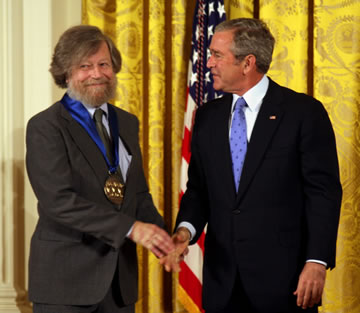
America's mystical composer gets National Medal of Arts

I am most eager to work with artists I admire unreservedly. Collaboration depends upon talent – the pairing of two talents that inspire each other. Morten Lauridsen, who seems to me one of the greatest living composers, wants to create a work together. That is very exciting. Helen Sung and I are going to write a jazz song cycle. The composer William Bolcolm has suggested doing a musical setting of my narrative poem “Haunted” for a pianist and an actor. Lori Laitman is writing a song cycle using my translations of Montale’s love poems. Paul Salerni and I have sketched out a dance opera. I also have a third opera subject in mind, but it is still in the early stages. But, of course, the important thing is to keep writing poems.
The article also included a poem from his forthcoming collection Pity the Beautiful (2011, Graywolf), titled “Finding a Box of Family Letters.” I thought it sounded familiar.  Indeed, it was. He read it to me a year ago, over wine at his house in Santa Rosa, at the same time he read “Haunted,” which I very much look forward to hearing with Bolcom’s musical setting.  The poem made a very strong impression on me then, and also when it was published in the Hudson Review some time later.

Some time ago, Dana sent me a DVD of Lauridsen’s Lux Aeterna – please, please go find it, if you haven’t heard it.  He’s largely unheralded in the MSM, but is perhaps the most popular choral composer in the U.S.  Moreover, Lauridsen has been called “”the only American composer in history who can be called a mystic.”

By the by, the magazine also has an essay by Jane Hirshfield, on American poetry.  Haven’t read it yet.

No love lost: “authors are some mean mofos”

Share

Hank James, zat you?

A few weeks ago, we wrote a few words on famous feuds between authors.

What better way to follow up than with nasty letters authors wrote on each others’ work?  I read flavorwire’s post on the topic some time ago, which excerpted a longer column from The Examiner here, with a Part 2 here.  It seems like as a good a way as any to begin the holiday weekend.

Take this one:

Wyndham Lewis on Gertrude Stein: “Gertrude Stein’s prose-song is a cold black suet-pudding. We can represent it as a cold suet-roll of fabulously reptilian length. Cut it at any point, it is the same thing: the same heavy, sticky, opaque mass all through and all along.”

As one commenter, Dave, concluded:  “Authors are some mean mofos.”

Instead of resnipping the earlier lists, however, I decided to raid the suggestions from readers.

No eraser

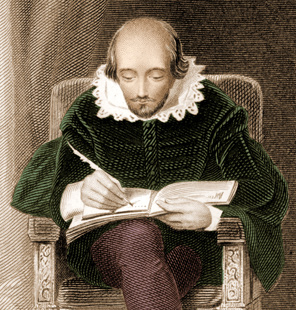
Ben Jonson on Shakespeare:  “I remember the players have often mentioned it as an honor to Shakespeare that in his writing, whatever he penned, he never blotted out a line. My answer hath been, ‘Would he had blotted a thousand.”

Baudelaire on Voltaire: “I grow bored in France – and the main reason is that everybody here resembles Voltaire … the king of nincompoops, the prince of the superficial, the anti-artist, the spokesman of janitresses, the Father Gigone of the editors of Siècle.”

H.G. Wells on Henry James: “A hippopotamus trying to pick up a pea.”

Ahem...

Louis-Ferdinand Céline on D.H.Lawrence’s Lady Chatterley’s Lover: “600 hundred pages for a gamekeeper’s dick, it’s way too long.”

As far as potty-mouth goes, try this one:  Stephen Fry on Dan Brown‘s The DaVinci Code: “Complete loose stool water. Arse gravy of the very worst kind.”

William Hazlitt about his good friend Coleridge: “Everlasting inconsequentiality marks all he does.”

Then there’s a Jane Austen pile-on:

Mark Twain:  “Just the omission of Jane Austen’s books alone would make a fairly good library out of a library that hadn’t a book in it.”

Charlotte Bronte‘s criticism is less snarky, more an excellent Romantic era critique of the preceding era’s Classicism:

"A Chinese fidelity..."

“. . . anything energetic, poignant, heartfelt, is utterly out of place in commending these works; all such demonstration the authoress would have met with a well-bred sneer . . . She does her business of delineating the surface of the lives of genteel English people curiously well; there is a Chinese fidelity, a miniature delicacy in the painting: she ruffles her reader by nothing vehement, disturbs him by nothing profound: the Passions are perfectly unknown to her; she rejects even a speaking acquaintance with that stormy Sisterhood; even to the Feelings she vouchsafes no more than an occasional graceful but distant recognition; too frequent converse with them would ruffle the smooth elegance of her progress. Her business is not half so much with the human heart as with the human eyes, mouth, hands, and feet; what sees keenly, speaks aptly, moves flexibly, it suits her to study, but what throbs is the unseen seat of Life and the sentient target of death–this Miss Austen ignores, she no more, with her mind’s eye, beholds the heart of her race than each man with bodily vision, sees the heart in his heaving breast. Jane Austen was a complete and most sensible lady, but a very incomplete, and rather insensible (not senseless) woman . . .”

Ceallaig‘s perceptive comment from an intelligent heart:  “My question is: if Mark Twain hated Jane Austen why does he say ‘every time I read it?’ Wouldn’t once have been enough? Ditto Noel Coward‘s slam on Oscar Wilde: ‘Am reading more of …’? as if the first dose wasn’t sufficient? I’m sure most of these slams were meant to be witty, and I agree with a number of them, but … wit used for the sake of nasty doesn’t work for me.”

Ellis: "a mean shallow stupid novel"

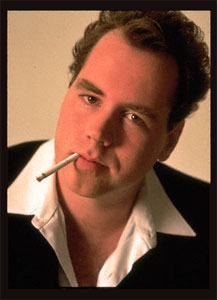
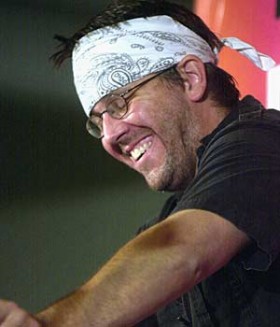
Then I found this interesting post, from bibliokept. David Foster Wallace on Bret Easton Ellis.  I leafed through Ellis’ Less Than Zero in the Stanford Bookstore a couple decades ago, and found it ugly and depraved.  I haven’t read Wallace at all, and have been put-off by his super-celebrity status, which, morbidly, seemed to accelerate with his 2008 suicide – until I read this excerpt from an interview:

“I think it’s a kind of black cynicism about today’s world that Ellis and certain others depend on for their readership. Look, if the contemporary condition is hopelessly shitty, insipid, materialistic, emotionally retarded, sadomasochistic, and stupid, then I (or any writer) can get away with slapping together stories with characters who are stupid, vapid, emotionally retarded, which is easy, because these sorts of characters require no development. With descriptions that are simply lists of brand-name consumer products. Where stupid people say insipid stuff to each other.

Wallace: "In dark times..."

‘If what’s always distinguished bad writing—flat characters, a narrative world that’s clichéd and not recognizably human, etc.—is also a description of today’s world, then bad writing becomes an ingenious mimesis of a bad world. If readers simply believe the world is stupid and shallow and mean, then Ellis can write a mean shallow stupid novel that becomes a mordant deadpan commentary on the badness of everything. Look man, we’d probably most of us agree that these are dark times, and stupid ones, but do we need fiction that does nothing but dramatize how dark and stupid everything is?

“In dark times, the definition of good art would seem to be art that locates and applies CPR to those elements of what’s human and magical that still live and glow despite the times’ darkness. Really good fiction could have as dark a worldview as it wished, but it’d find a way both to depict this world and to illuminate the possibilities for being alive and human in it. You can defend Psycho as being a sort of performative digest of late-eighties social problems, but it’s no more than that.”

I’d say it’s considerably less.

Bibliokept‘s thoughtful consideration of Ellis versus Wallace definitely worth a thoughtful read.