

New short biography of Hannah Arendt: “Her hope for the world lay in ‘natality.'”

Share
Hannah_Arendt1

A photo from before the dark times.

I don’t follow publishing news very closely (I know I should), but I was disappointed when the Penguin Lives series, edited by James Atlas, disappeared shortly after I became aware of it. In the olden days, before I became a blogger, I used to gulp down biographies like dark chocolate, and the short format (about 200 pages) made these books bite-sized. According to the Observer:

The Penguin Lives boutique biography series – a collaboration between Viking publishing, former New York Times Magazine editor James Atlas and former deputy mayor and financier Kenneth Lipper – is kaput.

Mr. Atlas, the general editor for Penguin Lives, told Off the Record that after publishing 22 of the diminutive, handsomely designed hardcover books pairing noted authors with an eclectic range of subjects ranging from Napoleon to Rosa Parks, Viking – a division of Penguin-Putnam – has decided to pull out of the venture.

“They’re closing it down. No real explanation was given,” Mr. Atlas said. “It was a question of its place in the corporate structure. It fit well, but it didn’t always fit well.”

Well, there you have it. That was a dozen years ago. Shows how up-to-date I am. Cut away to a few weeks ago when I received a notice of a package at the Stanford Post office. I tore open the package on my way to a meeting. A book by Hannah Arendt about “dark times.” I assumed it was a fancy new reissue of her Men in Dark Times – I wrote about that here, and assumed it would return me to that time “when there was only wrong and no outrage.” I figured my earlier post and been flagged by some ‘bot for a publishers’ mailing list. So I added the book to a tall pile for future perusal.

Wrong! The book is a short (134 pages) new biography of the philosopher by Anne C. HellerA Life in Dark TimesIt’s one of the short biographies issued in a new Amazon Publishing series called “Icons” (more here.) Seven of the eleven “inaugural” titles have already been published. Next on the list: Karen Armstrong takes on St. Paul, and Brooke Allen writes about Benazir Bhutto. What a good idea this is! It is still a good idea! And the Arendt book had a release date of only four days ago, so I’m just in time!

According to Adam Kirsch (we’ve written about him here and here), “Hannah Arendt was one of the most compelling and provocative thinkers of her time, and she remains indispensable today. In this lucid, accessible biography, Anne Heller shows how Arendt’s eventful life – shaped by war and exile, love and friendship – gave rise to her most important insights into politics and the nature of evil.”

I found this passage in the last chapter, at the end of her life. It is not about dark times – I hear enough about those already in the news – but rather about miracles. And couldn’t we all use one about now?

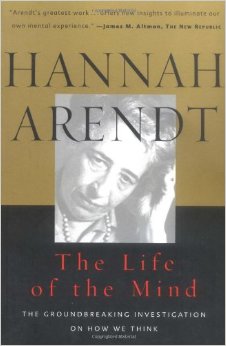
Arendt-KellerHer hope for the world lay in “natality,” “the miracle that saves the world,” she wrote, by which she meant the unimaginable possibilities that attend every human birth and must be safeguarded until they can reach full flower. “The beginning is also a god; so long as he dwells among men, he saves all things,” she noted, quoting Plato in her 1971 tribute to Martin Heidegger upon his eightieth birthday. And as she would write poignantly in her last book, The Life of the Mind, published after her death in 1978:

In this world which we enter, appearing from a nowhere, and from which we disappear into a nowhere, Being and Appearing coincide. … Seen from the viewpoint of the spectators to whom [a human life] appears and from whose view it finally disappears, each individual life, its growth and decline, is a developmental process in which an entity unfolds itself in an upward movement until all its properties are fully exposed; this phase is followed by a period of standstill – its bloom or epiphany, as it were – which in turn is succeeded by the downward movement of disintegration that is terminated by complete disappearance.

The human soul is born to make an appearance on a public stage, Arendt seemed to have concluded in her later years, and to become most vibrantly itself in a shared world. For her, authenticity did not require withdrawal from noisy modernity into the solitude of Being, as it did for Heidegger, but neither did it permit taking action without standing back and thinking about “what is.” And in her later years what is always encompassed the point of view of people different, even alien, from oneself.
Hannah Arendt: thinking vs. evil

Share

arendt3In her last, unfinished book, The Life of the Mind, Hannah Arendt returned to the subject of her earlier Eichmann in Jerusalem: The Banality of Evil. She concluded that the besetting sin of Eichmann “was something entirely negative: it was not stupidity but thoughtlessness.”

In the Time Higher Education Supplement, Jon Nixon discusses Arendt, the role of universities, “worldly thinking,” and amor mundi:

The Eichmann case raised a crucial question for Arendt: “Could the activity of thinking as such, the habit of examining whatever happens to come to pass or to attract attention, regardless of results and specific content, could this activity be among the conditions that make men abstain from evil-doing or even actually ‘condition’ them against it?” Arendt’s question arose in large part from her experience of totalitarianism, but also from her experience of political oppression under 1950s McCarthyism in the US and more generally from the ideological battle lines that defined the Cold War. She also viewed with increasing concern the unthinking consumerism and the assumption of ever increasing affluence that fuelled the American Dream prior to the stock market crash of 1973 and the oil crisis that followed later that year. Neither Hitler’s Nazism nor Stalin’s communism had, it would seem, exhausted the full potential of totalitarianism. So, the question remained urgent and pressing even within the heartlands of the democratic superpower of which she was now a citizen.

The Life of the Mind provides a tentatively affirmative response to that question: in so far as the activity of thinking requires us “to stop and think”, it may condition us against evil-doing. But this last work also raises – by implication at least – a more difficult question: could the activity of thinking not only condition us against evil-doing but predispose us towards right action? Here Arendt’s response is less clear, partly because it hinges on her suspicion of “pure thought” and partly because the final and crucial section of The Life of the Mind remained unwritten. What is clear is her insistence that without thinking that reaches out in dialogue to others there can be no informed judgement, no moral agency and no possibility of collective action – no “care for the world”.

Education was, for Arendt, an expression of that care – “the point at which”, as she wrote in her 1954 essay on “The Crisis in Education”, “we decide whether we love the world enough to assume responsibility for it”. Education provides us with a protected space within which to think against the grain of received opinion: a space to question and challenge, to imagine the world from different standpoints and perspectives, to reflect upon ourselves in relation to others and, in so doing, to understand what it means to “assume responsibility”. She had observed at first hand how such opinion can solidify into ideology. For her, thinking was diametrically opposed to ideology: ideology demands assent, is founded on certainty, and determines our behaviours within fixed horizons of expectation; thinking, on the other hand, requires dissent, dwells in uncertainty and expands our horizons by acknowledging our agency. It is the task of education – and therefore of the university – to ensure that a space for such thinking remains open and accessible.

Read the whole thing here. It’s worth thinking about as we redefine education and the humanities in collective and consumeristic ways. It’s also worth pondering as we head inexorably into an election season already riddled with clichés, banality, repetition, and derivative thinking.

Robert Pogue Harrison socks it to Silicon Valley

Share

pregnantPregnancy brings unaccustomed insight. For instance, I used to look around me and realize that everyone, including the dirty drunk on a park bench, required someone to go through hours of agonizing labor to bring him into the sunlight. Some woman, whether she consciously helped or hindered, nurtured the new being for nine months, offering the best of her body’s resources to a  tenant who would never be able to repay the rent – true whether the mom is a doctor or a drug addict. The fragility of the whole human endeavor, and the perishability of the robust daughter I eventually bore, used to bring me almost to the point of tears – also unaccustomed.



I realized that a huge amount of what we call “civilization” goes into maintenance. I estimated about a third of an individual’s lifetime, and about the same percentage of a society’s resources, goes into rearing and educating the next generation – whether, for an individual, it’s teaching kids to refrain from punching a pal in the sandbox, to eat with a fork, and to appreciate the finepoints of Bellini, or, on a societal level, building a school, funding studies on infant mortality, kicking a few bucks to the old alma mater, or supporting neighborhood basketball court.

Now, however, we’ve become a society “where children, metaphorically speaking, believe that adults need their guidance and tutelage,” according to the latest from Robert Pogue Harrison. It’s not so metaphorical, actually. I’ve often considered that our technological world is being driven faster, ever faster, by 15-year-olds with time on their hands to text hundreds of messages a day, to tweet their most trivial and transcient feelings to the world. Those who hold jobs, have children to feed and clean up after, math homework to correct, or a subpoena to respond to, don’t have time to fiddle with their smartphones or figure out Pinterest. And yet we must keep up, keep up, keep up – or lose our jobs and our social connections, lose our “relevance” and fall hopelessly behind.

Robert is on the same wavelength. In “The Children of Silicon Valley,” a strong and scathing essay on the New York Review of Books blog, he begins:

Harrison as DJ

Harrison as radio host. (Photo: L.A. Cicero)

In the new HBO comedy Silicon Valley, almost every new start-up representative at a high-tech conference ends his presentation with the programmatic words, “and this will make the world a better place.” When Steve Jobs sought to persuade John Sculley, the chief executive of Pepsi, to join Apple in 1983, he succeeded with an irresistible pitch: “Do you want to spend the rest of your life selling sugared water, or do you want a chance to change the world?” The day I sat down to write this article, a full-page ad for Blackberry in The New York Times featured a smiling Arianna Huffington with an oversize caption in quotes: “Don’t just take your place at the top of the world. Change the world.” A day earlier, I heard Bill Gates urge the Stanford graduating class to “change the world” through optimism and empathy. The mantra is so hackneyed by now that it’s hard to believe it still gets chanted regularly.

Our silicon age, which sees no glory in maintenance, but only in transformation and disruption, makes it extremely difficult for us to imagine how, in past eras, those who would change the world were viewed with suspicion and dread. If you loved the world; if you considered it your mortal home; if you were aware of how much effort and foresight it had cost your forebears to secure its foundations, build its institutions, and shape its culture; if you saw the world as the place of your secular afterlife, then you had good reasons to impute sinister tendencies to those who would tamper with its configuration or render it alien to you. Referring to all that happened during the “dark times” of the first half of the twentieth century, “with its political catastrophes, its moral disasters, and its astonishing development of the arts and sciences,” Hannah Arendt summarized the human cost of endless disruption “The world becomes inhuman, inhospitable to human needs—which are the needs of mortals—when it is violently wrenched into a movement in which there is no longer any sort of permanence.”

Hannah_Arendt1

She knew.

We purchase connectivity at the price of solitude, and, as I’ve written before, the very essence of the humanities is to teach one to be alone. Many of us have forgotten how to read, as opposed to scanning. Books are mere sources of data, not keys to meaning, clues to understanding another time, another place, another human being.  Quoting Thoreau – “Be it life or death, we crave only reality” – Robert adds, “Alas, Silicon Valley has enriched its coffers thanks largely to a contrary craving in us—the craving to trade in reality for the miniature screen of the cell phone.” He writes:

With a few exceptions, our new tech armies rarely take the time to think through what they are doing. Or if they do, they tend to think in ways that only add to the turmoil and agitation.

Silicon Valley, and everything it stands for metonymically in our culture, has indeed affected billions of people around the planet. The innovations have come fast and furious, turning the past four decades into a series of “before and after” divides: before and after personal computers, before and after Google, before and after Facebook, iPhones, Twitter, and so forth. In the silicon age, ‘changing the world’ means at bottom finding new and more ingenious ways to turn my computer or smart phone into my primary—and eventually my only—access to ‘reality.’

Read Robert’s essay here. Okay, okay, it’s a little bit of a rant at points, but Robert is an intelligent and provocative Jeremiah, and his words are worth a large audience. Another one of the skills that has gotten lost in our times is the ability to consider different points of view impartially – to be able to rub elbows with strangers who are not like-minded, not in one’s Twittersphere or Facebook circle. You don’t have to buy his whole argument – but you can, at least, look at it. It’s easier than being pregnant. Trust me on that one.

Prospero’s island: not monarchy, but despotism

Share

piotrbookPhilosopher Piotr Nowak was already installed at Vienna’s Institut für die Wissenschaften vom Menschen by the time I arrived for my stay as a fellow in 2008 – alas, an all-too-brief a sojourn! I had just returned from six weeks of research in Poland, and he was the only Polish fellow at IWM below the rank of rector.  He was hunkered on the floor below mine in the lavish white suites that we called offices, overlooking the canal. So Piotr and I visited and chatted between floors, or at the communal lunches provided for the fellows.

At the time, he was working on something about Hannah Arendt‘s notion of radical evil, and recommended some reading on that subject. He also introduced me to the works of Leszek Kołakowski.  The sociologist Zygmunt Bauman wrote of Piotr: “His writings usually contain a challenge: so many mysterious voids of ignorance still lurk in the familiar sphere of our acquired knowledge; and also extend an invitation: so many virgin lands, omitted on our overcrowded map of knowledge, are still waiting to be explored …”

So naturally, I was interested to read that he had just written a book in English on an unexpected subject, The Ancients and Shakespeare on Time, published by the intriguing Value Inquiry Book Series. He ponders a range of questions. What kind of place is Prospero’s island? I remember one Stanford professor – was it David Riggs? – who suggested Shakespeare’s inspiration was another verdant island – Ireland, with its strong tradition of household bards and music. Or perhaps the New World, a place that had a near-mythical status in Jacobean England.

Piotr’s Central European perspective is evident in the darker version of the island he offers on Prospero’s domain (he translated from the Polish himself):

It’s climate is warm and humid, which favours decay and decomposition. However, this is not of primary importance. The first thing that comes to mind in this respect is that it is a place where anything can be done to a fellow human being, including killing, inducing insanity, sentencing to forced labour, as well as arranging relationships and dissolving them. This can hardly be called monarchy – it is rather a sphere of arbitrary absolutism.

nowak

He, too, contains islands.

On Prospero’s island, even the laws of physics work back to front. A supposed God, Prospero plays with nature – he creates and destroys as he pleases, as well as strikes with lightning and uproots pines or cedar trees. He affects other people’s perception of the reality which he himself shapes according to his will. “Poor souls, they perished,” Miranda worries, bewailing the shipwrecked. “Not a hair perished,” we soon learn from Ariel. It is only Prospero who knows the truth. What is more important and terrifying, however, is that the magician wields power over the dead, whom he can resurrect at will, though we never learn what he does with them later on – perhaps he even kills them again. Finally, he gathers both his old and new adversaries. If Prospero encourages revolt among the latter, it is only for one purpose: so that they could witness in the nearest future the consequences of political freedom that was granted to the working classes. Two drunkards and one monster, liberated from all authority, fall victim to their own unbridled passions and bad habits. … However, he does not kill them, bcause he has already grasped that all power and knowledge, if it wants to be what it is, must have its limits. This is the moment we learn about the remarkable wisdom of Prospero. …

At the same time, he becomes aware that his wisdom cannot be inherited. … The young do not wish to remember other people’s stories, because they want to create their own – there is nothing strange or surprising about it. Meanwhile, old age – which mercilessly threatens everyone, accompanied by an invariable softening in the head – takes Prospero’s imperiousness by storm. He gradually moves into the shadow and is inclined to write down the story of his youth. Thus, he prepares a book-long interview, asking for applause, which he finally receives. But then he freezes into a monument. For some time, the young light candles for him and bring him flowers. Later, however, they simply forget.

In his memory…

Sounds like he is remembering a particular production of The Tempest – I don’t remember anything like the final scene he describes in any production I have seen. I also didn’t remember this lovely excerpt he includes from W.H. Auden‘s “The Sea and the Mirror”:

If age, which is certainly
Just as wicked as youth, look any wiser,
It is only that youth is still able to believe
It will get away with anything, while age
Knows only too well that it has got away with nothing.

The book is dedicated to the memory of the man he encouraged me to meet at IWM, one reason among several to be grateful to Piotr: the institute’s rector and one of Poland’s leading scholars,  Krzysztof Michalski.

Arendt’s Eichmann in Jerusalem turns 50 – and it’s still controversial

Share

eichmannHannah Arendt‘s Eichmann in Jerusalem was published fifty years ago, in 1963, and it’s still provoking controversy.  The New York Times offers two interesting takes: one from poet-critic Adam Kirsch, the other from author Rivka Galchen, who incidentally, was a recipient of the William J. Saroyan International Prize for Fiction (we wrote about the prize here). Both focus on the use of language.

Kirsch argues that she’s misunderstood. Many objected to the inflammatory tone, but for Arendt, the medium is the message: “It’s not hard to see that for Arendt, this stringency was a form of respect. By holding Jews to what she conceived to be the highest professional and personal standards, she was treating them as full moral persons. For Eichmann, on the other hand, she had only contempt, refusing even to dignify him with hatred: He appears in the book only as a bumbling mediocrity, ‘genuinely incapable of uttering a single sentence that was not a cliché.’ But it’s also easy to understand how this tactic could appear, to readers still traumatized by the Holocaust, as an arrogant inversion placing blame on the victim while minimizing the criminality of the criminal. Eichmann would be a better book, perhaps, if Arendt were not so intent on demonstrating mastery over her material, and could admit that at times the only adequate response to the Holocaust was mute pity and terror.'”

Kirsch points out that the book has been, at times, a litmus test for gentile and Jewish sensibilities. Arendt’s chum Mary McCarthy characterized the book as “a paean of transcendence, heavenly music, like that of the final chorus of Figaro or the Messiah“; Saul Bellow accused Arendt of “making use of a tragic history to promote the foolish ideas of Weimar intellectuals.”  Well, as we pointed out earlier, he didn’t like her much.

Hannah_Arendt1

She fled the Nazis twice, in 1933 and 1940.

Galchen writes that “Eichmann spoke in a mix of canned speech, officialese and repetitions of his own formulations. Arendt sees this as a symptom and an abettor of his variety of evil. ‘The longer one listened to him,’ she wrote, ‘the more obvious it became that his inability to speak was closely connected with an inability to think, namely, to think from the standpoint of somebody else.’”

She continued: “Nearly 15 years after the publication of Eichmann in Jerusalem, Arendt wrote another long essay for The New Yorker, ‘Thinking,’ in which she tried to clarify and further analyze the ‘thoughtlessness’ of Eichmann. ‘Clichés, stock phrases, adherence to conventional, standardized codes of expression and conduct have the socially recognized function of protecting us against reality; that is, against the claim on our thinking attention which all events and facts make by virtue of their existence,’ she wrote. ‘If we were responsive to this claim all the time, we would soon be exhausted; Eichmann differed from the rest of us only in that clearly he knew of no such claim at all.'”

Buried in the comments section is an unusual reminiscence from Rudy Wein: “I had lunch with Hannah Arendt not all that long after the publication of Eichmann in Jerusalem. I had read the New Yorker article, but was completely ignorant of the controversy. I was no doubt a soothing lunch companion, since I told her that I understood what she had in mind with ‘the banality of evil’ and agreed with her. So let me say, as no one really does in the above, what I think she meant by the banality of evil – that is the banality of Eichmann’s doing evil. And let me do so by pointing to the doing of evil that is not banal. Start with fiction: the baddies in the film Metropolis are explicitly, consciously aiming to kill, maim, undo those underground workers. Not banal. Himmler aimed at rounding up Jews, starving and killing them. Yes, he did what Hitler wanted done, but he was not following orders first and doing evil as a result; he aimed at doing that evil because he wanted it to happen. Eichmann, on the other hand, if anything like Arendt’s depiction is correct, followed orders first or, worse, induced what his superiors wanted done, for the sake of being the kind of bureaucrat that would be praised and, above all, be promoted. If doing good deeds would have accomplished that goal, Eichmann would have done good deeds. The fact of his evil’s banality doesn’t make it less evil or excuse it and, as I recall, Arendt agreed that Eichmann’s death sentence was fully justified.”

Read the whole thing here. And below, Margarethe von Trotta‘s 2012 film, Hannah Arendt, starring Barbara Sukowa, pretty much makes the case for Galchen and Kirsch:

Hannah Arendt on times “when there was only wrong and no outrage”

Share

Light-seeking missile

One of the joys of having office space in a major university library is that, well, you never have to go to the library.  You are already there.

On my way to the stairs I passed a book I had seen footnoted or recommended, somewhere – Hannah Arendt‘s Men in Dark Times.  It seemed to jump out at me from the shelves – so I grabbed the volume and continued on my way.

To posterity

Arendt lived in the long afterglow of the German Enlightenment, so it’s no surprise that this collection of essays, written from about 1955 to 1968 for various publications and occasions, should favor Germans – Lessing, Karl Jaspers, Walter Benjamin, Bertolt Brecht.  But there are some surprises, too – her friend Randall Jarrell, Isak Dineson, and Pope John XXIII, among others.

Why the title with its reference to “dark times”? She explains:

“I borrow the term from Brecht’s famous poem ‘To Posterity,’ which mentions the disorder and the hunger, the massacres and the slaughterers, the outrage over injustice and the despair ‘when there was only wrong and no outrage,’ the legitimate hatred that makes you ugly nevertheless, the well-founded wrath that makes the voice grow hoarse. All this was real enough as it took place in public; there was nothing secret or mysterious about it. And still, it was by no means visible to all, nor was it at all easy to perceive it; for until the very moment when catastrophe overtook everything and everybody, it was covered up not by realities but by the highly efficient talk and double-talk of nearly all official representatives who, without interruption and in many ingenious variations, explained away unpleasant facts and justified concerns.

No surprise.

When we think of dark times and of people living and moving in them, we have to take this camouflage, emanating from and spread by ‘the establishment’ – or ‘the system,’ as it was then called – also into account. If it is the function of the public realm to throw light on the affairs of men by providing a space of appearances in which they can show in deed and word, for better and worse, who they are and what they can do, then darkness has come when this light is extinguished by ‘credibility gaps’ and ‘invisible government,’ by speech that does not disclose what is but sweeps it under the carpet, by exhortations, moral and otherwise, that, under the pretext of upholding old truths, degrade all truth to meaningless triviality.

Let there be light.

…even in the darkest of times we have the right to expect some illumination, and that such illumination may well come less from theories and concepts than from the uncertain, flickering, and often weak light that some men and women, in their lives and their works, will kindle under almost all circumstances and shed over the time span that was given them on earth – this conviction is the inarticulate background against which these profiles were drawn.  Eyes so used to darkness as ours will hardly be able to tell whether their light was the light of a candle or that of the blazing sun. But such objective evaluation seems to me a matter or secondary importance which can be safely left to posterity.”