

Ellen Hinsey and “that most archaic idea, ‘thou shalt not kill.'”

Share

Are we facing the start of an "unlawful age"?

I’d heard the name Ellen Hinsey before.  We have a mutual friend in the eminent Lithuanian poet Tomas Venclova (although I am mostly a long-distance friend, and she is a longstanding colleague).  She has had the pleasure and labor of translating his poems into English for Bloodaxe’s The Junction: Selected Poems of Tomas Venclova.  I had the privilege of publishing an essay by Tomas in An Invisible Rope: Portraits of Czesław Miłosz.

The Paris-based poet is not usually mentioned in the New Yorker, however, so I noted her mention in this week’s “Page-Turner” blog post in the magazine about the closing of Village Voice (I wrote about it here). The relevent passage:  “On the night of the farewell party, it must be said, not everyone was teary. The novelists Jake Lamar and Nancy Huston, the poets Ellen Hinsey and Denis Hirson, and dozens of others were trading sentimental stories.”

Poetry International has a fascinating Q&A interview with her in 2009.  It starts slowly, but picks up considerable steam. It picks up precisely at the point where she said that a central concern in her The White Fire of Time and Update on the Descent was,  years following a murder in her family,  “how we can renew our belief in that most archaic idea, ‘thou shalt not kill.'”

She also poses “a question that I think we are extremely afraid to confront”:  “The last few years have brought us perilously close to an unspoken fear that we are losing the battle against violence, and that the climate of relative decency we have known is no longer holding firm. Or even that, if we do not do our best to battle against it, we may be facing the start of an unlawful age.”

"Above all, love language" (Photo: Dylan Vaughan)

Let me cite the final portion of the interview:

…Some years ago I mentioned that I was interested in the possibility of a “poetics of radical reflection.” For me this means, as Hannah Arendt wrote in the Life of the Mind, the idea that perhaps thought itself can help us to maneuver and survive the dangers around us—the dangers of our own making. With the end of the 20th century we found out that, incredibly enough, we did not arrive at the end of History. History and terror—as well as the possibility of meaning—are still with us. We didn’t escape their noose: they are, and will always be, things with which we must wrestle.

Q.  In the last poem in your book, “Update on the Last Judgment,” there is no “Judgment,” but only an “abyss.” What, then, is “judgment” and who is passing that judgment?

A.  This was a complex poem for me. When you begin to write a poem, you don’t always know exactly what you think about your subject. Regarding the topic in general, I tend to agree with what the Lithuanian poet Tomas Venclova wrote in his poem “Verses for a Child’s Birth”: “it’s best to keep silent/ because we don’t know yet if God hovers/ above the empty featureless waters.” However, it seems fair to say that until we arrive at that unknowable moment, we are entirely responsible for our actions here on earth and it is to our peril that we look for recourse or justification for those actions in any kind of afterlife. For the foreseeable future, we only have judgment with a small “j”, which is to say the mortal, imperfect and fallible judgment that we possess as human beings and with which we have to attempt to make sense of our world. Despite how terribly fragile it is, it is all that we possess. But it is still immense.

I had already bookmarked that particular poem, “Update on the Last Judgment” – the Poetry Foundation has it here.  Read the whole thing.  I’m not going to try to excerpt it.

.
Something you didn’t know about WaPo’s Anne Applebaum

Share

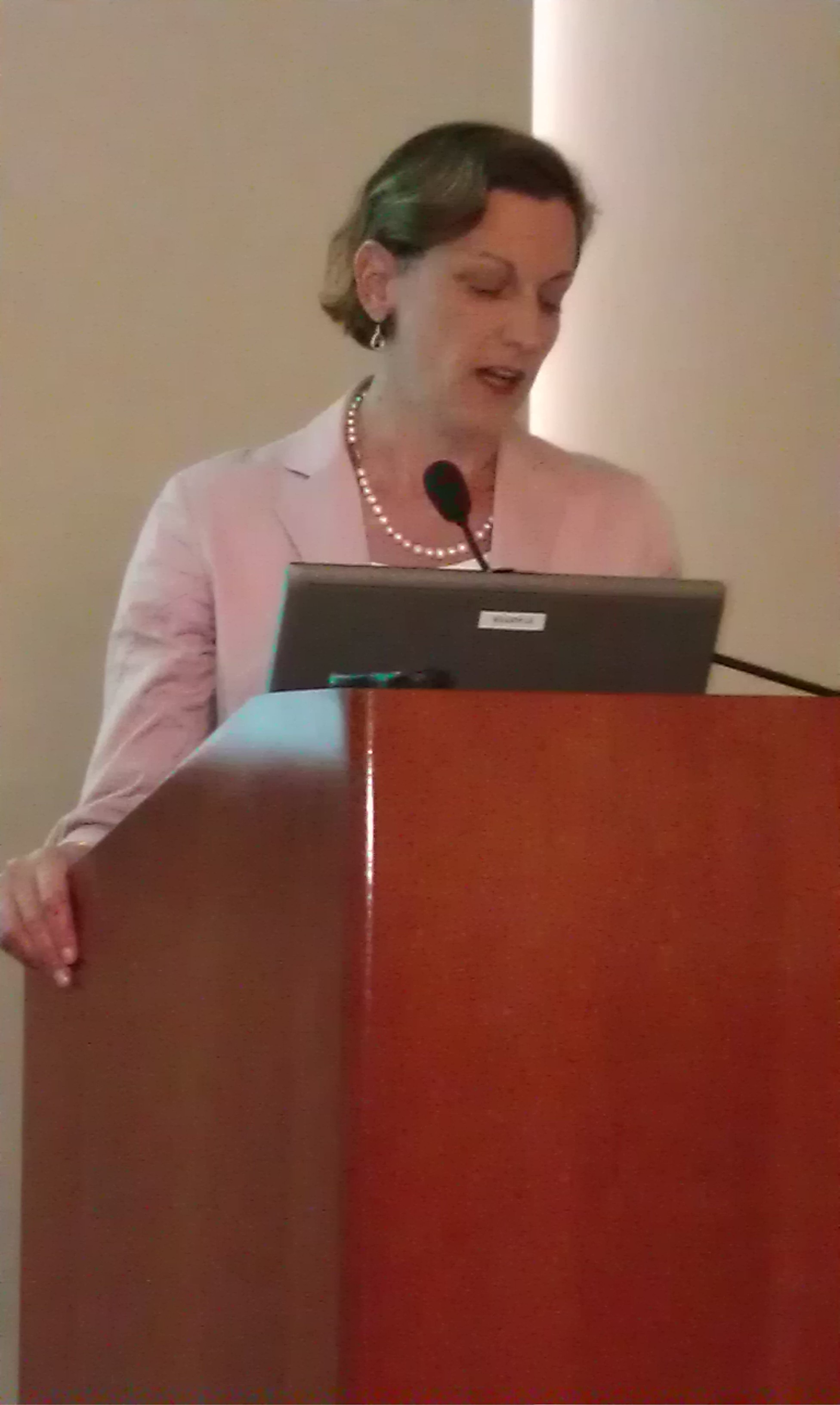
Last July at Hoover (Photo: My Droid)

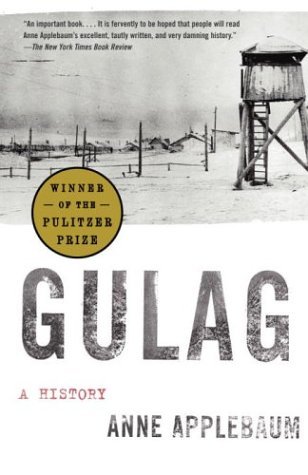
Anne Applebaum, author of the Pulitzer prizewinning Gulag: A History and Washington Post columnist, fascinated me a few months ago with her talk during the Hoover Archives Summer Workshop.  She described how the Communist Party coopted and squashed small civic organizations in Eastern Europe as a way to undermine the whole of its society – but who in the West would have given much importance to the suppression of, say, the Boy Scouts?

Applebaum, an American journalist based in London and Warsaw, has been in the limelight for years – she’s married to Radoslaw Sikorski, Poland’s minister of foreign affairs.

But I didn’t know this about her:  she has donated some of the fruits  of her research to Stanford’s Hoover Institution. It’s the aptly titled Anne Applebaum Collection.

Anne’s collection consists of one box and contains original documents from one of the Gulag camps. The collection is from the Kedrovyi Shor camp, a part of the Vorkutpechlag, a system of camps in Vorkuta-Pechora area in Siberia. The documents include office paper, correspondence memoranda, accounting documents, correspondence, directives, instructions, etc., mostly relating to food and clothing supplies and rations for inmates, as well as the details of  their daily routine.

Now that’s kind of cool.

Applebaum has been a Hoover media fellow.  Her affinity with the institution is obvious, given the institution’s “longstanding interest in the history of totalitarianism.”

“The range and quantity of the material at Hoover is really astonishing, and compares almost to nothing else,” she told me.

While digging through the online material about her, I found this article, “Lest We Forget,” in the Hoover Digest.  The whole piece is worth a read; it ends with this amazing paragraph:

“The more we are able to understand how different societies have transformed their neighbors and fellow citizens from people into objects, the more we know of the specific circumstances that led to each episode of mass torture and mass murder, the better we will understand the darker side of our own human nature. Totalitarian philosophies have had, and will continue to have, a profound appeal to many millions of people. Destruction of the “objective enemy,” as Hannah Arendt once put it, remains a fundamental object of many dictatorships. We need to know why—and each story, each memoir, each document in the history of the Gulag is a piece of the puzzle, a part of the explanation. Without them, we will wake up one day and realize that we do not know who we are.”

Saul Bellow on Hannah Arendt: The upshot? He didn’t like her much

Share

Letters out this month

Viking is publishing Saul Bellow: Letters this month.  It’s excerpted in Salmagundis 45th anniversary issue (Fall 2010/Winter 2011), which arrived in my mailbox a few days ago. Here’s an excerpt of Nobel laureate Saul Bellow’s March 12, 1982, letter to Leon Wieseltier. Clearly not a fan of political philosopher Hannah Arendt:

“The trouble is that her errors were far more extensive than her judgment.  That can be said of us all, but she was monumentally vain, and a rigid akshente [Yiddish: impossible woman, ballbuster] Much of her strength went into obstinacy, and she was the compleat intellectual – i.e. she went always and as rapidly as possible for the great synthesis and her human understanding, painfully limited, could not support the might of historical analysis, unacknowledged prejudices, frustrations of her German and European aspirations, etc. She could often think clearly, but to think simply was altogether beyond her, and her imaginative faculty was stunted.

German to the end?

“I once asked Alexander Donat, author of The Holocaust Kingdom, how it was that the Jews went down so quickly in Poland. He said something like this: ‘After three days in the ghetto, unable to wash and shave, without clean clothing, deprived of food, all utilities and municipal services cut off, your toilet habits humiliatingly disrupted, you are demoralized, confused, subject to panic. A life of austere discipline would have made it possible for me to keep my head, but how many civilized people lead such a life?’  Such simple facts – had Hannah had the imagination to see them – would have lowered the intellectual fever that vitiates her theories. Her standards were those of a ‘noble’ German intelligentsia trained in the classics and in European philosophy – what you call the ‘tradition of sweet thinking.’  Hannah not only loved it, she actively disliked those who didn’t share it, and she couldn’t acknowledge this dislike – which happened to be the dislike of those (so inconveniently) martyred by the Nazis.  The Eros of these cultures is irresistible.  At the same time assimilation is simply impossible – out of the question to reject one’s history. And insofar as the Israelis are secular, they are in it with the rest of us, fascinated and also eaten up by Greece, France, Russia, England.  It is impossible for advanced minds not to be so affected. …

“Anyway, your Arendt pieces are wonderful, even though the concluding sentence … but what else can one conclude but ‘on course; and ‘in the dark’? We mustn’t surrender the demonic to the demagogic academics.  Intellectual sobriety itself may have to take the powers of darkness into account.”

Casper discusses Arendt (Photo: L.A. Cicero)

In his book, Donat recounts the entrenched pro-German mindset of most Jews, who were looking backward to the heritage of the German Enlightenment: “For generations, East European Jews had looked to Berlin as the symbol of law, order, and culture. We could not now believe that the Third Reich was a government of gangsters embarked on a program of genocide ‘to solve the Jewish problem in Europe.’”

But I rather wonder at his characterization of “Jewish passivity,” remembering the doomed heroism of the Warsaw Ghetto.  Only since the Fall of the Wall are some stories of Polish (Jewish and Christian) resistance coming to light.  History changes.

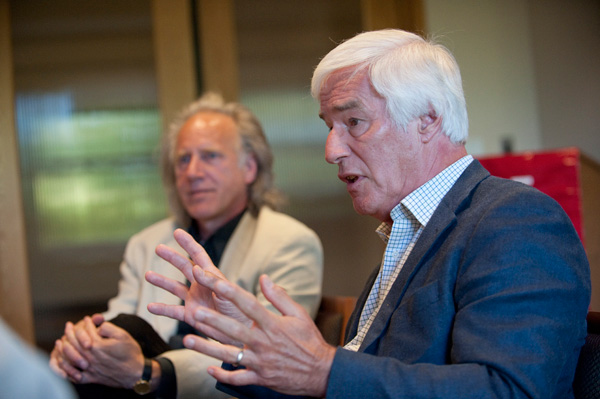
I attended a conference on Arendt last spring and was moved by Gerhard Casper’s tenacious loyalty to the friend he characterized as “a very private person”:   “She was forceful, opinionated, never had any doubts about her views,” he said. “In certain circumstances she was willing to listen carefully and be convinced she was wrong. Those were rare.”

Piotr Nowak recommended I read her pages on ineradicable evil in The Origins of Totalitarianism when we were at Vienna’s Institut für die Wissenschaften vom Menschen two years ago, while taking the “powers of darkness into account.”

Mexico, war, genocide, and Richard Rhodes

Share

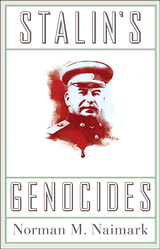
Yesterday, the opening of the Mexico bicentennial exhibition — a true fiesta, with tamales, top-notch horchata, chips and guacamole, and other munchies I didn’t have time to sample, along with a man named William Faulkner playing Mexican tunes on a harp.  I have a personal debt to Mexico, and came to pay my respects — but my conversations tended to turn instead to my article about Norman Naimark and the need to broaden our definition of genocide to include Joseph Stalin‘s millions of murdered people.

Hoover librarian Lora Soroka, who is Ukrainian (land of the Holdomor) and archivist Linda Bernard were particularly pleased that someone was finally nailing Stalin for genocide — the article is featured on Hoover’s home page.  Frankly, I’m surprised there are two opinions about that.  My article on Naimark’s new book, Stalin’s Genocides, left out so many aspects of our discussion. (We spoke on a sunny day on an outdoor patio, overlooking the Bay, at the Center for Advanced Study in the Behavioral Sciences, where it seemed almost indecently incongruous to be discussing crimes against humanity.)

Naimark said, “Intent is very important in genocide.” In the case of the American Indians, more often than not “the intent was to steal land in any way possible” — which makes it an instance of ethnic cleansing, rather than genocide.  And yet, individuals within that context acted with “the intent to wipe out a tribe.”  Hence, that history is one of ethnic cleansing marked by incidents of genocide, he said.  Evidently, the lines of international law are blurry.

One question I would like to see explored more powerfully is the link between technology and genocide.  Clearly, incidents within archaic society — for example, the Old Testament “bans” where every man, woman, child, and even livestock were killed to remove every trace of a people — show genocidal intent.

But technology has magnified our ability to commit genocide — technology enables imitation, which brings us directly into René Girard‘s territory, and also into Hannah Arendt‘s.  She observed in Eichmann in Jerusalem that once an unprecedented crime occurs, it is likely to repeat itself:  “If genocide is an actual possibility of the future, then no people on earth … can feel reasonably sure of its continued existence without the help and the protection of international law.”

Replication occurs through the medium of modern communication, which also enables the event itself.  Could the Rwandan massacres have occurred without national broadcasters egging the murderers on, announcing the victims’ locations and tracking them as they tried to flee?  It would be impossible to murder a million people in 90 days without coordination, moving the murderers and murdered to locations where they can be effective shot or gassed en masse.

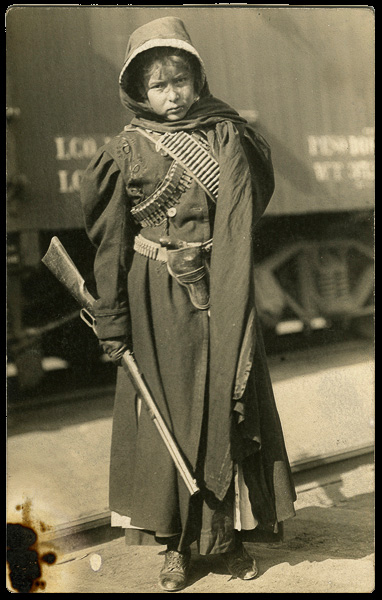
The less glamorous side of revolution: Mexican girl, probably an orphan, on a postcard. (From Stanford collection)

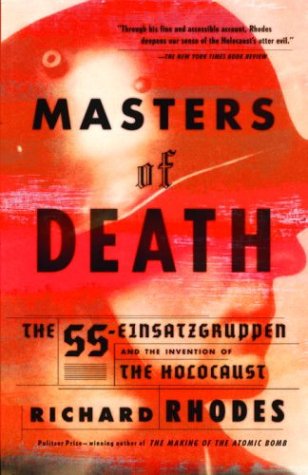
That brings us back to the Mexican celebration.  Andrew Herkovic was barking at me (we were all barking in the din of the gathering) about the work of Richard Rhodes, who wrote 2003’s Masters of Death: The SS-Einsatzgruppen and the Invention of the Holocaust.  His research discovered how murdering people the traditional way, one by one, proved traumatic for the murderers.  The Nazis escalated cautiously, improving mass murder methods; and finally,  “conditioning” the troops, to avoid “disabling trauma.”

The Jerusalem Post notes that Rhodes’s book “graphically and chillingly details the work of the special killing battalions of Himmler’s SS. . . Extremely well-written. . . [A] fine work of gruesome history.”  But I wonder, by detailing the crimes, do we risk their repetition?  By speaking about the unspeakable, do we ensure that it becomes a blueprint?

Coincidentally, Andrew had Rhodes’s cell phone number — he scribbled it down for me.  I’ll try phoning him today.  My reason:  Rhodes will be here for a November 11 talk during our Ethics and War program.  As war becomes more and more total … what do “ethics” mean in war?

Hannah Arendt on racism…

Share

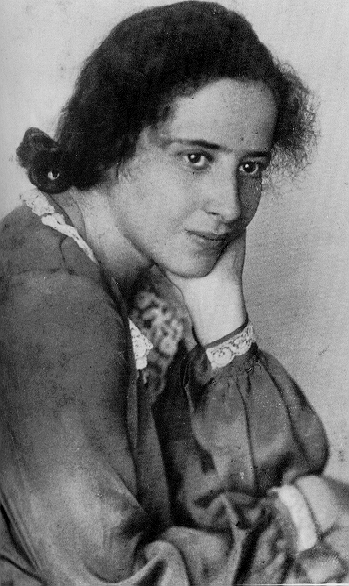
Hannah Arendt, about the time she wrote her dissertation on the concept of love in the thought of Saint Augustine, under Karl Jaspers

Last month, I wrote about an international conference on Hannah Arendt — best known for her Eichmann in Jerusalem (which coined the term “banality of evil”); article is here.  At the conference, the organizers played a 3-minute clip of the political philosopher speaking — Arendt’s friend  Gerhard Casper and others called it “vintage Arendt.”

It was the first time I had heard her voice — so thickly accented in her native German  it’s almost impossible at times to decode, even though she had, by that time, spent more than two decades in America.  I wanted to include the sound clip with the article — to give a flavor of one of the last century’s most powerful thinkers.

No joy.  My ever-vigilant editors didn’t want to run the clip unless they could clear copyright permission.  We traced the talk back to a 1968 Bard College lecture that was once available online, but which had mysteriously disappeared.  Was it withdrawn because of flagrant copyright violations resulting from the link?

Never underestimate the power of the boo-boo.  We finally heard from Bard last week.  The clips had inadvertantly been dropped from the website during an update.  The link has been restored.  And we, belatedly, will be including it in the article.

Until that time, I include the links  here and here.  It’s more than three minutes.  I transcribed a short portion on the justifications of violence, and racism, before getting overwhelmed by the (at times) impenetrable accent.

Here she goes:

Casper at the conference, Robert Harrison in the background (Photo: L.A. Cicero)

“We all know to what an extent the old combination of violence, life, and creativity has survived in rebellious state of mind of the new generation.  Their taste for violence is again accompanied by the glorification of life, and it frequently understands itself as a necessarily violent negation of everything that stands in the way of the will to live.  … Nothing, I think, is more dangerous theoretically than this tradition of organic thought. You saw it in all three:  revolution and power and violence.  You saw it in the concept of progress,  in the concept of power, and in the concept of violence. … The precedence of violence is justified on the grounds of creativity.”

“So long as we talk about these matters in non-political, biological terms, the glorifiers of violence will have the great advantage to appeal to the undeniable experiences inherent in the practice of violent action.  The danger of being carried away by the deceptive plausibility of such metaphors is particularly great, of course, where racial issues are involved.  Racism, white or black, is fraught with violence by definition, because it objects to natural, organic facts — the white or black skin, which no persuasion and no power could change.  All one can do when the chips are down is exterminate their bearers. Violence,  interracial struggle is always murderous, but it is not irrational.  It is the logical and rational consequence of racism — by which I do not mean some rather vague prejudices on either side, but an explicit ideological system.  Today’s violence, black riots, and the much greater potential for white backlash, are not yet manifestations of racist ideologies and their murderous logic.  The riots, as has recently been stated, are a particular protest against genuine grievances — and much the same is true for the backlash phenomena.  The greatest danger is rather the other way around:  since violence always needs justification, an escalation of the violence industry may bring about a truly racist ideology to justify it, in which case violence and riots may disappear from the streets and be transformed into the invisible terror of the police state.”

The Q&A session is supposed to be particularly interesting — haven’t gotten to that yet, but if I’m up to it, I’ll include a few notes later.

Take him up on his offer, Signor Segre

Share

segreJoseph Frank writes in The New Republic about Dan Vittorio Segre’s Memoirs of a Fortunate Jew, republished by the University of Chicago Press two years ago.  (Frank is the author of a five-volume series on Dostoesky — I wrote about it here.)
“Why did the book strike me so forcibly? It is beautifully and sensitively written, but more importantly it traces the author’s remarkable journey from the very heights of Italian Fascist society to a kibbutz in pre-Israeli Palestine, and finally back to his native land as an officer in the Palestine (Jewish) regiment of the British Army.”

frank_news

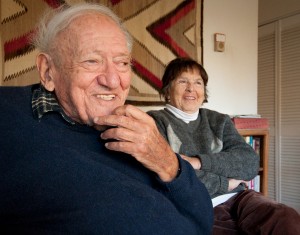
Joseph Frank, and wife Marguerite (Credit: L.A. Cicero)

For Frank, it was part of an ongoing train of thought: “I had for a long time been struck by the differences between the anti-Semitism of Mussolini’s Fascism and that of Hitler’s Germany.  Why had the Italian variety been so much less severe and fanatical?”

Hannah Arendt explored the same question in her Eichmann in Jerusalem (a.k.a. The Banality of Evil): “Assimilation, that much abused word, was a sober fact in Italy.” That sober fact  included native Jews whose roots reached back into the Roman Empire. While in Denmark, Jewish lives were saved thanks to an elevated civic and moral sense, in Italy, she wrote that it was “the outcome of the almost automatic general humanity of an old and civilized people.”

“Italian humanity, moreover, withstood the test of terror…” Arendt wrote that less than 10 percent of the 50,000 Jews living in Italy were killed — and the vast majority of those in the war’s panicky final months.  That is the lowest of any country in Europe, as I recall.

Frank would like to meet Segre.  “He is now head of the Institute of Mediterranean Studies in the Italian Swiss University of Luano.  Unfortunately, Google was unable to inform me whether he is still teaching.  But if he is, and I were a student, I would take the next train, plane, or boat to Lugano.”

Are you listening, Signor Segre?

UPDATE:  Signor Segre was indeed listening — even before we wrote this post.  Reply from Joseph Frank: “Dan Segre wrote me a very warm letter about my article and invited me to visit him in Switzerland.”  So is the nonagenarian professor — who, incidentally, was a friend of Arendt’s and thought the comments we cited were “absolutely perfect” — going to make the trek?  “I’m giving it serious thought if we get to Europe. And if you haven’t read the book, you should. It’s quite fascinating.”

(New podcast of Joseph Frank on Dostoevsky is up here.)