“Magpiety”: getting to the bottom of it.

Share

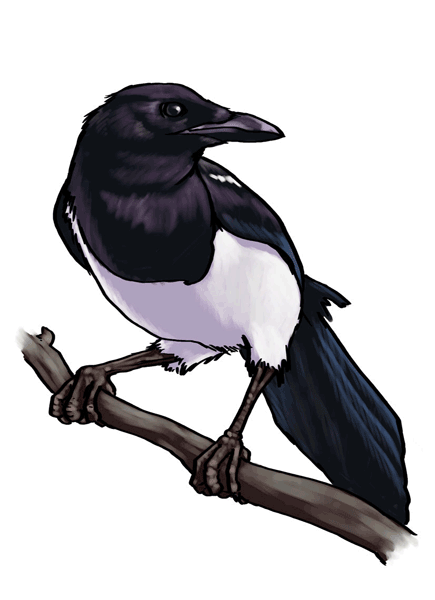
magpie2“Magpiety.” I had thought the title came from Nobel poet Czesław Miłosz and his poem by that name – his translator Peter Dale Scott has assured me that he himself invented the word, though I thought Miłosz had made the same claim. Anyway, I wrote all about the word Magpiety here. I thought the subject had exhausted itself and I had become the world expert.

Then I received in the mail the galley proofs for a collection of Melissa Green‘s poems, which will be out later this year: Magpiety, published by Arrowsmith Press in Medford, Massachusetts. When I scanned the table of contents, I expected to find a poem in tribute to the late great Polish poet – along the lines of Philip Levine‘s poem “Magpiety.” Nope.

My OED dates the usage of the word to 1845 (“Not pious in its proper sense/But chattering like a bird…”). Long before either Miłosz or Peter Dale Scott were born. The mystery deepened. Arrowsmith publisher Askold Melnyczuk sent me the author’s note that is to go at the beginning of the volume. In it, the poet writes: “Magpiety arose directly from the anonymous Renaissance poem ‘Tom O’Bedlam’s Song’ and with the call and response of the lesser known—and probably later—’Mad Maud’s Song.’ In order to write my version, I searched for language that had fallen out of English in order to invent a dialect for Maud’s voice as she struggled with delusions, her dread of madness, of the loss of Tom, and of Bedlam.”

Had the OED been bested by several centuries?

So I wrote the poet for an explanation, and this is what she said:

For a while, even I thought I’d invented the word Magpiety!

I hadn’t remembered it from the Miłosz – in fact, if pressed, I would have said I had yanked from one of Mark Strand‘s poems, but I must have been thinking of Philip Levine.

I have bushel baskets full of words with the same kind of frisson, that sit in the cellar year after year, ripening, until I need them, until the source of the word has been forgotten. I didn’t actually find any evidence for its use anywhere as early as the Elizabethans; rather when the time came to write the Mad Maud poems, I remembered the word ‘magpiety’ and employed it like a valise to pack in all the meanings I could in the manner of Humpty Dumpty.

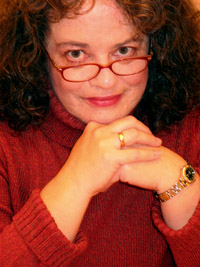
green-melissa

She likes the twinkly bits.

ORIGIN late 16th cent.: probably shortening of dialect maggot the pie, maggoty-pie, from Magot (Middle English nickname for the given name Marguerite) + pie (Old French from Latin pica)

‘Mag’ came to mean a woman, an idle chatterer, whose daylong running monologue, I imagined, expected no reply – so I saw Maud’s poems as full of a mad self-talk, with the world not responding. (The Corvidae are loud and raucous talkers). My confirmation name is Margaret, which made ‘Mag’ appropriate. It was easy to extend ‘pie’ to ‘piety’ (though I do remember your OED reference mid-1800 as the opposite of true piety; Pierus claimed his nine daughters sang as beautifully as the Muses and they were turned into magpies for that hubris/impiety). I am a magpie-ish kind of writer – drawn to the shiny, twinkly bits – but this magpie is full of reverence for the world. The rhyme in my head went ‘mag/hag/bag lady’ which is how I am convinced I’ll end up.

She ended with an apology: “Sorry I have no legitimate trail of breadcrumbs for you to take this word back into linguistic history. You see I just used it to suit myself.”

Connection with Miłosz?  Coincidence. Who would have guessed it?

“You whom I could not save”: Remembering Krzysztof Baczyński, who died this day, 1944

Share
baczynski

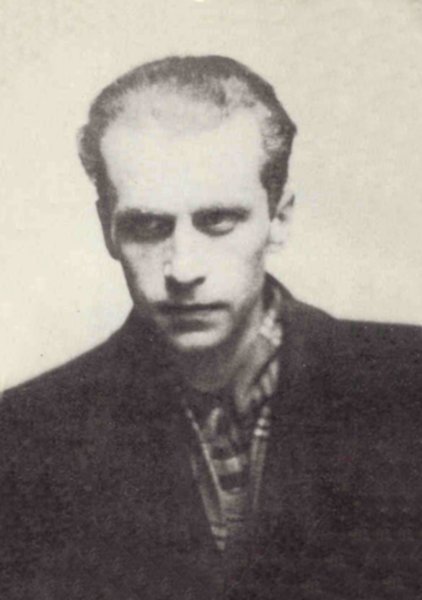
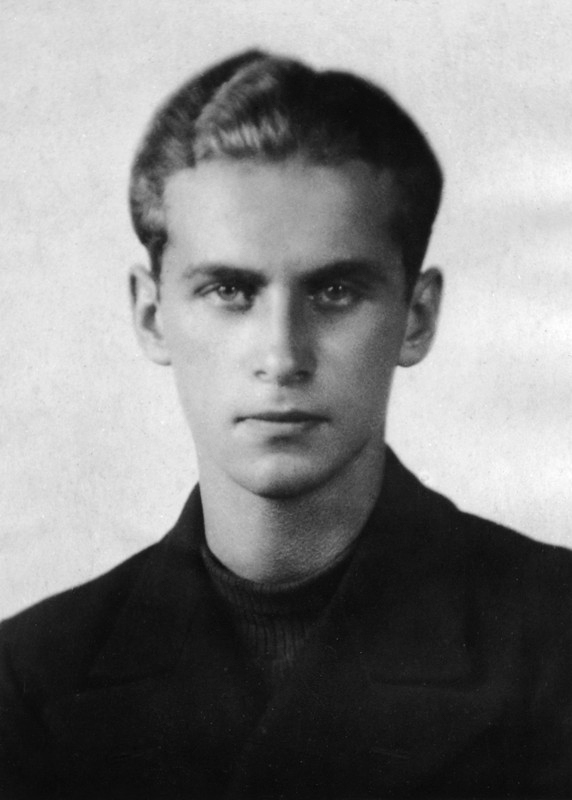
“Asthmatic, of frail health…a disciplined soldier…sheer effort of will.”

My friend Kasia Wozniak reminded me that today is the day Krzysztof Kamil Baczyński was killed as a platoon commander, on the fourth day of the Warsaw Uprising, August 4, 1944. He was 23.

It was what he himself imagined, apparently: a shower of bullets, grenades, hitting the dirt, and “one charge only, straight up to heaven.” Let us hope so.

His beloved wife Basia was wounded and died a month later, not knowing of her husband’s death. The ancient city was entirely leveled – the vengeful Germans brought in architects to more effectively make sure the city was demolished block by block. “In January 1947 Baczynski’s body was dug out of the ruins of the City Hall and Krzysztof and Basia were finally laid to rest together in one grave at the Insurgents’ cemetery at Powazki,” according to this page commemorating him.

He was an only child, the son of a father who was a literary critic and a mother, Stefania Zielenczyk, the sister of the well-known philosopher, Adam Zielenczyk. He grew up in one of those rare periods of Polish history, a free and independent Poland. His early enthusiasm for Marxism-Trotskyism evolved into a romantic nationalistic Messianism. “Asthmatic, of frail health, he became a disciplined soldier of the Home Army by sheer effort of will,” Czesław Miłosz wrote.

Little from this prolific writer exists in English – no book, certainly, but there are a few poems here. He was considered a very fine poet, “whose rich imagery served more and more overtly, as he developed, to point up his central theme of self-immolation for the sake of an ideal Poland.” That’s from Miłosz again. “Those critics were right who maintained that he strangely resembled Juliusz Słowacki in his concept of redemptive martyrdom.” Miłosz had little sympathy for this Polish nationalism and idealism, yet he mourned its many victims in the doomed attempt to protect Warsaw from the Nazis. And he memorialized them.

While search for something online to say about him, I ran across my own article about the Miłosz and Robert Hass collaboration, here, in which I quote from the then (in 2001) newly translated edition of Treatise on Poetry:

Krzysztof Kamil Baczyñski

Idealists died first.

No ancient Greek hero entered into combat
So deprived of hope, in their heads the image
Of a white skull kicked by feet in passing . . .

Trzebinski, the new Polish Nietzsche,
Had his mouth plastered shut before he died.
He took with him the view of a wall, low clouds
His black eyes had just a moment to absorb.
Baczynski’s head fell against his rifle.
The uprising scared up flocks of pigeons.
Gajcy, Stroinski were raised to the sky,
A red sky, on the shield of an explosion.

On this day I also think of the Nobel poet’s famous “Dedication.” Miłosz scholar and translator Clare Cavanagh impressed upon me that this poem, often read didactically, with a rhetorical flourish, in fact has a singular “you.” It was directed at a single listener, which very much changes the way one read it. Was it Baczyński? I wonder.

You whom I could not save
Listen to me.
Try to understand this simple speech as I would be ashamed of another.
I swear, there is in me no wizardry of words.
I speak to you with silence like a cloud or a tree.

What strengthened me, for you was lethal.
You mixed up farewell to an epoch with the beginning of a new one,
Inspiration of hatred with lyrical beauty;
Blind force with accomplished shape.

Read the whole poem here. And do check out the excellent commemorative page here.

Ukrainian poet Serhiy Zhadan at the end of Europe

Share
Serhij Żadan

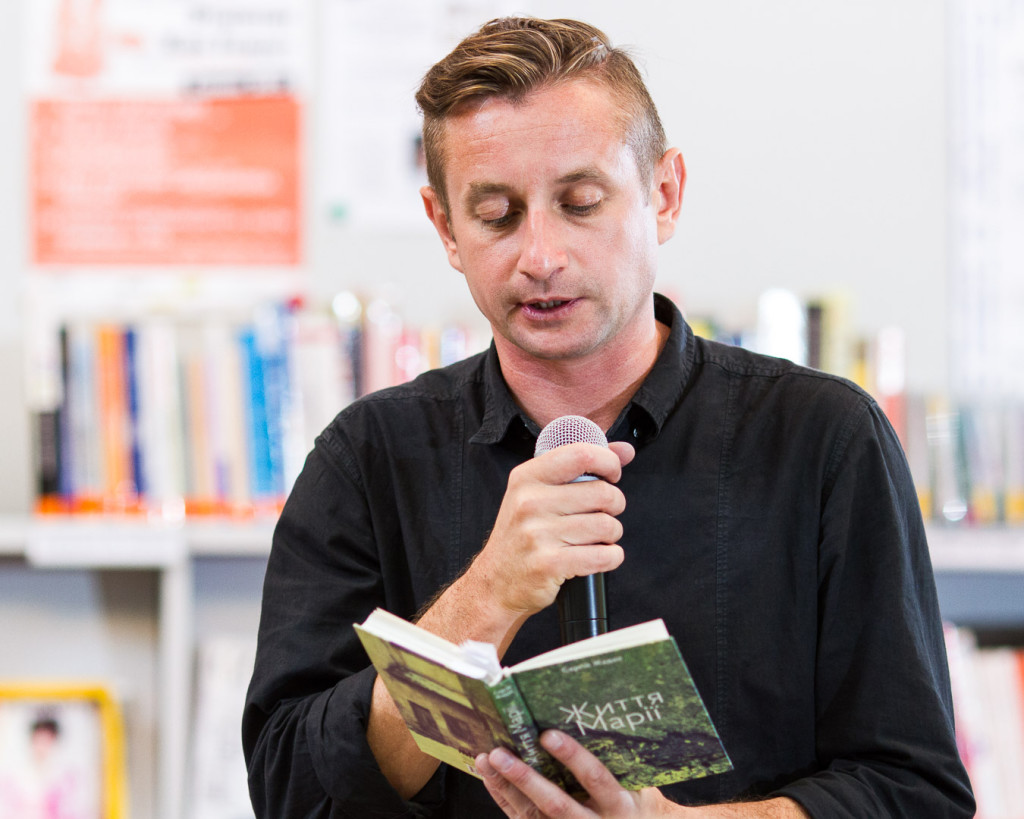
Reading from “Lives of Maria” in Wrocław, earlier this year. (Photo: Rafał Komorowski)

We wrote about Serhiy Zhadan, Ukrainian poet, novelist, essayist, and translator over a year ago, in a post titled, “They told him to kneel and kiss the Russian flag. Then he told them to…” That’s when the pro-Russian demonstrators broke his skull with bats in his native Kharkiv, the second largest city of Ukraine, a place that has the misfortune to be close to the Russian border.

“Americans need to understand, in Eastern Europe, writers still have a huge influence on society,” Vitaly Chernetsky, a professor of Slavic literature at the University of Kansas told the New Yorker in a story here. “It may sound like an old-fashioned ‘poet stands up to tyranny’ story, like something out of Les Miz—‘Can you hear the people sing?’—but it’s really kind of like that. … He’s a writer who is a rock star, like Byron in the early nineteenth century was a rock star.”

We were happy to see him appear last week in a New York Review of Books blogpost by Timothy Snyder, “Edge of Europe, End of Europe.” Tim said “What Zhadan actually seems to aspire to – and here his willingness to risk his life for Europe is a clue – is what [writer Mykola] Khvylovy called ‘psychological Europe’: the acceptance of conventions, the work to transcend them, and the absolute indispensability of freedom and dignity for the effort.” The discussion includes Czesław Miłosz as well:

Zhadan’s most recent work, a collection of poetry published earlier this year entitled Lives of Maria, is a book of Ukraine’s war and of Zhadan’s own survival: “you see, I lived through it, I have two hearts/do something with both of them.” Yet as the book proceeds the meditations are increasingly religious, the poems often taking the form of conversations with Maria herself. No one, in eastern Slavic culture or anywhere else, combines the writerly personas of tough guy and holy fool as does Zhadan. He raps hymns.

A happenstance Californian.

Kindred spirit?

At points in Lives of Maria, Zhadan sounds like Czesław Miłosz, the twentieth-century Polish poet, who also strove toward Europe through both the local and the universal: “I wanted to give everything a name.” Miłosz was the preeminent poet of a borderland, one to the north of Kharkiv, Lithuanian-Belarusian-Polish (and Jewish) rather than Ukrainian-Russian (and Jewish). His position, not so different from Zhadan’s perhaps, was that Europe can best be recognized on the margins, that uncertainty and risk are more substantial than commonplaces and certainty. And indeed, the last section of Lives of Maria is devoted to Zhadan’s translations of Miłosz. Zhadan begins with two of Miłosz’s poems, “A Song on the End of the World” and a “A Poor Christian Looks at the Ghetto,” that ask the most direct questions about what Europeans did during the twentieth century and what they might and should do instead. The second poem communicates the pain and difficulty of actually seeing and trying to learn from the Holocaust, which was, or at least once was, a central idea of the European project. The first transmits, almost breezily, certainly eerily, what a European catastrophe might feel like. It concludes: “No one believes that it has already begun/Only a wizened old man who might have been a prophet/But is not a prophet, because he has other things to do/Looks up as he binds his tomatoes and says/There will be no other end of the world. There will be no other end of the world.”

Where Miłosz wrote in Polish that the old man had other things to do, Zhadan writes in Ukrainian that there were already so many prophets. Perhaps so. Pro-European Ukrainians are taking a chance, not demanding a future. They watch the Greek crisis too, and their position is often more scathing than anything western critics of the EU could muster. The point then is not certainty but possibility. Zhadan might well have died for an idea of Europe; other Ukrainians already have. Yet the risks he has taken, both physical and literary, are not in the service of any particular politics. Many of his essays and poems are about the attempt to understand people with whom he disagrees. He is an outspoken critic of his own government. Like Miłosz, who described Europe as “familial,” or like Khvylovy, who called Europe “psychological,” Zhadan is pursuing experimentation and enlightenment, a sense of “Europe” that demands engagement with the unmasterable past rather than the production and consumption of historical myth. “Freedom,” writes Zhadan in Lives of Maria, “consists in voluntarily returning to the concentration camp.”

It rather makes me hanker for a translation. Anyone? Oh well, you can read all of Tim’s article here.

On his birthday: Czesław Miłosz on time, truth, and the “quest for reality”

Share
A happenstance Californian.

Birthday boy.

Today is Czesław Miłosz‘s birthday – his 104th. To celebrate the occasion, I revisited his Nobel lecture. Oh, and I baked him a little white cake; see below. And also, a photo at bottom from where it all began, at his birthplace in Šeteniai.

In 1980, Miłosz gave one of the all-time great Nobel addresses. A few excerpts to prove it:

“Every poet depends upon generations who wrote in his native tongue; he inherits styles and forms elaborated by those who lived before him. At the same time, though, he feels that those old means of expression are not adequate to his own experience. When adapting himself, he hears an internal voice that warns him against mask and disguise. But when rebelling, he falls in turn into dependence upon his contemporaries, various movements of the avant-garde. Alas, it is enough for him to publish his first volume of poems, to find himself entrapped. For hardly has the print dried, when that work, which seemed to him the most personal, appears to be enmeshed in the style of another. The only way to counter an obscure remorse is to continue searching and to publish a new book, but then everything repeats itself, so there is no end to that chase. And it may happen that leaving books behind as if they were dry snake skins, in a constant escape forward from what has been done in the past, he receives the Nobel Prize.”

“What is this enigmatic impulse that does not allow one to settle down in the achieved, the finished? I think it is a quest for reality. I give to this word its naive and solemn meaning, a meaning having nothing to do with philosophical debates of the last few centuries. It is the Earth as seen by Nils from the back of the gander and by the author of the Latin ode from the back of Pegasus. Undoubtedly, that Earth is and her riches cannot be exhausted by any description. To make such an assertion means to reject in advance a question we often hear today: ‘What is reality?’, for it is the same as the question of Pontius Pilate: ‘What is truth?’ If among pairs of opposites which we use every day, the opposition of life and death has such an importance, no less importance should be ascribed to the oppositions of truth and falsehood, of reality and illusion.”

***
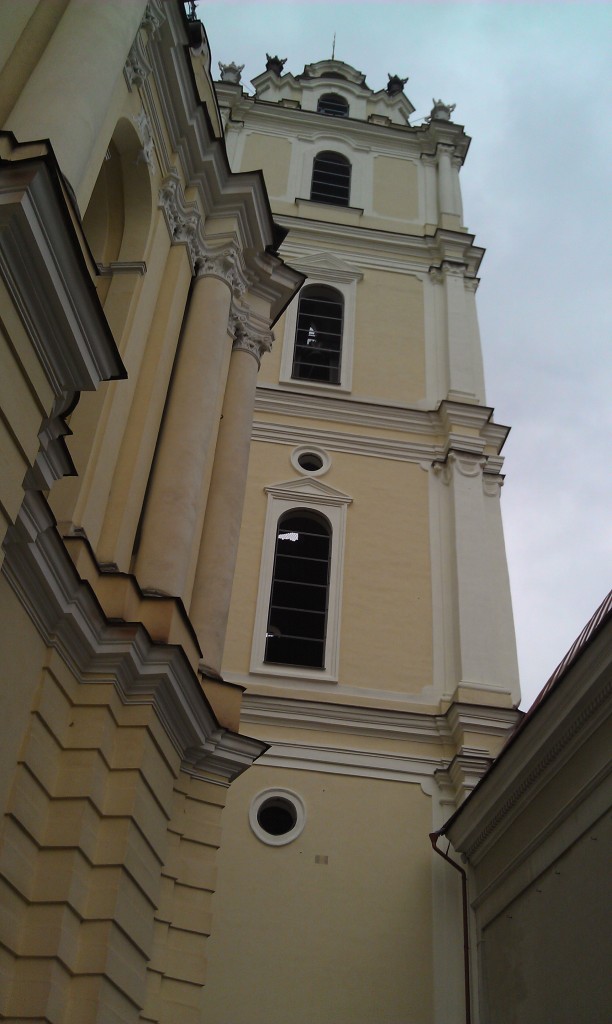
His alma mater, Vilnius University (Photo: C.L. Haven)

“The thick walls of our ancient university.”  (Photo: C.L. Haven)

“It is good to be born in a small country where Nature was on a human scale, where various languages and religions cohabited for centuries. I have in mind Lithuania, a country of myths and of poetry. My family already in the Sixteenth Century spoke Polish, just as many families in Finland spoke Swedish and in Ireland – English; so I am a Polish, not a Lithuanian, poet. But the landscapes and perhaps the spirits of Lithuania have never abandoned me. It is good in childhood to hear words of Latin liturgy, to translate Ovid in high school, to receive a good training in Roman Catholic dogmatics and apologetics. It is a blessing if one receives from fate school and university studies in such a city as Vilno. A bizarre city of baroque architecture transplanted to northern forests and of history fixed in every stone, a city of forty Roman Catholic churches and of numerous synagogues. In those days the Jews called it a Jerusalem of the North. Only when teaching in America did I fully realize how much I had absorbed from the thick walls of our ancient university, from formulas of Roman law learned by heart, from history and literature of old Poland, both of which surprise young Americans by their specific features: an indulgent anarchy, a humor disarming fierce quarrels, a sense of organic community, a mistrust of any centralized authority.”

***

“Our planet that gets smaller every year, with its fantastic proliferation of mass media, is witnessing a process that escapes definition, characterized by a refusal to remember. Certainly, the illiterates of past centuries, then an enormous majority of mankind, knew little of the history of their respective countries and of their civilization. In the minds of modern illiterates, however, who know how to read and write and even teach in schools and at universities, history is present but blurred, in a state of strange confusion; Molière becomes a contemporary of Napoleon, Voltaire, a contemporary of Lenin. Also, events of the last decades, of such primary importance that knowledge or ignorance of them will be decisive for the future of mankind, move away, grow pale, lose all consistency as if Frederic Nietzsche‘s prediction of European nihilism found a literal fulfillment. ‘The eye of a nihilist,’ he wrote in 1887, ‘is unfaithful to his memories: it allows them to drop, to lose their leaves;… And what he does not do for himself, he also does not do for the whole past of mankind: he lets it drop’ We are surrounded today by fictions about the past, contrary to common sense and to an elementary perception of good and evil. As The Los Angeles Times recently stated, the number of books in various languages which deny that the Holocaust ever took place, that it was invented by Jewish propaganda, has exceeded one hundred. If such an insanity is possible, is a complete loss of memory as a permanent state of mind improbable? And would it not present a danger more grave than genetic engineering or poisoning of the natural environment?”

birthday cake“For the poet of the ‘other Europe’ the events embraced by the name of the Holocaust are a reality, so close in time that he cannot hope to liberate himself from their remembrance unless, perhaps, by translating the Psalms of David. He feels anxiety, though, when the meaning of the word Holocaust undergoes gradual modifications, so that the word begins to belong to the history of the Jews exclusively, as if among the victims there were not also millions of Poles, Russians, Ukrainians and prisoners of other nationalities. He feels anxiety, for he senses in this a foreboding of a not distant future when history will be reduced to what appears on television, while the truth, as it is too complicated, will be buried in the archives, if not totally annihilated.”

***

 “Complaints of peoples, pacts more treacherous than those we read about in Thucydides, the shape of a maple leaf, sunrises and sunsets over the ocean, the whole fabric of causes and effects, whether we call it Nature or History, points towards, I believe, another hidden reality, impenetrable, though exerting a powerful attraction that is the central driving force of all art and science.”

“Our century draws to its close, and largely thanks to those influences I would not dare to curse it, for it has also been a century of faith and hope. A profound transformation, of which we are hardly aware, because we are a part of it, has been taking place, coming to the surface from time to time in phenomena that provoke general astonishment.”

***

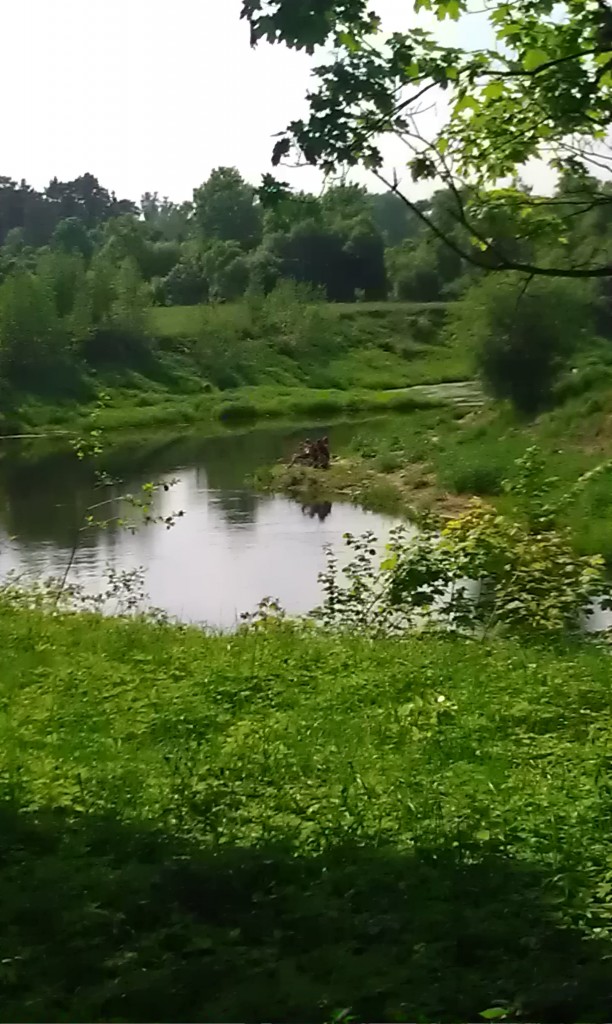
You can read the whole thing here. Regarding the photograph below: I had the great good fortune in 2011 to visit Miłosz’s birthplace in the rural Lithuanian village of Šeteniai. And yes, it is as idyllic as he said it was – it reminded me of the woods and deep green colors of Michigan. I took this photo on the former Miłosz family estate, overlooking the river. The fishers called out to ask if we had permission to photograph them. Yes, one of us shouted back, there was a journalist in the group. They laughed, thinking it was a joke.
IMAG0161

The perfect place to be born. (Photo: C.L. Haven)
Another honor for poet Tomas Venclova – keep ’em coming.

Share
t.venclova

Terrific poet in a little-known tongue.

One of our favorite people has bagged another honor: earlier this month, one of Europe’s most eminent poets, Tomas Venclova, was awarded for “creative fidelity to the values which comprise the foundation of European civilization.”  The ceremony took place at the Ossoliński National Institute, one of Poland’s oldest scientific libraries and research centers.

In his talk, the Lithuanian poet praised the previous prize laureates: “I have followed in the footsteps of people much greater than myself, such as Tadeusz Mazowiecki, Stanisław Szuszkiewicz, Sergei Kovalev, Václav Havel, Lithuanian president Valdas Adamkus and Zbigniew Brzeziński,” he said. (Personally, I’m not so sure about the “greater than himself” part.)

He also paid homage to the prize’s namesake, Jan Nowak-Jeziorański, a Polish journalist and war-time resistance fighter who was an emissary between the Home Army and the Polish Government in Exile in London. After the war in Communist Poland, Nowak-Jeziorański headed the Polish Section of Radio Free Europe. “Unfortunately I never met Jan Nowak-Jeziorański, although I know he was an emblematic figure in the history of Eastern Europe and global society,” said Venclova. “A politician and solider, journalist and social worker, a diplomat who was a paradigm of fidelity to his beliefs.”

Venclova himself is one of the five founding members of the Lithuanian Helsinki group, whose poetry in the disfavored Lithuanian language could be circulated only in samizdat. His dissident activities attracted the perilous attention of the Soviet authorities, and in 1977 he was forced to emigrate. He taught for many years at Yale University. His poetry has been translated by Czesław Miłosz into Polish, and by Joseph Brodsky into Russian. A selection of his poetry, translated into English by Ellen Hinsey, is at the Poetry Foundation here.

His previous honors include the Gloria Artis and Order of Merit Polish honours, as well as honorary doctorates from universities in Kraków, Gdańsk, Toruń, Lublin and the Lithuanian centres of Klaipeda and Kaunas. All that said, he is too little recognized in the West. So we think there should be more honors, west of the Danube. We have written about him here and here and here and here and here and here and here.

Congratulations, Tomas!

Czesław Miłosz: his letters, his left-handedness, and a Russian blue cat named “Tiny”

Share

CzeslawMilosz“To believe you are magnificent. And gradually to discover that you are not magnificent. Enough labor for one human life.”  
— Czesław Miłosz, Road-side Dog

David Sanders over at Poetry News in Review brought “Miłosz and His Fans” in Ontario’s Brick Magazine to our attention, and we’re mightily grateful. Molly Wesling was an assistant to Nobel laureate Czesław Miłosz in the early 1990s (we’ve written about him here and here, and a gazillion other places). Her reminiscences of the Polish poet (here) absolutely sparkles with gems. Here are a few paragraphs:

The indignities of aging were on the poet’s mind. He was translating the poems of Anna Swir (aka Świrszczyńska, 1909–1984), his friend from Warsaw, into English in collaboration with Leonard Nathan. Swir wrote about what happens when bodies decay and disappoint, and Miłosz admired her candour, rare for a Polish woman of her generation. His own writing from this period onward is full of such meditations. “They were betrayed by their bodies, once beautiful and ready to dance. Yet in every one a lamp of consciousness is burning, hence their wonder: ‘Is this me? But it can’t be so!’”

Still, the world rose up to smooth the poet’s path. One of the perks of being a Nobel laureate at University of California, Berkeley—at that time there were about fifteen, Miłosz the only winner in a non-scientific field—is your own parking space on campus for life. Miłosz also had the privilege of scoring a table at a moment’s notice at the wildly popular restaurant Chez Panisse. In Berkeley these were fairy-tale prizes, like flying carpets or enchanted pots that never run out of porridge.

Over the phone in the fall of 1990, Miłosz described where to catch the bus to his house and cautioned me about the many “lacunae” in the bus schedule. I knew then I’d caught the golden ring of part-time jobs. In between letters I jotted down a few of his asides. I’ve saved my notebooks, which is why I can quote from them twenty-five years later. Once, Miłosz looked at me as I was writing and said, “I used to be left-handed too, but they beat it out of me.” On Joseph Brodsky: “he is a genius”; Robert Frost: “marvellous”; the Laments by Renaissance poet Jan Kochanowski: “should be ranked with the world classics”; and my favourite: “these poems are awful” (I can’t say whose).

russianblue

Feed me.

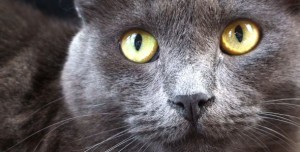
Miłosz and Carol were away for the year of 1991–92. I collected the mail and sent it to Chapel Hill. Ted was in charge of watering the bushes of the main house and tending to the needs of Tiny, the ancient Russian Blue who appears once or twice in the Miłosz oeuvre—both as himself and as a representative of the violent animal world. Through our weekly tryst at Miłosz’s aerie, Ted and I had become a couple, complete with grey cat, like the “Old World Landowners” from Nikolai Gogol’s short story of that name. When the eighty-one-year-old Master finally arrived back at his Berkeley home, he immediately noticed the dying rhododendrons and Tiny’s untidy litter box and was annoyed. Miłosz climbed back up the flagstone path to the carriage house and commenced a dressing-down. Later that evening he returned, this time to offer Ted a heartfelt apology the way only Miłosz could—eyebrows twitching, a humble bow of the head.

Read the whole thing here.