
Take a look around Nobel poet Czesław Miłosz’s home in Kraków: it almost breathes!

Share
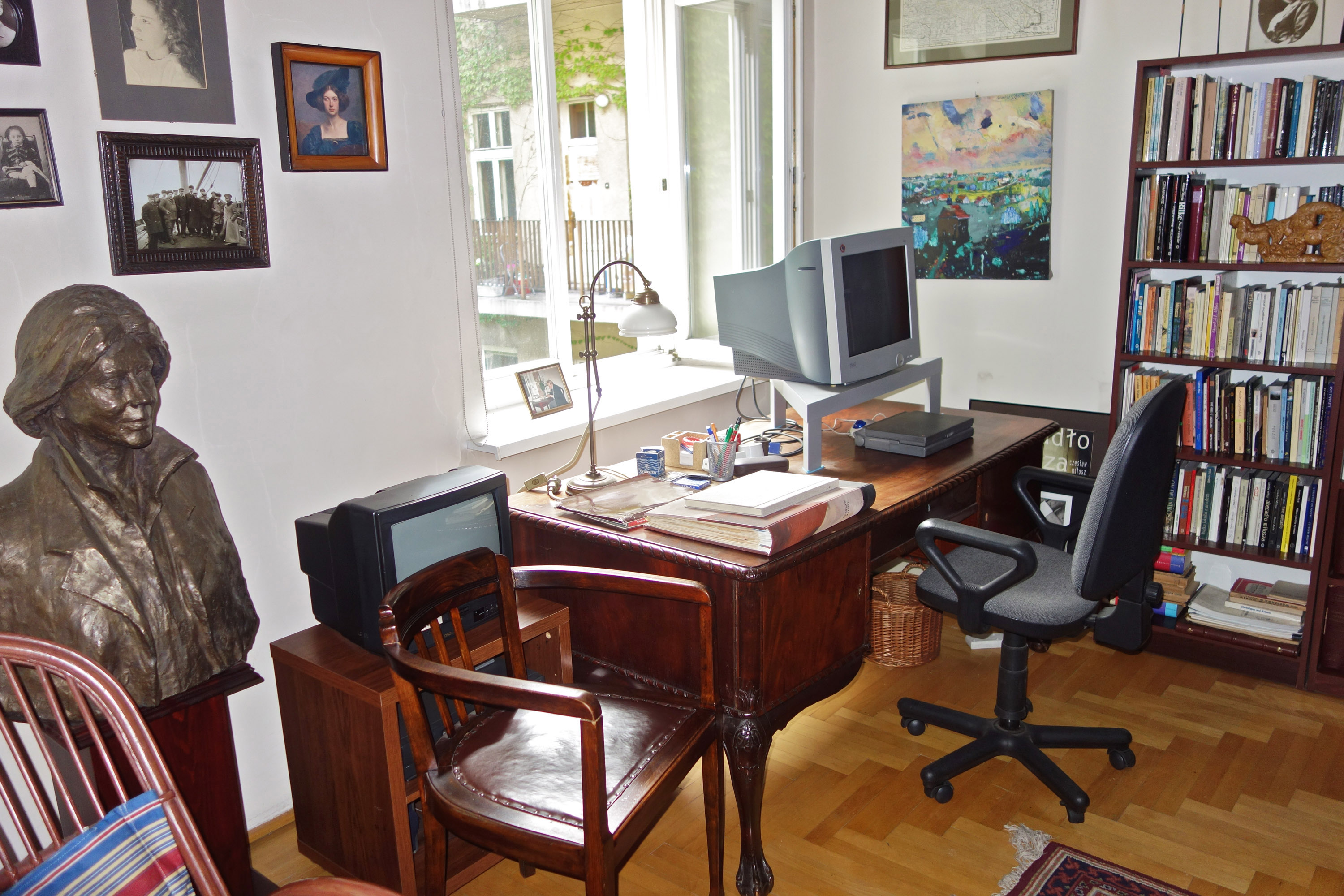
Czeslaw Milosz- reciepient of Nobel Prize in Literature in 1980, his former apartment in Krakow. Desk on which he wrote. Near left is bust of his second wife, Carol Thigpen. Krakow/Poland. 8.13.20016

He wrote his poems here, next to the bust of his wife Carol Thigpen

My visit to beloved Kraków last month was very short – so brief and tightly packed I didn’t have a chance to return to the apartment at No. 6 Bogusławskiego, where Czesław Miłosz spent the last years of his life. Fortunately, our roving photographer-reporter Zygmunt Malinowski made the journey from New York City, accompanied by our mutual friend, Prof. Aleksander Fiut. Here’s Zygmunt’s report:

Not far from Wawel Castle in Kraków and behind Planty, the park encircling the Old Town, is a street named Bogusławskiego. It’s a very short street, lined with trees on both sides seemingly closed off by perpendicular streets on either end.
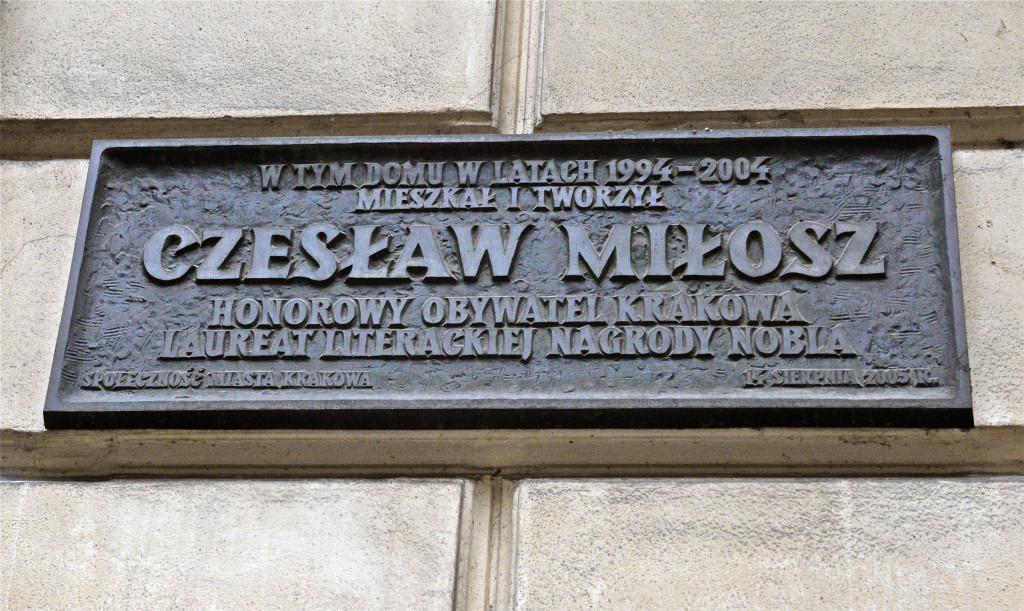
Plaque outside Czeslaw Milosz,s former apartment. In this building in the yr 1994-2004 lived ... CM honorary citizen of Krakow, Laureat of Nobel prize for literature. Community of Krakow. Aug. 14, 2005

Number 6, Bogusławskiego Street

The three-story gray masonry buildings with tall doors and decorative pediments over high windows give an aura of permanence. Aesthetics rather then economics dictated this nineteenth-century architecture. Among several entrances, one shows the address as Number 6.  The hall inside leads into a sunny courtyard.

In the center of the courtyard there is a round enclosure with plants and lush vines that cover the entire building wall. To the right of the hall, a wide wooden staircase with railing leads to the second floor where Nobel poet Czesław Miłosz, “one of the greatest poets of 20th century, perhaps the greatest,” according to fellow Nobel laureate Joseph Brodsky, lived and worked from 1996 to 2004, as the plaque on the other side of the arched entrance door notes.
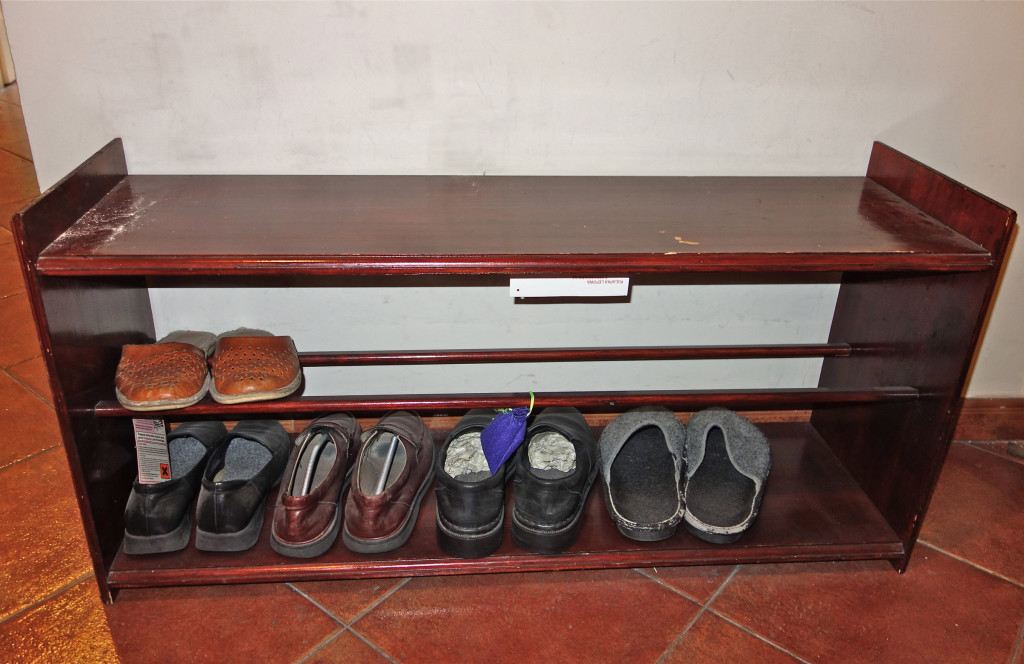
Czeslaw Milosz's, Nobel Lureat in Literaturte, apartment. Bench with poet's shoes and slippers.

His shoes and slippers are still there

I am here with Prof. Aleksander Fiut, a longstanding friend of Miłosz (they met in Paris in 1976) and author of several books about him, to visit and photograph the poet’s former apartment. As one enters through a high door there is a short corridor with a small wooden bench on the side – the poet’s shoes and slippers are still underneath, and his canes lean against the corner. At the end of the corridor a canvas tote bag is hanging on a hat and coat stand with Miłosz’s printed likeness and a quotation from his 1985 poem, “A Confession”: “My Lord, I loved strawberry jam…”

Behind, inclined against the wall is a framed front page news clipping with headlines from The Washington Post: “American Czesław Miłosz wins Nobel Prize for Literature” and The New York Times: “Polish Poet in US gets Nobel in Literature.”
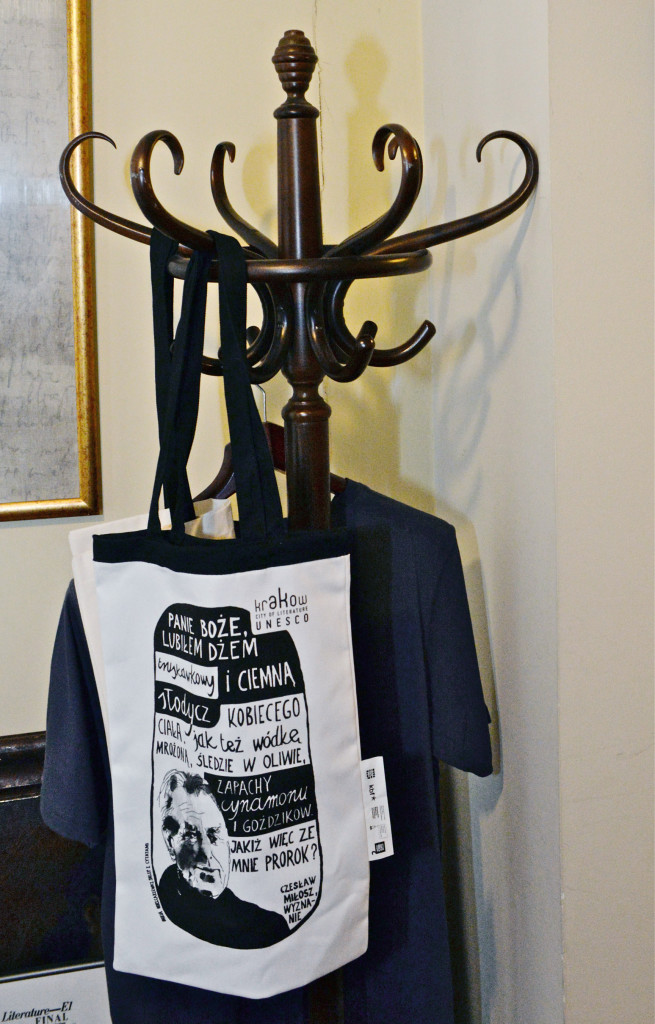
Czeslaw Milosz- reciepient of Nobel Prize in Literature in 1980, his former apartment in Krakow. Canvas tote bag with UNESCO logo , Krakoew city of literature, with Poet's likeness and quote from poem 'Confession' My Lord I loved strawberry jam... Krakow/Poland. 8.13.20016

“My Lord, I loved strawberry jam…”

To the left there is a small room with a desk opposite the window – a bookcase; file folders; and cartons of books, mostly unopened and sent by publishers. Author copies are stacked on the floor. This was the office of his wife, Carol Thigpen, who died in 2002. On the opposite side across the corridor, I enter the spacious living room (rather high ceilings add to this perception), which served as work space, library, and sleeping quarters. Soft upholstered sofas, a small glass-top table, and large bookcases crammed with books occupy three walls. Several paintings and lithographs are on walls, including ones by Józef Czapski and Jan Lebestein, friends from his Paris years.

My attention is immediately drawn to the right corner. A small antique wooden desk, with the computer he used in his later years, with large fonts to accommodate his failing eyesight. Two chairs offer a view of the courtyard and vine-covered wall. This is where he worked and wrote poems.

On the right, the books that he authored are arranged in the bookcase so they are closest to his desk. On top of it, some small framed photographs: his mother; Miłosz with Pope John Paul II in the Vatican; beautiful Erin, his granddaughter, whom I met in New York City; Prof. Fiut with Miłosz. To the left of his desk, hanging on the center wall, are photographs of his father, his first wife Janka, a small painting of the aunt that he admired, and his father in a group picture on the deck of a ship with Fridtjof Nantes, the famous Arctic explorer (Nantes visited Siberia in 1900s). A bust he commissioned of his second wife Carol Thigpen dominates the room. The people closest to his heart were closest to his desk.

It’s a bit unnerving to be here. It seems as if the inhabitants have only left for an outing and will soon return, and once again this place will be full of life…

I am grateful to Anthony Milosz and Prof Aleksander Fiut for the opportunity to visit the apartment, also to my friends in Kraków for their help. All photos copyright Zygmunt Malinowski.
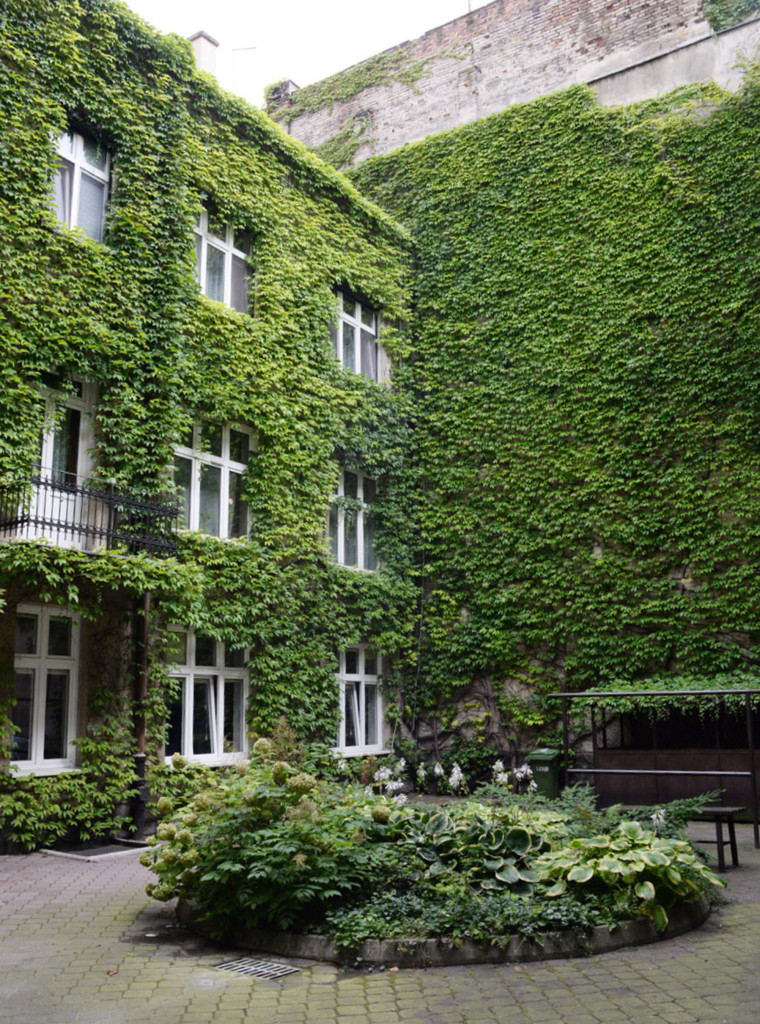
Courtyard overloking Nobel Laureat's Czeslaw Milosz's apartment. 8.13.2016. Krakow. Poland

Andrew Sullivan on living-in-the-web: “It broke me. It might break you, too.”

Share
andrew_sullivan_cropped

Getting off the grid. (Photo: Trey Ratcliff)

Author, journalist, blogger Andrew Sullivan has been a kind friend to the Book Haven over the years, picking up our posts in The Atlantic, The Daily Beast, and in his blog “The Daily Dish” – we’ve written about it here and here and here. Then last year he discontinued his blog – burned out, needed to get off the grid, he said.

I understood. Being online, all the time, had affected my own ability to read, think, and focus. Nowadays, I find it requires discipline to read a few pages without compulsively leaping up to google an unfamiliar word or doublecheck a random fact. But I’d never escalated to the hepped-up scale he did.

He tells his story in New York Magazineand it’s a riveting read, and a black warning. Here’s an excerpt:

For a decade and a half, I’d been a web obsessive, publishing blog posts multiple times a day, seven days a week, and ultimately corralling a team that curated the web every 20 minutes during peak hours. Each morning began with a full immersion in the stream of internet consciousness and news, jumping from site to site, tweet to tweet, breaking news story to hottest take, scanning countless images and videos, catching up with multiple memes. Throughout the day, I’d cough up an insight or an argument or a joke about what had just occurred or what was happening right now. And at times, as events took over, I’d spend weeks manically grabbing every tiny scrap of a developing story in order to fuse them into a narrative in real time. I was in an unending dialogue with readers who were caviling, praising, booing, correcting. My brain had never been so occupied so insistently by so many different subjects and in so public a way for so long.

I was, in other words, a very early adopter of what we might now call living-in-the-web. And as the years wentby, I realized I was no longer alone. Facebook soon gave everyone the equivalent of their own blog and their own audience. More and more people got a smartphone — connecting them instantly to a deluge of febrile content, forcing them to cull and absorb and assimilate the online torrent as relentlessly as I had once. Twitter emerged as a form of instant blogging of microthoughts. Users were as addicted to the feedback as I had long been — and even more prolific. Then the apps descended, like the rain, to inundate what was left of our free time. It was ubiquitous now, this virtual living, this never-stopping, this always-updating. I remember when I decided to raise the ante on my blog in 2007 and update every half-hour or so, and my editor looked at me as if I were insane. But the insanity was now banality; the once-unimaginable pace of the professional blogger was now the default for everyone.

If the internet killed you, I used to joke, then I would be the first to find out. Years later, the joke was running thin. In the last year of my blogging life, my health began to give out. Four bronchial infections in 12 months had become progressively harder to kick. Vacations, such as they were, had become mere opportunities for sleep. My dreams were filled with the snippets of code I used each day to update the site. My friendships had atrophied as my time away from the web dwindled. My doctor, dispensing one more course of antibiotics, finally laid it on the line: “Did you really survive HIV to die of the web?”

But the rewards were many: an audience of up to 100,000 people a day; a new-media business that was actually profitable; a constant stream of things to annoy, enlighten, or infuriate me; a niche in the nerve center of the exploding global conversation; and a way to measure success — in big and beautiful data — that was a constant dopamine bath for the writerly ego. If you had to reinvent yourself as a writer in the internet age, I reassured myself, then I was ahead of the curve. The problem was that I hadn’t been able to reinvent myself as a human being.

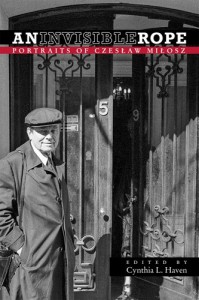
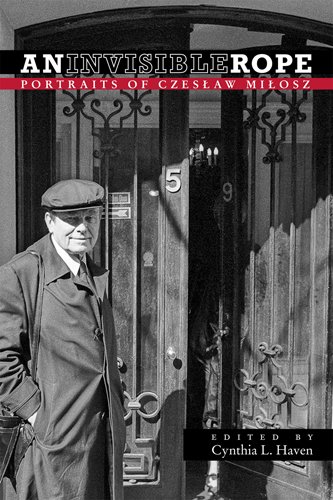
invisibleAnd that, of course, is the point, isn’t it? As I wrote in the introduction to An Invisible Rope: Portraits of Czesław Miłosz
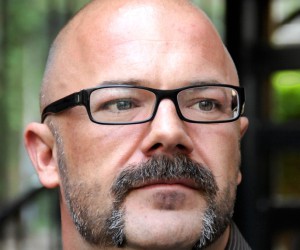
Few can deny the dizzying rate of social and technological upheaval in the information age, where we communicate in real time with Peru and tweet back what we hear, yet human greed, cowardice, and power-lust remains essentially the same. That acceleration, juxtaposed with man’s fallibility, is very much to the point.

One metric for measuring the chasm pertains to what Miłosz called être and devenir. (Or, to put a Thomist slant on it, heuses the Latin esse elsewhere.) When I interviewed him at his legendary Grizzly Peak home a decade ago, I asked him about être and devenir. He dodged the question: “My goodness. A big problem,” he said.

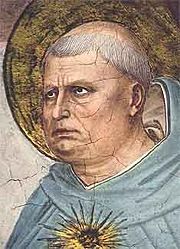
Saint_Thomas_Aquinas

Esse.

After some hesitation, however, he elaborated. “We are in a flux, of change. We live in the world of devenir. We look at the world of être with nostalgia. The world of essences is the world of the Middle Ages, of Thomas Aquinas. In my opinion, it is deadly to be completely dissolved in movement, in becoming. You have to have some basis in being.

In general, the whole philosophy of the present moment is post-Nietzsche, the complete undoing of essences, of eternal truths. Postmodernism consists in denying any attempt at truth.

Read Andrew Sullivan’s piece here. As he writes: “An endless bombardment of news and gossip and images has rendered us manic information addicts. It broke me. It might break you, too.”

David Sanders: “And the moment? Well, moments are always disappearing.”

Share
sanders-2010

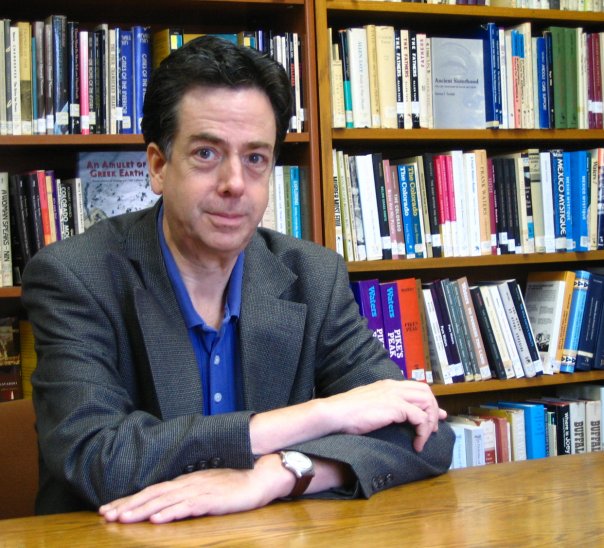
The poet, editor, publisher David Sanders

I met David Sanders many years ago. The occasion was the West Chester Poetry Conference – but circa when? The year 2000, I think, at an evening celebration at the home of the conference’s co-founder, Michael Peich. I don’t remember what the two of us were discussing so earnestly. I simply remember standing on the back porch with David, his cigarette embers glowing in the dark, a sea of crickets somewhere in the distance, and the orange tip of light making circles as he gestured. He was the director of Ohio University Press/Swallow Press then, and I thought of him as publisher, not a poet. Later, he became the founding editor Poetry News in Review at The Prairie Schooner – the Book Haven has discussed it here.

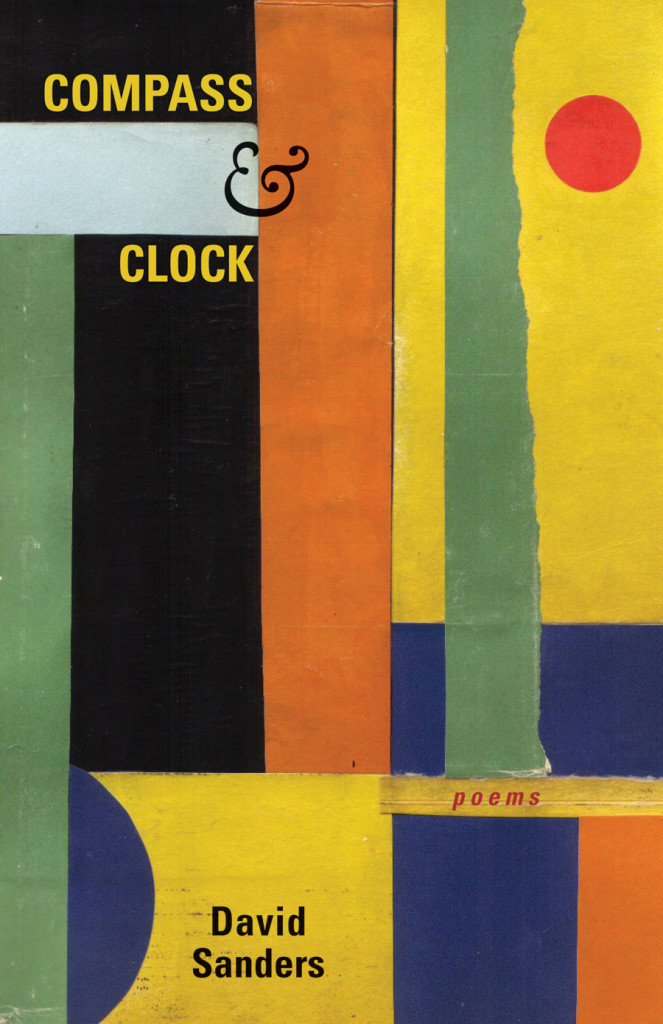
Recently, however, I was pleased to see the more personal side of the poet emerge, with the publication of his collection Compass & Clock. (The title does not refer to a poem in the collection – why the title then? Perhaps because one measures space, the other time.)

Poet, actor, and editor David Yezzi called the collection “the strongest new book of poems I have read in quite some time.” Poet Joshua Mehigan noted that the poet’s “kind, observant clarity can lull you into a sense of ease, even as he lays open the poignancy and diverse fascinations of existing on earth.” According to poet Andrew Hudgins, “Sanders knows well it is love itself that makes us miss and mourn the things we’ve lost.”

Here’s one on a topic we’re all too familiar with, the quotidian effects of death on the living – written, curiously, in first person, from the p.o.v. of the dead:

sanders-bookHousekeeping

The living pack us up.
Now that we have gone and died
it’s comforting to them
to know what’s left is tucked inside

a box, an urn, or closet
where memories, like dreams, abound.
They tend to the mess
our dying first has left around.

(Letters dried to mica,
clothes gone further out of style,
souvenirs of us
in storage, kept a little while.)

They allow themselves sadness,
drifting near this windy border.
But grief has raked out its embers,
which cool and die among the order.

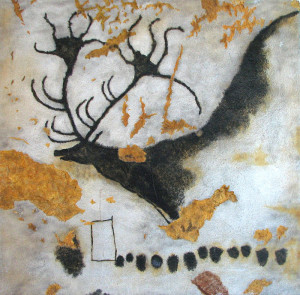
His poem “Lascaux” naturally caught my eye – I recognized immediately which poem he honors when he writes “after Miłosz.” The Nobel poet’s very early 1936 poem, “Encounter” is the first in his Collected Poems. You can read it here to see the Polish maestro’s earlier treatment of the same idea. One poet answers another through time. Here’s David’s unusual take:

Lascaux

Jacques Marsal, who as a boy discovered the prehistoric paintings of the Lascaux cave with three friends and became the cave’s guardian for life, died Saturday after a long illness.

lascaux_megaloceros– (AP) July 17, 1989

The first day, his dog disappeared in the forest,
lost down a hole. The next, exploring with friends,
he found the cave – leaping stags, buffalo,
prehistoric horses.
.                         Alone a moment, one French boy lived
a dream boys dream: to stand at the place
where for thousands of years no one has been.

That was 1940. Boy and dog are dead.
And the moment? Well, moments are always disappearing.

.                         after Miłosz

Poet Anna Frajlich’s long journey from Warsaw to New York

Share
frajlich

Anna, photographed by Krzysztof Dubiel.

Poet Anna Frajlich-Zajac (she uses Frajlich as her pen name) is retiring from Columbia University, where she taught Polish language and literature for decades. The Harriman Institute’s Ronald Meyer has written a tribute to the Polish poet. Here’s how she came to New York City, in a wave of Jewish emigration too little known in the West:

Anna and her family were part of the mass emigration of some 13,000 Poles of Jewish descent who had fallen victim to a virulent anti-Semitic campaign and political crisis known as March 1968. Emigration required renunciation of one’s Polish citizenship, which Anna had to perform on behalf of her two-year-old son. Like her fellow émigrés, Anna believed that she would never see her native land again. Officially they were bound for Israel, but her husband argued that if they were to leave Poland, they should go as far as possible from Europe; thus they informed the authorities in Vienna that they wished to make the United States their home. They traveled to Rome under the care of the gendarmerie due to their statelessness. As they awaited travel documents for the United States, they were charged only with refraining from any demonstrations, which left them free to explore the Eternal City and begin adapting to life in the West. Many years later Anna’s Roman ramblings would provide the background for her dissertation and monograph, The Legacy of Ancient Rome in the Russian Silver Age.

I couldn’t agree more with Anna’s assertion that “language is a key to literature, to history, to understanding progress of any sort.” I had the good fortune to meet Anna in connection with An Invisible Rope: Portraits of Czesław Miłosz:

Anna worked as a freelance cultural correspondent with Radio Free Europe (RFE) as a writer and interviewer, which culminated in her interview with Czesław Miłosz upon his receiving the Nobel Prize. She first met Miłosz at a lecture at the Guggenheim on October 17, 1978; he inscribed the date in his book about Stanisław Brzozowski, which Anna had purchased in a local Polish bookstore and brought for him to autograph. When writing her thesis on “one of the most original Polish thinkers of the twentieth century,” to cite Miłosz’s formulation, Anna had to travel across Warsaw to read this same book in the restricted section of the library, after producing a document from her thesis adviser. Now she had her own copy, with the author’s inscription. They continued to meet sporadically at readings and conferences.

invisibleThe Nobel interview, which has been published in English translation [that would be in An Invisible Rope: Portraits of Czesław Miłosz], almost did not come about. Miłosz had not been treated well by RFE in the early days of his emigration, and he did not feel obliged in the least to give them an interview. But he had been persuaded that since he had given an interview to Trybuna Ludu, the Polish Communist daily, he should give one to RFE. He agreed, but insisted that Anna conduct the interview. The interview took place at Miłosz’s home in Berkeley. The piece, which very much represents a poet interviewing a poet, was a resounding success; it was broadcast four times and published. In 1993, Anna was conducting interviews for the column “What Other People Read,” which was appearing in the cultural supplement to the Polish Daily News. She conducted a telephone interview with Miłosz for the column, realizing only after hanging up that she had forgotten to hit the record button. She immediately called him back and explained the situation. He “graciously” suggested that they conduct the interview again the next morning. You can read about Anna’s relationship with Miłosz, including how he introduced her to Scotch after they concluded the Nobel interview and that she taught his granddaughter Polish at Columbia, in her essay, “He Also Knew How to Be Gracious.”
Anna earned her master’s degree in Polish philology at Warsaw University, writing her dissertation on the philosopher and critic Stanisław Brzozowski and the Polish positivists. She began her graduate studies under the guidance of Zoya Yurieff, a professor of Slavic literatures and cultures at New York University who was an early inspiration and encouraged her graduate education in the first place. Yurieff also suggested the topic of ancient Rome in the poetry of the Russian symbolists.

What future for Anna? She plans to write a memoir called Women in My Life, which will include portraits of her mother and a Warsaw University professor, among others, and, of course, Zoya Yurieff.

Read the whole retrospective here. Meanwhile, a poem dedicated to her wonderful husband, reprinted with her permission:

Manhattan Panorama

to Władek 

The bridges overhang the city
like diamonds in a diadem
reflected lights are burning
in the Hudson and the Harlem Rivers
in the East River in the bay
and in puddles on the road
the bridges overhang the city
that shone in flight
between a setting star
and the rising moon
walls pinned into heaven
pressed by granite to the ground
wind in its stone sails
out to sea
it moves at dawn

(Translated by Ross Ufberg)

With love from Warsaw: Julia Fiedorczuk and a message from the mist

Share

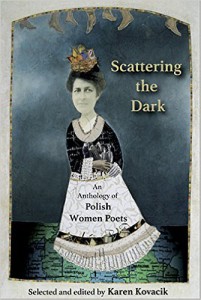
scatteringJulia Fiedorczuk, the young Warsaw poet, has written some beautiful verse – well, we wrote about that here, after a magical April night in Berkeley that ended at Chez Panisse. Most of the poems that were read that evening came from a new anthology Scattering the DarkBut one, inspired by Czesław Miłosz, was not. I was not able to use print it at the time, since it was under consideration for publication by the Poetry Foundation, and Julia kindly gave us Psalm 2 instead. We’re pleased to say that Julia’s “Psalm 31,” was not selected (Psalm V was, and is published online here). So here is Psalm 31, all these months later, below. “The whole cycle rhythmically and poetically alludes to Miłosz’s translation of the Hebrew Psalms,” the poet said. We think so, too. Tell us which of the three psalms you like the best (all translated by Bill Johnston). I still think this one has the most Miłoszian bent. She sent it with her love from beautiful Warsaw:

Psalm XXXI

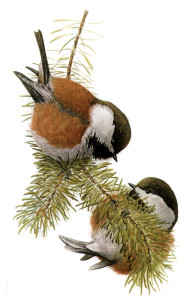
chickadeesfor R. K.

a chickadee had perched on the window-sill like a message
generated by the mist, October
was turning into November in the birches oaks alders,
in the frost-resistant flowers, in the cemeteries
where our fathers wrote no memoirs,
where they would not recognise our children, our
poems, ourselves. The television was showing Poland
that had perished, and then had not perished, and then
again had perished, and then not, and then the sun
flung up a mesh of branches, all at once
the chickadee was absorbed by sky before I could say
remember, remember me.

Happy birthday, Czesław Miłosz! He was no hero, and he knew it.

Share
IMAG0161

Outside his birthplace in Šeteniai, Lithuania. (Photo: Humble Moi)

When I wrote my first of many articles on Czesław Miłosz oh, some sixteen years ago, the editors suggested a headline that had the word “hero” in it. I knew he would have cringed at such a notion, and talked them out of it. He had, after all, served the Stalinist government of Poland, and he always remembered it.

His turnabout came one winter night in 1949 as he was leaving a lavish evening party attended by Poland’s ruling elite. On his way home at abut 4 a.m., he passed some jeeps carrying the newly arrested. “The soldiers guarding them were wearing sheepskin coats, but the prisoners were in suit jackets with the collars turned up, shivering from the cold. It was then I realized what I was part of.”

A happenstance Californian.

Birthday boy.

He compared the process to swallowing frogs: you could perhaps swallow one or two, but at the third the stomach revolts. It was not ideology or philosophy – but a revolt of the stomach. (Read more about what happened afterwards here.)

It’s Nobel poet Czesław Miłosz’s 105th birthday today, but Robert Zaretsky‘s article in last week’s New York Times wasn’t the best prezzie we could think of for the occasion. A salute to Miłosz all too quickly descends to another ritual denunciation of Donald Trump. Milosz’s vast and nuanced experience is put in service of a crude political end. This complicated poet’s oeuvre is marshaled to support today’s political grievances. Of course he had strong opinions, but the whole point of Miłosz is that he never saw himself apart from what he observed.

He never saw himself as the “good guy,” but rather as fallible and flawed, as cruel and indifferent as anyone else, given the same trials. Somewhere (I’m unable to find the reference) he described himself in wartime Poland averting his eyes from his Jewish neighbor on the staircase. He is the poet of guilt. (I wrote more about that here.) Said fellow Nobelist Joseph Brodsky of Miłosz’s wartime experiences: “Out of these ashes emerged poetry which did not so much sing of outrage and grief as whisper of the guilt of the survivor.” Hence, “Campo dei Fiori,” cited in the New York Times piece, is not an indictment of his fellow human beings, but an indictment of himself, also. That keen self-knowledge kept him far away from the soapbox. (He made an exception for his poem, “Sarajevo,” which he thought was sub-par. As he said, “Sometimes it is better to be a little ashamed than silent.”)

invisibleHe was not always sympathetic to the self-righteous. In my book, An Invisible Rope: Portraits of Czesław MiłoszCalifornia poet Morton Marcus recalls a 1970 reception that Miłosz hosted for the visiting Serbian poet Vasko Popa. The Polish Nobelist encountered several Berkeley students, wearing white armbands, en route to a protest against the U.S. invasion of Cambodia. After some belligerent inquiries from a slightly drunken Miłosz, the students made the mistake of saying that they were protesting for peace and love.

“Love, love, love!” mocked Miłosz, his voice rising to a shout. “Talk to me about love when they come into your cell one morning, line you all up, and say ‘You and you, step forward. It’s your time to die—unless any of your friends loves you so much he wants to take your place!’”

In The Captive Mind, he writes that whenever he is “drunk with the beauty of being alive amidst living human beings,” one image obstinately returned to him:

“I see before my eyes always the same young Jewish girl. She was probably about twenty years old. Her body was full, splendid, exultant. She was running down the street, her hands raised, her chest thrust forward. She cried piercingly, “No! No! No!” The necessity to die was beyond her comprehension—a necessity that came from outside, having nothing in common with her unprepared body. The bullets of the SS guards’ automatic pistols reached her in her cry.”

Szarlotka

Na Zdorovie

“Are Americans really stupid?” writes Zaretsky at the beginning of his piece. I wonder. A review of Captive Mind in Goodreads: “Excellent work about the intellectual deadening of Western Culture. A polemic on living under facist [sic] control and what it does to the mind.” It makes one wonder if people have lost their ability to read altogether. The book is a study of Miłosz’s experiences and observations under Communism, not Fascism. And his experience happened in Poland, not “Western Culture.”

Well, there you have it. Here’s to you, Czesław. Lifting the spiritual essence of a glass of Szarlotka to you, as I did on your centenary way back in 2011, celebrating in your home on Grizzly Peak in Berkeley.