
Au revoir, Marek Skwarnicki (30 April, 1930 – 12 March, 2013)

Share
marek

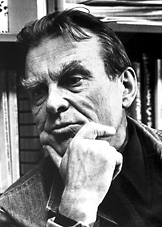
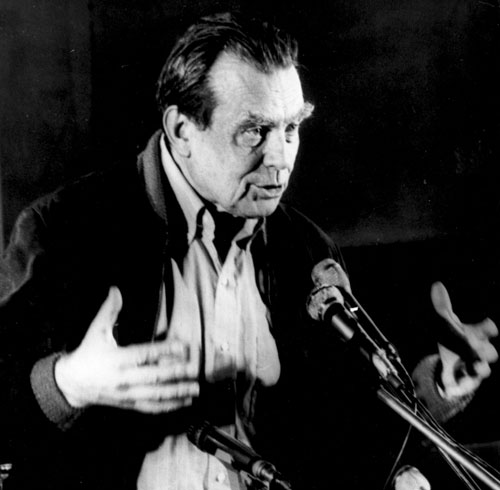
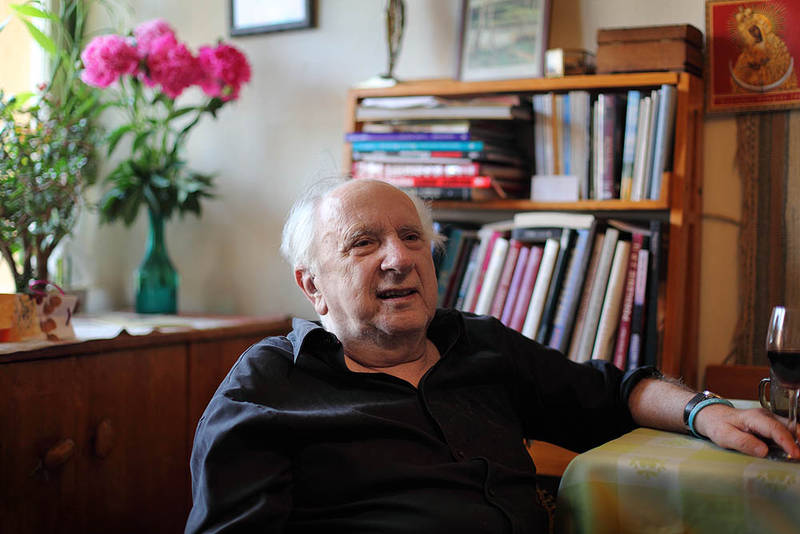
Marek Skwarnicki, in the crowded apartment on Ulitsa Pigonia

For the last week or two, I kept thinking that I should drop a note to Polish poet, novelist, essayist, journalist, and translator Marek Skwarnicki   So I finally wrote him a friendly email on Saturday, inquiring about his well-being and that of his wife, Zofię.  Marek is another in the tribe of people I wanted to stay in touch with – but he was so easy to lose track of, even in Kraków, living way out on Prądnik Biały, in the most farflung northern outskirts of the city, in one of the highest floors of an anonymous apartment block on Ulitsa Pigonia.

I googled him yesterday, just to see what he might be up to, and had another shock:  according to the Polish media, he had died on the 12th of March, about the same time I began having the impulse to write him.  (This is the second time this has happened in two months, which is eerie to say the least.)  He was a month shy of his 83rd birthday. President Bronislaw Komorowski posthumously awarded him the Officer’s Cross of the Mark Skwarnickiego Polish Order of Polonia Restituta, for “outstanding contribution to Polish culture.”  The Polish media don’t list a cause of death (nor does Rome’s La Stampa), nor tell us whether his wife survived him.  Obviously, I didn’t attend the 20 March funeral mass at the Benedictine abbey in Tyniec, celebrated by Cardinal Franciszek Macharski – the eminent poet Julia Hartwig spoke afterwards at the event, which was attended by former colleagues at Tygodnik Powszechny and Znak.

So let this be my tribute to one of the kindest people I remember.
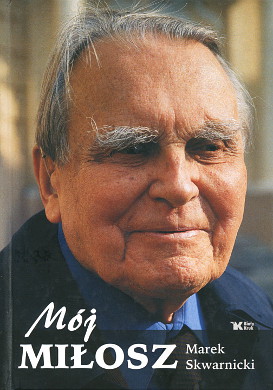
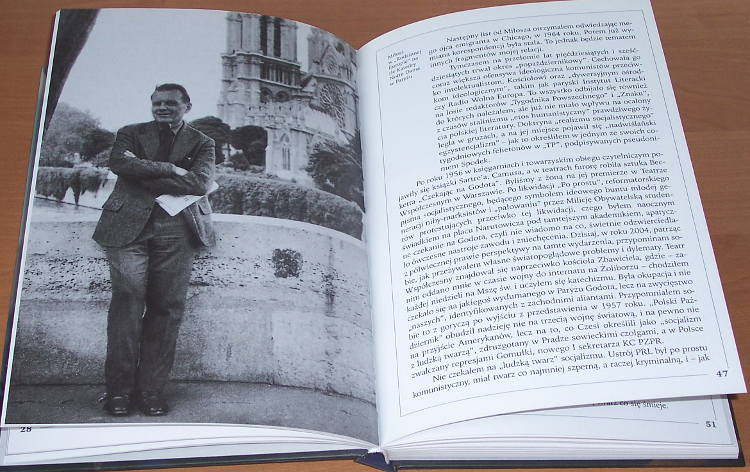
Moj-Milosz-Krakow-Bialy-Kruk-2004-CzeslawMarek was one of the contributors to An Invisible Rope: Portraits of Czesław Miłosz – I don’t remember who suggested I talk to him.  This is what I had to say about him in the Contributors Notes:

Marek Skwarnicki—Polish poet, writer, and translator of poetry—was imprisoned in the German concentration camp Mauthausen in 1944. From 1958 to 1991, he was on the editorial board of Tygodnik Powszechny. He has written many volumes of poetry and memoirs from his travels with John Paul II, which he covered as a reporter. His correspondence with Miłosz is included in his book Mój Miłosz (My Miłosz).

I made the trek out to meet Marek and his wife Zofię in 2008, during my fellowship to Poland.  Did I bring flowers on this visit, or the second?  I can’t recall, but flowers always seemed plentiful in that apartment, along with the sweetish wine and store-bought pastries they served to guests.  At one point I brought an armload of bright yellow flowers – that I remember.

On my first visit, the devout Catholic writer told me cheerfully, “Miłosz was a heretic, like all great artists” – yet gave a nuanced portrait of the anguished religiosity of the Nobel poet. In Invisible Rope, he tells the story of his first contact with Miłosz:

“Because of the changes in the Soviet Union, Khrushchev coming to power and de-Stalinization, the year 1956 became pivotal in Polish political history. The publishing policies in my country experienced a “thaw,” an easing up of the state censorship that used to control not only every printed word, but also the size of periodical circulation and even the content of business cards. The name of Czesław Miłosz was now permitted to be mentioned in print.  Tygodnik Powszechny — a general-interest, political, Catholic, and sociocultural weekly — resumed its publication after a forced hiatus.

While still a student, I had written for the magazine under an assumed name. Later, I forged relations with the former editors and, in 1957, (since because I myself had started writing poetry), my poem titled ‘A Letter from Warsaw’ appeared in Tygodnik Powszechny; this poem was my way of thanking Czesław Miłosz for being the ‘daylight’ of my young years and the ‘rescue’ in Warsaw. Truth be told, the entire Communist press lashed out at me. Nevertheless, the poem was published.
marekskwarnicki

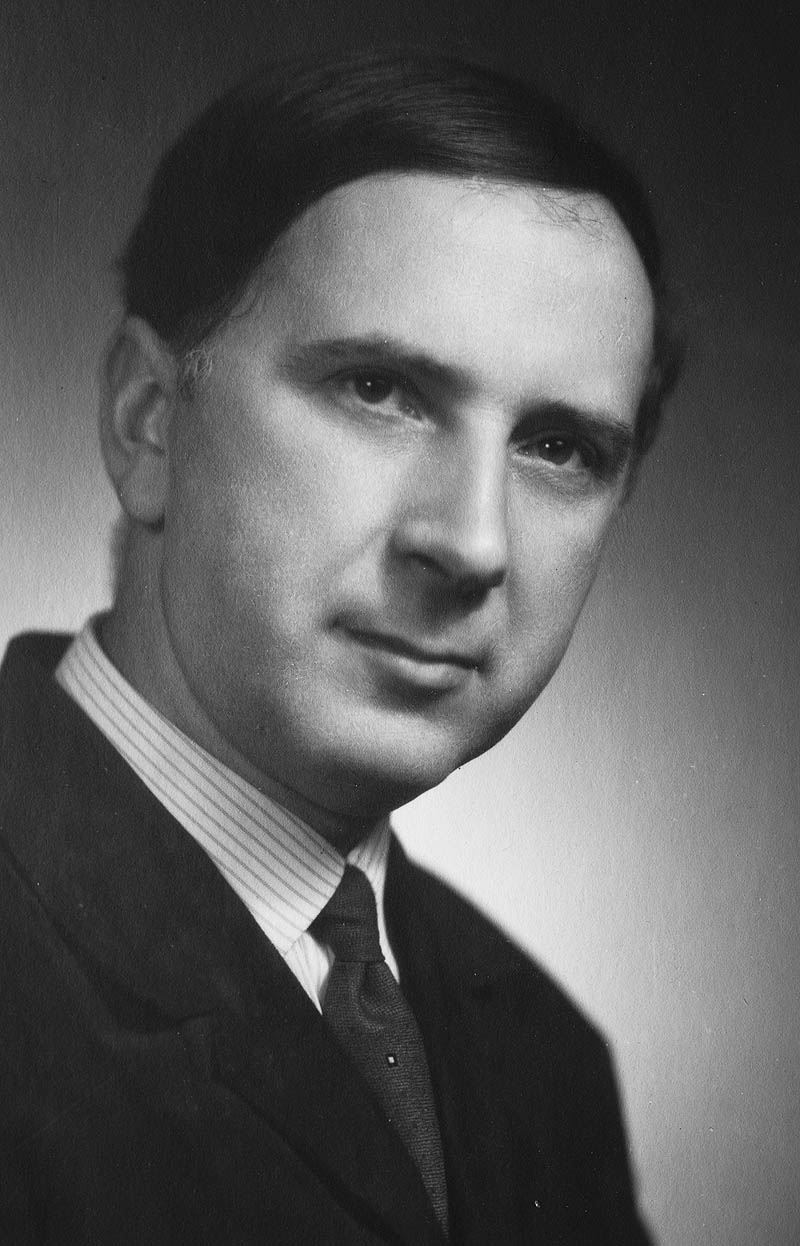
In younger days (Courtesy the Skwarnicki family).

On Christmas 1957, I received a letter from Paris. The envelope carried no return address. Inside was a white card with a red-and-white border. In the top left corner, there was a little Christmas tree and a handwritten inscription ‘Merry Christmas’; and in the lower rightcorner, it was signed ‘from Czesław Miłosz.’ This was the beginning of our relationship, which deepened into a friendship between an older poet and a younger one (this is how Miłosz described it) and ended only  with his death in Kraków.”

The two had a mutual friend in their fellow Pole and fellow poet, John Paul II.  Marek met Karol Wojtyla in the late ’50s in the editorial offices of Tygodnik Powszechny – well, Kraków is a small town.  From that time onwards, he became a sort of literary counselor to the poet-pope, and was invited to Rome to assist the Pope in the final editing of Wojtyla’s Roman Triptych: Meditations.  Marek also translated the Psalms – curiously enough, so did Miłosz, teaching himself Hebrew to do so.

The only time I riled this gentle man, even a little, was when, on his manuscript, I politely inquired whether Polish authorities weren’t tracking his unconventional trip across America, where he finally met Miłosz face-to-face after years of correspondence:

“I like to add that you made me slightly angry on you with your remarks about my fear of Polish political police. I am and I was in your free country the free man, not slave, not afraid of  Polish KGB.  I did not made report to them after return to [my] country.  They did not know that I was visiting office of Polish Section of Voice of America, what was more dangerous than [visiting] Milosz. Sorry. Warm wishes to you.”

I remember my second and last visit to the tiny, crowded apartment on Pigonia in 2011.  As I left, they urged me to come back again before the end of my trip – I remember saying goodbye, not knowing if I had the time in my tight schedule to find my way to this apartment building again.  I suspected I would not, but looked at the generous, expectant faces of this hospitable, open-hearted, and thoroughly devoted couple – half-blind, half-deaf, yet waiting for me – and I said I would try.
Moj-Milosz-Krakow2

What is Magpiety? An answer at last.

Share

Czesław Miłosz wrote, as he recalled the familiar cry of a bird during a stroll through an oak forest:

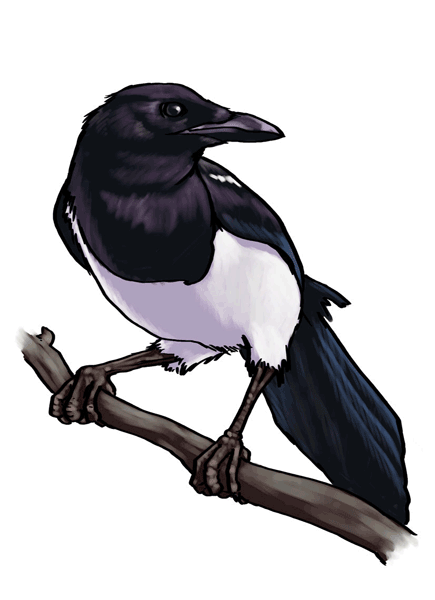
What is magpiety? I shall never achieve
A magpie heart, a hairy nostril over the beak, a flight
That always renews just when coming down,
And so I shall never comprehend magpiety.

I have since heard scholars and poets discourse learnedly on this particular poem (which is here).

In a binge of self-improvement a year or two ago, I signed on for the Oxford English Dictionary’s “Word for a Day.” The binge ended long before the avalanche of words stopped – they were either already familiar, easy to figure out, or otherwise not the etymological treat I was expecting.

But look what arrived in my inbox today:

magpiety, n.   Pronunciation: Brit. /maɡˈpʌɪəti/ , U.S. /mæɡˈpaɪədi/

Forms: 18 mag-piety, 18– magpiety.

Etymology: Humorous blend of magpie n. and piety n. Compare also mag n.3, mag v.2

Talkativeness, garrulity (esp. on religious or moral topics); affected piety.

1832 T. Hood Jarvis & Mrs. Cope in New Sporting Mag. Mar. 323 Not pious in its proper sense, But chattring like a bird, Of sin and grace—in such a case Mag-piety’s the word.

1841 T. Hood Let. in Memorials (1860) II. iii. 118 Such solemn questions as..whether your extreme devotion has been affected or sincere..in short, Piety or Mag-piety?

1891 Blackwood’s Edinb. Mag. 150 400/2 Conceive the agony of suppressed speech when a man is as garrulous as a magpie by nature; and my friend is that, though his magpiety is of an elevated sort.

1987 M. Daly Websters’ First New Intergalactic Wickedary Eng. Lang. 145 Magpiety, the impious impropriety of Prudes; irreverence for sir-reverence; Nagpiety’s Hagpiety.

Who knew?  The usage of the word does not begin with Milosz, as I had assumed.  In fact, it goes all the way back to 1832, and has a life of its own.

You can hear the poet read the poem here. He says:  “There is a very short poem, which when we translated with Peter Dale Scott – quite a trouble to find an equivalent for a notion of magpieishness … if there is a bird magpie, there should be magpieishness. We hit on the idea of translating that magpiety.”

Postscript on 2/3:  Poet and translator Peter Dale Scott has made an appearance in the comment section below. He wrote: “’Magpiety’ was my suggestion. Later I was ambivalent about it, but Michael Palmer assured me it was not such a bad idea after all. Apparently not, if it occurred to others before me.”

Join me in London! The British Academy celebrates Czesław Miłosz

Share
The reason for the celebration

The reason for the celebration.

Join me at the British Academy for a celebration of Poland’s 1980 Nobel laureate in literature: “His Master’s Voice: Czesław Miłosz and his dialogue with British, Irish and American poetry.” The event, arranged in association with the Polish Cultural Institution, will take place on Thursday, 6 December, from 6 to 7.30 p.m. at The British Academy, 10-11 Carlton House Terrace, London, with a reception afterward.

I’ll be taking on the American Miłosz, and I’ll be joined by:

George Szirtes, the distinguished poet, translator, and broadcaster, whose New and Collected Poems (2009) was Independent Poetry Book of the Year.

Jerzy Jarniewicz, one of Poland’s most highly-regarded poets, translators, and literary scholars.

Michael Parker, whose books include  Seamus Heaney: The Making of the Poet (1993), Northern Irish Literature 1956-2006 (2007), and Irish Literature Since 1990 (2009).

Stephen Regan, author of two books on Philip Larkin and a forthcoming critical study of the sonnet from Shakespeare to Heaney. He is the editor of Irish Writing: An Anthology of Irish Literature in English 1789-1939 in the Oxford World’s Classics series.

According to the Academy’s website, “At a juncture when the concept of ‘value’ is reckoned primarily in economic terms, it seems timely to consider how poetry promotes dialogue within and between cultures, and so promotes other, richer ways of seeing.”

The event is free, but registration is required – you can do that here.  It would be fun to see you!

“His sobering effect”: Czesław Miłosz’s “Notes on Joseph Brodsky”

Share

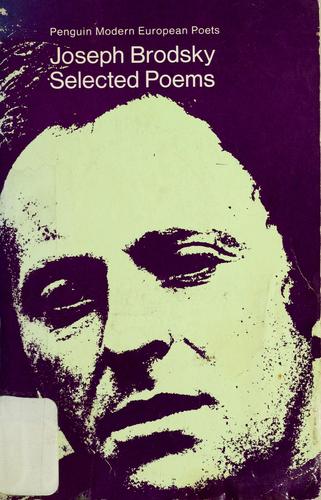
Last weekend I was chatting with Joseph Brodsky‘s first translator, George Kline.  The Bryn Mawr professor befriended the young Russian poet in St. Petersburg, and went on to be the translator of the Harper & Row 1973 Selected Poems, with a foreword by W.H. Auden.  It was later reissued as a Penguin paperback – I carried that dog-eared volume with me from 1976, when I bought it in an Ann Arbor bookstore, until it was lost it in a foreign city … somewhere in Vilnius, as I recall, sometime in the late 1990s.

George thanked me for sending him Czesław Miłosz‘s “Notes on Brodsky.” I couldn’t recall having done so, but looked up a copy for myself in Stanford’s Green Library, in a 1996 Partisan Review, to make sure I hadn’t.

The piece is well worth excerpting.  “The presence of Brodsky for many among his poet-colleagues was a mainstay and as if a point of reference,” the Polish poet wrote.  Later, “whatever survived from the past has been due to the principle of hierarchical distinction.”

“Here was a man who by his oeuvre and by his life reminded us, against what today is so often proclaimed and written, that hierarchy exists.  That hierarchy cannot be contrived by syllogisms and established in a discourse.  Rather, by living and writing, we affirm it every day anew. It has something to do with the elementary division into beauty and ugliness, truth and falsity, goodness and cruelty, liberty and tyranny. But, first of all, hierarchy means respect for that which is elevated and unconcern, rather than scorn, for that which is base. …

“To go straight to the goal, not letting oneself be swayed by any voices calling for one’s attention. That is, knowing how to recognize what is important and clinging only to it. That was precisely the the strong side of the great Russian writers of the past.

“Brodsky’s life and writing tended toward accomplishment, as an arrow tends towards the aim. Yet, evidently, that was an illusion, just as in the case of Pushkin or Dostoevsky. We must therefore formulate it differently – that fate tends straight to the aim, while the one who is ruled by fate knows how to read its main lines and to comprehend, be it dimly, that to which one is called.”

His words brought back what the Miłosz had said to me on the same subject, about “maintaining one’s own vision, one’s own taste, let us say, against the current fashion of the day.”

Esse.

From my Georgia Review interview a dozen years ago: “I have lived a long time in the West and tried to remain faithful to a line of Polish poetry. The same applies to Brodsky and Russia. The history of poetry is the history of language. That’s why Joseph Brodsky wrote that we write to please our predecessors, not our contemporaries.”  I’ve quoted this part before, about Milosz’s crucial division between esse and devenir:

“There was at a given moment a stable world where we could see, hold on to values that were a reflection of the eternal order of things. Now we are in a flux. This is a very peculiar way of life. … When everything is in flux, revision, it is healthy to have some poets who preserve the feeling of respect.  In a way, Brodsky was a conservative voice in that sense – he had a lot of sense.”

“For me, the value of Brodsky was his sobering effect, and his enormous feeling of hierarchy. He had a great feeling of hierarchy of value in works of art and works of literature.”

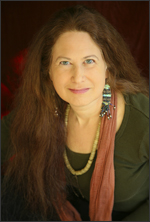
Jane Hirshfield, “the youngest and last of Czesław’s American poet-friends”

Share

Some time ago, the Book Haven wrote about California poet Jane Hirshfield‘s appearance at Kepler’s (we’ve also written about her here).  Jane and I came together over Czesław Miłosz a dozen years ago, when I interviewed her about her friendship with the Nobel poet for California Magazine. Two books and many articles later, after I have crossed the world tracing Miłosz’s journeys and speaking about him during Rok Miłosza, it was pleasing to find Jane’s elegant post about him on the Library of America blog “Reader’s Almanac” this week, as she remembers “Czesław Miłosz, (California) Poet.” (We’re also grateful to Jane and LOA for the mention of An Invisible Rope, in which Jane was one my contributors, and also for the hat tip to the Book Haven.)

Here’s an excerpt from Jane’s piece:

In late 2002, at ninety-one and returned to Poland from his long self-exile (ten years in Paris, then forty as professor and poet in Berkeley), Miłosz wrote this small poem in his notebook:

I pray to my bedside god.
For He must have billions of ears.
And one ear He keeps always open to me.
(tr: Anthony Miłosz)

Reading this in English eight years after the poet’s death, I was struck by its curious “bedside.” A translator’s note explains: the original adjective means “near-at-hand,” “handy.” The Polish words for a first aid kit, a home-library reference book, and hand luggage all use some form of podręczny. This would, then, be not the distant and fearsome God of Judgment, but the rescuing one who knows every sparrow that falls, and the poem points toward a fully-felt fulcrum of balance: its god is local and large, intimate and immense, able to carry in a small, household form something vast, life-saving, and essential. Even the typography holds dual vision: the “g” of “god,” is lower-case; the pronoun is “He.”

All those years ago, when I first spoke to her on the phone, she told me how she had initially befriended the Polish poet.  At a large outdoor gathering, the hostess approached Jane and suggested she introduce herself to Czesław Miłosz and his wife Carol.  Everyone was intimidated by him, and so these gatherings could often be lonely affairs. Jane described it in An Invisible Rope:  “I was, I believe, the youngest and the last of Czesław’s American poet-friends.  I met him only after he had already turned seventy-five, when we were both invited to a group picnic on Angel Island, in the middle of San Francisco Bay.  Not long after, he invited me to dinner after translating one of my poems into Polish.  He showed me how largely it is possible for a person to live, even in old age, rapacious for knowledge, experience, and –though it is not a term he would use – the understanding of wisdom. His investigation of good and evil was not conceptual but personal and pressing.”

And so her journey began – just as it began for me a dozen years ago, when I inadvertently became the last person in the U.S. to interview Miłosz (without warning, he returned to Kraków forever a few months after my California Magazine profile).  Jane does her best to describe the impression, and does it much more eloquently than I can in this midnight blog post:

“Perhaps I am trying to sketch here a premise too complicated for such a brief form as this virtual Library bookshelf. But Miłosz, a poet of almost incalculable range, continually reminds us also that poems, and poets, live in the small, in the local and comic recognition, in the living and perishing real. We do not, cannot, live in general; even exile takes place in a place, a deck overlooking a Bay, on which a poet with extravagant eyebrows turns the pages of a New Yorker for its cartoons. We breathe the air that is near to us, scented with redwoods and lemons, or with the exhaust of refineries, power plants, airplanes, wars. If a poet in exile continues writing, he or she will be sustained by that air and that place, and will become of it.”

Then she cites the poem that I know is her favorite … or at least one of her favorites (can there ever really be a favorite?)  She also reads and discusses the same poem, “Winter,” in the video below:

“Sustok, sustok” … this just might be the language of heaven

Share


"Above all, love language." (Photo: Dylan Vaughan)

Diana Senechal discovered the Book Haven, and we discovered her own blog “on education and other things.”  One of those other things was Tomas Venclova, the subject of a recent post on this site.  She wrote about her first encounter with the Lithuanian poet’s verse:

It was in 1988 that I first encountered Tomas Venclova’s poetry. I was a senior at Yale; he was directing my independent project on Russian poetry translation. Knowing that he was a poet, I wanted to read his work (but didn’t want to tell him this). So one day I made a furtive trip into the library stacks. I opened up a volume of his poetry and read the lines,

Sustok, sustok. Suyra sakinys.
Stogų riba sutampa su aušra.
Byloja sniegas, pritaria ugnis.

What did these words mean? At the time, it didn’t matter. I was drawn into the sounds, or what I thought were the sounds. “Sustok, sustok. Suyra sakinys.”

(Later, I learned that they meant, roughly, “Stop, stop. The sentence disintegrates. The border of rooftops coincides with the dawn. The snow proclaims, the fire repeats.”)

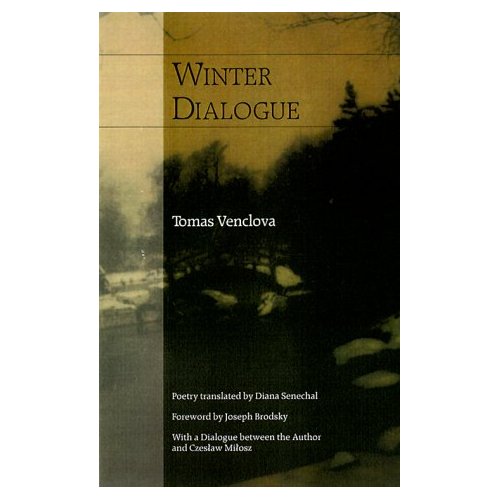
Tomas later invited her to translate his poems – an honor, certainly.  But she has some mixed feelings about the poems she eventually translated for Winter Dialogue.  She writes:

Inspired and inspiring.

“The strength and weakness of my translations was that I tried to preserve the sound, rhythm, and form of the original—or, rather, to recast the poem in comparable sound, rhythm, and form. When it worked, it worked splendidly (for instance, in Tu, Felix Austria,” “Pestel Street,” and “Autumn in Copenhagen”). When it didn’t, it came across as stilted. I don’t regret taking this approach. I do wish, in retrospect, that I had trained my ear to hear the translations in themselves. I always heard the originals behind the translations.”

As a teacher, she worries about the lack of quietness in our world, the lack of silence within us. Natalie Gerber made similar observations about her own university students in upstate New York – I quoted her a bit here.  Diana Senechal’s proposed solution?  The reading, writing and memorization of poetry.  Joseph Brodsky would certainly have endorsed her suggestion – we had to memorize hundreds of lines.

I was so enthusiastic about her recollections that I immediately downloaded MP3 version of Venclova’s album “Winter Dialogue: Chants from the Holy Land, and shall go to bed listening to the Lithuanian language.  After all,  Czesław Miłosz said it just might be the language of heaven.