
Why reality holds little love for poets

Share

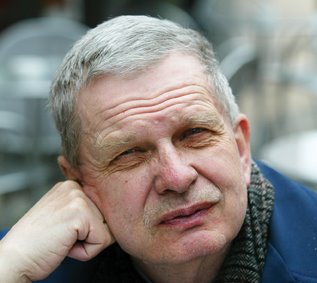
Venclova: "Above all, love language" (Photo: Dylan Vaughan)

“To travel through time, a poem must possess a unique intonation and perception.”

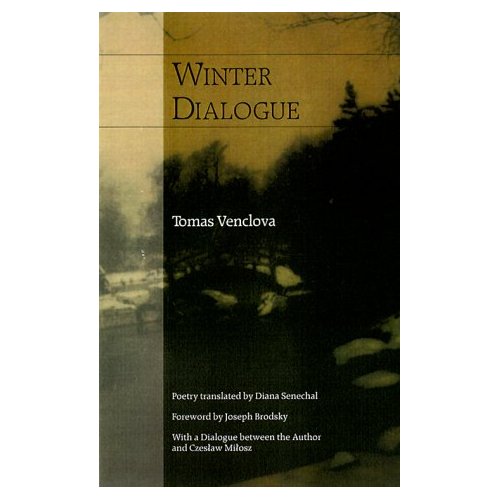
I’d never read the late great Nobel laureate Joseph Brodsky‘s essay on his friend and fellow poet Tomas Venclova (they also shared a common fate, ejected from the U.S.S.R. a few years apart), but last week I rummaged through the Stanford Libraries to find the Lithuanian poet’s Winter Dialogue so that I could find the Brodsky essay, “Poetry as a Form of Resistance to Reality,” which was included as a foreword to the volume.

It didn’t disappoint:

Venclova’s poetry fits this requirement perfectly. His intonation is striking for its restraint and low-key quality, for the conscientious, intentional monotony that seems to be trying to muffle the far too obvious drama of his existence. In Venclova’s poems the reader will not find the slightest sign of hysteria or the slightest insistence on the uniqueness of the author’s fate, an insistence that logically presumes the reader’s compassion. On the contrary, if his poems postulate anything, it is the awareness of despair as a habitual and exhausting existential norm, which is temporarily overcome not so much by an effort of will as by the simple elapse of time.

I have The Junction: Selected Poems, and look forward to comparing its choices with the total collection of Winter Dialogue.  In any case, one particular poem, which the poet himself discussed in recent correspondence, has become a particular favorite. From “Tu, Felix Austria” (translated by Diana Senechal):
Death is not here, she always looms.
The tones of the bells come closer;
she lives in granite, heat, wine,
and bread, in chestnuts entwined
with acacias. She roams
in dreams. History is part
of death. Galileo, not Hegel, was right:
eppur si muove.  A dense, charred
sphere revolves into night.

What at first seemed real is just a denial
of time. There is no revival
in sleep. Nothing and clouds extend
through the window. Death
is not here. Death is at hand.
She rides around in the cage of the room,
crosses out the next calendar date,
then looks in the mirror and meets
you face to face.

Brodsky continues in the introduction:

Venclova’s song starts at the point where the voice usually breaks, at the end of exhalation, when all inner forces are used up. In this characteristic lies the exceptional moral value of his poetry, because the ethical focus of the poem is in its lyricism rather than in any narrative element. For the lyrical quality of the poem is in effect a sort of utopia attained by the poet, and it conveys to readers their own psychological potential. In the best circumstances, this “good news” provokes a similar internal motion in readers, moves them toward creation of a world on the level suggested by this news. At the least, it liberates them from dependence on the reality they know, making them aware that this reality is not the only one. That achievement is not small, and it is for this reason that reality holds little love for poets.

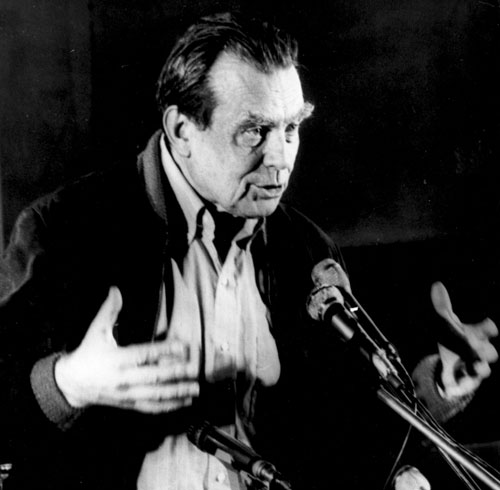
Tomas Venclova tells the story of how he was deprived of Soviet citizenship on video here.  Curiously, the story involves Algirdas Avižienis, the kindly professor from Kaunas who showed me Czesław Miłosz‘s rural birthplace.
 

“Distance is the soul of beauty.” Finally. He explains.

Share

His thought…

Nobel laureate Czesław Miłosz‘s personal secretary Agnieszka Kosińska wrote the concluding essay, “Last Poems and Ars Moriendi,”  for my book, An Invisible Rope: Portraits of Czesław Miłosz.

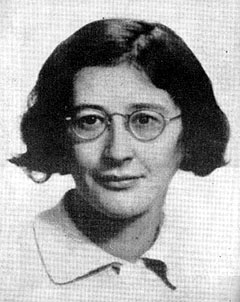
Here’s the final paragraph, translated by Artur Rosman: “For me, working with Milosz, being with him all day long, was like being locked in a submarine: it was a total submersion in Milosz’s world, coupled with incredible pressure from within and without. Now, six years after his death, I continually test myself against the saying of Simone Weil that Miłosz liked to cite, ‘Distance is the soul of beauty,’ and I try to understand what I saw and heard while working with him.”

I’ve puzzled over Weil’s thought for some time. Then, a few days ago, I found Jonas Mekas‘s There Is No Ithaka: Idylls of Semeniskiai and Reminiscences.  The Lithuanian poet’s collection has a foreword by the Lithuanian-born Miłosz – I don’t think it’s been collected in any of his volumes of essays.  So years after Agnieszka’s comment, the maestro finally offers this elucidation:

…building on hers.

“‘Distance is the soul of beauty.’ This sentence of Simone Weil expresses an old truth: only through a distance, in space or in time, does reality undergo purification. Our immediate concerns which were blinding us to the grace of ordinary things disappear and a look backward reveals them in their every minutest detail. Distance engendered by the passing of time is at the core of the oeuvre of Marcel Proust. Distance in space and awareness that borders with their barbed wire separated him from his country allowed a young Lithuanian to write his Idylls.”

Mekas turns 90 in December, and is better known as an avant-garde filmmaker than as a poet.  “You have the possibility to give light a dimension in time,” he said. Poetry does the same, of course.

Gore Vidal’s “piety”

Share

"a one-man great society"

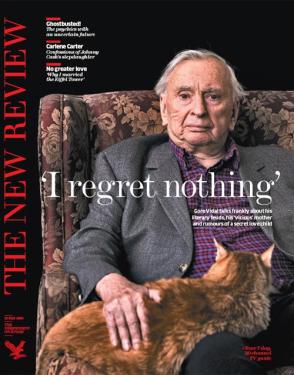
That’s it.  I’m in love with Gore.

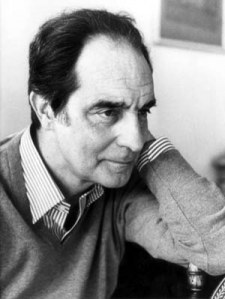
No, no, not that Gore.  Gore Vidal. I know, it’s sudden…  I was watching the interview I posted a few days ago.  It uncovered a Vidal I didn’t know existed.  He is moved almost to tears recalling Italo Calvino‘s death.  He, the disdainful mandarin, notorious for his literary fights and insults, humbly drops to one knee before someone he considers his better.  Didn’t know he had it in him:

“I have studied the landscape of literature all my life, and he was the only great writer of my time.”

“Let’s use a word that is often misused – universal.  Where Calvino was, there was literature. Like it or not.”  “He was it. He was the real thing.”

We don’t live in a great time for writers or writing, he said, “but Calvino was a one-man great society.”

“Calvino was there, everyone who knew about him admired him, read him, wrote about him.”

The interviewer, Riz Khan, asks Vidal what passed through his mind at Calvino’s funeral.  The author’s eyes seemed to mist up, as he answered: “When will there be another?  With Italo, I thought literature had died.”

“It was as if a great prince had died. The whole nation went into mourning,” he said in slow, emphatic syllables. “What American or Brit or Frenchman would have that audience in his own country today?”

Vidal was not, apparently, a great fan of the literature of Eastern Europe.  Otherwise, he would have recalled one funeral in 2004 where thousands lined the streets of Kraków.

Czesław Miłosz came to my mind for another reason.  I remembered speaking to the Polish poet about his friend and fellow laureate, Joseph Brodsky, and his description of what Miłosz called the Russian poet’s “piety.”  From my Georgia Review interview a dozen years ago:

There was at a given moment a stable world where we could see, hold on to values that were a reflection of the eternal order of things. Now we are in a flux. This is a very peculiar way of life. … When everything is in flux, revision, it is healthy to have some poets who preserve the feeling of respect.

For me, the value of Brodsky was his sobering effect, and his enormous feeling of hierarchy. He had a great feeling of hierarchy of value in works of art and works of literature.

Brodsky was very sensitive to the sacredness of being. Yes. That’s why I call him pious. I didn’t ask him if he believes in God – you felt in him that openness to the sacred.

“Piety.”  It’s an impressive quality.  And I thought of that as I listened to Vidal speak.  The sense of  “hierarchy of value in works of art and works of literature.”

Khan asked Vidal what impressed him most about Calvino’s character.  Vidal, one short year before his demise, gazed straight ahead as if staring down death: “Truth.”

Watch the video for yourself, here.


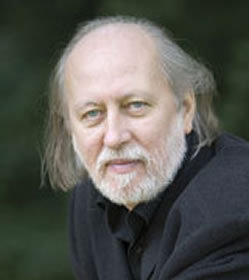
László Krasznahorkai: “So-called high literature”? Finito.

Share


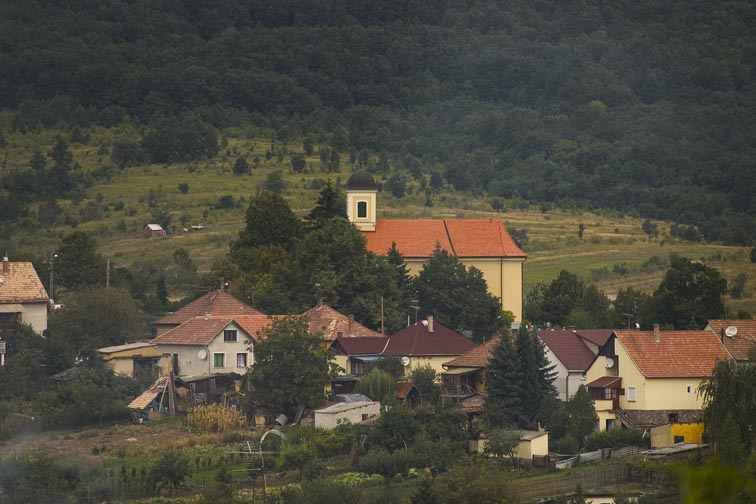
Hungarian writers tend to be a lonely lot – the fruit of their labor is stranded out on the most inaccessible branch of the broad language tree.  Who speaks Hungarian, except those born to it?  Its closest antecedents are Turkish and Finnish, and they aren’t all that close.  Wisely,  László Krasznahorkai divides his time between New York and Berlin, as well as the cosy little village of  Pilisszentlászló,  about half an hour out of Budapest.  That, in addition to the skyrocketing  reputation of his work, has put him in the world’s literary epicenter.

More thoughts on "this rotten world we live in."

After all, Susan Sontag said he is “the contemporary Hungarian master of apocalypse who inspires comparison with Gogol and Melville. W. G. Sebald said, “The universality of Krasznahorkai’s vision rivals that of Gogol’s Dead Souls and far surpasses all the lesser concerns of contemporary writing.”

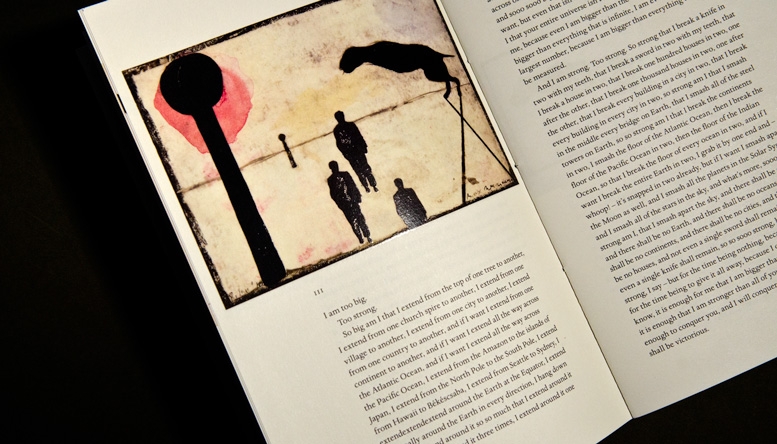
To my discredit, then, I discovered Krasznahorkai only this year when, in Paris, Daniel Medin shoved a Cahier into my hand.  The short, 39-page work,  Animalinside, was undertaken for the Cahiers Series as part of a collaboration with German painter Max Neumann (we’ve written about the Cahiers series here). For reasons to tedious to get into, the book wound up in a stack of backlogged reading, and I’d only got round to reading it after the interview in the current Quarterly Conversation.

The interview is republished from The Hungarian Review – a publication I regard with gratitude, as its editors allowed me to republish Czesław Miłoszs poem “Antigone,” translated by George Gömöri and Richard Berengarten – the poem, in English, exist only in the journal and An Invisible Rope: Portraits of Czesław Miłosz. It’s not the only reason I read the Q&A with interest, however; it’s lively stuff.

A few excerpts:

Ágnes Dömötör: Many people have the impression that your books are hard to read and to understand. That’s a myth, but don’t you think you’ve got some bad PR?

László Krasznahorkai: You know, the problem is that anything that’s the least bit serious gets bad PR. Kafka got bad PR, and so does the Bible. The Old Testament is a pretty hard text to read; anyone who finds my writing difficult must have trouble with the Bible, too. Our consumer culture aims at putting your mind to sleep, and you’re not even aware of it. It costs a lot of money to keep this singular procedure going, and there’s an insane global operation in place for that very purpose. This state of lost awareness creates the illusion of stability in a constantly changing world, suggesting at least a hypothetical security that doesn’t exist. I see the role of the tabloid press somewhat differently. I can’t just shrug it off and say to hell with it. The tabloid press is there for a serious reason, and that reason is both tragic and delicate.

AD: Suppose someone who has never read anything by you picks up this interview and says: what an interesting guy, which one of your books would you recommend to them? What would be a point of entry to your life’s work?

LK: The Old Testament. The Book of Revelation. Let them choose from my books at random.

AD: How do you relate to your fellow Hungarian writers? Do you ever e-mail one another? Would you tell György Spiró, for instance,‟I liked your last book, Gyuri?” I’m asking because in an earlier interview you seemed to see yourself as an outsider on the literary scene.

Pilisszentlászló ... half an hour away from Budapest

LK: I don’t just see myself as an outsider, I am one. Which doesn’t mean I’m not happy to see colleagues I admire; after all, we share the same fate. But I also worry about them. I worry, for instance, because they’re in literature, something that you can still sell for awhile, but it’s getting harder and harder. This kind of communication is really over and done with. Its disappearance is a rather obvious process; it is happening faster at some points of the world than at others. I’m afraid this kind of literature is not sustainable.

AD: You mean it’s not just the authority of literature that’s finished but literature as such?

LK: The so-called high literature will disappear. I don’t trust such partial hopes that there will always be islands where literature will be important and survive. I would love to be able to say such pathos-filled things, but I don’t think they’re true.

On our tabloids: “The structure of vulgarity is very complex.”  He also talks about apocalypse, and “this rotten world we live in.”  And rock bands?  You can read about his favorite ones, along with the rest of the interview, here.

What does he think about bloggers, such as Humble Moi?  “Recently one blogger suggested that I should be hanged. I immediately put on my space suit, started the engine and went to the moon for a while.”  That puts me in my place.

Meanwhile, here’s what Irish novelist Colm Tóibín said about Animalinside:

Language for Krasznahorkai is a force struggling against the domination of cliché and easy consumption, offering small, well-organized revolts, plotting in upstairs rooms for plenitude and jagged rhythm, arming itself with clauses, sub-clauses and asides, preparing high-voltage assaults on the reader’s nervous system. … The world of his fiction is enclosed and stable, it must be taken on its own terms. … His work is full of menace, but it would be a mistake to read the menace either as political or as coming from nowhere. …


Miłosz at the Faculty Club

Share

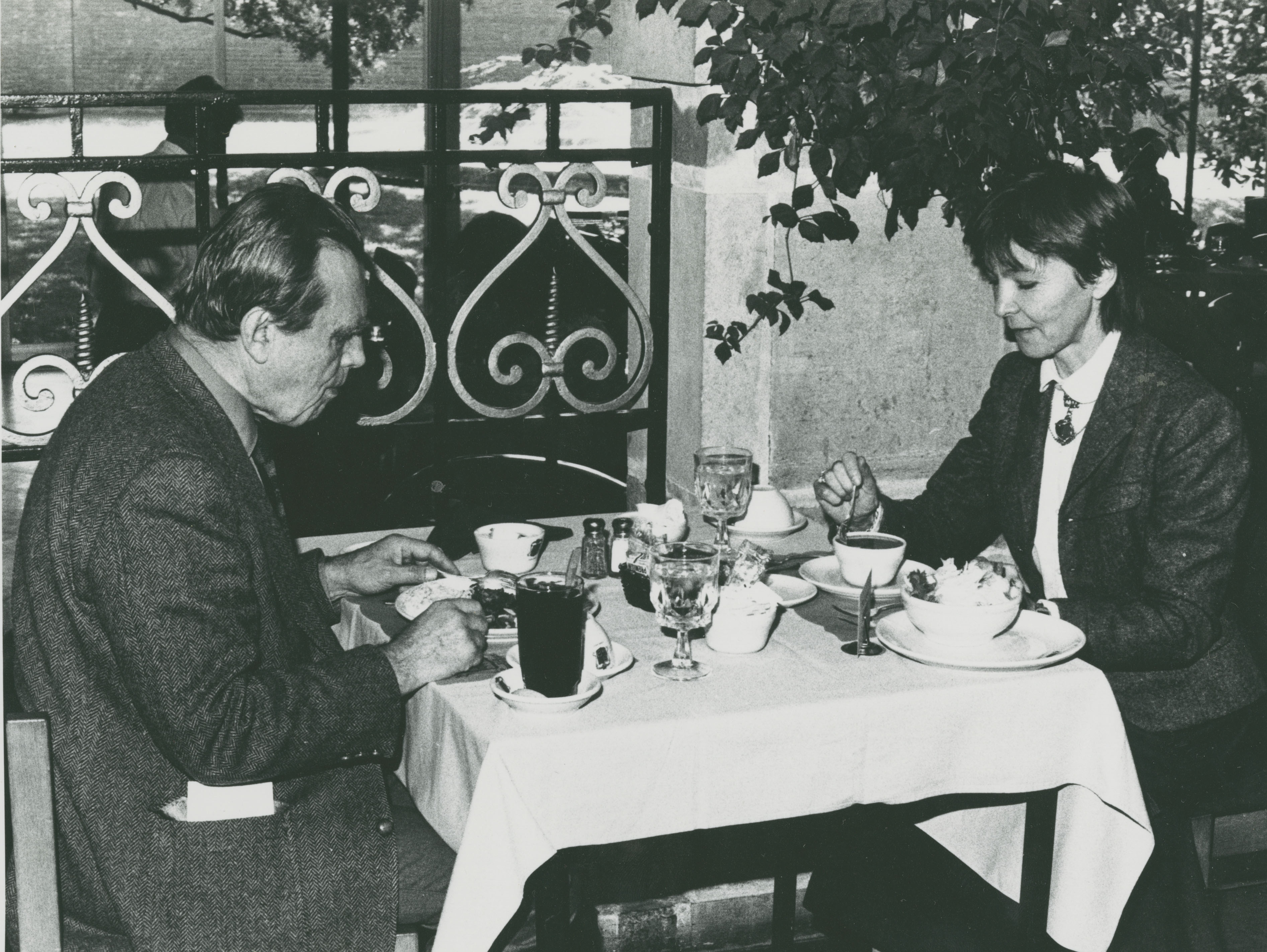
My friend Mike Ross immediately thought of me when he read today’s post from “The Rice History Corner” blog at his alma mater, Rice University in Houston.  (I’m flattered.)  It features a Czesław Miłosz having lunch at the university’s faculty club with Prof. Ewa Thompson.  The Nobel poet recorded a program for KUHT-TV with Thompson and other Houston writers and scholars, and also gave a talk at the University of Houston.

Zagajewski provided another Houston link

The column is written by the university’s “centennial historian,” who doesn’t give her name.  She has good taste, though:  Patrick Kurp‘s blog Anecdotal Evidence is at the top of her blogroll.  Moreover, she delights in such poets as Zbigniew Herbert and Adam Zagajewski, as well as Miłosz.

The connection between Miłosz and Houston rang a bell in other ways.  Adam Zagajewski arrived on the campus of the University of Houston in 1988, and later launched a program connecting the students in Texas with Miłosz in Kraków.  So the link between Miłosz and Houston is stronger than might be supposed.

Meanwhile, in my perambulations around the web, I found Christopher Hitchens‘s “The Captive Mind Now,” words written on Miłosz’s death in 2004, in which he revisits the landmark Captive Mind and “ketman,” and somehow brings Azar Nafisi‘s Reading Lolita in Tehran into the mix, with its dedication from the Polish poet’s “Annalena”:

To whom do we tell what happened on the
Earth, for whom do we place everywhere huge
Mirrors in the hope that they will be filled up
And will stay so?

“The Hitch” concludes:  “The long-term achievement of Milosz was to have scrutinized, not just in between but clean through, and well beyond, the party ‘lines’ that claim for themselves exclusive truth. In doing so he shamed the so-called intellectuals who managed the ugly trick of denying freedom to their own minds, the better to visit the same deprivation upon others.”


The man who volunteered for Auschwitz: the greatest story never told

Share

Some time ago, I discovered the peculiar connection between Czesław Miłosz and the Franciscan priest, Father Maximilian Kolbe – I wrote about it for the Poetry Foundation here.

Kolbe had the distinction of being the only person who ever volunteered to die at Auschwitz.  This claim is not generally made for him, but my sources were good.  I visited a researcher at Auschwitz,  Piotr Lipiński, and he explained that the death camp wasn’t the sort of place that fostered altruism.  More convincingly, he explained that the Communist authorities who assumed power after the war were very eager to find someone else – someone besides a priest, that is – who had made such a terrible deal.

The Communist government was anxious to bury the stories of Polish wartime heroes – it’s one reason, for example, the name of Irena Sendler, the woman who saved 2,500 children from the Warsaw ghetto, did not become known until after 1989.  (I’ve written about her, oh, here and here and here and here and here and here.)  Or the name of Jan Karski, who received a Presidential Medal of Freedom last month.

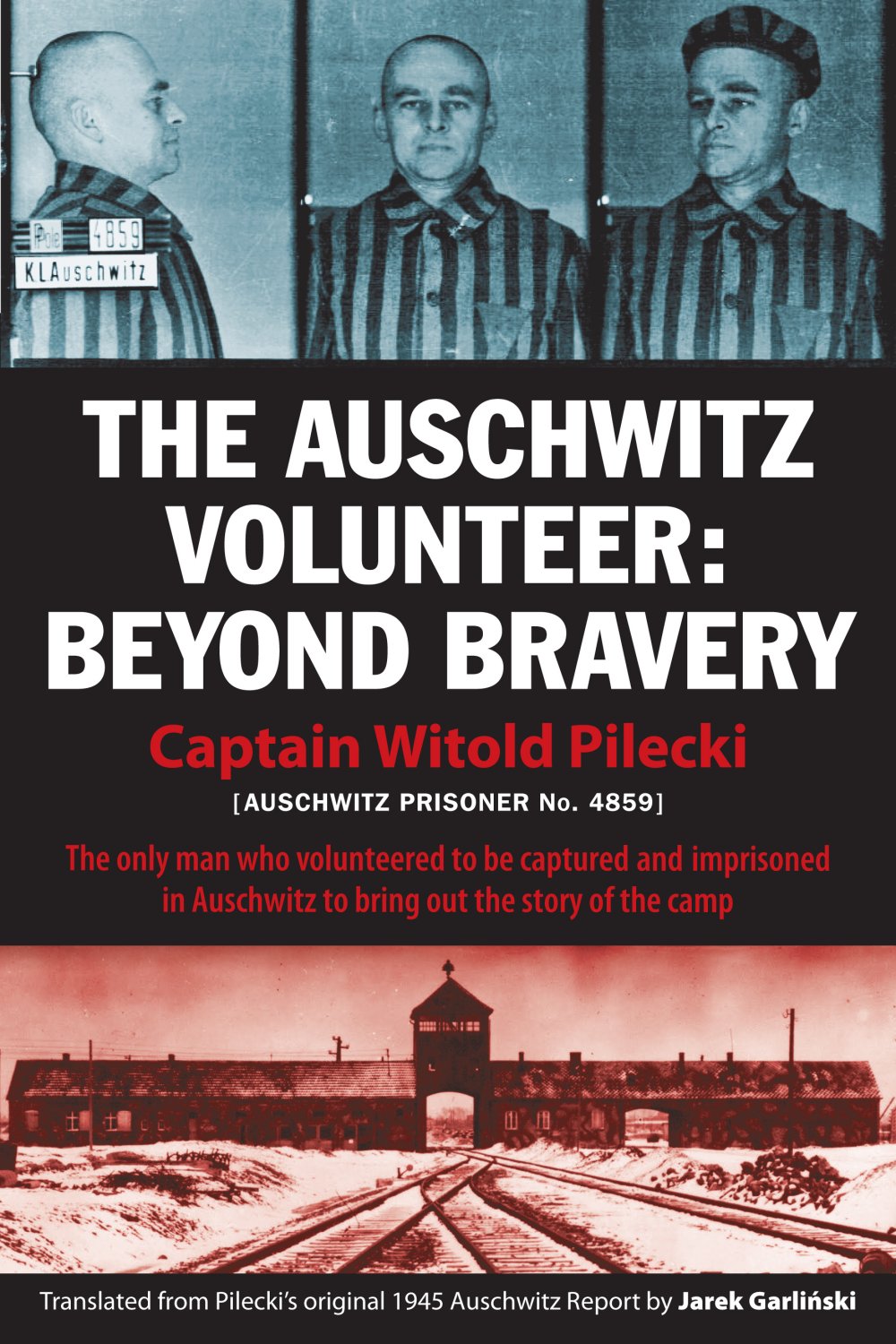
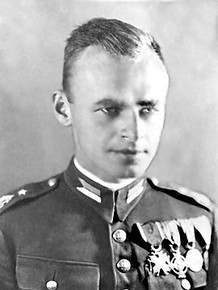
So here’s another one to add to the list: Captain Witold Pilecki, who had the distinction of being the only known person to smuggle into Auschwitz, so he could report back to the Allies about the conditions there.  They didn’t listen.  They thought he was exaggerating.

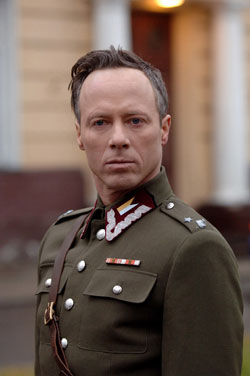
Probosz as Pilecki

Since 1989, Poles, too, have been learning about him, thanks to a 2006 movie, The Death of Witold Pilecki, with Marek Probosz portraying the hero.  The movie, with English subtitles, hasn’t had wide circulation.  Your better chance might be a new book:  The Auschwitz Volunteer: Beyond Bravery.  It’s been published by Aquila Polonica in Los Angeles.  That means it’s probably not going to get much mainstream publicity.  (NPR did a 2010 broadcast about him – it’s here.)  This heavily illustrated, 400-page book is the first translation into English of his report.

Auschwitz, of course, was not originally a camp for Jews, but rather P.O.W.s.  Pilecki, who was one of 150,000 Polish prisoners,  was at Auschwitz from September 1940 to April 1943, and would have seen its transition before he escaped.  Rabbi Michael Schudrich, the chief rabbi of Poland, wrote the foreword to the book:  “When God created the human being, God had in mind that we should all be like Captain Witold Pilecki, of blessed memory. May the life of Witold Pilecki inspire us all to do one more good deed, of any kind, each and every day of our lives.”

Norman Davies writes in the introduction:

Also a husband and father of two

“I myself became fully aware of the greatness of Witold Pilecki while conducting research on the Warsaw Rising of 1944.  Here was a man, who almost single-handedly had held up the German panzers on one of Warsaw’s main thoroughfares for a fortnight; using the pseudonym ‘Roman’, he then disappeared into his dugout and continued the struggle until the Rising capitulated over two months later. Only then did I realise that this was the same heroic character, who four years earlier had deliberately arranged to be arrested by the SS and be transported to Auschwitz.  In 1943, having engineered his escape, he wrote the first version of his Report on Auschwitz, which I had read and which had been the first of several attempts to inform the outside world of what was really happening. Pilecki was a Polish officer and Catholic who viewed his fight against his country’s oppression as synonymous with his patriotic and religious duty. If there was an Allied hero who deserved to be remembered and celebrated, this was a person with few peers.”

Like so many others (including Sendler) he was tortured by the Communist authorities. Pilecki was executed at their hands in 1948.  Compared with the Communists, “Auschwitz was easy,” he said after his sentence was pronounced.  His body has never been recovered.