
“Bah Humbug!” Was Ebenezer Scrooge neurodivergent? Maybe…

Featured

Share

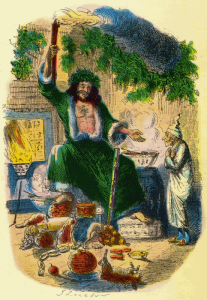
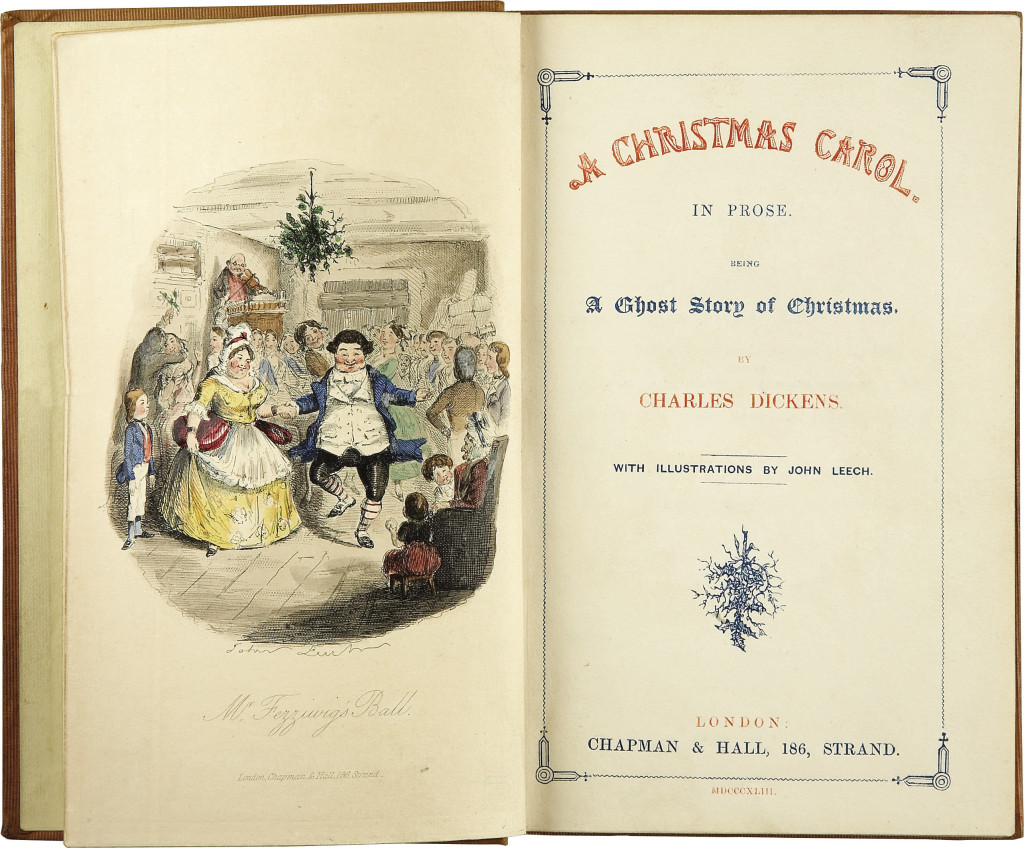
Ebenezer Scrooge is a nasty misanthropic miser, unworthy of our sympathy. He’s cruel to everyone around him, right? Not so fast. One Notre Dame professor is turning the tables on who may be the victim in Charles Dickens‘s A Christmas Carol. “Is Scrooge experiencing his behavioral traits negatively, or is he experiencing the effects of the social stigma of these traits?” asks Essaka Joshua, associate professor of English at the University of Notre Dame.
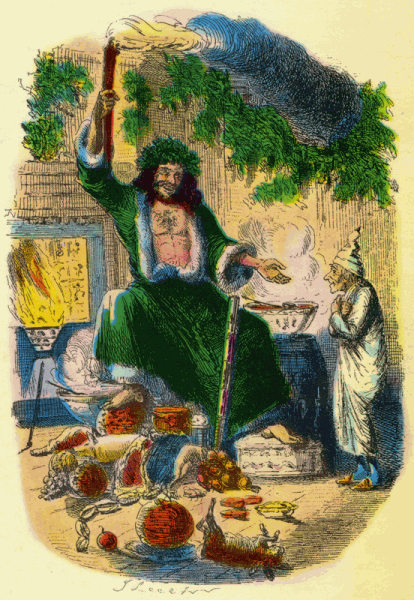
But was this encounter *consensual*?

From Notre Dame’s Medical Xpress:

In a new analysis of Scrooge … Joshua offers an unexpected perspective, by asking a simple question: What if we were wrong about Scrooge? What if it is, in fact, the characters who surround him who may need more empathy for their fellow man—particularly if that man is neurodivergent?

Joshua, whose research and teaching focus on disability studies, is now researching how the reading of A Christmas Carol changes if Scrooge is seen in this way. 

“It does not matter what condition Scrooge may or may not have. These diagnoses change over time,” she said. “But what happens if we think of Scrooge’s lack of sympathy and other traits as a legitimate part of his personality? Does Scrooge cause harm to himself or others? And is his ‘cure’ consensual or desired?”

Scrooge’s personality is characterized by his lack of compassion, his solitariness, his reluctance to spend money and his frustration with the expectation that he should conform to societal behavioral norms. Examining which of those behaviors actually need correcting helps the reader understand how Dickens presents normative personality types and how non-normative behavior is stigmatized, Joshua said.

“In places, the text is quite explicitly nasty about his negative behavior, but in other places, there is more ambiguity,” she said. “He eats the same melancholy meal each day at the same melancholy tavern—and we have to join the dots on that one and say ‘because he’s mean.’ But it may well be that we shouldn’t infer that at all, and we should just say ‘because he has to, because that’s his routine and that’s what he needs.’  … In fact, Joshua argues, many of Scrooge’s behaviors can be seen as cognitive and behavioral coping strategies commonly used by neurodivergent individuals to reduce anxiety, by avoiding social interactions, sticking to routines and using verification rituals to calm himself.

Read the whole thing here. And Merry Christmas, Uncle Ebenezer! There’s a little bit of him in us all!
Another reason to visit NYPL: See where Charles Dickens wrote

Featured

Share

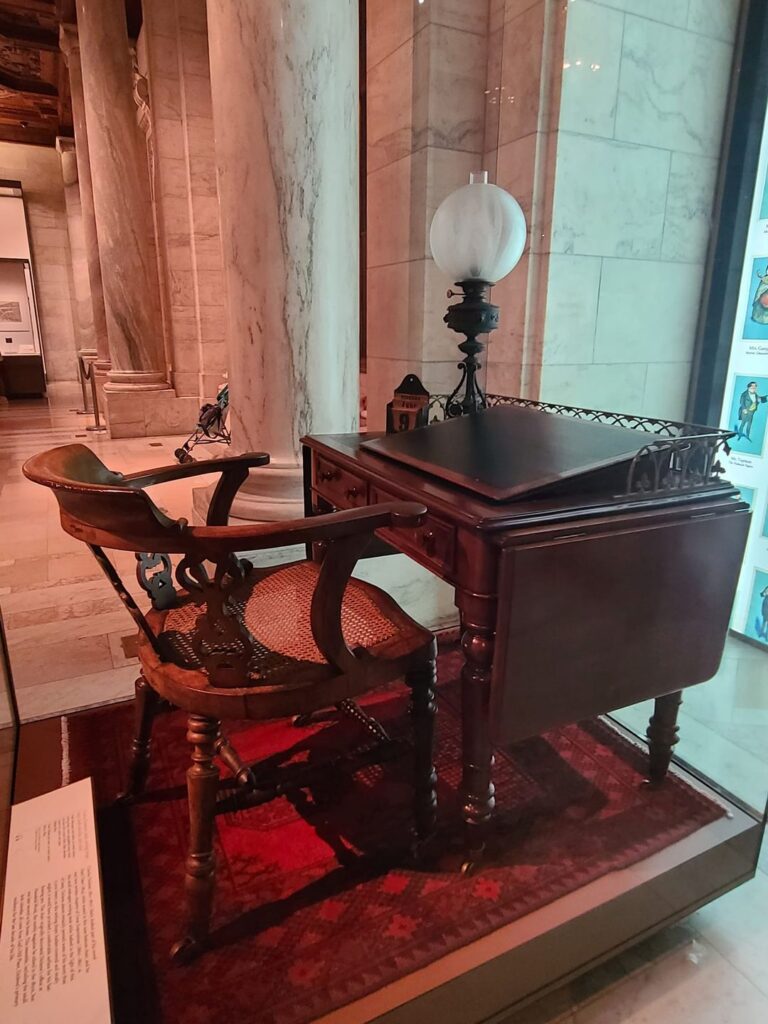
Reason #1 to visit the New York Public Library: Charles Dickens‘ writing desk, chair, and lamp from his home at Gad’s Hill Place. At this desk, this author wrote Hard Times and sections of Great Expectations, and much of his correspondence, too. “As a fan of Dickens, this took my breath away,” says Prof. Martha Reineke of the University of Northern Iowa, who took the photo. There will be a few more reasons to visit NYPL in future posts.

A Christmas lost-and-found story – courtesy a book-loving Victorian girl named Minnie Percy

Share

The story of a gift that’s lost and then found seems to be a Christmas theme, and so we present this little Victorian Christmas story, from Bay Area high school English teacher Chris Bunje Lowenstein. Careful Book Haven readers will remember that Chris is a Dante-lover (we wrote about her Dante pack of cards at an antiquarian book fair a few years back here).

A Dante-lover, too.

From Chris:

At this year’s seasonal Great Dickens Christmas Fair in San Francisco, I came across the quintessential “olde book shoppe,” which specializes in – of course – the works of Charles Dickens. The wooden bookcases in the shop bowed under the weight of a few thousand other beautiful books with decorative bindings, most of which were published from about 1880 to 1914. It takes the owner three days to create this replica of a 19th-century bookshop.

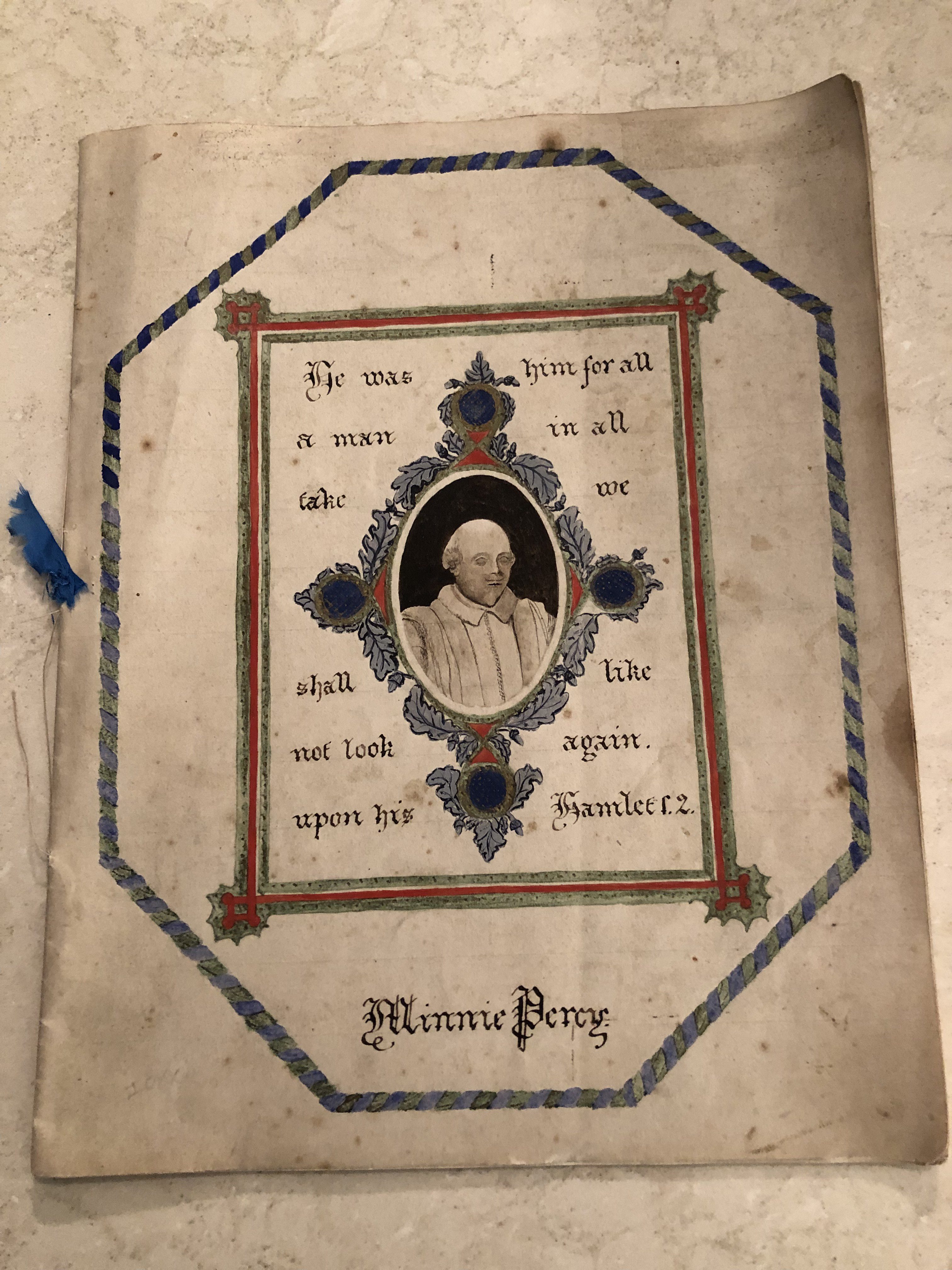
I spent a full hour in the shop, and, having decided to take some bits of history home with me, I purchased seven 19th-century books with beautiful decorative bindings. As I made my purchase, my eye happened to fall on a small group of papers, propped on a shelf and bound by thread and a fraying blue ribbon. The paper that formed the “cover” of this little booklet had a highly decorated, hand-colored drawing of Shakespeare. Underneath the drawing, in Gothic lettering, was the name “Minnie Percy”. I have no idea who Minnie Percy was or why she’d created this booklet, but I fell in love with the colorful cover and the fact that every word inside was handwritten. Here in this manuscript was a bit of Victorian history kept alive. I imagined the pleasant hours I would spend researching the piece, admiring it, and sharing it with my high school students and book collector friends. Impulsively, I purchased the little manuscript, but it didn’t fit in the bag with the seven other books I’d bought. To protect it, the owner of the shop placed the manuscript in between two pieces of cardboard, and, parcels and purse in hand, I wandered around the fair for two more hours before returning home only to notice …

I had lost it! Somehow, the manuscript had slid out of its protective cardboard and fallen to the ground unnoticed. I was ashamed at my own carelessness. I had allowed myself to be so caught up in the re-creation of history that is the Dickens Fair that I dropped and lost an actual piece of history, a piece of history whose caretaker I had implicitly agreed to become once I purchased it.

That evening, I emailed the fair’s producers, describing the manuscript and the vendor from whom I purchased it and asking them to please contact me on the chance that someone found it and turned it in. I heard nothing. The next day, on a break after one of my English classes, I checked my email. Nothing. And again after school. Nothing. After several days, I began to despair. Perhaps the manuscript had been swept up like the other trash at the end of the day and discarded. Or – best case scenario – perhaps someone saw the manuscript on the ground, recognized its beauty, and took it home. While I would have preferred to keep the manuscript for myself, I was at least consoled by this version of events, because in this version the manuscript would not be lost to history; it would live on in the care of someone else. By the end of the week, I had abandoned all hope. I would never know what became of that beautiful, one-of-a-kind, little gem.

Late Friday, the day after Thanksgiving, my phone rang. The caller identified himself as the owner of the bookshop at the Great Dickens Christmas Fair. “Someone turned in to the ticket office the manuscript you bought from me last weekend. The office had received the email with your contact information, so they brought the manuscript back to me and asked me to get in touch with you.”

I was so overjoyed that I swore I could hear Ebenezer Scrooge suggesting that I be boiled in my own pudding and buried with a stake of holly through my heart. A few hours later, I gave my name to the man working the will-call ticket booth, explaining why I was there. “Ah, madam” he said in his best Dickensian British accent, “we’ve been waiting for you. I have a parcel with your name on it. Just a moment.”

I thanked him and clutched the manuscript tightly, silently giving thanks to the kind soul – unknown to me – who also recognized that this manuscript was not a piece of trash but a treasure and who rescued it and, realizing that it belonged to someone else, turned it in. More than just a manuscript was returned to me on Saturday; my faith in humanity was also restored. God bless us, every one.

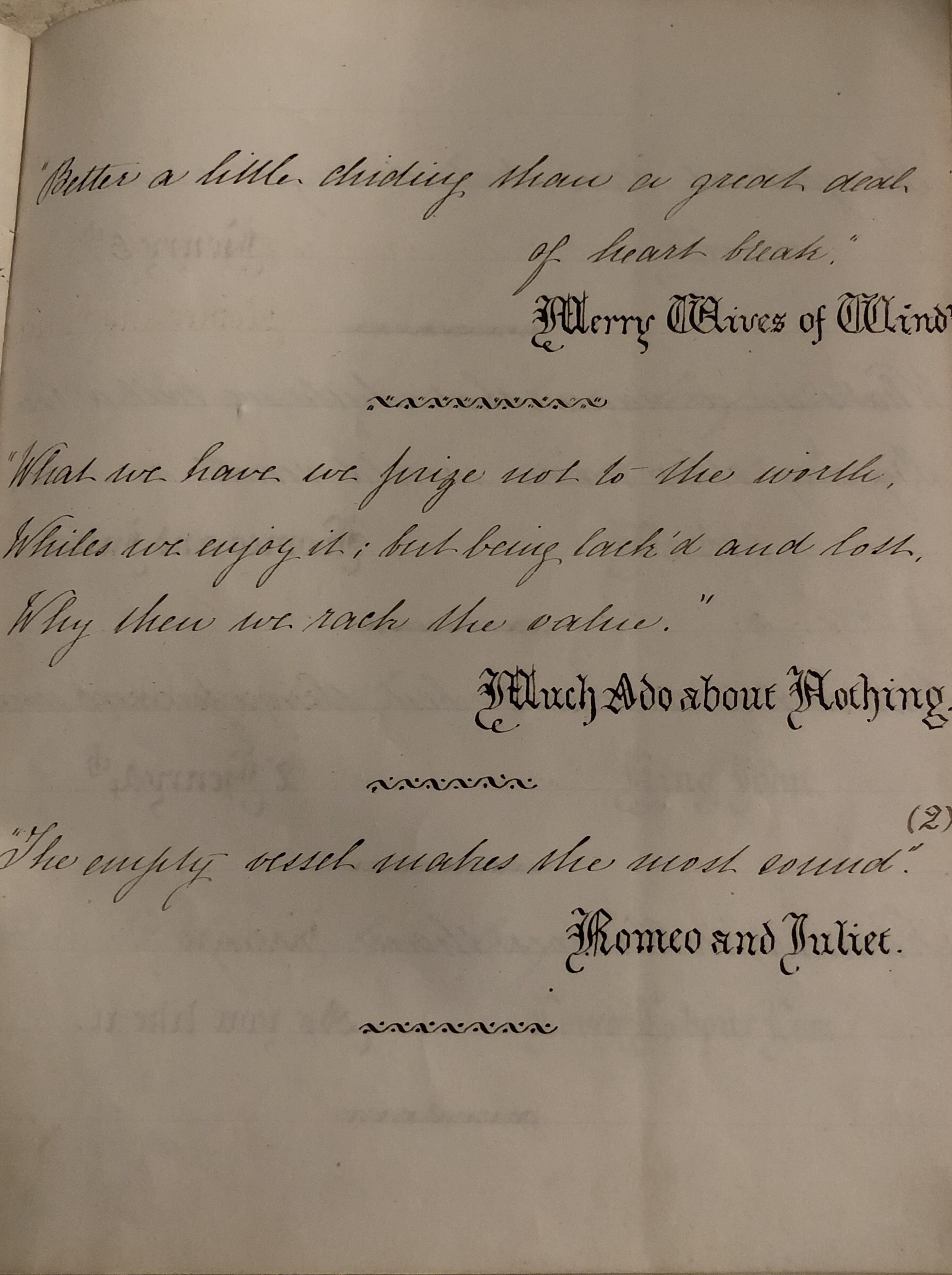
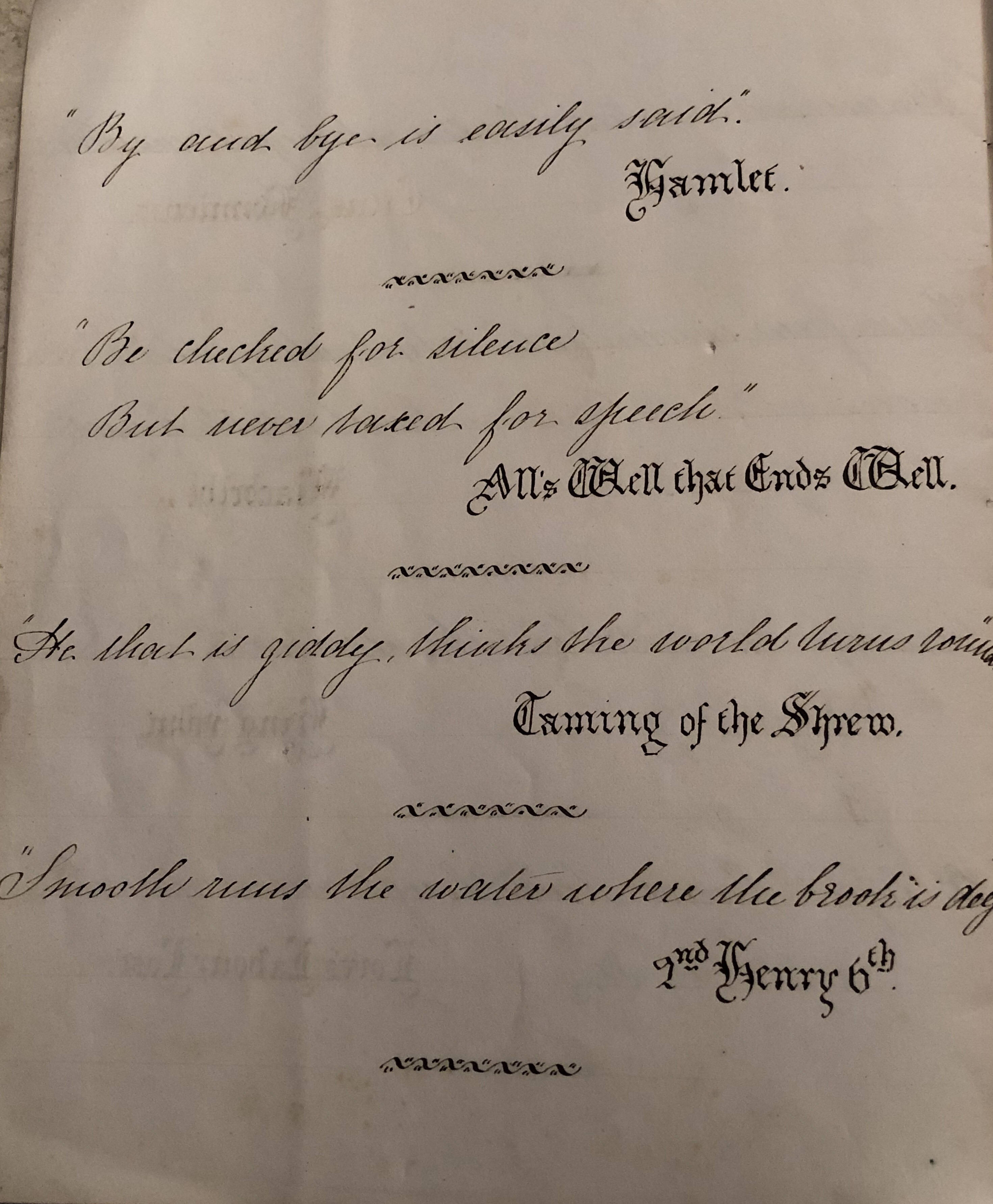
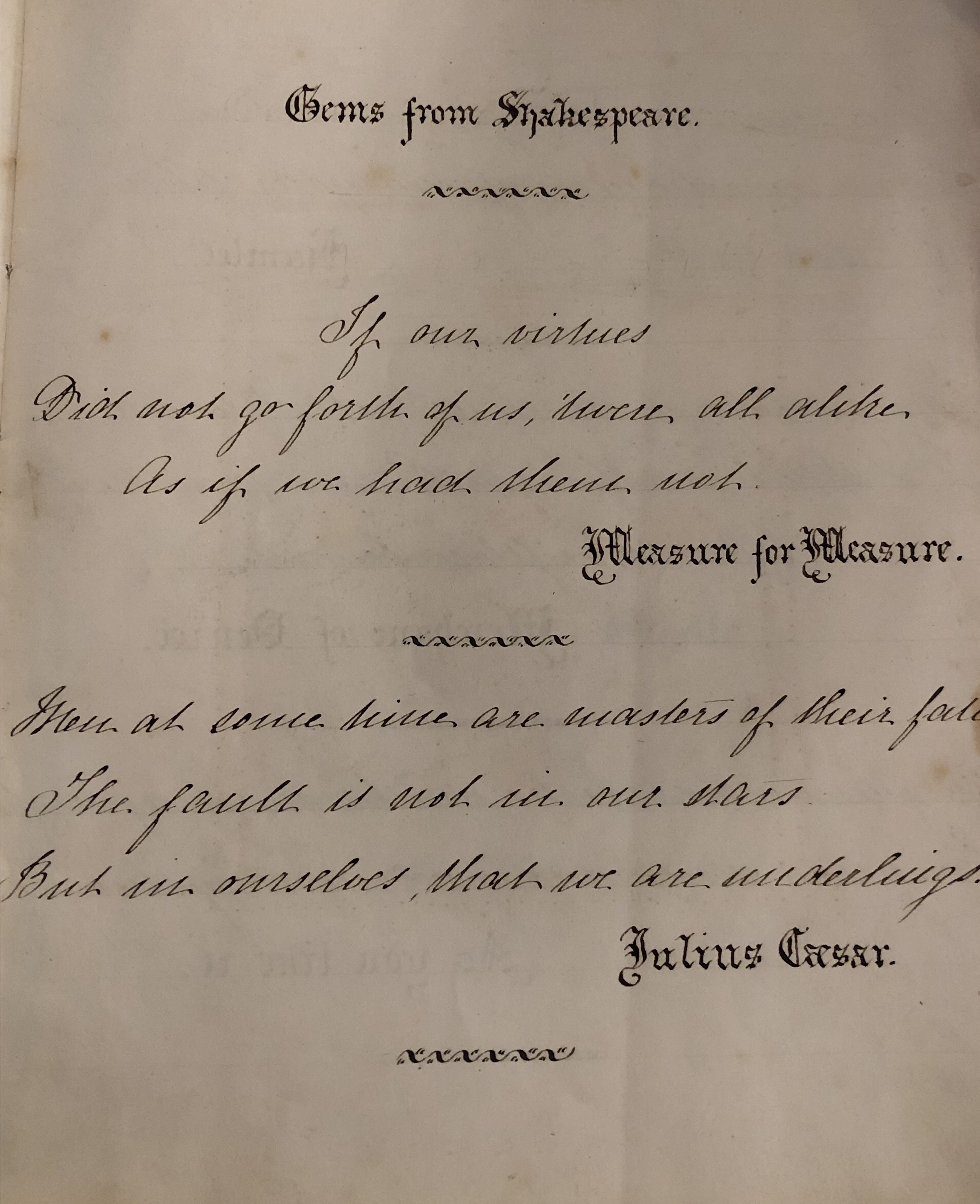
When I got home and finally had the chance to examine the manuscript booklet more closely, I saw that Minnie Percy had created a commonplace book she had titled “Gems from Shakespeare”. Inside the book were famous quotes from many of Shakespeare’s plays. The titles of the plays were written in large Gothic letters, and the bright blue ribbon that bound the book was also used for a bookmark. Written in Minnie Percy’s beautiful Spencerian script on the page the ribbon marks is the following quote from As You Like It:

And this our life, exempt from public haunt,
Finds tongues in trees, books in running brooks,
Sermons in stones, and good in everything.
I would not change it.

Want to communicate with the dead? A dead man tells us how. (Plus some kind words for the Book Haven!)

Share

Words of praise for the Book Haven from Rhys Tranter over at his lively and excellent website:

One of the finest literary blogs around is Cynthia Haven‘s The Book Haven, hosted by Stanford University. The site covers a rich variety of topics in a lively and accessible way, and includes reviews and interviews alongside thought-provoking essays. In addition, Haven is alert to the political and cultural turmoil that continues to shape contemporary American consciousness. In a recent post, she draws on the words of American writer James Baldwin to examine how literature can lead to greater empathy and understanding between people and communities:

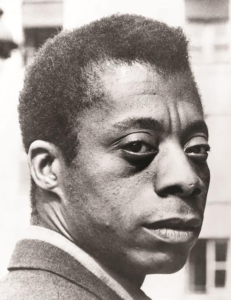
Preach it. (Photo: The Granger Collection)

There’s a direct line between our moral and social crises and the collapse of the humanities. […] Here’s one reason: literature is our chance to explore the world of  the “other,” to enter into some head other than our own. You can’t read The Brothers Karamazov without being able to understand multiple ways of living and thinking in the world, and some quite alien to one’s own p.o.v. That’s precisely what’s lacking in today’s public life, and that’s the understanding that should have been grounded in our educational system.

Then he included the words of James Baldwin I had cited: “You think your pain and your heartbreak are unprecedented in the history of the world, but then you read. It was Dostoevsky and Dickens who taught me that the things that tormented me most were the very things that connected me with all the people who were alive, or who ever had been alive. Only if we face these open wounds in ourselves can we understand them in other people.”

There’s so much to be said beyond Baldwin’s insightful words, however. We’ve said it before here and here, for example. Here’s a passage from James Marcus‘s interview with the late Susan Sontag on the subject:

“Education of the heart”

“Reading should be an education of the heart,” she says, correcting and amplifying her initial statement. “Of course a novel can still have plenty of ideas. We need to discard that romantic cliché about the head versus the heart, which is an absurdity. In real life, intellect and passion are never separated that way, so why shouldn’t you be moved by a book? Why shouldn’t you cry, and be haunted by the characters? Literature is what keeps us from shriveling into something completely superficial. And it takes us out of ourselves, too.”

“Perhaps some people don’t want to be taken out of themselves,” I suggest.

“Well, reading must seem to some people like an escape,” she allows. “But I really do think it’s necessary if you want to have a full life. It keeps you–well, I don’t want to say honest, but something that’s almost the equivalent. It reminds you of standards: standards of elegance, of feeling, of seriousness, of sarcasm, or whatever. It reminds you that there is more than you, better than you.”

“a form of moral insurance”

Joseph Brodsky went even further in his Nobel lecture (here), famously saying, “There is no doubt in my mind that, had we been choosing our leaders on the basis of their reading experience and not their political programs, there would be much less grief on earth. It seems to me that a potential master of our fates should be asked, first of all, not about how he imagines the course of his foreign policy, but about his attitude toward StendhalDickensDostoevsky. … As a form of moral insurance, at least, literature is much more dependable than a system of beliefs or a philosophical doctrine.”

It also prevents us Gary Saul Morson what I call the “Downton Abbey Syndrome”: “the more that authors and characters shared our beliefs, the more enlightened they were. This is simply a form of ahistorical flattery; it makes us the wisest people who ever lived, much more advanced than that Shakespeare guy. Of course, numerous critical schools that judge literary works are more sophisticated than that class on Huckleberry Finn, but they all still presume the correctness of their own views and then measure others against them. That stance makes it impossible to do anything but verify what one already believes. Why not instead imagine what valid criticisms these authors would advance if they could see us?”

“converse with the dead, the absent, the unborn”

According to Abraham Lincoln:  “Writing – the art of communicating thoughts to the mind, through the eye – is the great invention of the world. Great in the astonishing range of analysis and combination which necessarily underlies the most crude and general conception of it – great, very great in enabling us to converse with the dead, the absent, and the unborn, at all distances of time and of space; and great, not only in its direct benefits, but greatest help, to all other inventions.”

Protection against propaganda returns us to Rhys Tranter again, in his post this week:, which has takes on the more ominous side of a society that no longer cultivates emotional standards and discrimination, this time in the words of Thomas Merton: “[In] an evolved society there are no innocent victims of propaganda. Propaganda succeeds because men want it to succeed. It works on minds because those minds want to be worked on. Its conclusions bring apparent light and satisfaction because that is the kind of satisfaction that people are longing for. It leads them to actions for which they are already half prepared: all they ask is that these actions be justified. If war propaganda succeeds it is because people want war, and only need a few good reasons to justify their own desire.”

There’s more than one way to get rich.

Share

christmas-carol

Charles Dickens may not have made a fortune on the publication of A Christmas Carol, but he did leave the world a little richer. We can’t help but believe that he made himself a little richer, too.

dickensAside from boosting people’s awareness of the plight of the poor in Victorian England, though, Dickens also had a more immediate need: cash. He’d spent too much on his 1842 American tour, Golden writes, and he needed to support his large family. “Thinking creatively, he wrote himself out of his dilemma,” she reports.

The already well-known writer’s solution worked, to a degree. He sold out the first print run in a week, all 6,000 copies of it. By the end of the next year, writes Brandon Ambrosino for Vox, the book had sold more than 15,000 copies. But due to the book’s lavish bindings and the relatively low price he chose to sell it for, writes Michael Varese for The Guardian, much of that money didn’t make it back to the author, who was hoping to make at least £1000 from the book.  “What a wonderful thing it is that such a great success should occasion me such intolerable anxiety and disappointment!” he wrote.

Read the whole thing (with lots of links) over at The Smithsonian here.

One can be rich in poems, too. After our post a few days ago for Edwin Arlington Robinson‘s birthday with his Christmas sonnet, we got a message from poet R.S. Gwynn suggesting that “Karma” was in fact Robinson’s best Christmas poem. So we include it below:

robinsonChristmas was in the air and all was well
With him, but for a few confusing flaws
In divers of God’s images. Because
A friend of his would neither buy nor sell,
Was he to answer for the axe that fell?
He pondered; and the reason for it was,
Partly, a slowly freezing Santa Claus
Upon the corner, with his beard and bell.

Acknowledging an improvident surprise,
He magnified a fancy that he wished
The friend whom he had wrecked were here again.
Not sure of that, he found a compromise;
And from the fulness of his heart he fished
A dime for Jesus who had died for men.


Putting the “bel” in “bel canto”: last call for a stunning “Lucia di Lammermoor” at Opera San José!

Share

lucia

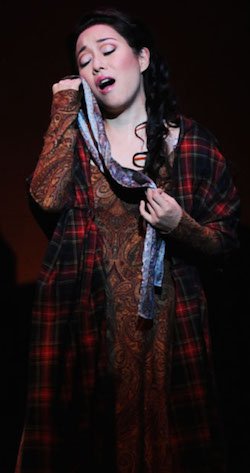
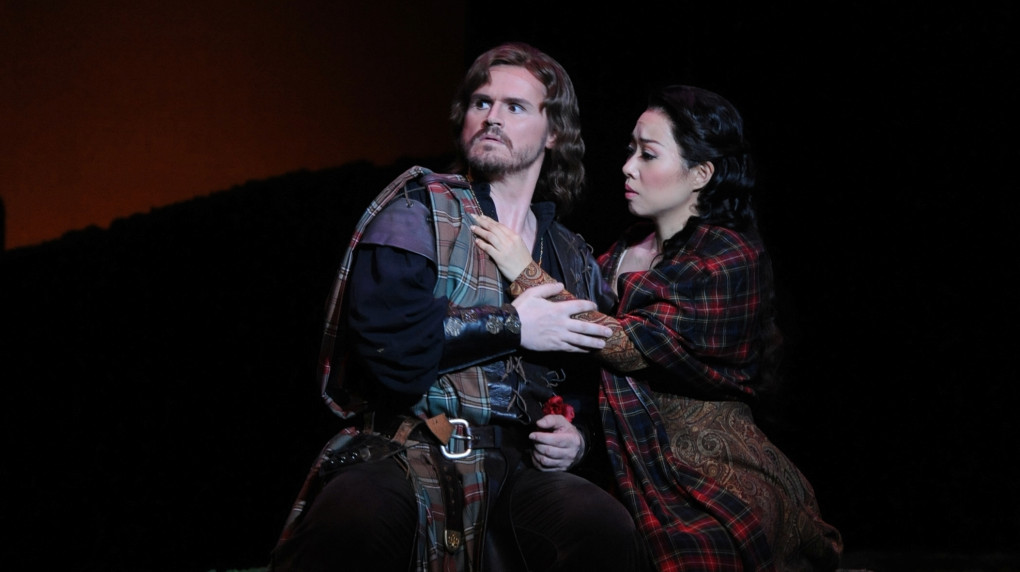
Tenor Kirk Dougherty and soprano Sylvia Lee cuddle in “Lucia di Lammermoor.”

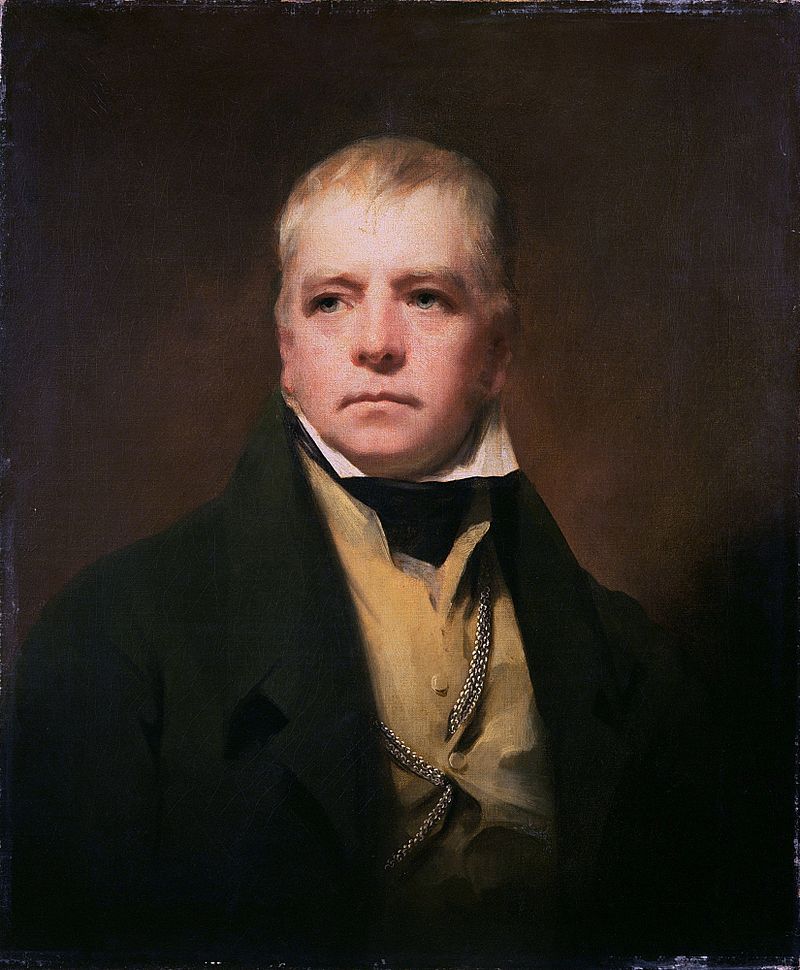
Who was the first novelist to enjoy truly international fame? If you guessed Charles Dickens, you would be wrong. His success was preceded by the author who is little read today, Sir Walter Scott. The Scottish author is certainly remembered in the world of opera, with his story The Bride of Lammermoor, a far-fetched tale of mayhem, madness, and bloodshed that is nevertheless based on a true story, told by Scott’s mother, Anne Rutherford, about an ill-fated romance set within a larger feud between the Dalrymples and the Rutherfords.

scott

He told the story.

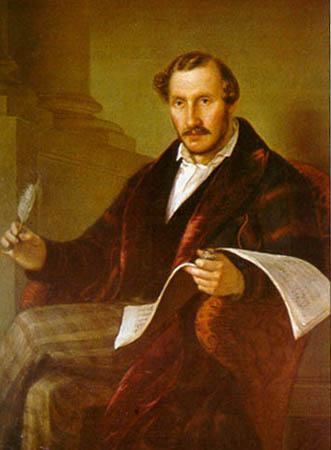
However, it’s not the plot that draws us into Gaetano Donizetti‘s 1835 Lucia di Lammermoor, a gory little tale of tribal vengeance in the highlands, but the glorious music, from beginning to end. How sad for my readers, then, that I’ve taken so long to write about this wonder of a production at Opera San José – since it closes tomorrow, with a Sunday, September 5, matinee at 3 p.m.! My excuse: I only saw the opera myself Friday night.

Soprano Sylvia Lee‘s perfect coloratura performance in the title role is a big reason for the excitement. Lucia has become her signature role, performed in Hong Kong, Tel Aviv, and her native South Korea before she began her residency at Opera San José this season. General Director Larry Hancock, in a talk before the performance, compared her to late, legendary Lily Pons, who was also associated with the role.

donizetti

He set it to music.

Charlise Tiee, writing in San Francisco Classical Voice, “Her acting was completely engrossing, her sweetness which is crushed into derangement, was utterly convincing. … Her voice is resonant from top to bottom and without a hard edge or a hint of shrillness. She attacked the coloratura passages with clarity and ease, yet was expressive. Her voice alone is well worth the trip to the South Bay and what a pleasure it is to see such an impeccable performance of an iconic role.”

“The show breathes with wonderful musicality, simple and direct acting, and plenty of vocal fireworks that underline the ‘bel’ in bel canto.”

Elijah Ho, writing in the San Jose Mercury was also enthusiastic: “To put it bluntly, it was a thing well-conceived and brilliantly executed. … Get in your car, or take the bus or the train. There is magnificent vocalism and so much more.”

By the time she had sung her final notes as Lucia on Saturday evening, it was apparent soprano Sylvia Lee had left us with something special.

sylvia_lee

A matchless Lucia

The singing actor, a winner of the 2007 Metropolitan Opera National Council Auditions, conveyed meaning seamlessly throughout the evening. We marveled at how she handled the delicate cantilena of “Regnava nel silenzio”, the way she took the delicate roulades in “Quando, rapito in estasi” with ease and elegance. When she was in her element, there was incredible evenness of tone. Pitches, no matter the distance, were hit squarely in the middle, and her legato flowed the Mozart-prescribed way: “like oil.”

Lucia’s mental collapse, culminating in the much-anticipated mad scene, was both subtle and gradual. Lee’s facial expressions, beginning with wide, crazy eyes, evolved from “Il pallor funesto” to “Soffriva nel pianto.” By the end, I couldn’t help but be disturbed by the contrast between her blood-soaked white dress, the forlorn, exhausted expressions of her face and the emanating beauty of her coloratura in response to the flute.

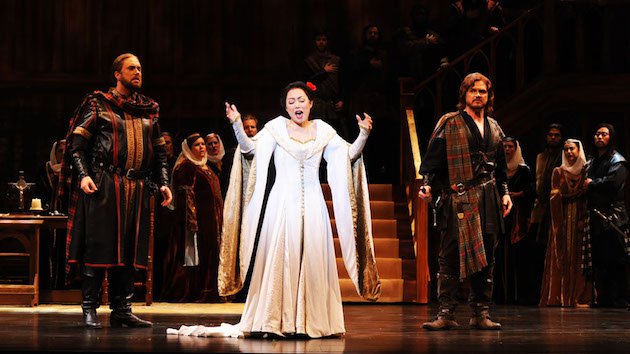
The opera is set in the 17th century, but Larry Hancock, thinking of the enormous plumed hats of the era and the silly breeches with their “nests of ribbons” (I loved that phrase), vowed “not on my stage.” He preferred a more medieval look to the opera, and recast Lucia in the 15th century. This required him to adjust political woes that beset the characters, suggested in the single line in the original: “William is dead; we will see Mary mount the throne” – referring to the joint rule of Mary, daughter of James II, and her husband William of Orange. Never happened, of course – Mary died first. Hancock rewrote the line, setting the action after the Battle of Bosworth Field in 1485, when Henry Tudor (i.e., Henry VII) defeated Richard III. Since England and Scotland were not united until 1707, during the reign of Queen Anne, Mary’s sister, I couldn’t understand why the Scots would much concerned with either death.

No matter, the 15th-century costumes were sumptuous, recalling the rough land where the elegant French Mary Stuart‘s life would be tormented by feudal clashes and turf battles less than a century later.

lammermoor_header

Baritone Matthew Hanscom puts the pressure on Lee and Dougherty in “Lucia di Lammermoor.”