
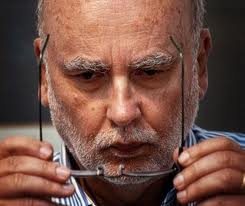
Adam Zagajewski is dead.

Share
No one can replace him. No one will.

Adam Zagajewski is dead. Poland’s leading poet, who achieved worldwide renown, was 75. He died in his beloved Kraków “after serious illness,” says the Polish press. That’s it. Few of my Polish acquaintance seem to know he was ill. They are universally shocked.

He is perhaps best known for the poem that was tacked to office bulletin boards and pinned to refrigerators with magnets after the 2001 World Trade Center attacks –”Try to Praise the Crippled World” translated by Claire Cavanagh. But that poem’s deserved reputation almost did a disservice to his corpus by overwhelming a fine and enduring legacy of poems and essays over many volumes and many years.

I’ve written about him here and here and here and here, among other places. And I wrote a profile of him for the Poetry Foundation here.

I last saw him a few years ago. We had a short rendezvous over espresso at the lovely Bona Street bookstore and café on Kanonicza. It was a tumultuous and confusing trip for a number of reasons, but meeting with Adam was a point of sanity and stillness. Well, because he always was.

According to Gazeta Wyborcza: “The only thing missing from all the awards, titles and distinctions he received throughout his life was the Nobel Prize for Literature. His name has appeared among the candidates for this award every year. In 2013, he was awarded the Zhongkun Chinese Literary Award, commonly known as the Chinese Nobel Prize. He was also a laureate of such awards as the Neustadt Prize for Literature (2004), the Heinrich Mann Prize (2015), the Griffin Prize (2016) and the Princess of Asturias Award (2017). He has been a finalist of the Nike Awards several times. He was awarded the Gold Medal for Merit to Culture – Gloria Artis and the Order of the Legion of Honor.”

He should have gotten the Nobel. I could not think of anyone more deserving. But two Poles had already won Nobels in the previous half-century – Czesław Miłosz and Wisława Szymborska – and he was passed over. Now there will be no chance to make amends.
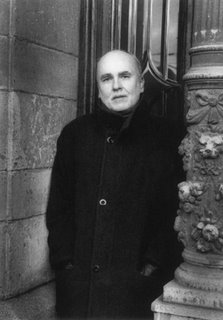
Unassuming grace

In recent years, he has been active in the cause for a truly free Poland. But always with a sense of proportion and insight. Zagajewski wanted to “avoid the reduction of freedom to the political dimension.” He continued: “Perhaps it is worth remembering that in every community that has not yet been dominated by illiterate people, there is also a different conversation, much calmer, quieter, attracting less attention, but not necessarily less important: about God, about the meaning of life, about art, about literature, music, the nature of civilization, the relationship between modernity and tradition, and death. And also about Miłosz, about Stanisław Brzozowski, about Plato and Wagner, about Bacon the philosopher and about Bacon the painter, about Chopin and Lutosławski.”

He is survived by his wife, actress and psychologist Maja Wodecka.

This is a major blow. Yet how fitting that this quiet unassuming man should die so quietly, without fanfare. He was a class act … but so much more than that. So much more. No one can replace him. No one will.

More soon.

Postscript: a few words from Ukrainian poet Ilya Kaminsky (we’ve written about him here):
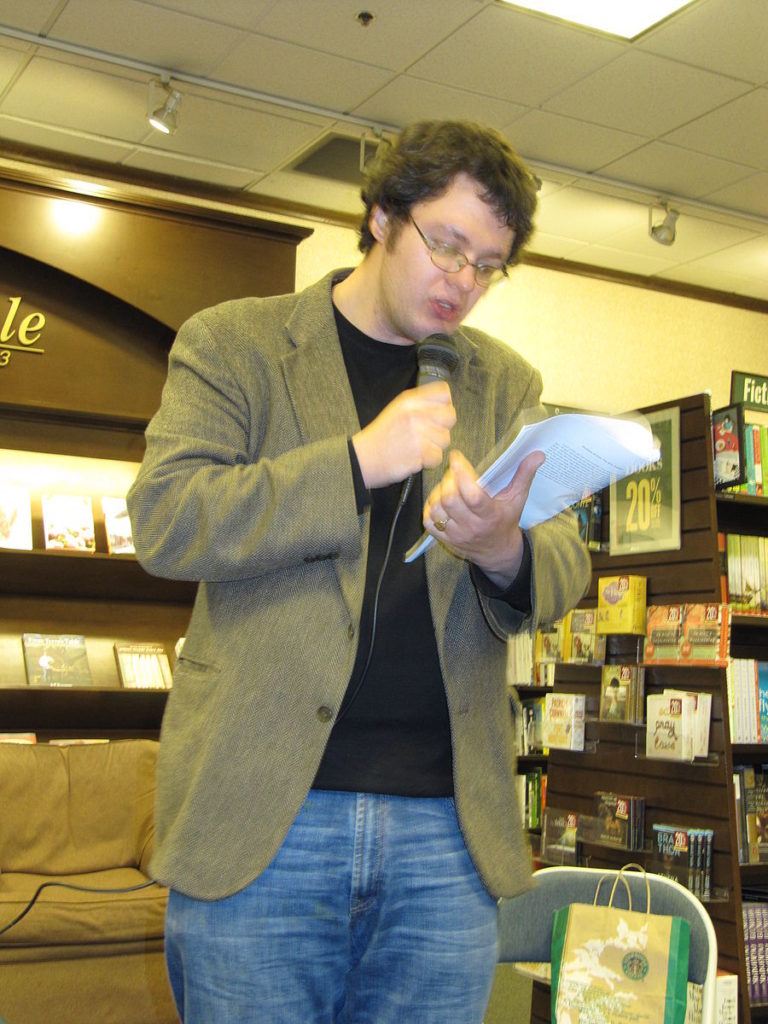
Kaminsky at book signing

One of the most beautiful things about Adam Zagajewski is that he didn’t have any of Bloomian anxiety-of-influence. He would pour the drink and welcome the conversation about poems he was influenced by, or poets he echoed, or how other poets echoed other poets (from the likes of Montale to Gottfried Benn to Vladimir Holan, lesser known Wiktor Woroszylski etc). He loved poets, chuckled (in that wonderful wry chuckle) with and about poets, recited lines (he recited some Russian poems by heart to me), told stories about them, smiled and shared the lines that influenced him, without any hesitation, or false reticence, and one time he wore a jacket that he proudly told me was the jacket that Joseph Brodsky gave him. He said “on my first trip to America, I was a skinny man who complimented Joseph on a jacket, and Joseph took this jacket off and simply gave it to me.” Adam was generous like that, too. Somewhere in my notes I have lists of poets and essayists he would recommend when we met once a month in Chicago. And then he would email next day and recommend some more.

He has many students, from Houston and Chicago, who will probably say much more about his teaching. I wasn’t one of them. I was just someone who benefited from his kindness and the generosity of his conversation. I will miss him, and miss the wide world of poetry he carried with him—a kind of person who could agree to drop you off at your hotel after a poetry reading, and then stop the car, midway, on the side of the road, and just keep talking about poetry. None of this was done with the over the top exuberance: he was a very shy person, gracious, precise. And he always told the truth about poetry. He believed in the soul; the soul must live in lyric poems. That, most of all.

His poem, “To Go To Lvov”– an elegy to the gone world but also a kind of a hymn to life — became password for many immigrants and refugee poets of my generation. If you love that poem, you are one of us. I love it for all those reasons, yes, but also because it allowed–in the last two decades of a bloody century–a kind of reprieve. It allowed a way for praise to enter poetry long after “Deathfugue” or “Howl” were written; it had all the force of those monumental works, and yet it allowed tenderness in.That is how I will always remember you, Adam. A poet who allowed tenderness in.

Postscript on 3/22, from poet Dan Rifenburgh (I’ve written about him here and here): I first met Adam when the poet Ed Hirsch arranged for Adam to come teach with him at the University of Houston, where I was a grad student.  Adam was a seemingly shy person, very calm and very gentle, yet there was no doubt he could lead a troupe of would-be poets through the labors of exegesis, critique and theory, as well as deal with all the interpersonal scrimmages that tend to break out under the pressures of the workshop setting. In fact, he was an excellent writing workshop leader, always keeping us out of the muck of competitive jealousies and personal digs. His commentaries on the poems under discussion showed the depth and breadth of his reading, his life experiences and his humanity. I recall I had submitted a rather bleak, dirge-like lyric on the loneliness of divorce that ended with a scene including the lines, “Across the street is a cafe/Still open at this hour./ A woman sits there, nibbling pastry.” Adam’s response was simply, “Edward Hopper?” and I had to laugh. He was deadly accurate that way. In fact, one wonders how so smart an individual could be so gracious and seemingly, well, good. Or was it all an act? What was behind this gentleness, his air of quietude, which could sometimes mimic a mystical complacency? Adam came naturally to his role of a cat lover. He was more feline than canine and he appeared to have nine lives. Certainly he had navigated through vast political upheavals. He witnessed the residue of fascism, the bleakness of totalitarian communism, the rise of Solidarity and then, after the fall of the Soviets, a Polish kind of populist revanchism. In such situations perhaps reticence is a survival skill? You can search his work for political comments and you’ll come up quite empty. Was he a gentle tabby or a sphinx? The answer lies in his rejection of rhetoric, that is to say, public speech designed to persuade, or move the polis to action. The 20th century tied rhetoric to propaganda to ideology to various forms of centralized power, and always to war, suffering and death. Adam was scampering away from all this on cat’s feet. What he found was not philosophy, science nor religion, but a way of being in the moment, a way of beholding the world as transitory and eternal all at once, even as it is both brutal and beautiful. In this he saw the arts and artists as his surest guides: the painters, musicians, poets, novelists and even diarists. He would sooner salute a kettle drummer than a commissar, or bow to a painter than a pope. He joined the ranks of artists by presenting his own unique relationship with this mysterious place where we all live. He refused to categorize or analyze it, yet by his gentle notations, and through his humility, he holds the world before us in its luminous, shimmering mystery.
What future for literature? Thinking fondly of “The Book People” in Farenheit 451

Share

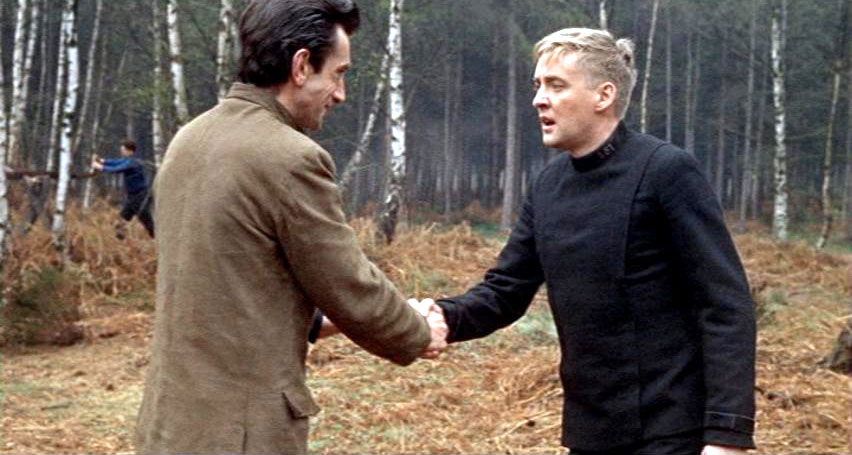
Oskar Werner meets with The Book People in “Farenheit 451”

I don’t go to movies often, but at some point in a few decades ago I saw François Truffaut‘s Farenheit 451, based on Ray Bradbury‘s dystopian novel of a future where books are banned and “firemen” destroy any they find.

I don’t remember much of it (lots of it seemed fairly incoherent), but the final scene was remarkable to me. And, perhaps, prophetic. We couldn’t anticipate then an era where books could be burned or banned again – now we can. The world where they are little regarded outside academia is already here. Joseph Brodsky, as always, put it well: “There are worse crimes than burning books. One of them is not reading them.”

Truffaut’s ending for Farenheit 451 puzzled many people when it came out in 1966. It doesn’t for many people who remember the Cold War world, when Anna Akhmatova had her friends memorize her poems, and then burn them. Memorizing allows you to become what is memorized; it becomes so internalized that it is forever a part of you.

Adam as always…

What is the answer? Adam Zagajewski told me years ago, when I asked him about a world that now longer turns to great literature, and specifically poetry, as it attempts to come to grips with the world and the self. What future for literature? “We’ll be living in small ghettos, far from where celebrities dwell, and yet in every generation there will be a new delivery of minds that will love long and slow thoughts and books and poetry and music, so that these rather pleasant ghettos will never perish — and one day may even stir more excitement than we’re used to now.”

In his introduction to Edward Snow’s translations of Rainer Maria Rilke. he elaborated:

“We have a new sorrow today: after the terrible catastrophes of the twentieth century, after the disasters that entered both our memory and imagination, we tread gingerly at the point where poetry meets society; “Don’t walk beyond this line,” as the sign on every jetliner’s wing warns us. And yet the central issue for us is probably the question of whether the mystery at the heart of poetry (and of art in general) can be kept safe against the assaults of an omnipresent talkative and soulless journalism and an equally omnipresent popular science—or pseudo-science. It also has a lot to do with the weighing of the advantages and vices of mass culture, with the influence of mass media, and with a difficult search for genuine expression inside the commercial framework that has replaced older, less vulgar traditions and institutions in our societies. In this respect, it’s true, poets have less to fear than their friends the painters, especially the successful ones, who, because of the absurd prices their works can now command, will never see their canvases in the houses of their fellow artists, in the apartments of people like themselves, only in vaults belonging to oil or television moguls who don’t even have time to look at them. Still, the stakes of the debate and its seriousness are not very different and not less important than a hundred years ago.”

There will be a future, for books and for reading them. See Ray Bradbury’s notion of it in his 1953 novel, Farenheit 451. Or watch Truffaut’s ending in the video clip below. (And let me know which book you would become… I’m curious…)


“He liked America’s gas stations, roadside bars, endless baseball games.” Adam Zagajewski and others remember Joseph Brodsky on his 80th birthday

Share

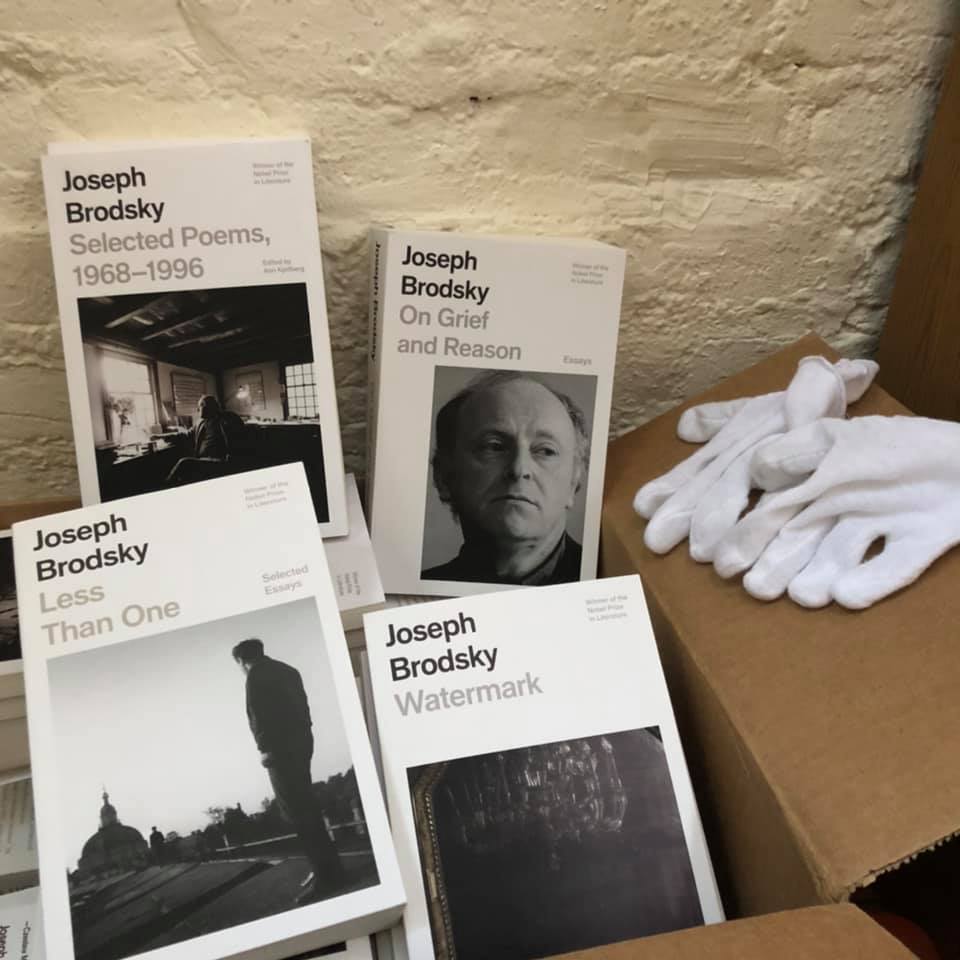
Farrar, Straus, & Giroux remembers his anniversary with four books. (Photo: Ann Kjellberg)

Today, May 24, would have been poet Joseph Brodsky‘s 80th birthday. The commemorations are worldwide. The biggest in the Anglophone world may be the republication of three of his landmark books by Farrar, Straus, & Giroux: his two volumes of essays, Less than One and On Grief and Reason, and a fourth, a new Selected Poems, 1968-1996.

Ann Kjellberg‘s “Beyond Meaning: Joseph Brodsky’s Poetry of Exile” is in the New York Review of  Books here. An excerpt:

Literary executor Ann Kjellberg

“We now live in a time of which Brodsky was an advance scout—a time in which many writers operate beyond their original borders and outside their mother tongues, often, like Brodsky, bearing witness to violence and disruption, often answering, through art, to those experiences, in language refracted, by necessity, through other language. In Brodsky’s time there was a cluster of poets, some from the margins of empire, some, like Brodsky, severed from their roots—Walcott, Heaney, Paz, Milosz, to name a few—who brought with them commanding traditions as well as the imprint of history’s dislocations. We would do well now to attend to their song, standing as they did in our doorway between a broken past and the language’s future.”

If you’re up early in this morning, you might check out the Joseph Brodsky Memorial Fellowship Fund Facebook page, where poet Glyn Maxwell will be discussing his translations of the Russian Nobel laureate at 10.30 a.m. PST.

But for the most part, I have chosen to remember in a very different way. When I saw that Adam Zagajewski had published his own massive tribute in Warsaw’s Gazeta Wyborcza here, I spent an unconscionable number of hours on an otherwise busy day picking through the Polish to learn what he said. It became my own homage for the occasion.

Perhaps someday this long essay will appear in English, and I will be humiliated by my humble offering for you below. Perhaps Polish speakers around the world will send in correction and rebuke for my clumsy effort, assisted by Google. But until then, I’m the best you got, so please enjoy my wholly inadequate translation – and this is only a small portion of the whole, which runs to thousands of words. Excerpts below.

***

He loved bars, baseball, and Chinatown restaurants.

I knew him at his best as a good friend, but also as a follower of high culture, a defender metaphysical impulse in poetry. He was a ruthless enemy of totalitarianism, Soviet and any other, and an opponent of what Nabokov used to describe the words “poshlost,” banality, a lack of taste, smallness. He was able to reconcile his cultural elitism with an enormous fellow-feeling for the American way of life – which is the opposite of elitism. He liked America, including ordinary American gas stations; bars where giant TV screens dominated always, at any time of the day or night, and endless baseball matches. He knew and liked less-than-chic New York neighborhoods in Chinatown, which had his beloved restaurants. …

He loved English, including spoken American. He liked to use American idioms, though it happened that –  as it happens to foreigners – he couldn’t distinguish dead idiomatic expressions from live ones. Idioms live for several years or more then they go to the museum, i.e. to the dictionary, and there foreigners find them. With his arrogance (usually charming) he ignored the difference between “native speakers’ and those who learned the language late – as it happened, he even corrected “native speakers” (I was a witness – of course he was wrong, “native speakers” are always right), and they meekly accepted his correction.

***

I called him from Houston shortly after arrival from Europe. Usually the first days in Texas were difficult, melancholic for me – that’s why I was calling Joseph.  I was hoping for an intimate, friendly conversation (in other words – just gossip). But Joseph didn’t want to hear about my melancholy. He immediately asked me: what do you think about Horace‘s poetry?

He was just writing his essay about Horace. I mobilized myself to quickly remember what I thought of the poems of Horace, and my mood improved.

***

John Willett … told me once story related to Joseph. I remembered her exactly because it seemed fantastic and funny to me.

Adam Z. remembers

John, as already said, had known Joseph for a very long time; in some ways, he was a bit of an exotic character among Joseph’s American friends, where poets, poets, writers, and critics predominated. John was a professional diplomat who began his career in African countries, then worked for the State Department in many other countries, including in Italy or Turkey, and twice in Paris (I use the past tense, because unfortunately this educated, witty, and friendly man is dead). Well, John once told me he would tell me a story, which he didn’t tell anyone. It was like this: Joseph  had a mind that was passionate about a range of different topics, not only literature – e.g., military aviation (he knew everything on combat aircraft of the Second World War; when asked on what route he was flying to Europe he said: Luftwaffe) or the story of famous British spies – the Cambridge Four (who later became the Cambridge Five); anyway he wrote an essay about them.

One of those passions Joseph was the nuclear disarmament issue, the “Missile Gap,” as it was then called – a central issue in the 1980s.

He read all the articles on the subject, knew all about rockets, Pershings, and Minutemen, and on the loading facilities of both sides. He knew what are these rocket varieties were called, as well as their range and power of destruction. And of course he had his own theories.

He told John, who had was between missions lived in Washington – that he would gladly give a lecture at the State Department, in which he would present his concepts about disarmament. For a long time John tried to dissuade Joseph. He told him that, in the State Department, the world’s best experts devote every moment to studying these issues. They knew everything on this subject, and that he, a dilettante – extremely brilliant, but still a dilettante – couldn’t hold any weight in conversation with them, let alone convince them of his theories.

Joseph, however, insisted. And eventually John gave in and it led to a lecture at the State Department, and the great Washington missile specialists came, fresh from determining and calculating the balance of two arsenals.

“Well, how did it go?” I asked John. “You know it didn’t go well,” he replied.

Continue reading

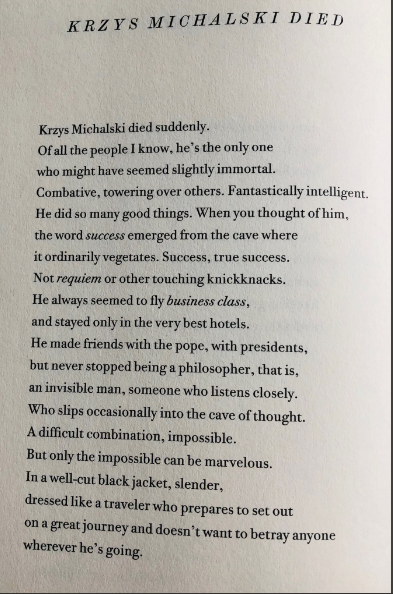
Adam Zagajewski on Krzysztof Michalski: “only the impossible can be marvelous”

Share

Much missed.

This poem is making an appearance on Twitter, thanks to Tom D’Evelyn. I hadn’t seen it, nor the new Adam Zagajewski collection Asymmetry, translated by Clare Cavanagh. Another postponed pleasure. The poem recalls philosopher Krzysztof Michalski, founder of Vienna’s Institut für die Wissenschaften vom Menschen, where I was a fellow and met him in 2008, and where he died five years ago of cancer.

Tom writes, Twitter fashion: “Adam Zagajewski Asymmetry Trans Clare Cavanagh. ⁦⁩ ‘Krzys Michalski Died’— yes he did. Google (I did). The poem does not lie: he was like that. Slightly immortal; I ordered his book on Nietzsche. The poem makes me envious ⁦⁩ in a good way. Thanks AZ!”

Adam Zagajewski and “the battle to imbue life with maximal meaning”

Share

A distinctive, insistent, civilized stance.

Adam Zagajewski is an absolutely foundational figure for many of us – not only because of his own poems and essays, but for his quietly insistent, civilized stance towards a world that teeters on the edge of chaos – we’ve written about him here and here and here and here. I once asked him, in an email interview a dozen years ago, what do we do in a world that seems to be averting its face from the non-consumerist values of reading, literature, poetry, philosophy? His reply: “We’ll be living in small ghettos, far from where celebrities dwell, and yet in every generation there will be a new delivery of minds that will love long and slow thoughts and books and poetry and music, so that these rather pleasant ghettos will never perish — and one day may even stir more excitement than we’re used to now.” It’s starting to sound like a good idea. Yet he remains in Kraków, and I stay put in Palo Alto.

So it was a privilege to review Slight Exaggeration, his book-length essay on… oh, just about everything. It’s up today at The Weekly Standard (and on the home page, too, no less). Read the whole thing here.

Meanwhile, an excerpt:

Gone, but still with us…

Zagajewski’s conversational style is distinctive, and the cadence is recognizable in his poems and essays. (Translator Clare Cavanagh conveys it well.) I was introduced to it a decade ago, an afternoon conversation that stretched into early evening, as we walked along the Planty, the public park that encircles Kraków. His words are tentative, unassertive, provisional, yet self-assured. The slight tonal “uptalk” lift at the end of his sentences as he turns a problem round, exploring its different angles, cannot ruffle his considerable authority. Czesław Miłosz, Zbigniew Herbert, Wisława Szymborska are dead: Zagajewski has survived the generation of greats, and matched it with a greatness of his own, a postwar brand of metaphysical heft and gravity that shoulders the singular legacy of Polish literature into the 21st century.

The recurring Romanian…

Slight Exaggeration patiently picks up where the poet left off a dozen years ago with A Defense of Ardor, extending his line of thought on painters, poems, composers, and history. Initially, the observations seem disconnected and a little unpruned, until certain names begin recurring (French-Romanian writer E. M. Cioran, for example, or composer Gustav Mahler, poet Rainer Maria Rilke, novelist Robert Musil)—and each time he repeats, the impression on the reader is richer. Clearly, he is weaving on a very large loom, and the shuttle that disappears out of sight swings back to pull the threads tighter. The disparate reflections weave into a long thought, the result of years, decades, a lifetime. And occasionally his trademark associative musings open into seminal mini-essays.

The battle for clear vision…

Zagajewski wonders why the wartime letters of the lawyer Helmuth James Graf von Moltke, who resisted Hitler’s abuses nonviolently, move him so much with their impeccable moral brilliance; those of a favorite poet, the wily and self-protecting Gottfried Benn, so little. He also admires artist and writer Józef Czapskis integrity, too: “Czapski sometimes speaks of himself—but always in terms of the ceaseless battle he wages for clear vision, for full use of his gifts, the battle to imbue his life with maximal meaning.” And Simone Weil? “Weil tortured Czapski, and she still tortures us.” What does it mean that we celebrate the birthday of Mozart and the “liberation” of Auschwitz on the same day? (He hesitates to use the word “liberation,” which implies a certain energy and esprit, for the Allied soldiers’ entry into hell.)

Time teaches tolerance for what cannot be changed. And in the course of his telling, time overlaps and leaves traces on the present. For example, he observes that the Gestapo occupied his Kraków apartment during the occupation: “A Gestapo officer no doubt occupied the room in which I now write.”

Read the whole thing here.

Partying with Walcott, Heaney, Brodsky: “I wished I could have brought it all home in a jar.”

Share

Could he have found a big enough jar?

I never met Nobel poet Derek Walcott – but Sven Birkerts did, and he writes a marvelous, ebullient essay about Walcott and his sidekicks and fellow Nobel poet laureates, Seamus Heaney and Joseph Brodsky, “Long Tables, Open Bottles, and Smoke” over at Lithub.

Sven Birkerts met the Caribbean poet in 1981 at Boston University. Walcott was allowing non-students to audit his poetry seminar, and Birkerts jumped at the opportunity. It sounds a lot like Joseph Brodsky’s class back in Ann Arbor, except for the locale with its associations:

“We met in #222, the same second-floor room on Bay State road where Robert Lowell had taught his now-legendary seminar that included, among others, young poets George Starbuck, Anne Sexton, and Sylvia Plath. Derek was pleased by the association and often invoked his old mentor “Cal.” Our class, which I audited for two years, had a loose free-associational format, like nothing I’d experienced—at least not before I met Joseph back in Ann Arbor. Was this how poets did it? It seemed radical and right, such a change from the syllabus-driven proceedings I’d known as an undergrad. In these sessions, a poem would be passed around—a ballad, something by Thomas Hardy or Elizabeth Bishop, say—like a specimen we could study, or, more flatteringly, like a melody handed off to a group of musicians to see what might happen. Meanings were not at issue—not in any conventional way. The conversations turned on rhythm, rhyme, cadence: the elements we came to see as primary to meaning.”

And the parties were unforgettable:

A judicious, sardonic rejoinder…

What a delight it was to see these three utterly distinctive looking individuals together at a party! And it seems, looking back, that there were parties all the time. Long tables, open bottles, and smoke. God, how people smoked in 1981—Joseph with his L&M’s (“Wystan smoked these”), Derek with filterless Pall Malls, Seamus with his Dunhills. And everyone gathered around them doing the same. If the reader now expects accounts of high literary seriousness, however, she will be disappointed. These gatherings were about play. They were exercises in comic brinksmanship. Who would pull off the night’s best line, the funniest story; which of the three would most quickly reduce the other two to convulsions? Those of us lucky enough to be at the table barely got a word in. If we had any function, it was to keep things going, to prompt. A question, a compliment—it didn’t matter, anything could be a trigger. Joseph was usually first out of the box with some dark jibe, which would inevitably set Derek into volatile contortions, releasing his extraordinary laugh, a full-body explosion. It would then fall to Seamus to offer the judicious sardonic rejoinder. I wished I could have brought it all home in a jar. My stomach hurt from laughing. I lay in bed, my head spinning from combined excesses, but also with the feeling that the world was, as Frost had it, “the right place for love.”

A full-body explosion

So much life – and all three are dead now. One poet mentioned in the article is most happily alive. I was pleased that Walcott loved Adam Zagajewski‘s “Going to Lvov,” and in a paragraph that makes me envious (I would not have put it this way, but I wish I had), he writes: “Derek’s reasons for adoring it are immediately clear. Zagajewski is writing directly in what I think of as the key of Walcott—and Brodsky—moving forward by the same logic of transformations, assuming the same coded equivalences between the things of the world and the words with which they are transmitted. Here the poet plays with such likeness directly, joining in our minds the visual punctuation of the Russian ‘soft sign’ and the sibilance that calls up the movement of water.”

And I couldn’t agree with him more when he reaches this conclusion: “These, I think, were the best years—before the Nobel Prizes. Say what you will, the feeling in a room changes when a certified Nobelist is present, never mind two or three. There is, of course, the overt or conspicuously concealed regard of the non-Nobelists present; and then the deft but still obvious efforts of the laureates not to be acting as eminences. It’s true, of course, that the poets were already known and honored before then, but somehow their earlier celebrity energized much more than it constrained.”

Read the whole exuberant essay here. Oh, and before I forget, check out his two-hour conversation on technology, books, and life over at the “Virtual Memories Show” here. Sample quote: “When I was your age, I discovered the doubling over of one’s own experience. . . . Themes, recurrences and motifs in my life began to manifest. Then as if on command, the whole sunken continent of memory began to detach from the sea-floor.”