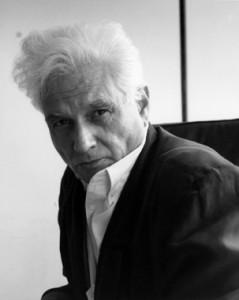
Be still my heart! France takes note of “The French Invasion”

Share

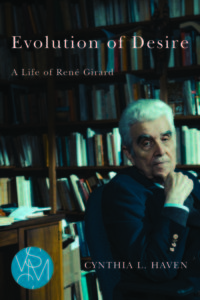
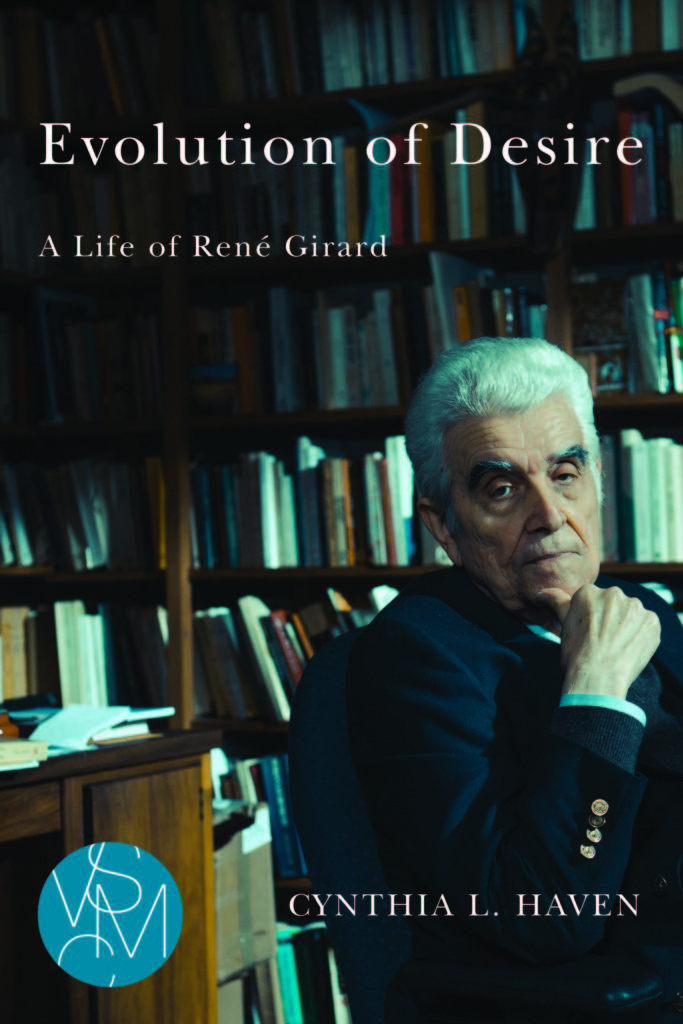
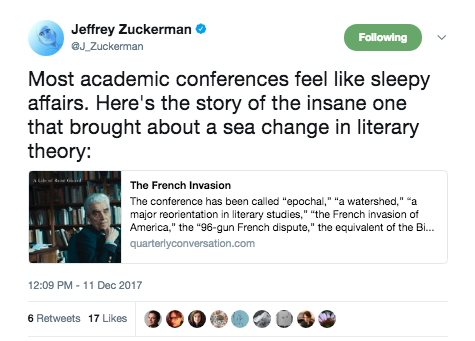
A belated postscript to last week’s Quarterly Conversation publication of a single chapter from Evolution of Desire: A Life of René Girard, which will be out in April (you can find the essay here; and our post about it here). It describes the 1966 Baltimore conference that René Girard organized, with Richard Macksey and Eugenio Donato, that brought French thought to America – and with it Jacques Lacan and Jacques Derrida.

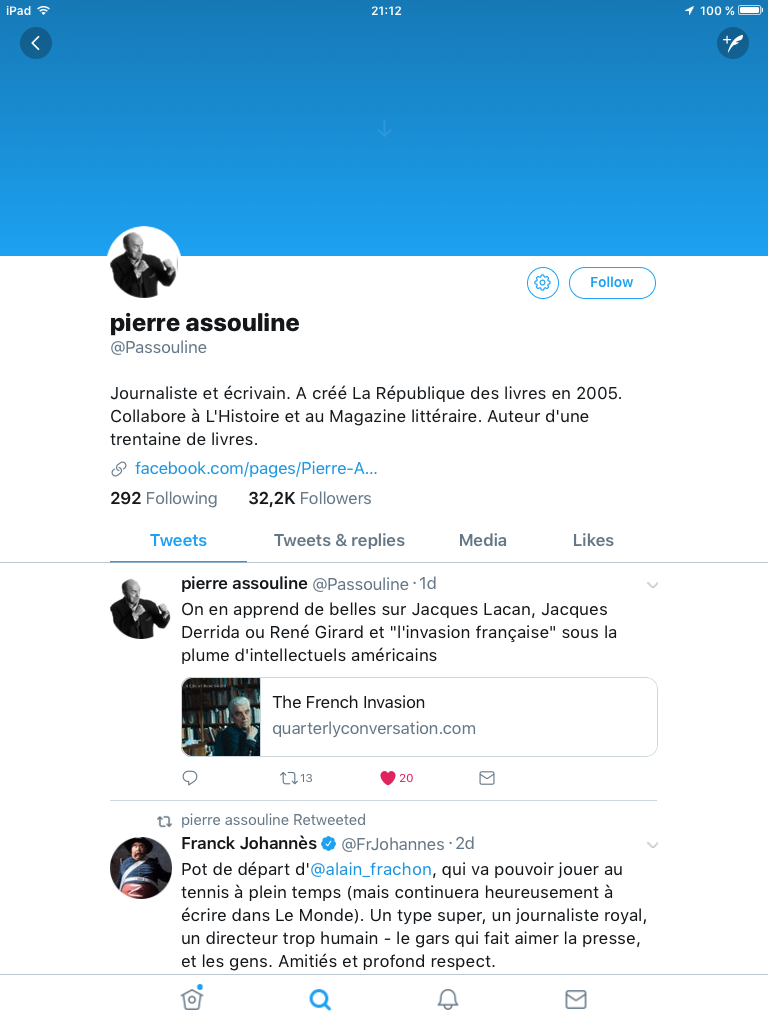
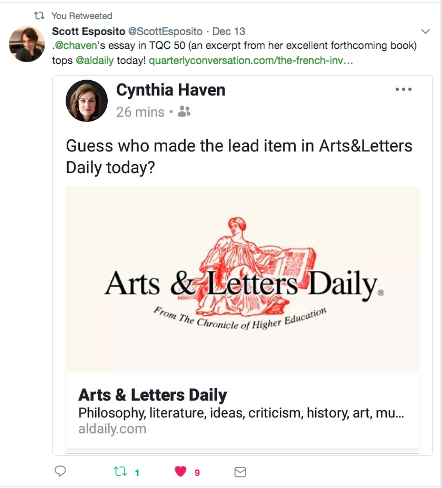
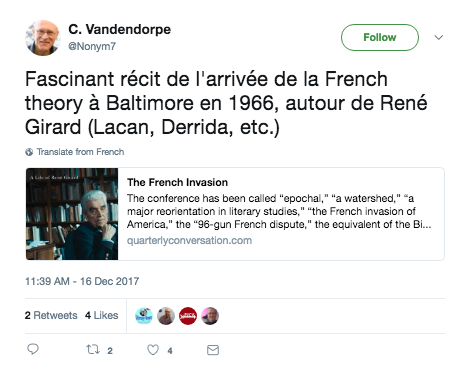
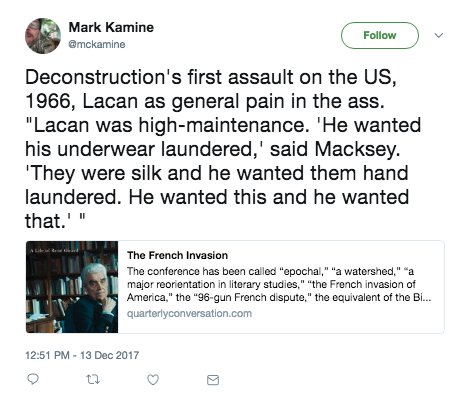
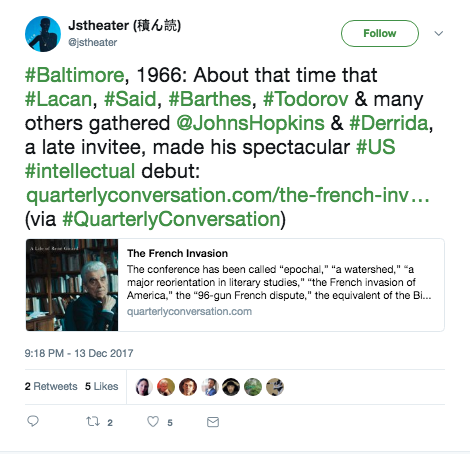
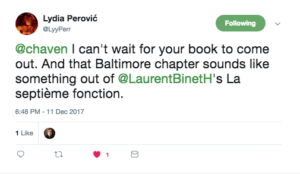
A few days ago, a friend from Paris sent us a Tweet we might otherwise have overlooked. Pierre Assouline is one of France’s most visible critics, and he’s on the Goncourt jury, which awards France’s most prestigious literary award. Moreover, he has more than 32,000 Twitter followers, so that tweet was retweeted more in the days after this screenshot. We lost track of the other French posts after that. But our hard little heart fluttered a bit to see France taking note.

We were also pleased to hear that “The French Invasion” is one of the tony Quarterly Conversation‘s top hitters, with 10,000 readers in the first few days. Give it a click if you haven’t. As one reader said a few days ago, “Haven’t read anything on the internet in a while that’s given me so much pleasure.”

Postscript on 12/20: There’s more: The popular economist Tyler Cowen has featured Evolution of Desire as the lead news item on his website here.  Wikipedia tells me he is #72 among the “Top Global Thinkers” in 2011, by Foreign Policy Magazine.

Here’s to Hitch on “Hitchmas”: “Never be a spectator of unfairness and stupidity.”

Share

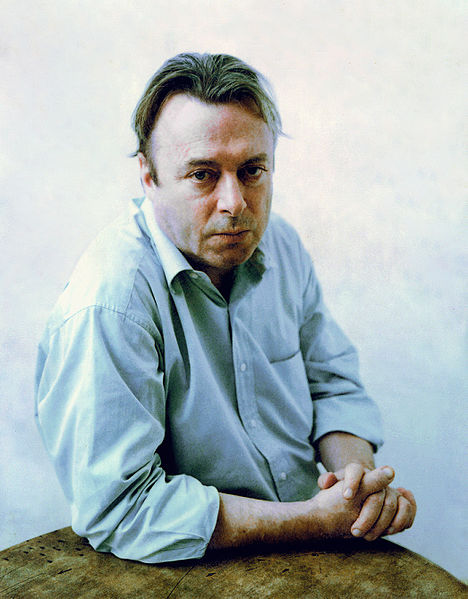
Hitchens in 2008 (Photo: Creative Commons)

An anniversary passed yesterday, the sixth year after the death of author, essayist, and journalist Christopher Hitchens. It’s not an event the Book Haven normally observes, but some in our circle do – mutual friend Steve Wasserman among them, and a few others who no doubt would raise a glass if they were here. The late poet and historian Robert Conquest (we’ve written about him here and here) was a close colleague. Some of Hitchens’s aficionados, whether they knew him or not, go so far as to call December 15 “Hitchmas” – there’s even a website for the celebrations here.

The title is catchy, but surely Hitchens himself would have scoffed at the implications of any “mass” in his honor. In any case, he hated Christmas (i.e., “Christ’s mass”) which he likened to “living for four weeks in the atmosphere of a one-party state” that “imposes a deadening routine and predictability.” Ah, but variation within custom is what makes all rituals memorable and moving – whether weddings, funerals, graduations, or holidays. It’s a delicate art. (See how fellow atheist Salman Rushdie celebrates here.)

You see? We are still arguing with him, even in absentia. While Hitchens is not a demigod to us, and while we are far from embracing all his views (indeed, who could embrace them all?), we nevertheless revere his eloquence, his frankness, his pugnaciousness, the fluency of his pen, his tenacity to what he held to be truth – and so we, too, raise a glass to him. How, after all, can one argue with this: “Never be a spectator of unfairness and stupidity. Seek out argument and disputation for their own sake; the grave will supply plenty of time for silence.”

In this case, we have help in our fête. Paul Holdengräber of the New York Public Library has an undated commemorative post over at the Wild River Review, which includes a two-minute clip of his interview with the author and journalist, three days before he became gravely ill in 2010. The two discuss death, dying, and a mutual interest in obituaries. (The full hour-and-a-half interview at the NYPL is here.)

“I was particularly taken not by the politics, which everyone knew and though of interest, mattered less to me just then, than the literary side. Hitch was a great reader and more candid in print about his life, his mother and father, his origins,” Holdengräber wrote.

“When I played W. H. Auden reading, and Isaiah Berlin teaching a class on Russian Thought at Oxford, Christopher’s eyes lit up. He felt pleasure in reciting poetry, moving his lips to Auden’s reading, and hearing his old professor, Isaiah Berlin talk. A less pugilist side to Hitch.”

When he asked Hitchens why he wrote his memoir Hitch 22 at the relatively young age of 60, he answered simply: “You’ve got to do it in time.”

Great news! Rome revokes Ovid’s exile!

Share

Come back, Ovid! All is forgiven! Whatever you did!

According to a report from ANSA,  the Rome city council yesterday revoked the Emperor Augustus‘s direct order exiling the poet from the city. It’s a little late: the poet died 2,000 years ago, in the year 17 or 18 A.D. He was between 58 and 60 years old.

The motion came from the ruling anti-establishment 5-Star Movement (M5S), which said it wanted to “repair the serious wrong suffered” by Publius Ovidius Naso, the the author of the Metamophoses and the Art of Love.

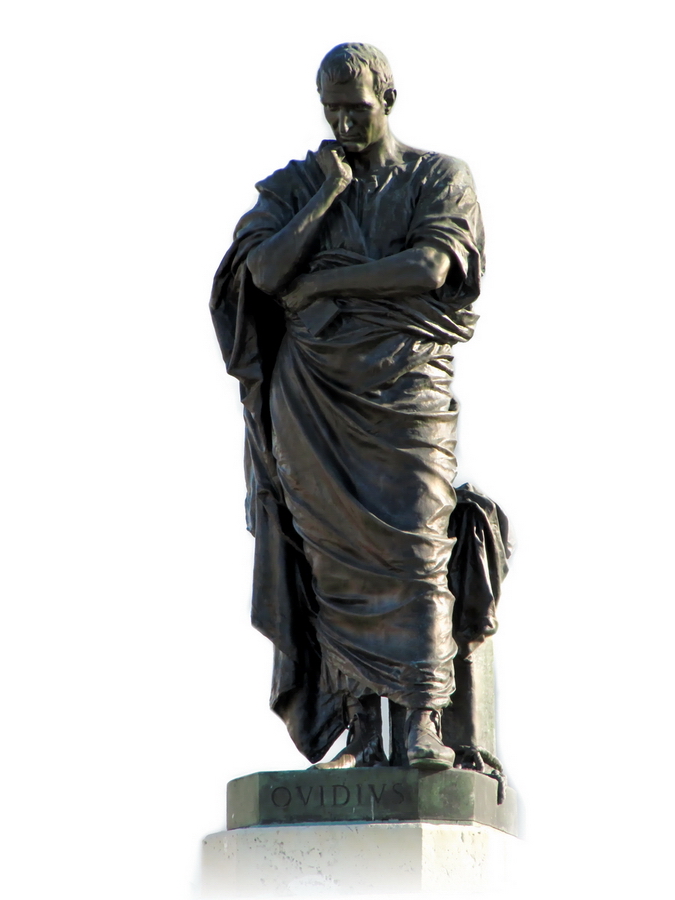
Ovid, one of the three canonical Roman poets along with Virgil and Horace, was exiled to a remote Black Sea town, Tomis, in today’s Romania, in 8 AD, in one of the mysteries of literary history. [Ettore Ferrari’s statue of Ovid in modernday Constanta at right.]

Ovid himself attributes his exile to carmen et error, “a poem and a mistake,” but his discretion in discussing the causes has resulted in much speculation among scholars.

According to a local website, the council unanimously approved the motion, which calls for “necessary measures” to be adopted to repeal the exile order, Repubblica reported. However, only the M5S took part in Thursday afternoon’s vote.

Rome’s deputy mayor and councillor for culture Luca Bergamo said the decision was “an important symbol because it’s about the fundamental right of artists to express themselves freely in a society in which the freedom of artistic expression is more and more repressed”.

Ovid has previously been acquitted by a court in Sulmona, the Abruzzo town where he was born, which passed its verdict onto Rome authorities.

Ovid wrote several poetry collections describing the pain of banishment. I wrote a little about this in my 2011 Kenyon Review piece about two other exiles, Nobel poets Joseph Brodsky and Czesław Miłosz:

According to a legend, Ovid wrote poetry in the language of the Gatae during his long exile on the Black Sea coast. “Brodsky would be an heir to that tradition, although his exile was not as dramatic as that of the Roman poet” (242), [Irena] Gross writes. She suggests Ovid may have been a literary “genotype” for Brodsky (285).

The pattern of Ovid, exiled for nobody knows what, may have absorbed Brodsky even earlier than generally supposed. I remember the poet in a melancholy mood in 1975. He asked me if I had read Ovid’s Tristia. I hadn’t, but got the book from the University of Michigan library, eager to please him. It’s still with me, with its sedate green cover and dog-eared edges, with exiled Ovid keening:

I am a Roman poet—forgive me, my Muses, forgive me—
.   And I am forced to say many things in Sarmatian speech.
(Book vii, 11. 55-56)

Salman Rushdie on Dec. 25: “Children change things. They are all Christmas fundamentalists.”

Share

Rockefeller Center Christmas tree (Creative Commons)

In this month’s issue of British Vogue, the renowned author Salman Rushdie explains the complicated history of his relationship with Christmas.

While growing up in Bombay, Christmas wasn’t a thing. “Not only were we not Christians, we weren’t a religious household, so December 25 was just that: the 25th of December.” However, he went to a local “Cathedral School,” and that meant hymns year round and carols in December, and all the students had to sing along, whether Hindu, Muslim, Sikh, or Parsi. “This pretty much atheistic boy of Indian Muslim heritage sang along with everyone else, recommending the adoration of a Middle Eastern boy who had been born the king of angels,” he recalled.

“And because we were, after all, schoolboys, we learned the comic version of ‘Hark!’ also.”

“Hark! the herald angels sing
Beecham’s Pills are just the thing.
If you want to go to heaven
Take a dose of six or seven.
If you want to go to hell,
Take the whole damn box as well.”

Years later, in London, he would get together with fellow “Christmas refuseniks” and go out for an Indian meal on the holiday – often at the Gaylord restaurant on Mortimer Street. “No presents, no stuffing, lots of irreverent fun and tandoori chicken.”

“Then came marriage and children.”

Children change Christmas. My sons Zafar and Milan wanted — still want — a proper Christmas. So do my nieces, my sister Sameen’s daughters Maya and Mishka. So does my daughter-in-law, Zafar’s soprano wife Natalie. They are all Christmas fundamentalists. Sameen and I have given in to their demands, and so for many years now there have been tall trees decked with ornaments, and holly, mistletoe, turkey, stuffing, bread sauce, cranberry sauce, brandy snaps, crackers, the whole nine yards, even the brussels sprouts. There is the Queen on TV. There is an annual ocean of wrapping paper. There are stockings. There are Christmas jumpers. My sister and I look at each other from opposite ends of the groaning dining table and ask, silently, how did this happen to us? We allow ourselves only two small rebellions. One: we don’t like Christmas pudding and won’t eat the stuff. And two: I don’t give her a Christmas present and she doesn’t give me one. That is our small acknowledgement of the people we used to be.

Of course, we have a grand time.

The whole story is online here. And here is why you absolutely must click on the link: you will see a charming family photo of the author himself as a boy, reading Peter Pan do his dreamily rapt sisters. You will see a modern-day Rushdie, stuffing himself with brussels sprouts and cranberry sauce at a table decorated with candles and ivy and pine cones. He is wearing a sweater with snowflakes and reindeer on it. Doesn’t get better than that. (And no, I won’t reprint it here. The copyright cops will be down on me faster than a duck on a June bug.) As Tiny Tim would say, “God bless us, every one!'”

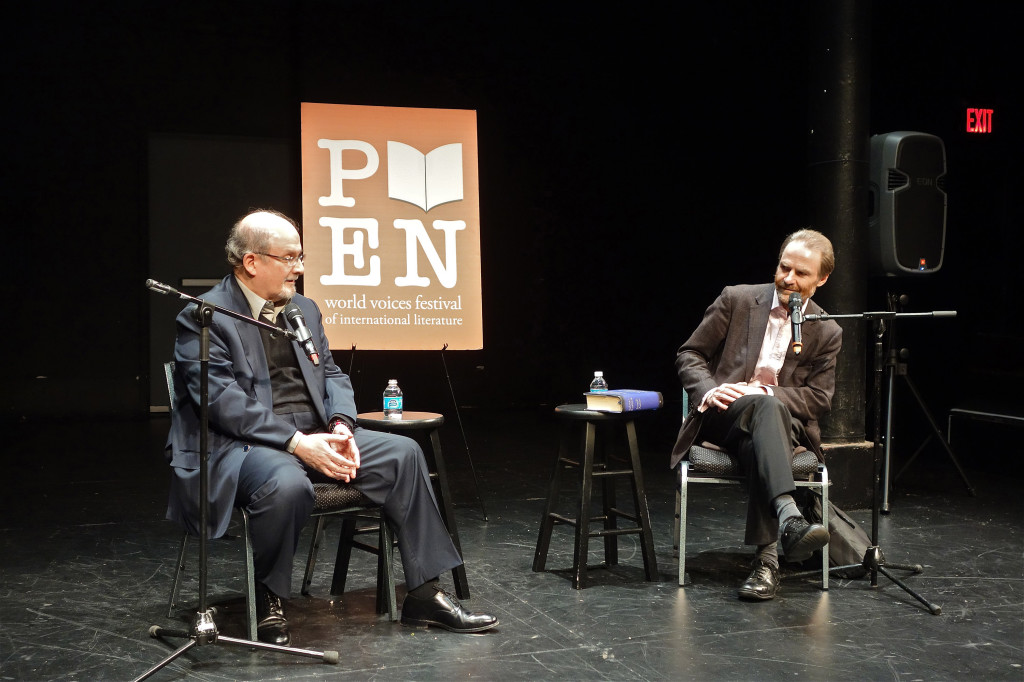
Salman Rushdie and Timothy Garton Ash in NYC, 2014. (Photo: Zygmunt Malinowski)


Evolution of Desire – the excerpt: “Haven’t read anything on the internet in a while that has given me so much pleasure.”

Share

Up at Quarterly Conversation, an excerpt from my Evolution of Desire: A Life of René Girard – to serve as appertif. The book will be officially out in April, and our kindly friends over at QC wanted to run an excerpt. Instead it became a whole chapter! “The French Invasion” describes a few wild days at Johns Hopkins University in 1966:

The conference has been called “epochal,” “a watershed,” “a major reorientation in literary studies,” “the French invasion of America,” the “96-gun French dispute,” the equivalent of the Big Bang in American thought.

To hear the superlatives, one would have thought that “The Languages of Criticism and the Sciences of Man” symposium held at Johns Hopkins for a few frantic days from 18 to 21 October 1966 was the first gathering of its kind ever held. It wasn’t, but it did accomplish a feat that changed the intellectual landscape of the nation: it brought avant-garde French theory to America. In the years that followed, René Girard would champion a system of thought that was both a child of this new era and an orphan within it. He was at once proud of his role in launching the symposium, and troubled by some of its consequences.

René Girard was one corner of the triumvirate that instigated the conference, and the senior member of the trio. The others were his Johns Hopkins colleagues Richard Macksey  (well, he will be familiar to Book Haven readers. We’ve written about him here) and Eugenio Donato. Donato was one of those rare birds in academia who “had a nose,” according to a French expression Dick Macksey borrowed. “He knew where the cooking was taking place.”

A chevalier moderne: Cécile Alduy raised to glory!

Share

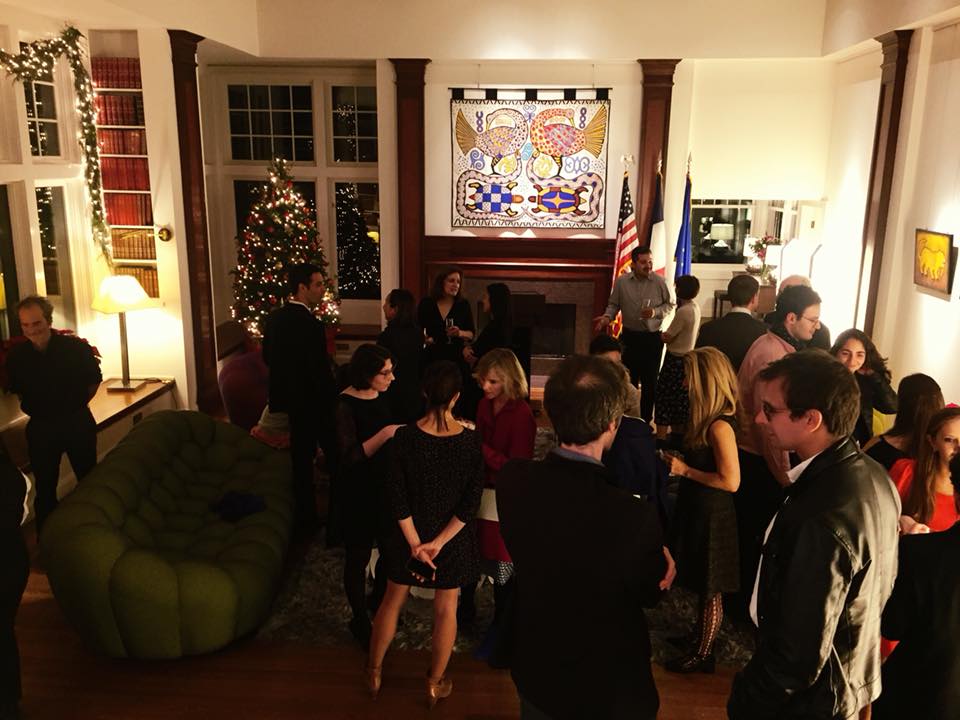
An intimate winter gathering at the home of the French consul. (Photo: Anaïs Saint-Jude)

On Thursday night, Cécile Alduy was raised to glory (we’ve written about her here and here). She was admitted to what the French Consul Emmanuel Lebrun-Damiens called “one of the most select clubs on earth.” Its ranks include René Girard, Claude Lévi-Strauss, Salman Rushdie, Peter Brook, Jeanne Moreau, and many others – and more recently, Stanford’s Robert Pogue Harrison (we wrote about the occasion here) and Marie-Pierre Ulloa. In short, at the San Francisco hilltop home of the French consul general, Cécile became the most recent “Chevalier de l’Ordre des Arts et des Lettres,” one of the highest cultural honors France offers.
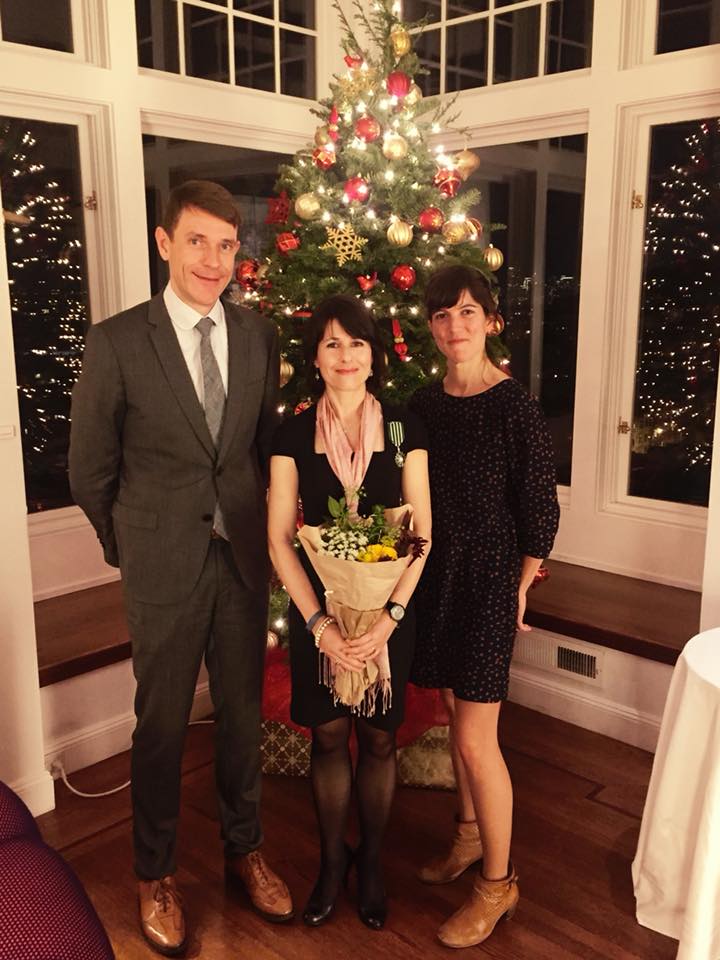
Consul General Emmanuel Lebrun-Damiens, Cécile Alduy, and cultural attaché Juliette Donadieu (Photo: Anaïs Saint-Jude)

Lebrun-Damiens noted that the order was created in 1957, and strongly supported by André Malraux when General de Gaulle created a Ministry of Culture for France in 1959. Then he praised Cécile.

“At the core of your work, you specialized in analyzing and deconstructing the notion and origins of the myth of national identity,” he told her. “You have used your exceptional artistic, aesthetic, and analytical sensitivity towards expanding artistic, political, and cultural horizons.”

“As a young researcher at the Ecole Normale Supérieure, you decided to dedicate your thesis to great Renaissance French poets and to study how they shaped the notion of national identity through their creative writing. Following that path, you eventually exceeded your original academic discipline – literature – and shifted towards contemporary political analysis, with a particular interest for the ideology and rhetoric of the French extreme right,” he continued, acknowledging her articles in The Atlantic, The Nation, The New York Times, Le Monde, and others.

Cécile’s children also attended the celebration, and gamboled with a few others in the room where she received the small green-and0white striped ribbon and medal. Their participation was fitting and significant: it highlighted the theme of generations that informed both her remarks and those of the General Consul: Lebrun-Damiens noted the role of both her grandmothers. Her paternal grandmother, Jacqueline Alduy, was the mayor of a little town Amelie-les-Bains in the Pyrénées-Orientales, holding the office for 42 years until age 77. “As a woman of convictions, she was especially proud of your work on the extreme right and the analysis of Jean Marie and Marine Le Pen’s discourse,” he added.

Her maternal grandmother figured not only in his remarks, but in hers.  Excerpt below:
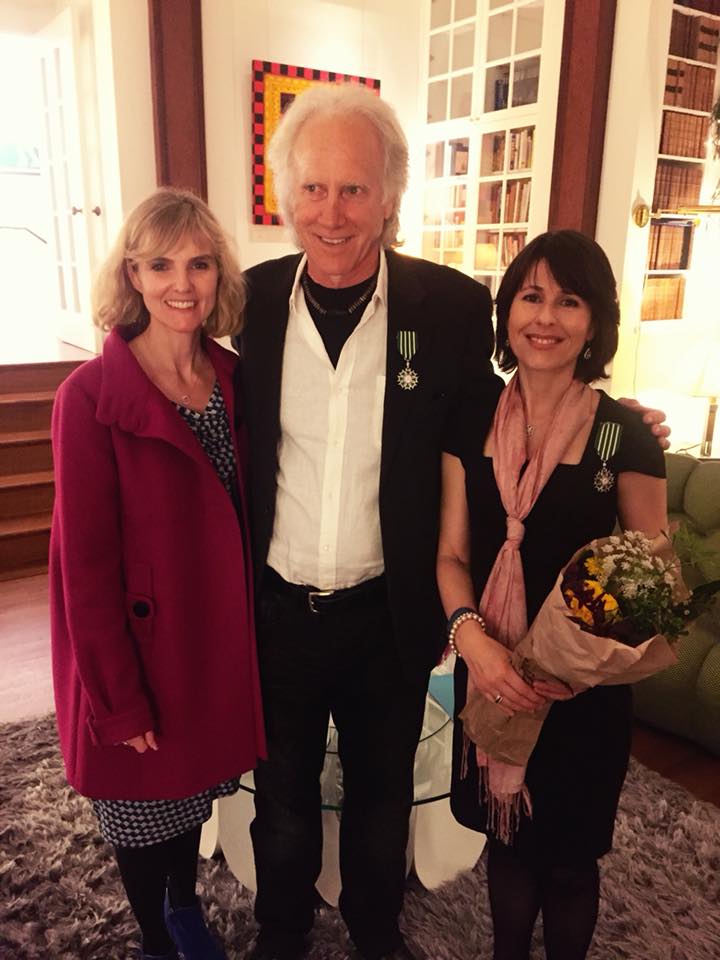
Three Stanford chevaliers: Marie-Pierre Ulloa, Robert Harrison, Cécile Alduy. (Photo: Anaïs Saint-Jude)

My first thoughts go to those who instilled in me the sense that literature matters, that beauty matters, that the arts matter, more maybe than anything else. That they are not just the salt of life, a little extra spice or pastime, but rather the soul of the human experience, what makes us uniquely, truly human, what keeps us alive, that by which we might be redeemed as a species, and as individuals.

You named already some of the benevolent figures who imparted on me a love for words: my maternal grand-mother, Madeleine Daumas, a bookseller at one point, a typist who copy-edited the numerous books of her husband, but mostly an avid, yet quiet, composed reader. She read and re-read start to finish all the works by Racine, Montaigne, Balzac, Stendhal, Perec, Butor, Claude Simon, Steinbeck, Nabokov, Faulkner, Julien Greene, Kundera, Philippe Labro, Sollers, Yourcenar, de Beauvoir, John Le Carré, Simenon, Michel Serre. Each Christmas, we counted not the gifts, but the number of pages to read she had received. She was the first to read my first poems, short stories, essays, thesis… (and knowing she was made me pay scrupulous attention to spelling) …

In her family, her parents made “arts and literature and cinema the normal thing we do as a family, like going outdoors or watching the news. Yes, I have to admit that I was not always a happy camper after hours walking through the Pompidou museum staring at contemporary art installations, or visiting Greek ruins under a 110 degrees sun in the Summer. But thanks to them I learnt how to see: colors, and light and shadows; I learnt the shape and tastes of cultures close and far.”

An added bonus: the tree…

Then she spoke of the mission of the chevalier: “enriching French culture is not a matter of celebrating ‘roots’ and ‘land’ as the nationalist rhetoric goes, that culture defies borders and fructifies anywhere, everywhere, that arts and letters and the values they embody not only travel but flourishes by contact, migration, pollination.”

“If anything, this medal and this city rewards the work of bridging, of crossing boundaries (national boundaries but also the boundaries of academic disciplines and methodologies), of traveling across cultures and languages, of being on the move and in several places and cultures at once.

“At a time when borders and walls are erected, I am extremely proud to declare myself a migrant, an immigrant, a bi-national, and a citizen of the world.”

It was, she said, not an achievement as much as a beginning: “a peaceful military draft of sorts, a call to arms to resist the spoliation of our common right to a world where words mean what they say, where principles apply, where cultures are respected and humanistic values upheld.”

…and the flowers

“Being called to become a Knight in the Order of Arts and Letters is less a recognition of past works than an invitation, a request really, to fight for the arts and literature: it’s a call to arms to defend with the means of sharp thinking, and eloquence, and sensitivity, and aesthetic form the value of artistic creation, which is another word for the work of being human.”

With the beautiful decorations for holidays, there was plenty to please everyone. Only one expressed mild disappointment. Her four-year-old daughter asked a thoughtful question: if her mother was now a chevalier – where was her sword?