

 Come back, Ovid! All is forgiven! Whatever you did!
According to a report from ANSA, the Rome city council yesterday revoked the Emperor Augustus‘s direct order exiling the poet from the city. It’s a little late: the poet died 2,000 years ago, in the year 17 or 18 A.D. He was between 58 and 60 years old.
The motion came from the ruling anti-establishment 5-Star Movement (M5S), which said it wanted to “repair the serious wrong suffered” by Publius Ovidius Naso, the the author of the Metamophoses and the Art of Love.
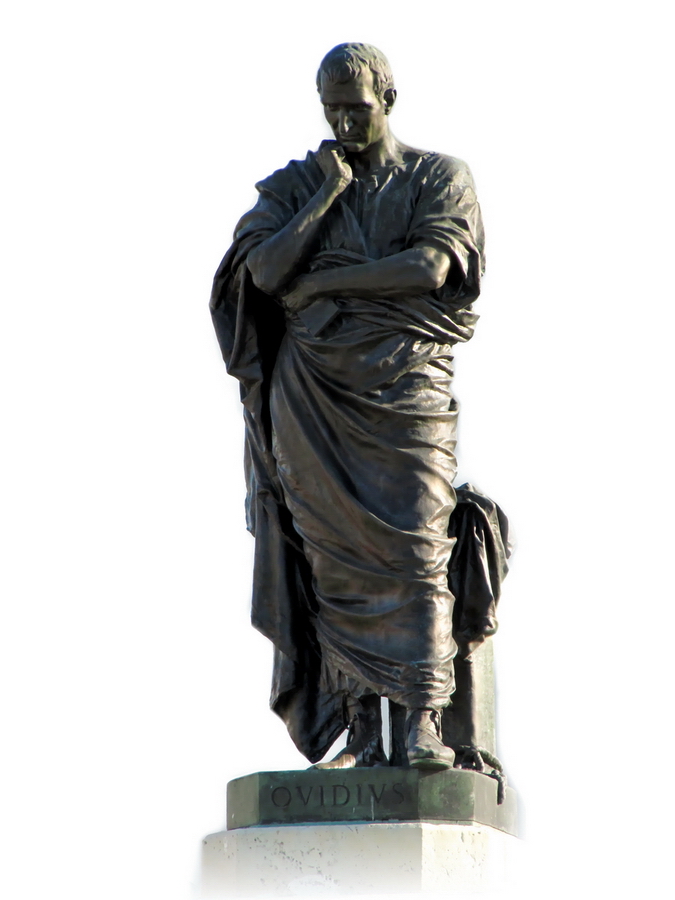
Ovid, one of the three canonical Roman poets along with Virgil and Horace, was exiled to a remote Black Sea town, Tomis, in today’s Romania, in 8 AD, in one of the mysteries of literary history. [Ettore Ferrari’s statue of Ovid in modernday Constanta at right.]
Ovid himself attributes his exile to carmen et error, “a poem and a mistake,” but his discretion in discussing the causes has resulted in much speculation among scholars.
According to a local website, the council unanimously approved the motion, which calls for “necessary measures” to be adopted to repeal the exile order, Repubblica reported. However, only the M5S took part in Thursday afternoon’s vote.
Rome’s deputy mayor and councillor for culture Luca Bergamo said the decision was “an important symbol because it’s about the fundamental right of artists to express themselves freely in a society in which the freedom of artistic expression is more and more repressed”.
Ovid has previously been acquitted by a court in Sulmona, the Abruzzo town where he was born, which passed its verdict onto Rome authorities.
Ovid wrote several poetry collections describing the pain of banishment. I wrote a little about this in my 2011 Kenyon Review piece about two other exiles, Nobel poets Joseph Brodsky and Czesław Miłosz:
According to a legend, Ovid wrote poetry in the language of the Gatae during his long exile on the Black Sea coast. “Brodsky would be an heir to that tradition, although his exile was not as dramatic as that of the Roman poet” (242), [Irena] Gross writes. She suggests Ovid may have been a literary “genotype” for Brodsky (285).
The pattern of Ovid, exiled for nobody knows what, may have absorbed Brodsky even earlier than generally supposed. I remember the poet in a melancholy mood in 1975. He asked me if I had read Ovid’s Tristia. I hadn’t, but got the book from the University of Michigan library, eager to please him. It’s still with me, with its sedate green cover and dog-eared edges, with exiled Ovid keening:
I am a Roman poet—forgive me, my Muses, forgive me—
. And I am forced to say many things in Sarmatian speech.
(Book vii, 11. 55-56)