Michel Serres calls for a strike – against the English language

Share
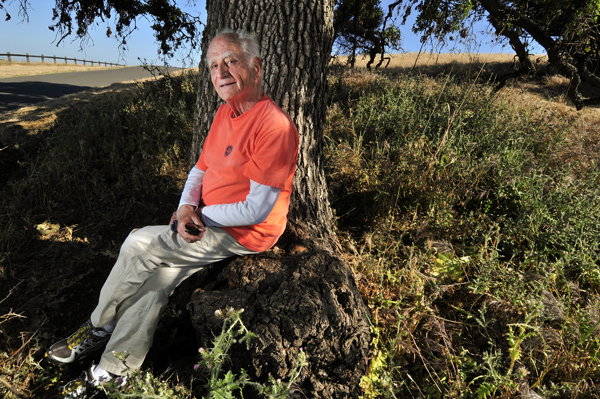
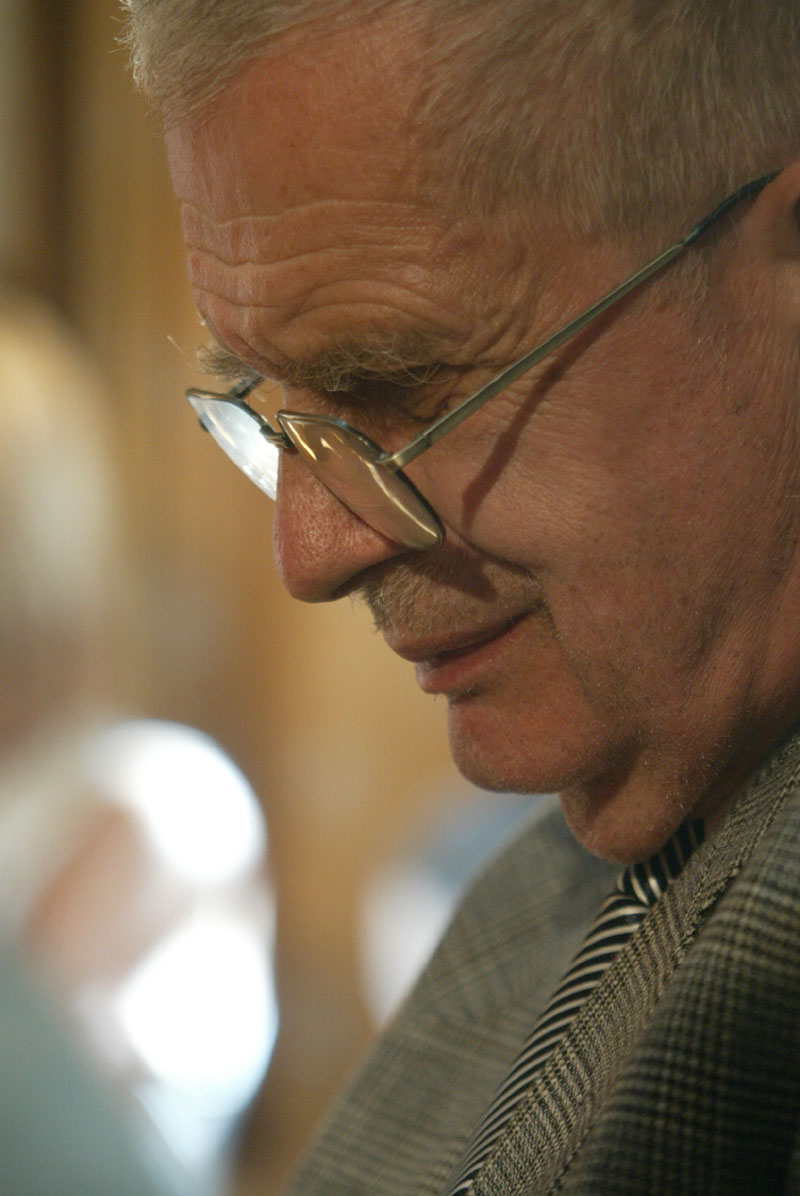
Resident Socrates (Photo: L.A. Cicero)

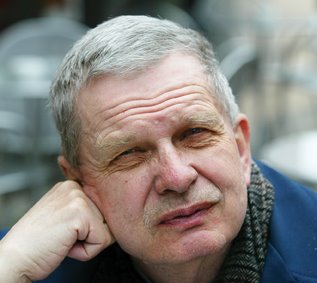
In quieter times (Photo: L.A. Cicero)

The French have always been protective of their language against the foreign invasion of words.  “Weekend,” “internet,” “football” make their regular incursions against the proud tongue of the Gauls, and are repelled, with mixed results.

Now France’s preeminent public intellectual Michel Serres (we’ve written about him here and here) has joined the fray.  In today’s Telegraph:

“There are more English words (in adverts) on the walls of Toulouse than there were German words during the Occupation,” said philosopher Michel Serres, a member of the Acadamie française [sic], the state body which aims to protect the French language.”

“I want to invite the French to go on strike. Each time that advertising is English, you don’t buy the product, each time a film’s title is not translated, you don’t go into the cinema,” he said in an interview with la Depeche du Midi newspaper.

The spelling error in a leading British newspaper makes a good case for the English taking a few more French classes – and when, oh when, will foreign diacriticals be an established style rule for newspapers?  It looks so insular when we refuse to honor the spelling of foreign names.

In any case, one Englishman fired back:

Stephen Clarke, the Paris-based English author whose novel The Merde Factor sees its hero battling with the anti-Anglais brigade, wrote a stinging reply to Mr Serres’ boycott call in a blog for the Telegraph:

“It is pretty thoughtless to compare advertising posters that we are free to ignore completely with Nazi proclamations informing people that they will be shot if they are found out of doors after curfew or sent to death camps if they belong to certain ethnic groups.

He’s threatening retaliation – a ban on all French words and expressions on the other side of the Channel.  No more gâteau for the English. Let them eat cake!

Meanwhile, here on the Pacific, Humble Moi had the honor of catching Michel Serres for one of his very rare English interviews – in fact, it’s the only one I’ve been able to find online:

Congratulations to Morgan Meis for the Whiting Award!

Share
morgan

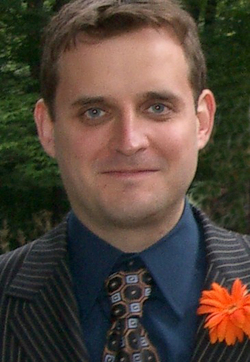
Happy man … and kinda rich, too.

Congratulations to Morgan Meis, a longstanding friend of the Book Haven!  He’s one of ten winners of this year’s Whiting Writing Award for “exceptional talent and promise in early career.” The prize carries a significant cash award of $50,000 – so he’s in clover…at least for awhile.  Morgan is the author of a novel, Angelus Novus (Soft Skull Press, 1995), and has written for The Believer, Harper’s, and each week for The Smart Set.  We know him mostly as an editor of 3quarksdaily, a filter blog treating literature, science, and the arts. He is a previous recipient of a $30,000 Andy Warhol Foundation Award for his art criticism.

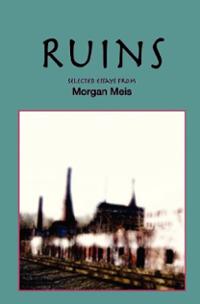
This year’s winners include: fiction writers Hanna Dela Cruz Abrams (The Man Who Danced With Dolls), Jennifer DuBois (Cartwheel) C.E. Morgan (All the Living),  Stephanie Powell Watts (We Are Taking Only What We Need), and Amanda Coplin (The Orchardist);  poets Ishion Hutchinson (Far District: Poems) and Rowan Ricardo Phillips (The Ground) and playwright Virginia Grise (Making Myth). Clifford Thompson (Signifying Nothing) received the award for nonfiction, as did Morgan, who is author of this year’s Ruins (Fallen Bros. Press), a collection of the best essays from one of America’s best and most poignant, personal and philosophical young critics, Morgan Meis Ph.D, on art, culture, politics and the transitory and illusory nature of time.”

ruins-revised-edition-morgan-meis-paperback-cover-artThe Whiting prizes were established in 1985 by the Mrs. Giles Whiting Foundation. According to the foundation, the award honors those “who have yet to make their mark on the literary culture.’’

Previous winners include Tony Kushner, who hosted the ceremony tonight in Manhattan,  Jonathan Franzen, and Mary Karr.

Afterwards?  I hear there’s some serious partying going on at the offices of the New York Times.

Postscript on 10/22:  No surprise, 3quarksdaily has its own announcement, with a pitcha, here.  It also informs me that Elif Batuman, Mark Doty, Jeffery Eugenides, Suketu Mehta, William T. Vollman, and David Foster Wallace are former winners.  Good company.

Back in the U.S.S.R.: Carl Proffer, Ardis, and an “eleven time zone prison”

Share
proffers

The basketball player who bootlegged books … with Brodsky and Ellendea

Last month, the University of Michigan commemorated two of the most remarkable people to cross the campus threshhold: the late Prof. Carl Proffer and his wife Ellendea Proffer Teasley, founders of the exuberant and trailblazing Ardis Publishers, which published the best Russian literature at a time when the Soviet government wouldn’t.  I’ve written about them here and here and here and here, as well as many other places over the last few decades, ever since the time I met them in the erstwhile Ann Arbor country club they had turned into a publishing house (as well as a family home with four kids).  I wasn’t at the September symposium, except perhaps in spirit.  Fortunately, the event left a welter of videos in its wake.  In one of them, Ellendea described, in 27 minutes, the intrepid  venture that was Ardis.

The young Carl Proffer was a longshot for a Slavic scholar, she recalled – a teenage basketball player who was more likely to become a lawyer rather than scholar, someone who never ventured beyond the required reading list. He discovered Russia through a casual interest in Cyrillic, which led him to a mentor – a distinguished Byzantine historian émigré who had been tethered to teaching a first-year Russian language course for the university.  “Then this man, meant for other things, this basketball player with a fancy prose style, fell in love with the literature,” said Ellendea.  That was sophomore year – junior year gave him the Scottish enlightenment and the gifts of persuasion.  He attended St. Andrew’s in Scotland, which runs on a tutorial system, and discovered philosopher David Hume.  “This was an amazing awakening. The basketball player became an intellectual, but not a normal one.”

“He was a person of high risk – captain of the team. … He was afraid of nothing. He could control his temper and his indignation. The rest of us could not; we were very young,” she recalled.  “Everyone he came into contact with went into Russian, too, because he spread the word. His philosophy was spreading the word … He was the first PhD candidate from Michigan. They built the program around him. He became the youngest full professor in 1972.”

ardis

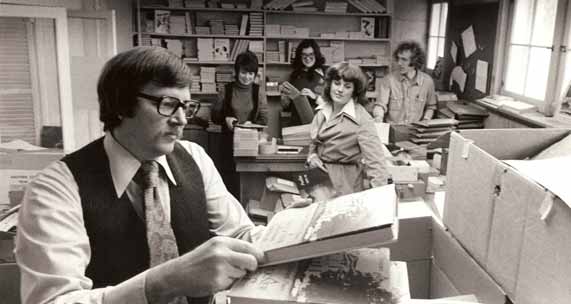
Carl and Ellendea at Ardis

Perhaps the biggest chance he took was with a pretty girl in a miniskirt. “It was easy not to take me seriously if you didn’t know me well,” said Ellendea, who was six years younger.  “He not only took me seriously and married me, but he made me a full partner.”  Every decision was made jointly, and she continued Ardis after his 1984 death until 2002, when Overlook Press acquired Ardis.  She received a MacArthur “genius” award in 1989.

“Carl could type 110 words a minute – that was important. Ardis was built on our bodies.  We used up our energy, and his energy was phenomenal.”  The venture was a dangerous one, and bootlegging manuscripts risked arrest and worse. They faced other dangers in the U.S.:  “We got no money from anyone. We lived on a knife edge – mortgaging our house every year.”

“We walked a razor’s edge, and he was cool,” with an important exception – “and this is where we get to the ‘why’ of Ardis,” she said.

The plight of their friends, the literary heart of Russia, left Carl in “absolute cold, angry outrage – destructive outrage.” She continued, “Our people, they wanted one book, they were writing a monograph and wanted one book on Toulouse Lautrec, they wanted one book on Shakespeare. … They knew so much, so many languages but never left this damn country, which was really an eleven time zone prison … We saw people like us, behind bars, and sometimes they were having to kiss their own chains and say, ‘It’s nothing. It’s great.’ It was no kind of life.  … This was our mood when we come back. We were enraged at what has happened to these remarkable people. Nadezhda Mandelstam with four locks on her door. It’s 1969, but she’s still afraid.  She said, ‘Don’t bring young people to me because they are the worst. They are the informers.'”

She described Soviet-era Russia as “a thin crust over a big volcano of peasant emotion, under the control of the gun and the whip. And that thin crust was a deep, rich, powerful culture to us.  Not just literature – music, art, dance.”“

The Proffers dressed up to meet their Russian contacts, but they choose to dress as Americans, not to emulate the proletariat or the Russian intelligentsia, since they were neither.  “We would be American, because the Russians were starting to think, ‘Oh, the whole world is like this.’ Visually, we would contradict that idea.  Because it’s easy to go into despair when you’re in jail for 70 years.”

“I want you to consider the daring, the nerve of him. He had daring, but he never said, ‘Now I’m going to jump from the high dive’ –  he just did it.  We were people of action, that is certainly true. … We were moving very fast because Carl, like [Joseph] Brodsky, did not think he had a long life ahead of him.”

I was there in spirit, and you can be, too – videos of the event are here.

Tomas Venclova speaks at the EU about his mother tongue and an “eccentric, capricious city.”

Share
t.venclova

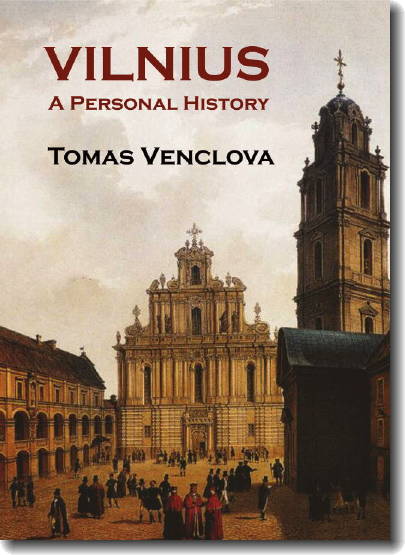
Tomas in Vilnius

I met Tomas Venclova in his role as a poet, and it is primarily as a poet he is known.  However, he has a lesser-known role as a champion of Lithuanian culture, literature, and above all language. His work in that arena is as impressive as his poetry – and he had a chance to show it at the European Union yesterday and today, in Brussels and Luxembourg, where he was speaking.  I asked him if I could share some of his remarks, which he had sent to me. “Mais oui!” he replied.

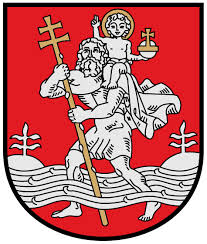
I’ve blogged so much about Vilnius and Lithuania – try here and here and here and here and here. But it’s a wonderful country and during my most recent visit, traveling from Warsaw to Vilnius, I gained a deeper appreciation of its wildness and mystery, of its old superstitions and myths, and the enchantment of  its jewel-box capital, aptly symbolized, on its coat of arms, by Saint Christopher wading through the mud of history.

The Lithuanian language has has kept many archaic features of ancient languages such as Sanskrit or Ancient Greek, and is spoken by about 3.2 million people. Yet, as Tomas pointed out, it’s in better shape today than Gaelic – “now, it is not just the official state language, but also the language of schools, universities, press and other media, as well as of very good theaters. Even before World War I, Lithuanian literature in Vilnius had built quite a reputation, though during the two interwar decades, when the city was annexed to Poland, it was often dismissed as inferior.”

Marvelous Vilnius, a Jerusalem claimed by two nations, the Lithuanians and the Poles, is “the perfect and sacred city which had been lost in the whirlwinds of history,” he said.  The city, which at times almost a religious space, “is often said to be mysterious and magic, eccentric and peculiar, the inspiration of myths and poetry. A particularly strong connection between the city and its surroundings is also very characteristic to it, allowing poets to see Vilnius as a pastoral place with ‘wild’ but idyllic nature intruding into the city center and adorning its baroque décor. … The text of Vilnius is composed of smaller texts, written in different languages, sometimes rich in code-switching, as for instance the seventeenth-century dramas, where Lithuanian and Belarussian cues are interwoven with Polish ones.

“But there is more than just linguistics involved here. Most varied cultural discourses overlay one another, letting competing myths sprout from the primeval mythological trunk. The national identity of many residents of Vilnius is similarly complicated: the same person can simultaneously belong to several cultures, which is why she or he sometimes stands aloof from the rest of society, suffering from an inner conflict.”

Two of the Polish language’s greatest poets were born and reared in Lithuania: Czesław Miłosz in the 20th century and Adam Mickiewicz in the 19th – and Miłosz was a close friend of the Lithuanian-language poet.  Venclova’s talk wasn’t short on his friend:
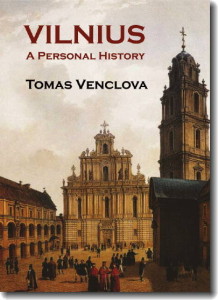
vilnius3“Czesław Miłosz, the greatest Vilnius poet of the twentieth century, also started his career in the interwar period … The life of Vilnius-Wilno (at that time, annexed to Poland) did not change much from Mickiewicz’s to Miłosz’s times; the city and its suburbs were populated by the same provincial Polish gentry, known as szlachta, the memories of the free masons’ lodges were still alive, and the great University, closed by Tsarist Russia in 1832, was reopened in 1918. Thus, the budding poet could readily feel he was entering a larger tradition. But for Miłosz, Vilnius was not a sanctuary to visit on a pilgrimage; nor was it a place asking for a particular literary genre to record its magnificence, namely, the poetic Baedeker, much exploited by the lesser poets of the time. Miłosz was not a regional but a European poet, as was Mickiewicz. According to him, the Mickiewicz tradition marked a revolt, a disagreement with reality as well as the prospect of exile. But for him, too, Vilnius-Wilno was a sacred city. Finding himself in exile in 1950s, he denied feeling nostalgic: he wanted to start anew and to build his poetic tower without looking back. Yet his texts soon acquired a double perspective: he would depict the city of his youth through the prism of his new French and American experiences, reviving the details of the past life with heartfelt love and skill, and contrapuntally comparing Vilnius to his new surroundings. He recreated the city spaces in the Proustian manner: his city is idealized because of his physical and temporal distance, but the picture is realistic enough and devoid of unnecessary sentimentality. In the cycle Miasto bez imienia (City without a Name) published in 1969, as well as in other poems, Milosz was approaching what he himself called apocatastasis, the revival of purified, primordial reality. He was greatly, probably mainly, interested in the language of that reality. In this, an obvious example and archetype for Milosz was Mickiewicz, but also the Lithuanian Konstantinas Sirvydas, the author of the seventeenth-century dictionary, to whom Miłosz devoted his beautiful poem ‘Philology.’

 “The peak of this poetry is manifest in the poems written after the restoration of Lithuania’s independence, when Miłosz could return to it. Nostalgia acquires a new shape: 52 years later, Vilnius looks like a city of the dead and Lithuania is some ‘other space’ described in metaphysical categories. At the same time, nothing has disappeared from the landscape of Vilnius: Miłosz sees the same ‘forests of brown gold’ in October, when the weather, again, is like wine, and the familiar hills and twisted baroque gables whisper that everything passes but are also witnesses to the permanence of the world, resurrected in human memory.

vilnius2“Miłosz and his companions were interested in the history and culture of the ethnic communities which had their own right to the city, namely, the Lithuanians, the Belarusians and the Jews. Together with a friend, he translated the works of the Lithuanian poet Kazys Boruta and wrote reviews of twentieth-century Lithuanian literature, his lifelong interest. In some ways he considered himself a Lithuanian who wrote in Polish; I remember how happy he was when Lithuanian translations of his poems were published before the Polish originals.”

“Miłosz possessed some knowledge of Lithuanian, just as Yeats possessed some knowledge of Gaelic,” he said – but that’s a bit of an overstatement. Miłosz was born among Lithuania’s Polish-speaking gentry, and didn’t bother to learn the language, even though he had a ethnically Lithuanian grandmother. Robert Hass said he began learning the language instead when Miłosz was in his 80s. Why bother so late?  “Because I think it might be the language of heaven,” he confessed to Hass.
vilniusDespite attempts to make Vilnius a truly national city, Tomas said, “the Lithuanian capital has remained what it had always been―complex and multidimensional, a continent in miniature. But this is a fragile condition, and we are responsible for it.”

“The creation of our continent and our civilization has always been a duty, an uncertainty, and a risk. I don’t know of any place in Europe that better lives up to this risk than Vilnius―a perpetual peripheral area and borderland, an eccentric, capricious, erratic city with a unique past that violates all the rules of logic and probability.”

 

Fame, I guess. My minute on Moscow TV.

Share
"Above all, love language" (Photo: Dylan Vaughan)

Tomas started it.

It’s a kind of fame I suppose, but centered thousands and thousands of miles from where I live. I’ve written about the Stanford Libraries exciting acquisition of a stunning treasure trove of drawings, poems, photographs, samizdat manuscripts and more from the Nobel poet Joseph Brodsky.  The story began in Vilnius, when I was visiting a friend of the eminent Lithuanian poet Tomas Venclova, the physicist Ramunas Katilius and his family. I told that story here.  The news was picked up by the Russian press – I wrote about that here.

Then a Russian TV station wanted to film the collection for its Moscow viewers.  See below.  Did I flunk my screen test?  My career in Slavic film-making – over before it began!  But working with the handsome young Russian videographer and photographer Grigory Rudko was great fun.  Enjoy the clips of Stanford, the Libraries, the Katilius Collection, and, if you can, Humble Moi.

Yes, yes, I know it’s in Russian. Please stop complaining.  You can read the whole story in English here – or in Russian, over here. And I’ll try to get that fractious look off my face in the screenshot below. (Postscript on 10/17: Fixed the screenshot! Enjoy my hand instead – it’s better than my scowl. Really.)

Happy 90th birthday, Italo!

Share

calvinoThe Italian writer Italo Calvino would have been ninety today.  Happy birthday, wherever you are…

“In an age when other fantastically speedy, widespread media are triumphing and running the risk of flattening all communication onto a single, homogeneous surface, the function of literature is communication between things that are different simply because they are different, not blunting but even sharpening the differences between them, following the true bent of the written language.”

birthday cake

– Italo Calvino (Oct. 15, 1923–Sept. 19, 1985)