Two Gioias for the price of one: on family, religion, the arts … and Stanford, too

Share
gioia

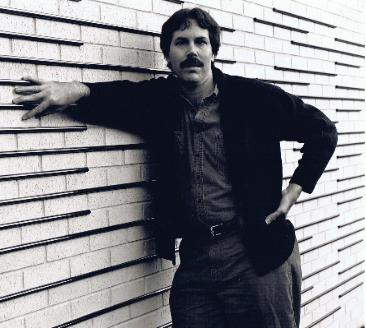
Tireless advocate of the arts, Dana Gioia (Photo L.A. Cicero)

Dana and Ted Gioia are two of my favorite people – but I haven’t had the opportunity to see the jazz scholar (Ted) and the poet (Dana) together.

So journalist Andrew Sullivan brought them together for me, or rather brought my attention to those who have brought them together.  Sullivan, who has been a friend of the Book Haven in the past, mentioned this quote from Ted in his recent post “Finding Sustenance for the Soul”:

“Those committed to a spiritual life understand what popular culture hasn’t yet learned (or is afraid to admit)—namely that the hunger of the soul cannot be satiated with sugary sweets and shallow entertainments.  Somewhere along the way, many people got the idea that the religious sphere and artistic sphere are at odds with each other.  I believe the opposite is true.  Both the arts and spiritual discernment broaden our perspectives and enrich our lives, and in very similar ways.

Ted_Gioia

All that jazz from Ted Gioia

“This was the single greatest lesson I learned from my years studying philosophy at Oxford—namely that the pervasive empiricism of modern life, which only accepts what it sees and quantifies, is ultimately a brutish philosophy.  The most important things in life cannot be seen with the eyes or measured with charts and numbers.  They are love, trust, faith, friendship, forgiveness, charity, hope, the soul, and the creative impulse.  You cannot live as a human without these, although you can’t even prove scientifically that any one of them actually exists.  They are metaphysical (a word used as an insult by my philosophy teachers, but their scorn was mistaken, in my opinion). To embrace these crucial aspects of our life, we must turn to art and religion. This hasn’t changed in the last two thousand years.  Nor will it change in the next two thousand years.”

Now I will bring them together, too, in this post.  You can read the rest of their interview on faith, family, the arts, the humanities, and, yes, Stanford (including its jazz), “The Arts—Agents of Change and Source of Enchantment,” here.

Nobel laureate Mario Vargas Llosa in Manhattan

Share
MVL_©_zygmunt_malinowski

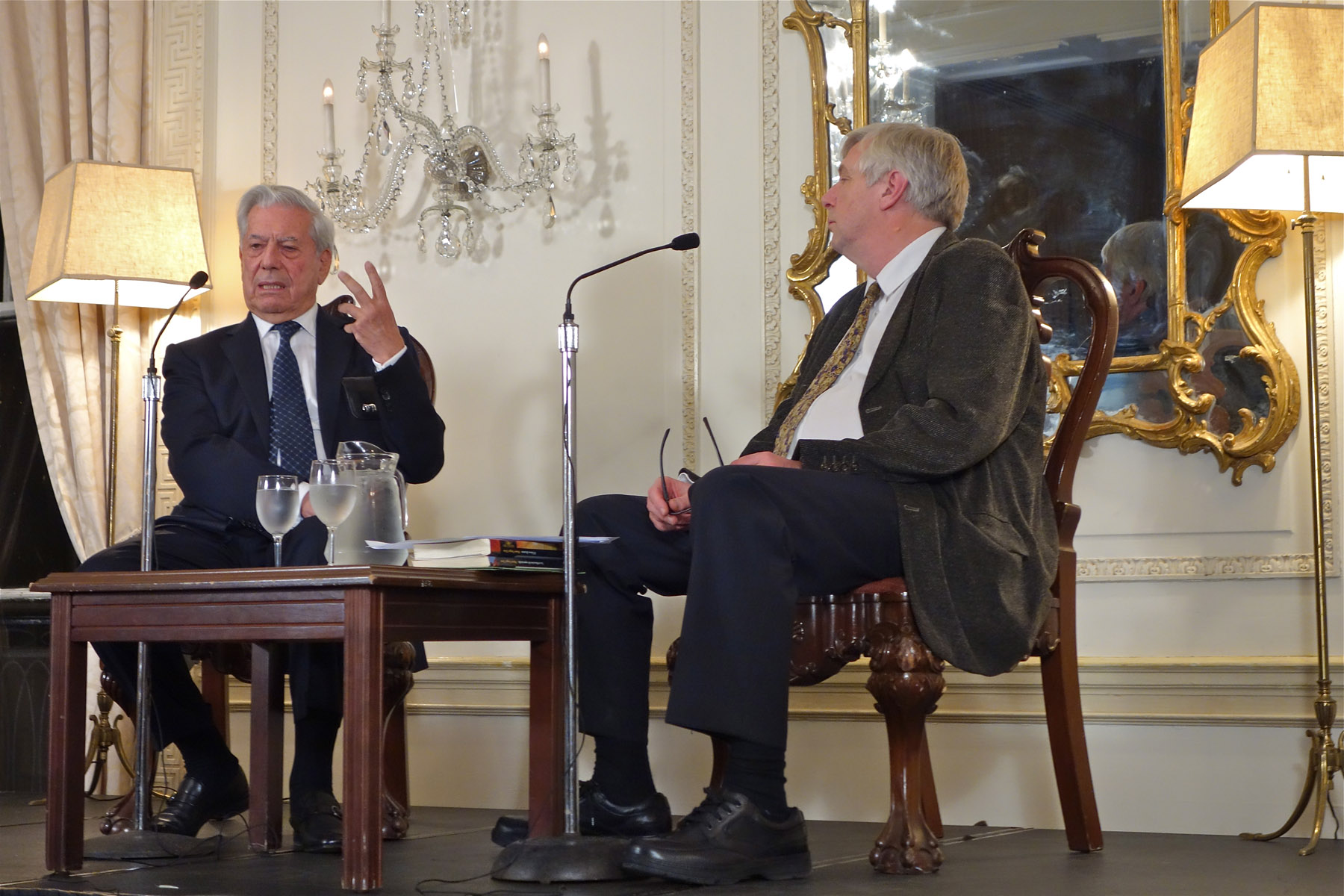
Mario Vargas Llosa in conversation with the leading Mario Vargas Llosa expert (Photo: Zygmunt Malinowski)

My favorite Polish photographer, Zygmunt Malinowski, sent me his photo of the November 7  evening with Nobel laureate Mario Vargas Llosa and John King, who is co-editor, with Efraín Kristal, of The Cambridge Companion to Mario Vargas Llosa and translator of several volumes of his essays.  And isn’t that room gorgeous? It’s the Americas Society in Manhattan. And don’t we all wish we lived in Manhattan?  Except for the weather … and the traffic… and the noise…

Vargas Llosa has also been awarded the Cervantes Prize, the Spanish-speaking world’s most distinguished literary honor; the Jerusalem Prize; and, most recently, the Carlos Fuentes Prize, among many other honors. His most recent novel is 2010’s El sueño del celta [The Dream of the Celt].  Vargas Llosa expert John King is on the faculty of the University of Warwick.

Zygmunt wrote in his email: “Having been to Peru several times on expeditions, I can say that Vargas Llosa captures that mysterious and fantastic Andean country like no other writer. He also publicly supported Solidarity back when that support meant so much.By the way, one of the questions after the discussion was: what are his thoughts regarding modern media (e-books, tablets) versus printed material – that is, books for the future, in about 10 or 20 years? His answer was that he hoped both would co-exist and that television/media is great for information and entertainment, but according to him, it was not capable of producing great art (such as War and Piece, Don Quixote, Ulysses). His concern was that ‘literature written exclusively for tablets may produce the kind of cultural objects that television produces’ and, if so, ‘literature would be impoverished.'”

John Hennessy likes big fat books.

Share
literature_hennessy-1

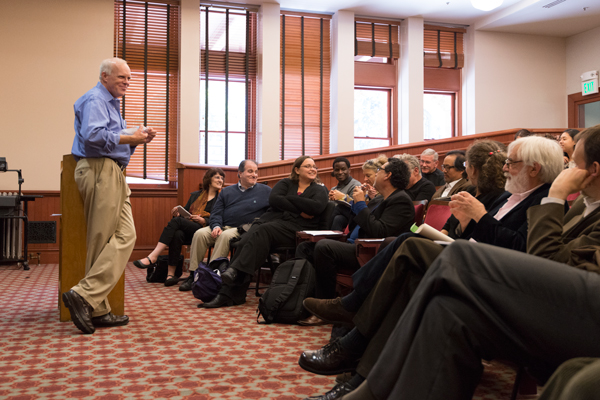
Love’s much better, the second time around: Stanford prez on the joy of rereading books. (Photo: L.A. Cicero)

Stanford prez John Hennessy is famously techie, right?  Here’s the surprise: the former computer scientist also likes ploughing through the big-hearted, super-retro, thousand-page classics of the 19th century. “I like sagas, a big story plus decades,” he confessed to a good-sized crowd at Piggott Hall last week during an exuberant, free-wheeling talk on “Why I Read Great Literature.”  You know the books he means: the kind that gets turned into a year’s worth of BBC Masterpiece Theatre viewing.
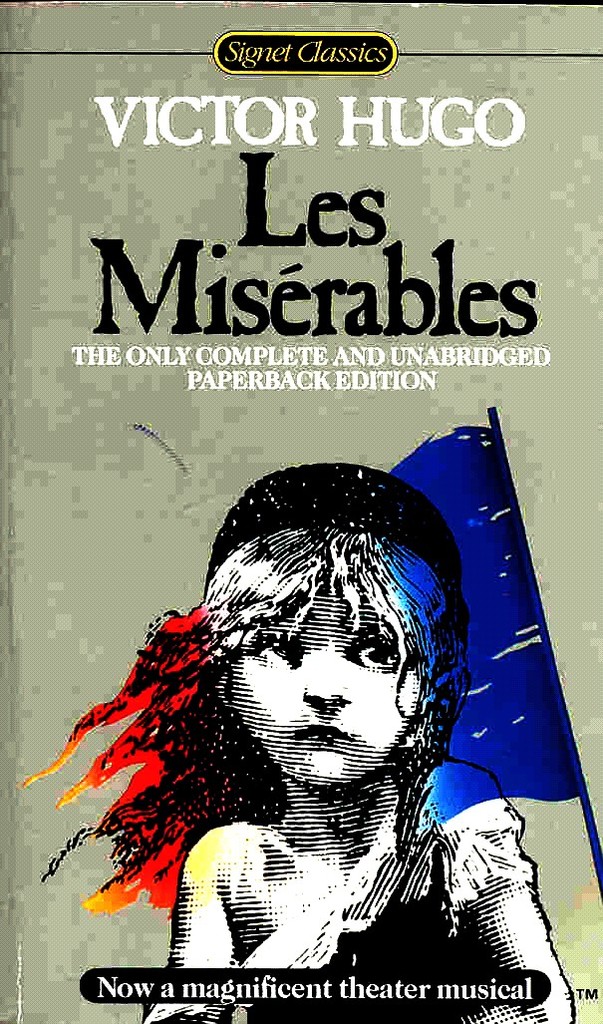
les_miserables_bookHe’s clearly a man after my own heart – he singled out Victor Hugo‘s Les Miserables for particular praise, saying that he’s read the whole shebang several times. This is comforting to me personally, after watching René Girard, that anti-romantic sage and immortel, politely squelch a smirk when I told him of my childhood adoration of the book.

For Hennessy, an apparent turning point in his reading tastes occurred the summer before he entered high school – an over-the-vacation reading assignment that somewhat parallels Stanford’s Three Books program.  Clearly one of the books took hold of his imagination:  he’s read Charles Dickens‘s A Tale of Two Cities several times since.  And although he wasn’t up to reciting the magnificent 118-word opening sentence last week, he did refer to it: “It was the best of times, it was the worst of times, it was the age of wisdom, it was the age of foolishness, it was the epoch of belief, it was the epoch of incredulity, it was the season of Light, it was the season of Darkness, it was the spring of hope, it was the winter of despair, we had everything before us, we had nothing before us, we were all going direct to Heaven, we were all going direct the other way – in short, the period was so far like the present period, that some of its noisiest authorities insisted on its being received, for good or for evil, in the superlative degree of comparison only.”

How many books are enclosed by an immortal first and last sentence? Hennessy had better luck reciting the the famous close:  “It is a far, far better thing that I do, than I have ever done; it is a far, far better rest that I go to than I have ever known.”
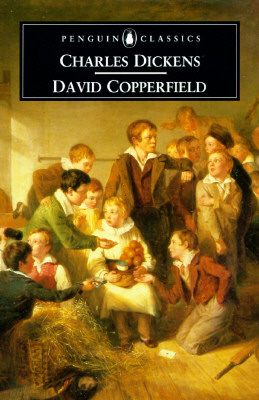
copperfieldDickens “has proven enough times that I could read anything he writes,” said Hennessy. “He grapples with Victorian England, social injustices, a system that obviously tramples on people.”  As for nasty schoolmaster Squeers, in Nicholas Nickleby: “If I ever met him, I would be forced to shoot him,” said Hennessy.  These books ask, he said, “How would I have approached that situation? What would I have done?”  Now we know. Hennessy would be compelled to commit homicide.  Fortunately, fortunately, Squeers must have died in Australia at least a century ago, presumably of natural causes.

Hennessy’s love for Dickens includes the worthy chestnut A Christmas Carol, which he rereads during the holiday season. As for David Copperfield, he gleefully quoted Mr. McCawber; apparently it’s one of his favorite lines: “Annual income twenty pounds, annual expenditure nineteen [pounds] nineteen [shillings] and six [pence], result happiness. Annual income twenty pounds, annual expenditure twenty pounds ought and six, result misery.” Well, that’s the techie in him.  Throughout the talk he kept presenting numbered lists of thoughts – he likes counting.  I always wonder how you know that, when you say you have five points to make, it’s going to stay five points, and not meander into seven.  Or you’ll forget one and have only four left.  He seems to be good at keeping track.

Like many a young ‘un, he was frogmarched to the great classics.  Some books are not wise choices for teenage boys – Fyodor Dostoevsky’s Crime and Punishment, for example. “I wasn’t up to it. It was too deep, too much angst to it. High school angst is different.”
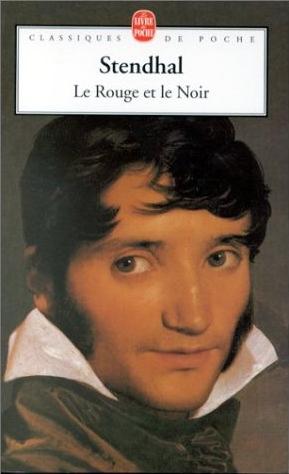
stendhal_5136“An author I was tortured by in high school was Edith Wharton,” he recalled pensively.  The inevitable high-school staple, Ethan Frome – it’s mercifully short, after all – was “not the right book for high school guys.”  What kid wants to read a tragic story of wasted lives?  They say love is much better the second time around – so it seems with these reheated feasts.  He’s warmed to Henry James, too, despite a premature exposure to “Turn of the Screw.”

I couldn’t agree more with his overall point, but I think the first exposure, however flawed, is important.  I’ve just rediscovered Stendhal in a big way after reading it in high school and finding it a little too cold-edged and cynical for my delicate teenage sensibilities.  It didn’t help that the class was reading it, for the most part, in French (we all cheated and found translations, of course – I now find it amusing that we thought Mademoiselle Vance didn’t expect us to do this). René Girard definitely approves of this late-life conversion to Stendhal.  I’ll have to have another go at Rabelais now, too.  These classics, reread at ten-year intervals, resonate within us at different layers of experience, but you do need a prime coat.

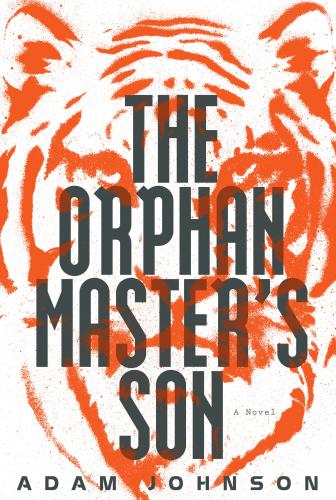
Hennessy’s passion is not restricted to Golden Oldies, or reheated feasts from early class assignments – he included some more recent fare in his endless list.  “Sometimes fiction is better at telling a story than non-fiction,” he said, citing this year’s Pulitzer prizewinning book, The Orphan Master’s Son by Adam Johnson (we’ve written about it here and here and here and, oh, lots of other places).  He also cited Arundhati Roy‘s The God of Small Things and Aravind Adiga‘s White Tiger, which helped prepare him for trips to India a few years ago.  Where does he get the time? Clearly, he doesn’t watch TV – I wrote about that here.
Orphan_Master_s_SonSepp Gumbrecht, author of In Praise of Athletic Beauty, offered what he called “the biggest compliment” to Hennessy: “I did not anticipate half an hour when I would not think about football.”  He praised Hennessy for taking a firm departure from clever literary theory and speaking with “unbridled and deliberately naïve enthusiasm” about books.  He noted the words and phrases Hennessy used most frequently in his talk (apparently, he was counting, too, which would certainly keep his mind off football):  1) redemption, redeeming; 2) tragedy, justice; 3) sacrifice, vengeance.  It doesn’t get better than this, does it?
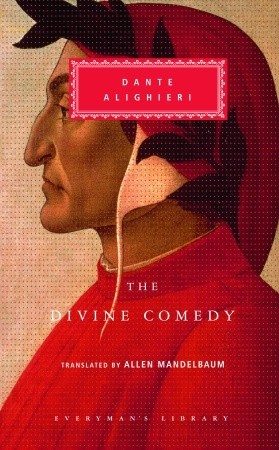
divinecomedyWell yes, it does. Hennessy didn’t forget the slash-and-burn, blood-and-guts classics, Homer’s Iliad and Dante’s Inferno.

And what does he read at the end of the day, before bedtime?  “Junk,” he said.  Just like the rest of us.

He escaped by a side door during the refreshments – but not before George Brown and I pleaded with him to reconsider the Purgatorio, the only book in the Divine Comedy where time counts for something – which it did for Hennessy, too, clearly, as he rushed to his next appointment.

***

(Photo above has a gaggle of professors – the contemplative head-on-hand at far right belongs to Josh Landy.  Next to him with the snowy beard is Grisha Freidin.  The ponytail at his right belongs to Gabriella Safran.  Next to her (if you leap an aisle) is David Palumbo-Liu in black glasses, and the half-head to his right belongs to Sepp.  Humble Moi at far left with the black Mary Janes.  Many thanks for the excellent photography from Linda Cicero, which has often graced this site.)
 

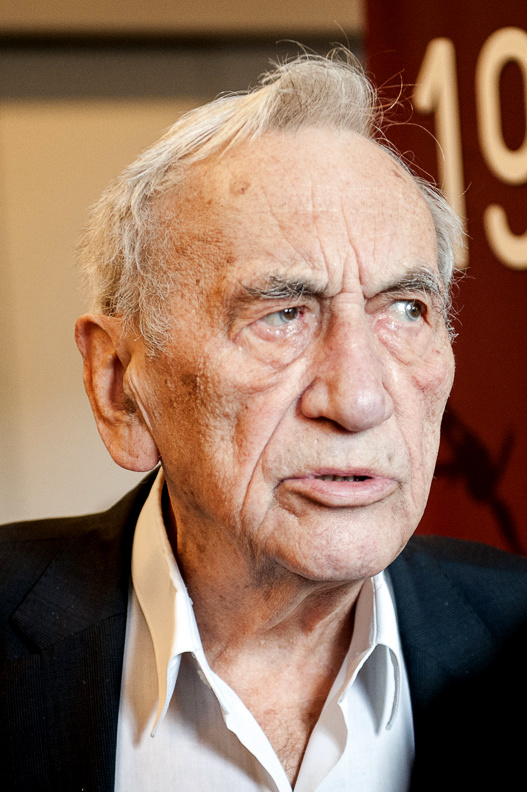
Tadeusz Mazowiecki, father of Poland’s democracy: “listen to other people, even if you don’t agree with them”

Share
jane curry

Janey

Robert Wessling introduced me to Jane Leftwich Curry at a Stanford Christmas party several years ago.  He thought we’d have a lot to talk about, although it wasn’t apparently obvious when I met the tall (6’+), lanky scholar with a lingering Texas drawl.  But he was right, and we’ve been talking ever since.  She’s one of the leading scholars on Poland and a professor at Santa Clara University, author of Poland’s Journalists: Professionalism and Politics, The Black Book of Polish Censorship. and the forthcoming Together We Are Strong: The Story of the People in the People’s Revolutions (I wrote about her at the Vaclav Havel celebration here). When it comes to Polish public life, she seems to know everyone.

So I was interested and pleased to see that she wrote a a thoughtful retrospective on Tadeusz Mazowiecki, the former prime minister of Poland who has been called the father of Polish democracy over at America Magazine here.  He died October 28 at 86. Janey says that he left a democratic Poland with one of Europe’s most vibrant economies and a model for political leadership in times of change. But more importantly, she traces the internal dynamics of the man.

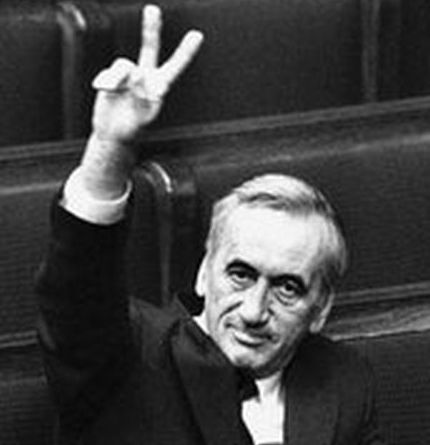
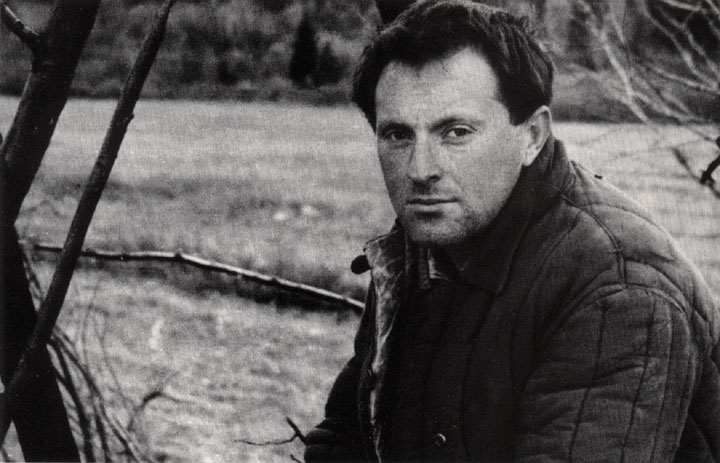
“Mazowiecki was not dramatic or charismatic,” she writes.  “With sagging face and slumped shoulders, he always looked like a rumpled academic with worn jacket and coat. His words came slowly as he thought and smoked yet another cigarette. He stood his ground but he also heard the other side whether he was having a one-on-one meeting in 1989 with Mikhail Gorbachev, whose staff had to hunt for an ashtray for him, or sitting folded on the floor of the Gdansk Shipyards with striking workers talking about what they wanted to demand and how.”

Tadeusz_Mazowiecki

“words came slowly as he thought and smoked yet another cigarette”

A few excerpts about the unassuming man who “talked, listened and worked with all sides, even when that was not popular”:

… as his grandchildren noted in their eulogy to him, what he taught them and those who worked with him—in the anti-communist opposition, in the Roundtable negotiations over sharing power in 1989, as Prime Minister, and when he headed the UN delegation to report on human rights abuses in Bosnia—was to “listen to the other people, even if you don’t agree with them. Really hearing leads to compromises.” …

In spite of being held in internment for more than a year [during martial law], longer than most others, he was not silenced or bitter. He returned to editing his monthly journal. Then, seven years later, the unimaginable happened: the government sought out negotiations with the very men they had interned and shunned. Mazowiecki stepped in and negotiated with, among others, General Jaruzielski, who imposed martial law, and the head of the Security Services.

With the Catholic leadership as a mediator, he drew others in but took the lead, without seeming to, in both secret and not-so-secret preparations for the historic Roundtable Accords that changed history: elections that led to a Solidarity rout of the communists, the first democratic government since 1920 for Poland, and, ultimately, the fall of the Berlin Wall and communist rule in Europe.

Tadeusz_Mazowiecki_-_Europeana_1989_-_TV_Interview

(Photo: Creative Commons)

In the negotiations, he was clear that the change had to be real. Solidarity had to be legalized. There had to be more authentic elections. And Solidarity and the rest of the opposition had to be central in deciding how to change the system. He also listened and helped find compromises; after all, Soviet troops were still stationed in Poland, the country was making changes not even mentionable in the rest of the Bloc initially, and Communists had run the government and the economy for more than forty years. …

Mazowiecki did not gloat. In his first speech as Poland’s Prime Minister and in all his retrospectives, he was clear that victory was not about doing to others what they had done to you. It was about bringing all sides together and doing what was right. He committed himself then to “drawing a thick line” between the past and present and going on, without looking back and settling accounts with the past. …

As prime minister, he continued to work with with President Jaruzielski. Was this forced Catholic-Communist collaboration difficult? “Well, what was hard was, every time I met him, he apologized for martial law and interning me. I kept telling him it was not important now.” Vintage Mazowiecki.

Read the whole thing here.

“My friendship with him was perhaps the longest he’d ever had.” Stanford’s Paul Gregory on Lee Harvey Oswald

Share

gregory_paulr_biophotoI’ve known Paul Gregory for several years (and written about him here and here and here) –  I know him as a compelling writer, a fine Russian scholar, and the author of books on the women of the U.S.S.R.’s gulag, Nikolai Bukharin, and Lenin’s brain. He’s mentioned before that he knew Lee Harvey Oswald, but I certainly didn’t know how well until I read today’s story in the New York Times Magazine. I also learned of his unusual donation to the Hoover Archives – more on that below.

Like everything Paul writes, the current NYT story is an excellent read.  It’s also a profoundly sad one, the story of an insecure and misguided misfit’s attempt for grandeur, and how an unlucky confluence of events led him to shoot and kill President John F. Kennedy on November 22, 1963.  It’s also the story of his wife, Marina Oswald, a confused and abused Russian wife pulled into an international crisis before she knew more than a handful of English words and phrases.  So many theories have been spun around the assassin since – after reading this, the theories seem bigger than the man.

But I’ll let Paul tell the story:

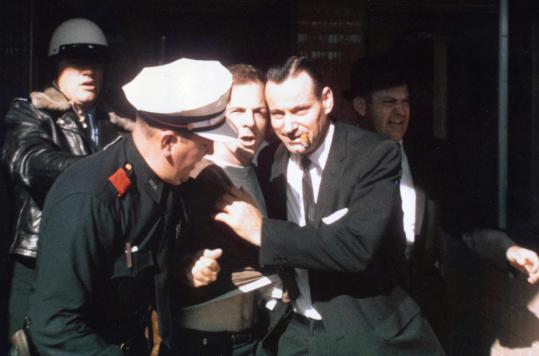
oswald-in-dallas

Oswald arrested at the Texas Theatre

It was 7 a.m. on Sunday when the single phone at the bottom of the stairs echoed through my parents’ red-brick house, right off Monticello Park in Fort Worth. “Mr. Gregory,” a woman said as my father picked up, “I need your help.” Who are you? he asked in his Texas-Russian accent, still half-asleep.

The caller said only that she had been a student in his Russian language course at our local library, and that he knew her son. In that instant, my father, Pete Gregory, linked the voice to a nurse who sat in the back of his class and had once identified herself as “Oswald.” Until this phone call, he hadn’t realized that she was the mother of Lee Harvey Oswald, a Marine who had defected to the Soviet Union only to return two and a half years later with a Russian wife and a 4-month-old daughter. My father helped Lee and his young family get settled in Fort Worth a year earlier. The Oswalds had been my friends. …

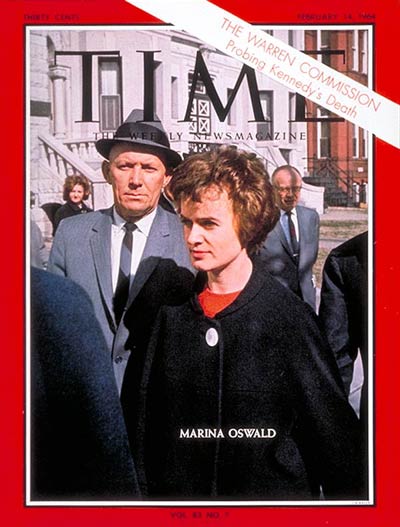
time-coverMy father recounted that weekend’s events to me a few days later over Thanksgiving dinner, when I returned home from the University of Oklahoma, where I had just begun graduate school. Through my father, I had become a close — or, as Robert Oswald would later say, almost the only — friend of Lee and Marina Oswald’s from virtually the moment they arrived in Fort Worth, in June 1962, until the end of that November. While that five-month period might seem fleeting, it was a significant period in Oswald’s life. He was never in the same place for long. By age 17, he had already moved some 20 times. Then he dropped out of high school and joined the Marines, before being released and traveling to Moscow. He avoided deportation by attempting suicide and was sent to Minsk, where he met Marina. In the year and a half after he returned to the United States, he moved several more times. My friendship with him was perhaps the longest he’d ever had.

My family tried to put those tragic events behind us, but over the ensuing decades, as I became an academic and a research fellow at the Hoover Institution at Stanford, I felt compelled to combine my memories and the historical record to present my own sense of Oswald. Most Americans believe that Oswald shot Kennedy. Yet according to one recent A.P. poll, only a quarter of Americans believe that one man acted alone to kill Kennedy. “Would Oswald,” as Norman Mailer wrote, “pushed to such an extreme, have the soul of a killer?” As I pored back over those months, I realized that I was watching that soul take shape…

post_card

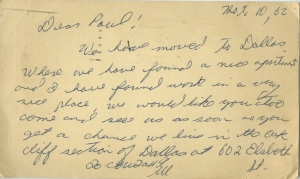
A postcard from the Oswalds (Photo: Hoover Archives)

Read the rest here.  But this fascinating postscript is not in the New York Times – Paul has just made a valuable  donation to the Hoover Archives.  The story behind it:  Young Paul Gregory began taking Russian lessons from Marina.  Here’s what he says in the article about it on one occasion:  “As I was leaving their house, he raced to the bedroom and returned with a faded pocket English-Russian dictionary that he used during his time in Minsk. ‘Take this,’ Lee told me. Only later did I realize that Oswald was showing off in front of Marina, pointing out that he didn’t need the dictionary but that I did.”  Now that dictionary is at the Hoover archives, thanks to Paul’s generosity.  Read about it here.  Paul also donated the postcard from the Oswalds that may have ended their friendship. Paul had congratulated Marina on her English after receiving the postcard, with a few corrections. Then he got a phone call from the distraught wife:  “’I did not write that letter. Lee did.’ Her tone told me all I needed to know; Lee had been deeply insulted and mortified by my response. Marina then told me she was unhappy. She hinted at physical abuse and explained that she had left him only to reconcile after he pleaded for her to attend Thanksgiving at his brother’s house.”

Why the humanities? Because “evil is always a bad stylist,” says Brodsky

Share
menlo

Menlo Circus Club … a classy venue for a book club

Last week at lunch with a friend, we both shared our distaste for the current thinking to defend the humanities – I’ve written about this in the last two days in a rant here and with Nobel laureate Coetzee’s remarks here.  The best antidote I know is Joseph Brodsky‘s Nobel lecture, excerpted below.  In fact, I focused on this essay during a lively get-together at the Menlo Circus Club recently, and it provoked a stimulating discussion.

Not everyone appreciates Brodsky’s circumlocutious Russian sentences, I know, but it’s well worth bearing out, believe me.

From the Nobel lecture (or read the whole thing here):

If art teaches anything (to the artist, in the first place), it is the privateness of the human condition. Being the most ancient as well as the most literal form of private enterprise, it fosters in a man, knowingly or unwittingly, a sense of his uniqueness, of individuality, of separateness – thus turning him from a social animal into an autonomous “I”. Lots of things can be shared: a bed, a piece of bread, convictions, a mistress, but not a poem by, say, Rainer Maria Rilke. A work of art, of literature especially, and a poem in particular, addresses a man tête-à-tête, entering with him into direct – free of any go-betweens – relations.

brodsky3

Doing time for his verse, Archangelsk 1964

It is for this reason that art in general, literature especially, and poetry in particular, is not exactly favored by the champions of the common good, masters of the masses, heralds of historical necessity. For there, where art has stepped, where a poem has been read, they discover, in place of the anticipated consent and unanimity, indifference and polyphony; in place of the resolve to act, inattention and fastidiousness. In other words, into the little zeros with which the champions of the common good and the rulers of the masses tend to operate, art introduces a “period, period, comma, and a minus”, transforming each zero into a tiny human, albeit not always pretty, face.

The great Baratynsky, speaking of his Muse, characterized her as possessing an “uncommon visage”. It’s in acquiring this “uncommon visage” that the meaning of human existence seems to lie, since for this uncommonness we are, as it were, prepared genetically. Regardless of whether one is a writer or a reader, one’s task consists first of all in mastering a life that is one’s own, not imposed or prescribed from without, no matter how noble its appearance may be. For each of us is issued but one life, and we know full well how it all ends. It would be regrettable to squander this one chance on someone else’s appearance, someone else’s experience, on a tautology – regrettable all the more because the heralds of historical necessity, at whose urging a man may be prepared to agree to this tautology, will not go to the grave with him or give him so much as a thank-you.

Rilke_in_Moscow_by_L.Pasternak_(1928)

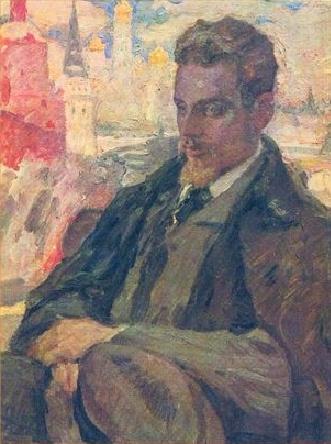
Rilke in Moscow, painted by Leonid Pasternak (1928)

Language and, presumably, literature are things that are more ancient and inevitable, more durable than any form of social organization. The revulsion, irony, or indifference often expressed by literature towards the state is essentially a reaction of the permanent – better yet, the infinite – against the temporary, against the finite. To say the least, as long as the state permits itself to interfere with the affairs of literature, literature has the right to interfere with the affairs of the state. A political system, a form of social organization, as any system in general, is by definition a form of the past tense that aspires to impose itself upon the present (and often on the future as well); and a man whose profession is language is the last one who can afford to forget this. The real danger for a writer is not so much the possibility (and often the certainty) of persecution on the part of the state, as it is the possibility of finding oneself mesmerized by the state’s features, which, whether monstrous or undergoing changes for the better, are always temporary.

The philosophy of the state, its ethics – not to mention its aesthetics – are always “yesterday”. Language and literature are always “today”, and often – particularly in the case where a political system is orthodox – they may even constitute “tomorrow”. One of literature’s merits is precisely that it helps a person to make the time of his existence more specific, to distinguish himself from the crowd of his predecessors as well as his like numbers, to avoid tautology – that is, the fate otherwise known by the honorific term, “victim of history”. What makes art in general, and literature in particular, remarkable, what distinguishes them from life, is precisely that they abhor repetition. In everyday life you can tell the same joke thrice and, thrice getting a laugh, become the life of the party. In art, though, this sort of conduct is called “cliché”.

Art is a recoilless weapon, and its development is determined not by the individuality of the artist, but by the dynamics and the logic of the material itself, by the previous fate of the means that each time demand (or suggest) a qualitatively new aesthetic solution. Possessing its own genealogy, dynamics, logic, and future, art is not synonymous with, but at best parallel to history; and the manner by which it exists is by continually creating a new aesthetic reality. That is why it is often found “ahead of progress”, ahead of history, whose main instrument is – should we not, once more, improve upon Marx – precisely the cliché.

Continue reading