
Giving voice to the voiceless: Katyń — Massacre, Politics, Morality

Share

“Both my grandfathers were Polish officers,” said Nicholas Siekierski. As I stroll through the new exhibition at Hoover Institution with the personable young archivist, he adds, “They were lucky to be taken prisoner by the Nazis rather than by the Soviets.”

What happened to those not so lucky is Katyń.

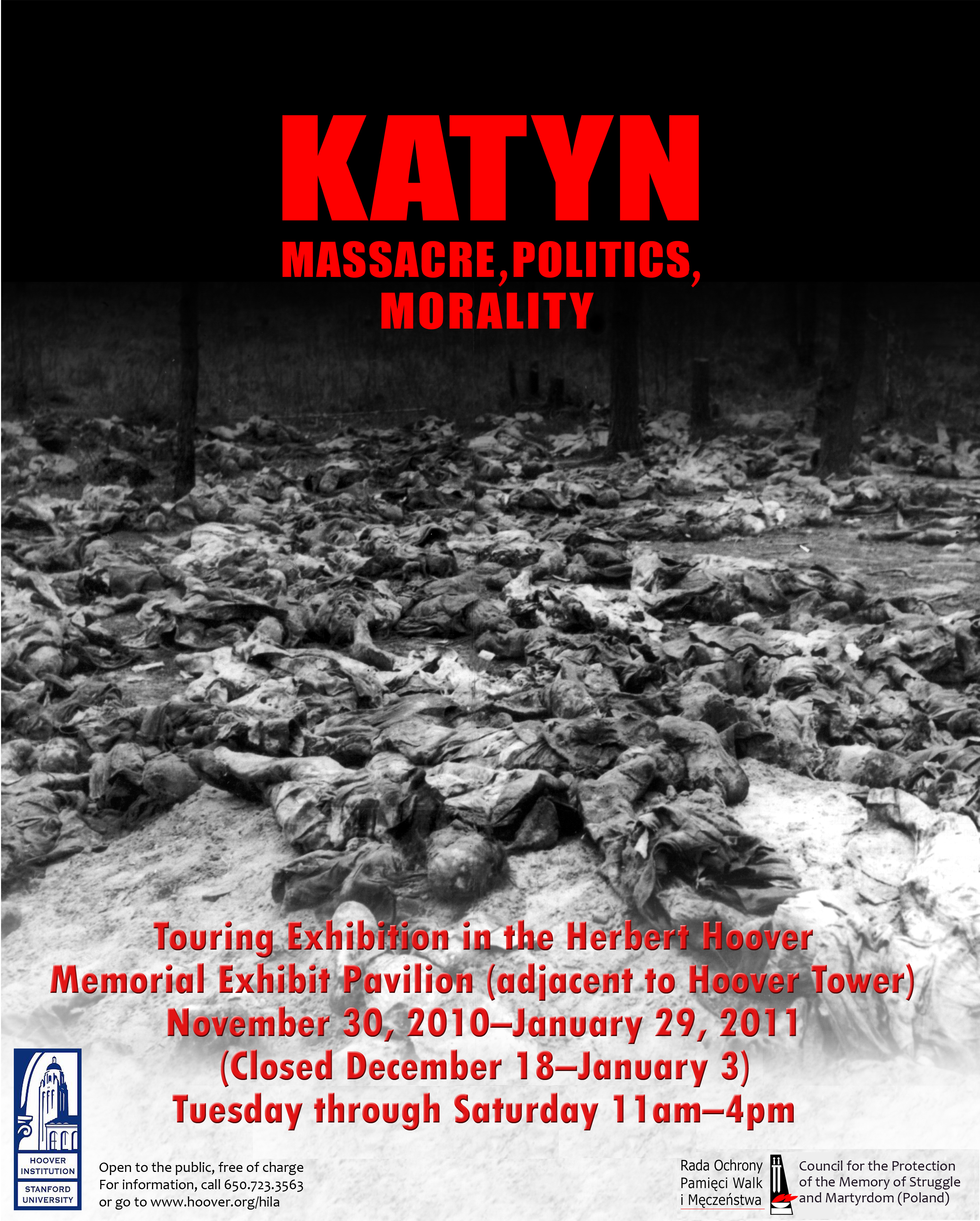
Nick is the assistant archivist for exhibits and outreach at Hoover Institution; his father, Maciej Siekierski, is the curator of the East European Collection at the Hoover Library and Archives.  Father and son worked together on the current exhibition at Hoover:  a grim, impressive, dignified reprise of an atrocity, Katyń: Massacre, Politics, Morality.

We’ve written about Katyń before — here and here.  It’s hard to write much about Poland in the 20th century without running head-on into Katyń, either as a symbol or as a reality. It was the central, inescapable monstrosity in Polish life, but a silent one; they were not allowed to speak of it openly for decades. When the Soviet Union occupied Eastern Poland in September 1939 tens of thousands of Polish professional military officers and reservists, policemen, landowners, lawyers, doctors, educators, and civil servants were arrested.  In short, Poland’s political, social and intellectual elite were made prisoners. The following spring, the Soviet Communist Party Politburo ordered the execution of about 22,000 of them.
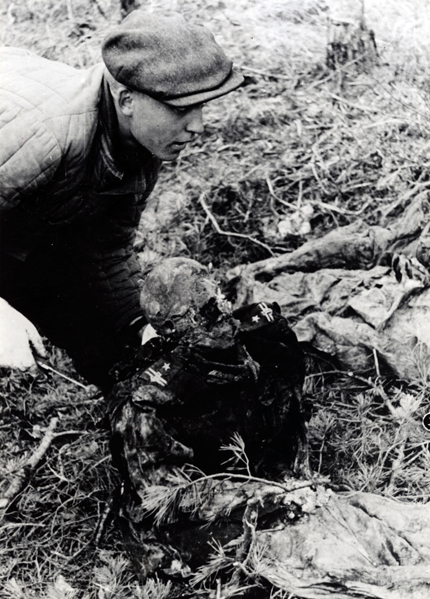
The Germans investigated in 1943 (Photo: Polish Ministry of Information and Documentation records, Hoover Institution Archives)

The mass shootings carried out in the spring of 1940, some of them in the Katyń forest near the Russian city of Smolensk, are remembered as the Katyń Forest Massacre.  For the next half-century, Communist leaders lied, evaded, and attempted to pin this crime against humanity on the Nazis. The touring exhibition, produced by Poland’s Council for the Protection of the Memory of Struggle and Martyrdom, documents the murder of Poland’s elites carried out by the Soviet security service.  The exhibition was launched at the EU headquarters in Brussels and then moved to the Library of Congress, but its most extended stay will be here, at Stanford, from Nov. 30 to January 29, 2011 (it’s closed during winter break, Dec. 18-Jan. 3, but otherwise open Tuesday through Saturday, 11 a.m. to 4 p.m.).  The exhibition is augmented by documents and photographs from Hoover Archives.
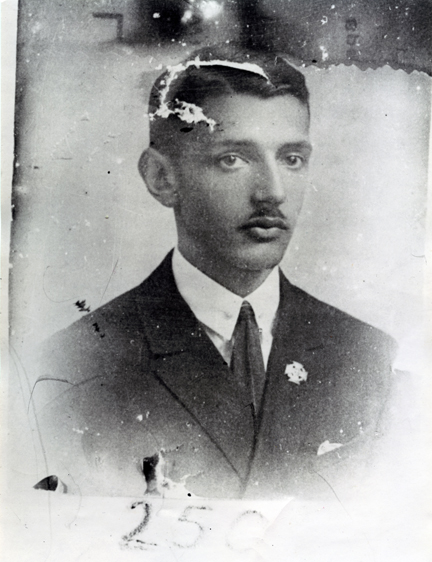
An unknown Katyń victim, probably from an identification card

If the Polish army coats at the entrance of the exhibit look familiar to those who have seen Andrzej Wajda’s acclaimed film, Katyń, it’s more than coincidence.  These two coats were recreated for the film, says Nick. “I saw them in the Warsaw Uprising Museum while I was a volunteer there in September, after they had been used in their exhibit on Katyń,” said Nick. “They offered to loan the uniforms to us for free once they heard about our exhibit.”  The grave, gray coats, like the exhibit, are impressive:  a softer look than you’d expect for an army uniform, yet relinquishing none of the impression of strength. As we all know, Katyń was followed by another horror this year, 70 years later — the airplane crash, en route to a memorial, that killed killed Poland’s President Lech Kaczyński and first lady Maria Kaczyńska, along with Poland’s deputy foreign minister and a dozen members of parliament, the chiefs of the army and the navy, church leaders, the president of the national bank, and others.  At the entrance to the exhibit, I am handed a flier, a speech titled “Freedom and Truth,” dated April 10, 2010.  Perhaps the words Kaczyński never had a chance to speak are also a fitting memorial:

***

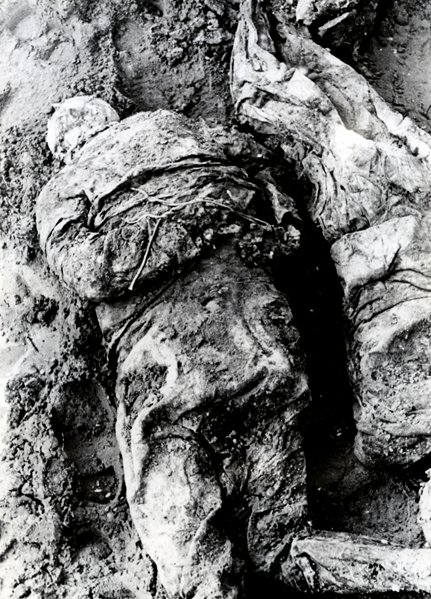
It happened 70 years ago. They were tied up and killed with a shot to the back of the head, so there would be little blood. Later, the bodies – still with the buttons of their uniforms depicting eagles on – were placed in deep ditches. Here, in Katyn, 4,400 people died this way. In Katyń, Kharkiv, Tver, Kiev, Kherson, and Minsk a total of 21,768 people died.

"Tied up and killed" (Polish Ministry of Information and Documentation records, Hoover Institution Archives)

The murdered were Polish citizens, people of various denominations and professions; military men, policemen, and civilians. There were generals and regular officers, professors and village teachers. There were military chaplains of different denominations: Catholic, the main Rabbi of the Polish Army, the main Greek Catholic chaplain, and the main Orthodox chaplain. …

These people were killed without trials or court decisions, murdered in violation of the laws and conventions of the civilised world.

What can one call the death of tens of thousands of people – of Polish citizens – without trial? What else can one call it than genocide? If that was not genocide, then what is genocide? …

The crime was a key constituent of a plan aimed at destroying free Poland: a country which – ever since 1920 – had stood in the communist regime’s way to conquering Europe.

This is why the NKVD tried to re-educate the prisoners: they were to support the plans of conquest. Officers of Kozielsk and Starobielsk chose honour and remained faithful to their Fatherland.

Stalin and the Politburo wreaked vengeance upon those who would not yield: they ordered them killed. The murdered were buried in ditches in Katyń, near Kharkiv, and in Mednoye. These hollows were intended to be the grave of Poland, the free Republic of Poland. …

Let us recall some facts: it was we Poles who first opposed Hitler by force of arms. It was we who fought Nazi Germany from the beginning of the war until its end and, by the end of the war, ours was the fourth most numerous army of the anti-Nazi alliance.

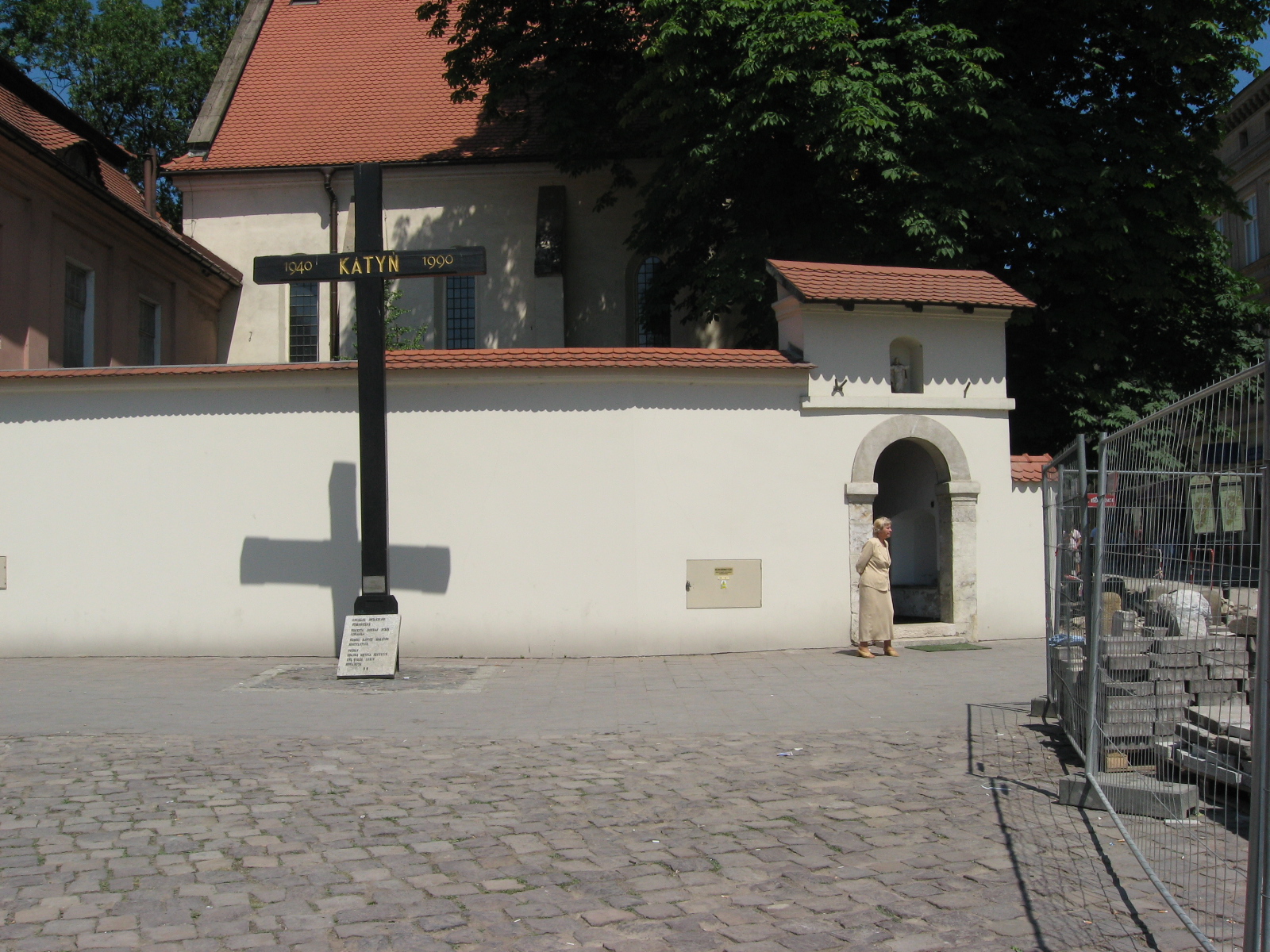
Memorial outside St. Idzi's in Kraków (Photo: C. Haven)

Poles fought and died on all fronts: at Westerplatte and near Kock, in the Battle of Britain and at Monte Cassino, near Lenino and in Berlin, and also as guerrillas and in the Warsaw Uprising. Among our soldiers, there were brothers and children of the victims of Katyń. …

The world was never supposed to know the truth – families of the victims could not mourn them in public, could not grieve them or pay them a decent last tribute. The lies were supported by the power of the totalitarian empire and by Polish communist authorities. People telling the truth about Katyń, even students, paid for it dearly. In 1949, Józef Bałka, a twenty-year-old student from Chełm, was sentenced to three years in prison by a military court for daring to speak the truth about Katyń during a class. It seemed that – as the poet said – the only witnesses of the crime would be “the unyielding buttons” found at the Katyń graves. There are, however, also people who would not yield and – after four decades – the totalitarian Goliath was defeated. Truth – the ultimate weapon against violence – triumphed. The People’s Republic of Poland was based on lies about Katyń and now the truth about Katyń constitutes the foundation of a free Poland. This is a great achievement of the Katyń Families and their struggle for the memory of their beloved dead – this was also a struggle for the memory and identity of Poland at large. This is also an achievement of the youth, of students such as Józef Bałka, and of teachers who – in spite of being forbidden to do so – told children the truth. We should also be thankful to priests, including Prelate Zdzisław Peszkowski and Rev. Stefan Niedzielak who proposed that a cross in memory of the Katyń victims be placed in the Powązki Cemetery and who was murdered in January 1989. We should be thankful to publishers of underground publications and we also owe much to independent initiatives, the Solidarity movement and to millions of parents telling their children about the real history of Poland.
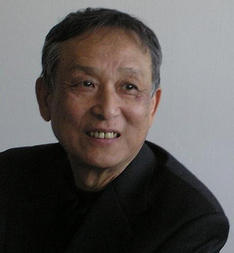
Nobel laureate Gao Xingjian in Paris: “I hate Chinese food most.”

Share

A "global citizen" who eats Japanese

Liu Xiaobo‘s Nobel Prize in literature is not the first award to a Chinese writer.  That honor went in 2000 to novelist, playwright, critic, and painter Gao Xingjian, who emigrated to Paris as a political refugee in 1987.  Now, he says, “I live in Paris, but eat Japanese food almost every day for my health.”  The 70-year-old writer adds, “I hate Chinese food most.”

Excerpts from Akihiko Shiraishi‘s interview in today’s Asahi:

On nationalism and the writer:

Nationalism isn’t necessarily pushed on the people by the powers that be. Nationalism can bubble up from among the people themselves, as did Japanese militarism during World War II. That war was not caused by the emperor alone. The Japanese people themselves were caught up in their nationalistic frenzy. Mao Tse-tung was responsible for the horrors of the Cultural Revolution, but the Chinese masses were also guilty of irrational behavior. We all need to become more aware of this sort of insanity inherent in human nature. And perhaps literature can help there.

On his play, Escape:

Q: You then dashed off the play Escape. The story revolves around a young man, a young woman and a middle-aged intellectual who escape the massacre at the hands of the military and hide in an urban warehouse. But in the end, they are all killed, aren’t they?

A: I wrote it at the request of an American playhouse. But when I sent my finished manuscript, they asked me to rewrite it and include an “American hero” in the story. I refused. Even some of my pro-democracy activist friends in China got on my case because I didn’t give them the hero they wanted. After the publication of “Escape,” I was dispossessed of my home in China, purged from public office, and expelled from the Chinese Communist Party. I became a bona fide fugitive.

Q: But your play wasn’t a denunciation as such of the Tiananmen protests. It dealt with a theme that is universal–how people act in extreme circumstances.

A: I wrote a tragedy of contemporary people, not a political drama. There is no mention of China or Tiananmen. Just like in any classic Greek tragedy, I tried to depict the difficulties of human existence itself. The play has since been performed around the world, including Japan. When it was recently staged in Slovenia, one local reviewer said, “This play is about our very history.”

On Chinese culture:

Q: Soul Mountain, which you published in 1990, chronicles your spiritual odyssey when you traveled deep into the Chinese hinterland. The work left a lasting impression on me, especially your depictions of quaint villages of ethnic minorities and sensuous folksongs sung by village elders. Am I correct to assume that China, in your mind, is a conglomeration of these diverse cultures, rather than a nation-state?

A: That is exactly my understanding of Chinese culture. In China, the history of emperors has been recounted as China’s legitimate history. But aren’t there also other histories? I always asked myself. While traveling along the Yangtze river, I collected many old local poems and mythical folk tales, including those of the ethnic minorities. This made me realize that there is no single source of Chinese culture, but that Chinese culture is a composite of diverse ethnic and regional cultures. This revelation deepened my understanding of ethnic and cultural diversity, and freed me from thinking of China as a monolithic state.

“Non-consumptive research”? There must be a catchier word for it.

Share

Jockers: Definitely "non-consumptive" (Photo: L.A. Cicero)

Patricia Cohen ran a post on the “Arts Beat” at the New York Times spotlighting my recent piece on Matt Jockers‘s and Franco Moretti‘s “non-consumptive research” — that is, they shovel books into a computer, which allows researchers to make more empirical judgments on books, if you ask the right questions and look in the right directions.  It’s “non-consumptive” because the researchers don’t actually read the books — heaven help anyone who tried to read thousands of Victorian novels; it would do something to the brain. It’s a fascinating line of research — though not quite my thing.  I’m interested to see what they turn up.

Cohen’s beef?

Did the folks at the Literature Lab try to come up with a particularly un-catchy phrase? Readers, I’m sure you can do better. Send in your suggestions for a more felicitous phrasing.

For those of us who have read a lot of Victorian novels, the word “consumption” certainly does have other connotations.  Jockers is a strapping young man — definitely not “consumptive.”

Unambomber in the news again: “He’s not crazy,” says Jean-Marie Apostolidès

Share

The man known as the Unabomber, Ted Kaczynski, has been in the news again — or rather, his property has.  The Huffington Post announced that Kaczynski’s 1.4-acre parcel in western Montana is on the block for $69,500.

John Pistelak Realty of Lincoln said that the listing offers potential buyers a chance to own a piece of “infamous U.S. history.”

Kaczynski was a subject of a blog post on the Book Haven awhile ago — on the basis of his writings, not his crime.  Psychologist and French scholar Jean-Marie Apostolidès takes the Unabomber’s anti-technology manifesto very seriously. He tells the story of how he translated the Unabomber’s works into French, and was briefly Kaczynski’s pen pal:

In retrospect, Apostolidès thinks the lawyers wanted him to help certify Kaczynski was insane. Yet, he said, “I’m convinced he has neurotic problems – but no more than anyone else. He has to be judged on his ideas and his deeds.” Our insistence on his insanity may be a way to avoid grappling with that, he said.

In an interview, Apostolidès leaned forward across the desk in his campus office and his voice dropped: “This will shock you. He’s a very nice guy, sweet, open-minded. And I know he has blood on his hands. You cannot be all bad – even if you kill, even Hitler.”

More here.

Rowan Somerville: “There is nothing more English than bad sex”

Share

We have a winner!

According to The Guardian’s Susanna Rustin, literary sex appears to be on the way out.  I say it’s about time.

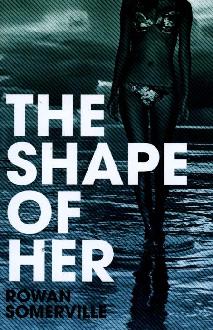
The cause for the ruminations was this year’s Booker Prize and The Literary Review‘s Bad Sex award a few days ago.  Beating out nominee Tony Blair, novelist Rowan Somerville, author of The Shape of Her, took home the dubious prize with “one killer sentence using the image of a butterfly collector – ‘like a lepidopterist mounting a tough-skinned insect with a too blunt pin he screwed himself into her.'”

“He graciously accepted the honour, presented by film director and food critic Michael Winner, saying: ‘There is nothing more English than bad sex, so on behalf of the entire nation I would like to thank you.’

“The judges were also impressed by his nature notes, such as the pubic hair ‘like desert vegetation following an underground stream’, and the passage: ‘He unbuttoned the front of her shirt and pulled it to the side so that her breast was uncovered, her nipple poking out, upturned like the nose of the loveliest nocturnal animal, sniffing the night. He took it between his lips and sucked the salt from her.'”

If you sense a sort of groping for effect (pun actually not intended), join the club. I think that’s the danger of sex scenes in novels.  They try too hard. I, personally, would have awarded this line alone from Somerville:  “She released his hair from her fingers and twisted onto her belly like a fish flipping itself, her movement so brusque his chin bounced off her head.”

At best, they make sex sound like hard, hard work.  At worst, they come across as parody.  Or simply very, very gross.  For grossity, this bad sex passage from The Literary Review‘s potpourri is enough to chase anyone into celibacy:

It felt to him as if he were tending a delicate weeping wound, and as he probed it with his tongue he heard her moan quietly. Excited by the oysterish intricacy of her he sucked and licked the salty folds until they became sweet …  (Anthony Quinn, The Rescue Man)

Ewwwwwwwww!

Yesterday's hot is today's kitsch

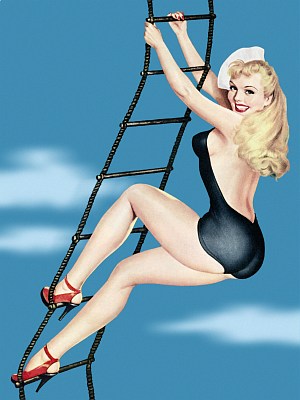
The truth is, nothing dates faster than sex – or rather, its expression.  Look at the cutesie or “exotic” nude postcards of the 1920s, or the squeaky clean coyness and plastic artificiality of G.I. pinup girls in World War II.  I have a feeling all these hot, hot, groaning-and-panting sex scenes in our movies and books are going to cause a lot of yucks for a future generation.  Just like we attach funny captions to those 1920s postcards and laugh at yesterday’s turn-on.  Just like the Bad Sex contestants give us a giggle now.

The contest appears to have had a chilling effect on the Booker prizes, the British equivalent of the Pulitzer:  ‘What was really striking, and we talked about it all the time in the meetings, was how little sex there was,” says biographer Frances Wilson, one of this year’s  judges.

“I thought I was going to have to steel myself to read a lot of sex stuff,” says the chairman of judges, Andrew Motion, “and about halfway through I realised that it wasn’t happening.”

Naturally, prudery is blamed, rather than a resurgence of good taste:

“Adam Thirlwell, whose debut novel, Politics, was a startlingly explicit examination of bedroom manners, believes we are living through ‘a very conservative era’ in literary terms. …

He points out that there is no such thing in a novel as a ‘scene’, and that even by thinking in terms of ‘sex scenes’, both readers and writers are showing the influence of cinema, in which sex is depicted according to a narrow vocabulary bearing the taint of pornography, which is all about visual stimulation and bears little relationship to the questions about language, and the representation of interiority, that novelists should be worrying about.”

Mais où sont les neiges d'antan?

They ignore something else:  I, for one, as a reader am not that terribly curious about the author’s idea of what his or her characters do behind closed doors.  I actually have a pretty vivid imagination.  Most of the time, I feel that the author is indulging his own fantasies, and, while writing, is … how can I put this delicately?

“Australian novelist Christos Tsiolkas goes further, saying that the attacks by some critics on his novel The Slap as being vulgar or pornographic ‘bemuse me as they seem to ignore how much of sexual imagination, particularly male sexual imagination, is now experienced through pornography itself.'”

And that’s what concerns me, as a human being.  I agree with René Girard that we are, to a much larger degree than generally supposed, mimetic creatures.  The one place that had been fairly insulated from imitation was sex — when the bedroom door closed, what happened within remained there. Thanks to our inundation in sex in movies, billboards, advertising, books, people are haunted by the idea that there is something that they are not getting, some fun others are having that they are not, something that some sex counselor, newspaper article, or survey told them they should be doing or feeling.  The one corner for a man (or woman’s) inimitable stamp has now entered the world of the media, marketing, and “branding.”

I don’t find myself agreeing with Naomi Wolf all that often, but this passage in her “The Porn Myth” had something worth pondering, as she recalled a conversation she had with a student at Northwestern, after she had talked about the effect of porn on relationships.

“Why have sex right away?” a boy with tousled hair and Bambi eyes was explaining. “Things are always a little tense and uncomfortable when you just start seeing someone,” he said. “I prefer to have sex right away just to get it over with. You know it’s going to happen anyway, and it gets rid of the tension.”“Isn’t the tension kind of fun?” I asked. “Doesn’t that also get rid of the mystery?”

“Mystery?” He looked at me blankly. And then, without hesitating, he replied: “I don’t know what you’re talking about. Sex has no mystery.”

Wonder why art books cost so much lately?

Share

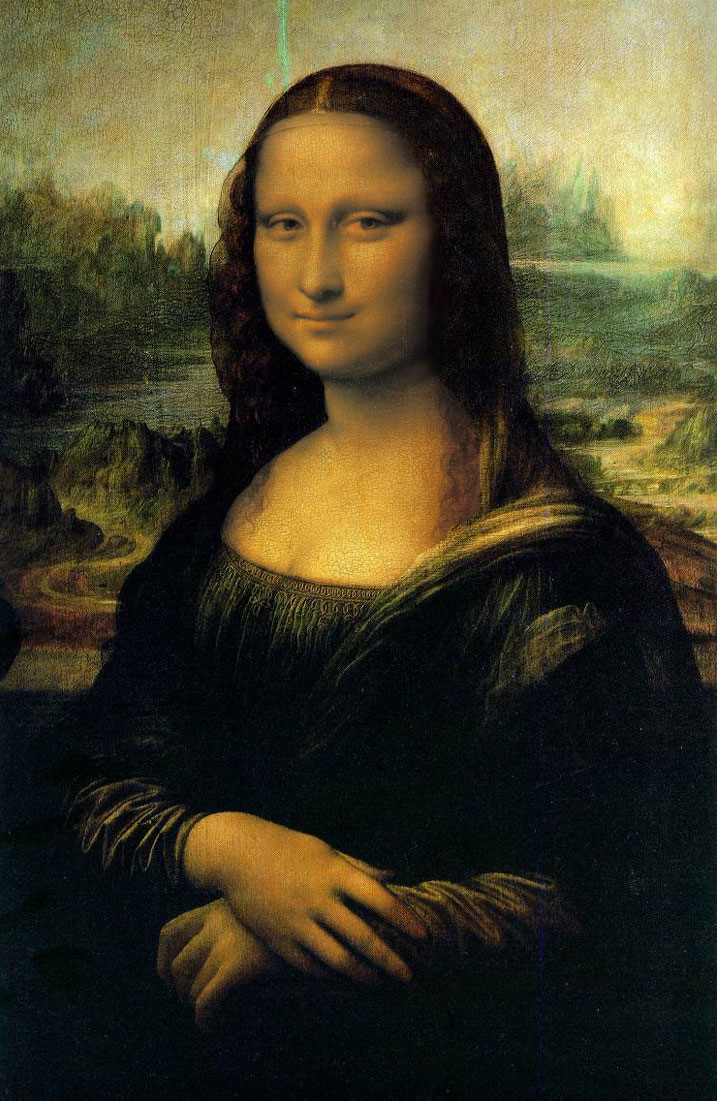
How much for the lady in the window?

I hold in my hands  a slim, attractive book of a little over 100 pages.  The well- (but not lavishly) illustrated paperback costs 50 bucks.

The reason:  it includes art reproductions. No, I’m not talking about the cost of 4-color reproduction, special shiny paper, et cetera.  These images are reproduced on regular paper stock.

Over a quick dinner at the Stanford Faculty Club, the author told me that his small publisher had to fork out $25,000 in royalties to secure 30 images for a press run of 1,000 books.  That’s $25 per book for artwork, before you even factor in the costs of reproduction.  Nearly $1,000 per image.

Nor are we talking about spanking new artwork, fresh from SF-MOMA, or the need of starving artists to buy kitty litter for their cats.  These are all old paintings — some several thousand years old.  They are all in the public domain.

Basically, it’s the photo rights monopolies like Bridgman Art Library and the museums who own the paintings and charge though the nose. These controlling entities make using full color photos in books prohibitively expensive. Especially for books put out by the shoestring academic presses. You are paying for their images of the images — and no, you can’t go to the museum and take your own snap.

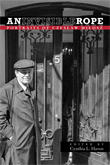
Our current copyright mess is not, of course, confined to images.  Words get pretty messy too.  For my own book, An Invisible Rope, which should be out within days, I had to pony up to more than four different organizations for rights to republish a small handful of poems, poems excerpts, and a few chunks of letters:  HarperCollins in the U.S., Penguin in the U.K., the Andrew Wylie Agency in New York, the Andrew Wylie Agency in London, and as a few others as well.  Andrew Wylie (nicknamed “the Jackal”) is, of course, notorious for his tough dealings and arrogance (no, I don’t know much about his latest electronic deals and can’t comment).  I have to say my dealings with the Wylie Agency — for three books now — have been unfailingly cordial, professional, and fair.  I have nothing but good things to say about Wylie.  Nevertheless, I was in some cases paying for translators to cite poems they themselves had translated.  In other cases, I was paying to cite iconic poems that are already all over the internet.

Ouch!

Our whole copyright law is screwy, and my own book (as well as my friend’s) demonstrates it.  (See Carol Shloss of James Joyce lawsuit saga fame for a true horror story — copyrights controlled by one whack job destroyed a generation of Joyce scholarship.) Copyright is not designed for heirs to control what scholars say about an artist or author — even though that’s how it’s been used by the Joyce Estate and the Ted Hughes/Sylvia Plath Estate, and others.  Nor should it be legalized extortion.  Rather, it is to protect the financial interest in an artists’ works.  So, say, on a Lescaux cave drawing or an Ptolemaic mural — whose interests are being protected?  My own limited use of poems will not damage anyone’s pockets — in fact, I sincerely hope it will increase interest in Czesław Miłosz‘s oeuvre.

However, this impoverished writer is feeling lucky, after a dinner with the author, that she only had to shell out several hundred bucks for permissions (though it came out of my own pocket, not my hardscrabble publisher’s).

Postscript on 12/5: More thoughts from the worldwide web:

The incomparable jazz scholar Ted Gioia wrote at Facebook:

Yes, this is all too true. In many instances, the person who has the rights to the images included in a book makes more money than the author.

And Blogger Art Durkee wrote over at Books Inq., where this post was linked:

I’ve been to several museums lately, and mostly they let you make non-flash photographs of their permanent collections, for personal or scholarly use. But they make you pay through the nose for any commercial use. It’s partly about control, yes, but it’s also partly about making money from their collection. It’s an interesting conundrum. The copyright control of the aspect is actually fairly open-ended, and perhaps more open to question than they would lead us to believe.