
Salman Rushdie: The Shah of Blah in Menlo Park

Share

The Shah of Blah celebrated being in “a great bookstore” last night, and lamented he had “never made it to Kepler’s before.”

“I am delighted to finally find my way to Menlo Park.”

Delighted to be in – what?  Menlo Park?  At Kepler’s?  Salman Rushdie, who has lived in London, Bombay, and New York looks forward to quietly signing books for a hundred people in this polite little burg?

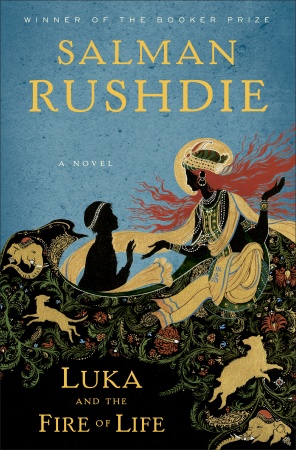
Clearly, this was not the abrasive Salman Rushdie I remember from 2008.  Was there the sort of metaphysical body switch one might find in his latest book Luka and the Fire of Life?  Even the voice was different:  The word choice was distinctly British, but the accent softer, Americanized.  There wasn’t a bodyguard in sight.  He was nothing but charm and affability.  (I wrote about the recent kerfuffle with Jon Stewart and the Cat Stevens/Yusuf Islam here and here and here.

Luka and the Fire of Life was written for his son Milan.  His older son advised Rushdie:  “Dad, don’t write novels. Write series.”

“It is very good commercial advice.”  He didn’t take it.  It was more than two decades between his first children’s fantasy, Haroun and the Sea of Stories, and the sequel. 

What motivates him to “make it new”? “A low boredom threshold,” he said.  “Repetition is the most boring thing in the world for me.”

Here are my notes as he answered questions from the audience:

Are Western audiences missing a lot of the cultural references?

“They’re missing something, sure, but they’re all still sitting here,” he said, indicating the audience.  Polite Menlo Park laughter.

He noted that William Faulkner is now popular in India; apparently, “what they’re getting is enough.”

We lose cultural references not only in space, but in time, he said.  Tolstoy, for example, is full of references that are lost to a 21st century audience.

But still, he said, it’s fine if only one-and-a-half billion people get it – “merely one-fifth of the human race.  So it’s kind of a private joke.”  More polite laughter.

How long has he been writing books?

“Books that got published?  Since 1975.  I was writing before that – just nobody liked it.

How did he move from unpublished to published?

“I started to write better books.”  It took “12 and a half years getting it wrong.”

“I’m grateful my earlier efforts never saw the light of day,” he said – it’s the   advantage of being a novelist over a playwright.  “You can make your mistakes in private.”

But a play’s not alive till it’s performed.  “You’re naked, vulnerable in front of an audience.”

Are his books autobiographical?
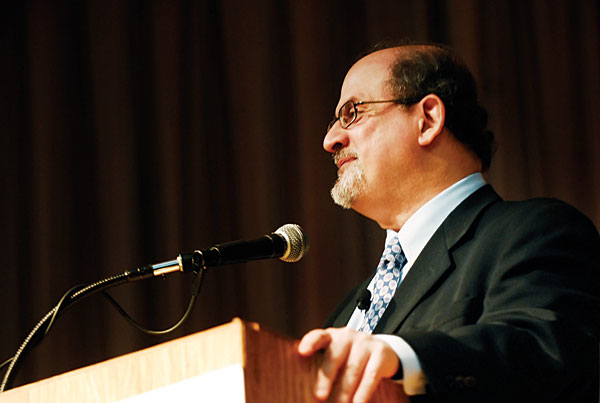
Writing from the borderland (Photo: Mae Ryan)

“People are always asking if the characters in my book are autobiographical,” he said, noting it was any novelist’s most-frequently asked question. “It means I must have had one helluva life.”

He recalled giving opposite answers to this question to journalists in the same city, on the same day.  When the responses were published at the same time, “nobody even noticed.”

He also commented on the longing of readers to be in the book.  He recalled meeting a “very grand” lady covered in jewelry and carrying a fan.  She swatted him with the fan, and accused him of representing her in his book. “Naughty boy!  Never mind.  I forgive you.”  He replied to no avail: “Madam, you have to accept that this is the first time I have ever laid eyes on you.”

“I don’t know why you’re going on about it.  I said I forgive you,” she replied haughtily.

On roots

“The place you land is not the place you start from.”

Rushdie said that we live in a world where “everyone knows everything within ten seconds.”  But he recalled growing up in a slower world in India, where communication was pretty much left to the radio and newspaper.

He commented on “the individual in the world to whom the idea of roots is not important — not uprooted, but who moves around in the world without a sense of belonging.”

“We have privileged roots and the idea of belonging in our culture,” he said. “Other ideas are not given air time, except in art,” where we often celebrate the outcast, the voyager, the cowboy, the adventurer. “Official culture says, ‘Stay home.’”

On imagination and reality

“Things cross between imagination and reality,” he said, noting that we live among “things even our grandparents would have found ridiculously fanciful – airplanes, cellphones.”  (Well, his grandparents perhaps.  Mine whizzed about in airplanes.)

“Before you can make a wheel, you have to imagine a wheel.  The world begins in imagination and move into reality.”

“I wanted to write about that borderland.”

And not a word about the fatwa.
More good news for Ian Morris … and a quick world tour through time

Share

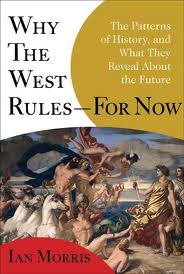
Not only is Why the West Rules — for Now the bedside reading of Niall Ferguson, but The Economist has just named Ian Morris‘s weighty tome  as one of the top books of 2010:  “An entertaining and plausible book by a British historian at Stanford University that shows how debates about the rise of China or the fall of the West are ultimately a sideshow, as nature will bite back savagely at human society.”  (We wrote about it here and here.)

The Economist reviewed the book last October:  “Ian Morris, a polymathic Stanford University professor of classics and history, has written a remarkable book that may come to be as widely read as Paul Kennedy’s 1987 work, The Rise and Fall of the Great Powers.”

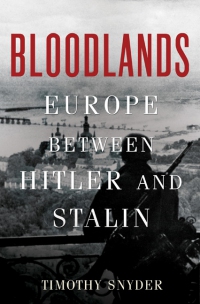
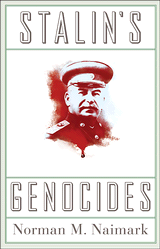
Also receiving The Economist‘s best-of-the-year praise — in fact, right above the Why the West Rules, is Timothy Snyder‘s Bloodlands: “How Stalin and Hitler enabled each other’s crimes and killed 14m people between the Baltic and the Black Sea. A lifetime’s work by a Yale University historian who deserves to be read and reread.”  (Bloodlands was discussed on The Book Haven a few weeks ago, with Norman Naimark‘s Stalin’s Genocides, and again here.)

In the spirit of Morris’s book, if you’d like to watch ten centuries roll by in five minutes — click “play” below.  We think it’s kind of fun.

Top global thinkers read Ian Morris’s Why the West Rules — For Now … and an odd blunder

Share

Archaeologist Morris digs for the secrets of the ages

Foreign Policy has published its Second Annual Top 100 Global Thinkers List — “a unique portrait of 2010’s global marketplace of ideas and the thinkers who make them” — and there are inevitably some surprises.

The one that pleased us most is that nestled in Niall Ferguson‘s recommended reading list of three books (Ferguson comes in at #80) —  Ian Morris‘s Why the West Rules — For Now.  We’ve written about Morris, the man who knows everything, here and here.

Other names mentioned in these pages appear on the list — Christopher Hitchens, Liu Xiaobo, Mario Vargas Llosa, Clay Shirky, David GrossmanAyaan Hirsi Ali made the cut, and so, ironically, did the man who has derided her — Ian Buruma finishes the list at #100.  (Tariq Ramadan follows immediately after at #62).  But what’s curious about her blurb is this bizarre understatement:

“The first time you heard about Ayaan Hirsi Ali, it was likely the story of a brave Muslim woman fleeing her forced marriage in Somalia to become an outspoken critic of Islam. But her flight didn’t stop there; after more than a decade living in the Netherlands, she left Europe and its painful debates over assimilation for more comfortable ground: conservative America.”

Well, no.  Not quite.  They neglect to mention that she fled Holland because a fatwa called for her death, her colleague Theo van Gogh was murdered, and the Netherlands not only failed to protect her, but turned on her, questioning her immigration status. Big difference.

Why did no one at Foreign Policy flag this boo boo?  I guess all the copy editors have been laid off.

Lightning strikes back: Book wars and Bloodlands

Share

Is a critic ever being entirely “fair”?  Once my thoughts splash onto the printed page, I’ve agonized about whether the words that sounded so reasonable in my head would have been said to the author’s face.  On the other hand, when I’m being generous, I wonder if I’m doing the reader a disservice.  So I sat up straight when Jesse Freedman wrote over at Books Inq. last week:

“Readers of the LRB got a significant dose of honesty earlier this month when Richard J. Evans, Regius Professor of History at Cambridge, offered a scathing review Timothy Snyder‘s Bloodlands: Europe between Hitler and Stalin. …

“I have to say, I respect Evans for his review – not only because his arguments are well grounded, but because he fights the tendency among (a fair number of) reviewers to praise pretty much everything they are handed.”

Strong words indeed from Books Inq.  Bloodlands was discussed on The Book Haven a few weeks ago, along with Norman Naimark‘s Stalin’s Genocides.

In his review, “Who Remembers the Poles?” Evans begins:

‘Who, after all, speaks today of the annihilation of the Armenians?’ Adolf Hitler asked his generals in 1939, as he told them to ‘close your hearts to pity,’ ‘act brutally’ and behave ‘with the greatest harshness’ in the coming war in the East. It’s often assumed that in reminding them of the genocide of at least a million Armenians by the Ottoman Turks during the First World War, Hitler was referring to what he intended to do to Europe’s Jews. But he was not referring to the Jews: he was referring to the Poles. ‘I have sent my Death’s Head units to the East,’ he told the generals, ‘with the order to kill without mercy men, women and children of the Polish race or language. Only in such a way will we win the living space that we need.’”

Yet Evans castigates Snyder for failing to draw a clear enough distinction between the Holocaust and the concurrent genocides, distracting from what was unique:

“That uniqueness consisted not only in the scale of its ambition, but also in the depth of the hatred and fear that drove it on. There was something peculiarly sadistic in the Nazis’ desire not just to torture, maim and kill the Jews, but also to humiliate them. SS men and not infrequently ordinary soldiers as well set light to the beards of Orthodox Jews in Poland and forced them to perform gymnastic exercises in public until they dropped; they made Jewish girls clean public latrines with their blouses; they performed many other acts of ritual humiliation that they did not force on their Slav prisoners, however badly they treated them in other ways. The Slavs, in the end, were for the Nazis a regional obstacle to be removed; the Jews were a ‘world enemy’ to be ground into the dust.”

Snyder, he said, also fails to consider Hitler’s other victims sufficiently:

“Thus the eight million foreigners working in the Reich in the latter stages of the war were not all ‘from the East’ as Snyder claims – one and a quarter million of them were French, more than half a million were Italian, and nearly half a million were Belgian or Dutch. The killing of up to 200,000 mentally handicapped and sick Germans by Nazi doctors gets a brief paragraph; the hundreds of thousands of German and Western European Jews who were murdered are dismissed in a little more than a page; sites of mass murder that lie outside Snyder’s ‘bloodlands’ and where the killings were not perpetrated by the Nazis or the Soviets are dealt with in equally perfunctory fashion. The 300,000 Serbs slaughtered by the fascist regime in Croatia, the 380,000 Jews killed on the orders of the Romanian government, and further afield still, the tens of thousands of Spanish Republican prisoners executed by the Francoists and the hundreds of thousands more confined in brutal labour camps after the end of the Civil War, or the Gypsies killed in large numbers not just by the Germans but also by the Croatians and Romanians – all of these get barely a mention or no mention at all.”

Evans concludes:

“The fundamental reason for these omissions, and for the book’s failure to give an adequate account of the genesis of the Final Solution, is that Snyder isn’t seriously interested in explaining anything. What he really wants to do is to tell us about the sufferings of the people who lived in the area he knows most about. Assuming we know nothing about any of this, he bludgeons us with facts and figures about atrocities and mass murders until we’re reeling from it all.”

Reaction was swift and terrible in the Dec. 2 LRB.  Oxford’s Norman Davies makes the striking point that we are “emotionally conditioned” to observe the suffering of Hitler’s victims, not so quick when it comes to recognizing the victim’s of our ally, Jozef Stalin. Moreover, by emphasizing the uniqueness of the Holocaust, we fail to notice larger patterns in the concurrent genocides — a point akin to Naimark‘s contention in Stalin’s Genocides.  It is a point, Davies said, Snyder is better equipped than most historians to make.

But a reader in New York, Charles Coutinho, delivers the coup de grace:  “Richard Evans’s less than entirely positive review of Timothy Snyder’s book may or may not have been influenced by Snyder’s own less than positive review of Evans’s latest book in the New York Review of Books.”

Evans admits that Coutinho “does indeed put his finger on one of the many reasons Snyder’s book made me so cross, which is that Snyder devoted almost all of what was meant to be a review of The Third Reich at War in the New York Review of Books to making erroneous and unsubstantiated claims about my supposed ignorance of Russian and East European history.”

Return to the first sentence of this post. Lather. Rinse. Repeat.

Correction:  Thanks, Dave Lull, for pointing out that it was Jesse Freedman, and not Frank Wilson, who had made the original post at Books Inq. that brought the Evans article to my attention.  For the record, I certainly did not mean to fault Jesse F.  — it was the job of the LRB editor to make sure the reviewer doesn’t have an axe to grind or a fanny to kiss when writing a review.

Saul Bellow: “The name of the game is Give All.”

Share

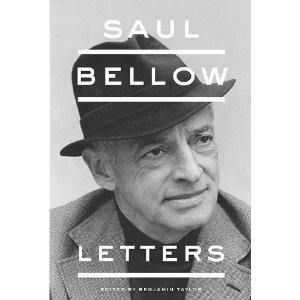
A few days ago, I posted an excerpt from Saul Bellow: Letters — an epistle from Saul Bellow to Leon Wieseltier, on the subject of Hannah Arendt.

I didn’t know till I was tipped off by Robert Hamerton-Kelly at lunch yesterday that Wieseltier had already reviewed the letters in the New York Times a few days earlier. The long, ebullient review of a friend by a friend praises the author’s “stunning, almost baffling plenitude”:

“Bellow’s letters are — as anybody who corresponded with him must have expected them to be, and here I must disclose, or confess, or boast, that the volume includes also some gorgeous letters to me, written in the fullness of our friendship decades ago, when we used to worry over metaphysics and the novel as we chopped wood — one of Bellow’s greatest books. [Editor] Benjamin Taylor records that it contains only two-fifths of what Bellow called his ‘epistling,’ but its riches are nonetheless immense. Taylor has selected and edited and annotated these letters with exquisite judgment and care. This is an elegantissimo book. Our literature’s debt to Taylor, if our culture still cares, is considerable.”

More excerpts, in case you missed it:

“In recent years, Bellow has been venerated primarily for his laughter and his language. His British admirers in particular, orphaned by the dreariness of their own postwar fiction and in abject (and rather boring) envy of American energy, have remade Bellow according to their need: a comic writer, a high mocker and essentially a stylist. There is some truth, obviously, to this worship of his ebullience, of the libertine vigor of his voice. Of all modern writers, Bellow somehow managed to combine intellectuality and vitality without compromising either of the indispensable terms. The life-force never deserted him, even as it was always attended by interpretation. The unruliness of existence was Bellow’s lasting theme; but while he studied it, he never quite ordered it. In his fiction and in his life, he seemed to believe in the fecundity of disorder.

“Yet something is missing from the chortling celebration of Bellovian jollity, and that is its foundation in gloom. ‘Bitter melancholy’ is ‘one of my specialties,’ he tells Edward Shils in 1962. About ‘the power to despair,’ he writes to a friend in 1961 that ‘having myself felt it, known it, bathed in it, my native and temperamental impulse is to return to sanity in the form of laughter.’ The letters show a man constantly wresting high spirits from low, and forbidding himself ‘the newest wrinkle in anguish.’ The charming and gregarious writer feels ‘almost astrally alone, but still “I’m out for sursum corda. Lift up the heart.’ … There is an almost erotic charge to Bellow’s endless affirmations; they are so affecting because they are so willed. Since they are deeply reflective, they do not seem merely manic. ‘Really,’ he writes to Lionel Trilling in 1952, ‘things are now what they always were, and to be disappointed in them is extremely shallow. We may not be strong enough to live in the present. But to be disappointed in it!'” …

“Bellow liked to scoff at serious people, but he never left their company. He, too, always had something urgent to say. … The view of Bellow as primarily a stylist, the pleasure-seeking reading of Bellow, the cult of his sentences, is inadequate. His manner was rougher and more controversial, stubbornly animated by ultimate questions, motivated by mind, an intervention in society as well as in literature. Even greater than how he said what he said was what he had to say. His writings, these letters included, are efforts in explanation, or in the hunger for explanation. He did not compose manifestoes or programs, and he despised ideologies — Norman Mailer is ‘such an ideologist,’ whereas ‘I do everything the hard way’; but his ridicule of intellectuals never led Bellow, as it did some of his contemporaries, to the barbarities of anti-intellectualism. …”

“One marvels for many reasons at the man who wrote these letters, but for no reason more than that he was a free man. I do not refer merely to his rebelliousness and his restlessness, to his ‘jail-breaking spirit.’ He is beset by cares and obligations; his friends die and die and die … but nothing ever robs him of the free and unfettered use of his powers. ‘A language is a spiritual mansion from which no one can evict us,’ and in that palace Bellow was sovereign. ‘The only sure cure is to write a book,’ he advises Alice Adams. Only time, and the accidental ingestion of a poison fish in the tropics in 1994, dims him. Otherwise, for the duration of the long and unsinkable life chronicled in these pages, he is a large man growing larger, a spirit expanding, an unabating lightstorm, and ‘the name of the game is Give All.’ He never loses his constancy of purpose. In the penultimate letter in this volume, in the winter of 2002, he sums himself up for a distant relative in a casual Abschied: ‘Actually, I’ve never stopped looking for the real thing; and often I find the real thing. To fall into despair is just a high-class way of turning into a dope. I choose to laugh, and laugh at myself no less than at others.'”

Postscript from the “Great Minds Think Alike” Dept.:  Over at Anecdotal Evidence today, Patrick Kurp also has a post inspired by Wieseltier’s review of Bellow — it’s here.

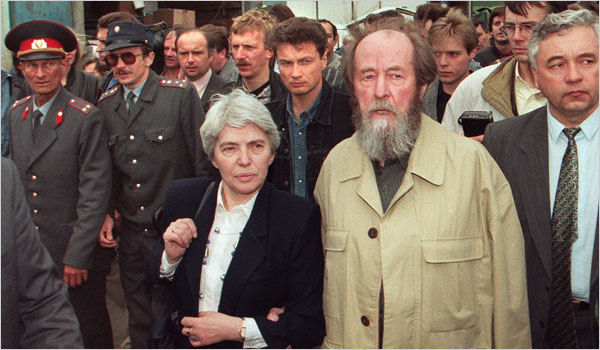
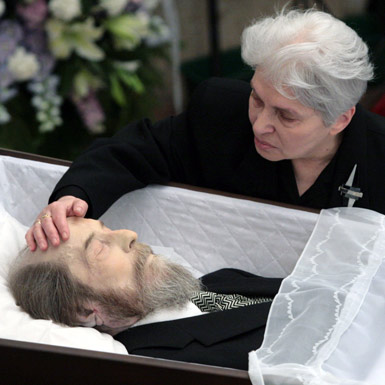
Aleksandr Solzhenitsyn revisited: “I welcome your snowballs”

Share

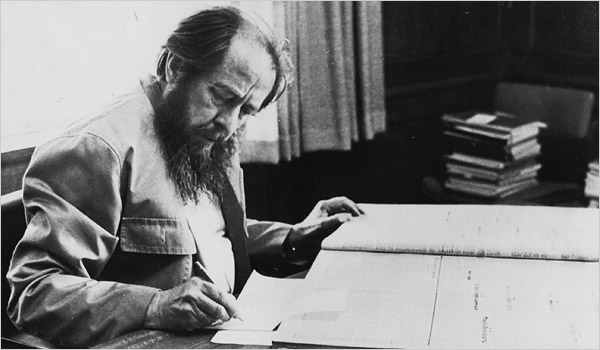
At the Hoover Institution archives in 1976: "silent, aghast, a simply endless witnessing"

Russia watcher and New Yorker editor David Remnick wrote in 2001: “In terms of the effect he has had on history, Solzhenitsyn is the dominant writer of the 20th century. Who else compares? Orwell? Koestler? And yet when his name comes up now, it is more often than not as a freak, a monarchist, an anti-Semite, a crank, a has been.”

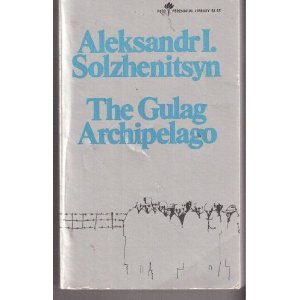
I remember reading my silver-covered Gulag Archipelago, vol. 1, in the backrooms of the Pontiac Press where, as a brand-new intern in the hard, gritty little burg, I was supposed to be compiling the results of a reader survey.  I kept snatching a few minutes here and there to read more, and more.  It was, as author Richard Wirick wrote, “300,000 words of stupefying revelations — silent, aghast, a simply endless witnessing. Its didacticism, the repetitious parade of exclamations … we have to be reminded that quantity sometimes becomes quality, that the sheer numbers murdered — and of a country’s own people — requires a special category of inimitable evil.”

Somehow, the last few days of research in various and sundry brought me to Wirick’s excellent Bookslut piece on the author’s 2008 death, “Solzhenitsyn: The Last Giant.” Afterward I revisited Aleksandr Solzhenitsyn‘s much-criticized (“scolding,” “hectoring”) 1978 Harvard address.

On the contrary, I find it provocative, often prescient, and at the very least worth another look.

On a legalistic society…

“I have spent all my life under a communist regime and I will tell you that a society without any objective legal scale is a terrible one indeed. But a society with no other scale but the legal one is not quite worthy of man either. A society which is based on the letter of the law and never reaches any higher is taking very scarce advantage of the high level of human possibilities. The letter of the law is too cold and formal to have a beneficial influence on society. Whenever the tissue of life is woven of legalistic relations, there is an atmosphere of moral mediocrity, paralyzing man’s noblest impulses.

And it will be simply impossible to stand through the trials of this threatening century with only the support of a legalistic structure.”

On human freedom…

“The defense of individual rights has reached such extremes as to make society as a whole defenseless against certain individuals. It is time, in the West, to defend not so much human rights as human obligations. …

Such a tilt of freedom in the direction of evil has come about gradually but it was evidently born primarily out of a humanistic and benevolent concept according to which there is no evil inherent to human nature; the world belongs to mankind and all the defects of life are caused by wrong social systems which must be corrected. Strangely enough, though the best social conditions have been achieved in the West, there still is criminality and there even is considerably more of it than in the pauper and lawless Soviet society.”

On the press…

“Here again, the main concern is not to infringe the letter of the law. There is no moral responsibility for deformation or disproportion. What sort of responsibility does a journalist have to his readers, or to history? If they have misled public opinion or the government by inaccurate information or wrong conclusions, do we know of any cases of public recognition and rectification of such mistakes by the same journalist or the same newspaper? No, it does not happen, because it would damage sales. A nation may be the victim of such a mistake, but the journalist always gets away with it. One may safely assume that he will start writing the opposite with renewed self-assurance.

Because instant and credible information has to be given, it becomes necessary to resort to guesswork, rumors and suppositions to fill in the voids, and none of them will ever be rectified, they will stay on in the readers’ memory. How many hasty, immature, superficial and misleading judgments are expressed every day, confusing readers, without any verification. The press can both simulate public opinion and miseducate it.”

On intellectual fashions…

“Without any censorship, in the West fashionable trends of thought and ideas are carefully separated from those which are not fashionable; nothing is forbidden, but what is not fashionable will hardly ever find its way into periodicals or books or be heard in colleges. … This gives birth to strong mass prejudices, blindness, which is most dangerous in our dynamic era. There is, for instance, a self-deluding interpretation of the contemporary world situation. It works as a sort of petrified armor around people’s minds. Human voices from 17 countries of Eastern Europe and Eastern Asia cannot pierce it. It will only be broken by the pitiless crowbar of events.”

I could go on:  “If humanism were right in declaring that man is born to be happy, he would not be born to die.”

One can’t help thinking that Solzhenitsyn’s remarks about Western cowardice, its colossal failure of nerve, were pretty much spot-on.  For example, in the 1970s, Henry Kissinger warned President Gerald Ford against a visit from the Nobel laureate, saying the visit would cause controversy, and that fellow dissidents found his positions an embarrassment.  Guess who didn’t get an invite.  One thinks more recently of the Dalai Lama leaving the White House by the back door, near the garbage.  Or the unseemly waffling of nations deciding whether to boycott the Nobels this year, in support of China against the imprisoned writer Liu Xiaobo.  Or the modern inability to understand much more beyond branding, positioning, marketing, and public relations values — Jon Stewart‘s apparent inability to discern why inviting Cat Stevens to celebrate peace and sanity might not be such a red-hot idea.  Or… or … or…

Writing after Solzhenitsyn’s 2008 death, Wirick comments that the writer seems to have outscaled the criticism:

“And yet there he was. After Borges and Beckett, Calvino and Bellow, the man pretty much stood by himself out on the landscape: a chipped, fierce, creaking monument, taunting the wind for its shuddering fall. On the night it came, and a friend called with the news, I closed my eyes and saw my favorite photograph of him, I believe by Harry Benson. It’s the one where he is deeply breathing, hands on chest, the nearly Russian air of his whitened Vermont pastures. It’s a picture that shows a lot more wisdom and self-deprecation than most people see. The superficial view takes the smile on his face and closed eyes to be saying how ‘happy’ he is to finally be in a ‘free’ country. I see him saying something at once richer and lighter, playful and more complex: ‘I’m a writer. I’m a ham. I make mistakes. I just happen to straddle the age like Abi Yoyo. But it is always only a step, as Mr. Nabokov said, from the hallelujah to the hoot. I welcome your snowballs.'”