
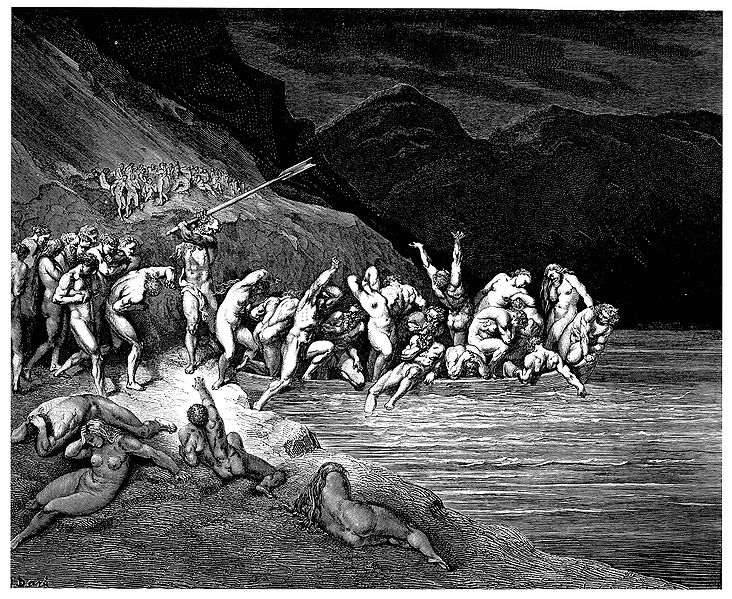
Dante and crowds

Share

Gustave Doré's version of Canto III: "...like a bird at its call."

Dante‘s Divine Comedy is brimming with crowd scenes.  Take this one, in Canto III of the Inferno, as Dante visits the damned souls who are waiting to be ferried to hell:

Come d’autunno si levan le foglie
l’una appresso de l’altra, fin che ‘l ramo
vede a la terra tutte le sue spoglie,
similemente il mal seme d’Adamo
gittansi di quel lito ad una ad una,
per cenni come augel per suo richiamo.

In Charles Singleton‘s translation: “As the leaves fall away in autumn, one after another, till the bough sees all its spoils upon the ground, so there the evil seed of Adam: one by one they cast themselves from that shore at signals, like a bird at its call.”

In a recent lecture, Robert Harrison pointed out the classical sources for the image of leaves: Aeneas sees the same infernal scene in his visit to the underworld in Book 6 of the Aeneid.  Since Virgil was by Dante’s side during his otherworldly excursion, the comparison would have been on his mind. Here’s Virgil’s version (in Robert Fitzgerald‘s translation)

..as many souls
As leaves that yield their hold on boughs and fall
Through forests in the early frost of autumn,
Or as migrating birds from the open sea
That darken heaven when the cold season comes…

Individual, particular names (Photo: Creative Commons)

But Robert noted that Dante put a new twist on Virgil’s old image, “It’s a traditional epic simile – but he singularizes it.”  Robert compared it to the Vietnam Veterans Memorial, whose massive presence resolves, as you draw nearer, into thousands and thousands of individual, particular names.

So the Inferno is composed of carefully delineated individuals – the mass “that swirls unceasingly in that dark and timeless air, like sand when a whirlwind blows” never entirely fades into facelessness.

•••

In all the images of leaves, sand, and birds, this one could easily be overlooked:

E come li stornei ne portan l’ali
nel freddo tempo, a schiera larga e piena,
così quel fiato li spiriti mali
di qua, di là, di giù, di sù li mena;

“And as their wings bear the starlings along in the cold season, in wide, dense flocks, so does that blast the sinful spirits; hither, thither, downward, upward, it drives them.”

It certainly grabbed me: My daughter, Zoë Patrick, is a “birder,” and during a recent trip to Golden Gate Park, she pointed out the drab and speckled birds who could be identified (she said) because they look like “flying cigars.”

They are apparently not native here: a Bronx drug manufacturer, one Eugene Schieffelin, decided to import them, in an effort to have all the birds from William Shakespeare‘s works in the U.S.

Shakespeare, you see, chose to include the starling in Henry IV, when another soldier, the fiery Hotspur says, “The king forbade my tongue to speak of Mortimer. But I will find him when he is asleep, and in his ear I’ll holler ‘Mortimer!’ Nay I’ll have a starling shall be taught to speak nothing but Mortimer, and give it to him to keep his anger still in motion.”

That’s because starlings can be taught to talk – see the video below of a starling saying, “Give me a kiss, baby.” Or go here to see a video of an even more voluble starling besotted with its own name, “Damar.”

But why did Dante’s choose starlings for his metaphor of movement?  Christian Stanley Ciesielski let me know what a “murmuration” of starlings can do – see the first video below for that, too.

As Christian suggested, “Imagine a whole murmuration of ‘Give me a kiss, baby.'”   Another expression of “the Love that moves the sun and the other stars.”

Emmerich’s film Anonymous: a time tunnel in the opposite direction

Share

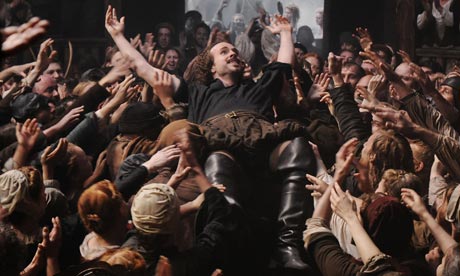
Ruth Kaplan finally got talked into viewing Anonymous, the film about William Shakespeare that is heavy on speculation and very short of facts (we wrote about it earlier in “Shakespeare or the Earl of Oxford? ‘It’s a shame sometimes that dead men can’t sue’ here).  She already knew some of the atrocities in advance: for example, the notion that Christopher Marlowe was devoured with his jealousy of Hamlet.  It was, in fact, written seven years after Marlowe was murdered.

Over at Arcade, she wrote:

“Anonymous also makes unsupported allegations, suggesting, for instance, that Shakespeare never learned to write the alphabet.  The film sees conspiracy in unremarkable events: the introduction makes the (dubious) assertion that we have not a single manuscript in Shakespeare’s hand, as if this is proof of a cover-up, as opposed to a norm for texts from that era.”

She’s also disturbed by the portrait of Queen Elizabeth as a hysterical, lovesick cougar, disinterested in the realm she governs. And she’s scornful of  the notion that an Elizabethan provincial boy couldn’t read (Elizabethan grammar schools were crackerjack – David Riggs discusses that here.)

A retrograde fantasy?

But what really got her was the retrograde fantasy of an entire era, “its ridicule of the very idea of social mobility.  Shakespeare’s desire to raise his social status is represented as vulgar.”

What does it all mean?

So far, she sounds like a lot of people who have seen the movie.  Then she adds a wholly different twist:

Social mobility in modern-day America is now at an all time low.  The gulf between those who go to college and those who don’t continues to widen.  Americans continue to resent women in power, and to resist placing them there: think of the response to Hillary Clinton during her presidential campaign, or look at the US Senate, where only seventeen women serve.  As for culture making, in 2010, only 7% of directors of domestic films were women.  Despite the progress that has been made, we continue to battle as a nation over how to represent and accord rights to non-straight citizens.  As an openly gay German, Roland Emmerich is perhaps an odd director of this portrait of power.  Yet his movie not only mirrors the reality of power in our country, it consolidates and perpetuates the heterosexism, misogyny, and class bias that help maintain that reality. 

The upshot?  “Anonymous may well be the portrait of an age, but it’s not Shakespeare’s.”

It’s good stuff.  Read the rest here.

Bodleian’s treasures on display: paradise as a library

Share

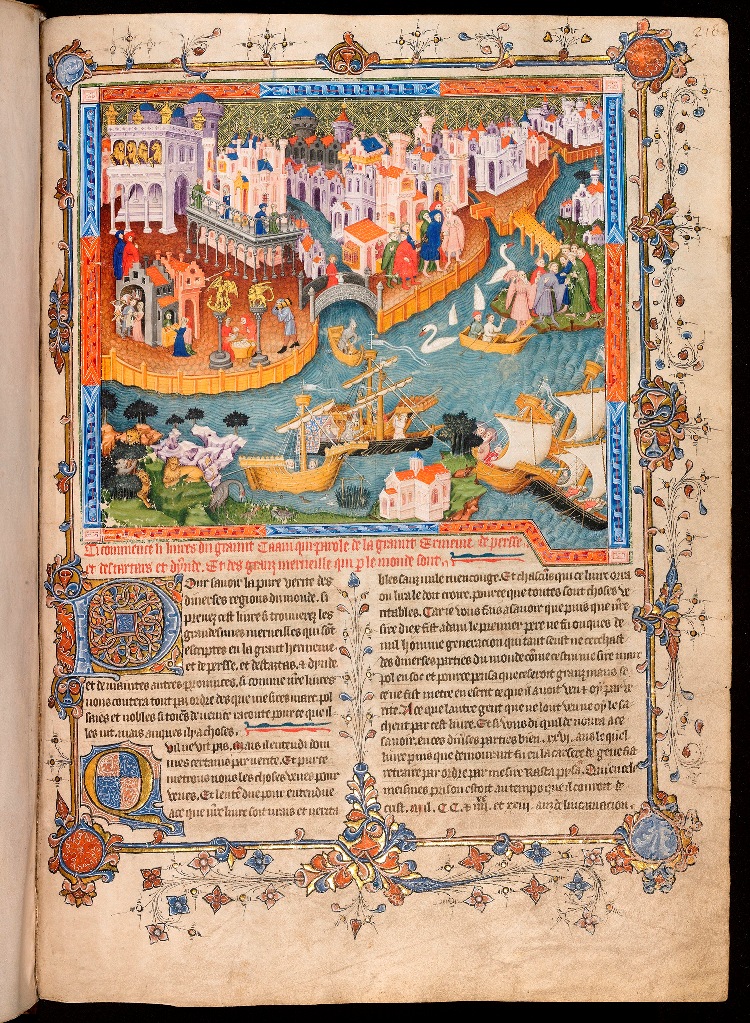
"Marco Polo's Travels," 14th century. Copyright Bodleian Libraries,University of Oxford

As you enter the darkened room,  a 1623 Shakespeare First Folio is to your right.  Enigmatic scraps of a poem by Sappho, circa 2nd century A.D., are to your left.  And all around you the wonders of the world: weighted with heavy seals, a 1217 “engrossment” of the Magna Carta is nearby (it was reissued under Henry III); so is a 1455 Gutenberg Bible.  In the corner of one glass case –  an exquisite 18th-century miniature scroll of the Bhagavad Gita, which shines like a cache of jewels, somehow pressed and rolled into paper.

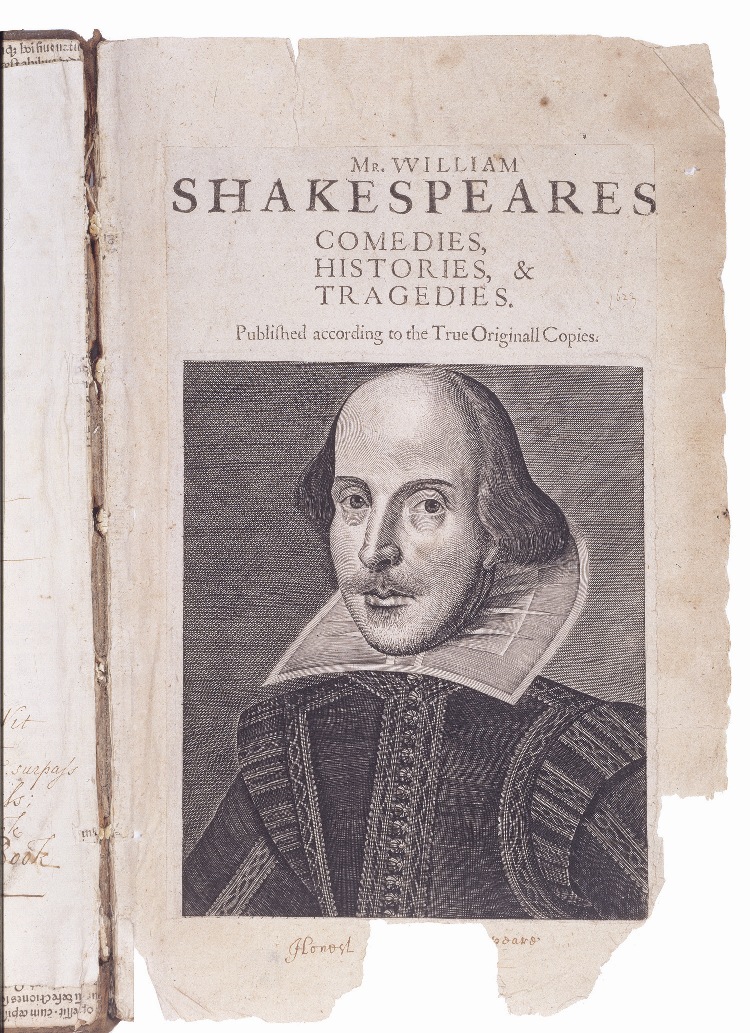
William Shakespeare, First Folio,1632. Copyright Bodleian Libraries,University of Oxford

“I have always imagined that Paradise will be a kind of library,” Jorge Luis Borges famously said. And here, in the Bodleian Library’s current exhibition, “Treasures of the Bodleian,” 30 Sept. – 23 Dec. 2011, everyone could see that, well, he had a point.  The exhibition anticipates a permanent gallery in the Weston Library in 2015.  The exhibition shows some of the Bodleian’s rarest, most important, and most evocative rarities.

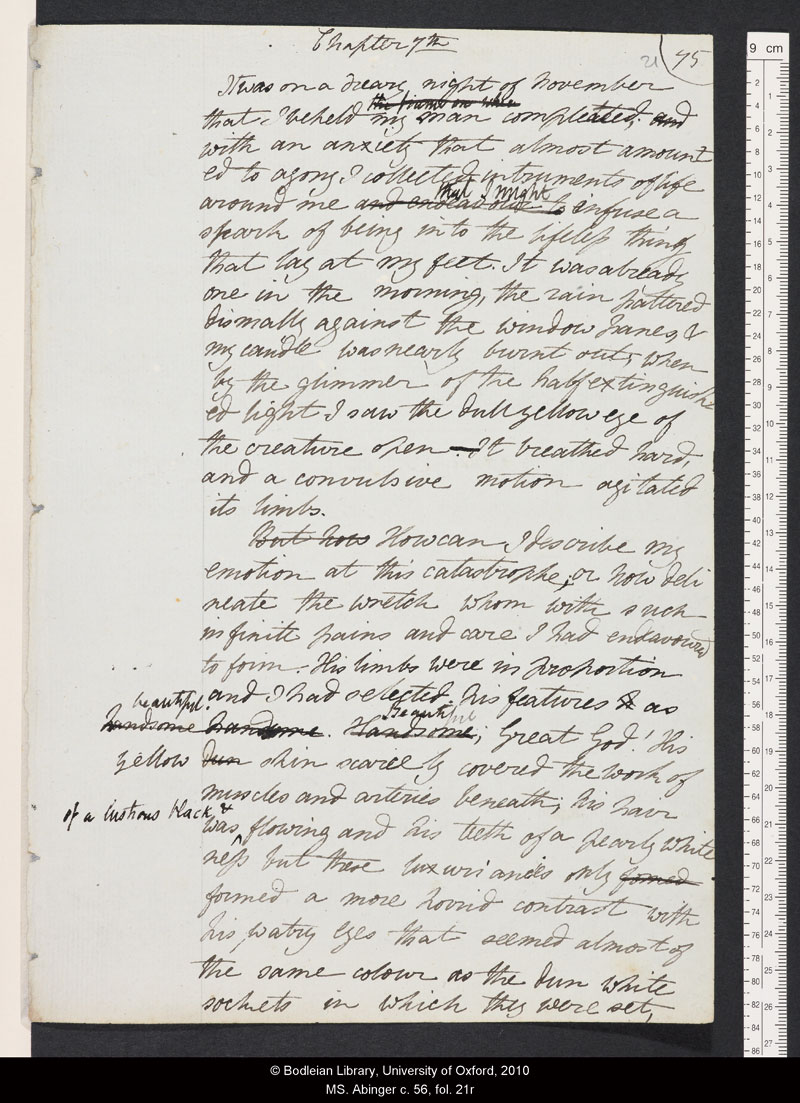
To wit:  In a corner, a single page of Mary Wollstonecraft Shelley‘s Frankenstein describes the ominous night of the creature’s creation. Her scrawled text is corrected and amended by her husband, the poet Percy Bysshe Shelley.  Other handwritten manuscripts are the work of Jane Austen, John Donne, and Gerard Manley Hopkins.  Others are the work of a brush rather than a nib: an exquisite 17th-century picture scroll of the sad Tale of Urashima, a classic Japanese fairy tale which I had read as a child.

For Sir Thomas Bodley, who basically created the museum that opened its doors in 1602, the Shakespeare first folio did not seem like the greatest find. According to the exhibition guide, he “would likely have dismissed this as one of the ‘idle books, and rife raffes’ that had not place among the Library’s predominantly theological collections.”

The volume left the library under mysterious conditions in 1674, and resurfaced only in 1905.  By that time, “the Bodleian was prepared to pay the unheard-of sum of £3,000 to buy back ‘its original long-lost copy of the First Folio of Shakespeare.'”

William Shakespeare,First Folio,1632. Copyright Bodleian Libraries,University of Oxford

I visited the exhibition in the company of my friend, Oxford’s Eliza Tudor, and we gravitated towards our favorites.  Hers seemed to be J.R.R. Tolkien‘s brilliant golden watercolor of Bilbo Baggins, rendered invisible by a magic ring, as he converses with a dragon.  She also took a liking to the Selden map of China, from the Ming era – the earliest Chinese map to show not only shipping routes, but also to depict China as part of a greater East and Southeast Asia. And for me … well, what a choice!  Perhaps I’ll plump for one of the earliest editions of Dante‘s Divine Comedy, fully illustrated, made within decades of his death (see video below).

But there are littler treasures, too – Mohandas Gandhi wrote to his friend, the Anglican missionary Charles Andrews, in a 1932 prison letter exhibited in the collection: “I can therefore never say beforehand what will occupy my attention exclusively or for the most part at a given moment and since a civil resister bargains for the punishment he receives for his resistance, he must not fret over it. Therefore and to that extent I am content with my lot.”

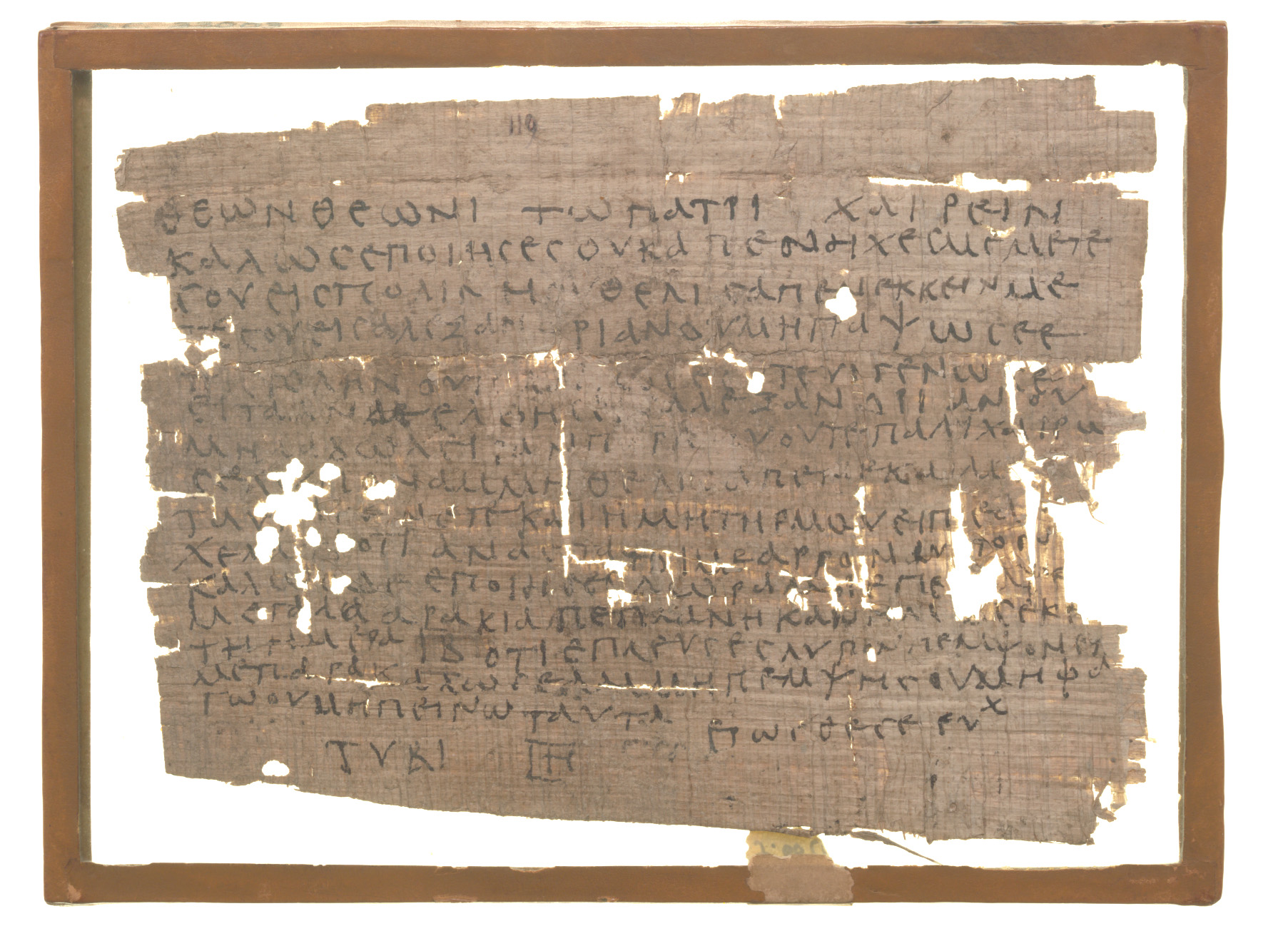
Letter from an Egyptian boy to his father, 2nd or 3rd century A.D. Copyright Bodleian Libraries, University of Oxford

Eliza arrived with her young son Fabian, who was mildly ill and did not attend school that day. His own choice was no surprise.  The exhibit that intrigued him the most was one of the earliest – about the same era, perhaps a little later, as the Sappho fragments: on a sheet of papyrus, an Egyptian schoolboy Theon complains to his father:

Theon to his father Theon, greetings. A nice thing to do, not taking me with you to the city. If you refuse to take me with you to Alexandria, I shall not write you a letter or speak to you or wish you good health. So: if you go to Alexandria I shall not take your hand or greet you ever again. If you refuse to take me, this is what happens. And my mother said to Archelaos, “He’s upsetting me, take him away!” A nice thing to do, sending me these grand presents, a hill of beans. They put us off the track that day, the 12th, when you sailed. Well then, send for me, I beg you. If you don’t send for me, I shan’t eat, I shan’t drink. There! I pray for your health.

Shakespeare or the Earl of Oxford? “It’s a shame sometimes that dead men can’t sue.”

Share

Rafe Spall as William Shakespeare ... or is it the Earl of Oxford?

Anyone who has attempted a novel, play, or screenplay based on real people, or a real event, has faced the difficult question: How much do you make up?  Do you make two people fall in love because it tidies up the script nicely – even though there’s no historical evidence for it?  Do you vilify a nice-man composer like Antonio Salieri because of a few rumors that started decades after his death – even for a top-notch script like Peter Shaffer’s Amadeus, which was further cemented in the public mind by a couple remarkable screen performances?  At what point are you simply defaming the dead?

Screenwriter John Orloff feels completely comfortable making stuff up for Anonymous, a new movie about the eternal Shakespeare authorship question.

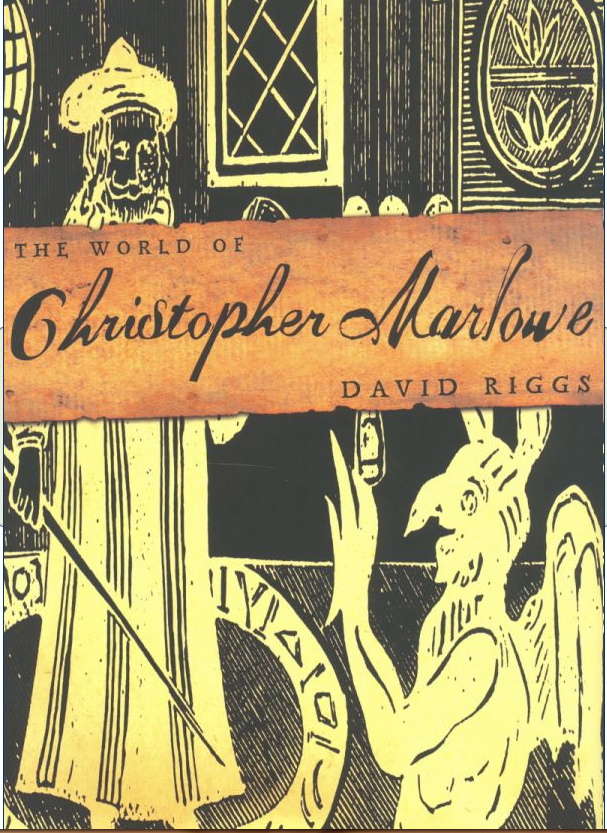
Spoiler alert: Edward de Vere, the Earl of Oxford did it, and William Shakespeare was merely the front man in this version, which the New York Times called the “cold-blooded murder of the truth.” David Riggs told me the only reason the gullible seek out alternative authorship for the plays and poems is that people are generally unaware of what top-notch grammar schools the Elizabethans had – he wrote about it in The World of Christopher Marlowe.

Here’s another story that should discredit the theory: I actually knew of someone who had gone through the Earl of Oxford’s letters.  The man couldn’t write to save his life.

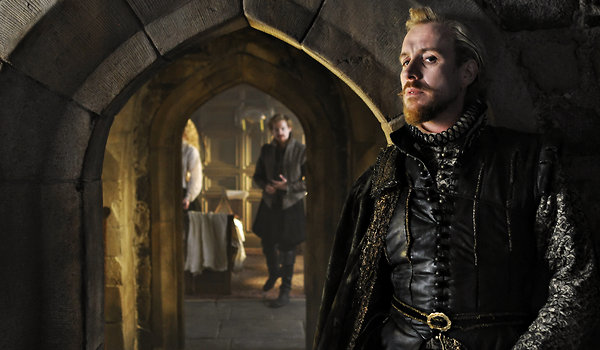
Rhys Ifans as Edward de Vere ... or is it Shakespeare?

Orloff is not a deep thinker, and the Wall Street Journal should be ashamed of printing platitudinous, clichéd passages like this:  “But I also wanted to tell a rocking good story and to express a theme that matters to me a great deal: that the pen is mightier than the sword.”

It gets worse.

The truth is, there is no truth in film—in any film. Even the films that we think are true, about real people in real places, actually aren’t.

This might seem obvious, but the emotions of a movie often overwhelm our intellect, blurring the line between fact and drama. We walk away feeling as if we have witnessed history.

But does this make a historical drama inferior to a history book or a documentary based on the same subject matter? Not necessarily.

Whatever a film might lack in literal truth, it can be far better at expressing the emotional truth of an event. [You don’t say! – ED]  In a movie, an audience can become connected to characters in a way that they often can’t in a straight historical account.

And this: “And, as I said, the film is not really about the Essex Rebellion. It is about showing that ideas are stronger than brute force. So how to make that point without wasting 20 minutes of the audience’s time?”  If the audience isn’t prepared to waste time, they shouldn’t be in the movie theater in the first place.

Then Orloff compares his historical liberties with those of Shakespeare himself.

This is a case where the comment section probes the issues more closely than the author of the article appears to have:

Harumph.

From Bill Wood:  “Nothing justifies outright lying to an audience. It’s one thing to present the argument that Shakespeare didn’t right [sic] his own work. It’s an idea that is baloney … It might make good drama. But it is also a lie. And most people will never bother to read the works which demonstrate what bunk it is.”

From David Brown: “One possible answer to Orloff’s question of how to make a point without wasting the audience’s time is to write your own story. If the history doesn’t support the story you want to tell, pick a different history that does fit – or just write your story without the crutch of misrepresenting great names and events.

From John Tufts: “Yes, stories exist to tell deeper truths, but Mr. Orloff is kidding himself if he thinks his movie is in the pursuit of truth. Neither movies nor theater, nor music, nor poetry, nor any art form has ever been very good at presenting what is real, but the history of all art has existed and been very successful at showing us what is true. That’s what makes Richard III great. Ultimately, it’s not about the real Richard III, it’s about the power of language, and the seduction of evil. Henry V isn’t about the real Henry Monmouth, it’s about the cost of war, and the challenges of leadership. These plays bend what was real to arrive at an essential truth. But for Mr. Orloff to say that he’s doing the same is nonsense. He’s bending what was real to arrive not an essential truth about the human experience, but instead to arrive right back where he started – a claim about what was real. He bends history to write not a great nor true screenplay, but a bad, and very unreal melodrama.”

Donald Forbes: “To aver that there is ‘no truth’ makes impossible any attempt to understand anything. There are no such things as facts, merely assertions of points of view. Relativism as usual morphs into nihilism and destructiveness. …”

As Thomas Conway, Jr., wrote, ” it’s a shame sometimes that dead men can’t sue.”

Ben Jonson: Not just another pretty face

Share

You don’t know the half of Ben Jonson.

In this case, a half would be about 140 pounds, for he tipped the scales at 280.  Ugly little sucker, too: his chum Thomas Dekker described him as “a staring Leviathan” with “a terrible mouth” and “a parboiled face … punched full of oilet holes, like the cover of a warming pan.”

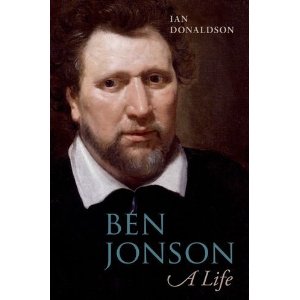
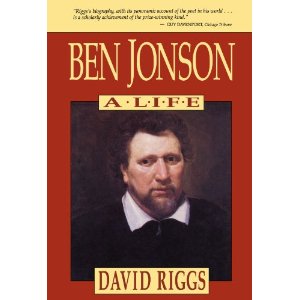
He’s not nearly so bad looking on the cover of Ian Donaldson‘s new Ben Johnson: A Life.  See right.

The Spectator reviews it here.  An excerpt:

“What a piece of work was Ben Jonson! If you lived in Elizabethan England and had just narrowly escaped the gallows after stabbing a man to death in an illegal duel, wouldn’t you want to keep your head down for a bit? Not Jonson. He converted to Catholicism.

A few months after the bishops of Canterbury and London, in 1599, declared the writing of satire illegal, what did Jonson produce? Every Man out of his Humour, a self-declared ‘comical satire’. The writing of history was also proscribed — Tacitean history being a particular sore point. So in 1603 Jonson produced Sejanus, a history play based on Tacitus. Epigrams were banned too. By 1612, Jonson got round to publishing some.

“Anyone would think he didn’t want to get on. Yet get on (despite the odd spell in chokey, and a fusillade of letters begging for forgiveness) is exactly what he did. He was the stepson of a bricklayer, with a criminal conviction for manslaughter, and a serial writer of plays that gave offence to court favourites — yet he became the pre-eminent dramatist and deviser of court entertainments of his era.”

Inevitably, the comparisons with William Shakespeare: “Though Shakespeare proved (in Jonson’s words) ‘for all time’, Jonson himself was eclipsed. What happened? He was classical, where Shakespeare was romantic.”  My goodness.  What on earth does those distinctions mean in the context of the 16th and 17th centuries?  The anonymous reviewer doesn’t quite figure this out.

The brush with murder is hardly a shocker, if you know how Christopher Marlowe was done in.  I wrote about that here (though the portrait that accompanies the story is almost certainly not Marlowe)  following the publication of David Riggs’s bio of Shakespeare’s rival poet, who may have been offed on orders of Queen Elizabeth I.  Moreover, Marlowe had tried his own hand at murder, or at least manslaughter:

“At the time of his death, Marlowe was a more prominent playwright than Shakespeare,” Riggs notes. By then, “Shakespeare had written Henry VI and Titus Andronicus, and they aren’t as good as Tambourlaine or Doctor Faustus.

In addition to being a revolutionary playwright, Marlowe was a blasphemer, a homosexual, a secret agent, “someone involved with a wide range of criminal activities,” Riggs says. In all probability, he wasn’t killed in a brawl but in a political hit, very likely on orders of Queen Elizabeth. …

Even in this unusual company, Marlowe stood out and was himself a subject for surveillance. He was a notorious brawler—in one case, the brawl resulted in a murder. Marlowe was held in Newgate, a “gloomy, rat-infested hold” for part of the time before he was discharged at trial.

By the way, David Riggs has his own 1989 biography of Jonson. See right.

Among these unsavory characters, the hardworking Shakespeare appears positively clean-cut, doesn’t he?

Why Americans talk like pirates

Share

But how would he have said it?

Way back in the 1980s, I was exploring Assisi with an Italian friend.  Many Italians couldn’t distinguish my accent from a British one, but he said it was easy to tell the difference.

“Americans go rarrr-rarrr-rarrr-rarrr,” he said.

The linguists call it “rhotic speech” – the pronounced “r’s” of American English, as opposed to the “pahking the cah” English of Londoners.

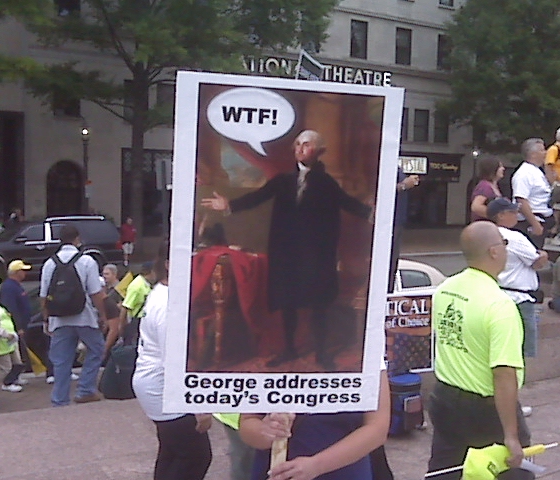
Nick Patrick takes on our rhotic r’s when tackling that timeless question:  What kind of accent did George Washington have?

In 1776, both American accents and British accents were largely rhotic. It was around this time that non-rhotic speech took off in southern England, especially among the upper class. This “prestige” non-rhotic speech was standardized, and has been spreading in Britain ever since.

Most American accents, however, remained rhotic.

There are a few fascinating exceptions: New York and Boston accents became non-rhotic. Irish and Scottish accents are still rhotic.

Prototype of American English

He seems rather surprised by this discovery.  But anyone who has plotted out the rhymes in John Donne could have told him so.

Years ago, there was a PBS program, “The Story of English,” that explained how the American regional accents came from regional British migrations.  The reason for the rhotic r’s was simply that many English immigrants came from the West Country, with the talk-like-a-pirate accents.  The Bostonian “pahking the cah” comes from the flatter accents of the East Anglian immigrants.

But it’s all leveling out now, right?

I bet you thought TV and movies were homogenizing accents across the nation.

Wrong.

According to NBC:

In fact, regional accents are becoming stronger and more different from each other, says William Labov, a professor of linguistics at the University of Pennsylvania in Philadelphia, although it’s not entirely clear why.

I’ve heard this before, too, on NPR years ago (you can listen to Labov speaking with Stanford’s Penelope Eckert in 1999 here), and it is certainly counterintuitive.

According to the NBC article, linguists say there are about ten major regional accents in the U.S., including New England, mid-Atlantic, Inland North, for the cities surrounding the Great Lakes, and the West, the country’s newest dialect.

Meanwhile, if you want to hear how William Shakespeare sounded onstage, as best as we can reconstruct it, I refer you to the youtube clip on our post last year:  “The archaeology of sound: ‘This reclaims Shakespeare for us.'”

Postscript on 9/12:  Hat tip to Dave Lull for this link on “Original Pronunciation” – don’t forget to check out this link that addresses the question, “How do we know?”