
René Girard and the verboten four-letter word

Share

What is the forbidden, unspeakable four-letter word in the English language?  René Girard has the answer:

“We often brag that no one can scandalize us anymore, but what about ‘envy’? Our supposedly insatiable appetite for the forbidden stops short of envy. Primitive cultures fear and repress envy so much that they have no word for it; we hardly use the one we have, and this fact must be significant.  We no longer prohibit many actions that generate envy, but silently ostracize whatever can remind us of its presence in our midst. Psychic phenomena, we are told, are important in proportion to the resistance they generate toward revelation.  If we apply this yardstick to envy as well as to what psychoanalysis designates as repressed, which of the two will make the more plausible candidate for the role of best-defended secret?”

The words are from his 1991 book A Theater of Envy: William Shakespeare – the only book he has written in English (fittingly, about William Shakespeare, who has been a lifelong passion for this devotee of French literature).  My copy of the book arrived a few days ago, and just in time.
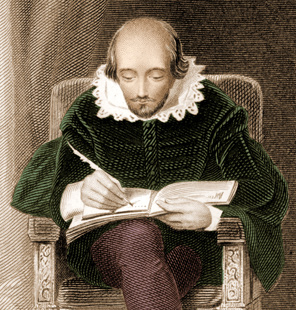
He has a lot to answer for.

Coincidentally, I checked out Arcade a few days later and found that João Cezar de Castro Rocha of Rio de Janeiro is extending René’s argument about “mimetic envy” to include  colonialism and the notion of “Shakespearean countries”:

Perhaps the best way of outlining a brief definition of what I propose to call Shakespearean countries is resorting to V. S. Naipaul’s The Mimic Men, whose title already suggests a Girardian reading of the work of the Nobel Prize [writer]. Reflecting upon his life, the protagonist and narrator of the novel, Ralph Singh, identifies a common feature between him and a “young English student”: “He was like me: he needed the guidance of other men’s eyes”. A little further, the narrator acknowledges the mimetic nature of his desire: “We became what we see of ourselves in the eyes of others”.

Whoever experiences this cultural circumstance lives a sort of “half a life”, always dependent upon someone else’s eyes and opinions – very much like Shakespearean characters, according to René Girard’s study William Shakespeare: A Theater of Envy. Indeed, Half a life is precisely the title-metaphor of another novel by the same writer. In it, Naipaul deals with the same fundamental issue expressed by a character [a Brahmin] who has casually met the English writer W. Somerset Maugham. Due to a series of revealing cultural misunderstandings, the writer considered the Brahmin a sacred and wise man, and wrote about him as a holy man in one of his novels. Then, the Brahmin immediately became “famous for having been written about by a foreigner”, as J. M. Coetzee aptly summarized the plot in an important review of Naipaul’s novel. However, to the Brahmin this fame did not come without its pitfalls: “It became hard for me to step out of the role”. The role created by someone else’s eyes, and as the character has to accept:  “I recognized that breaking out had become impossible, and I settled down to live the strange life that fate had bestowed on me”. In this case, fate has a proper name and refers to the foreigner’s gaze. And since the foreigner is seen as an undisputed model, he has the authority of defining what he looks at.

Naturally, the Brazilian scholar focuses more on Latin American literary and cultural history.  He’s made several posts already: “Mimetic Theory and Latin America” is here, “Mimetic Theory and Cannibalism” is here, and “Shakespearean Countries?” (cited above) is here.

Incidentally, W. Somerset Maugham inspired some mimesis of his own.  Leonard Nimoy has said that when he was creating a voice for Star Trek’s Mr. Spock, he listened to hours of recordings of the English writer reading his works.

 

Postscript on 5/13:  I thought the name João Cezar de Castro Rocha sounded familiar – he’s one of René Girard’s interlocutors for the book Evolution and Conversion: Dialogues on the Origins of Culture.

By the way, René’s theories are getting some new traction not only from a mini-revival of Shirley Jackson, whose landmark short story, “The Lottery,” describes the “scapegoat mechanism,” but also from The Hunger Games, another exploration of societal scapegoating.

A priest’s explanation of The Hunger Games in light of René’s theories (below) has been making the rounds … but there’s a curious omission. He describes the need for scapegoating when tensions arise within societies, but he skips a huge chunk of René’s thinking when he overlooks the cause of that tension – that nasty four-letter word taboo again.
The lunatic, the lover, and the poet: Shakespeare, Gioia, and a dash of Rimbaud

Share

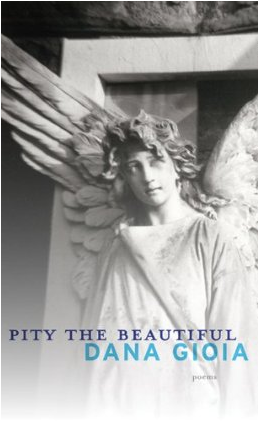
Greg Gioia can whip up one mean drink. Dana Gioia‘s new book, Pity the Beautiful, was fêted by a capacity crowd at Kepler’s last night.  One of the memorable highlights of the evening was Dana’s kid bro making a libation of his own invention, called “The Lunatic, the Lover, and the Poet.”

I watched him make it.  Parts of something that looked like Campari (but wasn’t Campari), then absinthe, and a few other ingredients, with a twist of orange for garnish.  “The lover,” Greg told me, was the quick spray of rosewater on top.  “The lunatic” was, obviously, the absinthe.

And “the poet”?  Greg told me the drink was a variation of one called “Arthur Rimbaud.”  But it also hearkens back to a line from William Shakespeares A Midsummer Night’s Dream:

Lovers and madmen have such seething brains,
Such shaping fantasies, that apprehend
More than cool reason ever comprehends.
The lunatic, the lover and the poet
Are of imagination all compact:
One sees more devils than vast hell can hold,
That is, the madman: the lover, all as frantic,
Sees Helen’s beauty in a brow of Egypt:
The poet’s eye, in fine frenzy rolling,
Doth glance from heaven to earth, from earth to heaven;
And as imagination bodies forth
The forms of things unknown, the poet’s pen
Turns them to shapes and gives to airy nothing
A local habitation and a name.

It’s also – for a third association – the title of a love poem in Dana’s new collection. Muriel Rukeyser famously said, “The universe is made of stories, not of atoms.”  Dana agrees:  We live by the stories we tell about ourselves, he said.  People who are “stuck” in their lives are in fact enmeshed in a particular narrative about their lives.  Then he read the poem.

It’s so lovely I’ll quote it in full, taking full advantage of Dana’s kind permission to do so:

The tales we tell are either false or true,
But neither purpose is the point. We weave
The fabric of our own existence out of words,
And the right story tells us who we are.
Perhaps it is the words that summon us.
The tale is often wiser than the teller.
There is no naked truth but what we wear.

So let me bring this story to our bed.
The world, I say, depends upon a spell
Spoken each night by lovers unaware
Of their own sorcery. In innocence
Or agony the same words must be said,
Or the raging moon will darken in the sky.
The night grows still. The winds of dawn expire.

And if I’m wrong, it cannot be by much.
We know our own existence came from touch,
The new soul summoned into life by lust.
And love’s shy tongue awakens in such fire –
Flesh against flesh and midnight whispering –
As if the only purpose of desire
Were to express its infinite unfolding.

And so, my love, we are two lunatics,
Secretaries to the wordless moon,
Lying awake, together or apart,
Transcribing every touch or aching absence
Into our endless, intimate palaver,
Body to body, naked to the night,
Appareled only in our utterance.

I think it’s one of his finest (I love the turn in the second stanza) – though I must admit that at some point the liquid form of the “the lunatic, the lover, and the poet,” began to take hold, and everything in the room was illuminated in a sort of roseate glow.  It had been a long week, and I had been fighting off illness.  Before I had a chance to go up for a refill of Greg’s potion, the initial euphoria faded, and I realized that it had only been the tension of a tight schedule that had been holding me together.  Suddenly my bones ached and my head throbbed.

I took Dana’s advice. A dash out the back door into the silence of the cool twilight and then homeward – as Dana suggested, I brought this particular story to bed.

Postscript on 5/6:  If you want Greg’s recipe, it’s here, on “Sidecar Cocktail Blog,”  the blog he’s been running for nine years.  That’s six longer than the Book Haven – whew!  how does he do it?   It’s a pretty good blog, too – clearly, writing talent runs in the family.  Brother Ted Gioia, occasionally mentioned on this blog, is a noted jazz scholar (I’ve written about him here).  His The Jazz Standards: A Guide to the Repertoire will be out with Oxford University Press next month.  Congratulations to all Gioias!

The word has a life of its own – “it lives in the kingdom of the mouth and the mind.”

Share

The author

When I visited Ann Pasternak Slater last fall, I asked if her husband, the writer Craig Raine, might have a copy of the famously blistering review he wrote of Joseph Brodsky‘s poetry. I say “famous,” but my efforts had failed to uncover any copy of the review in any library. He hadn’t, but some weeks later she wrote that he had suggested I look up the review in his 500+ page book of essays, In Defense of T.S. Eliot.  Feeling a little rebuffed, I nevertheless found a copy of the book in Stanford’s Green Library, and I must say that he’s rather won me over, on every subject except Brodsky.

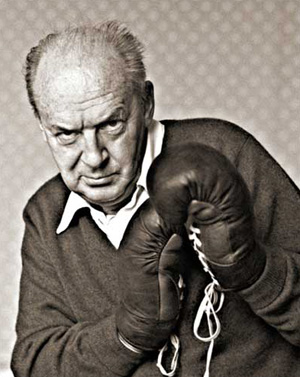
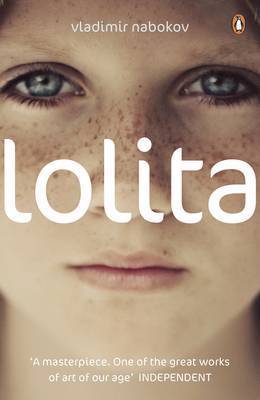
This paragraph, in particular, from the essay “A Book that Changed My Life,” about finding Vladimir Nabokov‘s Lolita as a 14-year-old boarding school student in 1959:

“I settled to read this dirty book – undeceived by the international tributes to Nabokov’s art which were anthologized at the back – and was at once bouleversé by the first paragraph, which had, as it turned out, a particular personal message from Nabokov to me. It was this: the word has a life of its own, a sound of its own and a shape of its own. It isn’t simply a harmless drudge, it is also a monarch with a retinue of associations. It lives in the kingdom of the mouth and the mind. If it is to obey you, you must cherish it as an individual and respect its unique powers and properties. Every word is irreplaceable, as Roget paradoxically but invariably demonstrates.”

Coincidentally, today’s Washington Post announced the death of 77-year-old Dmitri Nabokov, the author’s son, whose position as heir inevitably meant much of his life was spent protecting his father’s literary legacy and translating and editing his father’s plays, poems, stories, including the novella The Enchanter and the Selected Letters.

“My father is gradually marching — with his two favorite writers, Pushkin and Joyce — arm in arm into the pantheon to join the greatest of all, Shakespeare, who is waiting for them,” Nabokov told The Associated Press in a 2009 interview. “I like to think that I did my bit to keep things on track.”


Antoine Jaccottet’s Le Bruit du Temps: Fresh air for French readers

Share

Translation is the poor stepchild of literature – academics get more applause for producing their own books, not for translating the writing of others; for writers, it’s a distraction from their own work and not terribly well remunerated. Hence, a welter of books never appear on the international stage the way they deserve.

So it’s cheering to see a venture like the Paris-based Le Bruit du Temps, a publishing house crowded in one large room in one of the more picturesque neighborhoods in a city that has plenty of them.  Founder and director Antoine Jaccottet has a desk in one corner; his collaborator, Cécile Meissonnier, has a desk on the other side.  Pictures of Osip Mandelstam, Isaac Babel, and others are stuffed into the edges of a large mirror – they are the real masters here. The window next to it gives a clear view on a plaque indicates that James Joyce finished Ulysses across the street here, on rue du Cardinal Lemoine in the Latin Quarter.

Antoine Jaccottet, son of the poet and translator Philippe Jaccottet (who translated Goethe, Hölderlin, Mann, Mandelstam, Góngora, Leopardi, Musil, Rilke,  Ungaretti, and Homer into French), worked for 15 years at the famous French publisher Gallimard, publishing classics, before he broke out on his own for a shoestring enterprise in 2008. The tight-budge endeavor, however, produces elegantly designed, finely crafted volumes.

Masterpieces don’t die, he says, but they can get lost in the noise of time.  It’s the job of publishers to rediscover them for the public, and what better place than the small adventurous publishers who have a freedom and esprit not usually tapped by large publishing houses.

As I gaze over the offices teeming bookshelves, I notice an entire shelf of W.H. Auden in English.  He’s one of the house’s authors.  Le Mer et le Miroir … Auden in French? How does he come across?  It’s difficult, Antoine admits, for the French to “get” Auden’s sensibility.

He’s also published  Zbigniew Herbert in French, Lev Shestov‘s Athens and Jerusalem, the complete works of Isaac Babel, and Henry James‘s The Ambassadors.  Even Shakespeare‘s (cough, cough) Henry VIII.

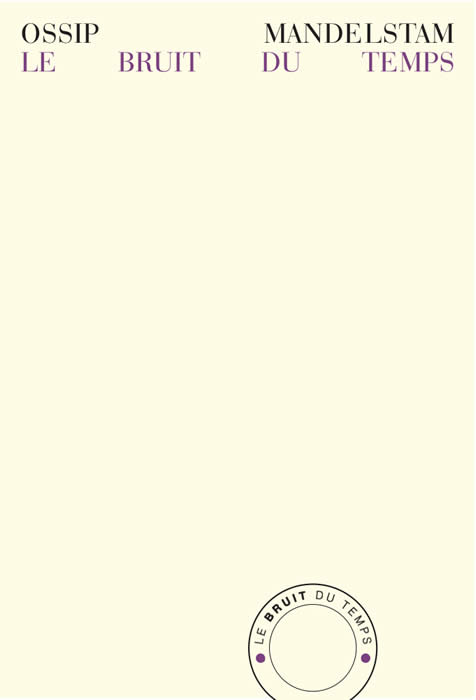
Mandelstam is, in a sense, the reason for the place.  The title of the publishing house itself – “the noise of time” – is taken from the title of Mandelstam’s prose collection, which includes perhaps his most autobiographical writing.  Antoine had been taken with the Russian poet in the 90s, and the translations and biography by the eminent scholar Clarence Brown.  One of the first books the house published was Le Timbre égyptien (The Egyptian Stamp).  The Ralph Dutli biography will be published this month.  (The house published Dutli’s poems in 2009).

A piece of old France

Le Bruit du Temps’ books by and about Mandelstam illustrate an underlying principle at the house:  Antoine publishes works that develop and deepen recurrent themes like a symphony.  In 2009, he published published Browning’s L’Anneau et le Livre, republished G.K. Chesterton‘s out-of-print 1903 Robert Browning (Chesterton’s first book), Elizabeth Barrett Browning‘s Sonnets from the Portuguese and Henry James‘s Sur Robert Browning. That’s probably more Browning than Elizabeth Barrett ever saw.

Literary journalism, apparently, is as much in a crisis in France as it is here – the media often publishes book blurbs intact, and critics are famous for not reading the books they review.  So how do people hear about books?  Often, they don’t, he says.

As I leave, Antoine gives me a little souvenir of my visit, the publishing house’s brand new Le Bruit du Temps, a slim and elegant volume, fresh from the press.  What could be more fitting?

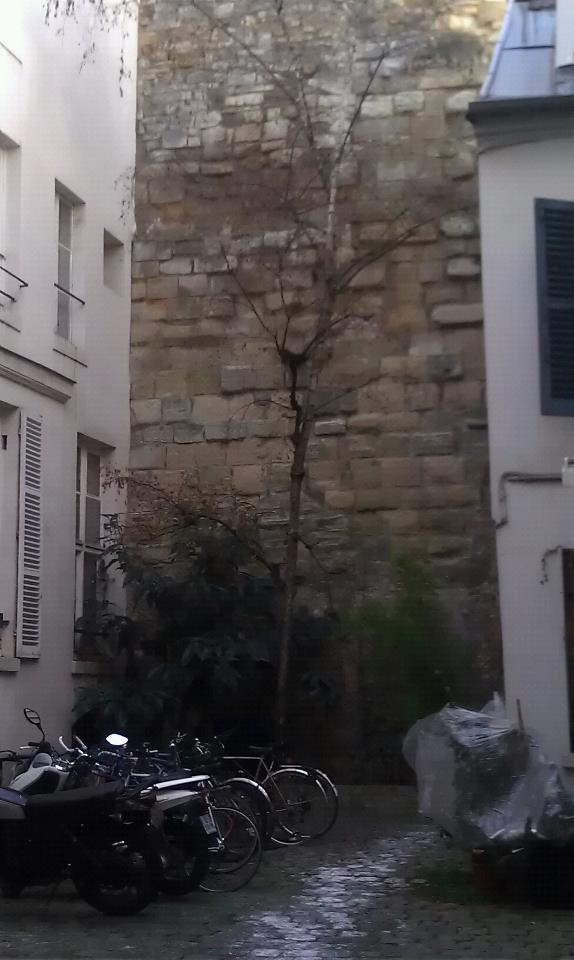
He also shows me a rarely seen landmark as he shows me the door – at the back of the courtyard, between the buildings, in the soft sunlight of the late afternoon, the ancient Paris city walls of  Philippe Auguste, the oldest surviving city walls, about the time of the poet Marie de France.

Postscript on 3/16:  Nice mention on the University of Rochester’s “Three Percent” blog over here.


Shakespeare around the world in 2012

Share

We meant to work this whimsical take on worldwide William Shakespeare celebrations into the next Book Haven post on the subject – but this one’s got a time peg, and we’re already nearly 10% through 2012.  As we are shoveling clothes and papers into a suitcase to head for Paris, here’s a few off-the-beaten track ways to celebrate the English language’s premiere Bard this year.

February:  Verona’s “Club di Giulietta” receives and apparently responds to hundreds of letters addressed to “Juliet” of  Shakespeare’s  famous love story.  On Valentine’s Day, the club awards the Cara Giuletta (“Dear Juliet”) prize to the writers of the “most compelling letters” received the previous year.  (See photo at right for Juliet’s balcony.)

March/April:  More locally, San Francisco’s African American Shakespeare Company  (“Envisioning the classics with color.”) finishes its 2011-12 season with a March-April production of Julius Caesar.  According to the website, “this political thriller about life and death political struggles tells us not only about the dead leaders we see etched in stone or live on TV each night, but also about the people who put them in power in the first place.” We wrote about the founding director of company, L. Peter Callender, during a Homeric venture at Stanford.  (In fact, if I’m not mistaken that rather looks like him in the Julius Caesar photo at left.)

April:  Prior to going to Chicago’s “Talk Like Shakespeare Day” on the Bard’s putative birthday on April 23, you might want to check out our post “The Archaeology of Sound” here.

Check the others at the Online Degree website here.


Writing is a life of poverty? Not.

Share

Waugh's digs at Piers Court, near Stinchcombe

For those of you entering this or that writing competition or perhaps applying for a grant, hoping to scrape together a few shekels so you can buy kitty litter – behold and weep!

Writing does not have to be a monastic dedication to a life of poverty – here are a few dwellings where famous writers had their desks and pencils.  Probably lots of other stuff as well – including maids, gardeners, and butlers.

Obviously, they mostly did not begin poor.  If one wants an independent income and a room of one’s own, it’s best to acquire them at birth.  (The old joke:  What does it take to make a small fortune as a writer?  Answer:  A large fortune.)

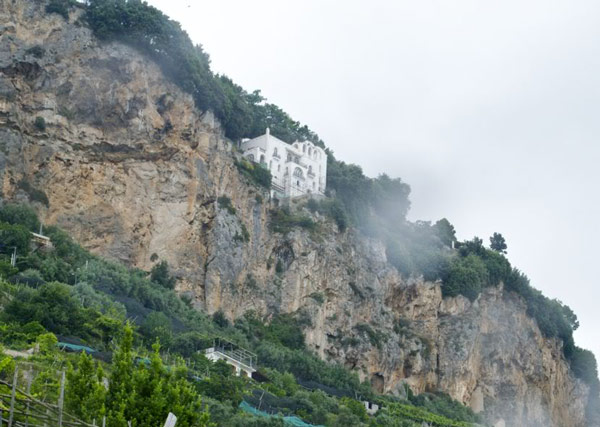
Vidal's domicile in Ravello, Italy

I’ve selected a few from Flavorwire’s 15 – based strictly on personal taste, the houses I would most love to live in.

Not surprisingly, Evelyn Waugh comes out tops with his home in Goucestershire.  Given my love of the English countryside and its stately homes – is this any surprise?

And for the winter break, I’ll take Gore Vidal‘s home on the Amalfi coast, just for the landscaping. It’s also known for handmade paper and plenty of limoncello. Pray for no earthquakes.

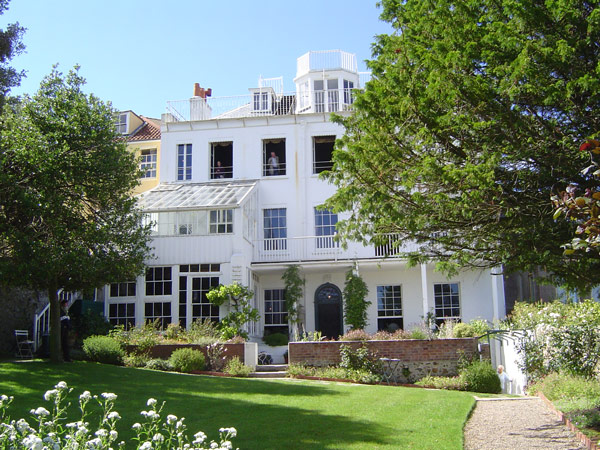
Where he lived in exile: Hugo

Perhaps it’s only a lifelong and slightly cheesy love for Jean Valjean that makes me hanker for Victor Hugo‘s “Hauteville House,” at 38 Rue Hauteville in St. Peter Port in Guernsey, where he lived during his exile from 1856 to 1870.  Hard to beat Guernsey for beautiful climate, and probably an improvement on Paris. This is the view from the garden, not the busy street. Thanks to the mild climate, the jardin is filled with trees and flowers.  Well, rather like Palo Alto.

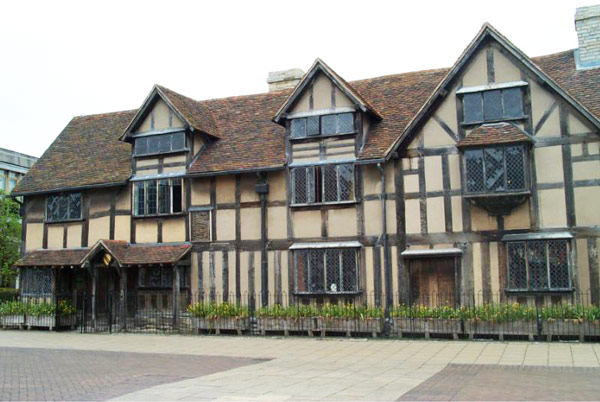
We can’t leave without citing the ur-house, and the only one of the bunch that I’ve seen face to face:  William Shakespeare‘s house in Stratford.  Shakespeare, to his credit, did make his own money, in sometimes less-than-savory ways (he was accused of hoarding).

The Bard's stomping grounds

I’ve seen lots of writers’ homes – Constantine Cavafy in Alexandria, Elizabeth Bishop in Samambaia, Mikhail Bulgakov in Kiev, Emily Dickinson in Amherst, C.S. Lewis in Oxford, Robinson Jeffers in Carmel, Alexander Pushkin in Moscow and Odessa,Winston Churchill at Blenheim and Chartwell, Czeslaw Milosz in Kraków and Berkeley and Lithuania, even John Milton‘s humble digs in Chalfont St. Giles, a couple miles from where I lived on the border of Hertfordshire and Buckinghamshire.

Can’t say these top the preferred list – but they certainly stack up very well.  See the rest here.