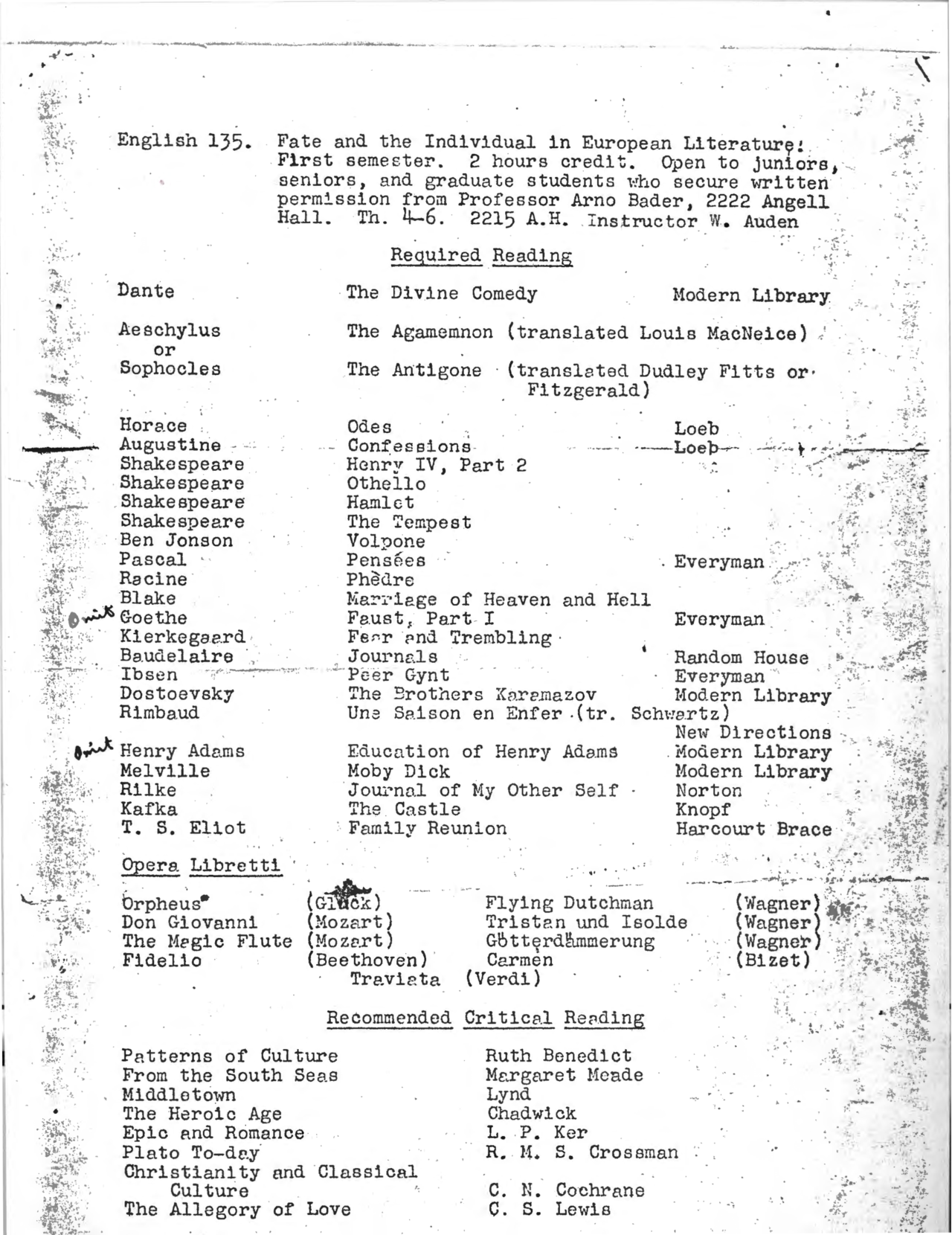
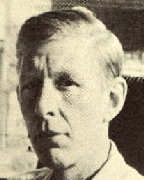
“What is this tattered sheet of paper?” you may ask. It is reproof. For somewhere in my garage, I have my very own copy of this syllabus, issued by W.H. Auden to his semester class on “Fate and the Individual in European Literature,” when he taught at my own alma mater, the University of Michigan, way back in 1941-42. I asked for it a decade or two ago, and would have been the first to put it online had I not misplaced it. Now it’s all over the internet – I knew the game was up when The Atlanticput it on tumblr a year ago. In any case, it has influenced my life in strange ways. For example, it’s the reason why Shakespeare‘s Henry V, Part 2, is the only work of literature on my Droid, besides the King James Bible. I still have some catching up to do to finish the list.
Cherce.
“What I find fascinating about the syllabus is how much it reflects Auden’sown overlappinginterests in literature across genres – drama, lyricpoetry, fiction – philosophy, and music,”Lisa Goldfarb, Associate Professor and Associate Dean at NYU’s Gallatin School, told the New York Daily News earlier this year. “He also includesso many of the figures he wrote about in his own prose and those to whom herefers in his poetry: especially “The Tempest” of Shakespeare; Kierkegaard,Baudelaire, Rimbaud, Melville, Rilke, as well as the opera libretti on thesyllabus.
“By including such texts across disciplines – classical and modern literature, philosophy, music,anthropology, criticism – Auden seems tohave aimed to educate his students deeply and broadly.He probably wouldhave enjoyed working with students on the texts he so dearly loved.”
Now it’s over at Flavorwire, along with the course instructions and syllabi for David Foster Wallace, Katie Roiphe, Lynda Barry, Lily Hoang, Susan Howe, Zadie Smith, Donald Barthelme. Check them outhere.
But for me? I’ll still take Wystan’s list. It’s cherce.
(P.S. I have a hidden motive for posting this syllabus. Now I can’t lose it.)
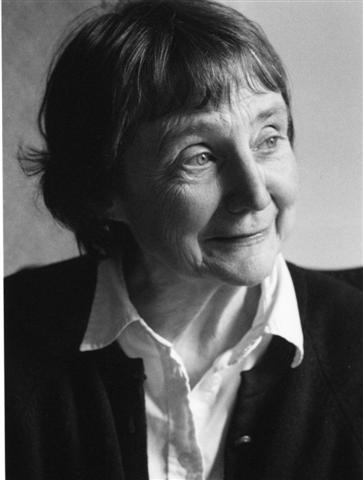
Her 17th century cottage near Llanbedr, during my 2009 visit.
Anne Stevenson turned 80 in January – and the occasion whizzed past without my noticing it. So it was a pleasure to be reminded of my neglect by the Times Literary Supplement this week, in an article by Thea Lenarduzzi. I was also unaware of Anne’s newest “probably my last” collection, Astonishment. I wrote about Anne a dozen years ago, here, and have had the pleasure of visiting her at both her residences, in Durham, and more recently staying in Wales, where she lives with husband Peter Lucas in a 17th century cottage near Llanbedr.
“One has to maintain a distance, an air pocket between the poet and the poem—a pocket of objectivity. The poem isn’t an expression of what you could say better in ordinary language, or in theoretical language,” she told me in 2000.
“I do believe that writing poetry is not something everybody needs to indulge in. Encouraging more and more people to express themselves and, above all, to publish poems or put them on the internet, does tend to thin the blood—of literature, I mean. People forget how to read. They forget that you need to develop a strong degree of attention to read intelligently the poetry of, say, Auden or Yeats, or even Roethke and Elizabeth Bishop. You need to be sensitive to all the sounds, rhythms, echoes, et cetera, that constitute a poem to know what’s going on in it. If nothing is going on except the promulgation of some one-dimensional idea or personal experience, if the so-called poem is nothing but a cut-up piece of not-very-interesting prose, then it isn’t poetry at all. It’s not asking anything of the reader, except perhaps fellow-feeling or sympathy.”
“A pocket of objectivity”
Not surprisingly, she is still a woman of strong opinions. From the TLS piece:
More overtly underwhelmed by the possibilities of mixed media was Stevenson. “There’s an awful lot of poetry about”, she said, emphasizing one word in particular. “And with 9,000 teachers of Creative Writing in US Colleges, turning out ten protégés each . . . you’re bound to bring the standard down”. With characteristically wry humour she questioned that age-old obsession with “doing something ‘new’” (“it’s terribly hard to do anything new, you know”), which operates at the expense of more self-probing verse (not to be confused with the “Words about words about words to pamper the ego / Of some theoretical bore”); and “Do It Yourself Poetry” built in ignorance of proper craftsmanship (with no sense of rhythm, form, heritage ). “We are losing contact with language . . . . I wouldn’t even begin to talk about the visual arts, ‘Conceptual Art…’” (that carefully placed emphasis again, a glint in her eye, and a laugh: “I am eighty, you know!”).
“I’ll just throw all of that in”, Stevenson quipped before bringing the evening to a close with a reading of her most recent poem, “An Old Poet’s View from the Departure Platform”, its final stanza running thus:
“I gaze over miles and miles of cut up prose, / Uncomfortable troubles, sad lives. / They smother in sand the fire that is one with the rose. / The seed, not the flower survives.”
Oh, and this will keep me in my place: she says ““Blog is the ugliest word I ever heard …” Read the whole thing here.
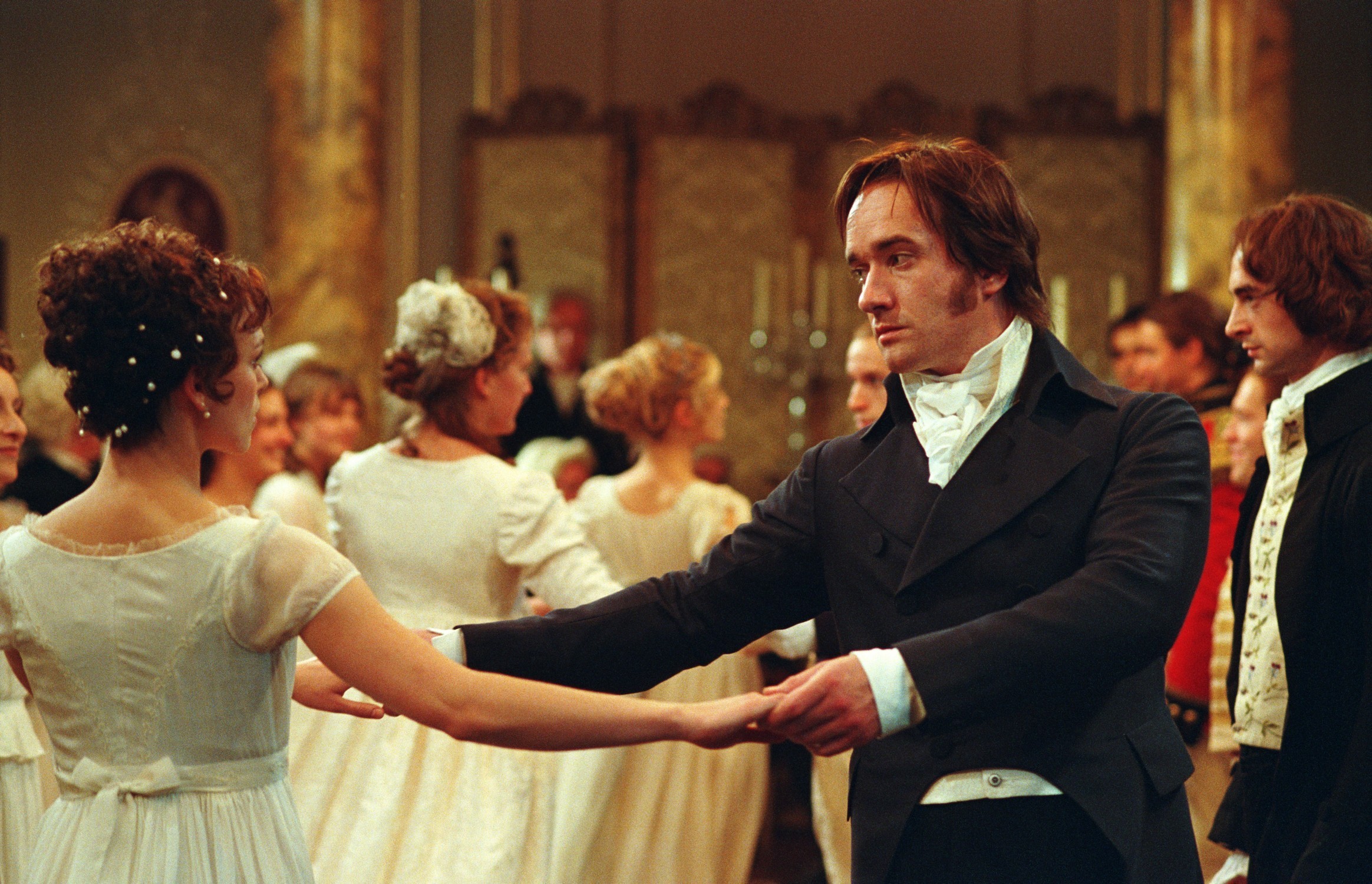
“…everything most profligate and shocking in the way of dancing and sitting down together…”
You could not shock her more than she shocks me, Beside her, Joyce seems innocent as grass. It makes me most uncomfortable to see An English spinster of the middle class Describe the amorous effects of ‘brass’, Reveal so frankly and with such sobriety The economic basis of society.
Shocked, shocked I tell you.
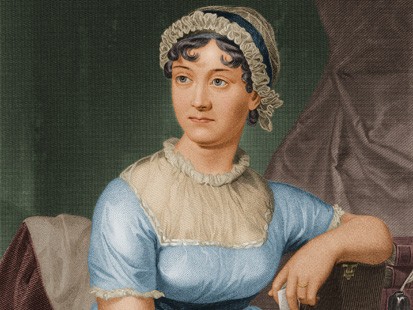
That’s W.H. Audenwriting about Jane Austen, the poet one small consonant away from sharing her surname. The poem is his 1937 “Letter to Lord Byron.”
In this weekend’s Independent, John Walsh explores the eternal question: “Why is Mr. Darcy such an asshole?” Actually, I’d never thought of it quite that way before, but Walsh points out that the character who is seen as noble and heroic acts like a complete jerk for the most of the novel:
“Has a supposedly romantic hero ever seemed less agreeable, less attractive or less charming? At a dance, he tells Bingley, in everyone’s hearing, that it would be a punishment for him to dance with any of the ladies present. What, Bingham asks, about Lizzie Bennet? Darcy regards our lively, clever, witty heroine and says, “She is tolerable, but not handsome enough to tempt me.”
This is not ‘pride’. It’s rudeness, bad manners, the words of (let us not mince words here) a stuck-up fool. We know he is ‘well-bred’ – can breeding make one so socially maladroit? He is hopeless at conversation. He is rude to Miss Bingley. He is awkwardly icy with Lizzie. Even when he finally proposes to her, he’s unforgiveably rude about her mother’s vulgarity, her own ‘inferiority’ and how degrading it would be for him to marry her. He admits, without apology, trying to derail the romance between Lizzie’s sister Jane and Bingley. The reader may be forgiven for wondering when any recognisably heroic virtues will appear.”
On the shelf…
Yet, in the second half of the book: “He’s discovered at his mansion, Pemberley, being charming, attentive and kind. We hear about his man-of-action heroics in persuading Wickham to marry Lydia. What has brought about this transformation?” May I suggest that Lizzie is a mere 20 years old, and Darcy 28? Who is not a jerk at such ages? Who does not have scores of memories of behaving poorly at such an age?
Walsh theorizes instead that Darcy reconsiders Lizzie after he three-mile walk through the mud to visit her sister who has taken ill at Bingley’s home. According to Andrew Davies, who adapted the book for the BBC, “She happens to bump into Mr Darcy just as he’s coming out of the house, and he finds that he responds very well to her looks. So I wrote in a stage direction: ‘Darcy is surprised to find that he has an instant erection’. I felt obliged to add, ‘I don’t mean we need to focus on his trousers, just that it’s what should be going through the actor’s mind’. Darcy’s obviously turned on by this heart-throbbing, muddy, warm girl.”
Well, that’s one interpretation. May I suggest a less obvious one in our modern times? Lizzie, up to that point in the novel, has appeared to Mr. Darcy as little more than a smart-ass who excels at pertness. In this incident, she displays loyalty, tenacity, and character – and it evokes the same in response. Not as sexy, admittedly, but a more enduring reaction.
Worthy.
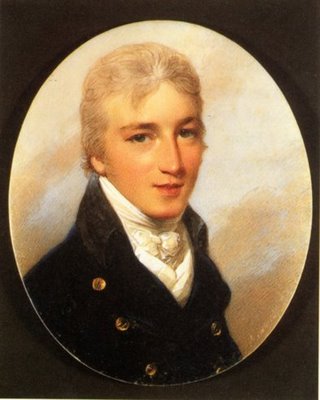
Walsh explores Jane Austen’s brief Christmas romance with the charming Tom Lefroy in 1795.“I am almost afraid to tell you how my Irish friend and I behaved. Imagine to yourself everything most profligate and shocking in the way of dancing and sitting down together,” she teased her sister in a letter. The gentleman’s family was alarmed, and whisked him back to the bar (no, not that kind of a bar – the legal profession). He was expected to become a barrister and pull the family’s economic sled, otherwise others might have to get off their duffs and work.
Austen did not rebound from the Christmas romance quickly.
But Walsh doesn’t say what happens next. Austen’s romantic hero was worthy of her: he became as MP for the constituency of Dublin University, Privy Councillor of Ireland, and eventually Lord Chief Justice of Ireland. When Austen died in 1817, he traveled from Ireland to England to pay his respects. A “Tom Lefroy” even bought at auction one of the early rejection letters she received for her novel, already a valuable record of poor literary judgment.
At the end of his life, he admitted to having loved Austen. His nephew wrote: ” My late venerable uncle … said in so many words that he was in love with her, although he qualified his confession by saying it was a boyish love. As this occurred in a friendly & private conversation, I feel some doubt whether I ought to make it public.” Probably a wise move. Lafroy’s eldest daughter, born June 24, 1802, was named Jane Christmas Lefroy.
About the time of Lefroy’s visit, Jane was penning the novel that would become Pride and Prejudice. Some speculate that Lefroy is the model for Darcy. Others claim that the author herself is the reserved Mr. Darcy, and that Lefroy is the teasing, lively Lizzie. I’ll make a third suggestion. Lefroy is the model for the lively, amiable Bingley, who appears casual in his affections even when he is deeply engaged. And perhaps Jane saw herself in Lizzie’s sister, also named Jane, whose quiet love persisted long after the romance was over.
Postscript: Jane Austen’s best marriage proposals are the ones that end up in a fistfight. In fact, the successful proposals happen offstage or through paraphrase, anyway. This one is much better on the page than onscreen, but still…
Postscript on 1/28: And we got some nice pick-up on this from our old friend Andrew Sullivan over at the Daily Beast. His piece, “The Cost of Love,” is here. What fun!
Lovely piece in the New Yorker about J.R.R. Tolkien‘s Lord of the Rings, and just in time for the current hubbub about Peter Jackson‘s adaptation of The Hobbit, the movie. I’ve never understood the Tolkien craze – I took an unsuccessful stab at The Hobbit as a teenager, and indulged in a weekend binge of the movies a few years back just to get the hang of it – but Erin Overbey goes some way to explaining the devotion to me:
We love to think about the dorky minutiae: how Hobbits invented the art of smoking pipe-weed, why trolls speak with Cockney accents, whether Middle-Earth is spherical. These elements aren’t distractions; they’re the magical details that elevate Tolkien’s books. People may come to Tolkien for the Milton-esque struggle between good and evil, but they stay for the fresh mushrooms and the Elvish.
Apparently, so did W.H. Auden, one of Tolkien’s early champions and defenders. In 1926, he heard Tolkien reading from Beowulf so beautiful that he decided on the spot that Anglo-Saxon was worth pursuing – it shows in Auden’s poetry. He also became a close friend of the Oxford professor. Thirty years later, he wrote in the New York Times about The Return of the King, the third installment of the Lord of the Rings cycle:
I rarely remember a book about which I have had such violent arguments. Nobody seems to have a moderate opinion: either, like myself, people find it a masterpiece of its genre or they cannot abide it, and among the hostile there are some, I must confess, for whose literary judgment I have great respect. A few of these may have been put off by the first forty pages of the first chapter of the first volume in which the daily life of the hobbits is described; this is light comedy and light comedy is not Mr. Tolkien’s forte. In most cases, however, the objection must go far deeper. I can only suppose that some people object to Heroic Quests and Imaginary Worlds on principle; such, they feel, cannot be anything but light “escapist” reading. That a man like Mr. Tolkien, the English philologist who teaches at Oxford, should lavish such incredible pains upon a genre which is, for them, trifling by definition, is, therefore, very shocking.
Perhaps the most memorable bit of Overbey’s piece is her description of Auden’s invitation to speak at a Brooklyn Tolkien Society in the 1960s. He looked, according to a witness, remarkably like “a Tolkienish wizard surrounded by a crowd of young and eager Hobbits.” Overbey writes:
So was he.
He began by talking about his personal relationship with Tolkien and the major influence his former professor had had on his life. Tolkien, he said, had originally fallen in love with the Finnish language, which has affinities with Elvish, because it has “fifteen or sixteen cases.” (“Fifteen!” one of the young attendees exclaimed.) Auden went on to tell the group how Tolkien had often admitted that he really had no idea where The Lord of the Rings was going when he first started the trilogy. In fact, Auden said, he wasn’t even sure how the pivotal character of Strider would develop as the narrative grew. Auden also let his rapt audience in on Tolkien’s fascination with “the whole Northern thing.” For Tolkien, Auden said, north is “a sacred direction.”
The nerdy group of lawyers, students, businessmen and military men snacked on unspiked eggnog and non-alcoholic cider – and also on fresh mushrooms, a preferred Hobbit dish. “The discussion spanned a variety of Tolkien-related topics: the correct method of writing in Elvish, the best way to assemble an accurate cosmological model of Middle-Earth.”
Read the whole New Yorker piece here– or Auden’s New York Times piece here. Or watch the trailer for the movie below. I might even make it to a theater before the New Year chimes in.
Pulitzer prizewinning playwright Arthur Miller was born and reared in New York City – but he loved Ann Arbor, where he attended university. Go figure.
It would be swell if Ann Arbor returned the love, but it appears the city is about to tear down his digs at 439 South Division Street. The street holds memories for me – I lived at 701 South Division. For one academic year, I lived even closer to his ghost, around the corner on Thompson Street, somewhere in the 500 block.
So how did he wind up so far away from the endless pavements of Manhattan? “Miller’s father, a practical-minded businessman, was amazed to hear of a faraway school called Michigan that would actually pay students money for writing. His son told him about the prestigious Avery Hopwood Awards, built from a legacy given by another MIchigan alumnus who had made a fortune on Broadway with such slight bedroom farces as Getting Gertie’s Garter and Up in Mabel’s Room … Miller’s father was impressed, but he reminded his son that he had to make some money first – before trying his hand at the Hopwoods.” Elnora Nelson writes in Arthur Miller’s America: Theater and Culture in a Time of Change: “He arrived in Ann Arbor after a circuitous bus ride and a hitchhike, he said, quite simply, ‘I felt at home.”
A house where famous playwright Arthur Miller once lived when he attended the University of Michigan could be demolished if no one steps forward to buy it and relocate it.
That’s what U-M officials indicated at a neighborhood meeting Thursday night as they gave an update on the $29 million expansion of U-M’s Institute for Social Research building.
The 3,210-square-foot wooden house at 439 S. Division St. stands next to the ISR building, a block south of downtown Ann Arbor, and was Miller’s first residence when he attended U-M in 1934.
“I just think it should be known, before it is demolished, what it is,” said Ann Arbor resident Marilyn Bigelow, a self-described informal historian who showed up to Thursday’s meeting to let U-M officials know she’ll be fighting to preserve the house, which dates back to the late 1800s.
420 Maynard, home of the 5-cent Cokes.
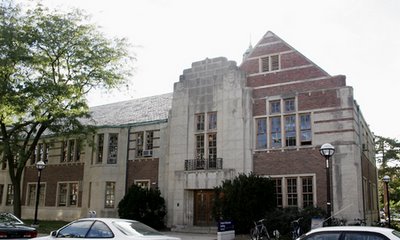
Of course the article includes photos: The homely wooden buildings of an earlier era, the soulless dark-glass facade of the Institute for Social Research, which needs ever more space, ever more parking. (The new $29 million expansion will have a “green roof,” of course.) The relics of Ann Arbor’s most eminent writers – Arthur Miller during the 1930s, Nobel laureate Joseph Brodsky in the immediate years after his exile, briefly Robert Frost and W.H. Auden– don’t stand a chance. Not even a plaque to commemorate the building I must have walked past hundreds of times.
“Although most Miller studies trace the beginning of his literary career at Michigan to his undergraduate submissions to the Hopwood Awards Committee, he first made his mark in Ann Arbor as a writer for the Michigan Daily.” It was then, and is still, at 420 Maynard Street, a few convenient blocks away from our homes on South Division (and Thompson). I expect the 5-cent Cokes that formed the main of our diet in the 1970s were much the same as he had swallowed – and the hot-type presses were already pleasantly passé in my time. In my era, Tom Hayden had cut a greater swath in the Daily‘s consciousness – I remember Hayden on a return visit to the offices, to talk to the editors about Indochina. But Miller’s influence has proved the deeper and more lasting one. And we both got two Hopwoods in the end.
In his autobiography Timebends, Miller reflects much on the radical legacy of Ann Arbor and the Daily. But I liked this paragraph the best:
“In the thirties, one of Ann Arbor’s small-town charms for me was its reassuring contrast with dog-eat-dog New York, where a man could lie dying on Fifth Avenue in the middle of an afternoon and it would take a long time before anybody stopped to see what was the matter with him. A short ten or twenty years later people were looking back at the thirties nostalgically, as a time and caring and mutuality.”
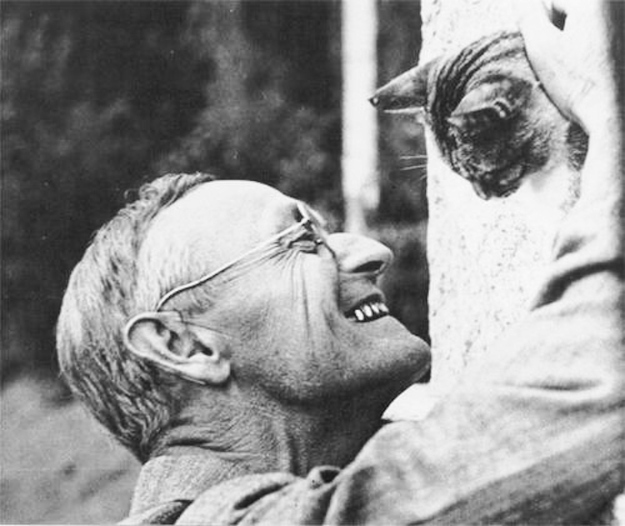
I have a lot of writing to finish between now and Sunday night – I’ll be going at it 24/7. Meanwhile, you might want to check out Buzzfeed’s “30 Renowned Authors Inspired by Cats.” There’s also more at Writers and Kitties.
Mark Twain was an obvious choice. But I combed through to see if they were going to remember some of the world’s most famous cat-lovers. Colette, for example, who famously said, “Plus je connais les hommes, plus j’aime mes chats.”
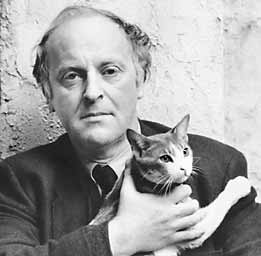
Mississippi and J.B. (Photo: Bengt Jangfeldt)
She’s there, along with Truman Capote, Ernest Hemingway, Edgar Allan Poe, Philip K. Dick, Hermann Hesse, Edward Gorey, George Plimpton, Jacques Derrida, W.H. Auden, and Jean-Paul Sartre make the cut. But where’s T.S. Eliot, for goodness sake?
A few other notables were missed. Where is Joseph Brodskyand his famous cat Mississippi?
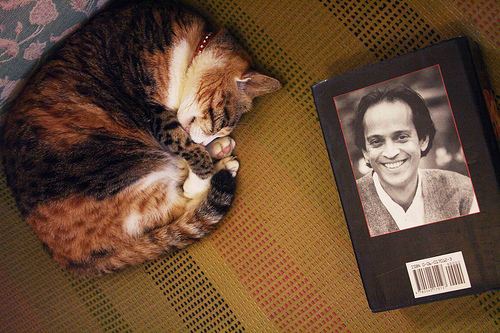
I’m not entirely sure Vikram Seth is a cat-lover, but I think he must be. The gnarly old tomcat Charlemagne, in The Golden Gate, is one of the great literary cats. I could find no photo of him with cats – only this from Delhi Walla, which is as close as I’m going to get tonight. And since my own copy of Golden Gate is loaned out to a good cause, I found this sole sonnet (the novel is composed of Pushkin tetrameter sonnets), in which the lawyer John is warned of his romantic competition for the heart of fellow attorney Liz. I like the way these fleet, four-footed sonnets fit onto wordpress better, next to a photograph, without awful line breaks:
Vikram Seth and fan
Ah, John, don’t take it all for granted. Perhaps you think Liz loves you best. The snooker table has been slanted. A cuckoo’s bomb lies in the nest. Be warned. Be warned. Just as in poker The wildness of that card, the joker Disturbs the best-laid plans of men, So too it happens, now and then, That a furred beast with feral features (Little imagined in the days When, cute and twee, the kitten plays), Of that familiar brood of creatures The world denominates a cat, Enters the game, and knocks it flat.
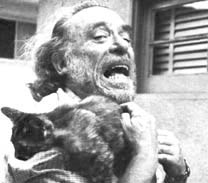
Charles Bukowski and friend
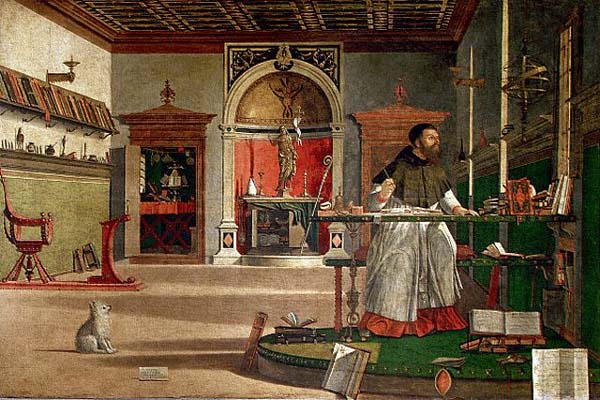
Speaking of Vikram Seth, let’s take a moment to give equal time to dogs. I have in mind one that played prominently in Seth’s novel, An Equal Music. It’s St. Augustine’s small white Maltese dog in Vittore Carpaccio‘s Saint Augustine in His Study, in Venice’s Scuola di San Giorgio degli Schiavoni. It’s from Carpaccio’s mature period – he began it in 1502 and completed it in 1507. It’s one of seven panels he made, still in the Schola, depicting the guild’s patron saints.
On Vikram Seth’s authority, I shlepped to the Schola a decade or so ago. It’s tucked away on one of Venice’s sidestreets and not easy to find. It was worth it. The schola is dark and mysterious and pure magic. The painting everything he said it would be.
Highly recommended.
.
A saint's best friend...Carpaccio's Augustine in his study