
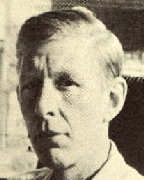
Biographers! Bah! Robert Conquest and W.H. Auden on “shilling lives”

Share

Daunting

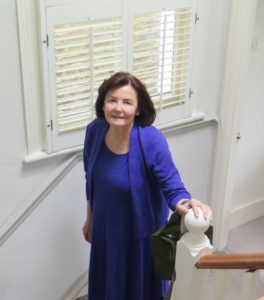
Elizabeth Conquest, a.k.a. “Liddie”, was surprised to hear that somewhere in my garage I had squirreled away W.H. Auden’s course syllabus – a copy, of course, from the Rackham archives of the University of Michigan. But then all the extant copies of the syllabus are copies of some kind. Probably mimeograph, in that era. Somewhere I have a xerox of that mimeo copy, or perhaps a xerox of the original typescript that Auden submitted when he was the resident poet at the university in 1941-42. It’s daunting, to say the least. Check it out here.

Liddie is the widow of the groundbreaking historian of the Stalinist era, Robert Conquest. He was also an important English postwar poet, and an influential figure of the “Movement” poets. She is the editor of The Complete Poems of Robert Conquest, to be published in Spring 2019 by Waywiser Press and is currently editing The Selected Letters of Robert Conquest. She is also editing Two Muses, her husband’s memoirs.

“Cracking the Books with Wystan” stirred her memories. Wrote Liddie: “Bob was, as a budding poet, much influenced by Auden—his earliest poetry notebook (1934-35) has many Auden quotations scribbled all over the inside covers, and bits here and there elsewhere.”
Liddie remembers

She sent me a paragraph from Bob’s unpublished memoir, Two Muses. In it, he reflects on the introduction of the 1956 New Lines anthology that launched the Movement poets:

In the preface I stressed the formal side because, after all, it was really Auden who brought back the formality that had been destroyed by Pound and others.  (A lot of the best of Auden’s poetry has a sort of hard surface which rejects the reader—and the later stuff about Nones and Lakes and such is unreadable—but there is a certain amount of energetic unpretentious stuff, and also some other odds and ends of lyrics etc., which come off pretty well.)  I think his original impact was from his a) self confidence, b) “new” preaching of not too homiletic a nature, c) not being unreadably modernist, yet able to claim the advantages of the latest thing.  Also the other purveyors were either worse (Spender) or less in the then groove (MacNeice).  I didn’t take to Auden at first reading (when I was c. 14), finding it cold, but gradually fell for the vigour and skill—not the lowest poetical virtues—and also, I suppose, the (then) mythopoeic effect—as in part of The Orators.

(Well, this reader rather likes “Nones” and in fact all of Auden’s “Horae Canonicae.” But as my brother always said, that’s why they make chocolate and vanilla.)
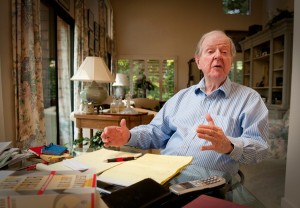
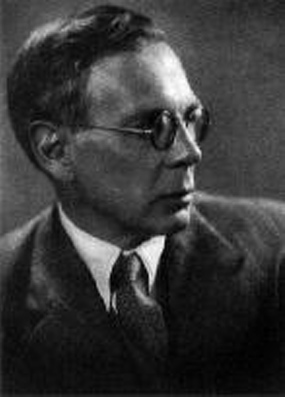
Bob Conquest at his desk (Photo: L.A. Cicero)

Liddie added, “Bob thought Charles Osborne’s biography was disgraceful, and shortly after it was published in 1979, wrote this sonnet, which appeared first in (I think) the TLS.

“One thing that impressed me about Bob is how everything he ever read remained lodged in that big head of his, to be effortlessly produced when needed.  I wonder how many readers of ‘Second Death’ ever notice the aptness of echoing Auden’s sonnet on biography in this criticism of Osborne, and in the same verse form.”

That is, Auden’s poem “Who’s Who” uses the same sonnet form established by Henry Howard, Earl of Surrey: iambic pentameter with abab cdcd efef gg.

Here’s Bob Conquest’s reaction to Auden’s biographer:

.

                    Second Death

A ten-pound Life will give you every fact
– Facts that he’d hoped his friends would not rehearse
To an intent posterity which lacked
Nothing of moment, since it had his verse.

Or so he thought. But now we come to read
What his more honest prudence had held in:
Tasteless compulsion into trivial deed,
A squalor more outrageous than the sin,

Piss on that grave where lies the weakly carnal? . . .
– Hopeless repentance had washed clean his name,
His virtue’s strength insistent on a shame

Past all the brief bravados full and final.
Without excuses now, to the Eternal,
He makes the small, true offering of his fame.

Haven’t read the original? Here’s Auden’s sonnet “Who’s Who”:

A shilling life will give you all the facts:
How Father beat him, how he ran away,
What were the struggles of his youth, what acts
Made him the greatest figure of his day …

(I have Liddie’s permission to reprint “Second Death,” but I don’t have the permission of the Auden Estate for “Who’s Who,” so the rest is here.)
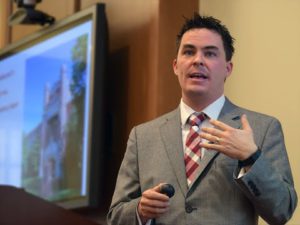
“This is the hardest class you will ever take,” the kids were told. And the course filled up within minutes.

Share

Auden knew what he was doing.

Kids are lazy little buggers who opt for easy courses, right?

Wrong.

Some time ago I wrote about W.H. Auden‘s syllabus during his time at the University of Michigan in the 1940s, a copy of which had been sitting in my files for decades. I can’t remember how I found it in the archives of the Rackham Graduate School, but occasionally I would run across it again, take it out, and stare at it, as at a marvel.

The reading list for his course, “Fate and the Individual in European Literature,” included: The Divine Comedy in full, four works by Shakespeare, Pascal’s Pensées, Horace’s odes, Volpone, Racine, Kierkegaard’s Fear and TremblingMoby-DickThe Brothers KaramazovFaust, Baudelaire and Rimbaud, Kafka, Rilke, T.S. Eliot. Also, nine operas. (Auden loved opera – and assigned three of Wagner‘s Teutonic masterpieces.) That’s more than 6,000 pages total. For a single course.

At the University of Oklahoma, three brave men – Kyle Harper, a classicist and the university’s provost; the historian Wilfred McClay; and David Anderson, a professor of English – decided to team-teach a year-long course, modifying Auden’s syllabus a little – to include, for example, Milton.

“This is the hardest class you will ever take.”

The result, according to Mark Bauerlein writing in the Chronicle of Higher Education:

When enrollment opened last semester, the unexpected happened. The course filled up within minutes. Harper had already warned his students, “This is the hardest class you will ever take.” The syllabus was posted online in advance, so that students knew exactly what they were getting into. The course meets a general-education requirement at Oklahoma, but so do many other courses with half the workload. To accommodate the unexpected demand, the class was expanded from 22 to 30 students, the maximum number that the assigned classroom could hold.

I sat in on a class in October. McClay lectured on Inferno. The atmosphere was genial but focused. You can tell after five minutes whether a class has an esprit de corps — no sullen faces, no eyes drifting to windows and cellphones, even the bad jokes get a laugh. McClay slid from Augustine to Bonaventura to Jesus, Jonah, Exodus, and the prodigal son before taking up Paolo and Francesca, and then the suicides, sodomites, murderers, and frauds in Dante’s torture zones.

The historian was game.

After class, about half of the students and I headed over to the dining room at Dunham College, one of Oklahoma’s graceful new residential colleges, for lunch. There, without the professors present, I asked the key question: Why did they sign up for Western-civ boot camp?

One fellow grumbled that he had to do three times as much work as he did in his other classes. The rest nodded. But you could hear in his words the self-respect that comes from doing more work than the norm, from climbing the highest hill while your peers dog it. Another student said that the page-count of the syllabus had flattered her, that it showed the professors respected her enough to demand that she take on a heavy load of historic literature.

The English prof was game, too.

“This is what I came to college for,” another said. One more chimed in, “This class is changing my life.”

They acknowledged, too, the distinctiveness of the works they read, one student calling them a “foundation” for things they study elsewhere. They admired the professors, to be sure, but the real draw was the material. When I asked what they would change about the course, they went straight to the books: add The Iliad and some of the Bible.

Read the whole thing here.

A postscript of 4/14 from John Murphy of the University of Virginia: “On my way out the door of higher ed and toward opportunities, both teaching and otherwise, elsewhere, one of my thoughts – in line with the program described here – is one way to revive the humanities might be to make the whole enterprise an honors curriculum or honors college within larger institutions. That would allow for a recuperation of the rigorous and seriousness that has long been lost within college and university humanities courses and it would also raise the value of a humanities degree as a credential. The implicit message would be “real college for real students” and it would be mark of distinction to have taken the more difficult and selective course of study, even if you went on to purse a “practical” career after that. It would be a sign to “practical” employers that a graduate had really hit the books during college and not taken the easy way out. Young people will work very, very, very hard at things that ultimately don’t matter as much as curricular education – i.e. athletics. So maybe foregrounding the aspect of difficulty might tap some kind of competitive spirit. ‘Auden College: No Pain, No Gain.'”

Must we really “love one another or die”? A few words on Auden’s “September 1, 1939”

Share

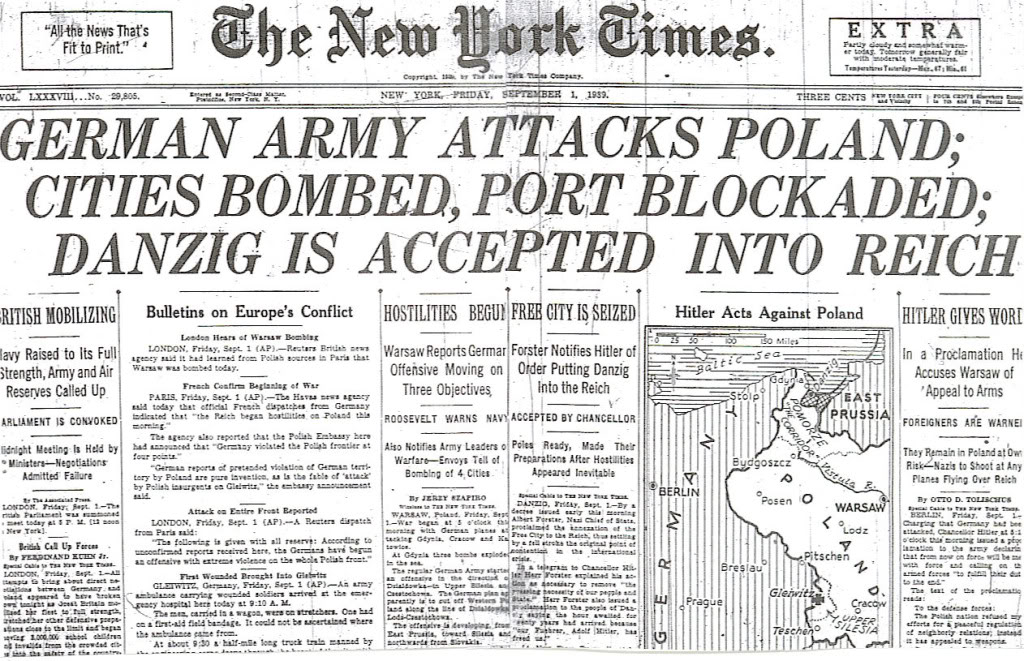
September 1, 1939, is the day Nazi Germany invaded Poland. W.H. Auden famously wrote a poem to commemorate the occasion. “September 1, 1939” begins:
I sit in one of the dives
On Fifty-second Street
Uncertain and afraid
As the clever hopes expire
Of a low dishonest decade:
Waves of anger and fear
Circulate over the bright
And darkened lands of the earth,
Obsessing our private lives;
The unmentionable odour of death
Offends the September night.

Accurate scholarship can
Unearth the whole offence
From Luther until now
That has driven a culture mad,
Find what occurred at Linz,
What huge imago made
A psychopathic god:
I and the public know
What all schoolchildren learn,
Those to whom evil is done
Do evil in return.

The poem was taken up after 9/11, and appeared under thumb tacks and refrigerator magnets throughout the nation. But the last lines of the second stanza got special scrutiny in the new century. Was it referring to eternal truths? Or claiming the Versailles Treaty that ended World War I justified the new invasion? Writing in the New York Times, Peter Steinfels asked: “One suspects that these characterizations would earn sharp rebukes if expressed in a poem titled ”September 11, 2001.’ More important, would a contemporary version of the 1939 poem be found guilty of what has come to be labeled ”moral equivalence’? Was Auden shifting moral responsibility from totalitarian evildoers to past misdeeds by those under attack and to a universal human egotism in which everyone was more or less equally complicit?”

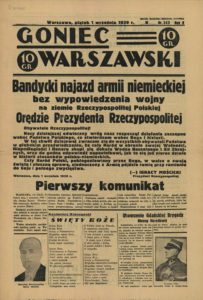
Headline: “Bandit invasion of the German army without declaring war on the lands of the Republic of Poland”

I would argue that to state a human principle, based on observation, is not to say that it is justifiable, admirable, or advisable. It is simply to say that it happens. Look at the Middle East. Look at the reprisals and mutual blame among factions in our national politics. Or between Putin and Trump. Or everyone in the world and North Korea. Tit for tat is a universal principle. But can it be reversed? Even on a small scale in our political sphere, will kindness cause a reciprocation of kindness? Can turning the other cheek become contagious? Unlikely. It takes forethought, intention, and forbearance. Retaliation requires only impulse.

A number of posts on Facebook to commemorate the occasion and the poem. From the poet and friend Alfred Corn: “One of the building blocks of Auden’s poem is the idea that ‘The buck stops here.’ Those to whom evil is done 99.9% of the time do evil in return. But a better choice is to repay evil with good. To break the cycle of vengeance rather than perpetuate it. A radical proposal, departing from all natural and normal responses. And yet on those occasions when it has been adopted, the results were redemptive. Not easy. Takes practice. Worth it.”

The penaultimate stanza of the poem:

All I have is a voice
To undo the folded lie,
The romantic lie in the brain
Of the sensual man-in-the-street
And the lie of Authority
Whose buildings grope the sky:
There is no such thing as the State
And no one exists alone;
Hunger allows no choice
To the citizen or the police;
We must love one another or die.

There’s the rub: Auden withdrew the poem from several collections because the last line struck him as glib. We don’t die for failure to love, do we? But there are so many ways to die, and so many ways to live, and six years after the poem was written, a couple big bombs over Japan convinced many of us we must live or die as a species.

In an essay, “The Normal Heart Condition According to Auden,” included in We must love one another or die : the life and legacies of Larry Kramer, Alfred Corn wrote:

Alfred Corn: an optimist?

If this poem engaged Larry Kramer so much that he chose to title two of his dramatic works with phrases drawn from it, we can also note that he is not alone in his admiration. It is one of the few Auden poems that ‘the common reader’ (that endangered species) can be counted on to recognize, and its apologists include Joseph Brodsky, who has written persuasively about its meaning and importance. The famous line from stanza eight, ‘We must love one another or die,’ has become proverbial, often quoted by people who have no idea where it comes from. A strange irony is that Auden himself, within a few years after the poem’s composition, came to dislike it. In his first Collected Poems, published in 1944, he reprinted ‘September 1, 1939’ minus the eighth stanza, which must have disappointed readers who were looking for what they regarded as its profoundest line. In later collections of his poetry, Auden dropped the whole poem and always refused permission for its inclusion in new anthologies; it was not reprinted until after his death, in the volume noted above. Auden decided that the famous line about love and death was untruthful; he remarked, in public and in private, that we are all destined to die, whether or not we love each other. 

It takes only a moment’s reflection to recognize this as a misinterpretation of the line’s actual meaning. In a poem whose point of departure is the date on which Nazi Germany invaded Poland and set into motion the Second World War, we are clearly meant to understand that the opposite of love is killing; that, if we fail to love, inevitably we’ll perform acts of violence. Auden could have revised the line and made its real meaning more explicit by saying, ‘We must either love or kill each other,’ but that revision wouldn’t fit the iambic trimeter in which the poem was written, nor would it rhyme with any other line in the stanza. No doubt Auden could have found some other workable solution, but he didn’t attempt to do so (apart from simply excising the stanza in its first reprinting).”

You can read the whole poem here.

Song without music: Auden’s “For the Time Being: A Christmas Oratorio”

Share

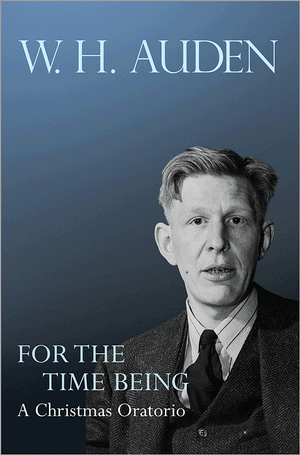
auden-christmasW.H. Auden learned of the death of his mother, Constance Rosalie Bicknell Auden, by telephone in August 1941, while he was staying in Rhode Island. The international call was taken by his lover Chester Kallman, who came to Auden’s bedroom and told him they would not be attending a party that evening. Then he told him why.

“Auden was stunned and grieved, not only because he had been very close to his mother all his life. He was already in a state of emotional fragility, having learned just the month before that Kallman, whom he loved and to whom he considered himself married, had been having sex with other men and meant to continue the practice,” writes Alan Jacobs, editor of Princeton University Press’ splendid critical edition of Auden’s For the Time Being: A Christmas Oratorio. Thursday is only the first of the Twelve Days of Christmas – if you haven’t seen the book already (it was published last year), you still have plenty of time to find it before Twelfth Night.

Auden would later write, “When mother dies, one is, for the first time, really alone in the world and that is hard” – Jacobs adds, “that experience of isolation was surely made far more intense through its arriving in the midst of hopes already ruined.”

A few weeks after the death, Auden moved to my own alma mater, the University of Michigan, to begin a year of teaching (his daunting course syllabus is here). And shortly after that he was applying to the Guggenheim to write “a long poem in several parts about Christmas, suitable for becoming the basis of a text for a large-scale musical oratorio.” That long poem was his attempt to see Christmas in double focus: as a moment in the Roman Empire and in Jewish history, and as an eternal and ever-new event.

His father, a learned and cultivated physician, was confused by the mixture of the past and present in the poem, the modern New York characters and the references to juke-boxes and clocks on the mantlepiece with ancient Judaea. Auden tried to explain in a long letter:

Sorry you are puzzled by the oratorio. Perhaps you were expecting a purely historical account as one might give of the battle of Waterloo, whereas I was trying to treat it as a religious event which eternally recurs every time it is accepted. Thus the historical fact that the shepherds were shepherds is religiously accidental – the religious fact is that they were the poor and humble of this world for whom at this moment the historical expression is the city-proletariat, and so on with all the other figures. What we know of Herod, for instance, is that he was a Hellenised Jew and a political ruler. Accordingly I have made him express the intellectual’s eternal objection to Christianity – that it replaces objectivity with subjectivity – and the politician’s eternal objection that it regards the state as having only a negative role. (See Marcus Aurelius.) …

I am not the first to treat the Christian data in this way, until the 18th Cent. it was always done, in the Mystery Plays for instance or any Italian paintings. It is only in the last two centuries that religion has been ‘humanized,’ and therefore treated historically as something that happened a long time ago, hence the nursery picture of Jesus in a nightgown and a Parsifal beard.

Charles_Williams

Inspiration from an Inkling

If a return to the older method seems startling it is partly because of the acceleration in the rate of historical change due to industrialization – there is a far greater difference between the accidents of life in 1600 AD and in 1942 than between those of 30 AD and 1600.

Kind of makes one chuckle, doesn’t it? As one taps on a keyboard to produce a message that, as soon as I press the “publish” button, will be instantly available around the world…

“Auden’s recognition that those last few centuries of the Roman Empire might serve as a mirror for the twentieth-century self-immolation of the West is the initiating insight of the project that would become ‘For the Time Being,'” Jacobs writes. Well, we made it to the twenty-first. The poem was rooted in his reading of Inkling Charles Williams, Fyodor Dostoevsky, Blaise Pascal, Soren Kierkegaard, and many others.

Stephen Spender said that the poem “has the power in some of the choruses, of bringing to mind the mighty chorales of Bach.” The poem was set to be set to music composed by Benjamin Britten. It never was. The poem was far too long for that. Only two bits were set to music, and one, “Shepherd’s Song,” was dropped from the poem before it was published. The poem, published at the height of the war in 1944, was dedicated to the memory of his mother, Constance Rosalie Bicknell Auden.

Does “September 1” ring any bells? It should.

Share

nytimes

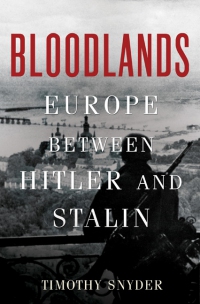
September 1, 1939.  The day has peculiar resonances if you are Polish, for reasons obvious in the 1939 headline above. The anniversary of the Nazi blitzkrieg almost slipped by me, were it not for my Polish friend Artur Sebastian Rosman‘s interesting and controversial post on the subject over at his blog, Cosmos the in Lost, in which the Czeslaw Milosz scholar discusses Timothy Snyders internationally acclaimed Bloodlands, which we’ve discussed before here and here and here and here. While Artur acknowledges that the Holocaust has become almost a “metaphysical measuring stick of humanity’s capacity for radical evil,” he reminds us that Hitler had even bigger plans in mind:

snyderBloodlands: Europe Between Hitler and Stalin puts the Holocaust within its Central European context. What’s frequently lost is how Snyder’s international bestseller suggests the Holocaust is not some ahistorical transcendent metaphysical essence, but rather a contingent historical event. First of all, Snyder’s book puts the Holocaust within the context of the genocides perpetrated against other populations stuck between Germany and the Soviet Union. Second, Bloodlands gives a thorough account of the Generalplan Ost: the secret German plan to exterminate the Slavs so that Germans could repopulate their lands and take advantage of the Ukrainian breadbasket.

The extermination of the Slavs was Germany’s main plan. What they did not anticipate was the strength of the Soviet resistance and how the herding of Jewish populations would cause the Nazis logistical problems. The rapid accumulation of large populations in ghettos led the Germans to send them to preexisting concentration camps. These camps were first used to systematically kill Catholic clergy, Polish resistance fighters, and Communists.

Read the whole thing here.  Of course, we couldn’t let the day go by without a mention of W.H. Audens September 1, 1939 (we’re glad that Artur didn’t forget it, either), which begins:

I sit in one of the dives
On Fifty-second Street
Uncertain and afraid
As the clever hopes expire
Of a low dishonest decade:
Waves of anger and fear
Circulate over the bright
And darkened lands of the earth,
Obsessing our private lives;
The unmentionable odour of death
Offends the September night.

Right again

Sock it to us, Wystan.

Accurate scholarship can
Unearth the whole offence
From Luther until now
That has driven a culture mad,
Find what occurred at Linz,
What huge imago made
A psychopathic god:
I and the public know
What all schoolchildren learn,
Those to whom evil is done
Do evil in return.

I’ve thought a lot of the last two lines of this excerpt in recent days – there’s plenty in the international news to remind us. What remedy? What remedy? How about the man who insisted that goodness properly understood is not passive, but active – that the world requires individuals who not only refrain from harming others, but energetically seek out those in need of help? Sir Nicholas Winton saved 669 Czech children from certain death in the Holocaust – about 6,000 people are alive today because of his efforts. He turned 105 years old last May, with an international celebration at London’s Czech Embassy; The Guardian wrote about that event here. “I am always surprised every time I come here to see all kinds of people who have come really very great distances to say hello,” Winton said. “As far as I am concerned, it is only Anno Domini that I am fighting – I am not ill, I am just old and doddery.”

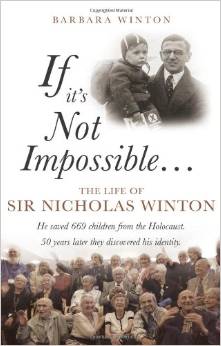
wintonHis daughter has just published a book about her father – The Guardian wrote about that over the summer too, here. “Like her father, Barbara Winton is not sentimental; she lets the story tell itself,” writes Emma Howard. “Both father and daughter resist hero worship. The book’s title is a nod to his often-repeated motto: ‘If it’s not impossible, there must be a way to do it.'” An excerpt that tells the story:

“Nearly 6,000 people in the world today are alive because Winton responded to a phone call from Prague in December 1938. The call was from his friend Martin Blake, who was engaged in helping Jewish refugees and was asking for Winton’s assistance. On arrival in Prague, Winton immediately took action, setting up an office in his hotel in Wenceslas Square. He persuaded the German authorities to let a number of Jewish children leave, and identified British foster families who would open their homes to them. (In November 1938, shortly after Kristallnacht, parliament approved a measure that would allow the entry into Britain of refugees younger than 17, if they had a place to stay and provided that £50 was deposited to pay for their eventual return to their own country.) He then organised eight evacuations on the Czech Kindertransport train from Prague to London’s Liverpool Street station. He spent only three weeks in Prague – the maximum length of time he could get off from his job as a stockbroker in the City – though he worked in the evenings during the following eight months to complete the mission.

“For half a century, Winton knew nothing of the nearly 700 people who now call themselves ‘Nicky’s children’. He did not seek them out after the war and rarely spoke of the episode. But the details were waiting to be found – in a scrapbook crammed with documents, photographs and a list of every child he saved. It was not until the BBC got hold of the scrapbook in 1988 that the story came to light. Invited by Esther Rantzen to sit in the audience of her show That’s Life!, Winton was overwhelmed when she announced live on air that the people in the audience around him were the children he had saved.”

Here’s how he found out he’d become a hero. It’s an awwwww video, for a little hope on a grim anniversary:

Philip Larkin on WWI: “Never such innocence again.”

Share
philip-larkin-1943-006

Larkin at Oxford in 1943, before “the failures and remorse of age.”

W.H. Auden‘s “September 1, 1939” was a World War II poem, without a single gun in it, and then had a powerful revival on 9/11. The New York Times recounted its newfound fame:

”Auden’s words are everywhere,” wrote the author of a ”Letter From New York” in The Times Literary Supplement of London. At least a half-dozen major newspapers reprinted ”September 1, 1939” in its entirety. It was read on National Public Radio. It was introduced into hundreds of chat rooms on the Internet. In the Chicago area, the Great Books Foundation and The Chicago Tribune sponsored discussions of it. Students at Stuyvesant High School, four blocks from ground zero in Manhattan, produced a special issue of their school newspaper (which The New York Times distributed to its readers in the metropolitan area) prominently featuring one of the poem’s most familiar lines, ”We must love one another or die.”

Surely, however, it shared the somber honors with Adam Zagajewski’s “Try to Praise the Mutilated World,” which appeared on the back cover of the New Yorker after 9/11.

zagajewski

Praising the mutilated world…

Could the poem for World War I be Philip Larkin‘s MCMXIV? It’s getting a lot of play this month, during the centenary of the beginning of the Great War.  The poem was first published in 1964, fifty years after the events it describes, in the collection Whitsun Weddings. 

A few words from critics about Larkin that I found along the way: Andrew Sullivan feels that Larkin “has spoken to the English in a language they can readily understand of the profound self-doubt that this century has given them.” X.J. Kennedy wrote that Larkin’s oeuvre is  “a poetry from which even people who distrust poetry, most people, can take comfort and delight.” J. D. McClatchy said that Larkin wrote “in clipped, lucid stanzas, about the failures and remorse of age, about stunted lives and spoiled desires.”

XCMXIV is only one remarkable sentence long  (mind the punctuation), and describes the enlistment of naïve young men at the war’s outset. Read it, and hear it, in the video below.