
Henry James’s “The Aspern Papers”: a story for the era of doxxing, “outing,” and our right to be left alone – Zoom discussion on Monday, August 24.

Share

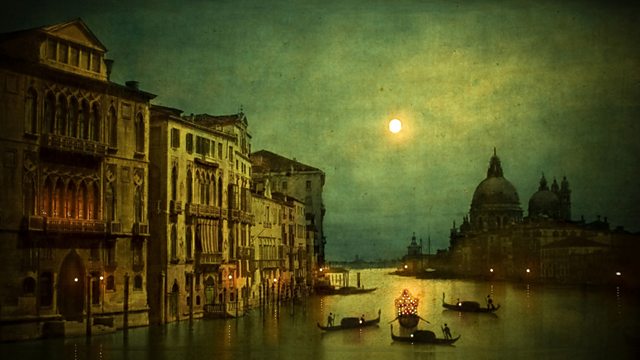
James: “the canals assume to the eye the importance of a stage…”

It’s two weeks to our special Zoom discussion of Henry James‘s short 1888 classic, The Aspern Papers. The Another Look book club will be hosting the event, in partnership with Stanford’s Distinguished Careers Institute, on Monday, August 24, 3-4:30 p.m. (Register for the event here.) If you haven’t read the short novel, you should – you really should. Those of you who associate Henry James with sentences that go on relentlessly for pages will be pleasantly surprised by this tight, yet psychologically insightful work.

The Aspern Papers was inspired Percy Bysshe Shelley‘s correspondence with Claire Clairmont, the stepsister of his wife Mary Wollstonecraft Shelley, the author of Frankenstein. (Shelley’s novel was featured in a January 2017 Another Look event.) Clairmont cherished the letters until her death. Of course, James transposes that into fiction – but it’s a lively and insightful read, and those daunted by James’s three-page-long sentences needn’t be afraid. The plot keeps a good pace in this psychologically insightful work, while treating us to the wonder that is Venice.

Himself

The story: an elderly invalid who once was the beloved of a renowned American poet, Jeffrey Aspern, lives in seclusion with her spinster niece in a Venetian palazzo. The unnamed narrator goes through elaborate machinations to gain access to her private papers and literary relics from the long-ago romance.

The story has new relevance for us today. “What James delivered, in 1888, was not some dusty antiquarian fable but a warning call against the cult of celebrity that was already on the rise, and against the modern insistence that artists and writers can – or should – be prized out of their work like cockles from a shell, for public consumption,” critic Anthony Lane wrote in The New Yorker. In the era of doxxing and “outing,” the story explores our right to be left alone, and our right to have secrets. At the heart of the book is the rapacious desire of one man to reach through time to possess another.

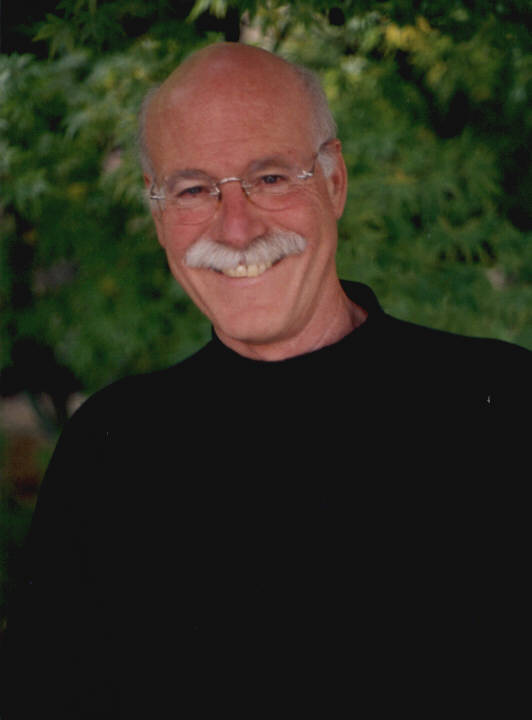
Tobias Wolff and Robert Pogue Harrison will lead the discussion. Acclaimed author Robert Harrison, professor of French and Italian, writes regularly for The New York Review of Books and hosts the popular talk show, Entitled Opinions. Wolff, a Stanford professor emeritus of English, is the recipient of the National Medal of Arts.

Elena Danielson, director emerita of the Hoover Library & Archives, will offer a few remarks as the author of The Ethical Archivist. And yours truly will have a few words to say on the occasion, too, as the author of the biography, Evolution of Desire: A Life of René Girard.

Again, register here. We’d love to see you!
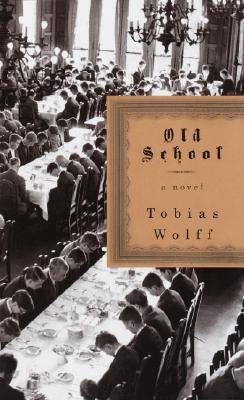
Teaching Tobias Wolff’s “Old School” to Hungarian teens – along with the reasons for rhyme

Share

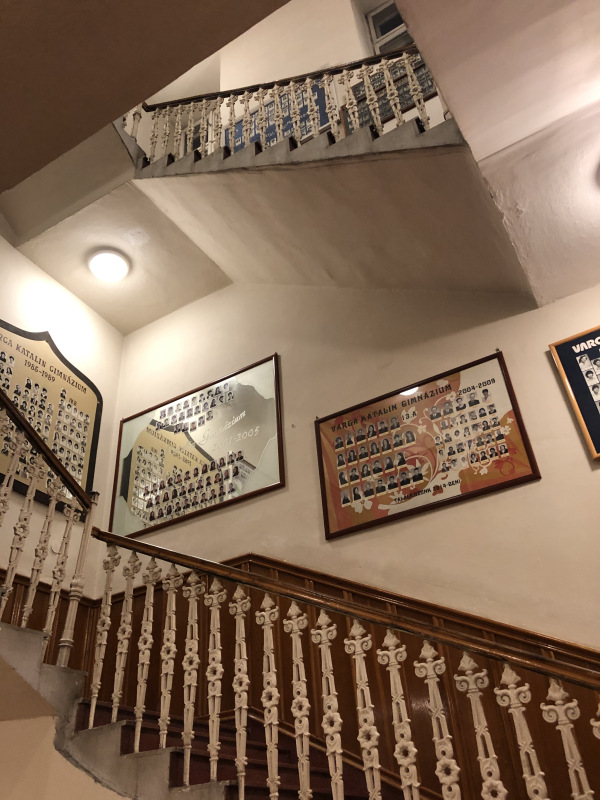
A staircase Varga Katalin Gimnázium in Szolnok, Hungary

Can Hungarian teenagers “get” an American novel set all the way back in the Kennedy Era? For a magical semester, author, educator, and translator Diana Seneschal taught her ninth-grade students at Szolnok’s Varga Katalin Gimnázium a novel by Stanford writer Tobias Wolff – in particular, 2003’s Old School. The upshot: they loved it. She had hauled copies all the way from the U.S. for her 33 students, paid for with an honorarium she had received in the U.S. At the beginning of the semester, Diana wrote me: “In addition, they have already read some Frost, we will read a Hemingway story or two, and I will tell them enough about Ayn Rand that they understand the change in the narrator’s response to her writing and attitudes.”

The reaction from her classes was enthusiastic: “One of the students asked her after the first class, ‘Is this book really for me to keep?'”

“When I told him it was, he said he was happy because he expected to reread it in the future. ‘I think this is my favorite book,’” he said.

The Book Haven met Diana via her translations of the eminent Lithuanian poet (and our mutual friend), Tomas Venclova. So it’s fitting we republish this description of one of the classes, in which Wolff’s fictional students discuss poetry:

The third chapter of Tobias Wolff’s Old School, “Frost,” has the following exchange between the narrator and Purcell (p. 44):

Frost. I don’t even know why I bothered submitting anything, given how he writes. I mean, he’s still using rhyme.

Yeah, so?

Rhyme is bullshit. Rhyme says that everything works out in the end. All harmony and order. When I see a rhyme in a poem, I know I’m being lied to. Go ahead, laugh! It’s true–rhyme’s a completely bankrupt device. It’s just wishful thinking. Nostalgia.

The situation was this: At the beginning of the third chapter, we learn that George Kellogg, the excessively benevolent editor of the Troubadour, has won the first contest and will thus get to meet with Robert Frost. Purcell dismisses the whole enterprise.

Stanford author Tobias Wolff

First I asked the students to explain what Purcell was saying. They did it, point by point. Then I asked what they thought of it. In the first section, one student burst out, “That’s what I think.” A few others seemed to concur. They gave reasons: to rhyme, you have to invent something; rhyme sounds pretty, whereas the world often isn’t; rhyme imitates other rhymes and rhymers. Then I asked whether anyone saw or heard rhyme in a different way. Hands shot up. One student said that good rhyme is hard, so you can admire it. Another said that we are drawn to harmony. Another said that rhyme makes a poem memorable. Another suggested that Purcell was speaking out of jealousy. Then we started talking about how rhyme can draw associations between things.

The other section was more subdued but just as perceptive. Most of them rejected Purcell’s complaint from the start. One student pointed out that you can rhyme with the word “chaos,” in which case you aren’t creating harmony at all. Another said that we rhyme all the time, that rhyme is part of our everyday language. Others talked about how rhyme makes you think.

Author, teacher, translator Senechal

This set us up well for the next lesson, where we discussed the rest of the chapter. When I arrived, I saw students discussing the novel in the hallway.

At the start of the lesson, I played a muffled recording of Frost reading “Mending Wall,” which they had read with me. In the first section, no one seemed to know what was going on until the very end, when one student cried out in Hungarian, “Emlékszem!” (“I remember it!”). In the other section, they recognized it right away. We then talked about the passage in Old School where the headmaster introduces Frost, and the one where the narrator’s understanding of “Mending Wall” changes as he listens to Frost reading it aloud. (This is a fictional Frost, but I can imagine Frost reading like this.)

Then the teacher Mr. Ramsey’s challenge: Aren’t those poetic forms–rhyme, stanzas, etc.–outmoded? Shouldn’t poetry reflect modern consciousness? And Frost’s response (of which this quote, from p. 53, is just a fraction):

Grief, not grievance

I am thinking of Achilles’ grief, he said. That famous, terrible, grief. Let me tell you boys something. Such grief can only be told in form. Form is everything. Without it you’ve got nothing but a stubbed-toe cry—sincere, maybe, for what that’s worth, but with no depth or carry. No echo. You may have a grievance but you do not have grief, and grievances are for petitions, not poetry.

You could read all the class lessons here. Or read her blog Take Away the Takeaway here. Or go to her TED talk here

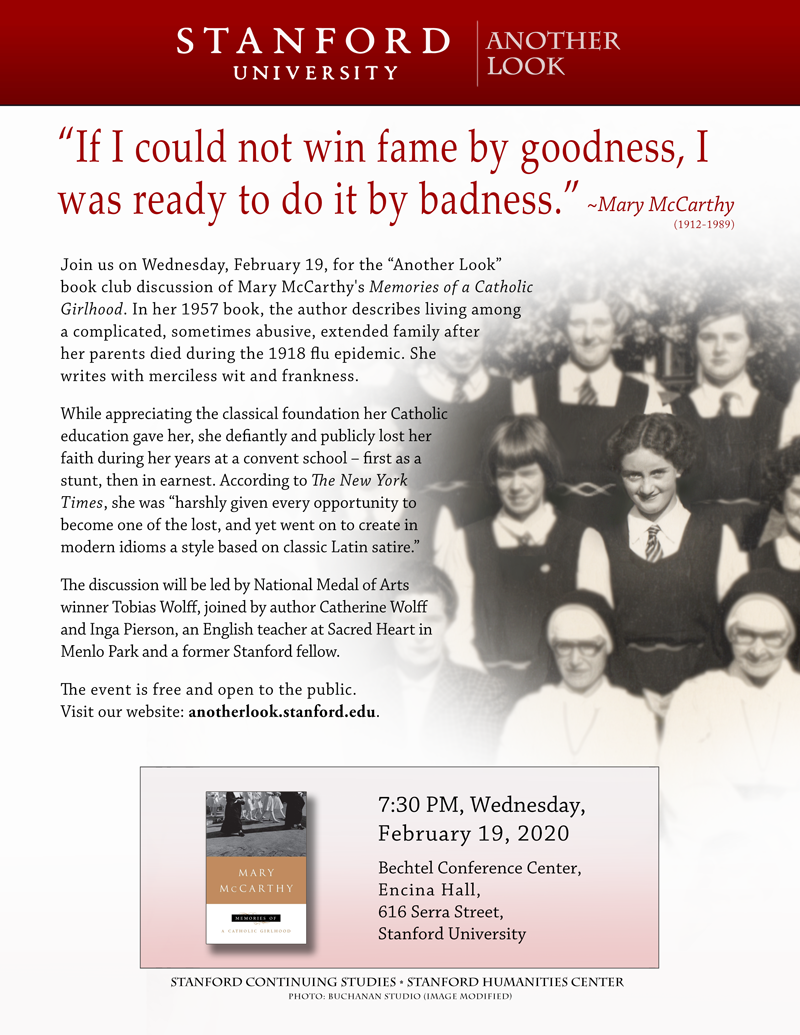
Mary McCarthy’s “Memories of a Catholic Girlhood” TONIGHT!

Share

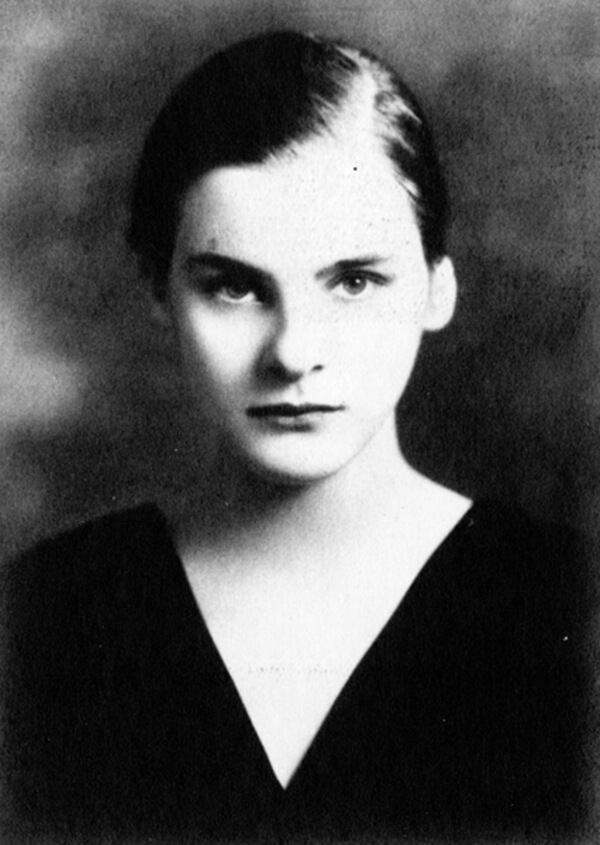
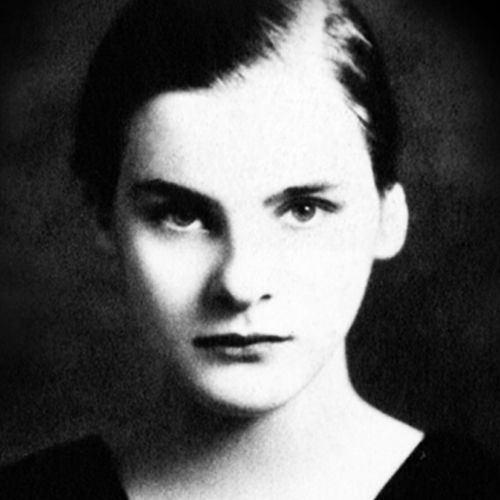
Schoolgirl days (Vassar Library & Archives)

“If I could not win fame by goodness, I was ready to do it by badness.”

It’s tonight! Another Look takes on Mary McCarthy‘s Memories of a Catholic Girlhood, a 1958 National Book Awards finalist for nonfiction. The discussion will take place at 7:30 p.m. on TONIGHT, February 19, in the Bechtel Conference Center of Encina Hall. Directions and parking for the event are here.

An excerpt from Charles Poore‘s 1957 review in The New York Times:

In Memories of a Catholic Girlhood Mary McCarthy plays a splendid trick on her future biographers by anticipating their researches and confounding their zeal. The book is a collection of stories she has written about her early years. Among them, for example, is “Yonder Peasant, Who Is He?” – one of the most stinging, brilliant and disturbing memoirs ever written by an American.

The autobiographical stories are marinated in italic commentaries that tell how much commonplace veracity or creative mendacity they contain. We are given background and interpretation, amplification and variorum readings on Miss McCarthy’s nomadic childhood from the West Coast to the Midlands, from convent schools to Vassar. And probably the sharpest criticism of her work you can find anywhere.

Now, many an author has done this sort of thing in the past. One thinks, at random, of Henry James‘ wonderfully revisionist prefaces to the New York edition of his works, or the glow of Conrad’s notes for his Canterbury Edition. Didn’t Ring Lardner write a series of brief, confidential overtures to his tales, one of which said: “The story is an example of what can be done with a stub pen”? Miss McCarthy is more generous with her revelations and interpretations. She goes at considerable length into her young religious faith and the agonizing reappraisals that accompanied her loss of it. She traces endlessly the ramifications of a family that contained Roman Catholic and Jewish members, Protestants and agnostics.

The conversation will be led by author Tobias Wolff, National Medal of Arts winner and founding director of Another Look. Panelists include author Catherine Wolff and Another Look regular Inga Pierson, who is also an English teacher at Sacred Heart Preparatory.

We are aware there is a televised Democratic Presidential Debate airing from 6-8 p.m. the same evening. However, we hope you will choose us! (And catch up with the debate or debate highlights afterward. Isn’t that what Youtube is for?) More information on the poster below.


“If I could not win fame by goodness, I was ready to do it by badness.” Mary McCarthy’s memoir comes to Stanford.

Share

In school, character is fate.” (Courtesy Vassar Archives)

You think the coronavirus is bad? Novelist Mary McCarthy will tell you about about one of the epic plagues of modern times.

Both her indulgent, fun-loving parents died during the 1918 Spanish flu pandemic. Then she and her three brothers were shuttled among relatives, some of them abusive. In her 1957 book, Memories of a Catholic Girlhood, she describes it all with merciless wit and frankness.

Now her book is coming to Stanford. It will be discussed at the Another Look winter event at 7:30 p.m. on Wednesday, February 19, at the Bechtel Conference Center in Encina Hall.

She was first sent to a Catholic convent school in Seattle, later to an Episcopalian seminary in Tacoma. While appreciating the classical foundation her Catholic education gave her, she defiantly and publicly lost her faith during those years – first as a stunt, then in earnest. She eventually graduated from Vassar.

Toby is leading the discussion.

“She never spares herself at all,” wrote Charles Poore in The New York Times. “The vanities and ambitions, the resentments and misunderstandings, the small triumphs and the scarring disasters that marked her early years are set forth with remarkable candor, so that her book is the most incisive contribution to the story of her development as an artist that we shall ever have.” She was “harshly given every opportunity to become one of the lost, and yet went on to create in modern idioms a style based on classic Latin satire.”

The conversation will be led by author Tobias Wolff, founding director of Another Look and a National Medal of Arts winner. Panelists include his wife, the author Catherine Wolff and Another Look regular Inga Pierson, a former Stanford fellow who brings some personal experience to bear on the subject: she is  an English teacher at Sacred Heart Preparatory in Menlo Park.

Inga’s coming, too.

The event is free and open to the public. Come early for best seats. And Stanford Bookstore on campus, Kepler’s in Menlo Park, and Bell’s Books in Palo Alto are carrying the books.

The Another Look book club focuses on short classics that have been forgotten, neglected, or overlooked—or may simply not have received the attention they merit. The selected works are short, in order to encourage the involvement of Bay Area readers whose time may be limited. Subscription at anotherlook.stanford.edu is encouraged for regular updates and details on the selected books and events.

Alfred Hayes’s “My Face for the World to See” at Stanford – a tough look at Hollywood, with a surprise guest, too.

Share

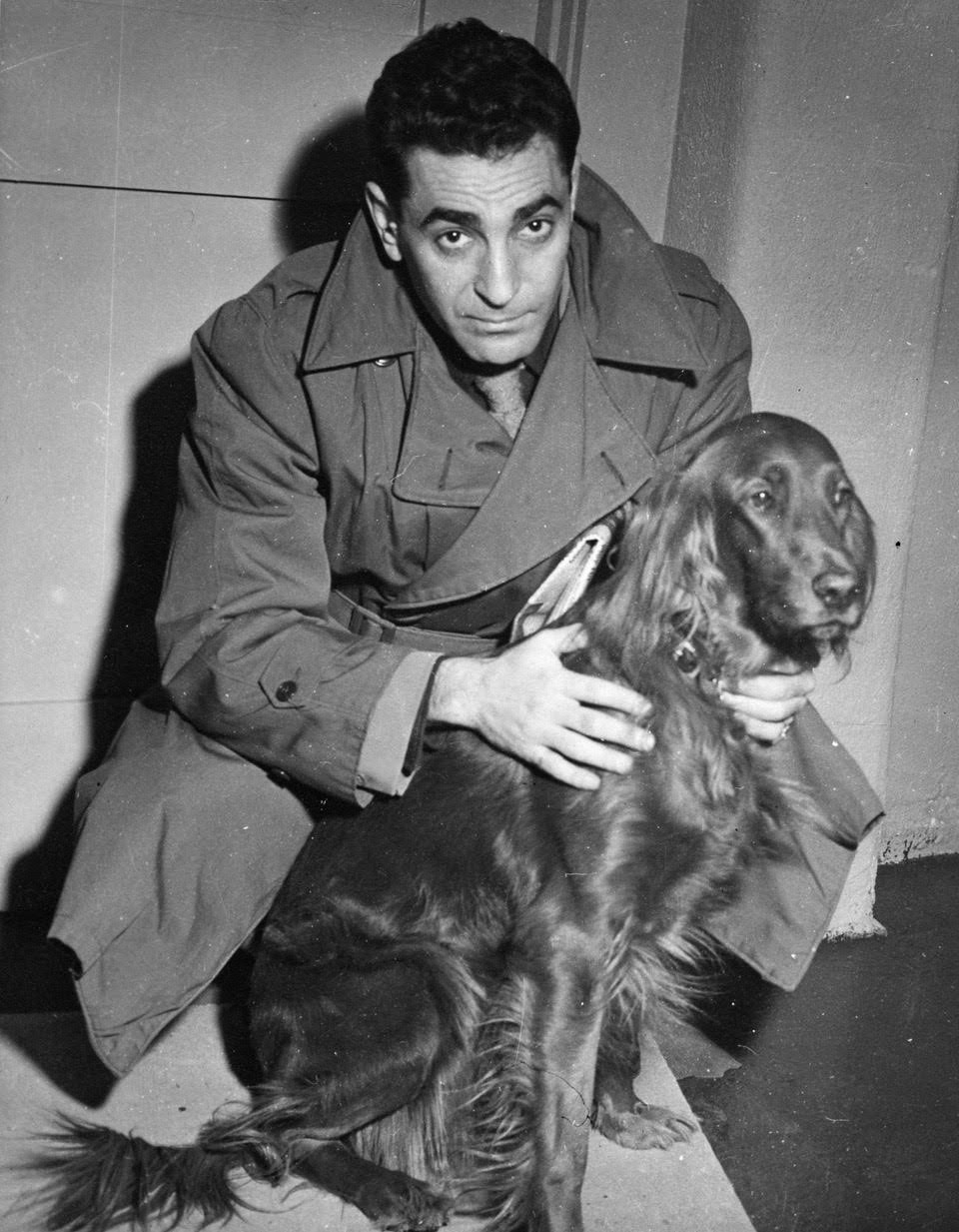
On October 30, Stanford’s Another Look book club took on Alfred Hayes‘s My Face for the World to See, a tough look at Hollywood by a film industry insider.

Author Alfred Hayes with friend

Photographer David Schwartz preserved the a terrific night for us – with four panelists, including David Thomson, the film critic and author who wrote the introduction to the NYRB Classics edition we were reading.

We had another surprise guest that evening, the author’s daughter, Josephine Hayes Dean, flew out to join us for the evening. David took a photo of that, too.

From left to right above: Another Look director Robert Harrison; the author’s daughter, Josephine Dean; novelist Terry Gamble; National Medal of Arts winner Tobias Wolff, and film critic David Thomson.

If you missed the stellar event, you can join us after-the-fact with the podcast here. It really was a lively and incisive discussion about a world where talent is chewed up and discarded, where thousands come to follow a dream that so rarely and randomly gets fulfilled.

Panelists in discussion below, from left to right: Robert Harrison, Tobias Wolff, Terry Gamble, and David Thomson.


Novelist Tobias Wolff’s school of hard knocks

Share

Toby @Stanford

Tobias Wolff is one of Stanford’s treasures. The National Medal of Arts winner and professor emeritus of English is one of the nation’s leading writers. He didn’t have it easy, though, and recounts the story in This Boy’s Life. His mother was was the daughter of a naval officer who lost all of his money in the 1929 crash when she was 13. When Wolff was 4, she left her husband and drove with her two sons to Sarasota, Florida. After the divorce, his father married money and took his older brother Geoffrey, while Tobias stayed with his mom. “He sent my mother nothing, not even the small amount a judge had ordered,” he recalls.

He also tells the story in “Tobias Wolff’s Rough Ride,” in the Wall Street Journal here. (And thanks to Liddie Conquest for the heads-up!) Two excerpts:

My mother didn’t scare easily. She had been through a lot after we left my father in 1950. When she remarried in 1957, we lived in Newhalem, Wash., a hamlet of 200.

My stepfather was a drinker. He liked to stop at a tavern 15 miles downriver. He often returned to the car drunk and sped home with my mother, stepsister and me. He took pleasure in frightening us.

The road to Newhalem climbed high above the river on the right. Despite Mom’s pleas to slow down, he took hairpin turns too fast, nearly sending us tumbling down to the river.

My mother’s face would be frozen in terror, but she never said another word. She probably just added the near-death experiences to a long list of reasons to leave him, which eventually she did.

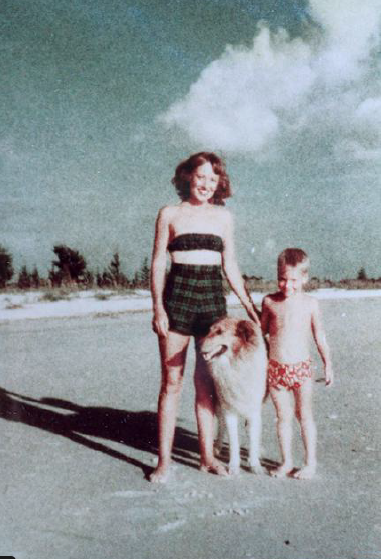
Mother, son, and dog, Sheppy, in Florida, 1950. (Wolff family)

I was born in Birmingham, Ala., where my father, Arthur, was a project manager at Bechtel Corp. He converted civilian planes into military aircraft. My family moved to Atlanta and then to Old Lyme, Conn. My father didn’t belittle my mother, Rosemary, or lay a hand on her. His abuse was extreme irresponsibility and infidelity.

***

In Sarasota, my mother met a man, and we lived with him for a couple of years. He was a good-looking guy, a former cop, who had been living in a trailer off his disability checks. He was physically abusive.

When she left him, my mother drove us to Utah. She was convinced we could become rich by prospecting for uranium deposits there. I was going into the fifth grade.

I loved the drive, staying in motels and crossing the Rockies. I imagined myself a character in a Western. In Salt Lake City, we lived in a one-bedroom apartment in a Victorian house.

Then the man we’d left in Sarasota tracked us down. We took a bus to Seattle in the middle of the night. We lived in a boardinghouse in West Seattle for a year.

Read the rest here.