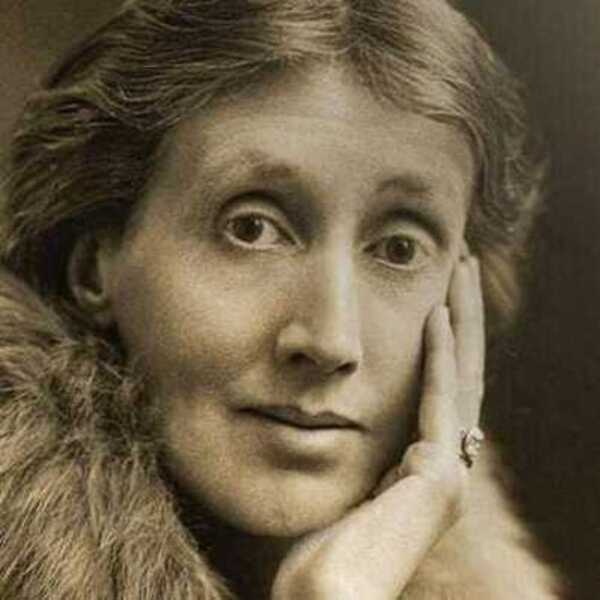
Please join us for a discussion of Virginia Woolf‘s 1929 A Room of One’s Own at 7 p.m. (PST) on Tuesday, April 11, in Levinthal Hall, Stanford Humanities Center, 424 Santa Teresa Street on the Stanford campus.
The Guardian called the book “a landmark in feminist thought and a rhetorical masterpiece” and rated it one of the top 100 non-fiction books of all time. Read about that here.
According to a contemporary review in The Los Angeles Times: “If you miss this book, which is profound and subtle and gently ironic and beautifully written, you will have missed an important reading experience.” Another Look will consider the work’s legacy a century later. The Bloomsbury author’s iconic book, an extended essay, is in public domain and widely available.
Panelists will include: Stanford Prof. Robert Pogue Harrison, author, director of Another Look, host of the radio talk show and podcast series “Entitled Opinions,” and a regular contributor to The New York Review of Books and Stanford Prof. Tobias Wolff, one of America’s leading writers, a founding director of Another Look, and a recipient of the National Medal of Arts.
Constance Solari is a writing coach and the author of four novels, including 2012’s Sophie’s Fire: The Story of Saint Madeleine Sophie Barat. Maria Florence Massucco, is a PhD candidate in Italian Studies who specializes in the 20th century novel. You’ll remember her from our discussion of Dorothy Strachey‘s Olivia.
Join us in person or virtually, but please register here. Or scan the QR code. We look forward to seeing you on April 11th! It’s going to be a great discussion.
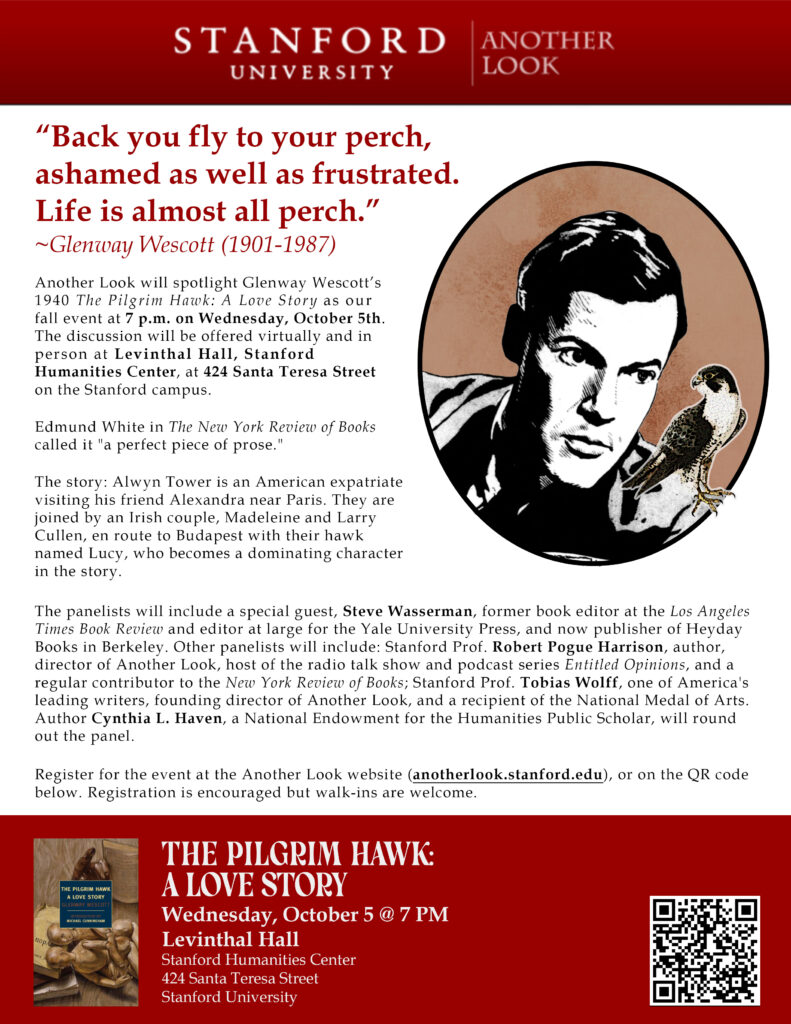
Another Look was launched in November 2012, with William Maxwell’s So Long See You Tomorrow. Now we celebrate our tenth anniversary with another wonderful and too-little-known book, Glenway Wescott‘s 1940 novella The Pilgrim Hawk: A Love Story(NYRB Classics). The event will take place at 7 p.m. on Wednesday, October 5, at Levinthal Hall in the Stanford Humanities Center, 424 Santa Teresa Street, on the Stanford campus. The event will also be livestreamed. Come celebrate our tenth with us!
Registration is encouraged, but walk-ins are always welcome. Register here – or on the QR code on the poster below.
The Book
The Pilgrim Hawk: A Love Story traces a single afternoon in a French country house during the 1920s. Alwyn Tower, an American expatriate and sometime novelist, is staying with a friend outside Paris when a well-heeled Irish couple drops in — with Lucy, their trained hawk, a restless, sullen, disturbingly totemic presence. Lunch is prepared, drink flows, and the story that unfolds is both harrowing and farcical.
Novelist Michael Cunningham in his introduction calls the book “murderously precise and succinct.” Critic and author Susan Sontag said, “The ever-astonishing Pilgrim Hawk belongs, in my view, among the treasures of twentieth-century literature, however untypical are its sleek, subtle vocabulary, the density of its attention to character, its fastidious pessimism, and the clipped worldliness of its point of view.”
The Panelists
The panelists will include a special guest, Steve Wasserman, former book editor at the Los Angeles Times Book Review and editor at large for the Yale University Press, and now publisher of Heyday Books in Berkeley. Other panelists will include: Stanford Prof. Robert Pogue Harrison, author, director of Another Look, host of the radio talk show and podcast series Entitled Opinions, and a regular contributor to the New York Review of Books; Stanford Prof. Tobias Wolff, one of America’s leading writers, a founding director of Another Look, and a recipient of the National Medal of Arts. Author Cynthia L. Haven, a National Endowment for the Humanities public scholar, will round out the panel.
The Venue
Some of you may remember that Levinthal Hall is where Another Look began a decade ago. You’re right! Our audience attendance outgrew that venue in 2015, and we moved to a larger space. However, now we are offering virtual as well as in-person attendance, which allows us to return to our former home. We will announce how to register for the virtual event in our next email, as we are still finalizing arrangements.
Parking
Metered parking spaces are available along Santa Teresa Street. Parking is free after 4 p.m. Free parking is also available on the lot adjacent to the Stanford Humanities Center after 4 p.m.
How to get the book
Books are available at Kepler’s Books in Menlo Park (650-324-4321) and Books Inc. at Town & Country in Palo Alto (650-321-0600). We’d recommend calling first to make sure a book is waiting for you. Books are also available at Amazon and at Abebooks. If all else fails, you can order directly from the publisher here.
Our October 5 event is sponsored by Stanford Continuing Studies, the Stanford Humanities Center, and the Division of Literatures, Cultures, and Languages.
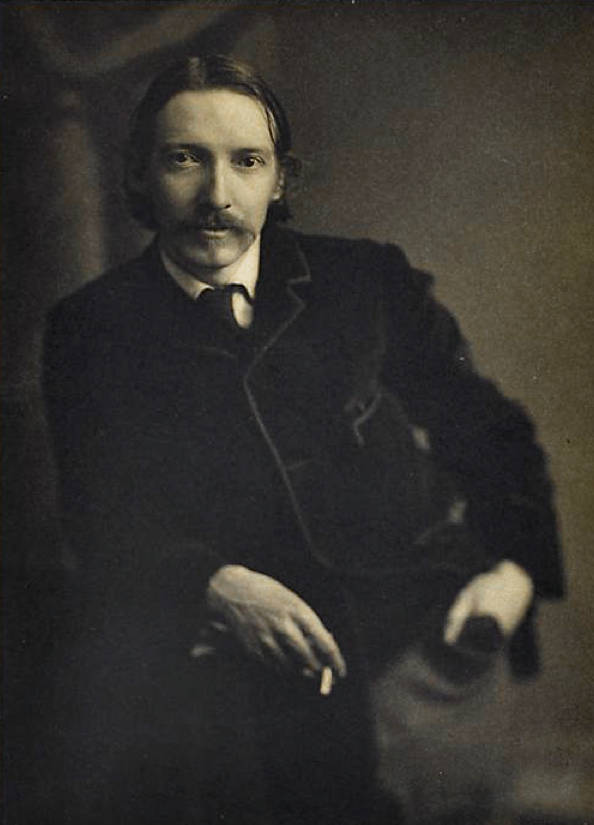
Stanford’s “Another Look” book season continues in 2022 with Robert Louis Stevenson’s The Strange Case of Dr. Jekyll and Mr. Hyde. The discussion will take place at 7 p.m., Tuesday, April 12, at the Bechtel Conference Center in Encina Hall. Go here to register.
Stevenson’s short 1885 novel is universally known but little read today – an important reason why it needs “another look.” Vladimir Nabokov called it “a fable that lies nearer to poetry than to ordinary prose fiction.” The Russian author compared it to Flaubert’s Madame Bovary or Gogol’s Dead Souls.
“Is Jekyll good?” he asked. “No, he is a composite being, a mixture of good and bad, a preparation consisting of a 99% solution of Jekyllite and 1% of Hyde … He is a hypocritical creature carefully concealing his little sins.” Popular author Stephen King agreed that Stevenson’s novel is moral tale, “a close study of hypocrisy – its causes, its dangers, its damages to the spirit.” Utterson, he contends, is the book’s real hero.
Henry James called Dr. Jekyll and Mr. Hyde a “short, rapid, concentrated story, which is really a masterpiece of concision.”
Stevenson’s dark vision had come to him in a dream – as it had for Mary Shelley, who went on to write Frankenstein, a book that Another Look featured in 2018. Both works share a fascination with the limits of science, medicine, and technology on our humanity.
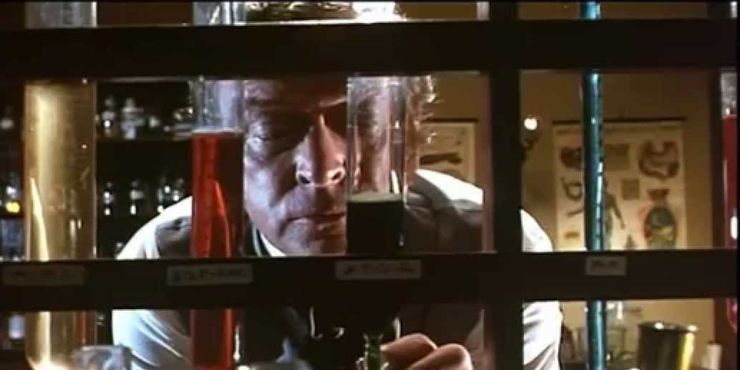
Michael Caine as Jekyll and Hyde
Acclaimed author Robert Pogue Harrison will moderate the discussion. The Stanford professor who is Another Look’s director writes regularly for The New York Review of Books and hosts the popular talk show, Entitled Opinions. He will be joined by eminent novelist Tobias Wolff, founding director of Another Look and a National Medal of Arts winner, and Ana Ilievska, Andrew W. Mellon Postdoctoral Fellow and Stanford Humanities Center and a lecturer in Stanford’s Department of French and Italian.
Books are available at Stanford Bookstore and Kepler’s – but the book is also widely available online and is offered as a free e-book on Amazon as well.
The event marks our first in-person event since the beginning of COVID in 2020. The occasion will also be offered virtually for those who cannot attend on the Stanford campus. (Registration encouraged, but walk-ins are welcome.)
We survive on donations, so go here if you’d like to further the cause of good books. Register HERE to attend what looks like it will be a terrific event!
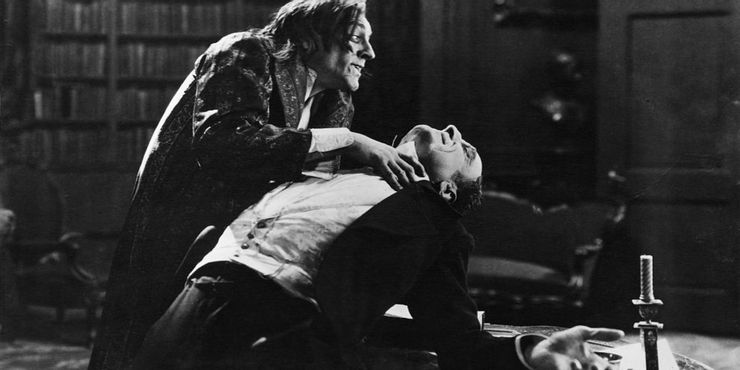
The 1920 silent film with John Barrymore – a silent classic.
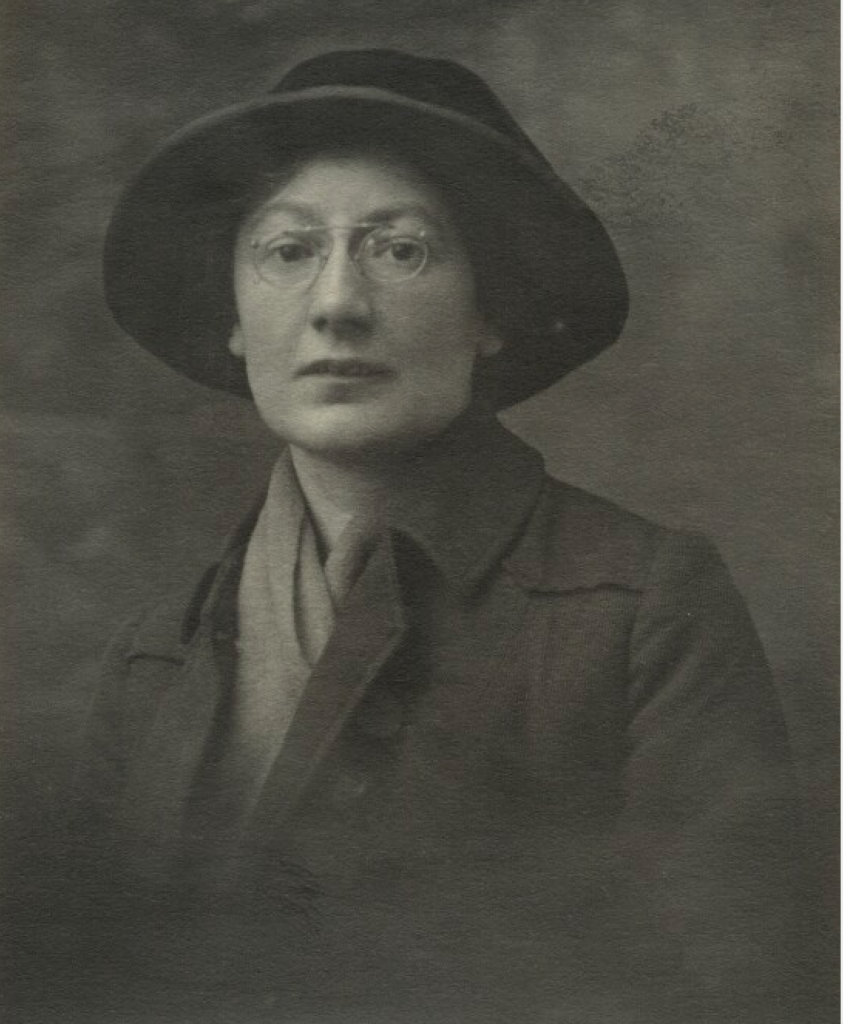
Dorothy Strachey (1865-1960), sister of the writer Lytton Strachey, was a Bloomsbury insider.
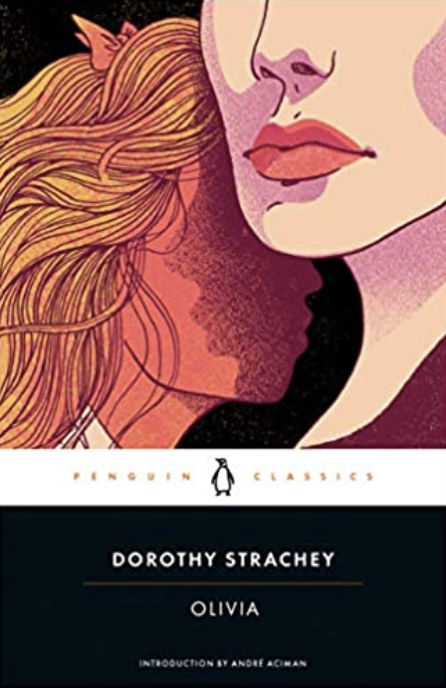
Please join Stanford’s Robert Pogue Harrison, Maria Florence Massucco, and Tobias Wolff, for a webinar discussion of Dorothy Strachey’s 1949 novel, Olivia.The event will take place 5:00-6:30 p.m. (PST) on Wednesday, October 13. Given the ongoing COVID situation, this will be a virtual event.
Stanford’s Prof. Robert Harrison, an acclaimed author and director of Another Look, will lead the discussion, joined by the eminent novelist Tobias Wolff, founding director of Another Look and a National Medal of Arts winner. Massucco, a PhD candidate in Italian Studies who specializes in the 20th century novel, will round out the panel.
André Gide called Olivia“a little masterpiece,” and we think you’ll agree. The story traces the intense emotional currents among the girls and teachers in a finishing school outside Paris. Olivia, a 16-year-old English girl, finds herself falling under the spell of the charismatic Mademoiselle Julie, a founder of the school. The Times (London) praised Olivia’s “strange combination of strength and delicacy” and the Wall Street Journal noted that the book is “extravagantly French in its sensibilities.”
Dorothy Strachey and her famous brother, the writer Lytton Strachey, were prominent in the Bloomsbury group. Olivia is her only novel.
The book is available through Amazon (also on Kindle), as well as Stanford Bookstore (650-329-1217) Kepler’s in Menlo Park (650-324-4321), and Bell’s Books in Palo Alto (650-323-7822). Secondhand copies are also available on Abebooks as well. If all else fails, you can order directly from Penguin at 800-793-2665, but allow for delivery time and shipping costs.
Like all our events, this webinar is free and open to the public, but please register on the link below. See you on Zoom!
Carol Edgarian: “a remarkable writer of intelligence and compassion.”
Stanford’s Another Look book club will hold its long-postponed discussion honoring author William Kennedy, a Pulitzer-prizewinning, MacArthur “Genius” Fellow, at 3 p.m. (PST) on Friday, February 26. The Zoom event is free and open to the public – register HERE. Read more about the event here.
The discussion will be led by National Medal of Arts winner Tobias Wolff, with panelists Carol Edgarian, novelist and a founding editor of Narrative Magazine, and Robert Pogue Harrison, an acclaimed author and host for the popular radio series, Entitled Opinions. Wolff and Harrison are, respectively, the founding and current directors of Another Look.
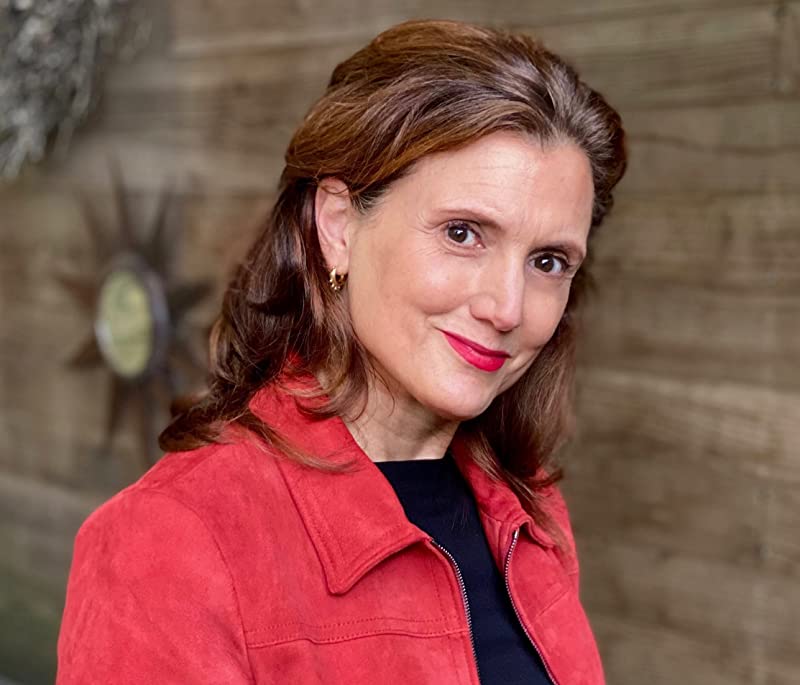
Edgarian is a newcomer to Another Look, but no stranger to Stanford. She graduated from the university in 1984 – so she’ll have a Zoom homecoming with the Another Look event. Amy Tan, another celebrated local author, called her “a remarkable writer of intelligence and compassion.”
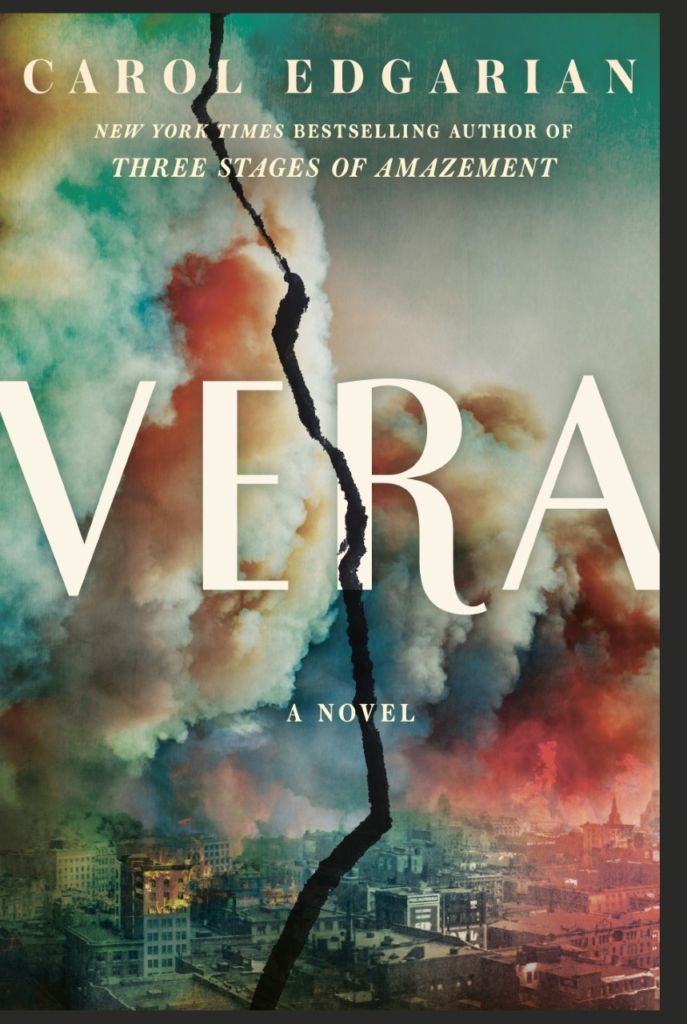
Her newest book, Vera, will be out on March 2 with Scribner. It’s a novel set against the 1906 San Francisco earthquake,
It’s already getting praise: “A novel of resilience in the face of disaster, just what we need right about now,” wrote fellow novelist T.C. Boyle. “Edgarian’s tale couldn’t have come at a better time.”
Her previous books include the New York Times bestseller Three Stages of Amazement and the international bestseller Rise The Euphrates, winner of the ANC Freedom Prize. Her work has been described by The Washington Post as notable for its “generosity of spirit, intelligence, humanity, and finally ambition.”
Her articles and essays have appeared in TheWall Street Journal, NPR, and W, among many others. But she is perhaps best known as co-founder of the Narrative (www.NarrativeMagazine.com), which publishes fiction, poetry, and art. It also sponsors Narrative in the Schools, which provides free libraries and writing resources for teachers and students around the world. Over the years, the online magazine has published Ann Beattie, T. C. Boyle, Joyce Carol Oates, Jayne Anne Phillips and our own Tobias Wolff.
“When we started the magazine,” she told Ron Charles ofThe Washington Post in 2014, “the thinking about online reading was that readers would not sit still for more than 1,000 words. We set about working against that grain, and from the first, we published long-form work: stories, novellas, novel serializations. One of the great things about digital publication, in our view, is that we can go long.”
To bring you up to speed on our upcoming event: Pulitzer prizewinning novelist William Kennedy has been called the Bard of Albany, but he began his career as a reporter. After a stint in the military and in Puerto Rico, he returned to his hometown, and saw the city of his birth with new eyes: “Without a sense of place, you don’t, as a writer, have very much. Place is all those forces of a given society impinging upon and determining character. Without it, a book becomes bloodless.”
Tobias Wolff will lead the discussion
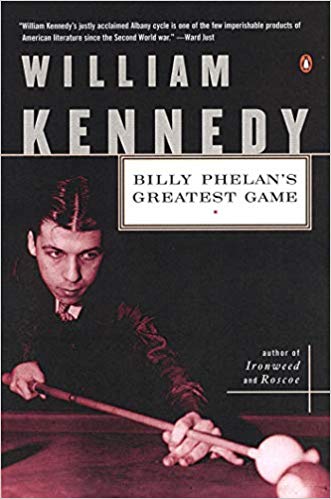
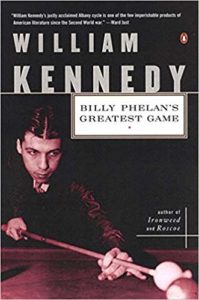
Billy Phelan’s GreatestGame belongs to William Kennedy’s celebrated Albany sequence of novels. According to Stanford’s Tobias Wolff, “Set during the Depression, it concerns a young gambler and bookie, the Billy of the title, who suffers a setback that compels him to embark on an odyssey – and I use that word advisedly – through the demimonde of his city, during which he encounters temptations and dangers that test his resolve to the limit. There are gangsters, there is a kidnapping, but at its core this novel is about character, and what this man will do and endure to preserve his honor.”
Like all our events, it is free and available to the public. Register HERE, and welcome Carol Edgarian back to Stanford … virtually speaking.
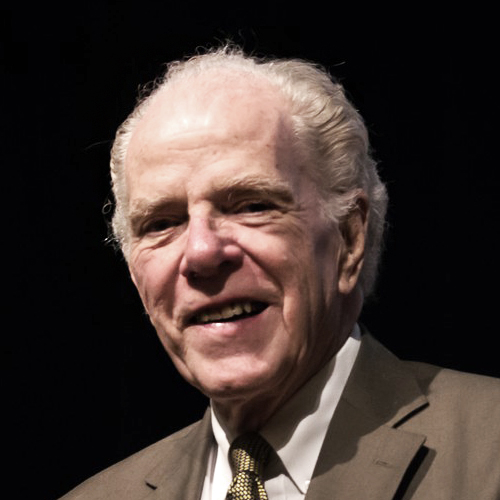
The Bard of Albany, Irish-American author William Kennedy
It’s happening! It’s finally happening! At 3 p.m. (PST) on Friday, February 26, Stanford’s Another Look book club hold its long-postponed Another Look discussion honoring author William Kennedy, a Pulitzer-prizewinning, MacArthur “Genius” Fellow. Our event for the 1978 book was one of the early COVID casualties at Stanford last spring. Now it will be rescheduled as a Zoom event (isn’t everything nowadays)?
From our announcement:
Pulitzer prizewinning novelist William Kennedy has been called the Bard of Albany, but he began his career as a reporter. After a stint in the military and in Puerto Rico, he returned to his hometown, and saw the city of his birth with new eyes: “Without a sense of place, you don’t, as a writer, have very much. Place is all those forces of a given society impinging upon and determining character. Without it, a book becomes bloodless.”
According to Stanford’s Tobias Wolff, who will lead the discussion: Billy Phelan’s GreatestGame belongs to William Kennedy’s celebrated Albany sequence of novels. Set during the Depression, it concerns a young gambler and bookie, the Billy of the title, who suffers a setback that compels him to embark on an odyssey – and I use that word advisedly – through the demimonde of his city, during which he encounters temptations and dangers that test his resolve to the limit. There are gangsters, there is a kidnapping, but at its core this novel is about character, and what this man will do and endure to preserve his honor.”
The discussion will be led by National Medal of Arts winner Tobias Wolff, with panelists Carol Edgarian, novelist and founding editor of Narrative Magazine, and AnotherLook Director Robert Pogue Harrison, an acclaimed author and host for the popular radio series, Entitled Opinions.
Like all our events, it is free and available to the public. Registerhere.
And check out my Los Angeles Review of Books interview with Bill Kennedy, discussing his life and, in particular, Billy Phelan’s Greatest Game. An excerpt:
CYNTHIA HAVEN: Hemingway wrote: “Everything changes as it moves. That is what makes the movement which makes the story. Sometimes the movement is so slow it does not seem to be moving. But there is always change and always movement.” It’s a thought you echo more than once in Billy Phelan, for example, when you write: “We are only as possible as what happened to us yesterday. We all change as we move.” You’ve said, “The movement is what creates the action, and the action is what creates the story” — which in turn creates more movement. Clearly, you’ve thought about this a lot. Could you share a few more thoughts?
WILLIAM KENNEDY: I must’ve been deeply persuaded by Hemingway’s lines to have lifted them without crediting him; but I always listened to what he said about writing. In The Angels and the Sparrows, I created Francis Phelan, a wino in his 30s, a clever, obnoxious loner returning home for his mother’s funeral (she kicked him out), who stops at a neighborhood bar for a beer and is hostile to the bartender. It was a good scene. He was a sad, broken young guy, but I disliked him seriously, even as I was creating him, and didn’t want to carry him forward.
Then, maybe 15 years later I started to write Billy Phelan and I reinvented the Phelan family. I had to get rid of Francis as that antipathetic young wino. He still had to be a bum, but I aged him into a tortured figure at the bottom of the world who was Billy’s father, and his life immediately became an open-ended challenge to my imagination. It turned out that he had abandoned his family 22 years earlier after his 13-day-old son, Gerald, slipped out of a diaper while he was changing him, fell off a table, broke his neck and died. In the fall of 1938, Francis drifts back to Albany to vote in a Democratic primary election, knowing the machine will pay him $5 for this; so he votes 21 times, earning $105, and is put in jail. Billy, the gambler, hears he’s in town and bails him out. The new Francis, after living through 16 years of shame and guilt over dropping the infant and running off, became a pitiable but likable human being. I don’t know where Gerald came from. There was no such incident in my life, nor can I remember hearing of one; perhaps I forgot it. But years ago I decided it was a gift from my unconscious, a fruitful one. In Billy, Francis was so vitally real that he leaped onto my typewriter and demanded his own novel. So I wrote Ironweed for him.



 WILLIAM KENNEDY: I must’ve been deeply persuaded by Hemingway’s lines to have lifted them without crediting him; but I always listened to what he said about writing. In The Angels and the Sparrows, I created Francis Phelan, a wino in his 30s, a clever, obnoxious loner returning home for his mother’s funeral (she kicked him out), who stops at a neighborhood bar for a beer and is hostile to the bartender. It was a good scene. He was a sad, broken young guy, but I disliked him seriously, even as I was creating him, and didn’t want to carry him forward.