
Mary McCarthy’s “Memories of a Catholic Girlhood” TONIGHT!

Share

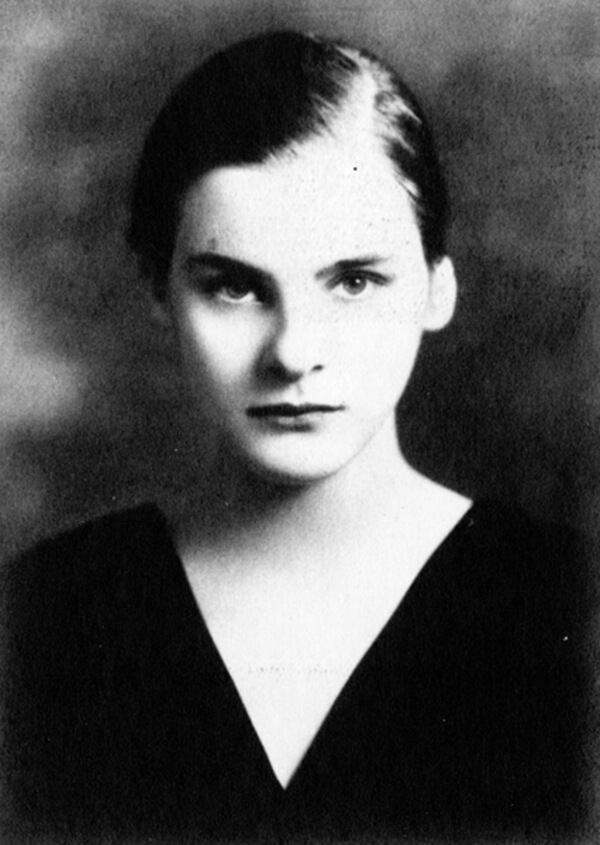
Schoolgirl days (Vassar Library & Archives)

“If I could not win fame by goodness, I was ready to do it by badness.”

It’s tonight! Another Look takes on Mary McCarthy‘s Memories of a Catholic Girlhood, a 1958 National Book Awards finalist for nonfiction. The discussion will take place at 7:30 p.m. on TONIGHT, February 19, in the Bechtel Conference Center of Encina Hall. Directions and parking for the event are here.

An excerpt from Charles Poore‘s 1957 review in The New York Times:

In Memories of a Catholic Girlhood Mary McCarthy plays a splendid trick on her future biographers by anticipating their researches and confounding their zeal. The book is a collection of stories she has written about her early years. Among them, for example, is “Yonder Peasant, Who Is He?” – one of the most stinging, brilliant and disturbing memoirs ever written by an American.

The autobiographical stories are marinated in italic commentaries that tell how much commonplace veracity or creative mendacity they contain. We are given background and interpretation, amplification and variorum readings on Miss McCarthy’s nomadic childhood from the West Coast to the Midlands, from convent schools to Vassar. And probably the sharpest criticism of her work you can find anywhere.

Now, many an author has done this sort of thing in the past. One thinks, at random, of Henry James‘ wonderfully revisionist prefaces to the New York edition of his works, or the glow of Conrad’s notes for his Canterbury Edition. Didn’t Ring Lardner write a series of brief, confidential overtures to his tales, one of which said: “The story is an example of what can be done with a stub pen”? Miss McCarthy is more generous with her revelations and interpretations. She goes at considerable length into her young religious faith and the agonizing reappraisals that accompanied her loss of it. She traces endlessly the ramifications of a family that contained Roman Catholic and Jewish members, Protestants and agnostics.

The conversation will be led by author Tobias Wolff, National Medal of Arts winner and founding director of Another Look. Panelists include author Catherine Wolff and Another Look regular Inga Pierson, who is also an English teacher at Sacred Heart Preparatory.

We are aware there is a televised Democratic Presidential Debate airing from 6-8 p.m. the same evening. However, we hope you will choose us! (And catch up with the debate or debate highlights afterward. Isn’t that what Youtube is for?) More information on the poster below.
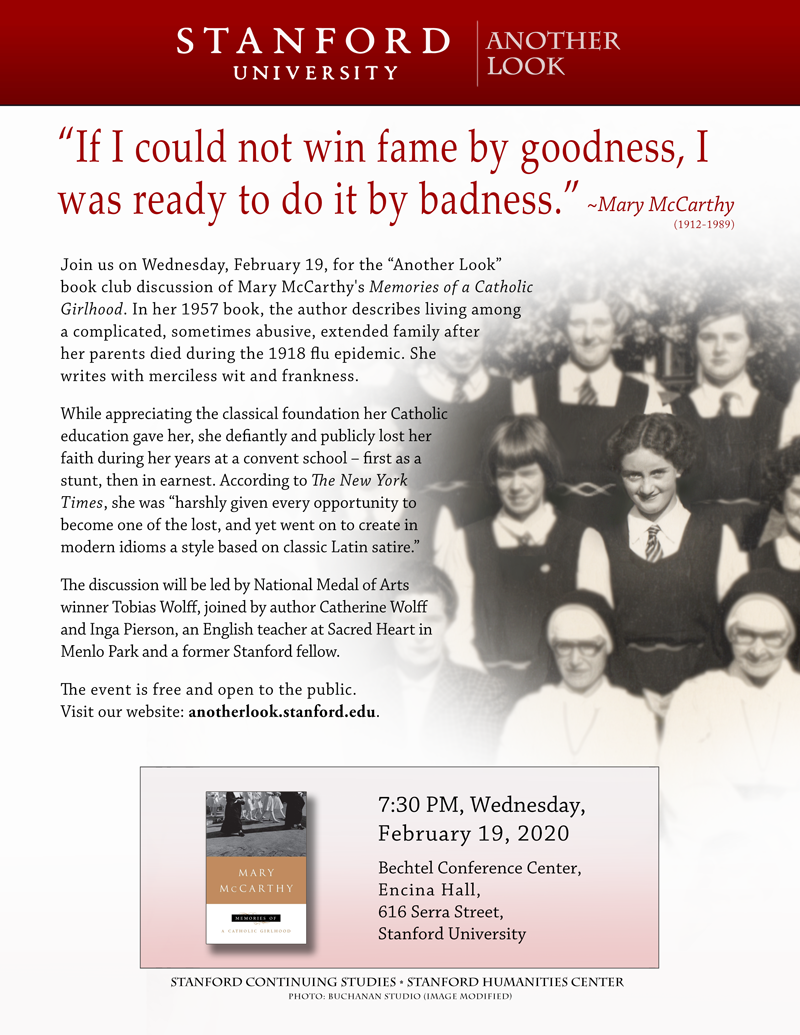
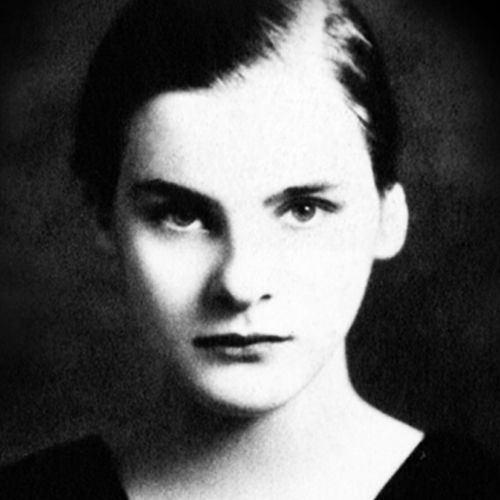
 

“If I could not win fame by goodness, I was ready to do it by badness.” Mary McCarthy’s memoir comes to Stanford.

Share

In school, character is fate.” (Courtesy Vassar Archives)

You think the coronavirus is bad? Novelist Mary McCarthy will tell you about about one of the epic plagues of modern times.

Both her indulgent, fun-loving parents died during the 1918 Spanish flu pandemic. Then she and her three brothers were shuttled among relatives, some of them abusive. In her 1957 book, Memories of a Catholic Girlhood, she describes it all with merciless wit and frankness.

Now her book is coming to Stanford. It will be discussed at the Another Look winter event at 7:30 p.m. on Wednesday, February 19, at the Bechtel Conference Center in Encina Hall.

She was first sent to a Catholic convent school in Seattle, later to an Episcopalian seminary in Tacoma. While appreciating the classical foundation her Catholic education gave her, she defiantly and publicly lost her faith during those years – first as a stunt, then in earnest. She eventually graduated from Vassar.

Toby is leading the discussion.

“She never spares herself at all,” wrote Charles Poore in The New York Times. “The vanities and ambitions, the resentments and misunderstandings, the small triumphs and the scarring disasters that marked her early years are set forth with remarkable candor, so that her book is the most incisive contribution to the story of her development as an artist that we shall ever have.” She was “harshly given every opportunity to become one of the lost, and yet went on to create in modern idioms a style based on classic Latin satire.”

The conversation will be led by author Tobias Wolff, founding director of Another Look and a National Medal of Arts winner. Panelists include his wife, the author Catherine Wolff and Another Look regular Inga Pierson, a former Stanford fellow who brings some personal experience to bear on the subject: she is  an English teacher at Sacred Heart Preparatory in Menlo Park.

Inga’s coming, too.

The event is free and open to the public. Come early for best seats. And Stanford Bookstore on campus, Kepler’s in Menlo Park, and Bell’s Books in Palo Alto are carrying the books.

The Another Look book club focuses on short classics that have been forgotten, neglected, or overlooked—or may simply not have received the attention they merit. The selected works are short, in order to encourage the involvement of Bay Area readers whose time may be limited. Subscription at anotherlook.stanford.edu is encouraged for regular updates and details on the selected books and events.

Walter Tevis’s The Queen’s Gambit: you read the book, here’s the podcast of the Another Look discussion!

Share

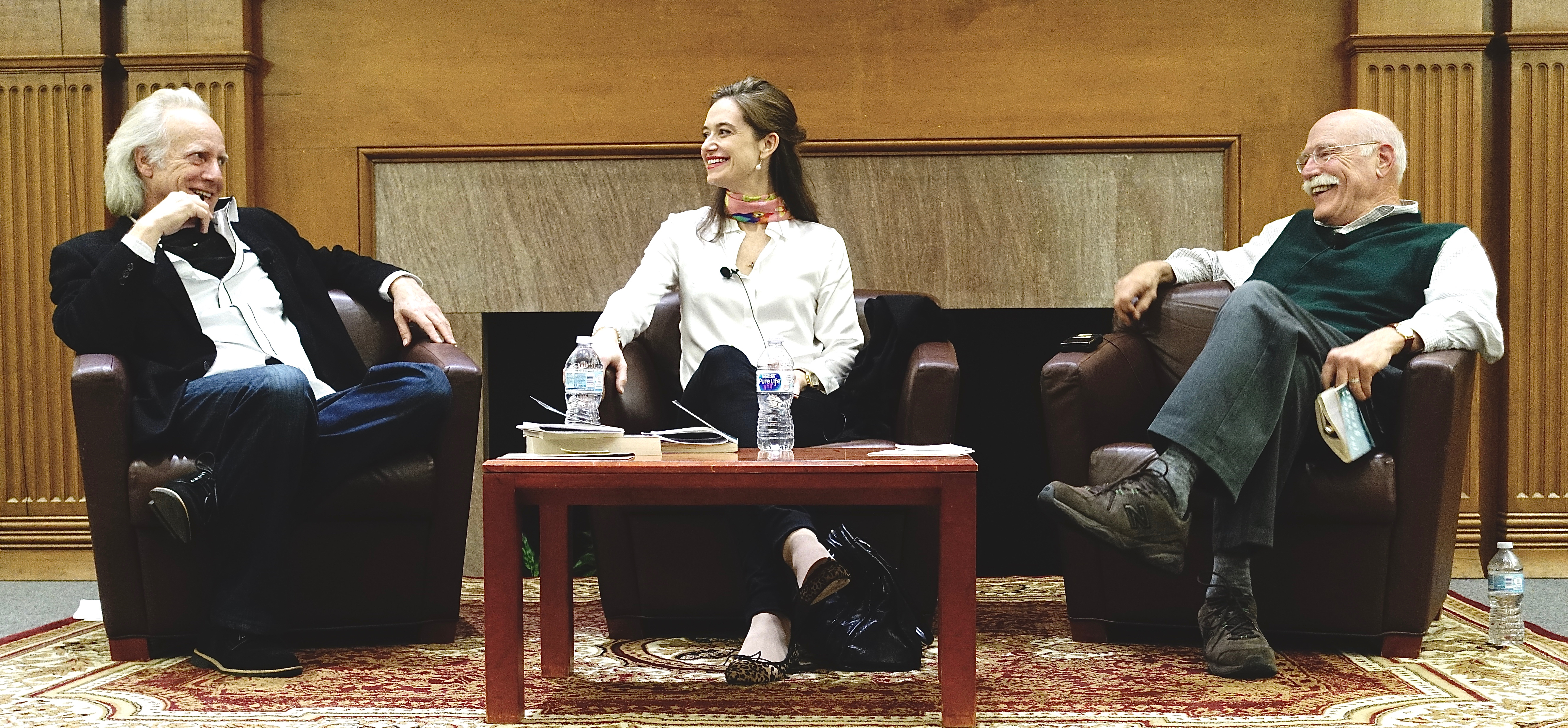
Walter Tevis is best known for his three novels that were turned into major films: The Hustler, The Color of Money, and The Man Who Fell to Earth. But on January 29, Stanford took another look at his overlooked masterpiece, The Queen’s Gambit, a book about chess, and the teenage girl who masters it. The lively discussion was headed by Another Look’s founding director, the eminent author Tobias Wolff. He was joined by Robert Pogue Harrison, a regular contributor to The New York Review of Books, and former Stanford fellow Inga Pierson. Some considered it our best event ever! Judge for yourself: the podcast of the discussion is here.

Tevis was born in San Francisco and grew up in the Sunset District. While his parents relocated to Kentucky, he spent a year in the Stanford Children’s Convalescent Home (which later became Stanford’s Lucile Salter Packard Children’s Hospital). Hence, Another Look’s winter event will be a homecoming for the author, who died in 1984.

Photos below by Another Look friend David Schwartz.

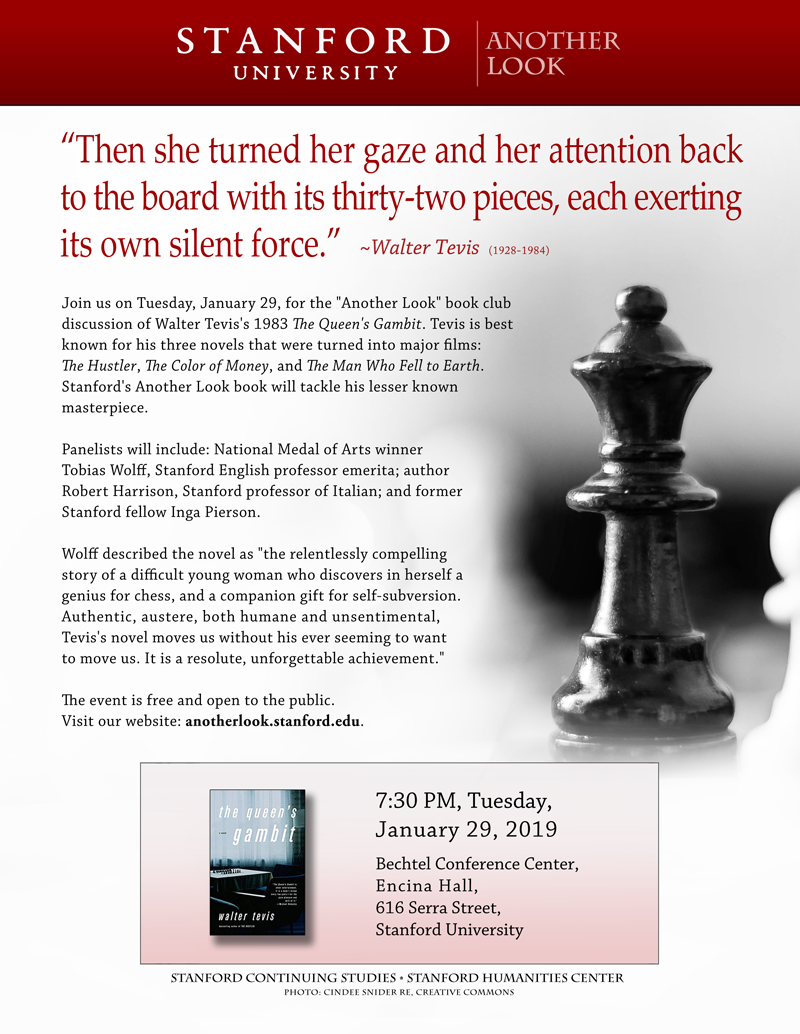
TONIGHT! Stanford’s Another Look features Walter Tevis’s “The Queen’s Gambit”!

Share

Local boy

Please join us for the Another Look book club discussion of Walter Tevis‘s Queen’s Gambit. The novel is about chess, and more particularly about Beth Harmon, a sullen and unremarkable orphan – until she plays her first game. By sixteen, she is playing chess at the U.S. Open Championship. The Queen’s Gambit follows the intense mental and existential pressures that a chess champion must endure in order to remain at the top of the game.

Tevis is best known for his three novels that were turned into major films: The Hustler, The Color of Money, and The Man Who Fell to Earth. Tevis was born in San Francisco and grew up in the Sunset District. While his parents relocated to Kentucky, he spent a year in the Stanford Children’s Convalescent Home (which later became Stanford’s Lucile Salter Packard Children’s Hospital). Hence, Another Look’s winter event will be a homecoming for the author, who died in 1984.

The event will take place at 7:30 p.m. TONIGHT, Tuesday, January 29, at the Bechtel Conference Center of Encina Hall. Panelists will include Stanford’s National Medal of Arts winner Tobias Wolff; acclaimed author Robert Harrison, and former Stanford fellow Inga Pierson.

Inga Pierson on Frankenstein: “You wonder if this is a comment on all the Enlightenment ideas.”

Share

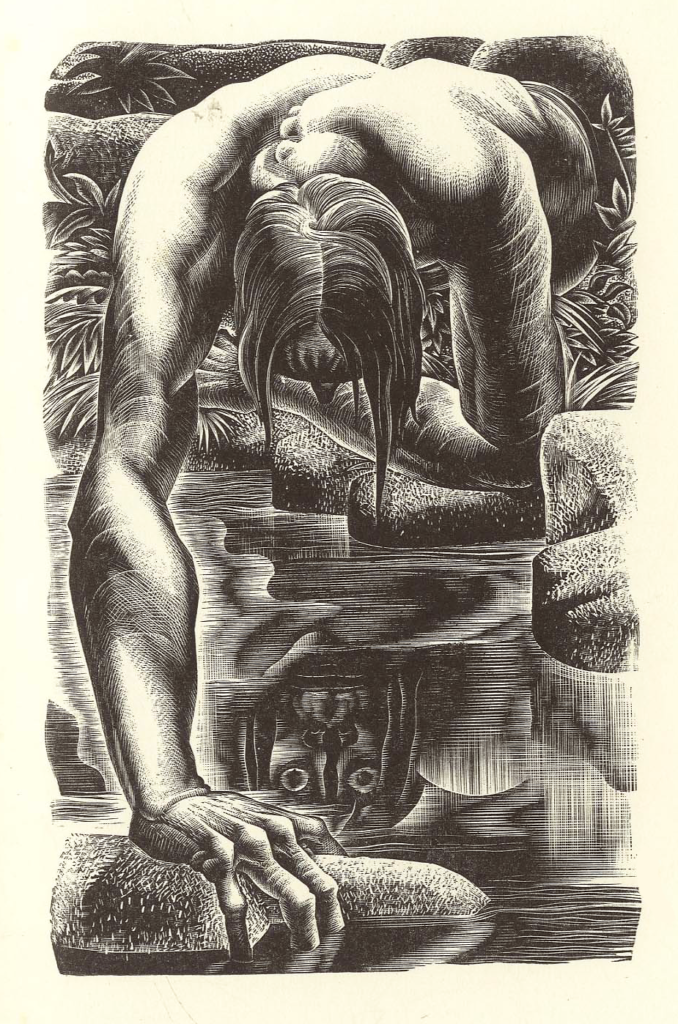
“THERE IS SOMETHING IN THE CREATURE THAT YEARNS FOR THE HEAVENS.”

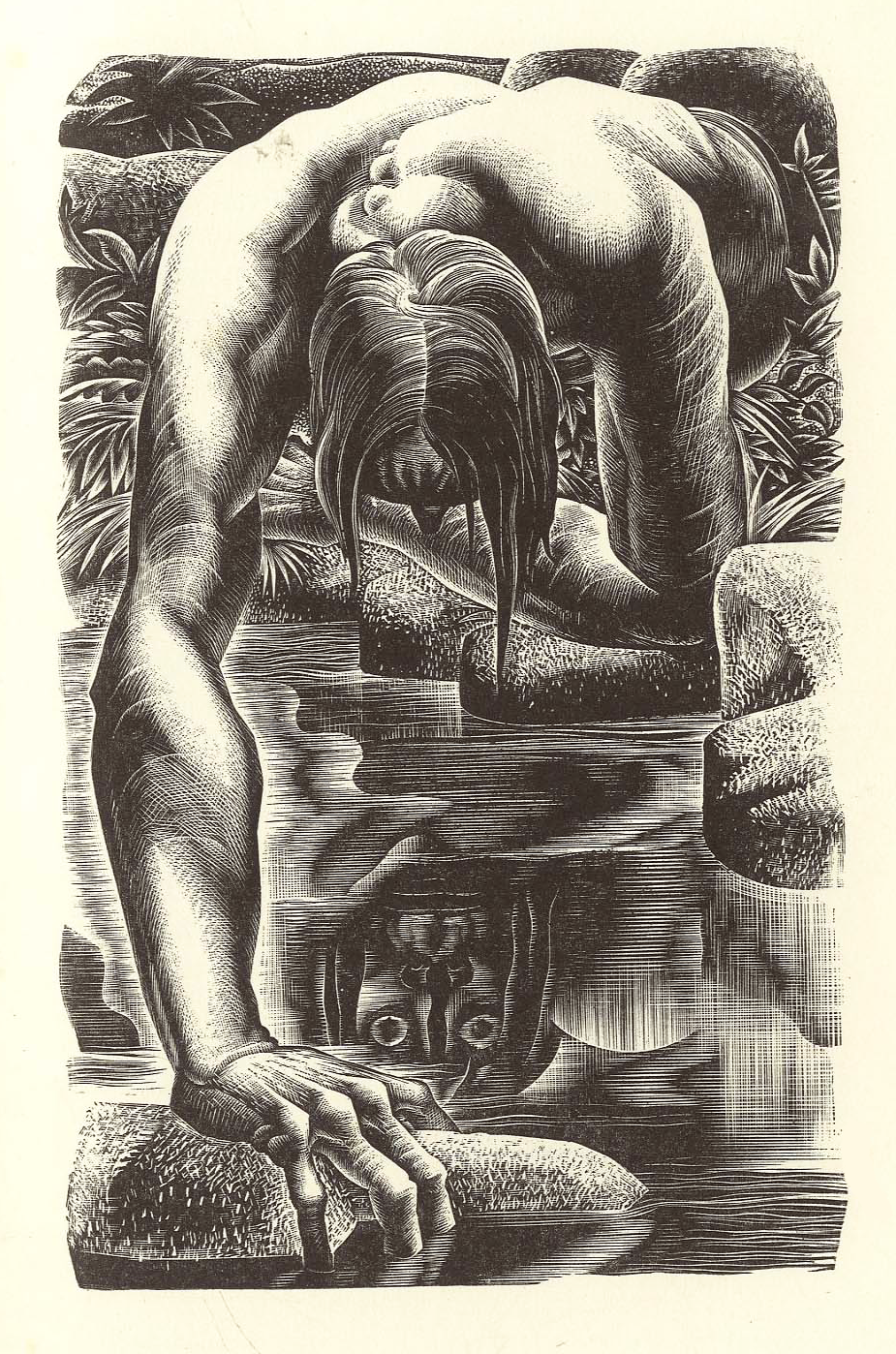
“The Creature Gazing into a Pool.” Artist: Lynd Ward. Provided by the Estate of Lynd Ward.

January 2018 marks the 200th anniversary of the publication of Mary Shelley’s Frankenstein: or, The Modern Prometheus, and the occasion has been commemorated with celebrations, conferences, retrospectives, editorials, and more. Clearly, the book belongs to the 21st century, as much as it did the 19th and 20th. A new podcast on the Los Angeles Review of Books’ Entitled Opinion channel, featuring Inga Pierson, explores how Shelley’s astonishing novel is a parable for our times.

It will be commemorated again at 7:30 p.m. on Wednesday, January 24, with the Another Look discussion of Shelley’s remarkable novel. Go here for details.

The story was born on the shores of Lake Geneva in the summer of 1816, the coldest summer on record. The 18-year-old Mary Godwin had eloped with the poet Percy Shelley, “at that time, more of an incorrigible trouble-maker than a poet…the nineteenth-century equivalent of a rock star.” She had been disowned by her family and was still haunted by the death of her infant first child. One stormy night, the couple huddle in a villa with the poet Lord Byron and a few others. Their discussion is fueled by the era’s cutting-edge discussions of evolution, materialism, electricity, and the animating principle of life. They cite Coleridge and talk about their dreams. Finally, they devise a contest to create a ghost story during their Swiss sojourn.

In a feverish “waking dream,” Shelley envisioned Frankenstein, about an experiment to recreate life that ended sadly and violently. “It’s the great question of the novel: What goes wrong? He’s the perfect being, according to rationalist, Enlightenment principles,” says Pierson. Yet even Victor Frankenstein himself is never won over by his own creation, who nevertheless craves his acceptance and love. “The monster, for better or for worse, has what we call a soul, and it could have been turned into a beautiful soul,” says Entitled Opinions host Robert Harrison.

On the money: Inga Pierson on “Frankenstein.”

“You wonder if this is a comment on all the Enlightenment ideas,” adds Pierson. “Victor says he’s an Enlightenment intellectual. He’s not afraid of graveyards, he doesn’t believe in ghosts, he’s doesn’t worry about God.” He attends the University of Ingolstadt, which was famous in its day for “natural philosophy – “that’s the 19th century term for STEM.” Victor is monomaniacally steeped in mathematics, chemistry, anatomy, physiology. The Creature is a humanist, however, and Mary Shelley gives him all the best books: he finds Paradise LostSorrows of Young Werther and Plutarch’s Lives under a tree. Who, in the end, is more humane?

“The monster comes to life very much like a human child would,” she notes. “There’s a wonderful discussion of him opening his eyes for the first time, and Mary Shelley knew what that looked like. She’d had infants.”

“While he’s learning to distinguish one sensation from the next – hunger, thirst, cold. In the same passage where he’s distinguishing cold from hunger, he looks up and sees the moon. To me that’s evidence of a soul of sorts – the poetic inclination of the mind, the religious inclination, or maybe those are the same.”
According to Pierson, “Mary Shelley is a dissenting voice in an era when people were very excited about scientific discovery. It’s easy to get excited, and when it goes bad, disclaim responsibility.” In that sense, Frankenstein is still out in the world in so many ways.

At the end of the novel, the Monster is floating away on a block of ice to the ends of the world. “He is a creature who is alone, adrift, and friendless – motherless and friendless.”

Listen to the podcast here.

“MARY SHELLEY IS A DISSENTING VOICE IN AN ERA WHEN PEOPLE WERE VERY EXCITED ABOUT SCIENTIFIC DISCOVERY.”

Potent quotes:

“The Monster comes to life very much like a human child would.”

“There is something in the Creature that yearns for the heavens.”

“There’s a wonderful description of him opening his eyes for the first time. Mary Shelley knew what that looked like. She’d had infants.”

“Victor is a failure, a disaster, and you really don’t have characters like that until the 20th century.”

“Mary Shelley questioned that kind of grandiloquence that her husband Percy embraced. She saw it as a form of hubris.”

“Mary Shelley is a dissenting voice in an era when people were very excited about scientific discovery.”

Stanford celebrates Frankenstein on the bicentennial of its publication – be there on Jan. 24!

Share

Artist: Lynd Ward, provided by the Estate of Lynd Ward

Today is more than the usual New Year’s Day. It marks the bicentennial of the very day the 20-year-old Mary Shelley published her masterpiece, Frankenstein; or, The Modern Prometheus on January 1, 1818. It was an immediate popular success. The book would rock the world, and inspire films, theater adaptations, television shows, video games, sequels, and spinoffs. But today’s public conception of the hero may owe more to Boris Karloff‘s iconic 1931 film role than to the “the Creature” that Shelley created in her classic, with its complicated and troubling humanity.

Hence, the winter “Another Look” event spotlights Shelley’s Frankenstein. The discussion will take place at 7:30 p.m. on Wednesday, January 24, at the Bechtel Conference Center. Frankenstein will be a special two-hour event with four panelists. So far, we’ve seen a lot of interest in this one from the medical and technology  communities – at Stanford and beyond. We’re bracing for a full house.

Another Look’s winter event on Frankenstein is part of Stanford’s year-long celebration of the bicentennial of the book’s publication. Shelley’s tale has proved timely, even prophetic, given our current concerns about artificial intelligence, stem cells, and animal-to-human transplants. Frankenstein explores the role of conscience in creation, and asks: What does it mean to be human? Is it wise to play God? What are the creator’s moral obligations towards his or her creation?

While the campus-wide Frankenstein@200 will explore the moral, scientific, sociological, ethical and spiritual dimensions of the book, Another Look will focus on the book as a literary work: a flowering of the romantic imagination, as well as a pioneering landmark in science fiction.

According to critic Harold Bloom, “The greatest paradox and most astonishing achievement of Mary Shelley’s novel is that the monster is more human than his creator. This nameless being, as much a modern Adam as his creator is a modern Prometheus, is more lovable than his creator and more hateful, more to be pitied and more to be feared, and above all able to give the attentive reader that shock of added consciousness in which aesthetic recognition compels a heightened realization of the self.”

Acclaimed author Robert Pogue Harrison will moderate the discussion. The Stanford professor who is Another Look’s director writes regularly for The New York Review of Books and hosts the popular talk show, Entitled Opinions. He will be joined by three panelists who have all taught Frankenstein at Stanford: French Prof. Dan Edelstein, Classics Prof. Andrea Nightingale, and former Stanford fellow Inga Pierson.

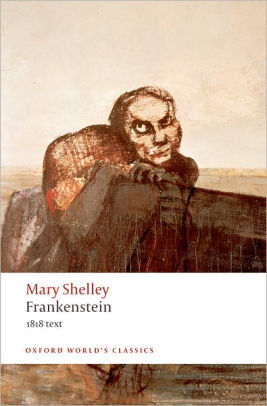
The panelists will be focusing on the original 1818 version of the novel, rather than the later 1831 edition – and discussing some of the differences between the two. You can find the Oxford edition of the original at the Stanford Bookstore, Kepler’s in Menlo Park, and Bell’s Books in Palo Alto. (But don’t worry if you’ve read a different edition!)

The Another Look book club takes on short classics that have been forgotten, neglected, or overlooked—or may simply not have received the attention they merit. The selected works are short, in order to encourage the involvement of Bay Area readers whose time may be limited. Subscription at anotherlook.stanford.edu is encouraged for regular updates and details on the selected books and events.

All Another Look events are free and open to the public – and please bring your friends!