Happy birthday, Jane Austen! Here’s how she’s like the Beatles.

Share

austenLos Angeles poet (and Stanford alum) Timothy Steele celebrates Jane Austen’s birthday today. Let’s join him:

If any writer put in the work, it was Jane Austen, who was born on this day in 1775. From age 11, she wrote tirelessly, trying out different genres and styles, coming at her subjects from every conceivable angle. But she didn’t break into print until she was 36, and her career as a published author was compressed into the six years between 1811 and her death in 1817. She may remind us of the Beatles, who spent countless hours rehearsing and performing in clubs, and then burst on the scene in 1962 and ran the table for eight glorious years before breaking up. Another parallel between Austen and her musical countrymen is that both drew heavily on available models while producing work that was utterly fresh and magical—work that sounded, as Ray Charles said of the Beatles, like nothing you’d heard before. (The Beatles absorbed such influences as R&B, the skiffle craze, music hall standards, Chuck Berry, and Brill Building Pop, while Austen synthesized the psychological intimacy of Samuel Richardson, the clever satirical plotting of Henry Fielding, and the watchfulness of Fanny Burney.)

Discerning readers recognized immediately that Austen had enlarged and transformed English fiction. Walter Scott, the reigning king of the novel, confided to his diary, “That young lady has a talent for describing the involvements and feelings and characters of ordinary life, which is to me the most wonderful I ever met with.” He added, “The big Bow-Wow strain [the novel of adventure] I can do myself like any now going; but [she has] the exquisite touch which renders ordinary common-place things and characters interesting from the truth of the description and the sentiment.”

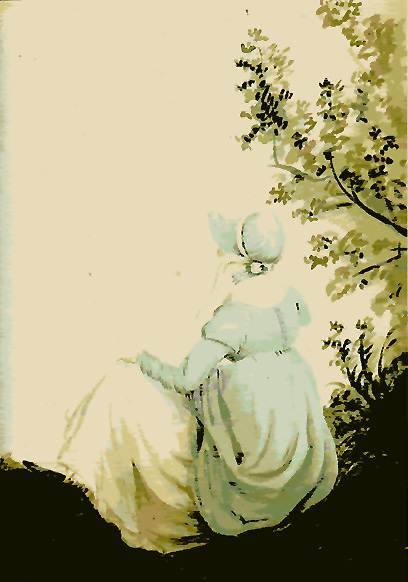
Happy, birthday, Jane! (At right, a watercolor of Jane, at the age of 28 or 29, by her sister Cassandra.)

Best Christmas carol ever? Christina Rosetti’s “In the Bleak Midwinter”

Share

A guest post from Los Angeles poet (and Stanford alum) Timothy Steele, on a Christmas theme:

tim120

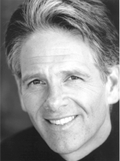
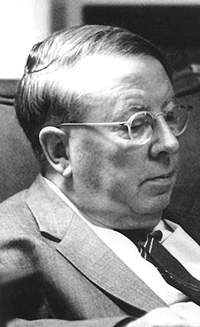
Tim Steele

When in 2008 the BBC asked choirmasters in the United Kingdom and United States to name their favorite Christmas carol, Harold Darke’s setting of Christina Rossetti’s “In the Bleak Midwinter” topped their list. The poem first appeared in 1872 in a holiday issue of Scribner’s Monthly, which had asked Rossetti for a contribution appropriate to the season. Though she never collected the poem in a book, her brother William included it in the edition of her Poetical Works that he published in 1904, ten years after her death. The poetry-loving Gustav Holst recognized the poem’s choral possibilities and in 1906 did a setting of it that some prefer to Darke’s, which dates from 1911.

rosetti1

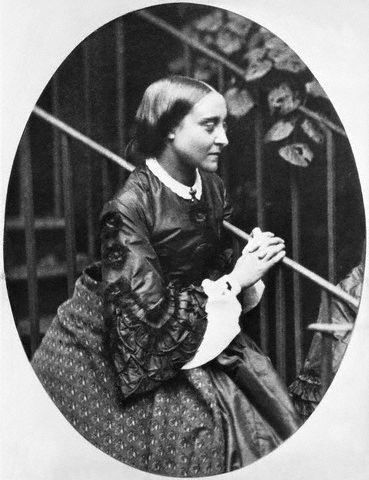
She was troubled. (Photo: Lewis Carroll)

For all its lovely directness, “In the Bleak Midwinter” reflects Rossetti’s troubled religious faith. An Anglo-Catholic influenced by Calvinism and Adventism, she found God the Father terrifying and remote but identified with the humanity and suffering of Jesus. In describing the nativity, she mentions the attendant celestial spirits but stresses the earthier elements of the scene—the tangible milk and love that Mary gives her child and the comforting companionship of the animals in the stable. This attraction to natural manifestations of divinity may remind us of Emily Dickinson, who was Rossetti’s nearly exact contemporary and of whose work Rossetti was an early champion. (Both poets were born in the bleak, midwintery December of 1830—Rossetti on the 5th, Dickinson on the 10th—though Dickinson died in 1886, eight years before Rossetti.)

Below is the text of Rossetti’s carol, plus a performance of it in Darke’s setting.

“A Christmas Carol”

In the bleak mid-winter
Frosty wind made moan,
Earth stood hard as iron,
Water like a stone;
Snow has fallen, snow on snow,
Snow on snow,
In the bleak mid-winter
Long ago.

Our God, Heaven cannot hold Him
Nor earth sustain;
Heaven and earth shall flee away
When He comes to reign:
In the bleak mid-winter,
A stable-place sufficed
The Lord God Almighty
Jesus Christ.

Enough for Him whom cherubim
Worship night and day,
A breastful of milk
And a mangerful of hay;
Enough for Him whom angels
Fall down before,
The ox and ass and camel
Which adore.

Angels and archangels
May have gathered there,
Cherubim and seraphim
Throng’d the air,
But only His mother
In her maiden bliss,
Worshipped the Beloved
With a kiss.

What can I give Him,
Poor as I am?
If I were a shepherd
I would bring a lamb,
If I were a wise man
I would do my part,—
Yet what I can I give Him,
Give my heart.

– Christina Rossetti (1830 – 1894)

Happy birthday to Oliver Goldsmith and William Hogarth! A few words from poet Tim Steele on the occasion.

Share
tim120

Birthday boy.

More birthday news comes to us via our learned friend, the Los Angeles poet Timothy Steele, this time on the double birthday today of poet Oliver Goldsmith and painter William Hogarth. He enjoined us to celebrate Virgil’s 2,085 a few weeks ago. Here’s what he has to say on today’s occasion:

Other poets may have been more celebrated for their art and scope, but none was more trusted, as Samuel Johnson noted, than Oliver Goldsmith, whose birthday is today. Though Goldsmith repeatedly burned through large sums of money, friends and associates rarely failed to advance him funds whenever he requested loans. As a result, he died £2,000 in debt, a remarkable figure for somebody of his era and modest background.

hogarth

Still stooping to folly, all these years later.

Paradoxically, he wrote acutely about economics, and historians of that subject still cite the lines in “The Traveller” about income inequality (“should one order disproportion’d grow, / Its double weight must ruin all below”) and the passage in “The Deserted Village” about the effect of land enclosures on small farmers (“Ill fares the land, to hast’ning ills a prey, / Where wealth accumulates, and men decay,” etc.). Goldsmith’s lyric poems include Olivia’s song from “The Vicar of Wakefield:

When lovely woman stoops to folly,
And finds too late that men betray,
What charm can soothe her melancholy,
What art can wash her guilt away?

The only art her guilt to cover,
To hide her shame from every eye,
And give repentance to her lover,
And wring his bosom—is to die.

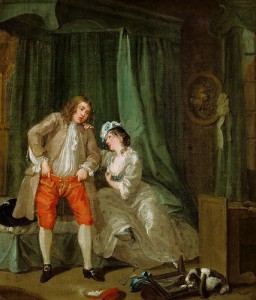
At right is “After the Seduction,” a painting by William Hogarth, another great eighteenth-century satirist whose birthday is today.

“One of the most significant short novels in English”: Janet Lewis and The Wife of Martin Guerre, Feb. 20 event

Share

She loved to travel. (Photo: “The Selected Poems of Janet Lewis,” used by permission of Ohio University Press)

NOTE:  Some of you may remember the launch of the Another Look book club last fall – I wrote about it here and here and here.  This season’s pick is another winner:  Janet Lewis‘s 104-page The Return of Martin Guerre, a novel that was, in fact, born at Stanford.  As I wrote in an article here, it all began with a terrible scandal in 1933.  From the “Another Look” website:

In May 1933, a Stanford University Press sales manager was arrested for the murder of his wife at their campus home on Salvatierra Street.

Was it murder or accident? Placid Palo Alto was embroiled in a sensationalized scandal that endured for more than three years. After conviction, appeals and retrials, David Lamson was finally acquitted.
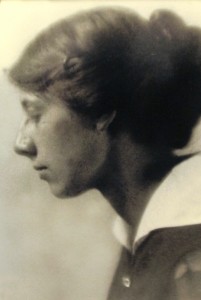
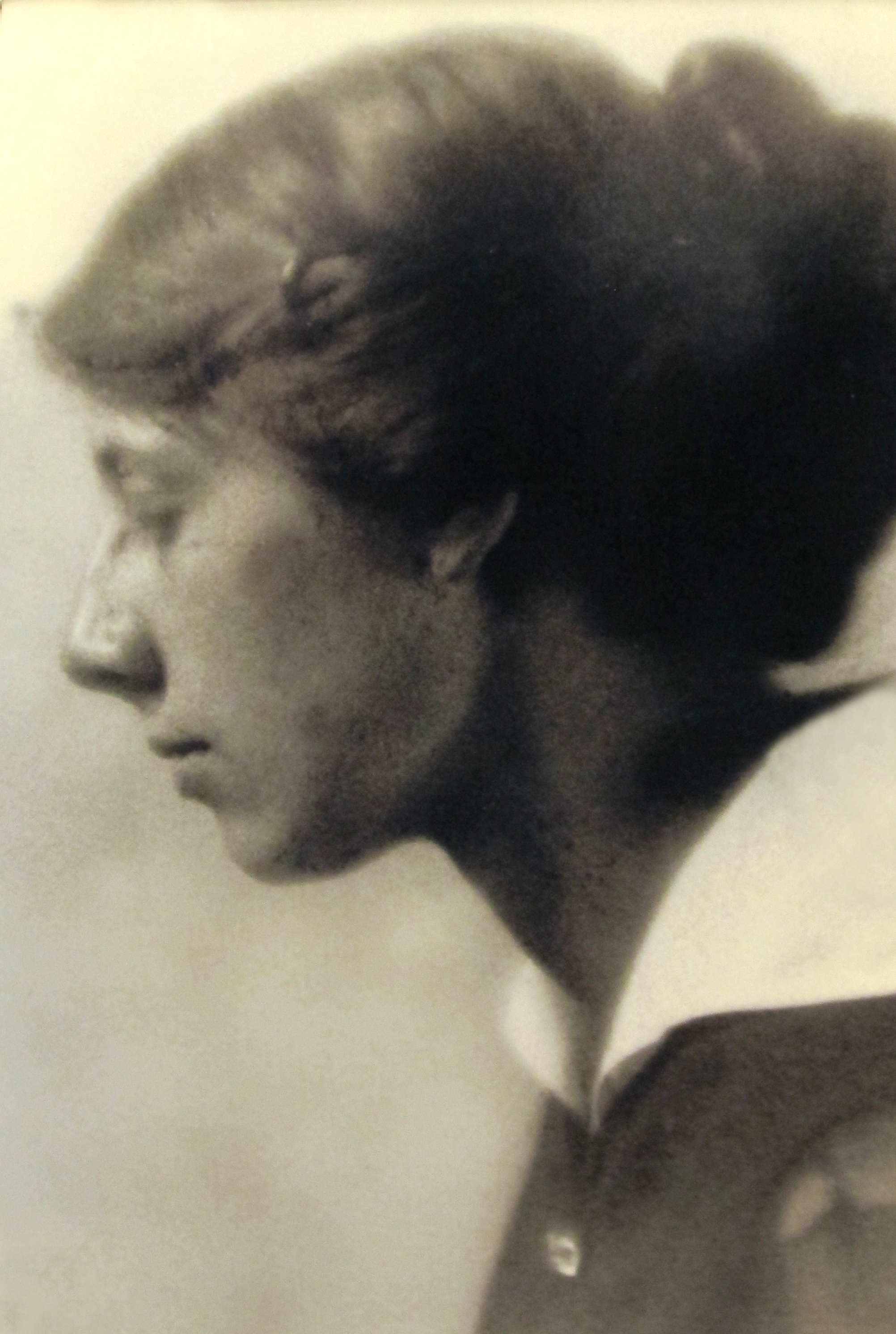
Young Janet (Courtesy Melissa Winters)

One of the unlikelier outcomes of the notorious case: three distinguished novels by Stanford poet Janet Lewis, focusing on historical trials that had been swayed by circumstantial evidence. The most famous was The Wife of Martin Guerre (1941), which eventually became the subject of an opera, a play, several musicals and a film. Atlantic Monthly called it “one of the most significant short novels in English.”

The book will be the focus of the second “Another Look” book club event at 7:30 p.m. Wednesday, Feb. 20, at the Stanford Humanities Center’s Levinthal Room. The event will be moderated by English Professor Kenneth Fields, who was a friend of the late Janet Lewis (1899-1998) and her husband, renowned poet-critic and Stanford professor Yvor Winters (1900-68).  

Fields will be joined by acclaimed novelist Tobias Wolff and award-winning Irish poet Eavan Boland, both professors of English. An audience discussion will follow. The community event is free and open to the public, but seating is limited and available on a first-come basis.

Winters’ role in the Lamson case was legendary: Outraged at the injustice, he actively campaigned for Lamson’s acquittal and helped prepare the defense brief. With a colleague, Winters provided a cogent 103-page pamphlet for public consumption, explaining why Lamson could not have killed his wife in the manner required by the prosecutor’s case.

A prescient colleague gave the Winterses a 19th-century book, Famous Cases of Circumstantial Evidence, including real-life accounts of the failure of justice. Lewis was struck by the 16th-century story of Martin Guerre and his wife, Bertrande de Rols.

Guerre abandoned his family and returned eight years later a changed man – or did he? Was he Martin Guerre at all? The case of imposture wracked southwestern France, just as Palo Alto had been roiled by the Lamson case.
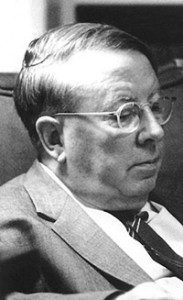
Outraged … and right.

According to the New York Times, “Miss Lewis pursued a literary life in which the focus was on the life and the life was one of such placid equilibrium and domestic bliss that she had to reach deep down in her psyche – and far back in the annals of criminal law – to find the wellspring of tension that produced some of the 20th century’s most vividly imagined and finely wrought literature.”

But for Lewis, The Wife of Martin Guerre was also born of her love for France. Lewis had been a French major at the University of Chicago. According to her friend, poet Helen Pinkerton, Lewis’ passion for the country began in 1920. For her graduation, her father gave her a round-trip ticket to Europe and $400. Lewis got a job with the passport office on Rue de Tilsitt, behind the Arc de Triomphe, and stayed for nine memorable months. She returned with a John Simon Guggenheim fellowship in 1950.

There was another reason for Lewis’s novels and short stories: Lewis was a gifted poet, but her prose brought more money than verse – and the Winters family of four needed the extra cash. In pre-war days, academia was still something of a gentlemen’s profession, with many professors holding independent incomes.

Moreover, colleagues who had been riled by Winters’ pugnacious opinions delayed his promotion to a full professorship until he was 50 years old – although he went on to get an endowed chair, a Bollingen Prize, a National Institute of Arts and Letters award as well as grants from the Guggenheim Foundation and the National Endowment for the Arts.

David Levin, writing in 1978, recalled that the Lewises “lived in extraordinary simplicity”: “The plain furniture in their small house in Los Altos did not change in all the years of our association, and Winters drove a 1950 Plymouth Suburban from 1949 until he stopped driving in the year before his death,” he wrote.

Her friends describe the Winterses devotion to their Airedale terriers, their cooking and their gardening in the Los Altos house they’d assumed in 1934 and never left.
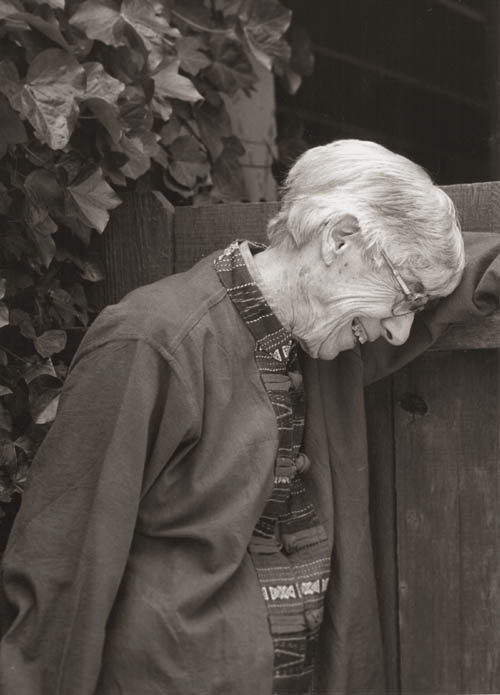
The poet in her 90s. (Photo: Brigitte Carnochan)

Lewis nevertheless made time for her writing – and perhaps the externally uneventful life contributed to the celebrated psychological poise. The British poet Dick Davis wrotein London’s Independent: “Her books possess a quality of deep repose, a kind of distilled wisdom in the face of human disaster and pain, which is difficult to describe and impossible to imitate, but which, once encountered, is unforgettable.”

Lewis has never been short of admirers: W.H. Auden, Marianne Moore, Theodore Roethke, Louise Bogan and others praised her work. Yet writer Evan Connell observed, “I cannot think of another writer whose stature so far exceeds her public recognition.”

In the years since her death, her reputation has been fostered by a circle of friends, including Los Angeles poet and Stanford alumnus Timothy Steele, who praised her poems for their “clear-sightedness” and “intelligent warmth.”

“They’re full of joy and sorrow. It’s very directly stated. No evasiveness. She doesn’t hide behind ironic postures or anything like that,” he said. “She is someone who has both a sense of the permanent patterns of existence and the transitory beauty of living things, of people and animals and plants.”

Steele recalled, in particular, a party on a summer day at the home of Helen Pinkerton and her then-husband, English Professor Wesley Trimpi. “Among the guests was [political philosopher] Eric Voegelin. He was brilliant, wearing a three-piece suit and discoursing very eloquently about Plato,” remembered Steele. “Janet appeared and said happily, ‘Does anyone want to go for a swim?’

“It seemed such a contrast – a rewarding experience in both cases. She was so vital and connected with physical activity and the warm summer afternoon.”

In any case, Lewis didn’t wait for a reply, but headed for the cabana and changed into her swimsuit for a quick dip. She was well into her 80s.

Ease, effervescence, and endless verse

Share

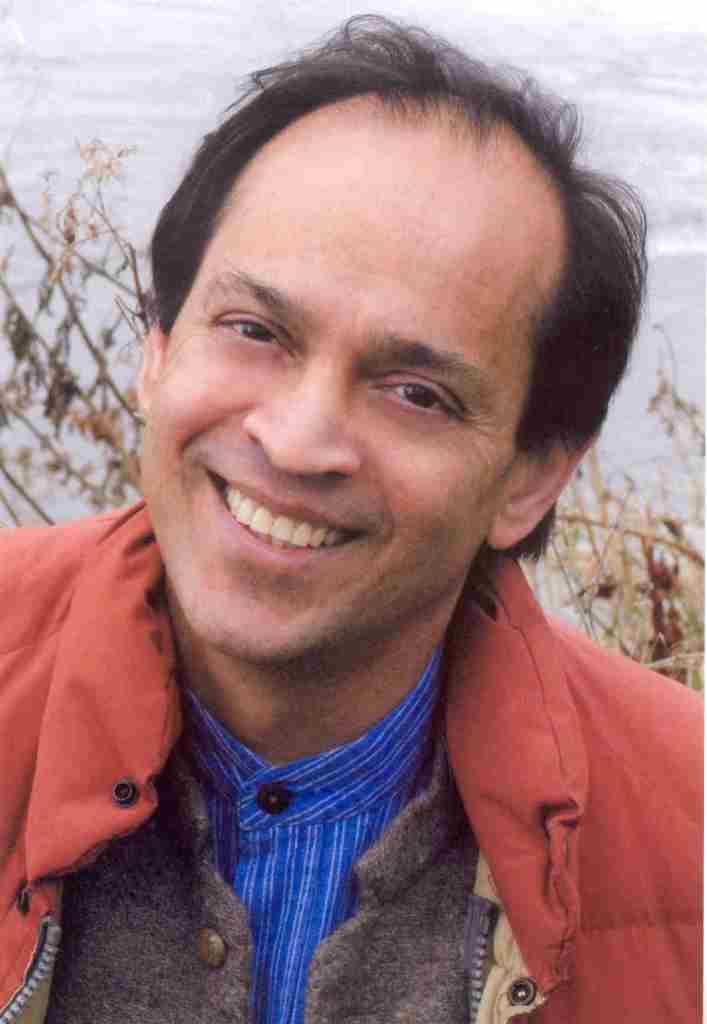
A few days ago, I wrote about near-forgotten novel-in-verse, The Golden Gate by Vikram Seth — and was surprised to learn that an acquaintance actually bought the book on the strength of my reportage. Such, such is the power of the word.  So let me have another go at it.  Who knows?  Maybe I’ll sell three.

In citing Gore Vidal‘s encomium, however, I somehow neglected the one below it, by his fellow poet, the late James Merrill:  “Mr. Seth’s beautifully conventional characters would self-destruct on the page of any prose fiction.  But his verse sets them glowing from within, and the result is as humanly poignant as it is mechanically reassuring — in short, a cause for rejoicing.”  So true.  And a large reason why I found it, despite its slight and commonplace characters, so much more satisfying than his novels.  The verse sustains them.  Power of the word, etc.

Here’s another strong reason why the 1986 book is so much fun:  Nothing keeps happening.  It brings to mind what Somerset Maugham said about Jane Austen: “Nothing very much happens in her books and yet, when you come to the bottom of a page, you eagerly turn it to learn what will happen next.  Nothing very much does and again you eagerly turn the page. The novelist who has the power to achieve this has the most precious gift a novelist can possess.”

Take this, for example, a random sonnet early in the book, while John waits in a San Francisco Chinese restaurant for his sculptor friend Janet Hayakawa:

John thinks, “It’s not that I’m fastidious. …
I wish they’d turn that music down.  …
It’s gross. That calendar is hideous …
(He stares at a distasteful clown.)
… I’ve waited half an hour, blast her!”
Her hands encased in clay and plaster,
Janet arrives at twelve to two:
“So sorry, John, I had to do
This torso. Yes I tried to hurry.
I’m glad you’ve got yourself a beer.
What’s that? Tsingtao? Don’t look severe.
I didn’t mean for you to worry.
You’ve ordered? No? This place is fun!
What’ll you have? It’s family-run.”

Seth’s miraculous gift for playfulness and delight in meter and rhyme overwhelmed his Stanford class, I’m told.  One participant confided that the kids puzzled over the phrasing in one of his poems, till they realized he had rhymed all the first words in the lines, as well as the last.  One begins to understand how he might be able to write verse at a staggering 600 lines a month for over a year.

In The Golden Gate, his effervescence and ease brims over so thoroughly that he puts his dedication, author’s note, acknowledgments, and even his table of contents into Pushkin’s fleet, four-footed sonnets.  I wonder how many people understand his dedication:

Veracity and vim

So here they are, the chapters ready,
And, half against my will, I’m free
Of this warm enterprise, this heady
Labor that has exhausted me
Through thirteen months, swift and delightful,
Incited by my friends’ insightful
Paring and prodding and appeal.
I pray the gentle hands of Steele
Will once again sift through its pages.
If anything in this should grate,
Ascribe it to its natal state;
If anything in this engages
By verse, veracity, or vim,
You know whom I must credit, Tim.

The mentor he credits is Los Angeles poet Timothy Steele, author of several collections of verse, and a prosody scholar as well, with his Missing Measures and All the Fun’s in How You Say a Thing.  Tim also edited the Poems of J.V. Cunningham, a kind of homage to the poet who weds emotional intensity to stylistic purity — and who was a major influence for Tim at Stanford.  Tim is also the subject of my third-of-a-book interview, Three Poets in Conversation, where he shares space with Dick Davis and Rachel Hadas (who, incidentally, was a close friend of James Merrill.)  Years earlier, I did a shorter online interview with him for the Cortland Review.

No longer on P.S.T.

Here’s Seth’s author’s note:

The author, Vikram Seth, directed
By Anne Freedgood, his editor,
To draft a vita, has selected
The following salient facts for her:
In ’52, born in Calcutta.
8 lb. 1 oz.  Was heard to utter
First rhymes (“cat,” “mat”) at age of three.
A student of demography
And economics, he has written
From Heaven Lake, a travel book
Based on a journey he once took
Through Sinkiang and Tibet. Unbitten
At last by wanderlust and rhyme,
He keeps Pacific Standard Time.

That last lines lie — when I interviewed him a decade ago, he was dividing his time between London and Calcutta.  Wanderlust had bitten again.

Update: Triumph!  Frank Wilson of Books Inq said this morning he is getting a copy of Golden Gate after what he purports is a vacation out in the hinterlands!  That makes two copies sold.  Any other takers?