
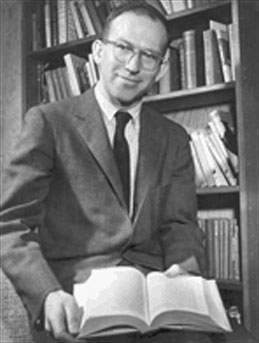
Happy birthday to poet Edgar Bowers! He thought “intelligence and sympathy” would save the world.

Share

edgar-bowers3Los Angeles poet Timothy Steele has another birthday post (see earlier ones here and here and here). This time the Stanford alum is appreciating another Stanford alum, the under-recognized Edgar Bowers:

Born in Rome, Georgia, on March 2, 1924, Edgar Bowers served in Europe in the Second World War with the Army’s Counter Intelligence Corps. After Germany surrendered to the Allies, he was posted to Hitler’s alpine retreat in Berchtesgaden, where he headed a unit of the “De-nazification” program, whose goal was to identify individuals and groups responsible for atrocities committed during the Third Reich.

In his later years, Bowers came to believe that the survival of the species depended on its intelligence and sympathy, though he recognized that human knowledge is inevitably limited and that science and peace will probably never entirely overcome the forces of ignorance and war. He published five books of poetry, including a Collected Poems in 1997.

Bowers died of non-Hodgkin’s lymphoma in San Francisco in 2000.

One of Bowers’s best-known poems is “The Astronomers of Mont Blanc,” which he reads in the video below. The poem and the recording  (taken the early 1950s, when he was a graduate student at Stanford University) are reproduced with the kind permission of The Literary State of Edgar Bowers and its Executor, Joshua S. Odell.

Happy birthday, Edgar!

The Astronomers of Mont Blanc

Who are you there that, from your icy tower,
Explore the colder distances, the far
Escape of your whole universe to night;
That watch the moon’s blue craters, shadowy crust,
And blunted mountains mildly drift and glare,
Ballooned in ghostly earnest on your sight:
Who are you, and what hope persuades your trust?

It is your hope that you will know the end
And compass of our ignorant restraint
There in lost time, where what was done is done
Forever as a havoc overhead.
Aging, you search to master in the faint
Persistent fortune which you gaze upon
The perfect order trusted to the dead.

– Edgar Bowers (1924-2000)

Happy birthday to poet Edgar Bowers! He thought “intelligence and sympathy” would save the world.

Share

edgar-bowers3Los Angeles poet Timothy Steele has another birthday post (see earlier ones here and here and here). This time the Stanford alum is appreciating another Stanford alum, the under-recognized Edgar Bowers:

Born in Rome, Georgia, on March 2, 1924, Edgar Bowers served in Europe in the Second World War with the Army’s Counter Intelligence Corps. After Germany surrendered to the Allies, he was posted to Hitler’s alpine retreat in Berchtesgaden, where he headed a unit of the “De-nazification” program, whose goal was to identify individuals and groups responsible for atrocities committed during the Third Reich.

In his later years, Bowers came to believe that the survival of the species depended on its intelligence and sympathy, though he recognized that human knowledge is inevitably limited and that science and peace will probably never entirely overcome the forces of ignorance and war. He published five books of poetry, including a Collected Poems in 1997.

Bowers died of non-Hodgkin’s lymphoma in San Francisco in 2000.

One of Bowers’s best-known poems is “The Astronomers of Mont Blanc,” which he reads in the video below. The poem and the recording  (taken the early 1950s, when he was a graduate student at Stanford University) are reproduced with the kind permission of The Literary State of Edgar Bowers and its Executor, Joshua S. Odell.

Happy birthday, Edgar!

The Astronomers of Mont Blanc

Who are you there that, from your icy tower,
Explore the colder distances, the far
Escape of your whole universe to night;
That watch the moon’s blue craters, shadowy crust,
And blunted mountains mildly drift and glare,
Ballooned in ghostly earnest on your sight:
Who are you, and what hope persuades your trust?

It is your hope that you will know the end
And compass of our ignorant restraint
There in lost time, where what was done is done
Forever as a havoc overhead.
Aging, you search to master in the faint
Persistent fortune which you gaze upon
The perfect order trusted to the dead.

– Edgar Bowers (1924-2000)

Happy firthday to the mixed-up guy who invented Spoonerisms!

Share

tim120Another birthday tribute from Los Angeles poet, scholar, and friend Timothy Steele. Collect the whole set here and here and here and here, among other places. Meanwhile, today’s birthday boy:
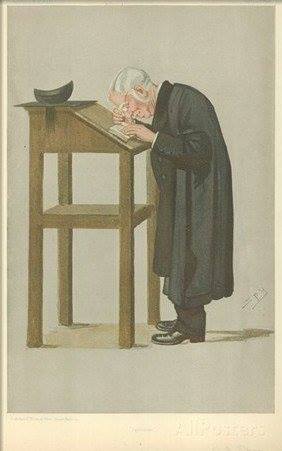
Born on this day in 1844, William Spooner was for many years Dean and Warden of New College, Oxford. He became so famous for transposing the initial sounds of words that we now refer to such slips of the tongue as “Spoonerisms.” Errors attributed to him include an offer of assistance to a foot-weary acquaintance (“May I sew you to a sheet?”); a reproach of a lackadaisical student (“You have tasted a whole worm!”); a description of his favorite means of transportation (“a well-boiled icicle”); directions from Oxford to London (“Leave by the town drain”); and reassuring words about Providence (“Our Lord is a shoving leopard”).

spoonerThough some gems associated with Spooner are doubtless apocryphal, he does seem to have been almost congenitally disposed to mixing things up. He once spilled salt on a tablecloth and immediately poured claret over it. Giving guests a tour of his college, he warned them that a staircase they were about to descend was badly lit, then switched off the weak lighting, and led them down into total darkness. Also, he suffered from albinism, so his eyesight was poor. Reading lectures was a challenge, and he naturally mangled the text from time to time. It was reportedly during a formal address to farmers that he called them “noble tons of soil,” and it was during a speech before Queen Victoria that he said, “Which of us has not felt in his heart a half-warmed fish.”

When he died in 1930, Spooner was remembered not only for his eccentricities but also for his long and fruitful marriage (depending which account you read, he and his wife produced five or seven children), for his able administration of New College, and for his devotion to his students. Among the latter, Leonard Woolley (“Woolly of Ur”) recalled how, when he was young and clueless, Spooner convinced him to become an archeologist. Spooner had long been aware of his reputation, and his friends sometimes detected a subversive wit in his odd expressions, as in his remark to a colleague: “Your book fills a much needed gap.”

So hail, Dr. Spooner! It’s your Firthday on Basebook! (At right, is Leslie Ward’s 1898 caricature of Spooner for Vanity Fair.)

“Death is so plain!” Remembering Thom Gunn on the anniversary of his death.

Share

gunn1

tim120I’ve been thinking about San Francisco poet Thom Gunn in the last few days, for reasons I won’t get into. But perhaps a subliminal one is worth mentioning: he died on this day, twelve years ago. I was, to my best knowledge, the last person to interview him at his flat in the City, in a Q&A published in The Georgia Review – not online, alas. 

He was apparently on L.A. poet’s Tim Steele’s mind, too. Both poets are alums of Stanford’s English Department and its Creative Writing Program. Gunn studied with the legendary Yvor Winters while at Stanford; Tim was a Jones Lecturer. 

Tim remembers one of Thom Gunn’s many fine poems on this sad anniversary:

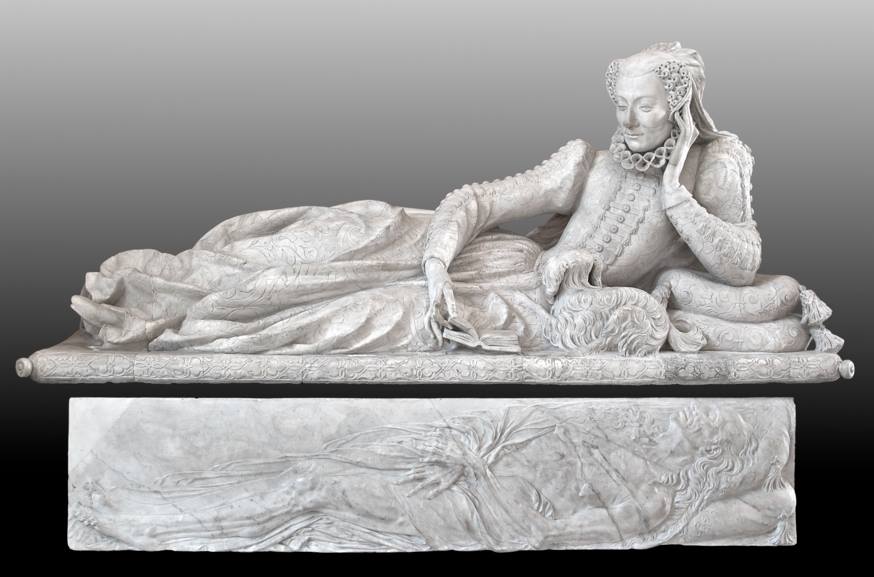
gunn3Thom Gunn died on April 25, 2004. A wonderful elegist, he also wrote with memorable affection about domestic animals, and these gifts come together in “Her Pet.” As he indicates in a video clip (below), he composed the poem when, during the AIDS crisis, he was reading Michael Levey’s “High Renaissance” and came across a reproduction of Germain Pilon’s sarcophagus for Valentine Balbiani (1518-1572) that resonated with own experiences of seeing friends die in the epidemic.
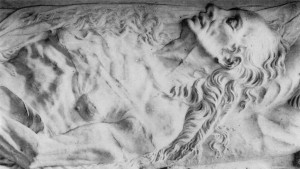
The Balbiani sarcophagus is an example what Erwin Panofsky calls “the double-decker tomb.” On the top of the tomb, Pilon depicts the reclining figure of Valentine as she was in life. Below, on the side of the tomb, he renders her as she was after she died.

Contracts concerning the sarcophagus survive, and they call not only for this double depiction of Valentine, but also for her being accompanied by “a little dog of marble, made as naturally as possible.” Dogs often appear on tombs, but generally at the feet of the deceased and chiefly as symbols of fidelity. In this case, however, the dog was an effigy of a real companion of the subject, and according to contemporary accounts, it died of sorrow three days after its mistress did.

gunn2Writing about the sarcophagus, Gunn imitates its appearance by devising a double sonnet. The first sonnet—the upper one—describes the portion of the tomb that shows Valentine alive. The second sonnet describes the side-relief of her in death. Below is the text of “Her Pet,” along with the two images of the tomb reproduced in Levey’s book. The video clip of Gunn’s reading of the poem is from a 1994 appearance at the Lannan Foundation in Los Angeles.
“Her Pet”

I walk the floor, read, watch a cop-show, drink,
Hear buses heave uphill through drizzling fog,
Then turn back to the pictured book to think
Of Valentine Balbiani and her dog:
She is reclining, reading, on her tomb;
But pounced, it tries to intercept her look,
Its front paws on her lap, as in this room
The cat attempts to nose beneath my book. …

[Well, copyright laws forbid us to do more. Listen to the rest below…]

Postscript on 4/26 from Tim Steele: “I well remember your Georgia Review interview with Thom. It brought many characteristic flashes of his insight. I also recall his comparing, in his conversation with you, Yvor Winters’s influence on him to his mother’s influence on him. (This appeared in your Stanford Magazine piece on Thom, I believe.) That’s an incredibly revealing and touching comment. People often think of Winters as a formidable father figure, and he may have been that for Thom to some extent. But Thom also saw Winters as a nurturing, supportive, literature-loving figure, just as his mother had been.”

Happy birthday to the bad boy of Roman poetry!

Share

tim120More birthday greetings from our correspondent, the Los Angeles poet (and Stanford alum) Timothy Steele. This time the occasion is the birthday of Ovid. Tim has offered occasional salutations to Virgil, Marcel Proust, Jane Austen, George Frideric Handel, Christina Rosetti, William Hogarth and Oliver Goldsmith. And we have written about Ovid here and here and here and here and here.

But the years roll round again relentlessly offering us another occasion to celebrate the author of Metamorphoses – and Tristia, too.

This Sunday marks the birthday of Ovid, the bad boy of Roman poetry. Born in 43 BCE, he reports in his Tristia that versing came naturally to him even as a child. His masterpiece, “Metamorphoses,” is a tour de force that knits together, by the recurring motif of transformation, myths and legends from the origin of the world up to the time of Julius Caesar. Though Ovid did not invent the stories, he recounted them with unforgettable psychological vividness and gave them their definitive form. No other poem has had a greater influence on subsequent art. Sculptors, painters, composers, novelists, and poets have drawn on it for centuries.

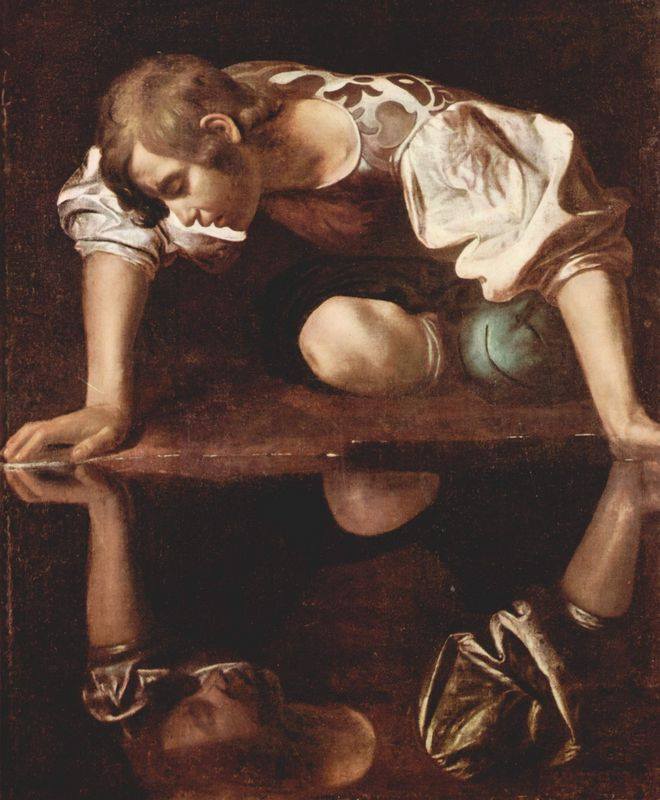
narcissusIn his own day, Ovid was immensely popular, but, unluckily, the emperor Augustus was not a fan. A libertine in youth, he metamorphosed as a ruler into a priggish defender of public morals, and he detested Ovid’s poems, which breezily treat sex and seduction and which parody conventional Roman pieties. In 8 CE he banned Ovid’s work from the state libraries and banished the poet himself to Tomis, an imperial outpost on the Black Sea notorious for its bandits and bad weather. Ovid died there in 17 CE.
Many anecdotes survive about Ovid’s genius and vanity. The Elder Seneca reports one of them in his Controversies (2.2.12): “[Ovid] was aware of his faults—and liked them. This is clear from an incident when he was asked by his friends to get rid of three of his verses; in exchange he asked that he should be allowed to make an exception of three verses which they could not touch. This seemed a fair condition. They wrote down privately the ones they wanted damned: he wrote down the ones he wanted saved. Both sheets contained the same verses. … From [this] it is clear that this talented man lacked the will rather than the taste to restrain the license of his poetry. He used sometimes to say that a face was all the more beautiful for a mole” (trans. Michael Winterbottom).

At right is a rendering of the Narcissus episode in Metamorphoses executed by the great bad boy of Italian painting, Michelangelo Merisi da Caravaggio.

catullus

Another bad boy

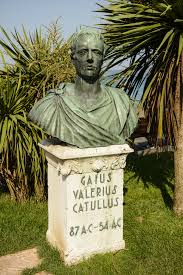
Postscript: A gentle reader wrote to ask … Isn’t Catullus the bad boy of Roman poetry? Tim replies:

“That’s a good question. Catullus is revolutionary in his sexual candor. However, his epigrams and lyrics are often bitterly realistic, and he is sometimes excruciating on the subject of his obsessive relationship with Clodia/Lesbia. His ultimate disillusionment with his passion for her is the opposite, it seems to me, of licentious. (Catullus was also very well-born and a friend of Caesar’s, who evidently admired his work.)

“Ovid, on the other hand, really is naughty. The Art of Love is virtually a vade mecum for adulterers. And in theMetamorphoses he presents (with great relish) the Greco-Roman gods and goddesses as pathologically vindictive, sensual, or deceptive. This isn’t to say Ovid can’t be poignant and moving, as in the tale of Baucis and Philemon or Pythagoras‘s powerful speech in favor or vegetarianism near the end of the poem.”

And then, courteous gentleman that he is, Tim thanked the reader for raising the point.

Happy 331st birthday, George Frideric Handel!

Share

tim120Always a pleasure to hear from our friend, the Los Angeles poet (and Stanford alum) Timothy Steele. Today he celebrates the birthday of Handel – a passion we both share, apparently. We’ve posted Tim’s birthday announcements here and here and here and here. Here’s what he had to say about the great composer:
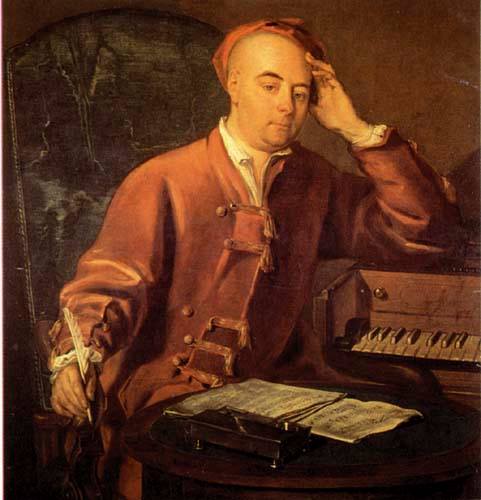
Like many composers, George Frideric Handel (1685-1759) sometimes found himself at odds with those who performed his music. On occasion, exasperation got the better of him, as in his collaboration with the gifted but capricious soprano Francesca Cuzzoni. One day during rehearsals at the King’s Theatre, Haymarket for Handel’s opera Ottone, she announced she didn’t like the “Falsa imagine” aria and told him to write another in its place. Handel seized her around the waist and swore he’d throw her out the window unless she sang what he’d written. (She did, and the aria became one of her signature hits.)

handel

He kept his temper … usually…

Usually, however, Handel kept his temper and bore his trials with ironical wit. When, prior to the opening of “Flavio,” the tenor Alexander Gordon objected to Handel’s harpsichord accompaniment and threatened to jump up into the instrument and smash it, Handel replied that he liked that idea and that they should use it in advertising the show, since more people would come to see Gordon jump than to hear him sing. On another occasion, Handel conducted a concert in Dublin featuring the violin virtuoso Matthew Dubourg. During one number, DuBourg tore off on a wild rambling solo. When he concluded, Handel, who had been marking time with orchestra, cheerily called out, “Welcome home, Mr. DuBourg!”

Welcome home, Mr. Handel! It’s your 331st birthday!

Above, Philippe Mercier’s portrait of the composer, around age 45, at his (unsmashed) harpsichord. Below, soprano Rosa Mannion’s lovely rendition of “Falsa Imagine” in a modern context.