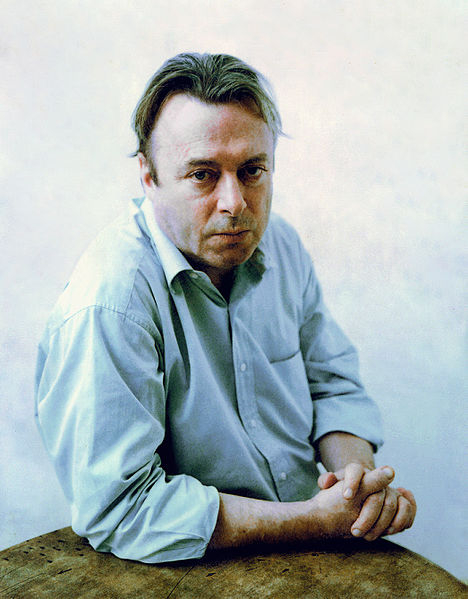
An anniversary passed yesterday, the sixth year after the death of author, essayist, and journalist Christopher Hitchens. It’s not an event the Book Haven normally observes, but some in our circle do – mutual friend Steve Wasserman among them, and a few others who no doubt would raise a glass if they were here. The late poet and historian Robert Conquest (we’ve written about him here and here) was a close colleague. Some of Hitchens’s aficionados, whether they knew him or not, go so far as to call December 15 “Hitchmas” – there’s even a website for the celebrations here.
The title is catchy, but surely Hitchens himself would have scoffed at the implications of any “mass” in his honor. In any case, he hated Christmas (i.e., “Christ’s mass”) which he likened to “living for four weeks in the atmosphere of a one-party state” that “imposes a deadening routine and predictability.” Ah, but variation within custom is what makes all rituals memorable and moving – whether weddings, funerals, graduations, or holidays. It’s a delicate art. (See how fellow atheist Salman Rushdie celebrates here.)
You see? We are still arguing with him, even in absentia. While Hitchens is not a demigod to us, and while we are far from embracing all his views (indeed, who could embrace them all?), we nevertheless revere his eloquence, his frankness, his pugnaciousness, the fluency of his pen, his tenacity to what he held to be truth – and so we, too, raise a glass to him. How, after all, can one argue with this: “Never be a spectator of unfairness and stupidity. Seek out argument and disputation for their own sake; the grave will supply plenty of time for silence.”
In this case, we have help in our fête. Paul Holdengräber of the New York Public Library has an undated commemorative post over at the Wild River Review, which includes a two-minute clip of his interview with the author and journalist, three days before he became gravely ill in 2010. The two discuss death, dying, and a mutual interest in obituaries. (The full hour-and-a-half interview at the NYPL is here.)
“I was particularly taken not by the politics, which everyone knew and though of interest, mattered less to me just then, than the literary side. Hitch was a great reader and more candid in print about his life, his mother and father, his origins,” Holdengräberwrote.
“When I played W. H. Auden reading, and Isaiah Berlin teaching a class on Russian Thought at Oxford, Christopher’s eyes lit up. He felt pleasure in reciting poetry, moving his lips to Auden’s reading, and hearing his old professor, Isaiah Berlin talk. A less pugilist side to Hitch.”
When he asked Hitchens why he wrote his memoir Hitch 22 at the relatively young age of 60, he answered simply: “You’ve got to do it in time.”
We’ve written about Steve Wasserman before – here and here and here. On Saturday, he gave the keynote address at the 17th Annual North Coast Redwoods Writers’ Conference at the College of the Redwoods, Del Norte, in Crescent City. The subject: “A Writer’s Space.” He’s given us permission to reprint his words on that occasion, and we’re delighted. Here they are:
Not long after I returned to California last year to take the helm of Heyday Books, a distinguished independent nonprofit press founded by the great Malcolm Margolin forty years ago in Berkeley, my hometown, I was asked to give the keynote speech at this annual conference. I found myself agreeing to do so almost too readily—so flattered was I to have been asked. Ken Letko told me the theme of the gathering was to be “A Writer’s Space.”
In the months that have elapsed since that kind invitation, I have brooded on this singular and curious formulation, seeking to understand what it might mean.
What do we think we mean when we say “a writer’s space”? Is such a space different than, say, any other citizen’s space? Is the space of a writer a physical place—the place where the writing is actually done, the den, the office, the hotel room, the bar or café, the bedroom, upon a desk or table or any available flat and stable surface?
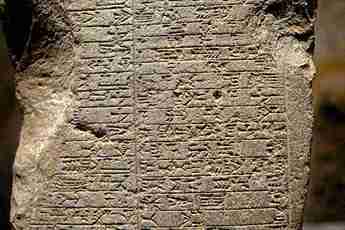
Babylonian shopping list
Or is the “writer’s space” an inner region of the mind? Or is it a psychological place deep within the recesses of the heart, a storehouse of emotions containing a jumble of neurological circuitry? Is it the place, whether physical or spiritual, where the writer tries to make sense of otherwise inchoate lives? In either case, is it a zone of safety that permits the writer to be vulnerable and daring and honest so as to find meaning and order in the service of story?
Perhaps it will be useful to begin at the very dawn of writing when prehistory became history. Let’s think, for a moment, about the clay tablets that date from around 3200 B.C. on which were etched small, repetitive impressed characters that look like wedge-shape footprints that we call cuneiform, the script language of ancient Sumer in Mesopotamia. Along with the other ancient civilizations of the Chinese and the Maya, the Babylonians put spoken language into material form and for the first time people could store information, whether of lists of goods or taxes, and transmit it across time and space.
It would take two millennia for writing to become a carrier of narrative, of story, of epic, which arrives in the Sumerian tale of Gilgamesh.
Writing was a secret code, the instrument of tax collectors and traders in the service of god-kings. Preeminently, it was the province of priests and guardians of holy texts. With the arrival of monotheism, there was a great need to record the word of God, and the many subsequent commentaries on the ethical and spiritual obligations of faithfully adhering to a set of religious precepts. This task required special places where scribes could carry out their sanctified work. Think the Caves of Qumran, some natural and some artificial, where the Dead Sea Scrolls were found, or later the medieval monasteries where illuminated manuscripts were painstakingly created.
First story
Illiteracy, it should be remembered, was commonplace. From the start, the creation of texts was bound up with a notion of the holy, of a place where experts—anointed by God—were tasked with making Scripture palpable. They were the translators and custodians of the ineffable and the unknowable, and they spent their lives making it possible for ordinary people to partake of the wisdom to be had from the all-seeing, all-powerful Deity from whom meaning, sustenance, and life itself was derived.
We needn’t rehearse the religious quarrels and sectarian strife that bloodied the struggle between the Age of Superstition and the Age of Enlightenment, except perhaps to note that the world was often divided—as, alas, it still sadly is—between those who insist all answers are to be found in a single book and those who believe in two, three, many books.
The point is that the notion of a repository where the writer (or religious shaman, adept, or priest) told or retold the parables and stories of God, was widely accepted. It meant that, from the start, a writer’s space was a space with a sacred aura. It was a place deemed to have special qualities—qualities that encouraged the communication of stories that in their detail and point conferred significance upon and gave importance to lives that otherwise might have seemed untethered and without meaning. The writer, by this measure, was a kind of oracle, with a special ability, by virtue of temperament and training, to pierce the veil of mystery and ignorance that was the usual lot of most people and to make sense of the past, parse the present, and even to predict the future.
A porous epidermis
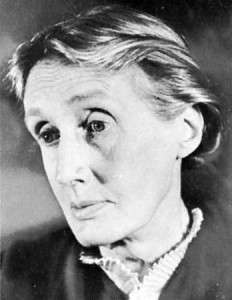
This idea of the writer was powerful. It still is. By the time we enter the Romantic Age, the notion of a writer’s space has shed its religious origins without abandoning in the popular imagination the belief that writers have a special and enviable access to inner, truer worlds, often invisible to the rest of us. How to put it? That, by and large, artists generally, of which writers are a subset, are people whose epidermises, as it were, are more porous than most people’s. And thus they are more vulnerable, more open to the world around them, more alert, more perspicacious. Shelley put it well when he wrote that, “Poets are the unacknowledged legislators of the world.” Think Virginia Woolf.
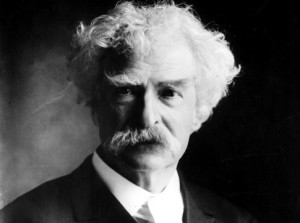
By the end of the nineteenth century, writers in their person and in their spaces are widely celebrated and revered, imbued with talents and special powers that arouse admiration bordering on worship. It is said that when Mark Twain came to London and strode down the gangplank as he disembarked from the ship that had brought him across the Atlantic, dockworkers that had never read a single word of his imperishable stories, burst into applause when the nimbus of white hair atop the head of the man in the white suit hove into view. Similarly, when Oscar Wilde was asked at the New York customs house if he had anything to declare, when he arrived in America in 1882 to deliver his lectures on aesthetics, he is said to have replied: “Only my genius.”
Applause, applause
Many writers were quickly enrolled in the service of nationalist movements of all kinds, even as many writers saw themselves as citizens in an international republic of letters, a far-flung fraternity of speakers of many diverse languages, but united in their fealty to story. Nonetheless, the space where they composed their work–their studies and offices and homes—quickly became tourist destinations, sites of pilgrimage where devoted readers could pay homage. The objects on the desk, writing instruments and inkwells, foolscap and notebooks, the arrangement of photographs and paintings on their walls, the pattern of wallpaper, the very furniture itself, and preeminently the desk and chair, favorite divan and reading sofa, lamps and carpets, all became invested with a sacredness and veneration previously reserved only for religious figures. Balzac’s home, Tolstoy’s dacha, Hemingway’s Cuban estate, are but three of many possible examples. Writers were now our secular saints.
Somehow it was thought that by entering these spaces, the key to unlocking the secret of literary creation could be had, and that by inhaling the very atmosphere which celebrated authors once breathed, one could, by a strange alchemy or osmosis, absorb the essence that animated the writer’s imagination and made possible the realization of native talent.
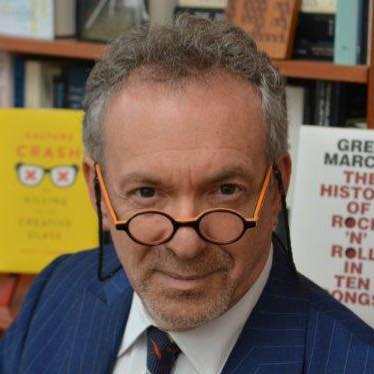
Excellent, excellent article on Steve Wasserman, one of the nation’s leading public intellectuals, this weekend at the San Francisco Chronicle. I’ve written about Steve in past posts on the Book Haven (here and here and here), and have been a big fan ever since I wrote for the Los Angeles Times Book Review during his nine-year editorship, when it was the best book review in the country, bar none. Now he heads Berkeley’s Heyday Books, after serving most recently as an editor at large for Yale University Press and even earlier stints (before LATBR) at Farrar, Straus & Giroux, Time Books/Random House literary agent with Boston-based Kneerim & Williams. He is one of the chief architects behind the successful Los Angeles Festival of Books.
The article, by Steven Winn, a former arts and culture critic for The Chronicle, begins:
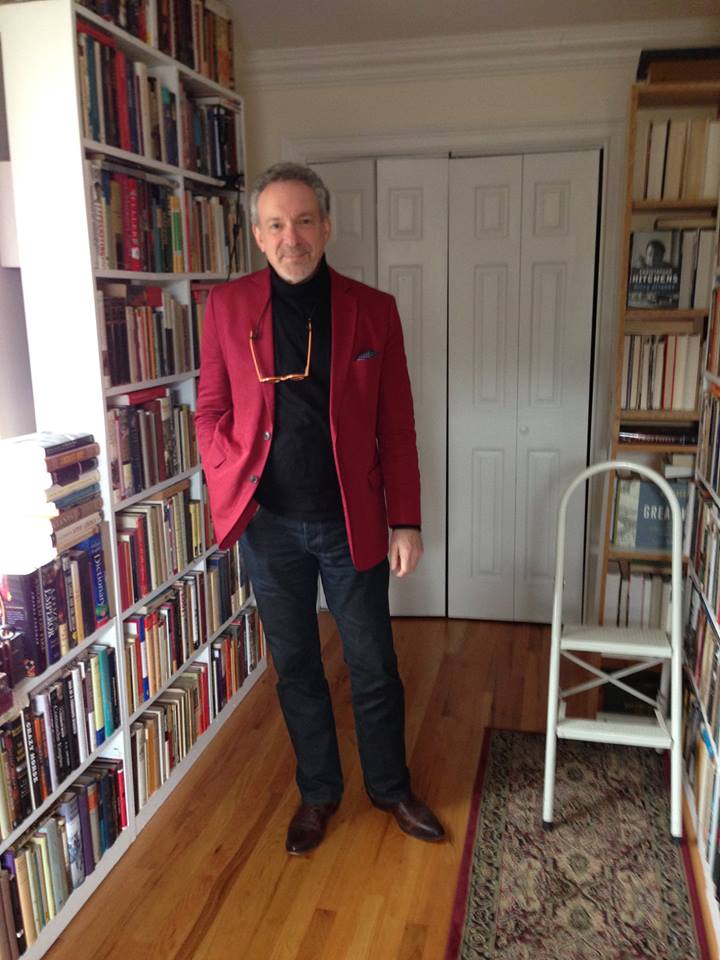
Steve with some of his books.
Books weigh heavily in the life of Steve Wasserman, the new publisher and executive director of Berkeley’s Heyday Books. So much so that when he moved from Connecticut to take the job, he shipped his 14,000-pound personal library and installed it on pristine white shelves that fill most of the wall space in the company’s warren-like offices on University Avenue.
But books, as Wasserman clearly exudes, walking a visitor through his carefully devised shelving system of some 15,000 volumes, aren’t just objects of pride and possession. They mean things, signify things in a culture that can seem indifferent if not hostile to what they embody.
“Ideas matter,” he says. “Writing well is the best revenge.”
Steve was reared in Berkeley, so his return to his roots at age 64 is fitting. A good thing for California, too: “He’s probably as knowledgeable about books and ideas as anyone alive,” said Robert Scheer, the Southern California author and journalist who has known Steven for nearly half a century. “To find someone who is both an excellent editor and agent and doesn’t feel competitive with you as a writer is very rare. He’s the total package.”
And we’d like to know a little bit more about that “carefully devised shelving system.” We could use one ourselves.
As I write, Steve Wasserman is shoveling his stuff into boxes. At least I hope he is. Steve, who has been editor at large for Yale University Press, is coming home to California at last, and it can’t happen fast enough for us. “The call of Berkeley was very strong,” he said. “I am something of a native son. I have missed California like the amputee is said to miss the phantom limb.”
The occasion is indeed one for celebration. On July 1, he will become publisher and executive director of Heyday Books, an outfit that publishes books about … California. The publishing house is situated on University Avenue in Berkeley, and you can’t get more Berkeley than that. The cover photo for his Facebook page was quickly changed to show a panorama of Berkeley, with the university’s landmark campanile. Steve grew up and went to university in this city on the Bay.
I’ve written about Steve’s time as editor of the Los Angeles Times Book for nearly a decade, a golden agewhen it was the best book review section in the country, bar none. He always had an eye for the era; for what might be relevant, rather than immediate. He was always willing to take a chance, and trusted that boldness, innovation, and intelligence would find an audience. I was proud to be a part of it.
Those traits served him well as editor at large at Yale University Press, where he “brought luster and allure to the Yale list, acquiring important books by such figures as Greil Marcus, Michael Roth, Martha Hodes, David Thomson, and David Rieff, publishing them with flair and gusto,” said John Donatich, the director of Yale University Press. “He will continue to consult with YUP, particularly editing several key authors still to be published.”
During those years also, he was a principal architect for the Los Angeles Times Festival of Books, now the largest book festival in the country.
A life in books.
At Heyday, he replaces Malcolm Margolin, who founded the company in 1974. Margolin seems pleased about the appointment, as is everyone else: “I can’t imagine anyone with better professional skills, more depth and variety of experience, and a more impressive record of accomplishment and public service. He knows California and its many cultures with intimacy, associates easily with the best writers and deepest thinkers everywhere, and his ample playfulness and wit have always been at the service of a humane social vision.”
One area he will examine is Heyday’s current distribution model. While the press publishes numerous important and beautiful books about California every year, the books are only sold in California bookstores, although they are also available online. Heyday does not have a national distributor and Wasserman does not know yet if that is because people outside the state are not interested. California as a topic is often denigrated by the East Coast, he said. Wasserman hopes to enhance Heyday’s reputation and showcase its role in interpreting California.
Steve sounds more than ready to come home and take on the new fight: “It has long been the case that California has been regarded by people who don’t live there, particularly the dyed-in-the-wool Manhattanites, who are the most provincial people in the country, as a strange backwater. Very often things California are dismissed as regional, not of national interest. Of course, all of that is rubbish. I would like to publish books that while interesting Californians, have broader resonance.”
“We couldn’t be more excited about bringing him back to California,” said Stanford alumna Emmerich Anklam (class of ’15) on the Heyday staff. “To use a favorite phrase from Steve’s predecessor Malcolm Margolin, ‘What a joy!'”
And below (pardon the blurry video quality) – this is for you, Steve.
One of the grace notes in my long career was writing for the Los Angeles Times Book Review when Steve Wasserman was its editor (I’ve written about him before here and here and here and here.) It was, at that time, the best book review in the country – the one that consistently offered the greatest number of “must-read” articles every single week. Here’s one of the things that made it terrific, in Steve’s own words:
In 1997, Penguin announced that it would publish a volume of Sor Juana Inés de la Cruz’s selected writings. Years ago, Carlos Fuentes had told me of this remarkable 17th-century Mexican nun and poet. I had never heard of her. Nor was I alone. Much of her work had yet to be translated into English, even some 300 years after her death. It was, Fuentes said, a scandal, as if Shakespeare had still to be translated into Spanish. The whole of Spanish literature owed a debt to her genius. Thus I decided that an anthology of her writings, newly translated by the excellent Margaret Sayers Peden and published under the imprimatur of Penguin Classics, ought to be treated as news. After all, about a quarter of the readers of the Los AngelesTimes had Latino roots.
I asked Octavio Paz, Mexico’s greatest living poet and critic, to contribute a lengthy essay on Sor Juana. When he agreed, I felt I had gotten something worth playing big on the front page of the Book Review. But when I showed my superiors the color proof of the cover, I was met with incomprehension. Sor Juana who? A nun who’d been dead for almost half a millennium? Had I taken complete leave of my senses? Couldn’t I find something by someone living who might be better known to our many subscribers, say, the latest thriller from James Patterson?
Dispirited, I trundled up to the paper’s executive dining room to brood upon the wisdom of my decision. When Alberto Gonzalez, the paper’s longtime Mexican-American waiter, appeared to take my order, seeing the proof before me, he exhaled audibly and exclaimed: “Sor Juana!” “You’ve heard of her?” I asked. “Of course,” he said. “Every school child in Mexico knows her poems. I still remember my parents taking me as a boy to visit her convent, now a museum. I know many of her poems by heart.” At which point, in a mellifluous Spanish, he began to recite several verses. So much for my minders, I thought; I’m going to trust Alberto on this one.
After Paz’s paean appeared in the Sunday edition, many people wrote to praise the Book Review for at last recognizing the cultural heritage of a substantial segment of the paper’s readers. Their response suggested, at least to me, that the best way to connect with readers was to give them the news that stays news. In the end, it hardly mattered. In the summer of 2009, four years after I left, the Tribune Company, which had bought the Times for more than $8 billion, shuttered the Review. The staff was mostly sacked.
Well, this is just one of the many reasons I loved the late, lamented L.A. Times Book Review. Steve also had the courage to publish my piece onIrma Kudrova‘s remarkable work on Marina Tsvetaeva, Death of a Poet, which had not yet been published in English (my long ago piece is here). The book was published by Overlook Press as a result of the interest. Kudrova, one of those lifelong devotees every Russian poet of any stature attracts, had access to Lubyanka prison interrogation records during the brief period they were made available to the public in pre-Putin Russia, which makes her record even more imperative.
The excerpt above is from Steve’s essay, “In Defense of Difficulty,” appearing in the The American Conservative, a notable departure for this staunchly left-wing writer who contributes regularly to Truthdig – I applaud his attempt to fight our current ideological segregation; it’s high time people learn to actually talk to one another again, especially on issues that should concern us all. Although he has described a telling incident from his L.A. Times days, the subject of his article is not self-promotion (I can do that for him) but rather the disappearance of serious criticism in our culture: “the ideal of serious enjoyment of what isn’t instantly understood is rare in American life. It is under constant siege. It is the object of scorn from both the left and the right. The pleasures of critical thinking ought not to be seen as belonging to the province of an elite. They are the birthright of every citizen. For such pleasures are at the very heart of literacy, without which democracy itself is dulled. More than ever, we need a defense of the Eros of difficulty.” (Cough, cough, Geoffrey Hill, cough, cough.)
Preach it, Steve.
I know, I know… don’t the old ‘uns always crab about the times? Yes and no. There are periods where this is not true, and everyone knows it – I think people do tend to know when they’re living in a golden age. In any case, shouldn’t an argument be evaluated on its own merits, and not whether or not others have said it before? Prima facie evidence is the disappearance of the book review section he once edited. Steve gets some reinforcement from such critics as Evgeny Morozov and Jaron Lanier, who worried that “whatever advantages might accrue to consumers and the culture at large from the emergence of such behemoths as Amazon, not only would proven methods of cultural production and distribution be made obsolete, but we were in danger of being enrolled, whether we liked it or not, in an overwhelmingly fast and visually furious culture that, as numerous studies have shown, renders serious reading and cultural criticism increasingly irrelevant, hollowing out habits of attention indispensable for absorbing long-form narrative and sustained argument.” As Leon Wieseltier, of the recently trashed New Republic, wrote, “Writing is not typed talking.” I think, as Steve rightly points out, “A culture filled with smooth and familiar consumptions produces in people rigid mental habits and stultified conceptions.”
I have often rebelled against editors who have insistently tried to excise exotic words and phrases from my copy, in favor of the well-worn, the over-familiar, even the clichéd – so Steve, who is now editor at large for Yale University Press, has me in his pocket with this one: “Sometimes it feels as if the world is divided into two classes: one very large class spurns difficulty, while the other very much smaller delights in it. There are readers who, when encountering an unfamiliar word, instead of reaching for a dictionary, choose to regard it as a sign of the author’s contempt or pretension, a deliberate refusal to speak in a language ordinary people can understand. Others, encountering the same word, happily seize on it as a chance to learn something new, to broaden their horizons. They eagerly seek a literature that upends assumptions, challenges prejudices, turns them inside out and forces them to see the world through new eyes. The second group is an endangered species … The exercise of cultural authority and artistic or literary or aesthetic discrimination is seen as evidence of snobbery, entitlement and privilege lording it over ordinary folks.”
He also describes Theodor Adorno‘s reaction to receiving his good friend Gershom Sholom‘s translation of the Zohar. (I wrote about the current effort to get that dense and esoteric masterwork into English here.) Adorno wrote that the casual reader will only discern the general schema, “which is truly revealed only at the price of a lifetime’s commitment – nothing less.”
“The price of a lifetime’s commitment.” Nothing less. I like that. Read the whole thing here. Meanwhile, I think I’ll go find that Penguin paperback on Sor Juana.
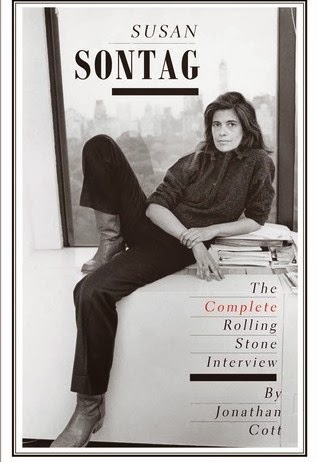
The Institute for Cultural Literacy in Berlin is having a retrospective on cultural icon and author Susan Sontag ten years after her death, to discuss the continuing relevance of her work. The reason I know about this distant event: my former editor at the Los Angeles Times Book Review, Steve Wasserman, will be giving the keynote address. Steve, a friend of the late author and cultural critic, is now editor-at-large for Yale University Press, which under his guidance recently released Jonathan Cott‘s Complete Rolling Stone Interview. Sontag was also one of the contributors of the late lamented LATBR, so I was in good company.
“Susan Sontag Revisited” will take place January 29-30 at Christinenstrasse 18/19. Apparently, the organizers are apparently expecting a crowd, for the website warns: “For safety reasons, venue doors will be closed when capacity limits are reached. We apologize for any inconvenience.” Get there early, or you will be pushed away by gendarmes.
In addition to Steve, other speakers include: Andrea Braidt, Carolin Emcke, Jörn Glasenapp, Erika and Ulrich Gregor, E. Ann Kaplan, Nihad Kresevljakovic, Michael Krüger, Juliane Lorenz, Christina Pareigis, Anne Ratte-Polle, Laurence Rickels, Hanna Schygulla, with Christina Tilmann moderating the proceedings, in English and German.
I would repair, at her invitation, to Sontag’s penthouse, Jasper Johns’ former studio, located on the Upper West Side at 340 Riverside Drive.
I remember the apartment well. Flooded with sunlight, surrounded by a generous terrace overlooking the Hudson, it was spartan: hardwood floors, white walls, high ceilings; in the living room a single Eames chair, an original Andy Warhol of Chairman Mao, and in the dining room a long monk’s table made of oak with a brace of long benches on either side; in the kitchen’s cupboards a stack of plates, a few glasses, and row after row of back issues of Partisan Review; leaning against one wall of Susan’s bedroom a curious stained-glass window from Italy of a spooky Death’s Head, a kind of memento mori and, perhaps most impressive, by her bedside a 24-hour clock featuring time zones spanning the globe. Most important, of course, were the walls which bore the weight of her 8,000 books, a library which Susan would later call her “personal retrieval system.”
I spent the summer nearly getting a crick in my neck from perusing the books and I remember thinking that, while I had just finished four years of college, my real education was only beginning. I discovered scores of writers I had never heard of as well as writers I distantly knew but had never read. For reasons wholly mysterious I found myself drawn to four blue-backed volumes: the journals of André Gide. These, like others in Susan’s library, were filled with her pencil underlinings and marginal notes. One such passage by Gide made a deep impression: “When I cease getting angry, I shall have already begun my old age.”
I think Gide is wrong on that one – but I think Sontag is right when she declares, according to Steve, “what amounts to a credo, asserting that ‘thinking is a form of feeling and that feeling is a form of thinking.’” Check out Steve’s post and voice recording of Sontag here.



 Excellent, excellent article on