
Susan Sontag to writers everywhere: “Stay home!”

Share

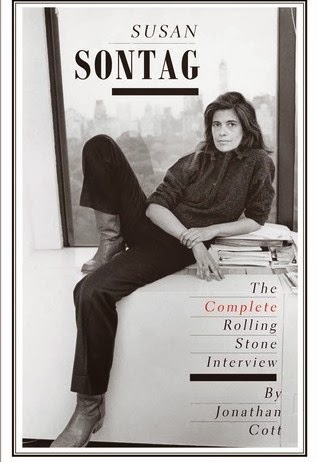
sontagThe book has been in my bedside stack for awhile now, but I didn’t realize quite how long awhile until I reread the note that came with it, on cream-colored Yale University Press letterhead, dated 2 October, 2013. “Dear Cynthia, All yours.”

Steve Wasserman, editor at large, had kindly sent me Susan Sontag: The Complete Rolling Stones Interview by Jonathan Cott. The original interview ran in The Rolling Stone in 1979 – but only a third of the twelve hours of conversations were published, hence this book. From the fly jacket: “Few modern intellectuals relished the art of the interview more than Susan Sontag. She embraced the process of thinking out loud. She spoke to Cott not in sentences but in measured and expansive paragraphs. He was struck by her ‘exactitude’ and ‘moral and linguistic fine-tuning’ – as she had once described Henry James‘s writing style. She would confide in her journals that ‘I am hooked on talk as a creative dialogue’ and added: ‘For me, it’s the principal medium of my salvation.'”

I began almost immediately penciling in arguments, cross-references, and approval in the margins. The text is addictive. But what might the Book Haven reader like to read?  Here’s a favorite excerpt:

… you’re not a public celebrity who gossips in the media about whom you’re going out with.

Well, what serious writer ever did?

I could go through a list.

But those people have destroyed themselves as writers. I think it’s death to one’s work to do that. Surely, the body of the work of writers such as Hemingway or Truman Capote would be on a higher level if they hadn’t been public figures. There is a choice between the work and the life. It’s not only a choice between how much you manifest yourself in the ways that the media invite you to, but just how much you go out altogether.

There’s a story of Jean Cocteau – to take an example of a writer I really admire – who, when he was in his late teens or early twenties, went to see Proust, who was already in his cork-lined room. Cocteau brought him some of his work, and Proust said, You really could be a great writer, but you have to be careful about society. Go out a little bit, but don’t make it a main part of your life. And Proust spoke as someone who, in the early part of his life, had lived a very social, what we would call café-society or jet-set life in Paris, but he knew that there was a time when you had to choose between the work and the life. It’s not just a question of whether you’re going to give interviews or talk about yourself – it’s a question of how much you live in society, in that vulgar sense of society – and of having a lot of silly times that seem glamorous to you and other people.
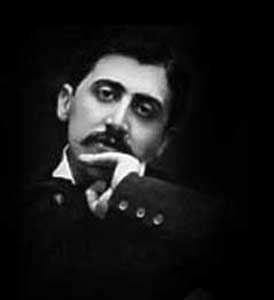
proust

Be careful.

But think of the Goncourt Brothers, who wouldn’t have written what they did unless they frequented parties almost every night in Paris during the Second Empire. In a way, they were extraordinarily brilliant but high-class gossip types.

They were also social historians using both the novel and documentary forms. Even Balzac did that. The problem, however, is a little different in the twentieth century since the opportunities are so much greater. I’m not saying that one has to be in a cork-lined room, but I think that one must have enormous discipline, and the vocation of the writer is, in some deep way, antisocial, just as it is for painters. Somebody once asked Picasso why he never traveled – he never took trips or went abroad. He went from Spain to Paris and then moved to the south of France, but he never went anywhere. And he said: I travel in my head. I do think there are those choices, and perhaps you don’t feel them so much when you’re young – and probably you shouldn’t – but later on, if you want to go beyond something that is simply good or promising to the real fulfillment and risk-taking of a big body of work, then that only becomes a possibility for a writer or a painter after years of work, and you have to stay home.”

Breaking bad news to Gore Vidal

Share
Vidal2

In 2009 (Photo: David Shankbone)

Facebook posts rarely live longer than a butterfly or moth, but fortunately this one did –  it landed on the cyberspace pages of Truthdig.  Steve Wasserman, one of my favorite editors evah, first met the author Gore Vidal in Los Angeles, 1979, while Steve was working as an editor of the Los Angeles Times Sunday Opinion section:

We took an immediate liking to each other and he began writing for me, more I always thought out of a lifelong compulsion to irritate the New York Times, which he’d long been convinced had had it in for him, than for any particular affection for the Los Angeles Times. Over the years, he became something of an Auntie Mame figure for me, giving me pep talks at Patrick Terrail’s fashionable restaurant, Ma Maison, where we would sometimes meet for dinner, encouraging me to lead as wide and as fruitful a literary life as talent and ambition would permit. We saw each other from time to time at his Hollywood home on Outpost Drive, in New York at the Plaza Hotel, and once at New Year’s in Venice at the Hotel Palace Gritti, where he complained that Susan Sontag and he were the only American writers of any distinction that Bob Silvers would publish in the pages of the New York Review of Books.

Years later, I became editor of the Los Angeles Times Book Review. Gore’s 1999 novel, The Smithsonian Institution, was about to be published. It was a modest entertainment, a satire in the manner of Duluth and Myra Breckinridge. I thought it an occasion to publish a lengthy consideration of Gore’s overall achievement as one of America’s foremost men of letters. Artwork suitable for using on the front page was commissioned and we chose a suitable reviewer.

Here’s the bad news: the reviewer thought the book sucked, big time.  How to break the news?  Or should he let Vidal read it over his morning coffee, just like everyone else?  Read the rest of the story, which was born on Facebook, here.

The ongoing demise of the L.A. Times Book Review

Share

The “Incredible Shrinking Book Review Section,”  chapter 464:  this news from Publishers Weekly:

In a move as significant for its breadth as its implications for the future of book coverage, the Los Angeles Times book review laid off all of its freelance book reviewers and columnists on July 21.

Susan Salter Reynolds was with the Times for 23 years as both a staffer and freelancer and wrote the “Discoveries” column that appeared each week in the Sunday book review. She was told that her column was cancelled and will not be replaced by another writer. “I don’t know where these layoffs fit into the long-storied failure at the Times,” she said yesterday, “but these are not smart business decisions. This is shabby treatment.”

Four staffers remain in the book review section: David Ulin, Carolyn Kellogg, Nick Owchar, and [Jon] Thurber. In December 2009 the TimesTimes building.” Thurber did make an exception for Reynolds so she could come to the office to pick up the multiple review copies she received daily in order to produce her column.

In December 2009 the Times laid off 40 features writers, including Reynolds, but brought many of them back to work part-time. “We were paid about one-third of what we had been making, and lost our health insurance,” Reynolds says.

Reynolds nixed

Reynolds hadn’t quite finished having her say, and added in the comments section:  ‘There are probably ways to cut costs without eliminating a person’s entire income after twenty three years in one phone call. I offered to continue writing for very little money until things got better. Also the quote about continued commitment is insulting to readers’ intelligence. When I was laid off a year and a half ago I was assured by the editor of the book section that it was purely cost cutting and there would be no more hires. Next thing I knew he had become the book critic and then they hired a full time blogger one month later. I understand these are tough times but isn’t publishing a world in which expertise has some value?”

I remember writing for the Los Angeles Times Book Review back in the days when it was under the visionary leadership of Steve Wasserman (and Tom Curwen, too, as the deputy book edior).  We’re not talking the neolithic period – we’re talking about within the past decade.  In my opinion, it was at that time the best book review in the country, with articles that were intelligent, innovative, often reviewing off-the-beaten-track books that were going to influence our era, even if they didn’t make this year’s bestsellers list.

What a shame to see that legacy trashed.  By limiting itself to four writers, no matter how top-notch they might be, its isolating itself from the expertise that used to be its trademark.

Wrote Randy Rogers:  “Picking up my paper from the driveway this morning I looked at it and thought “If the LA Times gets any thinner I’m going to have to wait a few days just to have enough to line the bottom of a bird-cage.  Why am I still paying for this ghost of a rag?”