TONIGHT! Stanford’s Another Look features Walter Tevis’s “The Queen’s Gambit”!

Share

Local boy

Please join us for the Another Look book club discussion of Walter Tevis‘s Queen’s Gambit. The novel is about chess, and more particularly about Beth Harmon, a sullen and unremarkable orphan – until she plays her first game. By sixteen, she is playing chess at the U.S. Open Championship. The Queen’s Gambit follows the intense mental and existential pressures that a chess champion must endure in order to remain at the top of the game.

Tevis is best known for his three novels that were turned into major films: The Hustler, The Color of Money, and The Man Who Fell to Earth. Tevis was born in San Francisco and grew up in the Sunset District. While his parents relocated to Kentucky, he spent a year in the Stanford Children’s Convalescent Home (which later became Stanford’s Lucile Salter Packard Children’s Hospital). Hence, Another Look’s winter event will be a homecoming for the author, who died in 1984.

The event will take place at 7:30 p.m. TONIGHT, Tuesday, January 29, at the Bechtel Conference Center of Encina Hall. Panelists will include Stanford’s National Medal of Arts winner Tobias Wolff; acclaimed author Robert Harrison, and former Stanford fellow Inga Pierson.

“Evolution of Desire: A Life of René Girard” goes into its third printing – and sparks some reflections in Zürich’s “Neue Zürcher Zeitung”

Share
 

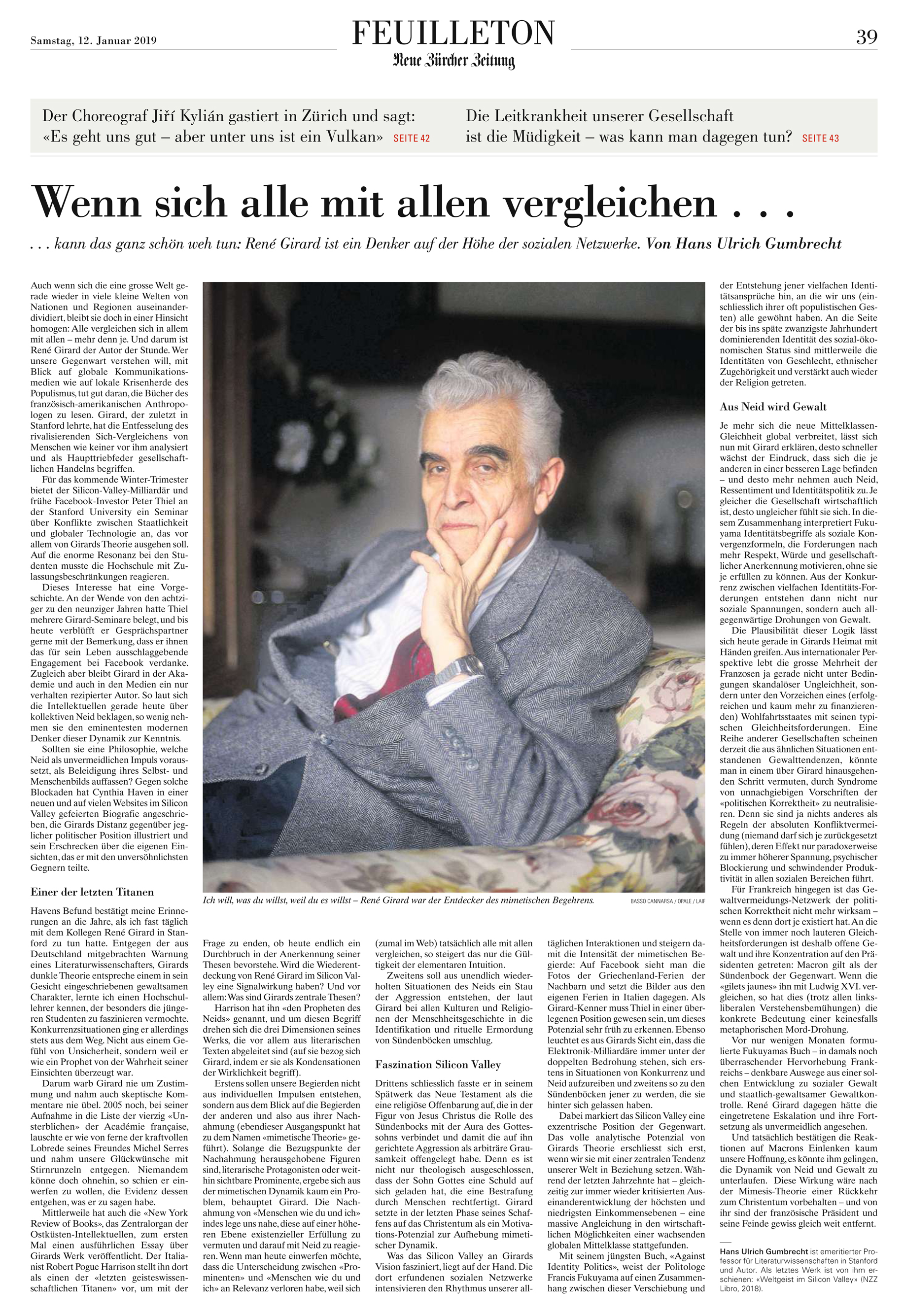
Some good news! Evolution of Desire: A Life of René Girard is going into its third printing in its first year! Here’s some more good news: an article in Zürich’s Neue Zürich Zeitungone of Europe’s most highly regarded newspapers. The piece is by one of the continent’s leading intellectuals, Stanford’s own Hans Ulrich Gumbrecht

The first few paragraphs in a rough, off-the-cuff translation by a German-speaking friend of ours. An excerpt from: “Equality, Desire, Violence and the Restrained Presence of René Girard”:

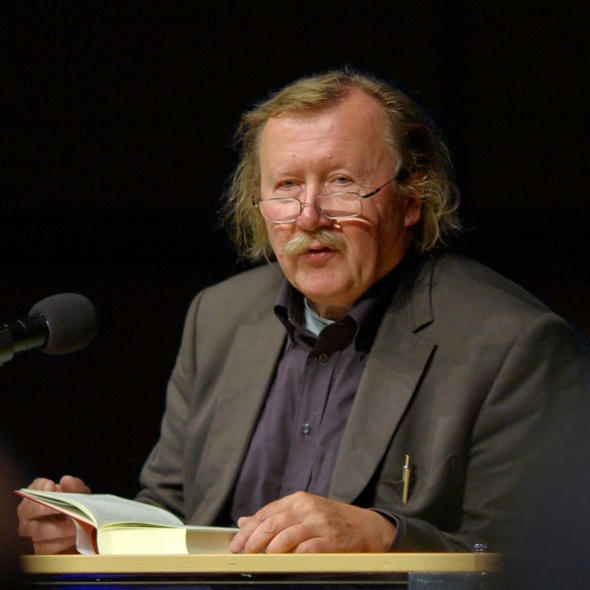
A few weeks ago the French magazine Le Point invited Peter Sloterdijk to a conversation about the protest movement of the yellow jackets and their relationship to President Macron. With his learned and yet very decisive point of view, the philosopher activated an unconventional line of intellectual positions: in addition to  Mikhail Bakhtin‘s thesis on the transformation of Carnival moments into violence, and to Alain Peyrefitte‘s identification of social immobility as the heritage of absolutism, and to Elias Canetti’s theory on the dynamics of people in masses, he also referenced–most of all–the vision of the French-American anthropologist René Girard, who is rarely cited in his own homeland, a vision of working out  collective tensions through the attack and murder of a “scape goat.” Sloterkijk’s interlocutor could only with difficulty hide his outrage over this application of an analysis of the present situation.

Sepp Gumbrecht (Photo: Reto Klar)

With his left-liberal aligned reaction, the news would have no doubt fit well, to hear that the Silicon Valley billionaire and original Facebook investor Peter Thiel offered, for the coming Winter quarter at Stanford, a seminar on the conflict between “Statehood and Global Technology,” a course that was supposed to be derived from Girard’s theory and a course with such unusual resonance among the students that the university had to implement conditions for acceptance into the class.  Around 1990 Thiel had in fact taken several Girard Seminars, and to this day Thiel likes to amaze his interlocutors with the comment that he owes his life-changing engagement with  Facebook to these Girard seminars. In view of Sloterdijk, Thiel and their antagonists, it is  increasingly evident that there is a  pattern of tension between the way eccentric thinkers trust Girard’s intuitions and a mostly unfounded refusal to even acknowledge them. Against this blockade, in a new biography which is widely celebrated in many websites in Silicon Valley, Cynthia Haven has described how Girard distanced himself from all political positions, and described his shock at his own insights, a shock he shared with his most vehement opponents.

Haven’s conclusions and the peculiar ambivalence that she references confirm my memories from the 1990s, when I met with René Girard as a colleague at Stanford almost daily. Despite the warning brought from Germany by an eminent literary scholar that Girard’s dark theory corresponds to a powerful sense of character engraved in his face, I learned to know a professor who fascinated the youngest students in particular, and who consistently avoided competitive situations. Not from a feeling of uncertainty or self-doubt at all, but rather because as a prophet he was convinced of the truth of his insights. He in fact felt called to point out these insights repeatedly, and yet expected no personal admiration, never courted agreement, and never held it against me for instance, when I reacted with skeptical commentary. Already in 2005, when he was accepted into the forty “Immortals” of the Académie Française, Girard heard from afar the powerful encomium of his friend Michel Serres and reacted to our congratulations with a rumpled brow. Nonetheless, he seemed to want to say, no one could avoid the evidence of what he had to say.

The articles goes on to discuss Robert Pogue Harrison’s “Prophet of Envy” in the New York Review of Books (“the central organ of the American East Coast intellectuals”), the intensification of internet envy with FaceBook, and more. Read it here.

Not enough good news for you? The Claremont Review of Books article is up. Did we mention we’re getting lovely letters? Enough! We’ll share more tomorrow.
 .

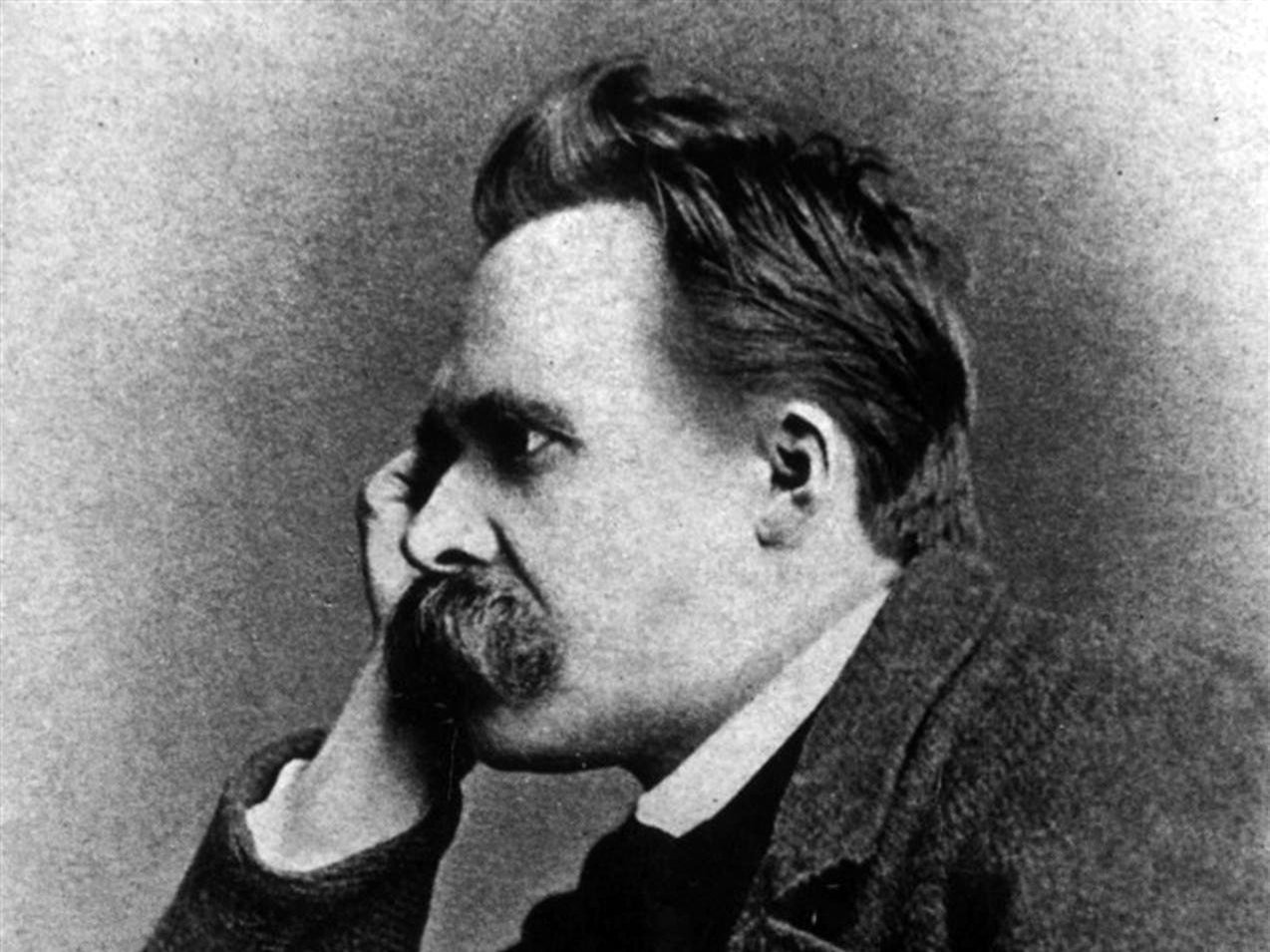
“Who was the most fateful person in the history of Western mankind?” Nietzsche answers.

Share

Sloterdijk wrote “Nietzsche Apostle.”

The Berlin national daily Die Welt has published Robert Pogue Harrison‘s recent Entitled Opinions radio/podcast interview with philosopher Peter Sloterdijk in time for the holidays here. You can listen to the interview (recorded in English) over at the Los Angeles Review of Books here

It’s kind of a Christmastime message, in a backhanded sort of way.

It begins:

Robert Harrison: I have just finished reading your splendid little book called Nietzsche Apostle, which was published in English in 2013 but first came out in Germany in the year 2000, on the hundredth anniversary of Nietzsche‘s death. What exactly you mean when you speak of Nietzsche as an apostle?

Peter Sloterdijk: he answer is quite simple. Nietzsche had very high ambitions, and he asked an elementary question, “Who was the most fateful person in the history of Western mankind?” And the answer he gave by himself, to himself, was that this person was obviously Saint Paul, whom he took for the real founder of Christianity – only apostle Saint Paul, who invented the apostolic role as such.

Saint Paul was the most fateful person in history, according to Nietzsche. If it were possible to undo the effects that Saint Paul had created, it would change the course of history. According to Nietzsche, Saint Paul brought genius into resentment. He elevated resentment to a level from which it could became a gospel.

Harrison: Do you believe that the figure of Jesus is secondary, in Nietzsche’s mind, to Paul?

He thought rather highly of himself.

Sloterdijk: In a certain way, yes. It’s absolutely not clear if Jesus had a universalist message. Jesus seems to be an elitist. He talks to those who can understand. Eventually there’s an encounter between the Gospels and the evangelical messages and Greek philosophy. The meeting began in Paul’s writings and were taken up in the fourth Gospel, which was written later. This meeting between Hellenism and the unruly Jewish method made possible what we call Christianity.

Harrison: Of course, the word gospel means “good news” or “glad tidings.” You make a point of Nietzsche’s claim that he wrote the fifth gospel in his book Zarathustra. Can you speak a little bit about this fifth gospel and the paradoxes at the heart of it? You claim Nietzsche made a great effort to convince himself of the “good news” and to continue believing that he was actually a bearer of good news. He was tormented by the fact that before you get to any good news, there’s terrible news – dreadful, awful news that he has to bring to humankind.

Sloterdijk: First of all, the category of “news” is problematic because news, in modern terms, is actuality, whereas for those who used it as a term ἄγγελμα in former times simply meant “message,” or in German, botschaft. The ἄγγελος is just a messenger. That is important. The connection with time is not yet so clear.

Read the rest here – but if you don’t know German, you’ll have to have a go with Google Translate. Or wait for English publication.

René Girard: “Today envy is the emotion which plays the greatest role in our society.”

Share

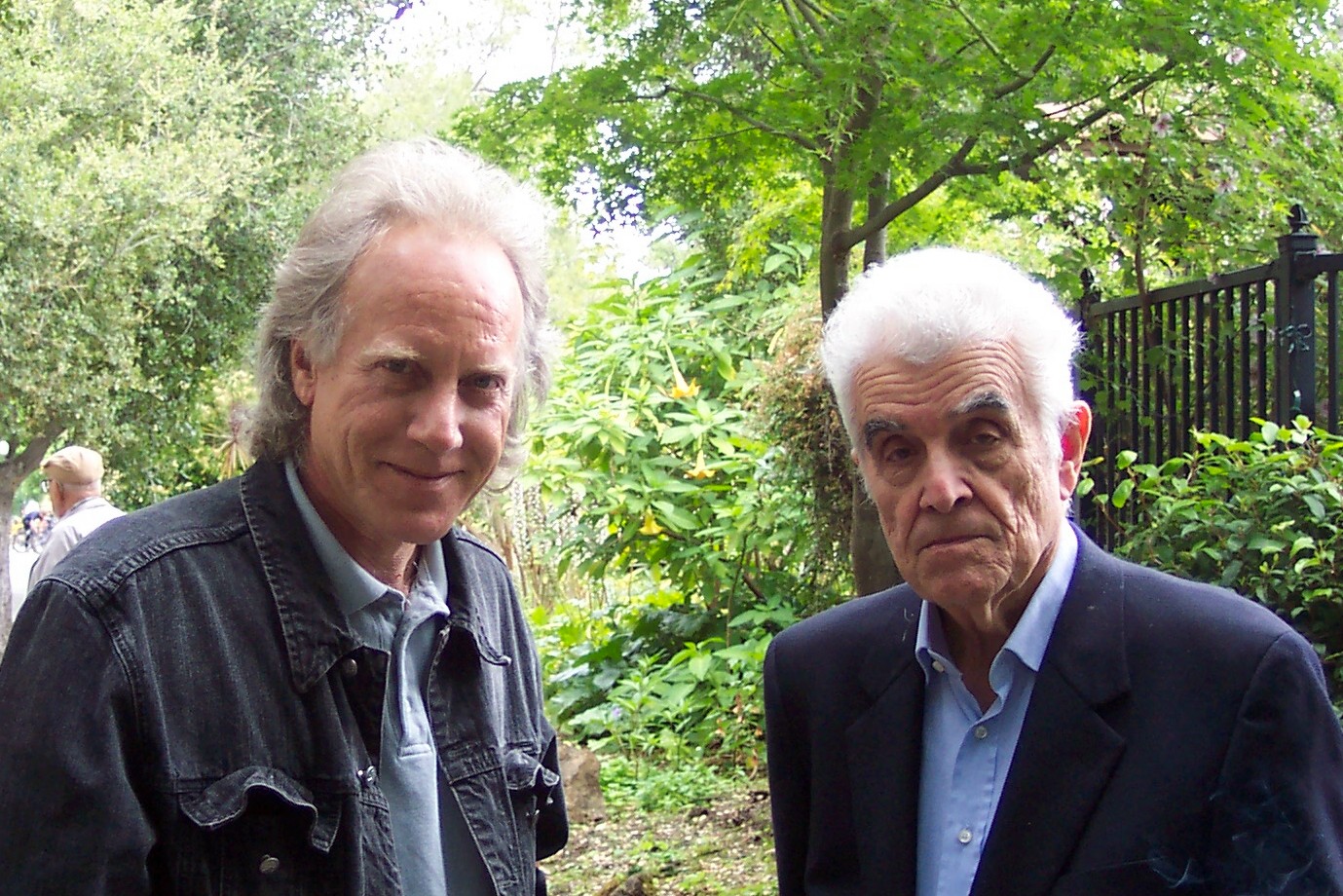
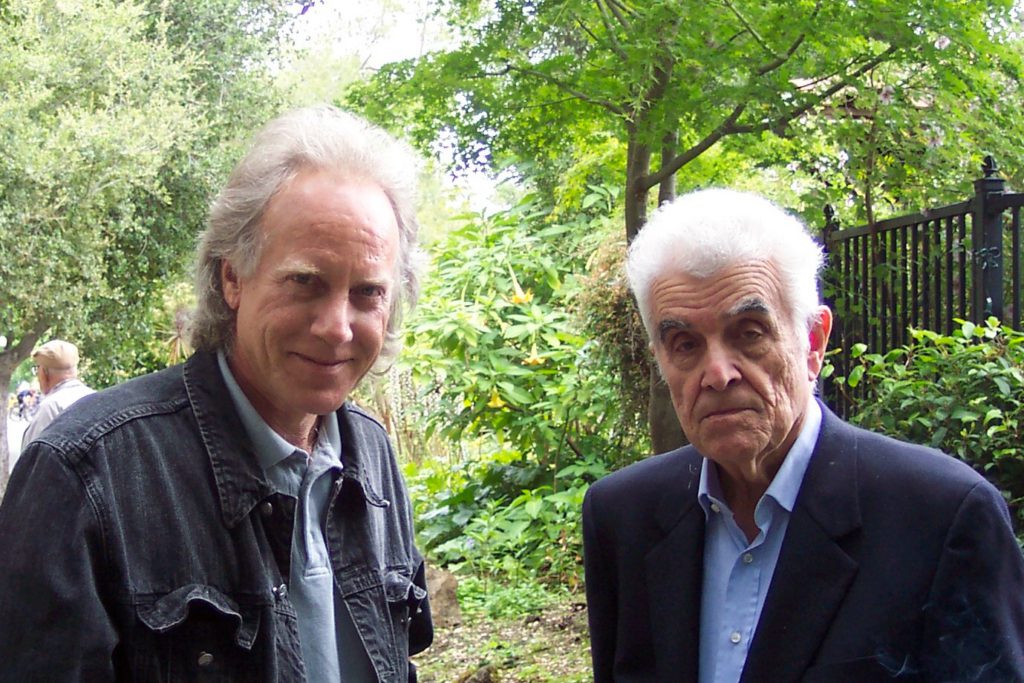
Robert Harrison with René Girard outside the Stanford Faculty Club (Photo: Ewa Domańska)

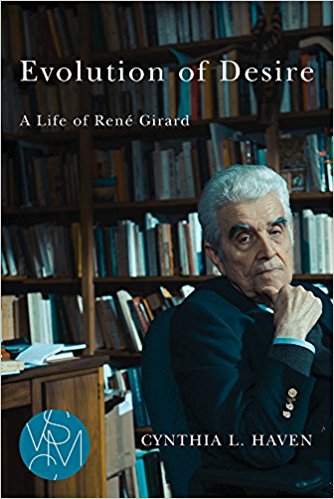
Here’s some good news for the holidays! My Evolution of Desire: A Life of René Girard has been named one of the San Francisco Chronicle‘s top books of 2018! You can read about it here. We can’t think of a better Christmas present. But there’s more good news.

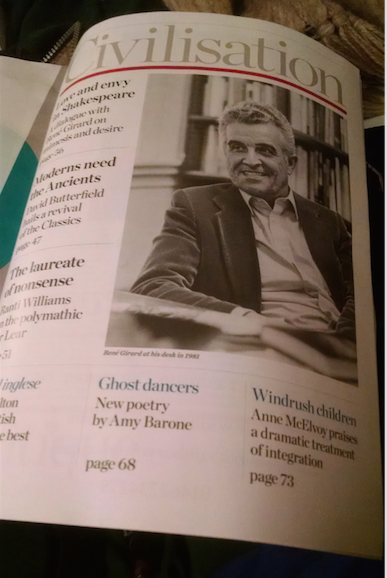
We wrote about Robert Pogue Harrison’s New York Review of Books essay, “Prophet of Envy,” on French theorist René Girard. We’ve also written about his Entitled Opinions radio show and podcasts. The year-end double issue of the U.K.’s  Standpoint has published a transcript of one of his 2005 Entitled Opinions interviews with his Stanford colleague – and with a line on the cover, too! (See right.) Excerpt below:

Robert Pogue Harrison: The founding adage of western philosophy is “know thyself.” That’s not an easy proposition. To know yourself means, above all, to know your desire. Desires lurk at the heart of our behavior, determine our motivations, organise our social relations, and inform our politics, religions, ideologies, and conflicts. Yet nothing is more mysterious, elusive, or perverse than human desire.

Our government invests billions of dollars in scientific research every year so we might better understand the world of nature, so that we might continue our pursuit of knowledge, yet commits only a tiny fraction of that to advancing the cause of self-knowledge. Most of our major problems today are as old as the world itself. The problem of reciprocal violence, for example. You would think we would want to understand its mechanisms, its psychology, and its tendencies to spiral out of control. Instead, we keep on perpetuating its cycles much the way our ancestors have done for centuries, and even millennia. Nor are we any closer to knowing the deeper layers of our conflicting and conflict-generating desires than they were.

René, your work has an enormous reach. It branches out into various areas and disciplines — literary criticism, anthropology, religious studies, and so forth. Today, I’d like to focus on what I take to be the foundational concept of all your thinking, namely mimetic desire. Can you tell our listeners exactly what you mean by that term?

René Girard: Mimetic desire is when our choice is not determined by the object itself, as we normally believe, but by another person. We imitate the other person, and this is what “mimetic” means. For example: why have all the girls been baring their navels for the last five years? Obviously, they didn’t all decide by themselves that it would be nice to show one’s navel — or that maybe that one’s navel is too warm, and one must do something about it.
One of San Francisco Chronicle’s top books for 2018

We’ll see the mimetic nature of that desire the day that fashion collapses. Suddenly, it will be a very old-fashioned to show one’s navel and no one will show it any more. And it will all happen because of other people — just as now, it is because of other people that they show it.

RPH: But how far do you want to go in saying that desire — by its very nature, and in human beings — is fundamentally mimetic?

RG: Maybe one can start from this question: what is the difference between need, appetite, and desire? Need is an appetite all animals have. We know very well that if we are alone in the Sahara Desert and we are thirsty, we don’t need a model to want to drink. It’s a need that we have to satisfy. But most of our desires in a civilised society are not like that.

Think of vanity, or snobbery. What is snobbery? In snobbery, you desire something not because you really had an appetite for it, but because you think you look smarter, you look more fashionable, if you imitate the man who desires that object, or who also pretends to desire it.

 And later in the interview…

RPH:  I asked in my opening remarks about why can’t we have an institution devoted strictly to the study of vengeance, for example, and work out its logic — reciprocal violence, these kinds of things. We are far from overcoming the behaviour that has characterised human history throughout the centuries.

But let’s move on to another emotion, which is closely linked, obviously, to hatred, vengeance, and jealousy, namely envy. I think envy is a highly underestimated emotion in the human relations. How do you see the role of envy?

RG:
 I see it the same way. Today envy is the emotion which plays the greatest role in our society, where everything is directed towards money. Therefore you envy the people who have more than you have. You cannot talk about your envy. I think the reason we talk so much about sex is that we don’t dare talk about envy. The real repression is the repression of envy.
And of course, envy is mimetic. You cannot help imitating your model. If you want money very badly, you’re going to enter the same business as the man who is your model. More likely than not, you will be destroyed by strength. So when people talk about masochism and so forth, they are still talking about mimetic desire. They are talking about how we move always to the greatest strength in the direction of the desire we envy most. We do so because that power is greater than ours — and it’s probably going to defeat us again. So there will be what Freud calls repetition in psychological life, which is linked to the fact that we’re obsessed with what has defeated us the first time. Our victorious rival in lovemaking becomes a permanent model. So novelists like Dostoevsky and Cervantes will show you characters who literally asked their rival to choose for them the girl they should love.

Read the whole thing here

Postscript on 12/18: The actual, physical copies of Standpoint arrived in my Stanford p.o. box today. It’s beauuu-ti-ful! (See photo at left.) Moreover, “Love and Envy in Shakespeare: A Dialogue with René Girard on Mimesis and Desire” leads the “Civilisation” section of the magazine. Thanks to Daniel Johnson and the London staff of Standpoint magazine. What fine work you do! And what a splendid Christmas present – not just for me, but for all of us!


Praise for Evolution of Desire: A Life of René Girard in the New York Review of Books!

Share

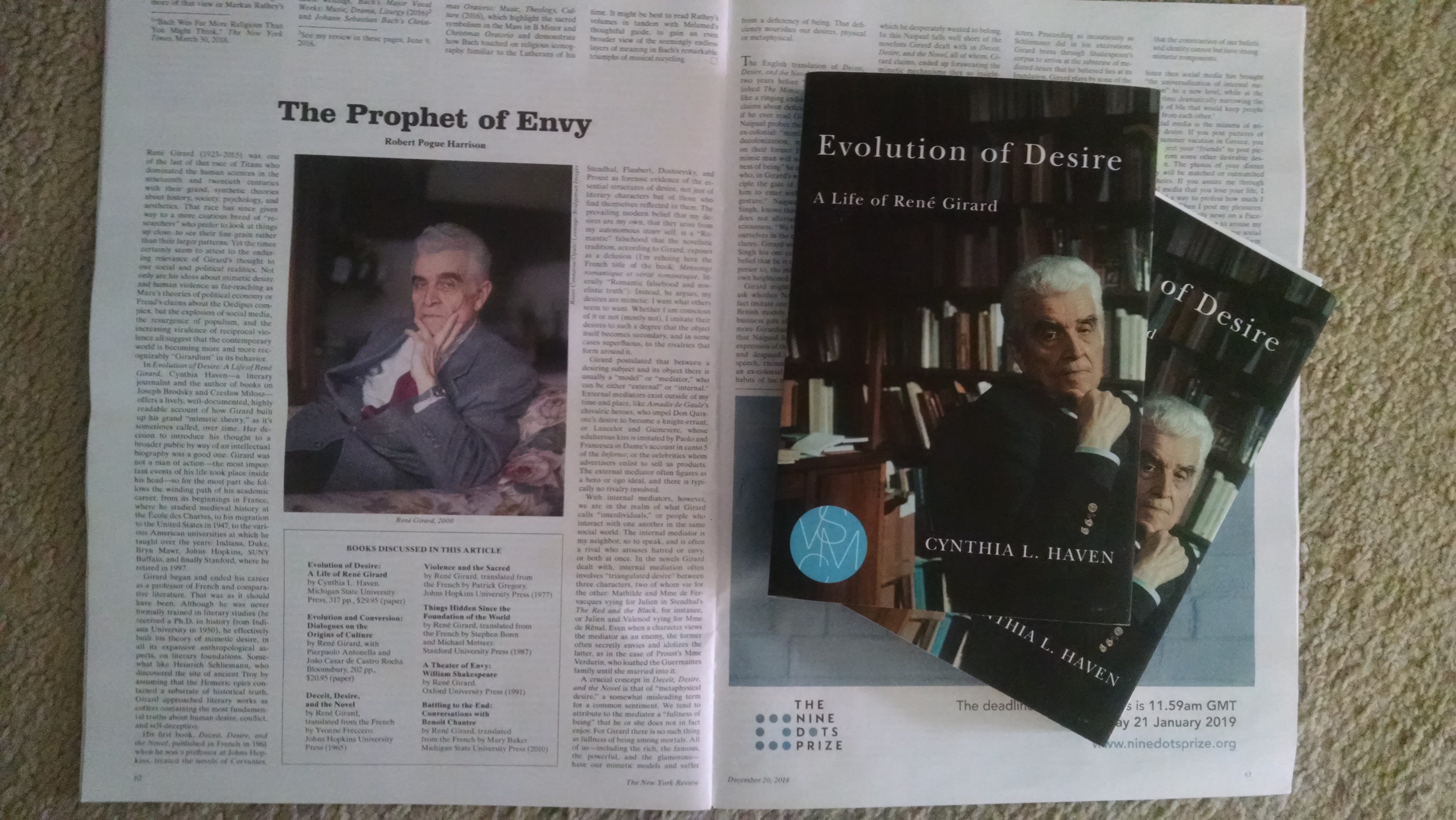
The New York Review of Books has a three-page spread on our favorite French theorist, René Girard, in its Dec. 20 holiday issue – and Evolution of the Desire: A Life of René Girard is at the top of it. The article, “Prophet of Envy” by Robert Pogue Harrison, a friend and colleague of the Académie Française immortel, is a bold and brilliant, incisive and insightful consideration of René Girard’s theories and works. I hope it is cited, picked up, and republished everywhere. It begins:

A friend of Harrison’s and a friend of mine…

René Girard (1923–2015) was one of the last of that race of Titans who dominated the human sciences in the nineteenth and twentieth centuries with their grand, synthetic theories about history, society, psychology, and aesthetics. That race has since given way to a more cautious breed of “researchers” who prefer to look at things up close, to see their fine grain rather than their larger patterns. Yet the times certainly seem to attest to the enduring relevance of Girard’s thought to our social and political realities. Not only are his ideas about mimetic desire and human violence as far-reaching as Marx’s theories of political economy or Freud’s claims about the Oedipus complex, but the explosion of social media, the resurgence of populism, and the increasing virulence of reciprocal violence all suggest that the contemporary world is becoming more and more recognizably “Girardian” in its behavior.

In Evolution of Desire: A Life of René Girard, Cynthia Haven—a literary journalist and the author of books on Joseph Brodsky and Czesław Miłosz—offers a lively, well-documented, highly readable account of how Girard built up his grand “mimetic theory,” as it’s sometimes called, over time. Her decision to introduce his thought to a broader public by way of an intellectual biography was a good one. Girard was not a man of action—the most important events of his life took place inside his head—so for the most part she follows the winding path of his academic career, from its beginnings in France, where he studied medieval history at the École des Chartes, to his migration to the United States in 1947, to the various American universities at which he taught over the years: Indiana, Duke, Bryn Mawr, Johns Hopkins, SUNY Buffalo, and finally Stanford, where he retired in 1997.

Of the seven books on the list, Evolution of Desire is the only one not authored by René himself. The  final book is one of my favorites, and I discuss it a good deal in Evolution of Desire: it’s his  Battling to the End: Conversations with Benoît Chantre:

A frequent essayist in NYRB

It is in many ways one of his most interesting, for here he leaves behind speculations about archaic origins and turns his attention to modern history. The book’s conversations with Benoît Chantre, an eminent French Girardian, feature a major discussion of the war theorist Carl von Clausewitz (1780–1831), whose ideas about the “escalation to extremes” in modern warfare converge uncannily with Girard’s ideas about the acceleration of mimetic violence.

Toward the end of his life, Girard did not harbor much hope for history in the short term. In the past, politics was able to restrain mass violence and prevent its tendency to escalate to extremes, but in our time, he believed, politics had lost its power of containment. “Violence is a terrible adversary,” he wrote in Battling to the End, “especially since it always wins.” Yet it is necessary to battle violence with a new “heroic attitude,” for “it alone can link violence and reconciliation…[and] make tangible both the possibility of the end of the world and reconciliation among all members of humanity.” To that statement he felt compelled to add: “More than ever, I am convinced that history has meaning, and that its meaning is terrifying.” That meaning has to do with the primacy of violence in human relations. And to that statement, in turn, he added some verses of Friedrich Hölderlin: “But where danger threatens/that which saves from it also grows.”

Here’s the good news! “Prophet of Envy” is online here! And the holidays are coming up – time to buy some books for family and friends.

Why We Want What We Want: René Girard and Robert Harrison in conversation

Share

“I THINK THE REASON WE TALK SO MUCH ABOUT SEX IS THAT WE DON’T DARE TALK ABOUT ENVY. THE REAL REPRESSION IS THE REPRESSION OF ENVY.” –RENÉ GIRARD

“Know thyself.” It’s not an easy proposition. As Entitled Opinions host Robert Harrison says, “To know yourself means, above all, to know your desire. Desires are what lurk at the heart of our behavior. It’s what determines our motivations. It’s what organizes our social relations. It’s what informs our politics, religions, ideologies, and above all, our conflicts.”

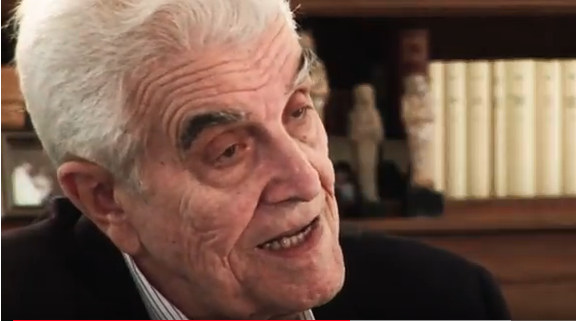
René in a video interview…

In this conversation and podcast, over at the Los Angeles Review of Books here, Harrison talks with Stanford’s expert on human desire, René Girard, whose work on the subject was rooted in literary criticism, but eventually reached across disciplines to embrace anthropology, sociology, history, religions, and even the hard sciences.

Girard began his work in the 1960s with a new concept of human desire: our desires are not our own, he said, we are social creatures, and we learn what to want from each other. He has been called “the new Darwin of the human sciences” and was one of the immortels of the prestigious Académie Française.

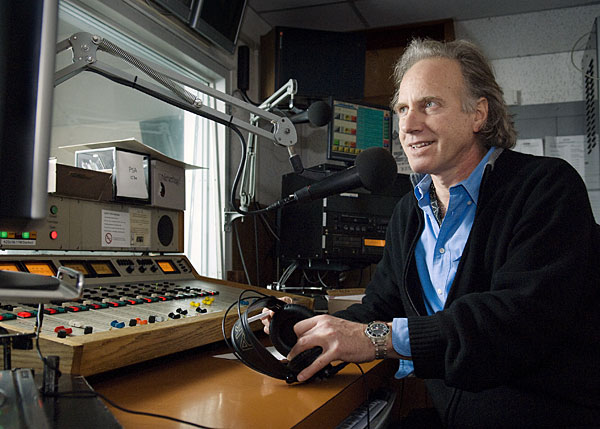
… Robert Harrison as radio host

Their 2005 interview discusses envy and desire in literature — in Canto V of the Inferno, in Cervantes, Balzac, and Flaubert, but most of all in the plays of Shakespeare. They also discuss the role of vengeance as an act of mimetic rivalry, “snobbery” as a form of imitation, and the “sacramental” nature of advertising today. “If you consume Coca-Cola, maybe if you consume a lot of it, you will become a little bit like these people you would like to be. It’s a kind of Eucharist that will turn you into the person you really admire.”

Ultimately, they talk about the mimetic escalation of warfare, Girard’s late-life fascination with the war theoretician Clausewitz, and the need to renounce violence.

This is Part 1 of a two-part discussion – you can listen to it over at the Los Angeles Review of Books “Entitled Opinions” channel here. Meanwhile, Robert Harrison writes about René Girard in the Dec. 20, 2018, issue of the New York Review of Books here.

Potent quotes:

From RENÉ GIRARD

Envy is the emotion which plays the greatest role in our society.”

Mimetic desire is an absolute monarch.”

If you have a rivalry, your vanity is involved and you want to win at all cost.”

The institution that is most mimetic of all is the greatest capitalist institution – the stock market.”

Clausewitz constantly shows you the mimetic nature of war.”

From ROBERT HARRISON

Nothing is more mysterious, evasive, or perverse than human desire.”

We are far from overcoming the behavior that has characterized human history.”

Why is it that human behavior is so resistant to adapting itself to what the mind knows?”

To know yourself means, above all, to know your desire.”

It’s amazing that our governments invests billions of dollars in scientific research every year in order to better understand the world of nature, yet commits only a tiny fraction of that to advance the cause of self-knowledge in order to better understand ourselves.”