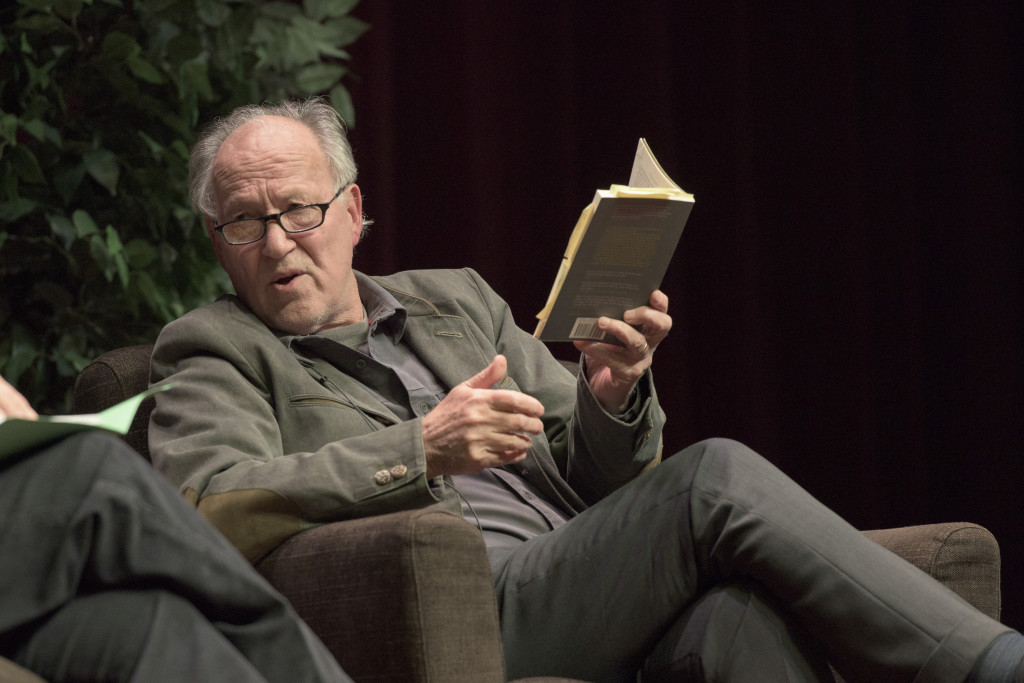
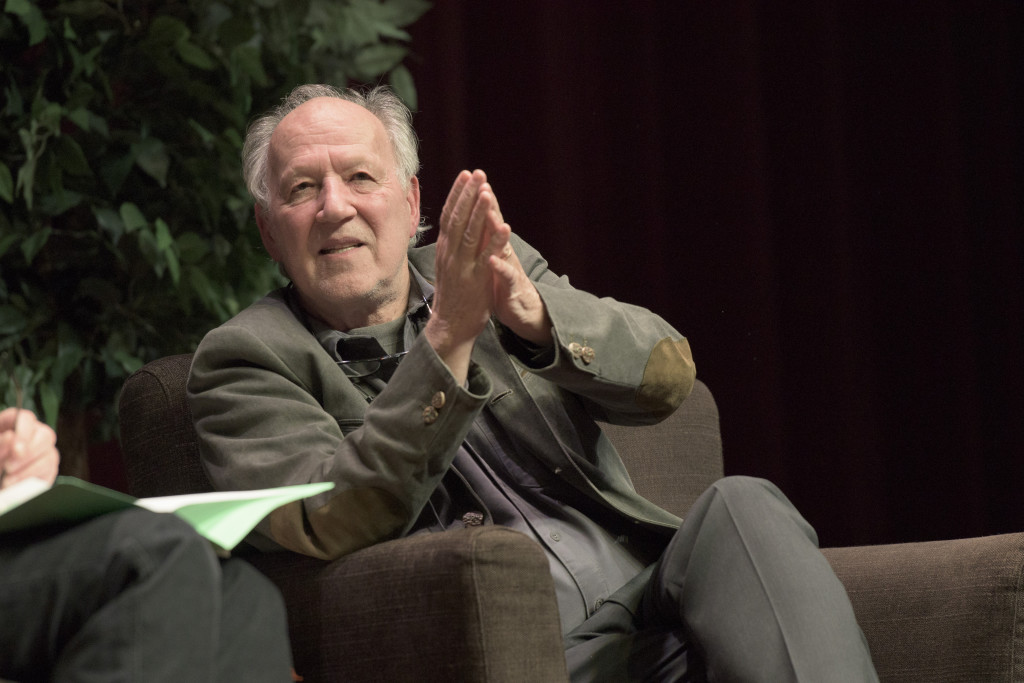
Legendary filmmaker Werner Herzog makes a point. (Photo: L.A. Cicero/Stanford News Service)
Those of you who follow the Book Haven know that we’ve been somewhat preoccupied with legendary filmmaker Werner Herzog, who visited Stanford on February 2 to discuss J.A. Baker‘s The Peregrine. The discussion ranged far beyond the book, to embrace Virgil’s Georgics, the 16th century Florentine Codex (originally in Nahuatl), the Edda, his films and his views on reading and filmmaking – well, he’s a force of nature. It’s all now available on youtube, in a full-length version (here) and a quick, two-minute highlights version (here). Or see below for both: short version on top, the full hour-and-a-half below (it’s worth the time, really).
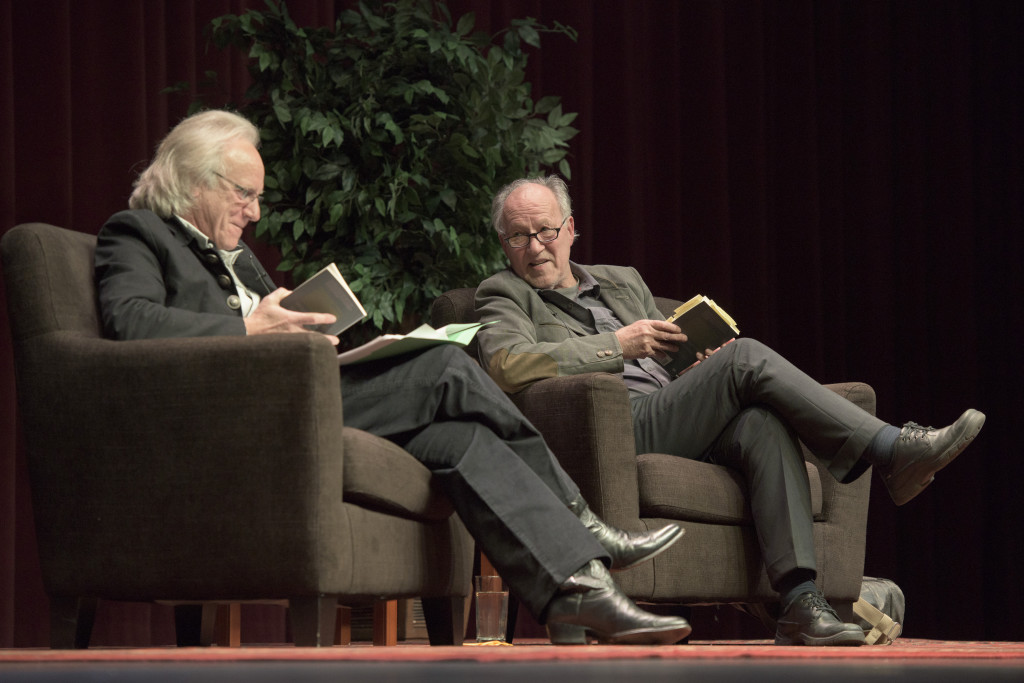
A sublime pairing. (Photo: L.A. Cicero)
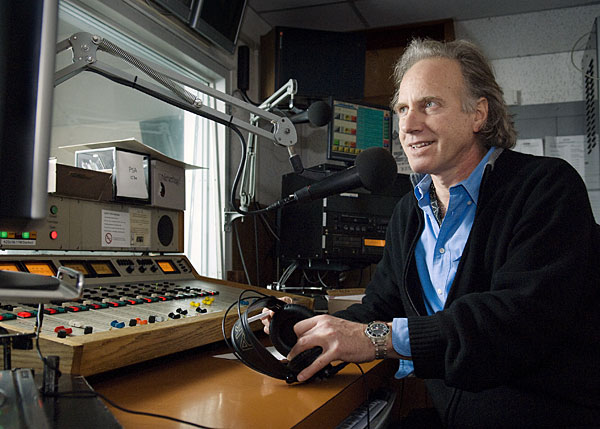
The event was part of the ongoing Another Look book club series of events – Another Look’s director,Robert Pogue Harrison, a regular contributor to the New York Review of Books and host for the popular Entitled Opinions radio talk show, was the interlocutor for the discussion (we’ve written about him here and here and here, among many other places). In fact, the encounter was born in a friendship – but not with Werner, at least not initially. Robert met and interviewed Lena Herzog for the April 17, 2013 interview with Entitled Opinions about her photography (download Robert’s interviews, including that one, here).
The Another Look event was covered by columnist Caille Millner in “When Werner Herzog Came to Stanford” in the San Francisco Chronicle (here). An excerpt:
Herzog, 73, is legendary for many reasons: his passion, his punishing film sets, his contempt for personal comforts, his aversion to the contemporary gadgets that rule our lives (he grew up in a remote Bavarian village without running water or flush toilets) and, above all, for his absolute independence from Hollywood filmmaking
I was curious about how this remarkable man would fit into Silicon Valley for an evening. What’s an on-demand app to someone who didn’t make his first phone call until he was 17 years old?
It tells you something about Herzog that the reason he drove up to Stanford from Los Angeles was to talk about a little-known, long-out-of-print book about a man and a falcon: “The Peregrine,” by British author J.A. Baker (it’s been lovingly reissued by the New York Review of Books Classics imprint).
A genial superstar. (Photo: L.A. Cicero)
She writes with style and brio, but I don’t agree with her when she dismissed the textual difficulties behind The Peregrine (as did Herzog). The issues of accuracy aren’t occasional and trivial, but pervasive and woven into the book, whose author insists on its authority as a work of direct observation. A small team of us, including an expert falconer, spent a good deal of time chewing over the magnificent text and its discrepancies – some of the issues are summarized briefly here. I even retrieved some of the letters of renowned falconer Dick Treleaven to Baker, which are now at the University of Essex (covered here), as we attempted to square Baker’s observations with reality. Robert, who wrestled even more deeply with these issues than the rest of us, had some very insightful things to say on the subject, but the onstage conversation veered off in another direction. The Peregrine is undeniably a masterpiece, but it raises questions about artistic truth, “real” truth, and what, exactly, Baker was doing. Robert’s remarks about Jimi Hendrix in the full-length video gives a hint of where his thoughts were taking him as he pondered this mysterious book. I’m convinced that these issues make the book more, not less, interesting, and raise fascinating questions about the process of creation.
One of my strongest memories of the evening, however, occurred after the conversation was over. I was the assigned person to whisk the genial superstar away to the back door and the car that was waiting for him there. He would have none of it. He wanted to shake hands and greet everyone who had come to see him. He was smiling and laughing as the crowd swarmed him. Impossible to pull him away. Who would want to?
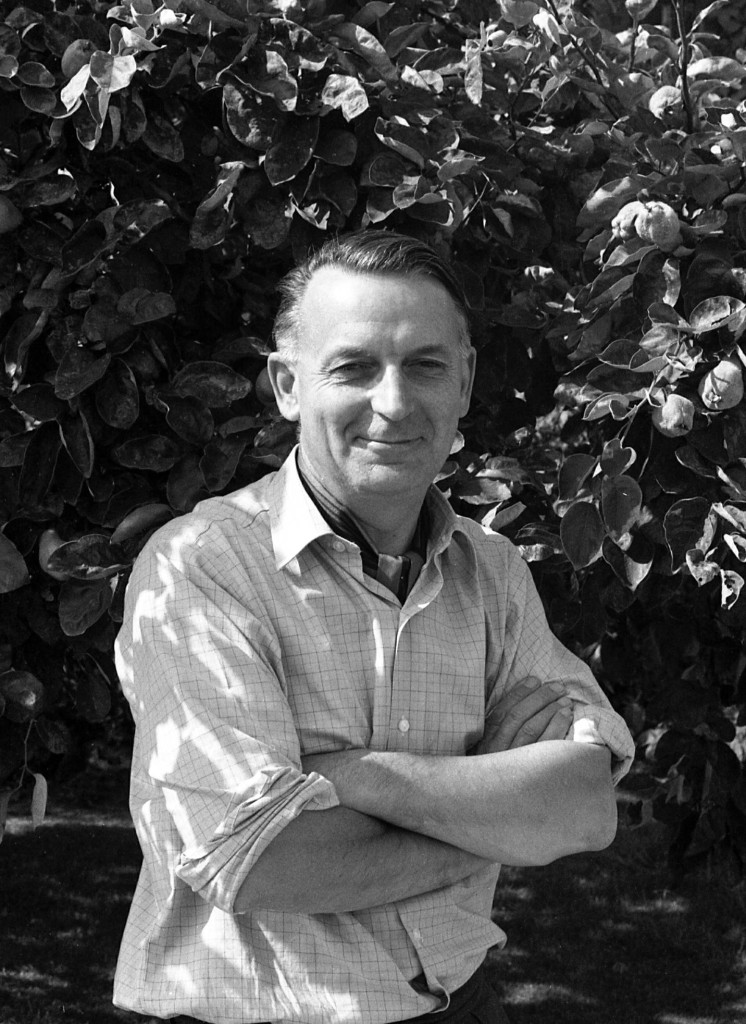
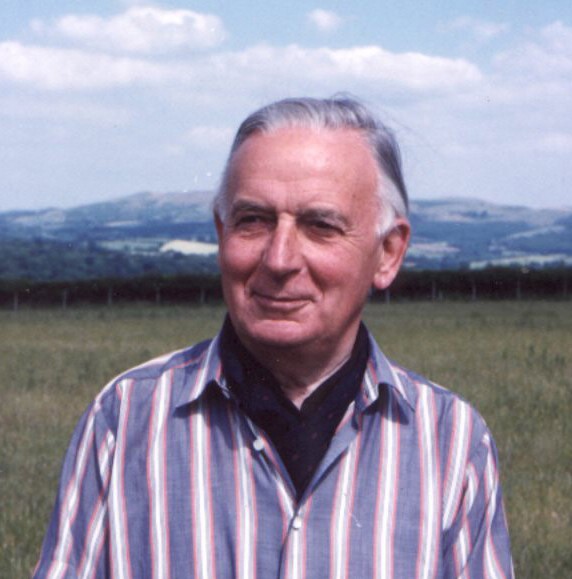
Carr by a quince tree, 1969 (Photo courtesy Bob Carr)
Stanford’s Another Look book club spotlights masterpieces that have been forgotten, overlooked, or otherwise just haven’t received the audience they merit. J.L. Carr‘s A Month in the Countryfits the bill perfectly. Other than an excellent biography by Byron Rogers, The Last Englishman, you’ll find little on the pitch-perfect book or its idiosyncratic, stubborn, and deeply private author.
That’s another reason to come to the Another Look discussion of A Month in the Country will take place at 7:30 p.m. on Monday, October 19, at the Bechtel Conference Center at Encina Hall on Serra Street on the Stanford campus. The conversation will be moderated by Robert Pogue Harrison, Another Look’s new director, along with acclaimed author Tobias Wolff, professor emeritus of English, and Jane Shaw, dean of religious life at Stanford and author of several books.
Parking is readily available around Encina Hall’s Bechtel Conference Center – a map is here. The nearby Knight parking structure, underneath the nearby Graduate School of Business, has plenty of room for free parking (seehere for a map). In addition, parking is available on Serra Street and in front of Encina Hall itself. Humble Moi will be at the front door by 6 p.m. for early arrivals, just to make sure you get in and save a seat.
Meanwhile, here’s ten things you probably didn’t know about the book or its author:
1. Carr’s book was born of a frustrating, decade-long endeavor to save a dilapidated 14th century Northamptonshire church. Read about it here.
2. “Splendid in their day – but not now.” Old English churches today are a staid affair, compared with their previous lives in the medieval centuries, where they were a riot of texture and color. Plus a short BBC film clip about how the stunning restoration of a Welsh church changed a village – which sheds some background on Tom Birkin’s labor to uncover a 14th century painting. Read about it here.
3. “He was my Dad, he wasn’t exceptional to me.'” J.L. Carr’s son doesn’t quite understand the fuss. “Carr was not an open man, neither was Bob, so theirs had been a perfectly friendly relationship with few confidences exchanged but no confrontations either,” wrote Carr’s biographer. “The result is that when you ask Bob Carr questions about his father, you sometimes feel you might just as well as be asking them of the lodger.” Read about it here.
4. “Thoo’s ga-ing ti git rare an’ soaaked reet doon ti thi skin, maister.” The Yorkshire accent was as mystifying to Tom Birkin as it is to Americans. Where did it come from? A short explanation, with a video clip on how the wrangling between the Vikings and the Anglo-Saxons can still be heard on the Yorkish tongue today. It’s here.
5. “This was the book nobody rejected, because they did not get the chance,” wrote Byron Rogers of A Month in the Country. But here are a few of the few words that have been said about this 1980 classic.
6. “’It was a sort of stage-magic’ : the Yorkshire countryside.” If you’ve never been to Yorkshire, here‘s your chance. A short video about the dales, rivers, and ethos of England’s enchanting county, a backdrop for Carr’s novel.
The author in Wales. (Photo courtesy Bob Carr)
7. “Hell? Passchendaele had been hell.” In the terrible history of the 20th century, the horrors of World War I were quickly overwhelmed by a greater war, but Passchendaele was unforgettable for those who remember the fear and the mud. It also marked the Germans’ introduction of mustard gas. Read about it here.
8. Penelope Fitzgerald, J.L. Carr, and the “death of the spirit we must fear.” The Booker award-winning author discusses Carr’s “nostalgia for something we have never had.” Read it here.
9. “Apples are the only exam I could ever hope to pass.” Carr would have been aware of the invasion of commercial apples, which was beginning about the time he wrote A Month in the Country. Have English apple-eaters have been seduced by the shiny red skins of foreign rivals? Read about it here.
10. Why Sara van Fleet and Wensleydale? Why did Carr pluck the Sara van Fleet rose for Alice Keach? And what’s so special about Wensleydale? Find out here.
The author next to a quince tree, 1969. (Photo courtesy Bob Carr)
The British novelist J.L. Carr had an implacable side. “Once he started something, he never let it drop,” his son recalled.
One example: Carr, a primary school headmaster, was wandering through a Northamptonshire village in 1964 when he ran across a dilapidated 14th-century church. Spending more than a decade in a tireless letter-writing campaign to restore the building, Carr battled bureaucrats, vandals, and a pilfering vicar. Eventually, the matter landed in the lap of the Queen of England.
From that infuriating experience was born a tender masterpiece: A Month in the Country, a late-life novel published in 1980, when Carr was well into his 60s. In the short book, two shell-shocked veterans of World War I look for healing and happiness in a Yorkshire village. One is restoring a medieval painting on the wall of the old church; the other is looking for a long-lost grave.
The Another Look book club will discuss the short novel at 7:30 p.m. Monday, Oct. 19, at the Bechtel Conference Center in Stanford’s Encina Hall. Another Look events, which focus on off-the-beaten-track novels, are free and open to the public. (Stanford Bookstore and Kepler’s in Menlo Park are stocking Carr’s book.)
Another Look was founded by the distinguished author Tobias Wolff, a Stanford professor of English. With his retirement this year, the book club was itself slated for demolition. The popular program has now been revived for its fourth season under the aegis of Stanford Continuing Studies, with Robert Pogue Harrison, a Stanford professor of Italian literature and an acclaimed author in his own right, as the new director. Harrison is also a regular contributor to the New York Review of Books and host for the radio talk show Entitled Opinions.
For the Oct. 19 discussion, Harrison will be joined by Wolff, who received the National Medal of Arts this month, and Jane Shaw, Stanford’s new dean for religious life at Stanford and author of several books.
Silent, watchful. (Photo courtesy Bob Carr)
“When I attended the last meeting of Another Look this past spring, I knew that no one had offered to take over for Tobias,” said Harrison. “Seeing the crush of people at Levinthal Hall fifteen minutes before starting time, with standing room only, eager to hear a discussion of Albert Camus’ The Stranger, I realized how much this book series means to people at Stanford and in the surrounding community. I felt it would be a real shame to let it let it die, so I offered to take over the directorship. And here we are, ready to go.”
Carr’s pitch-perfect short novel earned a Guardian Fiction Prize and was short-listed for a prestigious Booker Prize when it was published. The book’s fame was briefly outstripped by the 1987 film version, which effectively marked the film debuts of Colin Firth, Kenneth Branagh, and Natasha Richardson. The highly praised film was neglected after its release and finally rescued from oblivion by determined fans in recent years. The book, however, has a brisker pace, a quiet wit, a charm of its own – and a more enduring life.
“I read A Month in the Country about 10 years ago and was enchanted by its style, landscapes and themes,” said Harrison. “If any book fits the bill of Another Look – namely, a short novel from the past that richly deserves another look – it is Carr’s gem of a narrative, which takes on all sorts of different sorts of hues, depending on how you view it.”
Carr was the son of a Yorkshire stationmaster who was also a Wesleyan lay preacher. He eventually moved to Northamptonshire, where he was a teacher and schoolmaster for decades. He had a reputation for eccentricity: on school sports days, for example, he would set up Arithmetic Races where students had to complete sums at trackside blackboards before running on.
He decided to chuck it and become a writer. His first novel was published when he was in his 50s. To make ends meet, he founded Quince Tree Press, a publishing house that offered hand-illustrated county maps, idiosyncratic dictionaries and small, 5″ X 3.5″ editions of great poets, for less than the cost of a greeting card. It published the works of J.L. Carr as well – and still does.
But it was hard for Carr to build a literary reputation when each of his books was entirely different, in style, subject and outlook. The Harpole Report, for example, is a novel mostly in the form of a teacher’s log; the comedy writer Frank Muir called it “the funniest and perhaps the truest story about running a school that I ever have read.” As a result, Carr had a cult following, but no mainstream success until A Month in the Country.
Fame didn’t change him. He remained in Kettering, Northamptonshire, publishing books at Quince Tree Press, which is now headed by his son, Bob Carr. The author died in 1994 of leukemia, at age 81.
His biographer Byron Rogers described his visit to Carr’s deathbed as “uneasy bonhomie on my part, and silence and watchfulness on his.” Then he adds, “Though the irony is that most conversations with Jim Carr had been like that.”
***
The “Another Look” book club focuses on short masterpieces that have been forgotten, neglected or overlooked – or may simply not have gotten the attention they merit. The selected works are short to encourage the involvement of the Bay Area readers whose time may be limited. Registration at the websiteanotherlook.stanford.edu is encouraged for regular updates and details on the selected books and events. The website also has additional articles about J.L. Carr and other information on the Oct. 19 discussion.
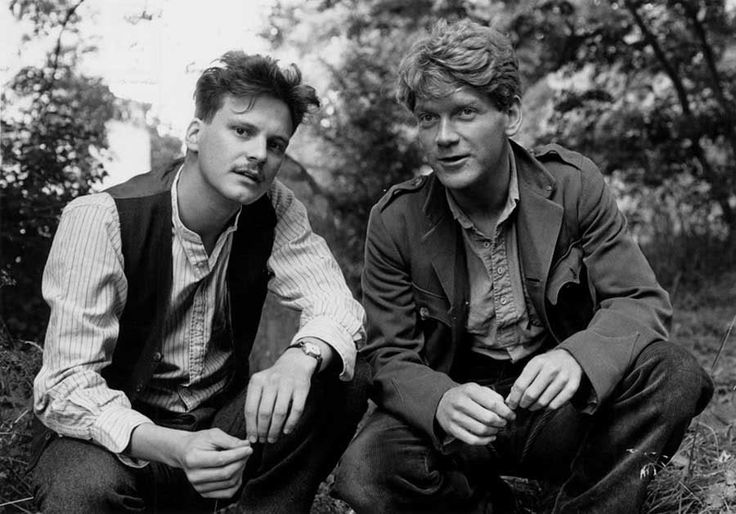
Firth and Branagh in the celebrated and long-lost film.
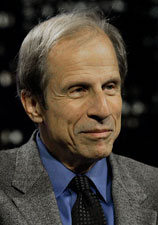
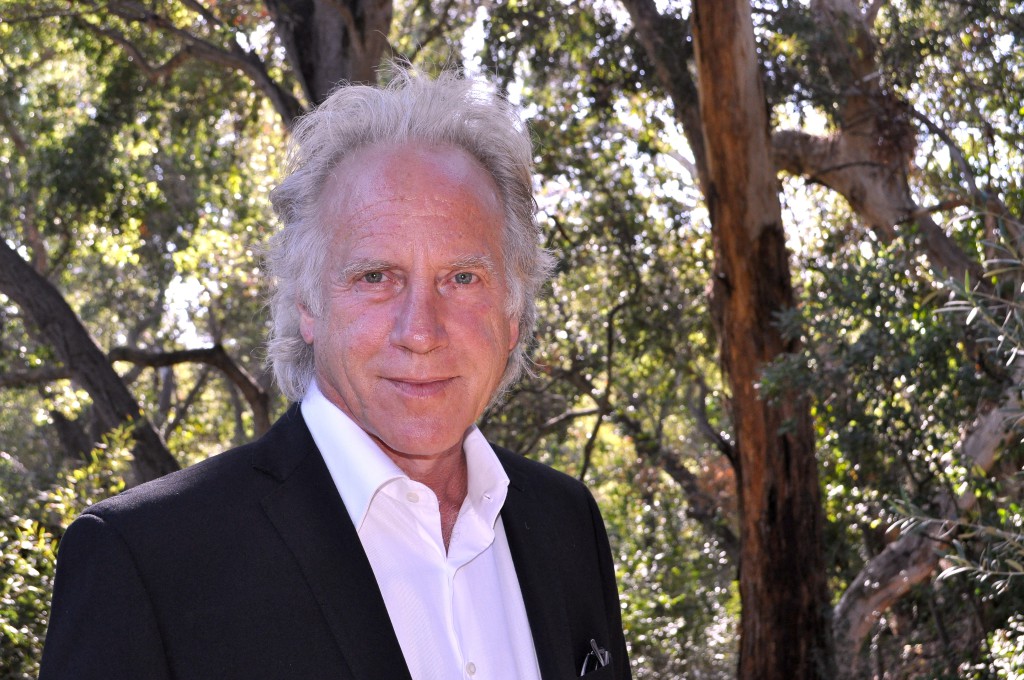
Singled out for praise. Here’s Robert Harrison on the bucolic Stanford grounds in a recent photo.
Is Robert Pogue Harrison the “single most significant writer in the humanities today”? I expect there’s lots of competition for the title, but one writer casts his vote in the current issue of the Southern Humanities Review. We’ve written about Robert so many times that I can’t list them all, but you could start here and here and here and here.
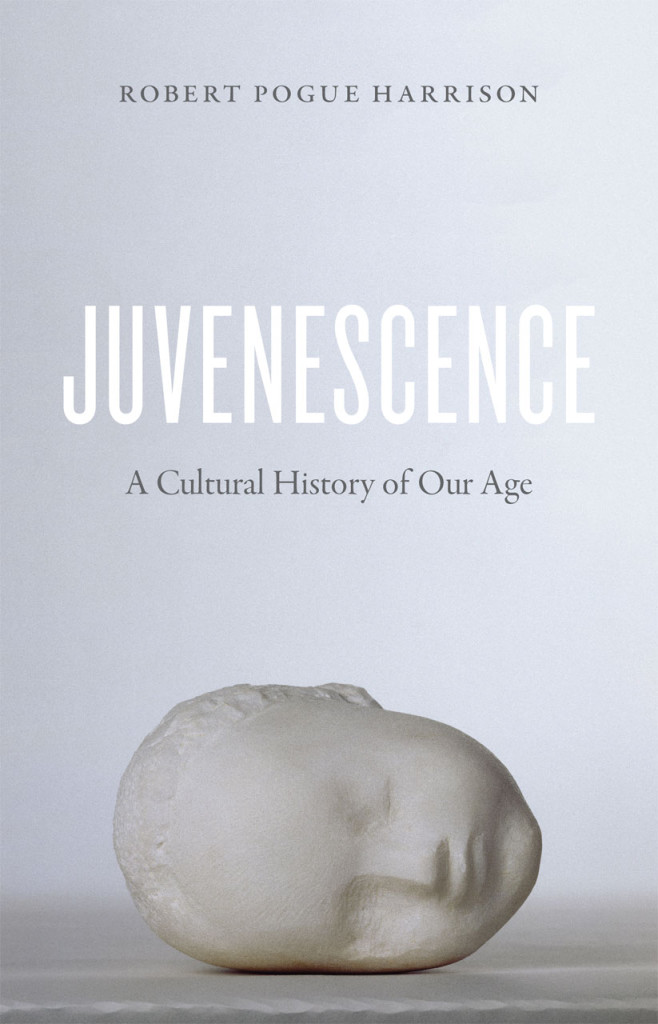
David W. Price builds his case on Robert’s most recent book, Juvenescence, but not only. He points out that the author “developed a particular style of writing that takes readers on a journey through time, tracing a particular concept or trope as it manifests itself in a wide array of literary and philosophical works” – and he recalls that the same approach winds through three of his previous books, too: Forests: The Shadow of Civilization, The Dominion of the Dead, and Gardens: An Essay on the Human Condition.
“In each of his books, Harrison demonstrates that responses to the most fundamental human questions often appear in the most unlikely places and that it takes a formidable intellect and an Auerbach-like memory to be able to discern a particular thread that runs through the tradition.”
Price flags a part of the book that caught my eye, too, especially since Robert has expressed some of the same thoughts elsewhere (try here):
Invoking Benjamin, he points out that “the newness that constant change brings into the world does not replace the ruins, rather, . . . it merely adds to the rubble.” For Harrison, real education involves immersing students in history and allowing them to hear “the dead speak in their own untimely voices.” Such an education appears increasingly hard to come by. Harrison argues that our current age “has declared all-out war on the dark continent of inwardness, silence, and attention, of the self in its wholeness wholly attending.” Those devices that miniaturize the world on a screen and enthrall us actually inhibit our maturation, claims Harrison. “[F]or some reason,” he writes, “the age demands that we remain at all times connected to the Borg collective, that we join its hive and hear inside our heads not the call of world renewal but the incessant drone that fills the network of globalized interconnection.” Harrison’s observations here give us pause, especially any of us who work within the broad field of education.
Price’s encomium includes a sort of prophecy: “In the not too distant future, there will be a book written on the works of Robert Pogue Harrison, and that author will surely note that at the heart of Harrison’s critical consciousness one finds his careful reading and profound understanding of the philosophy of Giambattista Vico. Just as Vico’s New Science grounded Harrison’s understanding of the relation between civilization and nature in his book Forests, the eccentric Italian’s philosophy orients Harrison’s understanding of the youthful nature of our current world.”
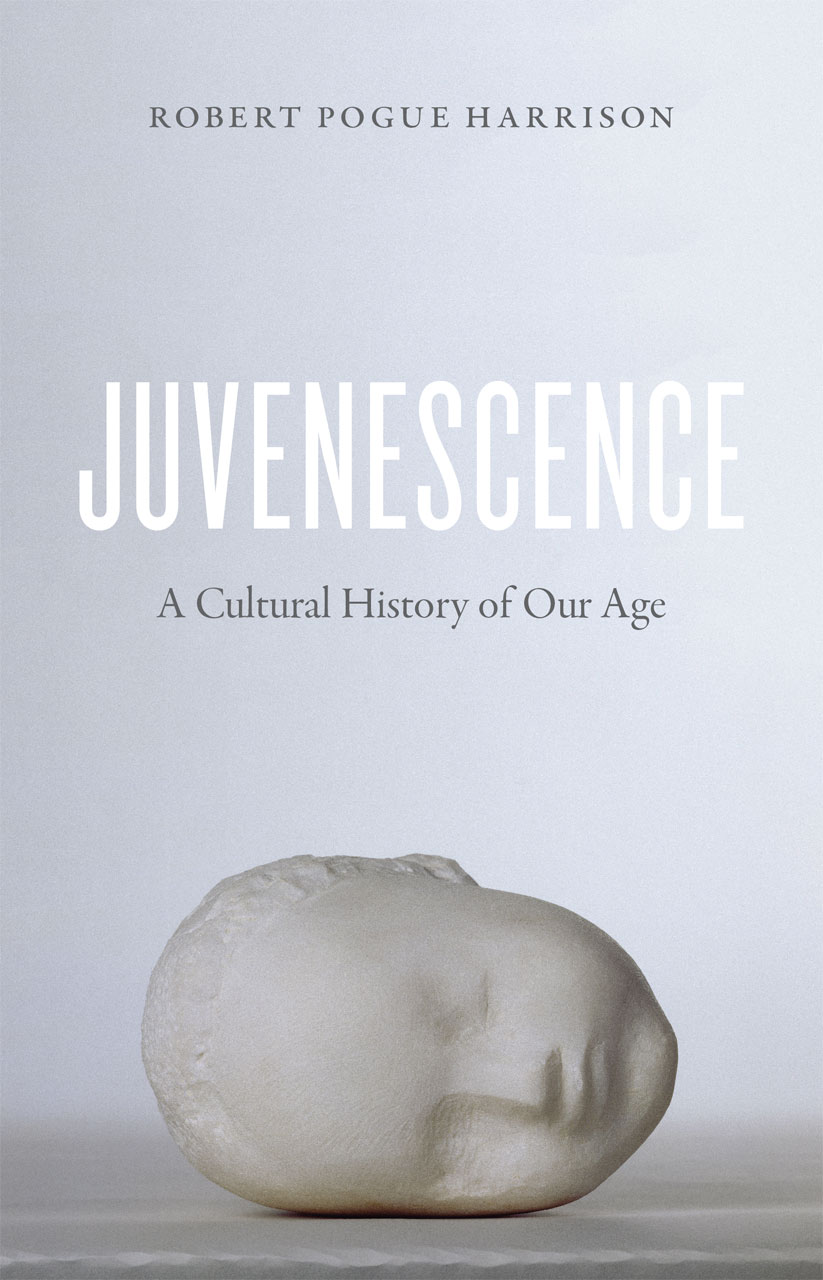
Neoteny. It’s a word that combines two Greek roots: neos, meaning new or young; teinein, meaning to stretch or retain. In evolutionary biology, it’s “a general slowing of the rate of development that makes it possible to retain juvenile features in later stages of the life cycle,” writes Robert Pogue Harrison in his new book Juvenescence (we’ve written about it here and here and here). “We don’t know if society can survive on genius alone without wisdom,” said Robert during a recent radio interview. “We may be on cusp.”
He spoke with Michael Krasny on KQED’s “Forum” (listen to it here), arguing that as the world gets older and the millennia stack up, we nevertheless have become younger than all previous generations – a very difficult paradox, he says.
Like Robert, I have pondered neoteny in our culture. We live longer and longer, on average – but have we had any net gains for human wisdom? Lately I’ve wondered if the added years are simply chunked onto a prolonged adolescence and youth. Education continues into one’s twenties and beyond. People wait till their forties and even fifties to have children. Old age has become a prolonged period of taxidermy.
KQED interlocutor
Still, we’re under the illusion that more time means better life, a greater fulfillment of potential. Does it? Mozart didn’t require middle age to finish his work (well, not much of it – he died at 45), John Keats completed his oeuvre at 25 – both relied on the youthful fire of genius. But what of the balancing wisdom of age? As Silicon Valley strives to extend our lifetimes to the brink of immortality (no doubt only prime specimens will be selected for the honor) – what kind of society will it yield, when the gravitas that traditionally comes with maturity is eschewed in favor of a fevered quest for the trappings of youth?
“I don’t deny that Silicon Valley high tech is every day changing our way of being in the world,” Robert said in the interview. But both he and Krasny pointed out that the most highly touted “revolutionary” changes wrought by Silicon Valley are often producing … well … sophisticated toys and doodads. A new app for local restaurants, for example. The trade-off should cause reflection, Robert said, for we’re increasingly passing our “reality” through the screen of a smartphone. Social media? I’m on Twitter, too, but I realize that it’s driven by a world of children – for teenagers with time on their hands, tweeting their grumbles about school lunches. We can never keep up. In the face of dizzying change, “we need a certain amount of inter-generational stability,” Robert said. Good luck with that. In a world of toys, who wants to be a grown-up? What’s the payoff?
Hey baby, it’s you.
I recall of comedy in the early 60s, the era of the beach party movies and others of that ilk, where you have fun, fun, fun till your daddy took the t-bird away. A staple comedic figure in these films would be a guy who had a title like “Dean of Students,” balding and a little stout and stuffy. He’d burst into the students’ dorm rooms where the girls in bikinis were partying with the boys. Arms akimbo, he’d open his mouth to raise his voice in outrage – and bam! – a bucket of slops prepared for a nerdy student would empty on his head instead. Laughter for all.
As I grew up, I realized what an essential figure the Dean of Students is – and not just for comedy. Somebody had to be the authority figure to say no. Somebody had to be willing to make themselves the figure of fun and face the ridicule of reckless youth, that hasn’t yet learned of the big pricetag attached to early decisions. It’s a thankless role – but part of a grown-up is not waiting for thanks or some sort of payoff to do what needs to be done. Maybe that’s words like “duty” have passed out of our rituals of praise – duty is a drag.
My father used to say that kids don’t need a dad to smoke marijuana with – they’ll find those buddies on their own. (Actually, his example was “to learn to skate,” not marijuana, but still…) Kids need parents to make sure they do their homework, are kind to animals, and can eat without revolting other people. They need grandparents for the lessons of time. Instead, our media regularly shows us a series of elderly women (cough, cough, Helen Mirren, Madonna) in bikinis, to prove to us they can still “get away with it” – and regularly features the masks of famous Hollywood zombies who have had so much surgery that they are now unrecognizable. In that sense, every Oscar ceremony is a “Night of the Living Dead.” This is what maturity offers us – the opportunity to compete with youth.
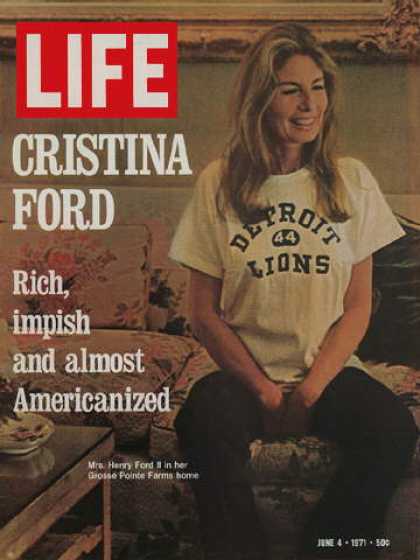
Who wants to be an adult? Growing up outside Detroit, the new Mrs. Henry Ford II, the Italian socialite Christina Ford regularly filled the local newspaper pages – her husband, in fact, rather resembled the Dean of Students in those beach party movies. I remember my mother reading one article where the forty-something Mrs. Ford lamented the disappearance of the Italian mamas of her youth, the thick-waisted, enveloping women in shapeless black dresses, who always had something wonderful about to pop out of the oven. My mother hooted with derisive laughter. “She’s supposed to be one of those women!” And well, you can see from the Life cover above.
Which is not an argument in favor of wearing shapeless black rags. The emphasis on wishing to be mothered, rather than wishing to mother – the wish to be loved, rather than exposing oneself to the great suffering that loving often entails – makes me wonder. What became of maturity, and eventually the graceful surrender to time? There’s a great freedom in not needing to be cool. The evening by the fireside with conversation and port instead of the evening with the trophy bride and papparazzi. (Cough, cough, Salman Rushdie – we wrote about that here.) In our public and political life, many keep calling for a Churchill – but would we want one if we could find one, and would we recognize one if we saw one?
So does that mean that we are all in the throes of adolescence, that we are all young? Not really, says Robert. “We’re a youth-worshiping society,” and yet “our society is waging pitiless war against the condition of youth, which requires idleness, shelter, freedom to fail, full-bodied relationship to nature.” It also requires “the freedom to pursue idiosyncratic call of the self, which requires disconnection from the noise of collective. It bears fruit later in human relations. We have made it more difficult to be truly young.”
Robert recalled leafing through his father’s school yearbook – the teenagers were “fully grown adults – youngish, but fully grown adults. I hardly see that in my undergraduates today.” Similarly, the faces of boys in developing countries who look like “weathered, fully formed adults. Dignfiied, majestic, senile traits – in the First World, we hardly ever acquire them.” Senile, that is, in the classic OED sense – “characteristic or caused by old age” opposed to puerile, “like a boy.” Our older people crave youth, and our youth are born into a vacuum. Are we the heirs of history – or its orphans?
A passage from his book:
“…neoteny resists the tyranny of legacy. To delay the rate of development entails not only a reluctance to grow up but a reluctance to reproduce a fixed and senile form that links us to ancestry by the laws of repetition and identity. In that regard neoteny gives humans a greater species freedom, both from the genetic dictates of the past and for new, as yet unrealized, possibilities. By holding on to the plasticity of youth for much longer periods, and in some cases throughout our entire lives, we have expanded our evolutionary options considerably, becoming over time a lighter, freer, more agile, and adventuresome species. In short, a more intelligent and youthful species. Or better, a more intelligent – because more youthful – species.
“The Ode on Man in Antigone offers us a glimpse into the more terrifying side of this youthful openness to wonder, discovery, and knowledge of the world. The determination to boldly go where no one has gone before takes us to the moon and into the arcana of chromosomes; it gives us the microchip and the atom bomb. Yet for all the novelties it has brought into the world since Sophocles composed the ode, there is one part of the ongoing human story that doesn’t change. Even if our youthful intelligence one day succeeds in rendering death optional rather than necessary, what the chorus says about anthropos will remain true: ‘everywhere journeying, inexperienced and without issue, he comes to nothingness.’ Thus, if our genius derives from our reluctance to grow up, our wisdom derives from our heightened awareness of death … it is when the two work together – and not one against one another – that human culture flourishes.”
Listen to the Robert Harrison interview on Michael Krasny’s “Forum” here.
I ran across this quotation from the Neapolitan philosopher Giambattista Vico (1668 – 1744) in Robert Pogue Harrison‘s new book Juvenescence – and I have been thinking about it ever since. I hope to give the book a fuller discussion later (although we included it briefly in a discussionhere). Meanwhile, consider these provocative words from Vico a sort of down payment in a busy week:
So that, as rational metaphysics teaches that man becomes all things by understanding them … this imaginative metaphysics [of early humans] shows that man becomes all things by not understanding them … and perhaps the latter proposition is truer than the former, for when man understands he extends his mind and takes in the things, but when he does not understand he makes the things out of himself and becomes them by transforming himself into them.

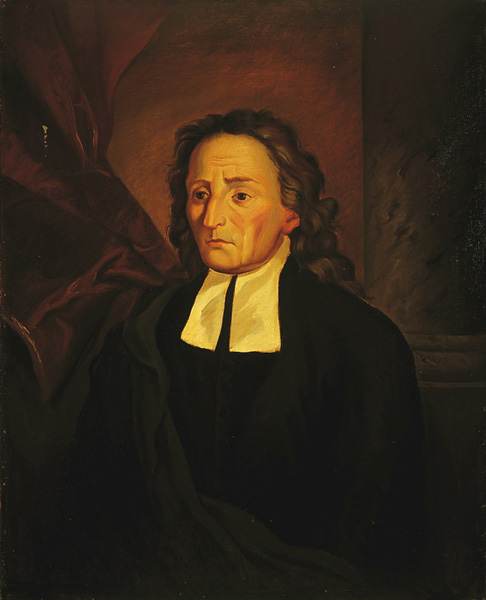
 3. “He was my Dad, he wasn’t exceptional to me.'” J.L. Carr’s son doesn’t quite understand the fuss. “Carr was not an open man, neither was Bob, so theirs had been a perfectly friendly relationship with few confidences exchanged but no confrontations either,” wrote Carr’s biographer. “The result is that when you ask Bob Carr questions about his father, you sometimes feel you might just as well as be asking them of the lodger.” Read about it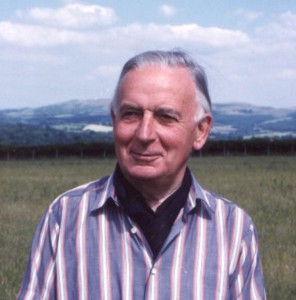
 “In each of his books, Harrison demonstrates that responses to the most fundamental human questions often appear in the most unlikely places and that it takes a formidable intellect and an Auerbach-like memory to be able to discern a particular thread that runs through the tradition.”