
It’s an honor when a highly esteemed writer takes on your book. I’ve had several to date, and yesterday brought another: Patrick Kurp of the matchless Anecdotal Evidence blog reviews Evolution of Desire: A Life of René Girard. It’s the lead story over at the University Bookman here.
He begins with the Three Stooges:

Merci, Monsieur Kurp.
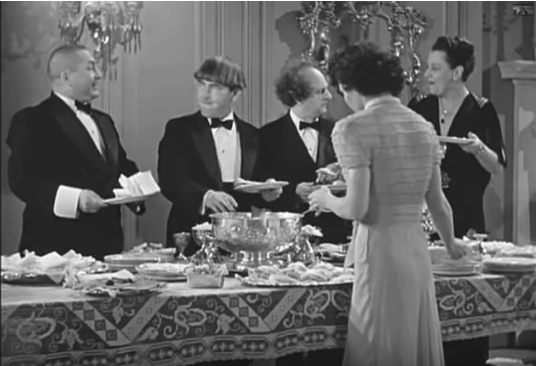
In their 1941 short feature In the Sweet Pie and Pie, Larry, Curly, and Moe are ex-cons hoping to marry three wealthy debutantes. The girls have other ideas. They throw a high-society party and bribe the butler to dump a cake on Moe’s head, expecting the Stooges to disgrace themselves. Moe responds with a cream pie to the butler’s face. A matron, recipient of collateral damage, prepares to retaliate when the butler points at Moe and says: “He did it.” The matron replies, “Thank you, but you started it,” and beans him with a pie. Soon the Stooges and guests in gowns and tuxedoes are enthusiastically heaving pies, and René Girard would have laughed and understood the scene perfectly. Once encountered, Girard’s theory of mimetic desire, his essential contribution to making sense of human nature, is irresistible, and helps to explain everything from slapstick, to social media, to the threat of thermonuclear cataclysm. …
He continues with some kind words for the reviewer and her subject:
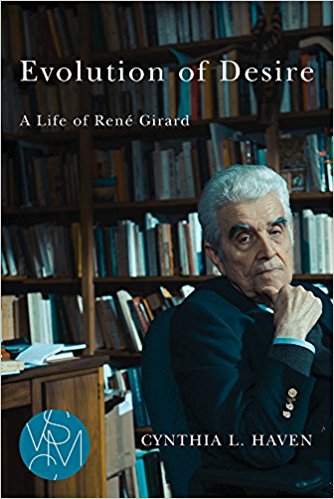 Haven is a seasoned literary journalist who has devoted books to Czesław Miłosz and Joseph Brodsky. She is attracted to the theme of civilization embattled, the persistence of culture, and its defenders in the face of barbarism and indifference. Her study of Girard is neither clinical nor drily academic. It welcomes readers previously unfamiliar with Girard and his work, as well as specialists. It also serves as an hommage. Haven befriended Girard and his family in his later years at Stanford University, an intimacy that provides glimpses of the husband, father, colleague, and friend not immediately available to readers familiar with his thought strictly through his books. Haven draws an attractive portrait of a thoughtful man who, until his death in 2015, was never too self-important to treat others with dignity and respect.
He concludes:
Summarizing Girard’s insights, Haven writes: “We live derivative lives. We envy and imitate others obsessively, unendingly, often ridiculously.… We find it easy to critique the mimetic desires of others, but our own snobbishness and sensitivity to public opinion usually escape our notice. We wish to conceal our metaphysical emptiness from others, in any case, and from ourselves most of all.” As the pies are flying in the Sweet Pie and Pie, Moe pauses and sententiously declaims, “Stop, stop. This has gone far enough. Love thy neighbor.” On cue, five guests, including a pompous U.S. Senator, push cream pies into his face.
Read the whole thing here. And just for you, Gentle Reader, we include the film clip below:
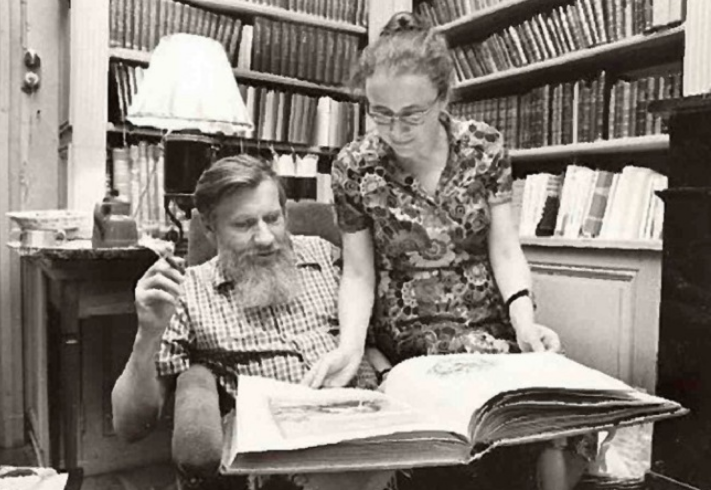
 As Patrick explains: “In 1966 he was sentenced to seven years of forced labor for trying to ‘subvert or weaken the Soviet regime.’ That is, he sent a pamphlet and stories to Paris for publication. Totalitarian regimes pay writers the compliment of taking their work seriously. Modern democracies don’t care, and let’s hope it stays that way.” Let’s hope indeed. Sinyavsky was freed in 1971, and emigrated to Paris, where he died in 1997.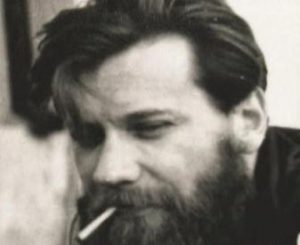
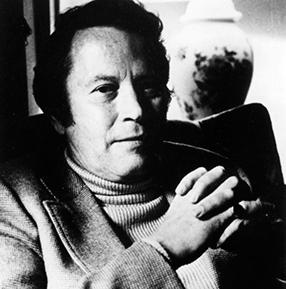
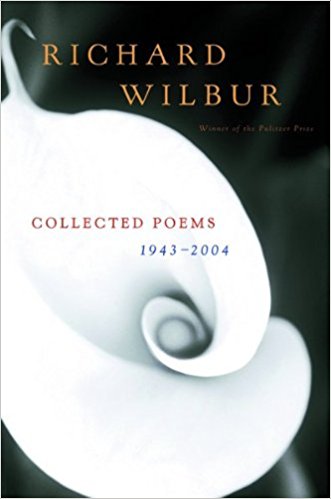 Note the order in which Wilbur describes composition: “fishing” for rhymes, sorting them, winnowing, rejecting most, all the while remembering the “direction and object” of the poem. A good rhyme isn’t the snap of a lock but a key to open the imagination. The ability to write first-rate poetry, like the gifts for mathematics and music (composition and performance), is a freakishly rare combination of rigor and openness. Few have been so lavishly gifted as Wilbur. Tin-eared critics will dismiss rhyme as handcuffs, something artificial to bind the imagination. On the contrary. When Wilbur likens rhyme to a psychologist’s parlor game, he’s not suggesting repressed memories and the unleashing of buried anguish and guilt. Music goes deeper than that. So melodic are some of Wilbur’s poems, so gracefully arranged, one might be tempted not merely to read his lines but intone them, as in these from “A Black Birch in Winter” (The Mind-Reader: New Poems, 1976): “Old trees are doomed to annual rebirth, / New wood, new life, new compass, greater girth.” Ella Fitzgerald would sing this bouncily, allegro moderato, with light stress on the nouns.



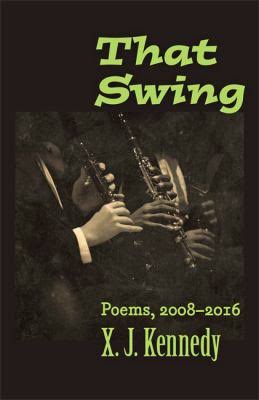 “Kennedy’s standing as a poet recalls the late Thomas Berger’s as a novelist. Berger, the author of some of the funniest novels in the language, always denied being a comic writer, because, in our culture, humor is regarded as suspiciously frivolous. But consider the serious humor of Kennedy’s “Lonesome George,” devoted to a giant tortoise, the last of its species, kept in a pen at the Charles Darwin Research Station in the Galápagos Islands: