
Revisiting Yalta with Milan Kundera, Czesław Miłosz: “We are living in the era of propaganda.”

Share

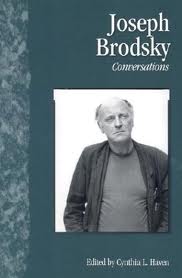
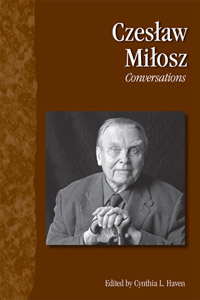
miloszEvery time I pick up Czesław Miłosz: Conversations I run into something terrific I’d swear I hadn’t read before.  I have performed a great service in the world – let me pat myself on the back.  (There, I’m done now).

A week or so ago, I wrote about Yalta, where the major postwar powers divvied up Europe, forking over the east to the tender care of Joseph Stalin. Then I ran across this passage while looking for another for something I was writing.  As so often happens, Miłosz throws a new light on an old matter.  So does Kundera.

From 1986 New Perspectives Quarterly, later excerpted and republished in the New York Review of Books:

Nathan Gardels:  Many Latin American writers argue that there is a great similarity between the U.S. war on Nicaragua and the Soviet war on the people of Afghanistan.  Eastern European writers, Milan Kundera, for example, seem to have a different view.  “When it comes to the misfortunes of nations,” Kundera has written, “we must not forget the dimension of time. In a fascist dictatorial state, everyone knows that it will end one day. Everyone looks to the end of the tunnel.  In the empire to the East, the tunnel is without end, at least from the point of view of human life. This is why I don’t like it when people compare Poland with, say, Chile.  Yes, the torture and the suffering are the same, but the tunnels are of very different lengths. And this changes everything.”

Do you agree with Kundera? Is this also your perspective?

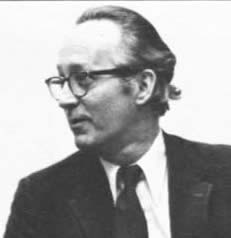
lemonCzesław Miłosz: Yes, yet I feel there is more to be said. Correct reasoning and realistic appraisal are very important. Moral issues are, of course, largely the result of sentimental propaganda. We are living in the era of propaganda.  A basic difference between the various social structures shouldn’t be underestimated. You shouldn’t put on the same scale of balance organisms which are completely different.  You cannot compare a lemon and a triangle.  They don’t belong to the same realm.

In Western thinking, parallelism has a very long tradition. I believe that the plan of division of the world between American and the Soviet Union, of which Europe is a victim today because Europe as a unit is destroyed by division, was due to a large extent to this parallel thinking.

triangleThe problem should be put in terms of certain acquisitions of civilization which risk being lost. For instance, I feel that a division of powers into legislative, executive, and judiciary is a basic acquisition of civilization. There is no reason to be ashamed of such an acquisition which some call “bourgeois democracy”; the worst can be withstood if this division is maintained.

So, the onslaught of the totalitarian state is just a kind of illness.  Of course, whether one cooperates and coexists with illness is a practical consideration. But to compare the two systems on a purely moral basis, that is completely wrong!
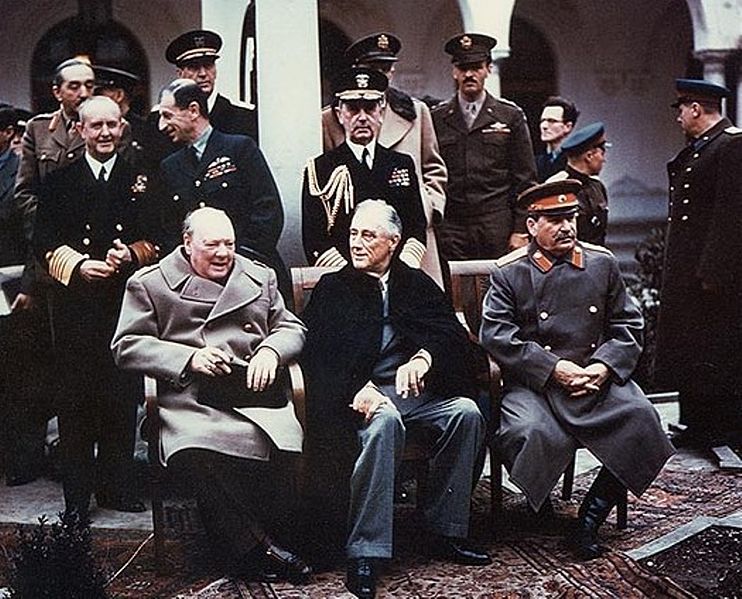
Yalta_summit_1945_with_Churchill,_Roosevelt,_Stalin

“When it comes to the misfortunes of nations, we must not forget the dimension of time.”

Applebaum and Shore: life under communism and its long, bitter aftertaste

Share
Yalta_summit_1945_with_Churchill,_Roosevelt,_Stalin

Decisions, decisions…

I listened to my mother.

I listened to Mummy.

My political education began very young.  When people would praise FDR in my family home, my mother would hiss “Yalta” between her teeth.  The 1945 photograph of Joseph Stalin, Winston Churchill, and Franklin D. Roosevelt sitting side by side at the Crimean resort elicited the muttered remark, “a bunch of criminals” (although she read Churchill’s multi-volume series on the war).  “Poor Neville Chamberlain believed he could trust Hitler. He was wrong. But I don’t think I’m wrong about Stalin,” Churchill naively opined.

Having a mother who was 100% Magyar was a good antidote to political correctness.  And she never forgot nor forgave the conference that forked over most of Eastern Europe to Stalinist rule.  (Perhaps it’s no coincidence that her daughter writes so much about Cold War-era writers from Poland and Russia.)

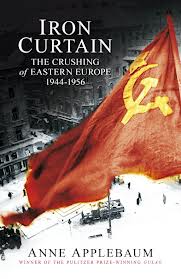
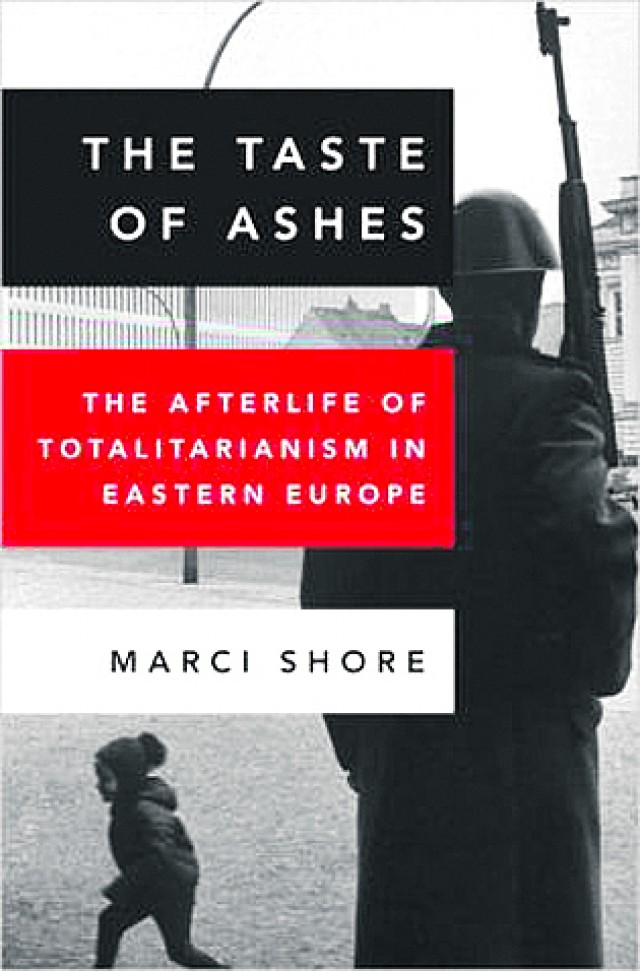
So I read with interest the Christopher Caldwells discussion of two impressive and recent books in the New Republic, Anne Applebaum‘s Iron Curtain: The Crushing of Eastern Europe 1944-56 and Marci Shore‘s The Taste of Ashes: The Afterlife of Totalitarianism in Eastern Europe.  I have endless admiration for both women.  You can read the article, “When Evil Was a Social System: The Moral Burdens of Living under Communist Rule in Eastern Europe,” here.

applebaumbookI pulled out piles of excerpts to cite, but this humble blog post quickly became top-heavy, and I felt the ominous presence of the copyright cops outside my door.  Let me settle instead for citing Caldwell’s concluding paragraphs:

“These two books are a sign that something is changing in our understanding of the twentieth century. Applebaum and Shore, while close in age, are on opposite sides of a generational razor’s edge. Applebaum, born in the 1960s, has adult memories of the Cold War; Shore, born in the 1970s, does not. Applebaum speaks to, and in the idiom of, those who survived totalitarianism. She dedicates her book to ‘those Eastern Europeans who refused to live within a lie.’ Her big, resolute book gives us the most authoritative knowledge we have about communism, and only the most authoritative knowledge.

marci“Shore is engaged in a different project. Her book shows what erudition looks like in the Internet Age. Like a blog string, it records every false step she makes on her way to understanding. Shore almost never writes about important matters in her own voice. This means a loss of authority compared with Applebaum’s more classical style, but it allows her to share more with the reader. It frees her of the historian’s superego. The question of whether the reader can handle certain of the explosive things she has to say about Jews and communism appears not to have occurred to her.  …

“Reasonable historians may differ about whether this sort of history-through-memoir is more honest (transparent) or more cowardly (non-
committal) than the standard kind. But it will be clear to any reader of good faith that Shore has chosen historical guilt as her subject in order to deepen our understanding, not to sow discord or rile anyone up. She has found a way to illuminate certain Polish and Jewish ideas about the worst episodes of the twentieth century that is frank, fresh, and gripping. Guilt, after all, is not just self-inflicted injury but productive moral work. At any time, “guilty” will describe almost any conscience functioning as it should.”

Read the whole article here.

milosz

Right on.

Meanwhile, a final anecdote lingers:  “Applebaum mentions a girl sent home from school for saying, ‘my grandfather says Stalin is already burning in Hell’—sent home not because the teacher disapproved, but to protect the girl, her friends, her grandfather, her school, and the people who ran it. In such circumstances, propaganda can be a balm. It provides a way for men to lie to themselves, to rationalize submission to the strong, to save face. ‘I don’t like everything Stalin says,’ you could mutter (quietly!) to your wife, ‘but someone has to do something about the illiterate.’” Do I detect a whiff of Czesław Miłosz‘s  ketman here?


Joseph Brodsky and the point of vertical takeoff: “there is a murderer in every one of us”

Share
Kline in 1974...

Kline in 1974…

My friend George Kline sent me a clip of the 1972 New York Times article that Joseph Brodsky wrote when he was only a few months out of the U.S.S.R.  The article, translated from the Russian by Carl Proffer, is surprisingly long – my guess is that the New York Times gave at least 5,000 words to this newcomer (I’m estimating from the pdf I have).  At first, it’s not apparent why.  His thoughts appear tangled and verbose and aimless – he sounds, in fact, like a zillion other disoriented dissidents and exiles and defectors of the era.  Then, suddenly, he achieves liftoff.  I excerpt the turning-point below, because it kept me awake the other night after I read it, and lingered into the following day.  Seamus Heaney said of his fellow Nobel poet: “Conversation attained immediate vertical takeoff and no deceleration was possible. Which is to say that he exemplified in life the very thing that he most cherished in poetry – the capacity of language to go farther and faster than expected and thereby provide an escape from the limitations and preoccupations of the self.”  See if you agree:

Brodsky4“… if we are to recall, for example, all those who perished in Stalin‘s camps and jails – not only the artists, but the ordinary, simple people – if we recall these millions of dead souls, where can we find commensurate feelings?  Can one’s own personal anger or grief or shock be commensurate with that mind-boggling figure? Even if one extends those feelings over a period of time, even if one starts to cultivate them consciously. The possibilities for compassion are extremely limited, far inferior to the possibilities for evil. I do not believe in the saviors of humanity, or in congresses, or in resolutions which condemn butchery. None of this is more than flailing away at the air, nothing more than a way to avoid personal responsibility and the feeling that you are alive and they dead. It is all just the reverse side of oblivion, the most comfortable form of the same disease – amnesia.  Why, then, not set up congresses in memory of the victims of the Inquisition, the Hundred Years’ War, the Crusades? Or are they somehow dead in some other way?

If one is to call conventions and make resolutions, the first resolution we should make is that we are all good-for-nothings, that there is a murderer in every one of us, that only chance circumstances save us, sitting in this hypothetical chamber, from being divided into murderers and their victims. What ought to be done first of all is to rewrite all of the history textbooks, throwing out all the heroes, generals, leaders and so forth. The first thing that should be written in the textbook is that man is radically bad. Instead of this, schoolboys all over the world memorize the dates and places of historical battles and remember the names of generals. The smoke of gunpowder is transformed into the mist of history and conceals those nameless and numberless corpses from us. We find philosophy and logic in history. So, it is quite logical that our bodies will disappear too, concealed by one kind of cloud or another, most likely a thermonuclear one.

brodsky2I do not believe in political movements, I believe in personal movement, that movement of the soul when a man who looks at himself is so ashamed that he tries to make some sort of change – within himself, not on the outside. In place of this we are offered a cheap and extremely dangerous surrogate for the internal human disposition toward change: political movements of one sort or another. Dangerous psychologically more than physically. Because every political movement is a way to avoid personal responsibility for what is happening.  Because man fighting on the exterior with Evil automatically identifies himself with Good and begins to consider himself a bearer of Good. This is no more than a kind of rationalization and self-congratulation; and it is no less widespread in Russia than anywhere else, although it perhaps has a somewhat different coloration there – because there are more physical reasons for it, it is more determined in the literal meaning of the word.  As a rule, communality in the sphere of ideas has not led to anything particularly good.

Terror’s human face: Women of the Gulag – the book and the movie. Help make it happen.

Share

Marianna Yarovskaya on location

I met Paul Gregory a couple years back, when his Politics, Murder, and Love in Stalin’s Kremlin: The Story of Nikolai Bukharin and Anna Larina (Hoover Institution Press, 2010) was just out.  I wrote about it, with a video of Paul, here) … well, “writing” might be too strong a word.  His noontime presentation at Stanford was so tight and so compelling that I pretty much presented what he said, as he said it.  I didn’t have to do much more.  (I’ve written about his Lenin’s Brain and Other Tales from the Secret Soviet Archives here).  Since meeting him, he’s become a high-powered economics blogger at Forbes 

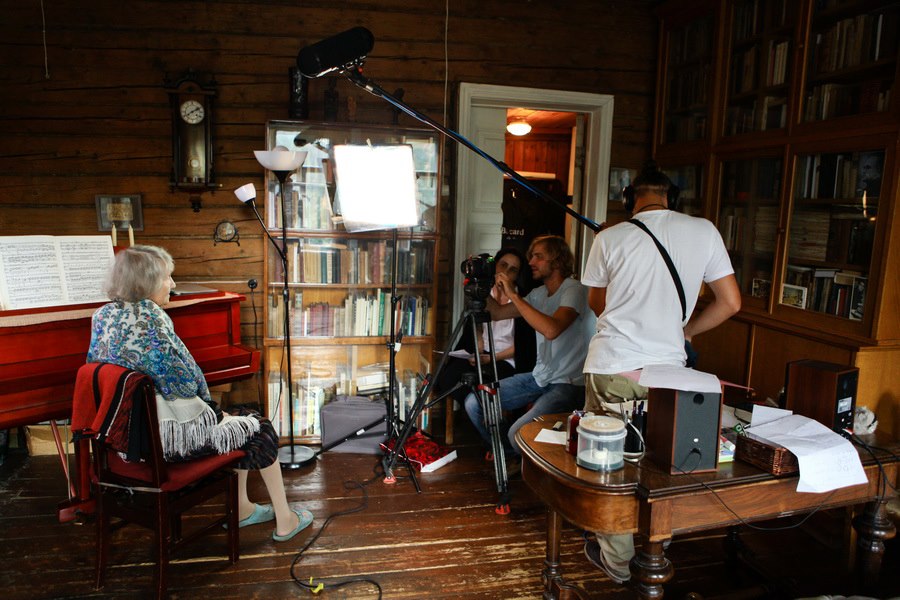
Filmmaker Marianna

The Bukharin book was such a great story, I kept seeing it as a film.  Instead, he’s saved the film for his newest book, Women of the Gulag.  He’s teamed with Muscovite documentary filmmaker Marianna Yarovskaya.  Paul told me some time ago about his newest effort: I was against several deadlines and didn’t have the extra brain cells to process it then, but given his previous book, I had little doubt that it would be stellar.

It is.  From his introduction:

A remark often attributed to Stalin is, “A single death is a tragedy, a million deaths is a statistic.”

This is the story of five such tragedies. They are stories about women because, as in so many cases, it was the wives and daughters who survived to tell what happened.

These five women put a human face on the terror of Stalin’s purges and the Gulag in the Soviet Union of the 1930s.  They show how the impersonal orders emanating from the Kremlin office of “the Master” brought tragedy to their lives. They cover the gamut of victims. Two are wives and daughters in ordinary families unable to comprehend why such misfortune has overtaken them. A third is a young bride living in the household of a high party official. The last two are wives of the Master’s executioners. These stories are based on their memoirs—some written by themselves, others by close friends or by their children.

Writer Gregory

Here’s the deal.  The book will be out early next year with Hoover Institution Press.  But the movie is in limbo until you pitch in over at kickstarter here.  The filmmaker is trying to raise $30,000 to finish the film, and she has 57 more days to raise the money on the kickstarter deal, which ends December 23.  Think of it as a Christmas present to Russia … or better yet, to mankind, because this history is important to record.

Applebaum at Stanford

“Why film a bunch of old babushkas?” Marianna is asked.  According to Washington Post‘s Pulitzer-prizewinning Anne Applebaum, who appears in the film, “Aside from its historic value, a project like this one has special significance in the light of contemporary Russian politics. In recent years, under President Putin, Soviet and Russian history have been re-politicized, and the Stalin period has come to be viewed with ambiguity by politicians, writers, film makers, and regrettably the public. The stories of the victims of the gulag, told by simple people who had little or no understanding of why this was happening to them, make an excellent antidote to creeping historical amnesia. This project is also urgent, of course, because most of their subjects are in their advanced years, and their stories have to be recorded now.”

Filmmaker Marianna explains why she’s passing the hat:  “We are now continuing the campaign and the project and are in post-production. We are also interviewing more women in other parts of Russia. We already have almost 40 hours of footage. These funds will go towards recording more testimonies on HD video and towards editing the footage we have gathered. Clearly the timing is urgent as the survivors and the heroines of the original Stalin gulag are getting very old. This is “the last chance.” (Marcel Krüger has an interview with her here.)

The film below gives a preview of their work.  I hope you find it as riveting as I do – and please do pony up whatever you can over at Kickstarter here.  Time is of the essence.  As always.

Forgotten tale of how America saved a starving Russia

Share

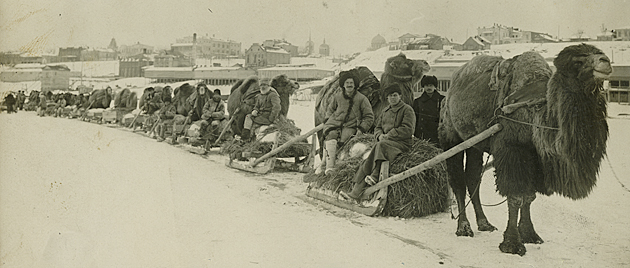
American Relief Administration transport column on the frozen Volga. (Photo: Hoover Institution Archives)

Every so often, a journalist stumbles upon a great, untold story during routine research or interviews.  And other times, a mammoth TV organization, such as PBS, stuffs a press release and DVD into your hand and urges you to cover it.

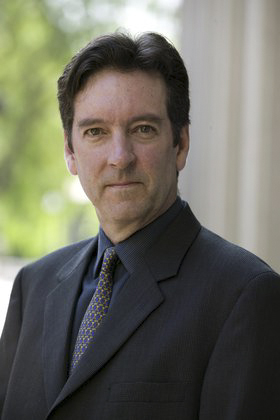
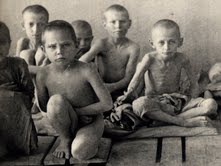
The latter case is how I found out about the terrible Russian famine of 1921-23 – and the American charity that alleviated it, marking perhaps the first time a large-scale relief was extended to an enemy. Historian Bertrand Patenaude tells how Herbert Hoover saved more lives than any person who has ever lived. Yes, I know, hard to believe, but apparently true.  (I wrote about it here.)

It’s at once a grim, inspiring, and astonishing story – the American Experience broadcast, The Great Famine, airs nationwide on Monday, April 11, on PBS.

The world barely remembers the terrible famine in the Soviet Russia – why?

Author, author!

Bert Patenaude, author of The Big Show in Bololand: The American Relief Expedition to Soviet Russia in the Famine of 1921, told me that he was a Stanford graduate student writing the last chapters on his dissertation about early Bolshevik food policy when, as he explains it, “I’m seeing what wasn’t such a simple story from the communist side.”

“This was a huge famine could have brought the whole country down.  And Americans were bringing in food supplies and relief,” he said.  “I couldn’t figure out why nobody talked about it – I resolved at that point to write a book.”  (The Stanford University Press book received the 2003 Marshall Shulman Book Prize.)

Of course, a decade later there would be a Stalin-engineered Ukrainian famine that is now considered genocide.  That famine, which killed 5 million Ukrainians, has become well known – perhaps, as Bert suggests, because it is “associated with the evil figure of Stalin.” Nevertheless, “this earlier famine was out right out there in the open.”

Orphaned and abandoned children

Author Maxim Gorky wrote to Hoover on behalf of the Soviet government to praise the relief efforts in 1922:  “Your help will enter history as a unique, gigantic achievement, worthy of the greatest glory, which will long remain in the memory of millions of Russians whom you have saved from death,” he wrote.

It didn’t happen. The Soviet government had a strong interest in forgetting.  In any case, 1921 was a pivotal year for the new market economy, said Bert.  That new economic policy (NEP) received the thunder – and the death of perhaps 10 million helpless Russians was quietly erased from the history books.

“As students in history in the 1970s, we did the same thing,” said Bert. “We would never talk about this famine.  We would talk about NEP.”

When I was writing the story about his research and the PBS show, I hesitated … I couldn’t say that Bert had actually rescued the tale from oblivion.  I was sure to get at least five angry scholars writing to me to complain that they had known about it.  Yet Bert admits that the reaction to the story, typically, is “Why didn’t I know anything about this?”

Bert had the perfect Solomonic suggestion:  he has retrieved the tale from archival oblivion.  With the PBS film, it will no longer be something buried in the Hoover Archives, or a footnote at scholarly conferences – but it will enter the public consciousness, where it deserves to be.  Even Gorky said so.

(Preview below.)

Watch the full episode. See more American Experience.

Mexico, war, genocide, and Richard Rhodes

Share

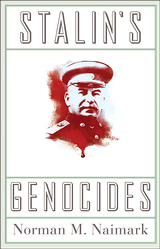
Yesterday, the opening of the Mexico bicentennial exhibition — a true fiesta, with tamales, top-notch horchata, chips and guacamole, and other munchies I didn’t have time to sample, along with a man named William Faulkner playing Mexican tunes on a harp.  I have a personal debt to Mexico, and came to pay my respects — but my conversations tended to turn instead to my article about Norman Naimark and the need to broaden our definition of genocide to include Joseph Stalin‘s millions of murdered people.

Hoover librarian Lora Soroka, who is Ukrainian (land of the Holdomor) and archivist Linda Bernard were particularly pleased that someone was finally nailing Stalin for genocide — the article is featured on Hoover’s home page.  Frankly, I’m surprised there are two opinions about that.  My article on Naimark’s new book, Stalin’s Genocides, left out so many aspects of our discussion. (We spoke on a sunny day on an outdoor patio, overlooking the Bay, at the Center for Advanced Study in the Behavioral Sciences, where it seemed almost indecently incongruous to be discussing crimes against humanity.)

Naimark said, “Intent is very important in genocide.” In the case of the American Indians, more often than not “the intent was to steal land in any way possible” — which makes it an instance of ethnic cleansing, rather than genocide.  And yet, individuals within that context acted with “the intent to wipe out a tribe.”  Hence, that history is one of ethnic cleansing marked by incidents of genocide, he said.  Evidently, the lines of international law are blurry.

One question I would like to see explored more powerfully is the link between technology and genocide.  Clearly, incidents within archaic society — for example, the Old Testament “bans” where every man, woman, child, and even livestock were killed to remove every trace of a people — show genocidal intent.

But technology has magnified our ability to commit genocide — technology enables imitation, which brings us directly into René Girard‘s territory, and also into Hannah Arendt‘s.  She observed in Eichmann in Jerusalem that once an unprecedented crime occurs, it is likely to repeat itself:  “If genocide is an actual possibility of the future, then no people on earth … can feel reasonably sure of its continued existence without the help and the protection of international law.”

Replication occurs through the medium of modern communication, which also enables the event itself.  Could the Rwandan massacres have occurred without national broadcasters egging the murderers on, announcing the victims’ locations and tracking them as they tried to flee?  It would be impossible to murder a million people in 90 days without coordination, moving the murderers and murdered to locations where they can be effective shot or gassed en masse.

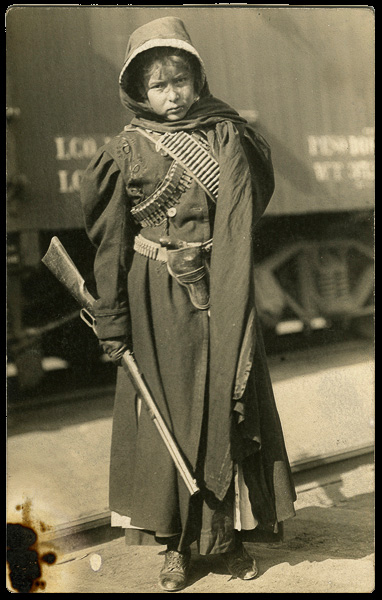
The less glamorous side of revolution: Mexican girl, probably an orphan, on a postcard. (From Stanford collection)

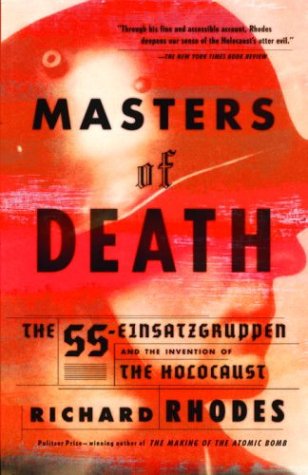
That brings us back to the Mexican celebration.  Andrew Herkovic was barking at me (we were all barking in the din of the gathering) about the work of Richard Rhodes, who wrote 2003’s Masters of Death: The SS-Einsatzgruppen and the Invention of the Holocaust.  His research discovered how murdering people the traditional way, one by one, proved traumatic for the murderers.  The Nazis escalated cautiously, improving mass murder methods; and finally,  “conditioning” the troops, to avoid “disabling trauma.”

The Jerusalem Post notes that Rhodes’s book “graphically and chillingly details the work of the special killing battalions of Himmler’s SS. . . Extremely well-written. . . [A] fine work of gruesome history.”  But I wonder, by detailing the crimes, do we risk their repetition?  By speaking about the unspeakable, do we ensure that it becomes a blueprint?

Coincidentally, Andrew had Rhodes’s cell phone number — he scribbled it down for me.  I’ll try phoning him today.  My reason:  Rhodes will be here for a November 11 talk during our Ethics and War program.  As war becomes more and more total … what do “ethics” mean in war?