

Paris Review’s Blair Fuller: writer, editor, and mentor extraordinaire dies at 84’

Share

“A sweetheart through and through”

Blair Fuller, former editor of the Paris Review, creative writing teacher at Stanford, and co-founder of the Squaw Valley Community of Writers – and mentor to many – died of cancer on July 23 in Petaluma.  He was 84.

Fuller wrote several novels and short stories, twice winning an O. Henry prize for short fiction.

“He was very gentlemanly, a sweetheart through and through,” said Edwina Leggett, who co-owned Minerva’s Owl bookstore on San Francisco’s Union Street with him, in the San Francisco Chronicle.  “He was very affectionate. He was kind to everybody.”

The New York native served in the Navy during World War II, then took a Harvard degree in philosophy.  In the 1950s, he went to the Ivory Coast and Ghana to work as an executive for Texaco. His first two novels were based on his experiences in West Africa.

The peripatetic writer moved to Paris and became one of the early editors of the Paris Review. According to an obituary on its website:  “He read each issue cover to cover and was quick with both praise and criticism: ‘The Levé piece is my favorite. I feel badly that he ended his life. An interesting and original man … I wish Beattie could be trimmed a bit. Bolaño never did grip me. Otherwise a fine issue.’ His first response to the Daily was typically forthright: ‘What a terrible idea!’”

When Pulitzer prizewinning author Wallace Stegner invited him to come and teach at Stanford in the 1960s, he headed West and never looked back.

According to the San Francisco Chronicle obituary:

After a few years at Stanford, Mr. Fuller co-founded the Squaw Valley Community of Writers with writer Oakley Hall. It was there he met actress and playwright Anna Deavere Smith, who was just launching her career and became a lifelong friend.

“He really helped me think of myself as a writer,” she said Friday. “He just intuitively understood my work. … He was absolutely invaluable to my development as a writer.”

Mr. Fuller also served on the board of the Magic Theater and American Conservatory Theater.
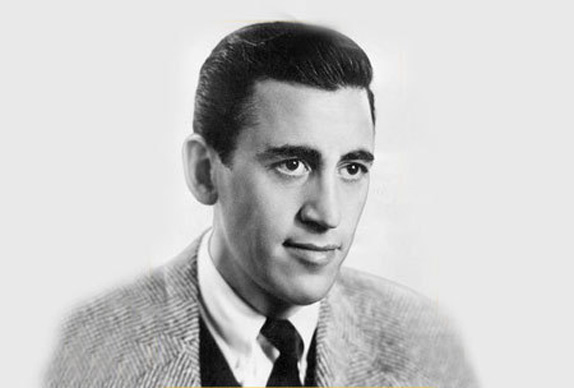
Salinger: “His cufflinks caught the light.”

In more recent times, he began to send his reminiscences to the Paris Review‘s blog.  Two from June:  An article about Harold “Doc” Humes‘s LSD party with Norman Mailer in 1960 is here; and his piece blandly titled, “An Evening with J.D. Salingerhere.  The latter is a real ‘wow’:

A headshot of him had appeared on the Catcher book jacket—dark hair slicked back above a longish, handsome face. This night he was well dressed in a suit with a faint glen plaid pattern, a white shirt whose collar was secured behind the knot of his necktie by a gold collar pin. His cufflinks caught the light. Why did his elegance surprise me?

But the reclusive writer was far from elegant.  I won’t give away the rest.

Mailer and Fuller had a rematch in the 1970s, when the pugnacious author stopped by Minerva’s Owl.  Fuller was busy, so he sent Leggett to entertain the notoriously difficult New Yorker:

“I was nervous and mad Blair was abandoning me,” Leggett said. “I said, ‘Lordy, what will I do with Norman Mailer?’

“Blair said, ‘That’s easy. Take him to the nearest bar.’ “

Postscript on November 9, 2021:

I had no idea “Mr. Fuller” had died. Fuller was a fine man, thoughtful teacher, who took over a college class from George Plimpton, a break for coeds. None of us shambled in with pajama bottoms rolled up under raincoats. 

He would have encouraged me when I stopped painting and making movies to write a book. Always supportive. The book is written. I’m in Submissions Purgatory. Shall I channel him?  – Ever, S. Again
Poet Moore Moran: A death in Ordinary Time

Share

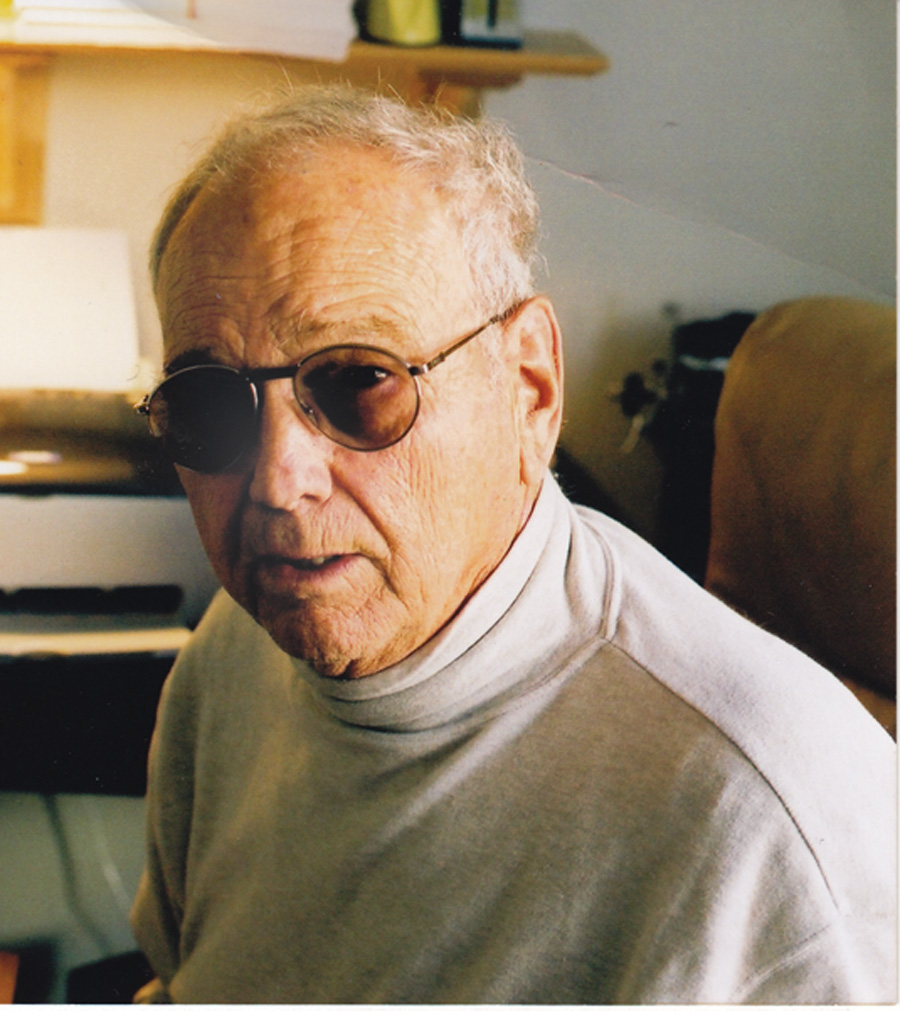
Moore Moran, Sept. 27, 1931 - Feb. 27, 2011

I received an email from my publisher at Ohio University Press/Swallow Press earlier this week – the poet Moore Moran, known to his friends as Mike, died on February 27.  He was 79.

I had blogged about the Santa Rosa poet here and here. He had published his first full-length book, Firebreaks, in 1999 – it bagged a National Poetry Book Award.  His newest book, The Room Within, was published last year.

“Imagine a poet who could deal with the experience of Jack Kerouac but with too much intelligence to limit himself to the road. You don’t have to imagine him. He exists. He has many skills, all of them beautifully bright, and on occasions when he looks into the abyss they take him safely over it,” said Turner Cassity of Moran’s poems.

But I was startled when I reread the email a few days later and realized I had overlooked that the memorial would not be in Santa Rosa, but nearby, in Menlo Park – where, it turns out, he had graduated from high school before getting two degrees from Stanford.

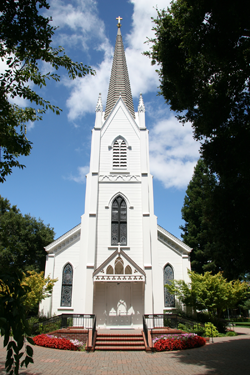
So I dropped in on Friday afternoon to pay my respects to a poet in the century-old Church of the Nativity.  But it was not a poet who was being honored so much as  “husband, father, grandfather, great grandfather, father-in-law, friend, poet,” according to the program.

He was much loved.  About 150-200 friends and family came to the mass, with bluegrass guitar and bass fiddle performers Dennis and Ehlert Lassen singing “Amazing Grace” and Leonard Cohen’s “Hallelujah.”  Not necessarily what one would expect from the poems, with their bleak, spare mystery.

Surprisingly, everyone looked like they had come for the same event – the men were all in jackets and ties, and the women in somber suits and dresses. Banished were all traces of “California casual,” where some people look as if they had wandered in from the garden or the beach or a cocktail party.  Nor did there seem to be any poets on hand from the “Yvor Winters Circle” – but then, the room was crowded and I was in a back corner, and this was a very quiet death, after all.

The priest, referred to only as “Father Davenport,” recalled that Moore Moran, despite disability, was “always smiling” and “a good man.”

His son, businessman Mike Moran, said, “I never stopped amazing my dad, and my dad never stopped amazing me.”  The son, to put it mildly, was not a poet or lit freak.

His father taught the kids Latin and music, as well as Yvor Winters, John Steinbeck, and J.D. Salinger.  He was “an encyclopedia of jokes,” recalled his son.  And, in fact, the program included his poem “Just Joking,” written on his 51st birthday, when he had “maybe a third of a tank left”:

…the bewildered heart in us which,
Year by year, measuring our slim attainments
With mounting despair, still feeds
In its recesses some faint hope, despite
The certain knowledge that what it hopes for
Cannot change the tide…

“He was often lost in afterthought,” said his son.  “I’m certainly no poet, but I came to appreciate my father’s poetry.” He recalled the children’s hesitancy to have their father correct their writing, because “then we’d go back for another hour of writing.”

But sometimes dad came in handy.  Moran Jr. recalled a long discussion his father launched when the son was having trouble “getting” Chaucer‘s Canterbury Tales.  The next day in class,  Moran Jr. performed the usual duck-and-hide with averted gaze, to avoid the teacher targeting him with a question.  The teacher targeted him anyway.

Thanks to his dad’s monologue, the so-so student poured forth with a reply “at a depth and level far beyond what my teacher had.”

The class was “absolutely stunned.  The whole room was silent,” he recalled.

“I was bumped up to AP English,” he said, and paused for only an instant. “That lasted about four days.”

On Moran’s memorial page at legacy.com, David Sanders wrote: “A gentleman and a fine poet. It was an honor to edit and publish his last book.”

“Just Joking,” with its rambling style is nice, but my favorite Moran poems are quick and cryptic – like this one:

Ordinary Time in the Pews

Church of the Nativity, Menlo Park

Ordinary days again.
Advent, Pentecost are past;
who now will accept our sins,
raise the dust in which we’re cast?

Cold the God flesh on the tree,
banned the crèche to attic murk,
sheer the silence after prayer.
Nothing seems at all to work.

Yet we try and try again
serving Him we hardly know:
honk if you love Jesus, friend,
beeping blessings as we go.

Here we meet who, somehow, must
rescue meaning from the dust,
where betrayal’s kiss presents
our best hope of relevance.

PostscriptPatrick Kurp at Anecdotal Evidence has added a lovely tribute here.  “Earth only will find him cold.”

Postscript on 3/7: Looking online for others who remember Moore Moran, I found this mini-memoir from Peter Robinson.