
More on “taking responsibility” and other hackneyed phrases

Share
(Image adapted from the Tumblr this isn't happiness, via ffffound)

(Image adapted from the Tumblr this isn't happiness, via ffffound)

My call to arms a few days ago (“Orwell watch #9:  ‘I take full responsibility for...'”) was picked up by Andrew Sullivan in The Daily Beast – here.  The passage he highlights:

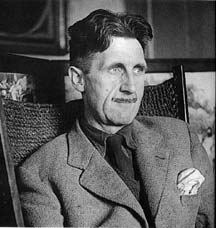
I suspect the phrase “take responsibility for” is actually a journalists’ invention, and people like Weiner picked it up from the media, rather than his heartfelt intentions. As George Orwell said in “Politics and the English Language,” this one could be “killed by the jeers of a few journalists.” I call out to journalists everywhere to jeer this phrase out of existence – unless it really means taking responsibility, the way I “took responsibility” for, say, raising a child, by paying for her upbringing, nursing her through illness,  attending back-to-school days, and preparing dinner every night.

Sure would be nice if we could we could drive this phrase into late-night comedy, wouldn’t it?  This expression has been due for the slaughterhouse since the IRA mayhem in the 1960s, and has made its small contribution to dulling our sense that words have meaning, and are meant to convey our feelings, thoughts, and intentions – not conceal them.
Language fails

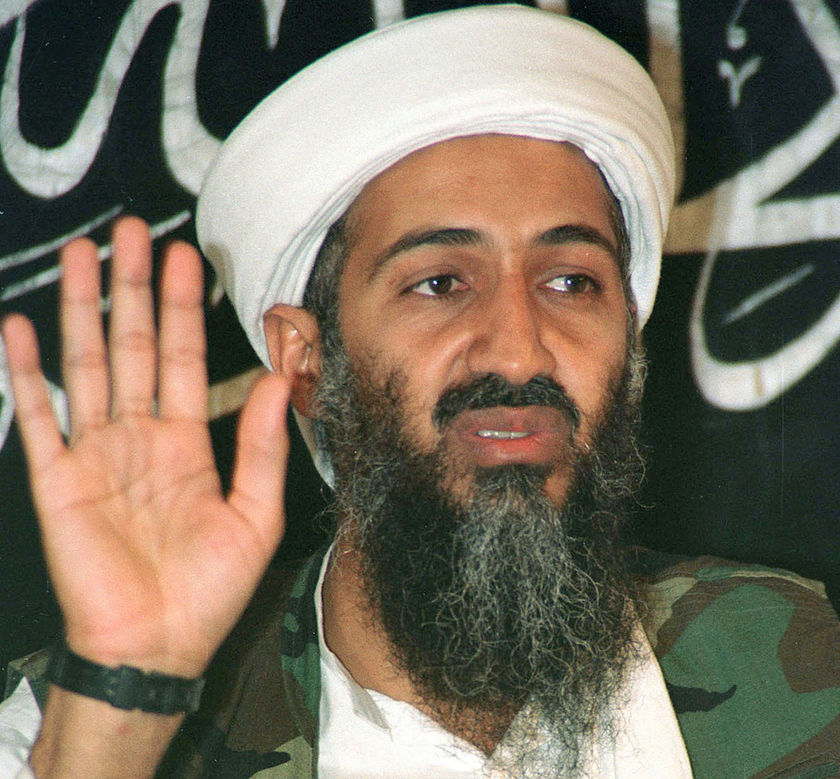
Meanwhile, the post generated some interesting conversation over at Frank Wilson‘s Books Inq. I was singled out, rightly, for a little criticism from Art Durkee:  “Calling [Osama] bin Laden‘s death ‘liquidation’ is also pretty Orwellian, it seems to me. Let’s call a spade a spade: it was a retaliatory political assassination.  But then, a great deal of political euphemism is and always has been Orwellian.”

Liquidation is indeed a strange term – did he dissolve into water? “Liquidation” sounds like the final sale at a failing bookstore, anyway. A colleague corrected me when I said “murder,” arguing that murder was a legal term, calling for the prosecution of the murderer.  One is at a loss – what neutral term can one say nowadays? Osama bin Laden’s “offing”?

Art’s p.o.v.:

“I don’t think there is a neutral term. I think you have to call an assassination what it is.

I think we have to be honest when murder is murder, and not whitewash it. (The best argument, for example, that I’ve heard against the death penalty is that it means that murder is criminalized for anyone to commit except the state.) Similarly, assassination needs to be called what it is, and acknowledged as the political tool it has always been, sanctioned or otherwise.

History may show if this particular sanctioned assassination (sometimes called a ‘sanction,’ or ‘termination with extreme prejudice’) was the right and good thing to do. Lots of people are claiming that already, but they’re also ignoring what making someone into a martyr can do. It’s a tricky call, and those who set policy ought to lose sleep over it.

But that’s the whole pattern that Orwell pointed out, isn’t it: the neutralization of language into mechanical, denatured, unemotional, technical terminology that allows one to deal with humans as dehumanized. Turn people into inhuman statistics, and you can sleep at night when you talk about ‘collateral damage,’ or ‘friendly fire,’ for example. Do that kind of neutralization of language enough, and you dehumanize yourself as well, Orwell warned.”

And so did Mark Twain, in ‘The Way Prayer.'”

Thoughts?
Orwell Watch #10: Literary criticism, or cut-and-paste?

Share

"Astonishing"

Joe Queenan, in his 2007 “Astonish Me,” describes his fixation with books that are called “astonishing.”  Hence, he’s got a lot of reading to do:

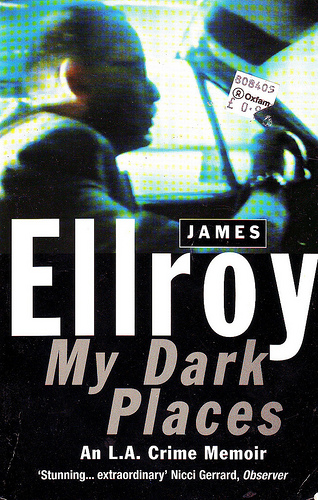
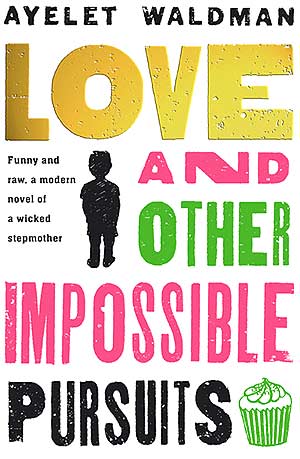
These are good times for the astonishable reading public. Among the masterpieces by Orhan Pamuk, who won last year’s Nobel Prize for literature, was The New Life, described by The Times Literary Supplement as ”an astonishing achievement.” Pamuk’s Nobel coincided with the premiere of a Court TV series based on James Ellroy‘s My Dark Places, a book that had been quite accurately described by The Philadelphia Inquirer as ”astonishing … original, daring, brilliant.” Not long before, Ayelet Waldman came out with Love and Other Impossible Pursuits, which, while apparently not astonishing in and of itself, did include a character that the novelist Andrew Sean Greer described as ”astonishing.” Then, Abigail Thomas published A Three Dog Life, singled out by Entertainment Weekly as ”astonishing,” and an ”extraordinary” love story — ”Grade: A.” Personally, I find the Grade A business redundant; if a book is astonishing, you’re obviously not going to give it a B.

Which brings us to Ward Six‘s “Literary Blurb Translation Guide,” a guide to literary grade inflation.  Here’s some of the site’s shortlist:

“brilliant” = smarty-pants
“profound” = written by old person
“taut” = limited vocabulary

"Pellucid"

“finely wrought” = namby-pamby
“clever” = thinks it’s being clever
“luminous prose” = too many goddam words
“a tour-de-force” = threw it across the room
“a triumph” = huge advance
“unflinching artistry” = lots of boobs and stabbing
“grabs you on page 1 and won’t let go” = stuck reading it on long flight
“achingly beautiful” = really long sentences
“a story for the ages” = ripoff of Tolstoy
“best of the year” = only thing I’ve gotten around to reading
“deeply imagined” = makes no sense
“incredible range and breadth” = all over the place

"Astonishing"

“radiant” = already been blurbed by people more famous than me
“rich language” = not enough paragraph breaks
“goes straight for the heart” = sappy
“trenchant satire” = poop jokes
“a small gem” = will sell five hundred copies, tops
“you’ll feel forever changed” = you will never get those hours of your life back
“searing…glorious…a fury of dazzling transcendence” = I’m just stringing random words together now

Ward Six readers offered more:

From Sung:  “astonishing” = cover is glossy instead of matte

From Violentbore:  “bildungsroman” = main character is younger than me

Michael Garberich said “My favorite has always been ‘uproarious’ – You might not laugh, but you know you’re supposed to at some point.”

From Aaron:  “Deeply felt” = astonishingly narcissistic.

Here’s Russell:

haunting = someone dies

pellucid = someone drowns

galloping = someone gets thrown from a horse

"Astonishing"

It keeps you honest.  I have to admit to an over-reliance on some of the clichés these folks have targeted. As George Orwell writes in “Politics and the English Language“:

Meaningless words. In certain kinds of writing, particularly in art criticism and literary criticism, it is normal to come across long passages which are almost completely lacking in meaning. Words like romantic, plastic, values, human, dead, sentimental, natural, vitality, as used in art criticism, are strictly meaningless, in the sense that they not only do not point to any discoverable object, but are hardly ever expected to do so by the reader. When one critic writes, “The outstanding feature of Mr. X’s work is its living quality,” while another writes, “The immediately striking thing about Mr. X’s work is its peculiar deadness,” the reader accepts this as a simple difference opinion. If words like black and white were involved, instead of the jargon words dead and living, he would see at once that language was being used in an improper way.

Orwell Watch:  Collect the whole set!

Orwell Watch #9: “I take full responsibility for…”

Orwell Watch #8:  “I know you’re disinterested in this, but…”

Orwell Watch #6:  “Like” and the culture of vagueness

Orwell Watch #5: Before we shoot off our mouths again…

Orwell Watch #4: Jared Loughner:  Madman, terrorist, or both?

Orwell Watch #3:  Please. No “gifting” this Christmas.

Orwell Watch #2: Murder in Yeovil

Orwell Watch #1: Paul Krugman vs. George Orwell. (Hint: Orwell wins.)

Orwell Watch #9: “I take full responsibility for…”

Share

Taking responsibility, or accepting blame?

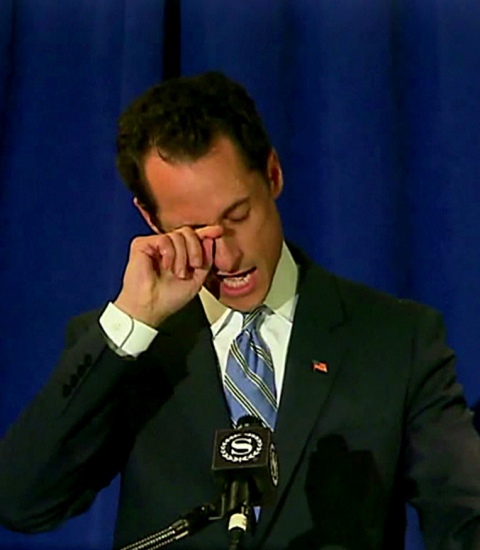
“I came here to accept the full responsibility for what I’ve done,” New York Rep. Anthony Weiner said at yesterday’s press conference, following his disclosure of unseemly online relationships with women.

But does he?  And what exactly does “take full responsibility” mean?

This verbal formulation, which surfaces most frequently following terrorist attacks or sexual confessions (à la Weinergate) always troubles me.  But not for the reasons cited on NPR, which seems to focus on the voluntary nature of the disclosure:

Doesn’t taking responsibility have to involve volition if it’s to be meaningful? What does it mean if you don’t have any choice? For Weiner, the image of the emperor having no clothes was about to become upsettingly literal. The existence of physical evidence — a child, let’s say, or a cache of photos and messages including a photo of himself literally holding up a sign with an arrow pointing to his own head that says “ME” — makes it hard to credit either man with much of anything other than not fleeing to Mexico or changing his identity. So … well done?

What [Arnold] Schwarzenegger seemed to mean by “taking responsibility” was partly the acceptance of the actual, tangible consequences of parenthood. For Weiner, it’s more complicated. What are the material consequences of his behavior that he’s now taking responsibility for? He’ll be publicly excoriated, but that’s only because he was found out, so what kind of a consequence is that? What kind of a consequence is it when the worst thing that happens to you because of something you did is that people treat you as having done it?

Taking responsibility exactly for what?

Does he take full responsibility for, say, the 21-year-old Seattle student Genette Cordova whose life and whose studies have been disrupted as she prepares for finals and was forced to drop a class? “I’m really upset. I feel like he’s a person of power and influence, who can make a statement and make all this go away,” her mother said when his actions still represented a choice rather than an inevitability.

In my book, “taking responsibility” is more than a synonym for “apologize.” It means actually doing something to ameliorate consequences.  Will he, for example, intervene with the college authorities on Ms. Cordova’s behalf?

I am always troubled in this usage when a terrorist group “takes responsibility” for a brutal attack that leaves people dead.  Do they comfort the bereaved?  Raise a fund for widows and orphans?

When we “took responsibility for” the liquidation of Osama bin Laden, in the terms that were bandied about several weeks ago – did we even sponge the blood off the walls of the hideout?  Do we take responsibility for the future of the children who watched the killing?  (How careful we are to call this a “killing” rather than a “murder or assassination” – why so much care on these phrases, but imprecise banalities on others?)  Please note:  I am not arguing for or against the necessity of what happened – I am pointing to the language used to describe the decision.  And, for that matter, Osama bin Laden “took responsibility” for a lot of killings on his own.

"We will weather this."

Doesn’t this really mean “accept the blame for”?  Or “takes credit for”? Or “confesses guilt”?

In the case of terrorists, I suspect the phrase “take responsibility for” is actually a journalists’ invention, and people like Weiner picked it up from the media, rather than his heartfelt intentions.

As George Orwell said in “Politics and the English Language,” this one could be “killed by the jeers of a few journalists.” I call out to journalists everywhere to jeer this phrase out of existence – unless it really means taking responsibility, the way I “took responsibility” for, say, raising a child, by paying for her upbringing, nursing her through illness,  attending back-to-school days, and preparing dinner every night.

Such phrases further the disjunct between words and actions – a chasm that already widened when Weiner was onstage weeping, and apologizing over and over, as if he had given names under torture, or crashed the car while drunk … yet when one looks at the photos from Twitter and Facebook, he hardly looks troubled or tormented.  He looks like he’s having a good time; he’s smiling and joking.  He is in full control of his faculties.

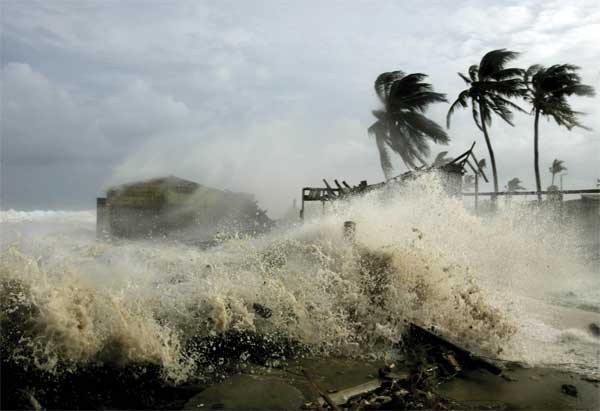
“We will weather this. I love her,” he said of his marriage, making his longstanding, premediated behavior sound like a force of nature – an earthquake, or a hurricane, perhaps.  The photos remind one that this wasn’t a momentary slip-up or the result of uncontrollable passion: it was a series of actions coolly considered, uninterrupted by his marriage almost a year ago.

I have to concur with NPR:

Maybe if public apologizers were better at just being sorry, we wouldn’t need “I take full responsibility for my actions” in the first place.

Orwell Watch:  Collect the whole set!

Orwell Watch #8:  “I know you’re disinterested in this, but…”

Orwell Watch #6:  “Like” and the culture of vagueness

Orwell Watch #5: Before we shoot off our mouths again…

Orwell Watch #4: Jared Loughner:  Madman, terrorist, or both?

Orwell Watch #3:  Please. No “gifting” this Christmas.

Orwell Watch #2: Murder in Yeovil

Orwell Watch #1: Paul Krugman vs. George Orwell. (Hint: Orwell wins.)

Postscript on 6/13:  More on “taking responsibility” – and some nice pick-up from Andrew Sullivan in the Daily Beast – over here.

Tomorrow: Meet the authors, and celebrate birthdays with Shakespeare, Wordsworth, Nabokov, and St. George

Share

“Cry God for Harry, England, and Saint George!”

Tomorrow, April 23, is William Shakespeare‘s birthday.  It’s also William Wordsworth‘s birthday, and Vladimir Nabokov‘s birthday – and St. George’s Day, to boot.

It’s also the 8th annual “A Company of Authors” celebration at the Stanford Humanities Center, an all-afternoon gig celebrating the variety, richness and importance of the books produced by the Stanford community.  (More on the event here.)

This year’s auspicious date is not entirely a coincidence.  George Orwell biographer Peter Stansky, who founded the event along with the late, lamented Associates of the Stanford University Libraries, was particularly pleased by the possibilities offered by the juxtaposition.

Peter will open the event by reading a poem by George Steiner about the wisdom of choosing one’s birthday – you see, it’s Steiner’s birthday, too.

The event was inspired by the Los Angeles Times Book Fair and the annual Humanities Center Book party.  There’s a difference, however: the books will be available for sale at a 10 percent discount.  The fête kicks off at 1 p.m., and it’s free at the Humanities Center on Santa Teresa, and the company will be excellent, if I do say so myself.

“It is open to all who wish to come and learn more about the authors’ thinking behind their work, would like to chat with the authors in the periods between sessions and have the opportunity to purchase their books,” he said.  It has another purpose – “and that we can all feel that somehow we are in the tradition of Shakespeare!”

Authors include:  Charlotte Jacobs, Henry Kaplan and the Story of Hodgkin’s Disease;

Birthday boy

Susan Krieger, Traveling Blind; William Kays, Letters from a Soldier; Gabriella Safran, Wandering Soul: The Dybbuk’s Creator: S. An-sky; Abbas Milani, Myth of the Great Satan and The Shah; Ian Morris, Why the West Rules—For Now; Karen Wigen, A Malleable Map; Elena Danielson, The Ethical Archivist; Jack Rakove, Revolutionaries; Karen Offen, Globalizing Feminisms; Myra Strober,  Interdisciplinary Conversations; Stina Katchadourian, The Lapp King’s Daughter; Dan Edelstein, The Enlightenment: A Genealogy; Herbert Lindenberger, Situating Opera: Period, Genre, Reception; Debra Satz, Why Some Things Shouldn’t Be for Sale.  And you guessed it, Humble Moi – Cynthia Haven for An Invisible Rope: Portraits of Czeslaw Milosz.

No RSVP needed

According to Peter, “Most importantly in my view, the books reflect the most important aspect of the University: the life of the mind which sometimes gets forgotten in the many day to day events that take place at Stanford. In my view, this event represents the essence of the University.”

It is also J.M.W. Turner‘s birthday as well as Shirley Temple‘s, which he doesn’t mention.  “Perhaps you can arrange for Shirl ey Temple to come,” he suggested to me.  Do you think?

Postscript:  I know, I know … Shakespeare’s birthday is conjecture, based on his April 26 christening.  Usually, in the 16th century, a birth was followed post haste by a christening in anticipation of instant death.  And, given that he died on April 23, and that April 23 was St. George’s day, and, after all, he did need a birthday – the world fixed on April 23rd.  Good enough for me.  Hope for you, too.  See you tomorrow.

Postscript on 4/23/2013  We mistakenly reported that Alexander Pushkin‘s birthday is on April 23.  Wrong!  It’s June 6, 1799 (what a pleasant way to usher in a new century!)  The error has been corrected.  Thank you, Tatiana Pahlen, for pointing it out to us.

Orwell Watch #6: “Like” and the culture of vagueness.

Share

"...and I’m like, you know, ‘Whoa, that is so wow!’"

“Like.”  Need we say more?  Via Books Inq, we came across this description of “the culture of vagueness.” A suitable addition to our George Orwell Watch. “Nobody likes a grammar prig,” says Clark Whelton, a speechwriter for New York City mayors Ed Koch and Rudy Giuliani.  Then he goes on to become one.  At least a bit of one.  Nevertheless, he has a point.  He takes on the current usage of “like,” which has “a long and scruffy pedigree,” buried in the mid-20th century’s Holden Caulfield

:

I recently watched a television program in which a woman described a baby squirrel that she had found in her yard. “And he was like, you know, ‘Helloooo, what are you looking at?’ and stuff, and I’m like, you know, ‘Can I, like, pick you up?,’ and he goes, like, ‘Brrrp brrrp brrrp,’ and I’m like, you know, ‘Whoa, that is so wow!’ ” She rambled on, speaking in self-quotations, sound effects, and other vocabulary substitutes, punctuating her sentences with facial tics and lateral eye shifts. All the while, however, she never said anything specific about her encounter with the squirrel.

Continuing on with a pool of undergraduates he interviewed for the position of intern on Koch’s speechwriting staff, Whelton considers other current verbal tics: “The candidates seemed to be evading the chore of beginning new thoughts. They spoke in run-on sentences, which they padded by adding “and stuff” at the end.”  He also noted: “Double-clutching (‘What I said was, I said . . .’) sprang into the arena. Playbacks, in which a speaker re-creates past events by narrating both sides of a conversation (‘So I’m like, “Want to, like, see a movie?” And he goes, “No way. And I go . . .”), made their entrance.” He finally takes on the trend to make statements into questions for the “all-interrogative interview”:

Undergraduates, I said, seemed to be shifting the burden of communication from speaker to listener. Ambiguity, evasion, and body language, such as air quotes—using fingers as quotation marks to indicate clichés—were transforming college English into a coded sign language in which speakers worked hard to avoid saying anything definite. I called it Vagueness.

The Orwell connection to public life:

Is Vagueness simply an unexplainable descent into nonsense? Did Vagueness begin as an antidote to the demands of political correctness in the classroom, a way of sidestepping the danger of speaking forbidden ideas? Does Vagueness offer an undereducated generation a technique for camouflaging a lack of knowledge?

More here. A postscript:  Some more thoughts on “vocabulary substitutes”:  How about all those emoticons to signal emotions the reader may not “get” from the text?  Or the insertion of verbal cues  — e.g., “Sigh,” “Snark,” “lol,” or, to suggest a lazy sort of irony, “ummm” — because the words alone cannot guide us to the writer’s intention? (In the case of lol, it’s become little more than a compulsive written tic, a space filler, even when no humor is intended.)  Or how about “Thank You” cards, with THANK YOU written across the front, because the sender couldn’t express the words convincingly in cursive, in his or her very own hand?

Collect the whole set!

Orwell Watch #5: Before we shoot off our mouths again…

Orwell Watch #4: Jared Loughner:  Madman, terrorist, or both?

Orwell Watch #3:  Please. No “gifting” this Christmas.

Orwell Watch #2: Murder in Yeovil

Orwell Watch #1: Paul Krugman vs. George Orwell. (Hint: Orwell wins.)

Valentine’s Day postscript (hat tip, Jim Erwin):

Orwell Watch #2: Murder in Yeovil

Share

Thank you, George.

Last month, I jeered at the cliché “soaring rhetoric” (already on the wane by the time I whacked at it), challenged the liberals’ rebranding of themselves as “progressives,” and, to be an equal opportunity offender, in the comments section I questioned the right-wing highjacking of the meaningless, self-congratulatory term “values.”

It seems timely to launch the second installment of the Orwell Watch, in honor of George Orwell‘s immortal essay, “Politics and the English Language” — especially after Books Inq. alerted me to a blog post datelined from the odd little burg of Yeovil, a few miles from my own ancestral village outside Glastonbury.

While Orwell’s rule “Never use the passive where you can use the active,” should, like everything else, be used in moderation (in this sentence, for example), it’s a pretty good yardstick to measure the intent to obfuscate.  In this squalid murder case, reported by Theodore Dalyrimple, the prosecutor has pretty effectively distorted a straightforward narrative.  The prosecutor’s through-a-glass-darkly verbiage attempts to describe the murder of 38-year-old Glynn Rowlands, over some stolen gold.

For simplicity (Dalyrimple’s phrasing is rather ornate), the prosecutor’s words from the Western Gazette are italicized below.  The journalist’s queries are indented.

Ben [one of his co-accused] started tying up his [the victim’s] arms and legs. Steve [another of the co-accused] picked up a brick and let it go in his face.

Let it go in his face? Do bricks, then, fly spontaneously into people’s faces like poltergeists, unless diverted from their course? Why did the young man not write that Steve threw, or smashed, the brick into the man’s face?

Glynn Rowlands had fallen into an ugly dispute with [the accused].

By the force of what social (or antisocial) gravity does one “fall into” ugly disputes? Of course, it is possible that the accused picked a quarrel with the victim completely at random: some people behave like that, though it is unlikely in this case, and in fact the prosecutor did not believe it. But an ugly dispute? One does not fall into ugly disputes as into cunningly-disguised elephant-traps.

Retribution was required.

But required by whom or by what? By the laws of the universe? Clearly the prosecutor meant by the accused; but then why not say “The accused sought retribution”?

He was to tell good friends who went to see him in hospital the reality of how gold was missing…

How gold was missing? Did it go missing spontaneously, of its own accord and volition? … Or did someone take the gold? If so, why not say so? Why the passive construction? Since the prosecutor soon went on to say that Rowlands “returned nothing”, he clearly believed that Rowlands had stolen the gold. Why did he not say “Rowlands confessed to stealing the gold”?

It was to get worse …

What was to get worse? The situation, that presumably acted like a demiurge independent of how the participants in it acted? What the prosecutor meant was that the accused allegedly behaved more and more threateningly towards the victim until they actually killed him.

At 3.17 pm on Thursday, December 3, hours before Glynn Rowlands was to lose his life…

Glynn Rowlands was to lose his life? In a fit of carelessness, perhaps, in the way that I sometimes mislay my keys because I am preoccupied by something else? Or by the spontaneous development of a head injury and multiple fractures of the ribs, as some — including Dickens — once thought that people could die by spontaneous combustion? Someone, whether the accused or others, killed Glynn Rowlands.

Does it matter?  I think it does.  As Orwell points out, fuzzy language leads to fuzzy thinking. Here a brutal murder by brutal people has been treated as a sort of inevitability, like leaves falling in the autumn. Human agency has been blanketed by a soft carpet of moral snow.

Legal pomposity is commonplace, and the journalist reacted to it with understandable derision.  Still, some active, Anglo-Saxon verbs — “beat,” “hit,” “stab” and “kill” — would have gone some way to describing the reality of the wretched man who was kidnapped, bound, stripped naked, brutally assaulted and left dying in a cold and muddy on a remote country lane.

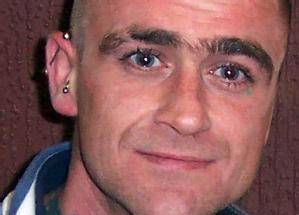
Postscript on 12/10:  Of course in my perambulations around the internet, I ran across a photo of Glynn Rowlands; it seemed exploitative to use it on a blog post that is essentially about the use of language. So I settled for a generic “Lady of Justice” image instead. On reflection, however, it seems wrong and indecent not to use it.