

Newspapers, advertisers, and book reviews – cont.

Share

A few days ago, I posted about “The future of book reviewing and one cranky man.”

I wrote about the absurdity of newspapers expecting book review sections to be supported by advertising from the strapped book industry:  “Of course, sports sections aren’t asked to support themselves by the advertisements of sports stores or the manufacturers of catcher’s mitts, so this standard has always been unevenly applied.”

In the comments section, medievalist Jeff Sypeck asked:

Is there a reason newspaper executives have behaved as if the ads in a book-review section could only be for books and publishers and similar literary/cultural products? Is it a lack of demographic info about book buyers for the ad sales people to tout? The unwillingness of, say, tire manufacturers to advertise alongside reviews of novels? A belief that the book section ought to be free of commercialism? Mere tradition or habit?

Good question.

Frank Wilson at Books Inq. explained the simple demographics of newspaper advertising succinctly: “the point is that a book section would attract more readers to a newspaper – even a lot of people who watch baseball read – and the more readers you have, the more advertisers you get.”
Not a reader anyway

Literary people read lots of things besides great literature and book reviews – they’re more likely to read newspapers in general.  As Jeff has pointed out before, that’s a much better bet than trying to get stoners to read.  Said Frank:

Newspapers flap their wings hoping to attract young readers by reviewing pop music, but those (theoretical) young reader don’t care what newspapers think about what they’re listening to. I certainly didn’t care that the local pop music reviewers thought little of Elvis when I was in high school. I also wouldn’t have cared if they’d thought the world of him.

But the experience of listening to music is fundamentally different from the experience of reading. Readers want to know what others have to say about what they have read. It’s an extension of the reading experience. Reading about the music you have heard is not an extension of the listening experience.

Maybe if more newspaper executives did some reading of their own, they would understand.

More comments followed. Jeff again:

Your last point reminds me of how for more than 15 years, the Washington Post has been trying to lure young people with reviews of video games and hip-hop concerts, apparently misunderstanding how many outlets are already devoted to discussing those subjects with greater affection and thoroughness. Time has shown them to be unlikely and unsuccessful ways to lure new readers to old media.


More comments at Books, Inq. here.
.

The most beautiful words in the English language. And the nominations are…

Share

For Frank in Philly.

“I’ve always been fond of lavender,” said Frank Wilson of Books Inq.  That was his nomination for the most beautiful word in the English language.  (Earlier nominations here.)

Others chimed in on my Facebook page:

Agustín Maes voted for murmur, also, florid.

Artur Sebastian Rosman was full of ideas:  noctilucent, donut, iris.  Donut? Doesn’t he mean doughnuts, at least?  (Artur, get something to eat.)  He also favored  “TSE words like chthonic.”  TSE is T.S. Eliot – of haruspicate fame (which always sounds like a man clearing his throat, not prophesying). “Filiation is also a lovely word,” Artur added.

“My favorite word of all time and by far the liveliest in any language is…. vivificantem.”  Well, as he noticed, that’s not really English; it’s Latin.  So it shouldn’t count.

Marianne Bacon quarreled with Deshoda, the blog that started the contest:  “I think that list on Deshoda (whatever that is) is a bit silly. How about Chestertonian words, or Jack Lewis words- like woodsmoke, or pipe, or fireplace, or snow, or Christmas, or pudding, or child. Or elf, or lamppost, or courage.”  But the contest isn’t for words with pleasant context or associations, but beautiful sounds.   “OK, inglenook.”  I thought, at first she meant the wine – but no, inglenook is “a chimney corner, is a small recess that adjoins a fireplace.”

Jim Erwin wrote: “prestidigitation and Terpsichore are good examples of fingerpoia and feetpoia.”  Wait a minute, he made those last two up.

Daniel Rifenburgh made half a nomination – Sussurus

From Edward Haven yielded to my entreaties: “I’ve started to like Giraffe, but I have to agree nothing compares to authenticity.”  A son after my own heart.

What?

Erën Goknar is “SO glad you mentioned the much-maligned [Edgar Allan] Poe and his bells!”

Finally, Sarang in my comments section offered “a little stream-of-consciousness: myrtle [in my fancy a portmanteau of myrrh, squirt, and turtle], scavenger, flounder, interred, fever, recalcitrant, splay, stray, splatter, vespers, pageant, expunge, effulgent, excrescence, gun, cleave, hew.”

Jeff Sypeck favored shorter-is-better:

My first impulse is to go with big, fun-to-say words like tatterdemalion, but I don’t think many of our little Anglo-Saxon words get enough credit for euphony: Read. Comb. Sleep. Yore. Soft little words can be beautiful, too!

Postscript on 7/15: A few more suggestions –

Joe Loya: Efficacious; ventriloquy; or supple. I love the way they look, sound, and their flexibility in application.

Another one from Artur Sebastian Rosman: Reconciliation is overused and under-practiced, but what a beautiful word.

And a few late nominees from Patrick Kurp incarnadine, philtrum, wan, atrorubent, flange .

More on “taking responsibility” and other hackneyed phrases

Share
(Image adapted from the Tumblr this isn't happiness, via ffffound)

(Image adapted from the Tumblr this isn't happiness, via ffffound)

My call to arms a few days ago (“Orwell watch #9:  ‘I take full responsibility for...'”) was picked up by Andrew Sullivan in The Daily Beasthere.  The passage he highlights:

I suspect the phrase “take responsibility for” is actually a journalists’ invention, and people like Weiner picked it up from the media, rather than his heartfelt intentions. As George Orwell said in “Politics and the English Language,” this one could be “killed by the jeers of a few journalists.” I call out to journalists everywhere to jeer this phrase out of existence – unless it really means taking responsibility, the way I “took responsibility” for, say, raising a child, by paying for her upbringing, nursing her through illness,  attending back-to-school days, and preparing dinner every night.

Sure would be nice if we could we could drive this phrase into late-night comedy, wouldn’t it?  This expression has been due for the slaughterhouse since the IRA mayhem in the 1960s, and has made its small contribution to dulling our sense that words have meaning, and are meant to convey our feelings, thoughts, and intentions – not conceal them.

Language fails

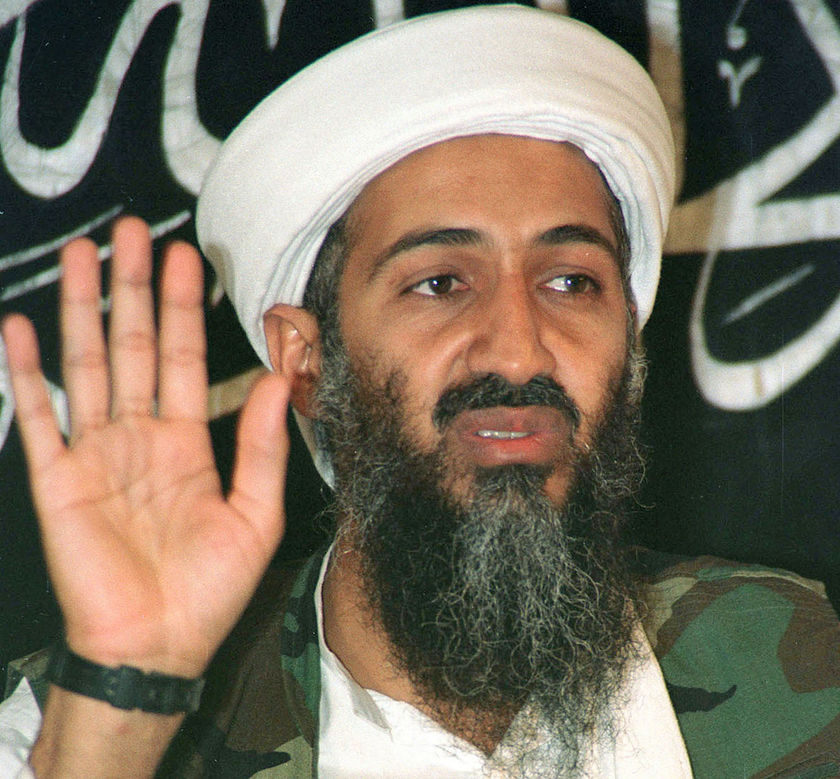
Meanwhile, the post generated some interesting conversation over at Frank Wilson‘s Books Inq. I was singled out, rightly, for a little criticism from Art Durkee:  “Calling [Osama] bin Laden‘s death ‘liquidation’ is also pretty Orwellian, it seems to me. Let’s call a spade a spade: it was a retaliatory political assassination.  But then, a great deal of political euphemism is and always has been Orwellian.”

Liquidation is indeed a strange term – did he dissolve into water? “Liquidation” sounds like the final sale at a failing bookstore, anyway. A colleague corrected me when I said “murder,” arguing that murder was a legal term, calling for the prosecution of the murderer.  One is at a loss – what neutral term can one say nowadays? Osama bin Laden’s “offing”?

Art’s p.o.v.:

“I don’t think there is a neutral term. I think you have to call an assassination what it is.

I think we have to be honest when murder is murder, and not whitewash it. (The best argument, for example, that I’ve heard against the death penalty is that it means that murder is criminalized for anyone to commit except the state.) Similarly, assassination needs to be called what it is, and acknowledged as the political tool it has always been, sanctioned or otherwise.

History may show if this particular sanctioned assassination (sometimes called a ‘sanction,’ or ‘termination with extreme prejudice’) was the right and good thing to do. Lots of people are claiming that already, but they’re also ignoring what making someone into a martyr can do. It’s a tricky call, and those who set policy ought to lose sleep over it.

But that’s the whole pattern that Orwell pointed out, isn’t it: the neutralization of language into mechanical, denatured, unemotional, technical terminology that allows one to deal with humans as dehumanized. Turn people into inhuman statistics, and you can sleep at night when you talk about ‘collateral damage,’ or ‘friendly fire,’ for example. Do that kind of neutralization of language enough, and you dehumanize yourself as well, Orwell warned.”

And so did Mark Twain, in ‘The Way Prayer.'”

Thoughts?

You see? Just like I said… Nicholas Carr thinks so, too.

Share

We're still stupid, he says

“I think as a society we’re choosing information overload: we’re choosing to sacrifice the more meditative and contemplative aspects of our minds.”

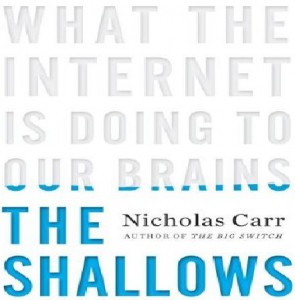
I wrote on just this subject a few days ago, in a post entitled “Are We ‘Outsourcing Our Brains to the Cloud?’” – then I ran across the latest from technology writer Nicholas Carr, who appears to agree, as shown in his comment above.  His latest book, The Shallows, discusses what he fears the Internet is doing to our brains.  It’s sold 50K hardbacks in the U.S. alone – that’s real books, with paper pages.

Carr, the blogger behind Rough Type and the author of the controversial Atlantic article, “Is Google Making Us Stupid?” got his first PC back in the 1980s and was an avid net user until “a few years ago, I noticed some disturbing changes in the way my mind worked. I was losing the ability to concentrate.”  According to the AFP article:

While the Internet has enormous benefits in delivering incredible amounts of information at incredible speed, it’s also a distracting and interruption-rich environment.

Carr said it encourages quick shifts in focus – and discourages sustained attention and the ability to think deeply and creatively about one topic and to challenge conventional wisdom.

Carr concluded, “We take in so much information so quickly that we are in a constant state of cognitive overload.”  He added that “multitasking erodes cognitive control. We lose our ability to say that this is important, this is unimportant. All we want is new information.”  However, when we open a real book with real pages, “there’s nothing else going on except words on a page, no distractions. It helps train us to be deep thinkers.”

Over at Books Inq., my previous column generated a few comments. Frank Wilson hoped we could find a sort of middle way:  “I think the problem is real, at least potentially. I just think we may be making too much of it. I have noticed, now that I have returned to work, that my memory is sharper for some reason. I think may be we just have to make some time to do things the old-fashioned way, things like memorizing poems. The way we still make bread, though we can buy it at the store.”

I hoped so, too.  But so far, Carr hasn’t had much success:

Carr admitted he himself has not had great success in limiting the time he spends online. But the biggest change he made as a writer and researcher was to use the web only to track down source material.

“Then I’d make an effort to actually read those things in print. I did find that made a big difference in my ability to be attentive and a thorough reader and hopefully a deeper thinker.”

But Carr said it was not just a matter of individual choice. If friends, colleagues and employers were constantly on line, “then you feel in many ways compelled to do so even if you don’t want to, because you don’t want to damage your career or your social life”.

Are we “outsourcing our brains to the cloud?” asks Bill Keller.

Share

Bill Keller, executive editor of the New York Times, recently let his 13-year-old daughter join Facebook – my goodness, how had he stopped her before then?  Within a few hours she had over 170 friends, “and I felt a little as if I had passed my child a pipe of crystal meth,” he admits.

This launches him on a meditation of our times. The column appeared last week, but in my travels I hadn’t gotten a chance to post a few words about it – nor have I had time to read all the comments, many of which are nuanced and excellent. It’s worth a look if you missed it.

Frank Wilson over at Books Inq. put this under the heading “More Complaining,” but I’m not so sure that’s the whole story.  I’ve made the same lament, and it’s not simply a curmudgeon criticizing the kids of today – I’ve noticed my own inability to concentrate without an every-five-minute squirt of dopamine from Twitter or Facebook … and yet, and yet, how else would I have met Arthur Sebastian Rosman, had not someone suggested our introduction on Facebook? (Actually, he had translated one of the essays in An Invisible Rope: Portraits of Czesław Miłosz, but he was just a name at the bottom of the page, back then.) I keep up with family, friends, and colleagues on Facebook, just as I rely on various news aggregators for news, and blogs for off-the-beaten track news.  Moreover, I’ve downloaded Henry IV, Part 2 onto my new Droid.

Yet I find it harder and harder to memorize a short poem.  Heavens, I find it harder and harder to read a short poem.  I find it harder and harder to get into that slow, reflective space where I can think long thoughts.  Keller writes:

As we became accustomed to relying on the printed page, the work of remembering gradually fell into disuse. The capacity to remember prodigiously still exists (as Foer proved by training himself to become a national memory champion), but for most of us it stays parked in the garage.Sometimes the bargain is worthwhile; I would certainly not give up the pleasures of my library for the ability to recite Middlemarch. But [Joshua Foer’s  Moonwalking With Einstein] reminds us that the cognitive advance of our species is not inexorable.

My father, who was trained in engineering at M.I.T. in the slide-rule era, often lamented the way the pocket calculator, for all its convenience, diminished my generation’s math skills. Many of us have discovered that navigating by G.P.S. has undermined our mastery of city streets and perhaps even impaired our innate sense of direction. Typing pretty much killed penmanship. Twitter and YouTube are nibbling away at our attention spans. And what little memory we had not already surrendered to Gutenberg we have relinquished to Google. Why remember what you can look up in seconds?

Robert Bjork, who studies memory and learning at U.C.L.A., has noticed that even very smart students, conversant in the Excel spreadsheet, don’t pick up patterns in data that would be evident if they had not let the program do so much of the work.

He concludes:

Basically, we are outsourcing our brains to the cloud. The upside is that this frees a lot of gray matter for important pursuits like FarmVille and “Real Housewives.” But my inner worrywart wonders whether the new technologies overtaking us may be eroding characteristics that are essentially human: our ability to reflect, our pursuit of meaning, genuine empathy, a sense of community connected by something deeper than snark or political affinity.

The most obvious drawback of social media is that they are aggressive distractions. Unlike the virtual fireplace or that nesting pair of red-tailed hawks we have been live-streaming on nytimes.com, Twitter is not just an ambient presence. It demands attention and response. It is the enemy of contemplation. Every time my TweetDeck shoots a new tweet to my desktop, I experience a little dopamine spritz that takes me away from . . . from . . . wait, what was I saying?

The irony, the irony … I found the column because of an online news aggregator, and I read it on an Apple screen.  Now I am blogging about it.

OK, Frank. Call me grumpy.

(I’ll be in a literal cloud in 12 hours, back to the U.S.A.,  after spending a lot of zlotys and a lot of time getting 20 pounds of books from my travels into the Polish mail today.)

Postscript on June 3:  By now everyone knows that Bill Keller has stepped down as executive editor.  Apparently, NYT staffers had to intervene in his hate-hate relationship with Arianna Huffington and the new social media.  Could that be part of the reason why?

Bad book reviews = great sales?

Share

The conventional wisdom in the book biz has always been that any publicity is good publicity — and a spectacular, jeered-at failure is a better option than a quiet, well-respected success reviewed only in the Journals That Count.  Even more so now, when the biggest risk is that your book will float away in the receding tsunami of seasonal offerings.

This Stanford study by two business professors confirms the conventional wisdom — to a point.  Bad reviews can dramatically boost sales for obscure and up-and-coming writers.  They don’t help the famous.

“Any publicity is not always good publicity, as the old adage goes,” Wharton’s Jonah Berger told the Stanford Daily. “But there were also cases where even negative publicity seemed to help sales, so it was interesting to think about when it helps versus hurts.”

The study,  co-authored by Berger and Stanford’s Alan Sorenson, first examined a 2001-2003 dataset of weekly national sales for 244 fiction titles reviewed by The New York Times. The size of sale spikes in the week following the release of each book review showed that positive publicity benefited all titles and the bad publicity only helped lesser-known and obscure authors.

The second part of the study looked at how bad publicity impacted well-known and obscure books over time. Subjects looked at glowing and nasty reviews for a well-known book by John Grisham and then reviews for an invented title.

Those who read bad reviews of well-known books were less likely to buy the book. Negative reviews of unknown books, however, did not affect whether or not the subject was likely to purchase it.

“Let’s say you’ve got bad publicity or bad press on one of your new brands,” Stanford business professor Baba Shiv said. “On one hand, it’s making your brand look familiar, which is associated with positive emotion and at the same time, it’s eliciting negative emotion towards the brand, which comes from the bad publicity.”

As mediabistro explained:

The studies depended on emotional “decay rate”– how quickly an emotion (both good or bad) fades away. Stanford business professor Baba Shiv explained: “In the case of a well-known brand, the familiarity is already there … the decay rate of negative emotion will be much slower.” (Via Sarah Weinman)

The key point was that familiarity with the authors helped everyone, and familiarity was such a strong positive that it dissipated much more slowly in consumers’ minds than the bad taste of a critic’s diss.  But the well-known books and authors already had the boost of familiarity — so the bad reviews could only hurt.

Read it here if you want to figure it out better than I have.

Of course, I wonder who is classifying a review is good or bad — most are kind of mixed, aren’t they?  And for myself, I’d much rather read a interesting failure — a profound book that failed in some key way, than a very well-reviewed lightweight book.  And name recognition is measured … how?

For another take on reviewing, read about Owl Criticism (hat tip, Frank Wilson).  Charles Baxter takes on amazon-type online reviews, accusing them of “Owl Criticism”: “With Owl Criticism, you have statements like, ‘This book has an owl in it, and I don’t like owls.’”

Frank’s reaction to Baxter is worth reading, too:  it’s here.